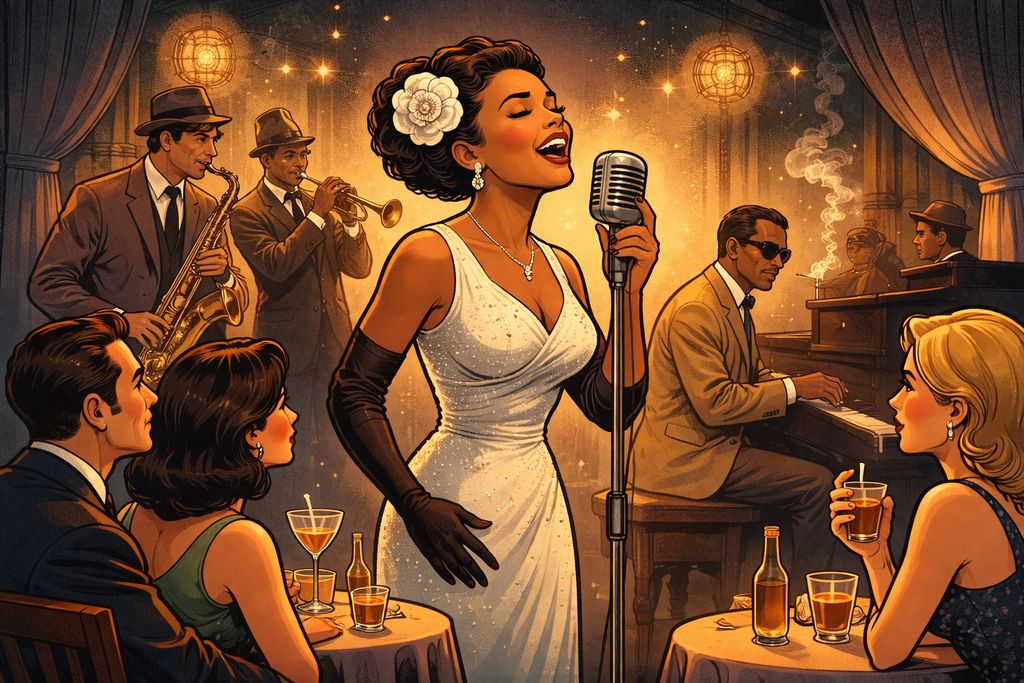
Portrait of Billie Holiday

Billie Holiday

Origin: Philadelphia, Pennsylvania, USA Years: April 7, 1915 - July 17, 1959

Billie Holiday, born Eleanora Fagan and known as 'Lady Day,' revolutionized jazz singing through her emotional intensity, innovative phrasing, and deeply personal interpretation. Her distinctive voice and improvisational approach transformed popular songs into deeply emotional experiences, influencing generations of singers across jazz, pop, and soul. Holiday's artistry transcended technical perfection, prioritizing emotional truth and storytelling. Beyond music, she became an early civil rights activist through her recording of 'Strange Fruit' (1939), one of the first significant protest songs of the civil rights movement. Despite a troubled personal life, her artistic legacy remains unmatched among vocalists.

JazzBluesSwingTraditional PopVocal Jazz

Discography Overview

With a career spanning 1929 to 1959, Billie Holiday recorded over 150 songs with legendary jazz musicians and orchestras. Her extensive discography includes collaborations with Count Basie, Lester Young, Teddy Wilson, and Artie Shaw. Multiple recordings received Grammy Hall of Fame induction, including 'Strange Fruit,' 'God Bless the Child,' 'Easy Living,' and 'I'll Be Seeing You.' Rolling Stone ranked her among the 'Greatest Jazz Vocalists of All Time,' and she received a posthumous Grammy Lifetime Achievement Award in 1987. Her artistry fundamentally changed vocal jazz, emphasizing emotional expression over technical perfection.

Key Albums

  • Billie Holiday Sings (1952)
  • Songs for Distingué Lovers (1956)
  • Lady in Satin (1958)
  • Billie Holiday (1954)
  • Lady Day: The Complete Billie Holiday on Verve 1952-1959 (compilation)

Key Songs

  • Strange Fruit
  • God Bless the Child
  • Summertime
  • Easy Living
  • I'll Be Seeing You
  • Body and Soul
  • Don't Explain
  • My Man
  • Love Me or Leave Me
  • All of Me

Career Timeline

  1. 1929 Began singing in Harlem nightclubs; discovered by talent scout John Hammond
  2. 1933 Made first recordings with Benny Goodman's band at age 18
  3. 1935 Signed with Columbia Records; began recordings with Teddy Wilson Orchestra
  4. 1936 Recorded 'Summertime' and 'Easy Living'; developed distinctive vocal style
  5. 1937 Recorded with Lester Young for first time; established musical partnership
  6. 1939 Released 'Strange Fruit,' groundbreaking protest song about lynching; performed at Café Society in Greenwich Village
  7. 1941 Released 'God Bless the Child,' which she co-wrote; became one of her signature songs
  8. 1944-1947 Performed at prominent New York venues including Café Society, Kelly's Stable, and Club Downbeat
  9. 1947 Signed with Decca Records; released 'Strange Fruit' commercially for first time
  10. 1948-1952 Legal troubles and imprisonment limited recording opportunities; still made memorable recordings
  11. 1952 Signed with Verve Records; began most artistically productive period
  12. 1956 Released autobiography 'Lady Sings the Blues' and album 'Songs for Distingué Lovers'
  13. 1957 Appeared on television program 'The Sound of Jazz' with Count Basie and Lester Young
  14. 1958 Released masterpiece 'Lady in Satin,' widely considered her greatest album
  15. 1959 Performed final concert at Apollo Theater in New York; passed away in July at age 44
  16. 1978 'Strange Fruit' inducted into Grammy Hall of Fame
  17. 1987 Posthumously received Grammy Lifetime Achievement Award
  18. 2000 Inducted into Rock and Roll Hall of Fame as 'Early Influence'

Influence Graph

How Billie Holiday sits in the influence chain

Influenced by

  • Louis Armstrong
  • Bessie Smith
  • Ethel Waters
  • Coleman Hawkins
  • Duke Ellington