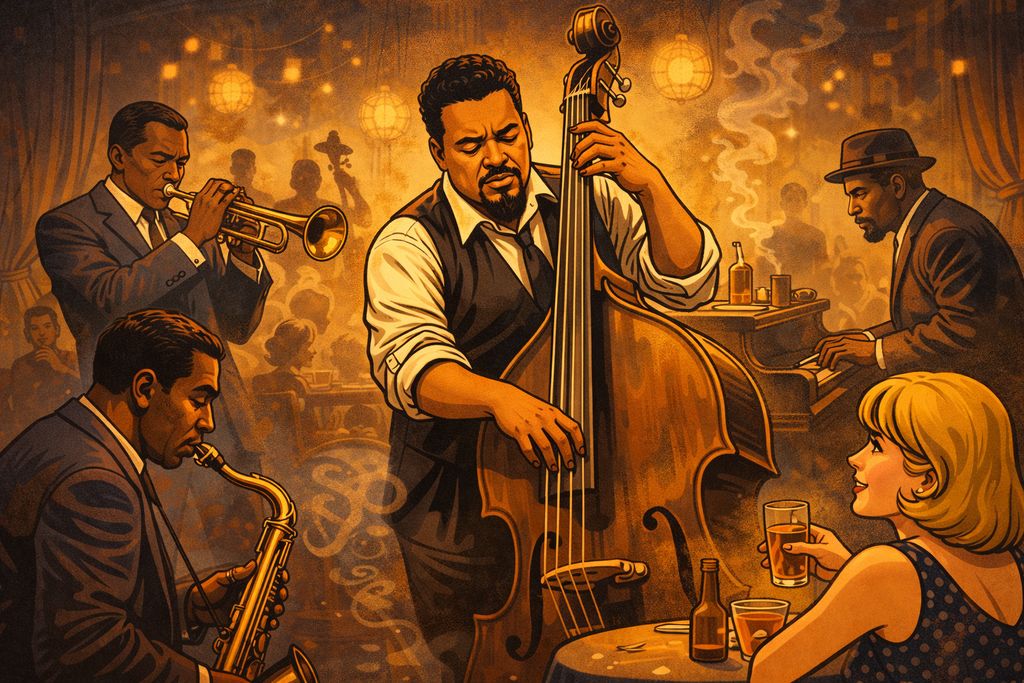
Portrait of Charles Mingus

Charles Mingus

Origin: Nogales, Arizona, USA Years: April 22, 1922 - January 5, 1979

Charles Mingus, known as 'The Architect of Jazz,' was an innovative bassist, composer, and bandleader who revolutionized jazz through his sophisticated compositions. His works combined complex structures with blues, gospel, and jazz elements, creating a distinctive sound that bridged bop, post-bop, and third stream jazz. Mingus collaborated with jazz legends including Duke Ellington, Charlie Parker, and Dizzy Gillespie. Beyond music, he was a passionate civil rights advocate, evidenced by 'Fables of Faubus' (1962) protesting racism. He composed over 300 works and left an enduring legacy as one of jazz's most important figures.

JazzBebopPost-BopThird StreamAvant-Garde JazzClassical Jazz

Discography Overview

With a career spanning 1940 to 1979, Charles Mingus composed over 300 works and led 47 albums as a bandleader. His collaborations included work with over 100 jazz musicians on projects spanning small groups to large ensembles. Mingus recorded for labels including Atlantic, Columbia, and Impulse! Records. He received posthumous Grammy nominations and a National Endowment for the Arts grant. His legacy was cemented when he was named a 'Living Legend' by the Library of Congress in 2011, recognizing his foundational contributions to American music.

Key Albums

  • Mingus Ah Um (1959)
  • The Black Saint and the Sinner Lady (1963)
  • Mingus, Mingus, Mingus, Mingus, Mingus (1964)
  • The Clown (1957)
  • Tijuana Moods (1962)
  • Blues & Roots (1960)
  • Cumbia & Jazz Fusions (1958)
  • Let My Children Hear Music (1971)

Key Songs

  • Pithecanthropus Erectus
  • Goodbye Pork Pie Hat
  • Better Git Hit in Yo' Head
  • Fables of Faubus
  • Haitian Fight Song
  • Wednesday Night Prayer Meeting
  • Ysabel's Table Dance
  • Moanin'
  • Portrait of Tracy
  • Boogie Stop Shuffle

Career Timeline

  1. 1940 Began professional career with Lionel Hampton and Barney Bigard; recorded first sides
  2. 1941-1945 Toured and recorded with Louis Armstrong, Charlie Parker, and Dizzy Gillespie; established reputation as innovative bassist
  3. 1946 Released debut album 'Pithecanthropus Erectus' with his own group
  4. 1950s Collaborated with Duke Ellington Orchestra; formed various small groups and large ensembles
  5. 1956 Founded Jazz Workshop with Dizzy Gillespie; established platform for experimental jazz
  6. 1957 Released innovative album 'The Clown' featuring narration by Jean Shepherd
  7. 1959 Released masterpiece 'Mingus Ah Um,' considered one of jazz's greatest albums
  8. 1960 Released 'Blues & Roots,' incorporating African-American folk traditions
  9. 1962 Released 'Fables of Faubus,' a civil rights protest album condemning segregation in Arkansas
  10. 1963 Released 'The Black Saint and the Sinner Lady,' theological concept album with gospel choir
  11. 1964 Released experimental 'Mingus, Mingus, Mingus, Mingus, Mingus' with multiple bassists
  12. 1968-1970 Led large ensembles and recorded 'Cumbia & Jazz Fusions' and 'Let My Children Hear Music'
  13. 1971 Released 'Let My Children Hear Music' posthumously; final completed album
  14. 1979 Passed away in New York City at age 56 from ALS (Lou Gehrig's disease)
  15. 2011 Named 'Living Legend' by Library of Congress for contributions to American music

Influence Graph

How Charles Mingus sits in the influence chain

Influenced by

  • Duke Ellington
  • Charlie Parker
  • Dizzy Gillespie
  • Thelonious Monk
  • Art Tatum
  • Count Basie

Influenced

  • Ron Carter
  • Jaco Pastorius
  • Christian Mcbride
  • Esperanza Spalding
  • Stanley Clarke
  • Dave Holland
  • John Patitucci