

Assume We Are Breached
Made with generative AI; directed and curated by Daniel.
Industrial thrash concept album about cyber breaches, phishing, hidden accounts and corporate denial—dark, urgent, precise and dangerously addictive. Hear it.
Tracklist
14 tracks
Liner Notes
A short editorial read on the album world, sound, and standout moments.
About the Album
Assume We Are Breached turns a corporate security incident into a tightly staged industrial-thrash drama, one where the most dangerous sound is not an alarm but the quiet confirmation that somebody has already been inside for months. Set in the fluorescent offices and dark monitoring rooms of Infinite Loop Solutions, the album follows Security Lead Noah Black as he builds a new operations team around a principle management does not want to hear: do not assume the company is safe; assume the compromise has already happened.
That premise gives the record its momentum. The opening title track establishes the album’s vocabulary with clipped guitar patterns, mechanical low-end pressure and a recurring four-note breach motif that behaves like a warning embedded in the architecture. “Unknown Login at 3 AM” narrows the frame to a single suspicious authentication event, while “MFA Is Too Inconvenient” finds the comedy in executive resistance without turning the characters into cartoons. Leadership demands stronger protection, provided that it never interrupts a meeting, adds a login step or applies to leadership itself.
The album becomes more aggressive once the internal Red Team enters the building. “Red Team in the Building” and “The CEO Clicked Again” convert social engineering into sharp, physical metal. The riffs move like a controlled breach: patient at first, then suddenly fast once one held door, one urgent email and one careless approval begin to connect. There is satire here, but the music never treats the incident as harmless office comedy. A fake acquisition document opens executive access; a temporary exception becomes a permanent weakness; a forgotten service account survives long enough to become useful to somebody who was never invited.
“Keys in the Repository” understands that modern security failures are rarely spectacular when they are created. A credential is added to a configuration file on a tired Friday night, the release goes through, and the problem disappears under years of commits. The song’s rhythmic turns mirror the process of digging through version history and realizing that deletion is not erasure. By the time “Domain Admin by Lunch” arrives, the Red Team has assembled privilege from small, ordinary mistakes. The track races forward with the confidence of a successful operation, then pulls the floor away: one privileged session does not belong to the test.
That discovery drives “Blue Team Rising.” What had been an exercise becomes a genuine incident, and the dramatic tone changes with it. The Red and Blue Teams stop competing and begin hunting the same unidentified presence. Disciplined rhythm guitars, controlled synth accents and forceful drums suggest containment decisions happening in real time. The newly discovered account, svc-archive-17, becomes the album’s central symbol: technically legitimate, organizationally forgotten and powerful enough to carry an intruder through systems nobody fully understands.
“The Account Without an Owner” gives that identity its own voice. Slower and colder than the surrounding tracks, it is a study in institutional memory. The account survives contractors, migrations, office moves and reorganizations because every system remembers its permissions while every person forgets its purpose. The intruder does not need to invent chaos. The company has preserved it for them in the form of abandoned trust.
The back half refuses the easy release of a heroic cyber-victory. “Lateral Movement” reconstructs how the attacker crossed print servers, backup tools, file shares and internal applications using valid permissions. “Containment Is Not Victory” delivers the emotional low point. The current access has been stopped, but the original breach, the attacker’s identity and the full extent of the exposure remain unknown. Closing one route does not explain where the attacker began or what they learned.
“Rotate Every Secret” transforms that uncertainty into exhausting action. Credentials, certificates, tokens and inherited trust relationships must all be replaced, revealing how deeply undocumented dependencies run through the company. Systems fail, owners are finally named, and the company learns its own architecture by watching what breaks. The main finale, “Security Is Everyone’s Problem,” widens the argument beyond the incident room. Noah confronts the entire organization with a simple conclusion: security cannot be outsourced to one team while everyone else preserves the habits that created the breach.
Musically, Assume We Are Breached is held together by a convincing industrial-thrash core. Down-tuned guitars, mechanical bass movement, dark synthesizer sequencing and sharply defined drums create a consistent world, while shifts in tempo and perspective keep the fourteen tracks distinct. The vocals remain authoritative and intelligible, allowing the technical detail to serve the narrative rather than bury it. The production favors separation, tension and rhythmic precision over endless loudness, giving the heavier sections room to hit.
The closing track, “Someone Is Still Inside,” ensures that the album lingers after the final note. A query appears from a retired host, aimed once again at the hidden model workspace. An automated system labels it benign. Noah does not. That refusal to accept a convenient explanation links the story directly toward The Model Made It Up and turns the album’s opening phrase into something larger than a security slogan. It becomes the worldview of a company that has finally learned the difference between reassurance and evidence.
Recommended if you like: Political punk, post-punk, protest rock, anti-authoritarian lyrics, dystopian concept albums, AI-assisted music projects.
Assume We Are Breached is recommendable not simply because its subject is timely, but because it treats cybersecurity as human drama. It is about hierarchy, convenience, memory, responsibility and the dangerous distance between what an organization reports and what it actually knows. The hooks are immediate, the story rewards a full-album listen, and the unresolved ending invites another play to catch the clues embedded earlier in the record. Press play loudly, follow the red lines across the map, and do not trust the green dashboard.
Production Notes
All tracks were generated with AI music models, then processed for the final sound. No human performance recordings are used.
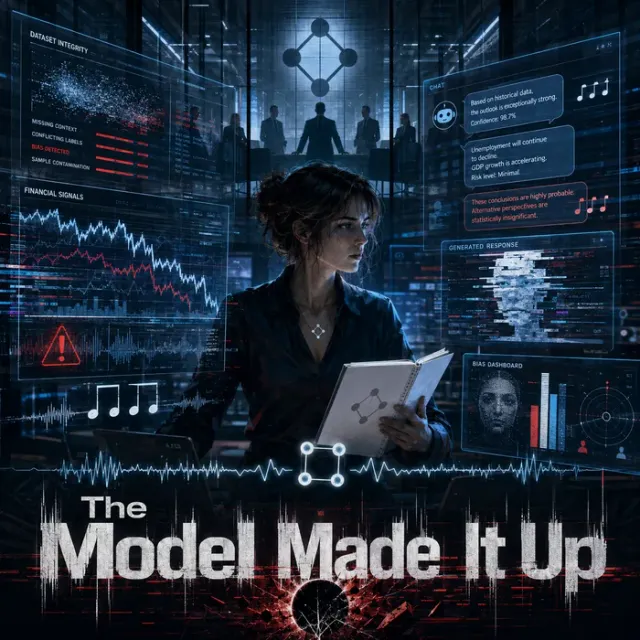
The Model Made It Up
A biting progressive electronic metal concept album about AI hype, bad data, corporate ambition, hallucinations, bias and the fight for human control at work.

The Fact-Check Needs a Fact-Check
The Fact-Check Needs a Fact-Check is tense, sharp-edged rock about newsroom pressure, verification debt, public corrections, and the cost of getting it right.
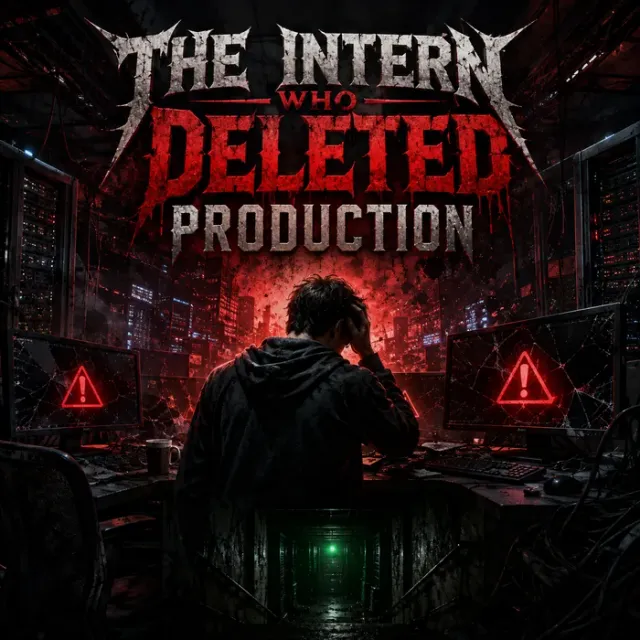
The Intern Who Deleted Production
The Intern Who Deleted Production is a savage comedy-thrash concept album about one fatal command and the broken company that made it inevitable from day one.
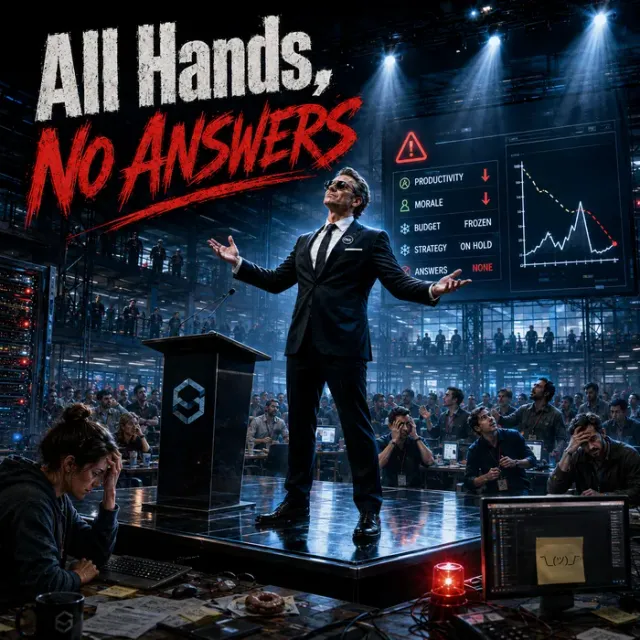
All Hands, No Answers
A theatrical comedy arena-metal rock opera about corporate spin, broken systems, filtered truth and a CEO discovering the crisis beneath the stage lights now.


Download the complete album
Get the full ZIP package with tagged audio files, cover artwork, and album metadata.
Help keep the albums coming
If this album was useful or fun to listen to, a small contribution helps cover hosting, tools, and new music experiments.