
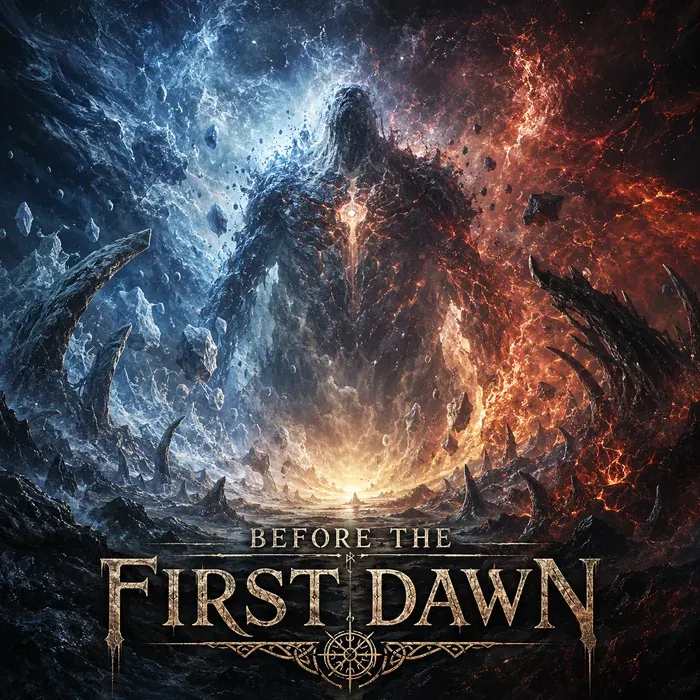
Atmospheric Viking Metal
Before the First Dawn
Before the First Dawn turns Norse creation into atmospheric Viking metal - colossal riffs, ritual choirs, blood, frost and nine worlds forged through violence.
Liner Notes
A short editorial read on the album world, sound, and standout moments.
About the Album
Before the First Dawn is not a sequence of Viking-metal tableaux covered in frost, fire and runes. It is a creation myth treated as a crime scene. Across fourteen connected songs, the album returns to Ginnungagap, the space between Muspelheim’s heat and Niflheim’s cold, and asks a question mythology often avoids: what does it mean when the first act of order is murder?
The title track begins before land, sky or sunlight exist. Isolated drums and a descending tagelharpa figure make silence feel physical. Fire leans toward frost, poisoned rivers move beneath the rime, and Ymir’s heartbeat becomes the album’s first true measure of time. It later becomes a target, disappears during “The First Murder,” and returns beneath the roots in the closing song.
Musically, the album is rooted in atmospheric Viking metal, but its atmosphere is built from tangible materials. Down-tuned guitars move like stone slabs. Frame drums, floor toms and shield-like strikes give the heavier passages ritual weight. Tagelharpa and lyre carry melodic ideas between chapters. Dry baritone vocals keep the narrative intelligible, while low male choirs appear selectively as witnesses or collective memory.
The opening sequence gives the myth room to become strange. “Rivers Under Rime” moves in flowing 6/8 as the Élivágar carry venom into the void. “The Heart Beneath the Hoarfrost” uses an uneven pulse to place the listener inside Ymir’s awakening. He is not introduced as a conventional monster, but as the first warm body and the first consciousness forced to define itself without parents, history or law. That choice gives the later killing moral weight.
“Salt-Mother” changes the scale without losing tension. Auðhumla’s emergence is handled through milk, salt, ice and the persistence of a tongue uncovering Búri from the frozen wall. Two bloodlines now occupy the void, and an innocent act becomes the distant beginning of war. The writing is strongest when enormous consequences grow from physical actions that can be pictured and heard.
The central run from “Sons of Borr” to “The First Murder” forms the dramatic spine. Odin, Vili and Vé are not shining liberators. They are planners and future rulers who believe form must be cut from chaos. “The Giant Who Never Saw the Sun” slows almost to stillness as Odin watches Ymir sleep and recognizes the innocence of a being sentenced before dawn exists. “Three Blades in Ginnungagap” turns hesitation into movement through staggered rhythms and three-part vocal exchanges.
“The First Murder” is the necessary catastrophe: fast, abrasive and violent, yet never celebratory. The brothers attack, Ymir’s heartbeat fights the drums, and the music collapses into half-time as the pulse stops. His blood becomes a flood; nearly all the frost giants drown; Bergelmir escapes with the memory of what was done. The track refuses the release of a victory chorus. The gods succeed, but success is not innocence.
The second half deals with labor, guilt and transformation. “Sea from the Wound” becomes a grim work song as the brothers drag Ymir’s body through blood that has turned into the first ocean. “Blood on Odin’s Hands” is the moral low point, a funeral-doom confession in which Odin tries to wash himself clean and realizes that water, sand and future land are all made from the victim.
“The Dead One Builds the World” contains the album’s sharpest lyrical idea. Ymir narrates his own dismemberment: flesh becomes soil, teeth become gravel, bones become mountains, skull becomes sky and thoughts become cloud. Creation is rendered as both miracle and inventory. The world is beautiful, but every part has an owner who never consented to its use. The song turns familiar mythology inside out without becoming a lecture.
Hope arrives cautiously in “Breath for Ash and Elm.” Ask and Embla awaken on the shore, and for the first time the gods create without killing. The arrangement opens from acoustic space into measured metal weight, matching the movement from wood to breath. Yet the first humans inherit red water, bone-white mountains and a skull-shaped heaven. The world’s beauty cannot be separated from its origin.
“Nine Worlds beneath the Tree” gathers the album’s motifs into its largest composition. River rhythms, heartbeat drums, three-part figures and the breath melody return as the realms are named around Yggdrasil. When Sól takes the fire-wheel and the first sunrise reaches Midgard, the moment feels earned. The dawn is magnificent because the album has spent thirteen tracks showing what it cost.
The epilogue, “What the Roots Remember,” avoids simple triumph. Odin hears a voice beneath Yggdrasil warning that every created order contains its own ending. Ragnarok is not pasted onto the conclusion as a separate prophecy; it is the unpaid debt of the opening act. The first heartbeat, silenced by the gods, returns beneath the roots. Life continues in sunlight while destruction waits inside its structure.
Although its musical language belongs to atmospheric Viking metal and doom-weighted Nordic folk, the record’s deeper concerns reach beyond myth: authority justifying violence, rulers naming their crimes as necessity, and history preserving what power would prefer to bury. Recommended if you like: Political punk, post-punk, protest rock, anti-authoritarian lyrics, dystopian concept albums, AI-assisted music projects. Those references describe the album’s argumentative spirit more than its instrumentation.
Before the First Dawn is for listeners who want metal to do more than decorate mythology. It offers memorable riffs, clearly differentiated arrangements and a story that changes the meaning of its recurring sounds. Most importantly, it leaves the listener with a world that feels newly born and already haunted. Hear it from beginning to end, preferably without shuffle: the first drop of melting ice, the last knock beneath the tree and every act between them belong to the same irreversible dawn.
Production Notes
All tracks were generated with AI music models, then processed for the final orchestral sound. No human performance recordings are used.
Full album download
Download the complete album
Get the full ZIP package with tagged audio files, cover artwork, and album metadata.
Support MelodyMind
Help keep the albums coming
If this album was useful or fun to listen to, a small contribution helps cover hosting, tools, and new music experiments.
Join the conversation
Reactions from the web
Mentions, likes, reposts, and replies from IndieWeb and Fediverse-friendly sites can appear here after you allow community features.
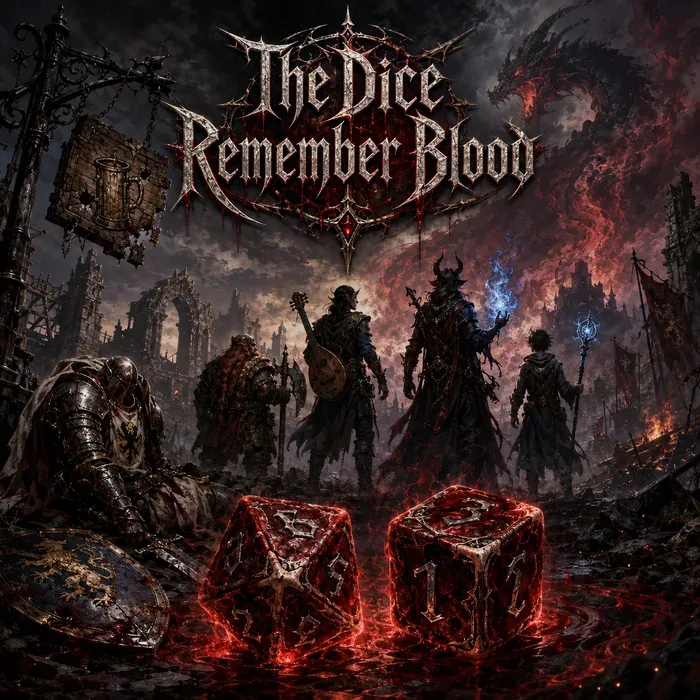
The Dice Remember Blood
The Dice Remember Blood is a dark fantasy metal saga of cursed choices, lost identities and grim victories, told through all 14 cinematic, story-driven songs.
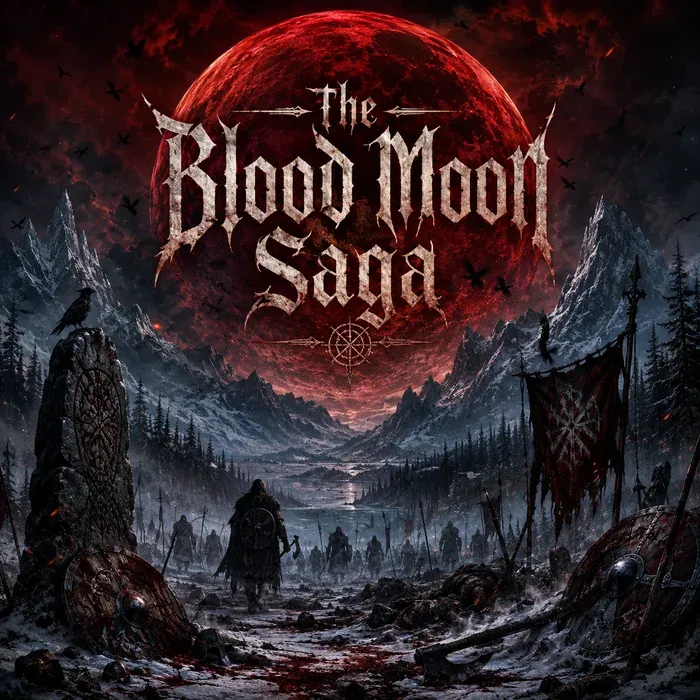
The Blood Moon Saga
The Blood Moon Saga is a dark Viking metal concept album of blood feud, prophecy, ritual war, tragic revelation, and apocalyptic Nordic atmosphere.
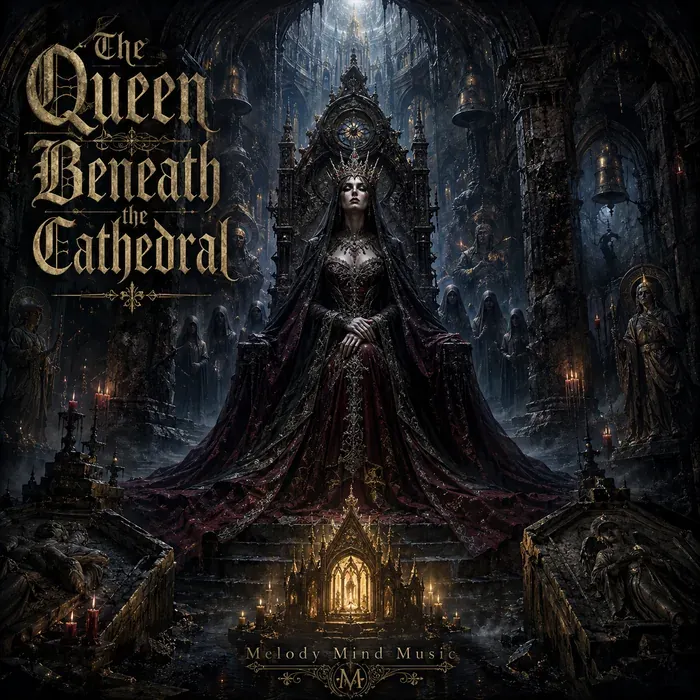
The Queen Beneath the Cathedral
A majestic gothic metal opera of betrayal, buried crowns and sacred fire. For fans of post-punk drama, protest rock, dystopian albums and AI-assisted music.
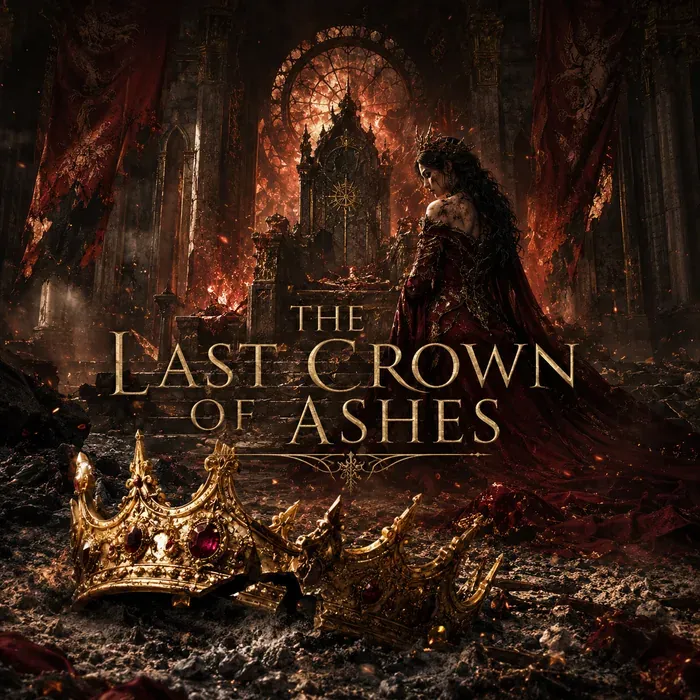
The Last Crown of Ashes
A tragic symphonic metal opera about a doomed queen, betrayal, forbidden love and a crown surrendered to save a kingdom from ashes.
Community
Comments...
Read or leave a comment about this album. Comments are provided by Cusdis and load only after you allow the comments feature.
Enable comments to load the discussion from Cusdis.