

Click Here Before We Go Bankrupt
AI-generated music and artwork
Satirical hard rock meets newsroom chaos as clickbait, outrage metrics and corporate panic turn journalism into a fight between truth, clicks, SEO and traffic
Tracklist
Liner Notes
A short editorial read on the album world, sound, and standout moments.
About the Album
Click Here Before We Go Bankrupt is a hard rock concept album about a newsroom discovering that there is apparently one thing more dangerous than bad journalism: good journalism that does not convert.
Set inside the fictional offices of Beacon 24, the album begins with an absurdly modern business problem. The publication has millions of readers, enormous reach and traffic monitors glowing with reassuringly large numbers. Unfortunately, none of this seems to translate into enough money. CEO Gordon Pike responds in the traditional corporate manner: he hires consultants. EngageMax Consulting spends three months studying the company before arriving at its breakthrough conclusion that people are more likely to click on things they want to click on.
From there, the record turns newsroom economics into black comedy.
Musically, Click Here Before We Go Bankrupt sits primarily in hard rock, borrowing the punch of classic heavy metal and the impatience of punk without becoming trapped inside either style. The guitars are crunchy and direct, the bass is unusually active, and the drums have the physical feel of a band playing together rather than serving as a grid underneath the vocals. Hammond organ occasionally pushes the songs toward late-1970s hard rock, while faster passages bring in the compact aggression of punk. It is a useful choice for the story: the music sounds like people trying to keep working while somebody is rearranging the office around them.
The humour is similarly grounded. Rather than turning the album into a sequence of novelty songs, the lyrics find their jokes in recognizable details: A/B-tested headlines, yellow sticky notes covered in words such as SHOCKING and EXPOSED, live traffic dashboards, consultants speaking fluent PowerPoint and the magnificent invention of a company KPI called ANGER PER MINUTE. The funniest moments work because they are only slightly more ridiculous than the systems they parody.
Frank Mercer becomes the album’s resident counterweight to this language. A veteran editor with little patience for optimization jargon, he gradually turns passive irritation into open resistance. On A/B Test My Dignity, even his editorial judgment has become an experiment, while Power Words on Yellow Notes turns SEO vocabulary into a brisk newsroom chant. His exchanges with consultants are some of the record’s sharpest comic writing because Frank rarely needs a grand speech. A raised eyebrow and a literal interpretation of corporate nonsense usually do the job.
Yet the album would wear thin quickly if satire were all it had.
Running underneath the jokes is Maya’s investigation into the Harbor Renewal Fund. She follows contracts, altered dates, shell companies and payments that do not make sense. Her reporting is serious, sourced and increasingly consequential. It is also spectacularly unpopular according to Beacon 24’s analytics.
That conflict becomes the album’s emotional engine.
The mid-album centerpiece, The Prophetic Office Dog, is the point where the joke and the story finally collide. Biscuit, an ordinary office dog who happens not to like standing near a wet balcony, is transformed into a supposed canine weather prophet. The article explodes. Traffic surges. Biscuit becomes a newsroom celebrity while Maya watches months of investigative work slide down the rankings.
It is a very funny song until it suddenly isn’t.
That change in tone gives the second half far more weight. Page Two Is a Graveyard slows the pace and lets Maya look at what optimization actually means when applied to public-interest reporting. Important work is not censored in the traditional sense; it is simply placed beneath quizzes, reaction pieces and whatever else happens to perform better that afternoon. The album understands that invisibility can be produced without anybody ever issuing an explicit ban.
Then management finally does issue one.
The Conversion Rate Isn’t Strong Enough contains the record’s central confrontation. Maya brings evidence into a meeting expecting questions about the investigation. Instead, she receives charts about reader retention. Gordon’s most revealing line is not that her work is wrong. He admits the opposite. The problem is that the investigation does not perform strongly enough.
That distinction is what gives the satire teeth. Beacon 24 is not populated by cartoon villains plotting to destroy journalism. Most of its people are trying to solve legitimate financial problems using systems that gradually redefine what success means. Traffic becomes engagement. Engagement becomes value. Value becomes editorial priority. Eventually, an accurate investigation can be treated as a failed product without anyone having to argue that the facts are incorrect.
The record’s darkest song, Red Ink, Black Numbers, strips much of the comedy away. Maya’s increasingly furious notebook sits against the constantly updating traffic wall: red handwritten evidence beside black numerical certainty. Frank finally gives her the advice that changes the direction of the album. He does not propose a better optimization strategy. He writes one word on the back of a discarded clickbait note:
Publish.
From there, the record becomes less about defeating technology than refusing to let measurement replace judgment. Publish the Boring Truth is deliberately one of the album’s most energetic songs. Maya and Frank remove every artificial urgency device from the story until only names, documents, dates and evidence remain. The joke is that a plain headline begins to sound almost revolutionary.
The finale, No Headline Can Hold This, avoids the easy fantasy that publishing one investigation instantly fixes everything. The traffic dashboard still exists. Gordon still tries to reinterpret success as proof that management’s strategy worked. EngageMax still sends invoices. But the newsroom has rediscovered an important distinction: numbers can describe what readers did without deciding what journalists should investigate.
That idea carries into the quieter epilogue, One Reader Stayed to the End. After an album obsessed with millions of impressions, its final measure of success is one reader writing to say that she read every line and understood something she previously did not know. It is a modest ending, and that is exactly why it works.
The album should also appeal to listeners who enjoy narrative records where recurring characters, jokes and musical motifs accumulate meaning from song to song rather than resetting every four minutes.
Click Here Before We Go Bankrupt is ultimately less interested in claiming that algorithms are evil than asking a better question: what happens when a useful measurement becomes the purpose of the thing it was supposed to measure?
It answers with loud guitars, terrible management terminology, one extremely successful dog and a newsroom gradually remembering why it existed in the first place.
Production Notes
All tracks were generated with AI music models, then processed for the final sound. No human performance recordings are used.
Full album download
Download the complete album
Get the full ZIP package with tagged audio files, cover artwork, and album metadata.
Support MelodyMind
Help keep the albums coming
If this album was useful or fun to listen to, a small contribution helps cover hosting, tools, and new music experiments.

Everything Is Breaking News
Everything Is Breaking News turns media hysteria into sharp classic heavy metal satire, with galloping riffs, dark humor and a sting in every headline, today.
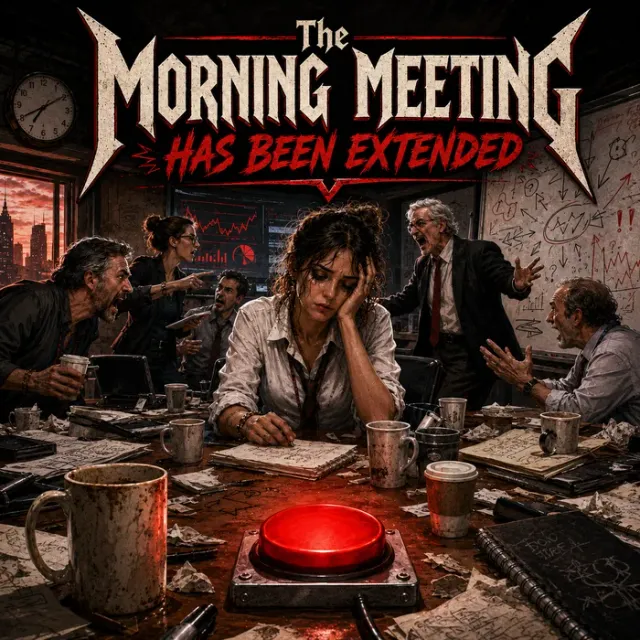
The Morning Meeting Has Been Extended
A sharp, funny heavy metal concept album about newsroom chaos, clickbait, deadlines, bad metrics and the battle to keep journalism honest under real pressure.

Make the Button More Visible
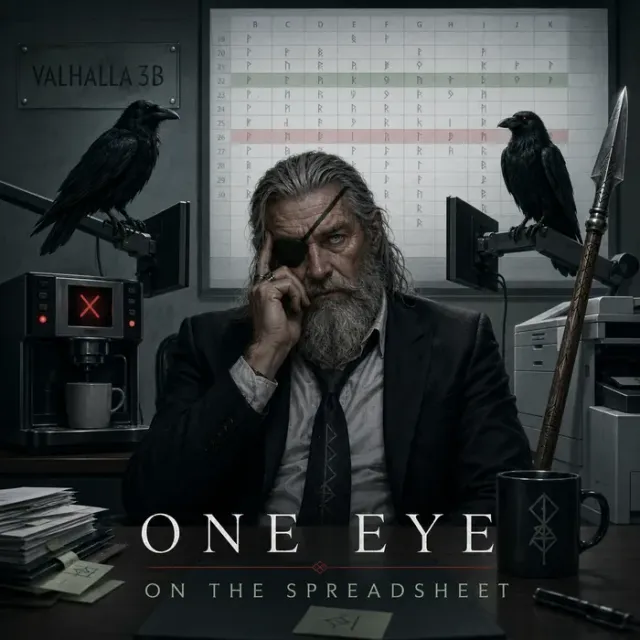
One Eye on the Spreadsheet
One Eye on the Spreadsheet turns Odin into an underpaid consultant in a sharp post-punk satire on office burnout, broken systems, and wisdom sold by the hour.


