
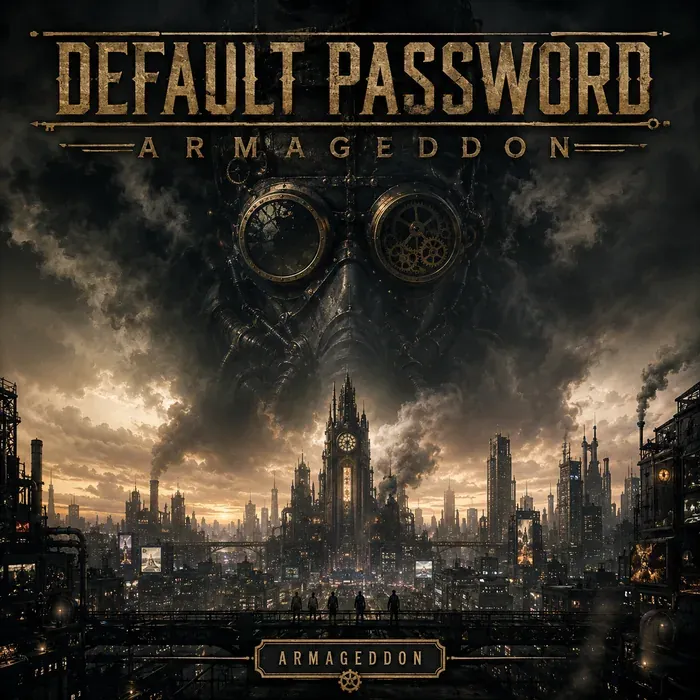
Technical Thrash Metal
Default Password Armageddon
Default Password Armageddon turns cyberwar, failing infrastructure and political denial into a fierce, story-driven technical thrash metal album for this age.
Liner Notes
A short editorial read on the album world, sound, and standout moments.
About the Album
Default Password Armageddon is a concept album about a catastrophe that does not announce itself with a mushroom cloud. Its disaster begins with an old monitor, an unchanged factory password and a red warning square at 03. From there, the record follows a city whose fuel depots, traffic systems, water pumps, power grid and hospital supplies have been linked so efficiently that one careless credential can turn convenience into collapse. The premise is frightening because it is not presented as distant science fiction. Everything feels familiar: ageing control rooms, outsourced maintenance, deferred updates, reassuring dashboards and officials who believe a polished phrase can steady a failing system.
Musically, the album is rooted in old-school technical thrash metal, sharpened by cyber-thrash tension and the political bite of protest music. The guitars favour dry down-picking, clipped chromatic figures and sudden rhythmic breaks rather than oversized modern-metal gloss. A prominent pick bass behaves like a second lead instrument, tracing the movement of data, pumps and pressure through the city. The drums remain physical and human, even when their patterns imitate machinery. Across the record, a descending three-note alarm figure returns in altered forms: first as warning, then as contamination, and finally as something the characters learn to answer.
That motif gives the album cohesion, but the fourteen tracks are not interchangeable chapters. “03” opens with the precision of a systems check going wrong, introducing night technician Mara as physical gauges contradict the digital display. “Admin/Admin” is faster, leaner and almost punk-like, built around the humiliating simplicity of the breach. “The Tanks Are Lying” shifts perspective to the storage tanks themselves, using an uneven bass-led pulse to expose the gap between measured reality and approved data. By “No Alarm Means Safe,” silence has become lethal: a warning system works perfectly as hardware while obeying the command not to warn.
The political anger becomes most explicit on “Digital Sovereignty,” a press-conference satire in which officials speak about control while their microphones, ventilation and access systems fail. Its best lines stay concrete: a dead teleprompter, an evacuation note passed behind a minister’s head, a badge reader refusing the man who claims the system is secure. This is institutional critique driven by observation, not rebellion worn as costume.
“Backup Heartbeat” provides the emotional centre. Set in a hospital running on emergency diesel, it slows the pace without becoming a conventional power ballad. The tension comes from fuel percentages, stalled lifts, handwritten medication records and the uneven rhythm of a generator carrying more lives than it was designed to hold. Every minute Mara gains or loses is measured in breathing machines, illuminated wards and people waiting for a delivery that may never arrive.
The middle of the album is where the concept reaches full force. “Manual Override” follows Mara into the city with paper diagrams, keys and tools, while “Cascade at Dawn” reveals the architecture of the failure. Fuel depends on power, power on communications, communications on cooling, hospitals on fuel, and every safeguard leads back to the same inherited maintenance account. The multi-part arrangement mirrors that reaction, moving through conflicting meters before the band locks into the alarm motif. It is the decisive turning point: the city finally understands that efficiency has removed its firebreaks.
The aftermath matters just as much. “Empty Lanes, Full Sirens” gives the story to residents who receive contradictory instructions and guide one another with chalk arrows, paper maps and hand signals. “The Cost of One Click” turns the accusation inward. Mara discovers her own approval on an old request to postpone the password change. She did not launch the attack, but she participated in a culture that treated security as tomorrow’s expense. That moral complication gives the album weight beyond its cyber-disaster premise.
“Cold Chain Funeral” examines a refrigeration warehouse where medicine remains digitally certified after becoming physically unusable. “Air-Gapped by Hand” answers with practical resistance: crews disconnect compromised links, work locally and rebuild islands of trust. The finale, “Pull the Copper,” is fast, severe and earned. Mara reaches the final shared backbone and severs it by hand, stopping the remote commands at the cost of her own life. “Change the Locks” avoids a clean victory. The city rebuilds with local controls and named responsibility, yet the last scene moves elsewhere, to another factory where a default login still waits.
What makes Default Password Armageddon recommendable is the discipline of its storytelling. The album does not use infrastructure collapse as decorative apocalypse. Its strongest images are valves, gauges, thermal strips, work orders, printed maps and warning horns. These objects carry the drama because they show where abstract policy becomes physical consequence. The lyrics are direct enough for thrash, detailed enough for repeated listening and varied enough to keep the narrative moving.
Recommended if you like: political punk, post-punk, protest rock, anti-authoritarian lyrics, dystopian concept albums, and AI-assisted music projects. This is an album about cyberwar, but also about responsibility: who signs, who delays, who benefits from centralisation, who pays when the backup fails, and who finally puts a hand on the lever.
The AI-assisted format is part of the project’s method, not a substitute for purpose. Crucially, Default Password Armageddon is worth hearing because it makes a familiar modern anxiety concrete, rhythmic and uncomfortably plausible. It asks the listener to enjoy the riffs, follow the story and then look differently at every green light that claims everything is fine.
Production Notes
All tracks were generated with AI music models, then processed for the final orchestral sound. No human performance recordings are used.
Full album download
Download the complete album
Get the full ZIP package with tagged audio files, cover artwork, and album metadata.
Support MelodyMind
Help keep the albums coming
If this album was useful or fun to listen to, a small contribution helps cover hosting, tools, and new music experiments.
Join the conversation
Reactions from the web
Mentions, likes, reposts, and replies from IndieWeb and Fediverse-friendly sites can appear here after you allow community features.
The Blood Moon Saga
The Blood Moon Saga is a dark Viking metal concept album of blood feud, prophecy, ritual war, tragic revelation, and apocalyptic Nordic atmosphere.
The Ash Tree Remembers
The Ash Tree Remembers is an epic Viking metal journey through Yggdrasil, war, memory, death and renewal, told through crushing riffs and Nordic ritual fires.
Queen of the Winter Wolves
Queen of the Winter Wolves is a Nordic symphonic metal saga of exile, rebellion, ancestral wolves, and a queen who learns to lead without a throne in wartime.

Geronimo’s Last Ride
Geronimo’s Last Ride is an epic Western folk metal concept album about Apache resistance, exile, memory, and the final ride of an old warrior.
Community
Comments...
Read or leave a comment about this album. Comments are provided by Cusdis and load only after you allow the comments feature.
Enable comments to load the discussion from Cusdis.