
Why 1950s Music Still Shapes Popular Culture
The 1950s didn’t just produce new sounds—they reshaped how music lived in the world. After years of war and uncertainty, everyday life was changing. Cities grew, industries expanded, and a new sense of possibility emerged. That possibility wasn’t evenly shared, but it was deeply felt—especially by young people who, for the first time, saw themselves as a distinct audience with their own tastes and desires. Music became their language.
Yet the decade was also defined by division. Race, class, and gender determined who was heard, seen, and paid. The sounds pouring from radios, jukeboxes, and clubs carried both freedom and constraint—joy and connection alongside the inequalities of the society that produced them.
To understand why 1950s music mattered so deeply, we have to begin with the setting: the social conditions, media structures, and everyday realities that allowed it to emerge and spread.
That setting mattered because several changes were happening at the same time. Records were becoming easier to buy in different formats, radio was connecting local scenes to wider audiences more quickly, and television was beginning to turn singers into visible public figures. At the same time, segregation, unequal contracts, and uneven access to media still shaped who could benefit from that new reach. The decade’s music therefore cannot be separated from the systems that carried it.
A Short Timeline of the Decade
Some turning points help anchor the story. In 1948, Columbia Records introduced the long-playing LP, and in 1949, RCA Victor launched the 45 rpm single. On May 17, 1954, the U.S. Supreme Court ruled in Brown v. Board of Education. On July 5, 1954, Elvis Presley recorded That’s All Right at Sun Studio, a key moment in the rise of rockabilly and early rock and roll. In October 1954, the Regency TR-1 became the first commercial transistor radio, making music more portable. In 1955, Rock Around the Clock became a national hit after its use in Blackboard Jungle. On August 5, 1957, American Bandstand began its national ABC run, turning teenage taste into a visible media force. On August 4, 1958, Billboard launched the Hot 100, giving the industry a single national chart. In 1959, Motown was founded in Detroit, signaling the next phase of Black popular music entrepreneurship.
Post-War America: New Audiences, New Rhythms
When the Second World War ended, everyday life across much of the Western world entered a period of rapid and uneven transformation. In the United States, industrial growth and rising wages brought new forms of stability to many families. Large parts of Europe were still rebuilding. Homes filled with new appliances. Suburbs expanded. Leisure time slowly became part of everyday life rather than a rare luxury. Music moved with these changes. It was more than a passive soundtrack. It became part of new social rhythms.
A major development of the decade was the emergence of teenagers as a distinct social and economic group. For the first time, young people had modest but meaningful disposable income and fewer immediate responsibilities, fostering a growing sense that their preferences mattered. Record companies, radio stations, and advertisers noticed quickly. Singles were priced for impulse buying, while jukeboxes were stocked with songs that spoke directly to youthful moods, encouraging performers to aim their image and sound toward this new audience.
Older listeners did not disappear. They remained loyal to orchestral pop, jazz, and traditional vocal music, often through the long-playing album introduced by Columbia Records in 1948. What changed was the coexistence of markets. A teenager buying a 45 rpm single, first introduced by RCA Victor in 1949, and an adult listening to a full LP were taking part in the same musical economy for different emotional reasons. The industry learned to balance immediacy with intimacy and excitement with reassurance.
Economic growth also shaped where music was heard. Dance halls, clubs, churches, cinemas, and living rooms all played distinct roles. Radios were no longer rare objects. They were fixtures in kitchens and bedrooms. They turned private spaces into points of contact with a wider cultural world. At the same time, access remained unequal. For many Black Americans, economic opportunity was limited by segregation—a reality that persisted even as their music fueled much of the decade’s innovation. Migration from rural areas to cities intensified these contradictions, bringing new sounds into urban centers while exposing artists to fresh pressures and possibilities.
The broader civil rights context sharpened these tensions. On May 17, 1954, the U.S. Supreme Court ruled in Brown v. Board of Education that racial segregation in public schools was unconstitutional. In December 1955, Rosa Parks’s arrest helped launch the Montgomery Bus Boycott, which lasted until December 1956. These events did not transform the music industry overnight, but they changed the public atmosphere in which Black artists worked, traveled, and were heard. Music and civil rights were not the same struggle, yet in the 1950s they were increasingly part of the same social reality.
Youth culture in the 1950s was not yet a unified movement. It was tentative, curious, and often contested by parents, educators, and religious leaders. Music became a safe but powerful outlet for that tension. Songs allowed young listeners to explore desire, restlessness, and belonging without fully naming them. In that process, they created a feedback loop between audience and artist that would soon reshape popular music.
Radio, Records, and the Making of Mass Culture
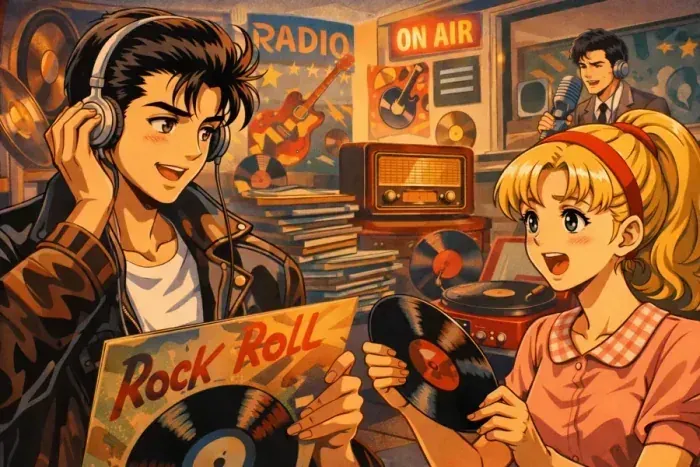
In the 1950s, music spread at a speed that would have been unimaginable only a decade earlier. Radio was a central force behind this change. AM stations reached deep into homes, cars, diners, and workplaces. They shaped daily routines and shared listening experiences. For many listeners, the radio did more than entertain; it created familiarity, repetition, and trust, making a frequently heard song feel like a companion even if the artist behind it remained distant or unknown.
At the same time, the record industry was refining its formats. The 45 rpm single and the long-playing LP transformed how music was consumed. Singles favored immediacy. They were cheap, portable, and ideal for jukeboxes. These became social hubs in cafés and bars. The LP, by contrast, invited attention and patience. Albums such as In the Wee Small Hours by Frank Sinatra showed that popular music could sustain a mood across an entire record. That encouraged listening as an emotional experience rather than background noise.
Radio playlists and record sales began to reinforce each other. DJs held enormous influence. They often acted as cultural translators between artists and audiences. A supportive disc jockey could break a record nationally. Silence on the airwaves could stall a career. That power imbalance would later spark public controversy. In the early years, however, it mostly shaped how tastes were formed. For young listeners, radio personalities felt approachable, even personal, which lent authority to the music they introduced.
By the late 1950s, listening was also becoming more portable. The first commercial transistor radio appeared in October 1954, and smaller sets spread through the second half of the decade. Portable listening loosened music from the shared family living room. Teenagers could listen in bedrooms, on sidewalks, or while moving through the city. The shift seems simple, but it helped make musical taste feel more personal, private, and independent.
The final years of the decade also introduced a quieter technical shift: stereo LPs began entering the commercial market in 1958. Their immediate effect was strongest in jazz, classical, and adult pop, where listeners were already using the album as a focused listening format. Stereo did not replace mono overnight, but it strengthened the idea that a record could offer songs in a more immersive listening space.
Record labels adapted quickly. Independent companies such as Chess Records and Atlantic Records focused on regional sounds and emerging artists, often taking creative risks that larger companies avoided. Their success pushed major labels to pay closer attention to rhythm and blues, vocal groups, and early rock and roll. The boundaries between genres remained firm on paper, but they blurred in practice as songs crossed charts and audiences.
Mass media also shaped image. Artists were increasingly seen as well as heard, whether in publicity photos, film appearances, or early television broadcasts. Visual presentation began to matter almost as much as sound. A performer’s voice, clothing, posture, and perceived attitude all contributed to how music was received. The shift placed new pressure on musicians, particularly those whose appearance challenged social norms.
By the end of the decade, radio and records had created a shared musical language across vast distances. Music no longer belonged only to local scenes or live venues. It traveled easily, carrying with it both the promise of connection and the weight of industry control—weight that fell unevenly across a divided nation.
Segregation and Sound in a Divided America
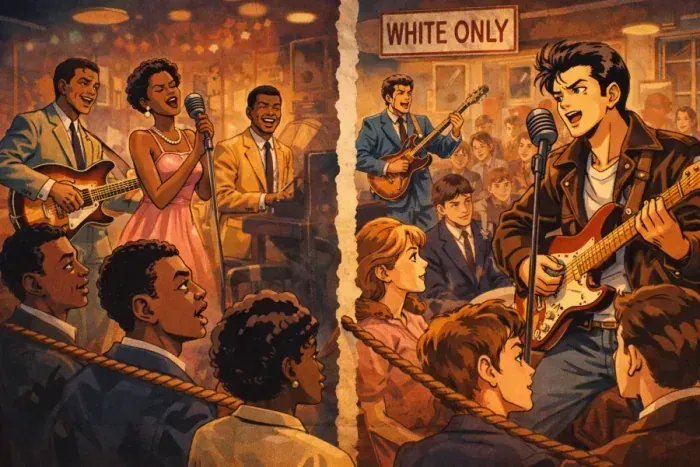
That shared language, however, carried contradictions. Music in the 1950s moved across racial boundaries more freely than almost any other part of American life, yet it did so within a society still rigidly shaped by segregation. Jim Crow laws governed daily existence in much of the country. They determined where people could live, work, travel, and perform. These realities were not separate from music. They shaped who could access studios, who could tour safely, and who was allowed to appear on certain radio stations or television programs.
Black musicians were at the center of many of the decade’s most important innovations. Blues, rhythm and blues, gospel, and jazz provided much of the rhythmic, vocal, and emotional language that would soon define popular music more broadly. Artists such as Ray Charles, Ruth Brown, and Muddy Waters built careers that were artistically ambitious and structurally constrained. Their records sold widely, but their opportunities were often limited by race-based marketing, segregated venues, and unequal contracts.
The record industry mirrored these divisions. Charts were separated into categories such as “race records” or rhythm and blues, even when the same songs were being purchased and enjoyed by white teenagers. Radio stations followed similar patterns. Some DJs quietly crossed these lines, introducing Black music to wider audiences late at night or under coded language. Others enforced them strictly, reinforcing the idea that certain sounds belonged to certain people.
Touring exposed these contradictions most sharply. Black performers traveling through the South faced constant uncertainty, relying on informal networks to find safe lodging and food. Even successful artists could be denied access to hotels or forced to enter venues through back doors. At the same time, white artists who recorded material rooted in Black musical traditions often encountered fewer obstacles, receiving broader promotion and more mainstream exposure.
By 1957, these tensions were impossible to dismiss as local or temporary. The crisis at Little Rock Central High School, where nine Black students faced violent resistance during desegregation, made the conflict visible to national television audiences. Music did not cause that crisis, but it circulated through the same media system and the same divided public sphere. The popularity of Black musical forms was rising at the very moment when equal access to schools, public space, and citizenship remained fiercely contested.
This imbalance also shaped the economics of crossover. In some cases, songs first recorded by Black artists reached broader white audiences through cover versions that were marketed as safer or more commercially acceptable. That process helped spread the music, but it also redirected credit, visibility, and income unevenly.
Despite these barriers, music created moments of contact that were rare elsewhere. Integrated audiences gathered around jukeboxes, radios, and dance floors. They sometimes did so without fully realizing how unusual this was. Songs crossed racial boundaries before laws and institutions did. That did not erase inequality, but it exposed how unstable those barriers could be.
The American music landscape of the 1950s was therefore defined by tension. Creativity flourished alongside restriction. Recognition and exploitation existed side by side. Understanding this dynamic matters. The point is not to reduce the decade to injustice alone, but to recognize how deeply social structures shaped both the sound of the era and the lives of the people who created it.
Teenagers, Taste, and a New Music Market
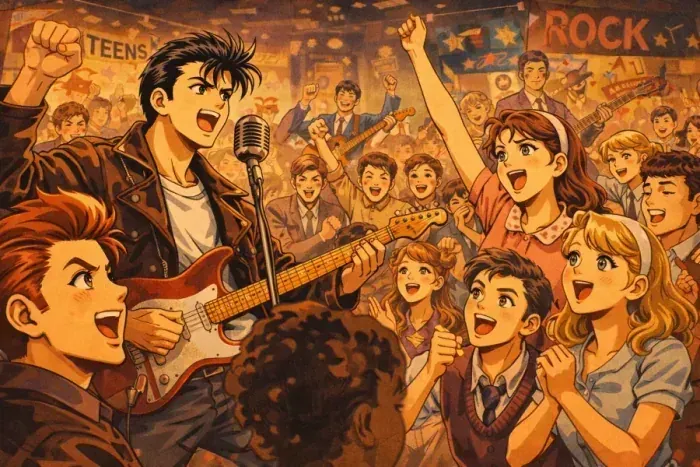
By the middle of the 1950s, the music industry had come to a clear realization. Teenagers were no longer just listeners. They were consumers, tastemakers, and cultural drivers. This shift did not happen overnight, and it did not happen gracefully. It grew out of a simple observation: young people were buying records in growing numbers, spending time around jukeboxes, and forming emotional attachments to songs that spoke directly to their experience.
The 45 rpm single was perfectly suited to this new market. It was affordable and easy to replace. It encouraged repeat purchases and fast-moving trends. A song could rise quickly, dominate for weeks, and disappear just as fast. For teenagers, that constant turnover matched the intensity of everyday life. Music became something to collect, share, and argue over. Owning a record was about sound, but also about belonging to a moment.
Record companies and advertisers moved quickly to shape this desire. Performers were styled carefully. Lyrics were scrutinized. Public appearances were designed to appeal to youthful fantasies without alarming parents too deeply. Artists such as Chuck Berry wrote songs that captured teenage routines with rare precision. They turned school, cars, and romance into vivid storytelling. Others, like Brenda Lee, were marketed as relatable figures. They balanced innocence and emotional depth.
Charts became another powerful tool. Rankings suggested objectivity. However, they also guided attention. A song’s position could influence radio play, retail placement, and public perception. Success often fed on itself. The higher a record climbed, the more visible it became. That pattern held regardless of whether its popularity reflected long-term impact or short-term excitement. The system rewarded immediacy and clarity, even when that came at the expense of complexity.
Consumption extended beyond records. Music shaped fashion, dance styles, slang, and social behavior. A hit song could inspire hairstyles, clothing choices, and even moral debates. Parents worried that music encouraged rebellion. Teenagers often embraced that very tension. The industry learned to sell identities as well as songs. Listening became an act of self-definition. Teenage girls were especially important to this new market. They bought records, followed performers closely, wrote fan letters, and helped turn emotional attachment into measurable market power.
Access was not equal. Economic and racial inequalities meant that not every teenager could participate in the same way. Some experienced music primarily through radio. Others did so through live performance. Some only did so at the margins. Still, the idea of youth as a unified market took hold. In treating teenagers as a collective audience, the music business helped create the very group it sought to profit from. The consequences of that decision would shape popular culture for decades to come.
Rock and Roll Breaks into the Mainstream
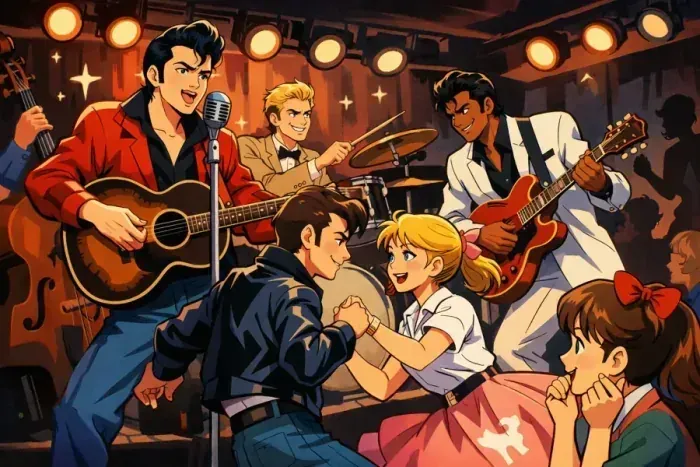
Rock and roll did not announce itself politely. When it began to spread in the early 1950s, it felt disruptive, noisy, and difficult to place. To some listeners it sounded raw and thrilling. To others it seemed unruly and threatening. What made it powerful was not only its sound, but the way it unsettled boundaries between age groups, social classes, and racial identities. Rock and roll carried echoes of blues, gospel, rhythm and blues, and country. It refused to stay neatly within any one tradition.
For young audiences, this music felt immediate and personal. Its rhythms invited movement. Its lyrics spoke plainly. Its performers often appeared closer to ordinary life than polished stars of earlier popular music. For many adults, however, rock and roll seemed to challenge ideas of respectability, discipline, and control. Debates about morality, sexuality, and race followed quickly. They turned songs into symbols of broader social change. "I wanted to write about school because most of my audience at the particular time was of a school element."
The next chapters trace how rock and roll emerged, spread, and provoked reaction. They look closely at the musical roots that shaped the style, the artists who brought it into public view, and the environments in which rock and roll was performed and heard. Just as importantly, they consider why this music mattered so deeply to those who embraced it and why it alarmed those who did not.
Rock and roll also changed the scale of musical change itself. Before the mid-1950s, a regional sound could remain local for longer. Once touring packages, radio play, record distribution, and television began reinforcing one another, a style could move from a city or region into a national argument in a remarkably short time. That acceleration helps explain both the music’s momentum and the intensity of the backlash against it.
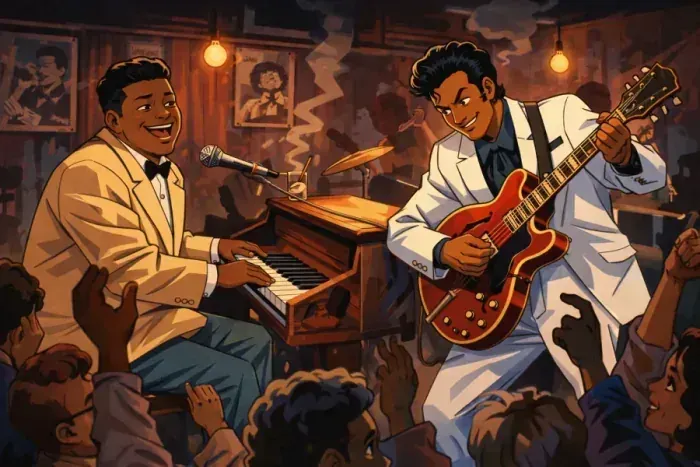
Rock and Roll's Musical Roots
Rock and roll did not emerge from a single place or moment. Its foundations were laid over decades through musical traditions that developed largely within Black communities in the American South and in urban centers. Blues, gospel, and rhythm and blues each contributed essential elements in sound, attitude, and emotional expression. What later audiences heard as something new was, in many ways, a reconfiguration of familiar languages.
The blues provided the core vocabulary. Electric blues, in particular, emphasized amplified guitars, driving rhythms, and direct storytelling. Artists such as Muddy Waters and Howlin’ Wolf recorded songs in the early 1950s that pushed volume and intensity forward. Their work reflected urban life and the Great Migration from the rural South to northern cities, capturing tension, humor, frustration, and desire with a clarity that resonated far beyond their original audiences.
Gospel contributed something different but equally important. Its call-and-response structures, emotional crescendos, and emphasis on vocal power shaped the way singers approached performance. When artists such as Ray Charles began blending gospel phrasing with secular themes, the result was controversial, but it was also transformative. The intensity of religious music was redirected toward love, pleasure, and personal freedom. In the process, it blurred lines many listeners had assumed were fixed.
Rhythm and blues acted as the bridge between these traditions and a broader commercial audience. Often recorded for independent labels and marketed within segregated systems, rhythm and blues records emphasized strong backbeats, danceable grooves, and concise song structures. Artists like Ruth Brown and Big Joe Turner found commercial success in the early part of the decade, demonstrating that this music could thrive commercially. Songs such as Shake, Rattle and Roll, which reached number one on the R&B chart in 1954, showed how humor, rhythm, and vocal force could combine into something immediately engaging.
Country music also played a role, particularly in its storytelling traditions and rhythmic simplicity. In regions where blues and country communities overlapped, musicians borrowed freely from one another, sometimes unconsciously. The result was a shared musical space in which boundaries mattered less than feel.
These roots mattered because they grounded rock and roll in lived experience. The music spoke plainly. It often spoke about everyday situations. It favored energy over refinement. When rock and roll finally broke into the mainstream, it carried with it the weight of these traditions, even when their origins were obscured or simplified. Understanding these roots helps explain why the music felt so alive and why it carried such cultural force when it finally reached a wider audience.
Rockabilly, Memphis, and the Sun Sound
One especially important bridge between country and rhythm and blues was rockabilly. Centered in and around Memphis, the style combined country guitar rhythms, blues phrasing, gospel energy, and the hard snap of slapped bass into a lean, urgent sound. Sun Records became the label most closely associated with that synthesis. Sam Phillips favored quick, live-feeling sessions with audible room sound and a distinctive echo that made records feel immediate rather than polished.
That approach mattered because it gave performers space to sound unstable in the best sense: excited, slightly dangerous, and emotionally present. Elvis Presley’s That’s All Right, recorded on July 5, 1954, is often treated as a landmark because it made this blend easy to hear. Carl Perkins, Jerry Lee Lewis, and Johnny Cash each carried different parts of the same Memphis logic forward. Perkins emphasized guitar drive, Lewis brought piano violence and gospel intensity, and Cash reduced arrangements to a stark pulse that felt both country and modern.
"If I could find a white man who had the Negro sound and the Negro feel, I could make a billion dollars."
Rockabilly did not replace rhythm and blues or country. It linked them in a form that white southern audiences could recognize quickly, while still drawing heavily on Black musical language. That does not make the style less important. It makes its history more revealing. Rockabilly shows how musical exchange, regional identity, and unequal access were all built into rock and roll from the start.
That speed also mattered. Sun could move quickly enough to turn a local session into a record that reached radio and retail before the initial excitement cooled.
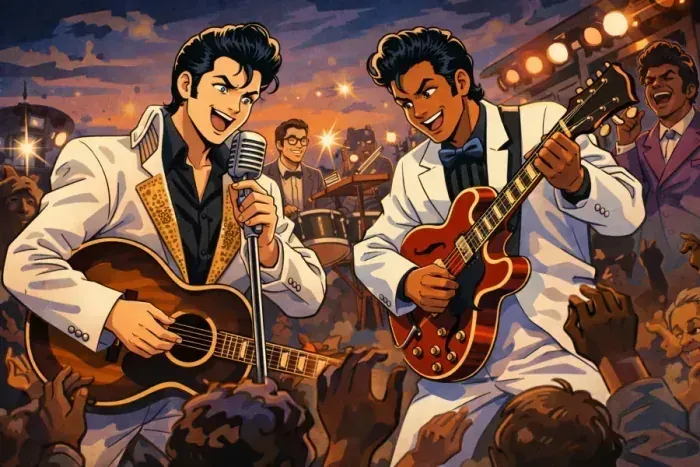
The Public Faces of Early Rock and Roll
As rock and roll moved from regional scenes into the national spotlight, a small group of performers became its public face. They came from different backgrounds and represented the music in different ways. What united them was timing, visibility, and a willingness—sometimes deliberate, sometimes accidental—to stand at the center of a cultural shift that was already underway.
One of the earliest figures to bring rock and roll into mainstream awareness was Elvis Presley. His mid-1950s recordings for Sun Records blended blues, country, and gospel into a style that felt both familiar and unsettling. Songs like That’s All Right and later hits such as Heartbreak Hotel introduced vocal intimacy and rhythmic looseness that contrasted sharply with established pop conventions. Recorded in January 1956, Heartbreak Hotel quickly rose to the top of the U.S. charts and became Presley’s first major national hit. His impact went beyond the music. His appearance, movement, and emotional delivery made him a focal point for debates about youth, sexuality, and respectability.
At the same time, Chuck Berry was defining another crucial aspect of rock and roll. His songwriting brought narrative clarity and wit to the genre. Tracks like Maybellene, released in July 1955, reached number one on the R&B chart and crossed into the pop top ten, while Roll Over Beethoven captured teenage life with unusual specificity. They placed cars, school, and romance at the center of the story. Berry’s guitar playing was built around sharp rhythms and memorable riffs. It became a blueprint for generations of rock musicians. His records showed that rock and roll could be clever, structured, and grounded in everyday experience.
Other artists contributed different dimensions. Little Richard brought theatricality and explosive energy to the form. Songs such as Tutti Frutti and Long Tall Sally pushed vocal expression to extremes. They combined humor, intensity, and a sense of joyful excess. His performances challenged conventional ideas of gender and decorum, even as they drew heavily on gospel traditions.
Female artists were also present, though they often faced tighter constraints. Wanda Jackson emerged as a powerful voice in rockabilly. She delivered songs such as Fujiyama Mama with confidence and drive. Her success made one thing clear: women could inhabit the sound and attitude of rock and roll, even as the industry offered them fewer opportunities and less promotional support.
These early stars did not invent rock and roll on their own. Yet their records made it visible and unavoidable. Through radio play, touring, and television appearances, their songs traveled far beyond local scenes. They turned a set of musical practices into a shared cultural reference point that would soon reshape popular music across genres and generations.

From Stage Energy to Studio Restraint
The tension between live performance and studio recording was central to the identity of early rock and roll. On stage, the music often felt volatile and unpredictable. In clubs, dance halls, and makeshift venues, performers fed directly off the energy of their audiences. Volume, movement, and spontaneity mattered as much as technical precision. These spaces allowed musicians to stretch songs, alter tempos, and respond to the mood of the room. They did so in ways that recordings rarely captured.
Touring circuits played a major role in shaping this live culture. Rock and roll shows were frequently packaged as traveling revues. They brought multiple artists together for long nights of performance. For many young listeners, these concerts offered a first experience of music as something physical and communal rather than distant. Dancing, shouting, and collective excitement were part of the event. At the same time, touring exposed deep inequalities. Black performers faced segregated accommodations, unsafe travel conditions, and limited access to venues. The road could be exhilarating, but it was also exhausting and precarious.
The studio presented a different set of pressures. Recording sessions demanded discipline and restraint. Time was expensive. Mistakes were costly. Producers often held final authority. Early rock and roll recordings were usually made quickly. They were sometimes made in a single take. Even so, they were shaped by technical limits. Microphones favored certain vocal styles. Mono recording required careful balance between instruments. Producers such as Sam Phillips believed in capturing immediacy while maintaining control. That balance defined the sound of many influential records.
This contrast created a subtle conflict. Live performances emphasized freedom and excess. Studios rewarded clarity and repeatability. Some artists thrived in both environments. They translated stage energy into concise recordings. Others felt constrained by the studio. They sensed that something essential was being smoothed out. Audiences, meanwhile, encountered two versions of the same music. A song heard on the radio might feel restrained compared to its live counterpart. Yet it was that polished version that traveled farthest.
Media exposure intensified this divide. Television appearances required even stricter control. They limited movement. They sometimes censored gestures deemed inappropriate. Performers were asked to contain the very qualities that made them exciting in live settings. That often frustrated artists and heightened the sense that rock and roll was being domesticated for mainstream consumption.
The push and pull between rebellion and control shaped the genre’s early evolution. It influenced how songs were written. It influenced how artists were presented. It influenced how audiences understood authenticity. Rock and roll’s power came not from choosing one side over the other. It came from constantly negotiating the space between them.

Why Rock and Roll Alarmed Adults
As rock and roll gained visibility, it also attracted resistance. By the mid-1950s, public concern about the music had grown into something closer to moral panic. Critics rarely focused on musical structure or lyrical detail alone. Instead, they responded to what rock and roll seemed to represent. Movement, volume, sexuality, and racial mixing became symbols. They represented a broader fear: that traditional social order was slipping out of reach.
Newspapers, parent organizations, and religious leaders often framed rock and roll as a threat to discipline and decency. Headlines warned of delinquency. Editorials linked music to juvenile crime and moral decline. Performers were scrutinized closely. The way an artist moved, dressed, or addressed an audience could provoke outrage. In this climate, the music itself was frequently secondary to the image surrounding it.
Television amplified these tensions. When Elvis Presley appeared on national broadcasts, camera angles were adjusted to limit his movements. That reflected anxiety about how his performances might influence young viewers. Radio stations were under pressure from sponsors and local authorities. They sometimes removed songs from playlists or restricted airtime. In extreme cases, records were publicly denounced or destroyed. These were acts of symbolic protest.
This backlash was deeply generational. Teenagers often embraced the criticism as confirmation that the music belonged to them. What parents feared, young listeners found exhilarating. Rock and roll offered a language that felt unfiltered and honest, even when its messages were simple. The very fact that adults disapproved strengthened its appeal. Music became a space where young people could assert independence without directly confronting authority.
Race played a crucial role in these reactions. Much of the anxiety surrounding rock and roll was rooted in its Black origins. Its ability to cross racial boundaries also caused concern. Integrated concerts and shared musical tastes challenged long-standing norms. This was true even when those challenges went unspoken. Condemnation of the music often disguised broader discomfort with social change.
For artists, the backlash carried real consequences. Careers could stall under public pressure. Labels sometimes pushed performers toward safer material. At the same time, the controversy fueled visibility. Debate kept rock and roll in the public conversation. That ensured that it could not be ignored. Attempts to suppress the music often had the opposite effect. They drew even more attention to its energy and cultural relevance.
By the end of the decade, the panic had not disappeared. It had lost some of its force. Rock and roll had become too widespread to contain. The conflict between generations did not end. It reshaped the terms of popular culture. It established music as a central arena, and the conflict reached beyond generational lines.
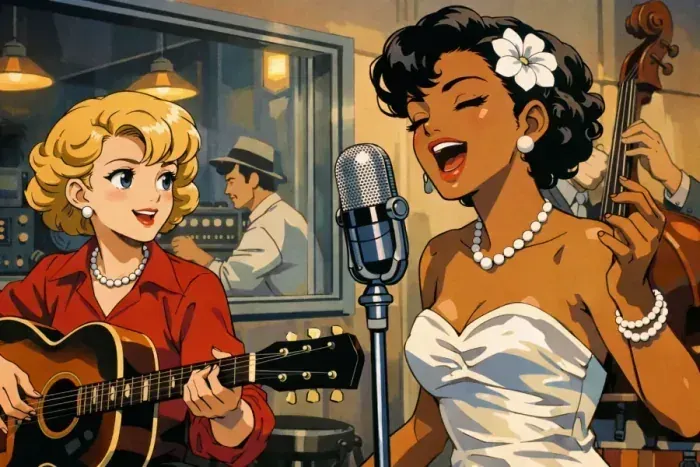
Women at the Center of 1950s Music
Gender, too, shaped who was heard and who was silenced. Women were not peripheral figures in the music of the 1950s but central voices who shaped how popular music sounded, felt, and was understood—often in the face of an industry that worked hard to limit their visibility or control their image. Female singers carried much of the decade’s emotional weight. Through ballads, jazz standards, rhythm and blues, and early rock and roll, they articulated longing, independence, humor, and vulnerability with a directness that resonated across audiences.
At the same time, their success existed within tight boundaries. Expectations around appearance, behavior, and repertoire were often more restrictive for women than for their male counterparts. Record labels and managers promoted carefully curated personas. Touring and media exposure came with additional scrutiny. Ambition and authority were frequently framed as problems to be managed. They were not seen as qualities to be celebrated.
Women stand at the center of the 1950s musical story—not as exceptions or novelties, but as artists navigating complex systems of power. The following discussion examines how female performers shaped pop, jazz, rhythm and blues, and rock and roll, how their voices helped define the decade’s sound, the structural limits they faced, and the quiet forms of resistance embedded in their music, performance, and career choices.
Looking closely at women also changes the balance of the decade’s history. It moves the story away from a narrow focus on a few male stars and toward a fuller account of how the era actually sounded. Women were essential not only as singers, but also as interpreters of songs, as style-setters, as public figures through whom the industry negotiated ideas about respectability, desire, and emotional control.
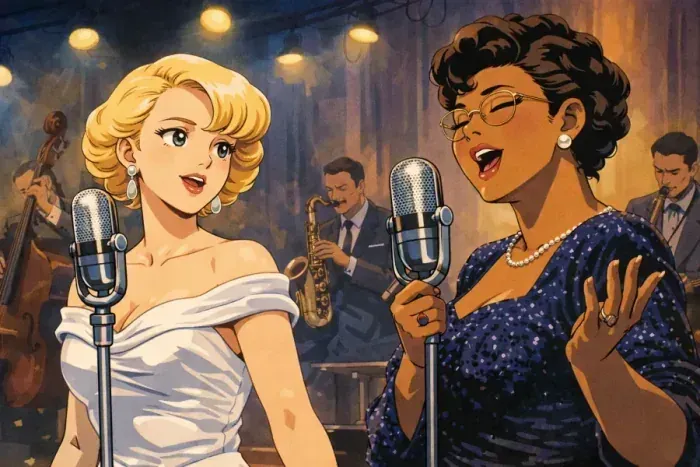
Women in Pop and Jazz: Vocal Authority
In the 1950s, pop and traditional vocal music offered women some of the most visible platforms in the industry. These styles valued clarity, emotional nuance, and interpretive skill, which placed the voice itself at the center of attention. Female singers were expected to communicate feeling with precision. They often did so within carefully arranged orchestral settings. While this environment could feel restrictive, it also allowed many artists to develop strong musical identities that went far beyond surface polish.
One of the defining figures of the era was Peggy Lee. Her work in the early 1950s, particularly Black Coffee, first issued as a 10-inch album in 1953 and expanded in 1956, introduced a restrained, intimate approach that contrasted with the more theatrical vocal styles of previous decades. Lee’s singing relied on subtle phrasing and understatement. Rather than projecting emotion outward, she invited listeners inward. She turned loneliness and desire into quiet conversations that helped redefine what emotional depth in pop music could sound like.
Similarly influential was Ella Fitzgerald. Her career during the decade demonstrated a different form of authority. She was known for her technical mastery and improvisational skill. Fitzgerald bridged swing-era traditions and the emerging LP format. She did this through her Songbook recordings. Albums such as Ella Fitzgerald Sings the Cole Porter Songbook, released in 1956, treated popular songwriting as serious artistic material. Her work showed that precision, joy, and intellectual engagement could coexist within mainstream vocal music.
Another crucial presence was Billie Holiday. Her influence continued to shape the decade even as her health and circumstances declined. Holiday’s interpretations carried emotional weight rooted in lived experience. She often bent melody and rhythm to serve meaning rather than technical perfection. Her recordings from the early 1950s retained a raw intimacy. That stood apart from the cleaner sound favored by many labels and reminded listeners that vulnerability itself could be a form of strength.
The industry’s expectations for female pop singers were often contradictory. Women were encouraged to appear elegant and emotionally expressive, but rarely confrontational. Lyrics explored love, heartbreak, and longing, but direct expressions of anger or independence were frequently softened. Despite this, many singers found ways to assert agency through song selection, phrasing, and collaboration with arrangers who respected their musical instincts.
Traditional vocal pop in the 1950s provided women with both opportunity and constraint. It offered national visibility and artistic legitimacy. At the same time, it reinforced narrow definitions of femininity. The enduring success of these artists lies in how they worked within those limits without being defined by them. Their recordings continue to resonate not because they conformed, but because they brought personal truth into familiar forms.
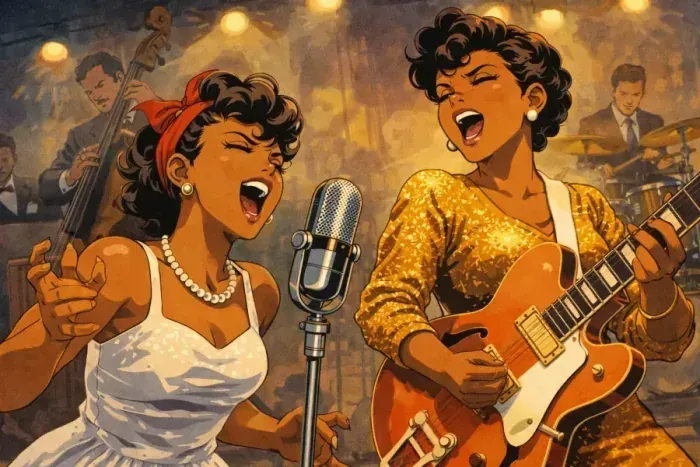
Women in Rock and R&B: Force, Risk, and Presence
While pop and jazz offered women a degree of visibility, rock and rhythm and blues presented a different kind of challenge. These styles were louder, more physical, and more closely associated with rebellion and sexuality. For women, entering this space meant confronting assumptions about who was allowed to sound forceful, playful, or openly assertive. The industry often treated female performers in these genres as anomalies—a pattern that persisted even when their influence was undeniable.
Rhythm and blues, in particular, relied heavily on female voices. LaVern Baker emerged as one of the most dynamic performers of the decade. She blended humor, strength, and emotional directness. Songs like Tweedlee Dee and Jim Dandy showcased her ability to command attention without softening her presence. Baker’s recordings were commercially successful and stylistically influential. Yet her contributions were often framed as novelty rather than central achievement. In reality, her vocal power and rhythmic confidence helped define the sound of 1950s rhythm and blues.
Even more foundational was Big Mama Thornton, whose performances embodied a raw intensity that challenged gender norms outright. Her original recording of Hound Dog, released in 1953, reached number one on the R&B chart, combining humor, authority, and physical presence in ways that were rare for any artist, male or female. Thornton’s version preceded Elvis Presley’s famous 1956 cover and carried a sense of lived experience and command that later interpretations often lacked. Yet, despite the song’s massive influence, she received limited financial reward or recognition for her original recording—a stark example of the structural inequalities that shaped women’s careers in these genres.
Rock and roll, as it developed, inherited both the energy of rhythm and blues and the constraints placed upon female performers. Women were expected to temper their sound, balance toughness with approachability, and avoid appearing too confrontational. Some navigated this carefully, carving out space through stage presence and vocal delivery rather than overt defiance. Others found their careers curtailed by an industry uncertain how to market them.
Gospel-trained artists such as Sister Rosetta Tharpe further complicated these boundaries. Tharpe’s electrified guitar playing and joyful performance style blurred distinctions between sacred and secular music. Her influence on early rock musicians was substantial, even when her role was downplayed in later histories. She demonstrated that virtuosity, faith, and showmanship could coexist, expanding the possibilities for women in performance.
Women in rock and rhythm and blues did not merely participate in these genres; they shaped their sound, energy, and emotional range. Their struggles were not the result of limited talent or ambition but came from an industry slow to accept women who refused to stay within prescribed roles. Their recordings remain powerful reminders that the roots of rock and roll were never exclusively male, despite historical narratives that often suggest otherwise.
The Industry's Grip: Image, Access, and Control
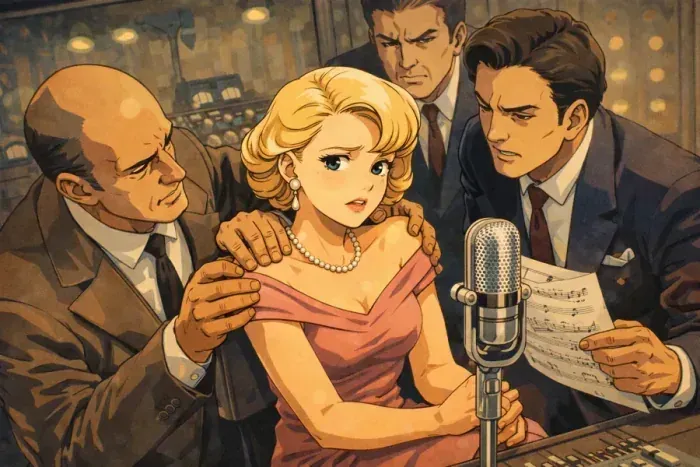
Behind the visibility of female performers in the 1950s stood an industry that exercised careful and often intrusive control. Record labels, managers, and promoters shaped careers through contracts that limited artistic autonomy and reinforced narrow ideas about how women should sound, look, and behave. Success was encouraged, but only within clearly defined boundaries. Crossing them could result in lost promotion, reduced radio play, or quiet exclusion.
Image was a central concern. Female artists were expected to appear composed, attractive, and emotionally expressive, but not demanding or defiant. Publicity photographs, stage wardrobes, and interview narratives were tightly managed. A singer’s personal life was often framed as part of her appeal. Her musical decisions were treated as secondary. That focus placed additional pressure on women. They were expected to perform musically and socially. Confidence could be misread as arrogance. Ambition could be misread as a lack of gratitude.
Contracts reflected these dynamics. Many women signed agreements that offered limited royalties. They offered little control over repertoire or recording schedules. Touring added further strain. Travel was exhausting. Safety was not guaranteed. Expectations of decorum followed performers everywhere. Unlike many male artists, women were often discouraged from appearing too visibly tired, angry, or independent. Emotional labor became part of the job—an unspoken requirement that rarely received recognition.
Despite these constraints, some artists found ways to assert agency. Peggy Lee negotiated greater creative input over arrangements and material. She quietly shaped the sound of her recordings. Others exercised control through song choice. They gravitated toward material that allowed subtle expressions of frustration, longing, or autonomy. In rhythm and blues, performers like Ruth Brown later challenged unfair contracts, drawing attention to systemic exploitation that affected many artists, especially women.
The emotional cost of these pressures was rarely acknowledged at the time. Discussions of mental health were almost nonexistent. Burnout was often interpreted as personal weakness rather than structural failure. When careers stalled, responsibility was frequently placed on the artist rather than on the conditions surrounding her work. That silence has contributed to the underrepresentation of women’s struggles in historical accounts of the decade.
Gendered success in the 1950s was a careful balancing act. Women were celebrated for their voices, yet constrained in their choices. Their achievements were real—often accomplished despite the systems meant to support them. Recognizing these dynamics clarifies rather than diminishes their artistry, revealing the resilience and quiet resistance embedded in their work.
Jazz Becomes a Listening Art
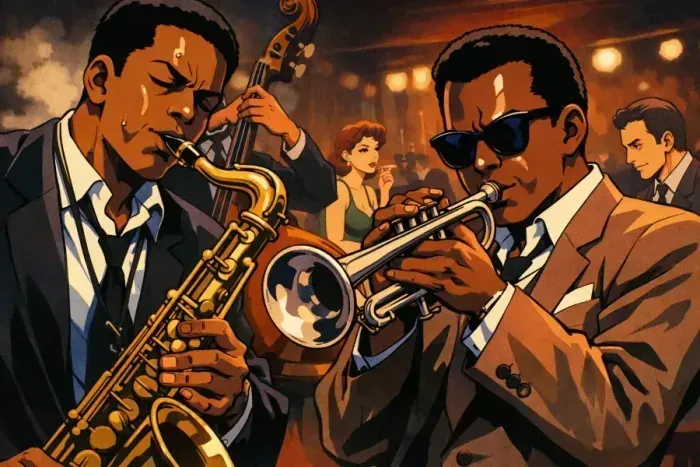
While teenagers danced to rock and roll and women fought for recognition in pop and R&B, jazz was undergoing its own transformation. The genre entered the 1950s as a mature art form with a long, complex history—it had filled ballrooms, dominated radio, and produced some of the century’s most influential musicians. But the decade brought major change. Big bands were fading. Audiences were fragmenting. Jazz was shifting from mass entertainment toward something more specialized: a listening-focused art.
This was not a decline so much as a reorientation. Smaller ensembles allowed for greater experimentation. New recording formats made extended improvisation possible on record. Jazz musicians began to explore mood, texture, and space in ways that challenged earlier conventions. The music took on new meanings and became associated with intellectual seriousness, artistic independence, and, for many listeners, cultural sophistication.
Jazz in the 1950s also reflected broader social tensions. Issues of race, authorship, and recognition were impossible to ignore. Black musicians continued to innovate, yet they often received less financial security and public acknowledgment than their white counterparts. Clubs, festivals, and recording studios became sites where artistic ambition met economic and social constraint.
Jazz’s changing identity can be traced through the artists, albums, and spaces that shaped it. Together, they show how the genre navigated shifting audiences, technological advances, and cultural expectations, laying groundwork that would influence both the avant-garde and the mainstream in the years to come.
The decade also changed how jazz was discussed. Critics, collectors, and serious listeners increasingly treated it as music to study and compare, not only to dance to. Albums, festival appearances, and club reputations became part of a growing critical culture. That helped raise jazz’s status, but it also sharpened questions about who would receive lasting recognition and whose work would be treated as central.
From Swing to Bebop and Beyond
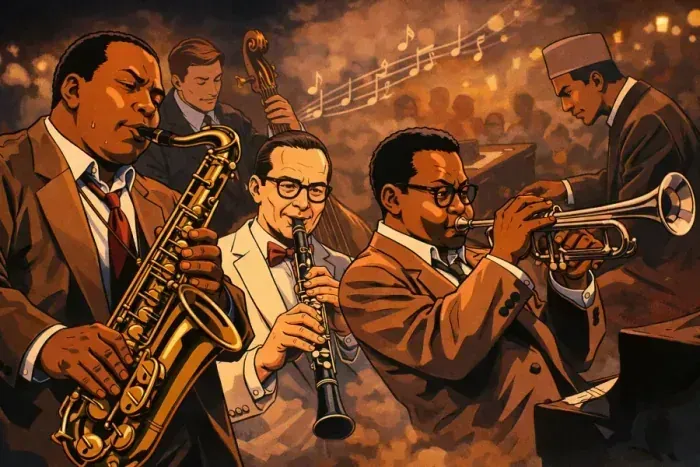
The shift from swing to bebop and later to cool jazz marked a major turning point in jazz history. Swing had dominated the 1930s and early 1940s. It was built around large ensembles, danceable rhythms, and tightly arranged charts. By the early 1950s, however, the economic and cultural conditions that sustained big bands had changed. Maintaining large groups was expensive. Audiences were splintering. Musicians were increasingly drawn to smaller settings. These settings allowed greater individual expression.
Bebop emerged from this environment. It was both a musical and cultural statement, developed earlier in the 1940s but reaching broader visibility in the following decade. It favored small combos, fast tempos, and complex harmonic structures. Improvisation became central rather than decorative. Artists such as Charlie Parker and Dizzy Gillespie reshaped the language of jazz. They pushed it away from dance halls and toward attentive listening. Their recordings challenged audiences. They demanded focus and familiarity with musical form. Jazz was no longer primarily social music. It was increasingly presented as an art that required engagement.
This shift had social implications as well. Bebop was closely associated with Black urban culture and artistic autonomy. Its complexity resisted easy commercialization. Some musicians saw this as a form of protection against exploitation, though that same resistance also limited its mainstream reach. Clubs replaced ballrooms. The audience often became smaller, more specialized, and more male. Jazz was gaining artistic prestige. It was losing mass visibility.
Cool jazz developed partly in response to these changes. It retained bebop’s emphasis on improvisation but softened its edges, favoring relaxed tempos, lighter textures, and a more restrained emotional tone. Miles Davis played a key role in this transition, particularly through recordings such as Birth of the Cool. These sessions, recorded between 1949 and 1950 and released in 1957, emphasized balance, space, and ensemble interplay, offering an alternative to bebop’s intensity. Cool jazz found receptive audiences on the West Coast and among listeners drawn to its reflective atmosphere.
The coexistence of bebop and cool jazz showed how wide the genre had become. Jazz was no longer moving in one direction. It was branching to meet different audiences and artistic priorities. Some listeners embraced its intellectual demands, while others were drawn to its quieter, more introspective moods.
That branching prepared the ground for hard bop, modal jazz, and the avant-garde. Miles Davis’s 1959 album Kind of Blue became a landmark of modal jazz. Its emphasis on scale-based improvisation rather than chord progressions influenced countless musicians and expanded the possibilities of jazz expression. By the end of the decade, jazz had become firmly identified as an evolving art form rather than a fixed style.
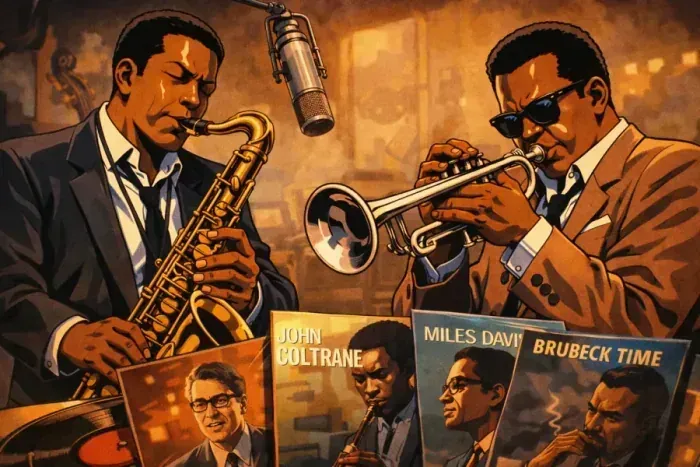
Landmark Jazz Albums of the 1950s
The 1950s changed how jazz was recorded, packaged, and understood. The long-playing album changed the relationship between musicians and listeners, allowing ideas to unfold over time rather than being compressed into short singles. Artists could think in broader arcs and shape albums as cohesive statements rather than loose collections of tracks. For jazz, with its dependence on improvisation and nuance, that was a major shift.
One of the most influential figures of the decade was Thelonious Monk. His recordings from the mid-1950s, including Brilliant Corners, released in 1957, challenged conventional notions of harmony, rhythm, and form. Monk’s compositions were angular and unpredictable. They demanded close attention from both fellow musicians and listeners. Studio sessions were often difficult, not because of a lack of preparation, but because his music resisted easy execution. The resulting recordings captured tension and personality. They preserved the sense of risk that defined his approach.
Another milestone came from Miles Davis. His work throughout the decade reflected constant refinement. Albums such as ‘Round About Midnight, released in 1957, presented jazz as both modern and accessible. It balanced complex improvisation with a sense of mood and restraint. Davis’s ability to assemble distinctive ensembles and allow space within arrangements demonstrated how leadership and collaboration could coexist in recorded form.
The decade also elevated the role of the studio itself. Labels like Blue Note Records became known for their commitment to sound quality and artistic freedom. Producers encouraged extended takes, used careful microphone placement, and created relaxed session environments. That approach allowed musicians to perform with a degree of comfort that mirrored live settings while still benefiting from the clarity of recording technology.
Vocal jazz also flourished in album form. Singers used the LP to explore repertoire with greater depth. They often revisited standards with new interpretive angles. The album became a space for storytelling, emotional continuity, and artistic identity. Rather than chasing immediate hits, many jazz artists focused on building bodies of work that reflected their evolving voices. "I just tried to do with my voice what I heard the horns in the band doing."
These albums and sessions did more than document performances. They changed how jazz was heard, studied, and remembered. By capturing extended improvisation and subtle interaction, recordings from the 1950s preserved moments that might otherwise have been lost. They also helped establish the album as a serious artistic medium in jazz and far beyond it.
The Clubs Where Jazz Lived
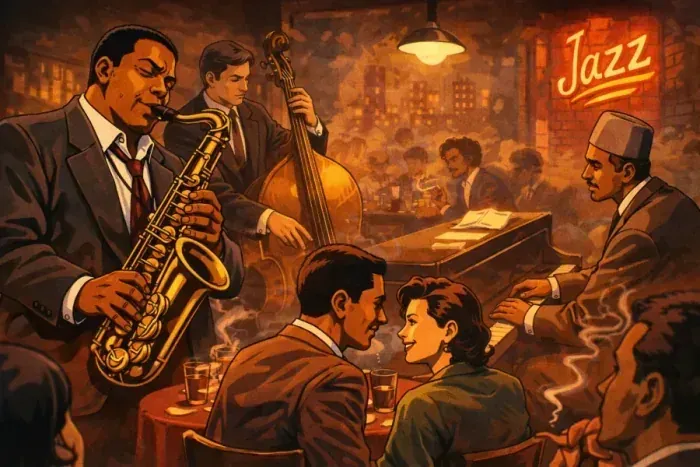
While recordings shaped jazz’s legacy in the 1950s, live performance remained the music’s lifeblood. Clubs were where ideas were tested, refined, and exchanged, often night after night. The jazz economy of the decade depended on these spaces, small rooms where musicians and audiences met at close range. The atmosphere was intimate, sometimes tense, and deeply social. Listening was active. Applause, silence, and conversation all fed back into the performance.
Urban migration played a decisive role in shaping this live culture. The movement of Black Americans from the rural South to northern and western cities transformed neighborhoods and musical scenes. Cities such as New York, Chicago, Los Angeles, and Detroit became hubs where musicians could find work, collaborators, and audiences. These environments encouraged stylistic exchange. Blues musicians encountered jazz players. Swing veterans played alongside younger bebop innovators, and boundaries softened through proximity.
Clubs like the Five Spot in New York or small West Coast venues offered platforms for experimentation. Performers were often paid modestly, sometimes relying on multiple sets per night to make a living. Touring schedules were demanding, and stability was rare. Yet these spaces allowed musicians to develop personal voices away from the constraints of radio and studio expectations. Extended solos, unusual arrangements, and spontaneous interactions were encouraged rather than suppressed.
The live jazz economy also reflected broader inequalities. Segregation affected where musicians could perform and who could attend. Integrated audiences were more common in northern cities, but discrimination remained present in hiring practices and pay. Many Black musicians found that their music attracted white audiences while their personal freedom remained restricted. This contradiction was part of daily life on the bandstand.
For all those challenges, live performance fostered community. Musicians learned from one another through shared stages and informal mentorship. Younger players absorbed techniques and attitudes simply by listening and participating. The club circuit became an education system that passed down knowledge no recording could fully capture.
Festivals also began to reshape jazz’s public image. The first Newport Jazz Festival took place in Rhode Island in 1954, giving the music a prominent summer stage outside the club circuit. Symbolically, that was as important as the money. Jazz was being presented not just as nightlife, but as a major cultural event worthy of travel, press coverage, and sustained attention. As the decade continued, high-profile Newport appearances helped strengthen the idea that jazz belonged in the national cultural mainstream, even if that recognition remained uneven.
By the end of the 1950s, economic pressures and changing tastes began to threaten some of these spaces. Rock and roll drew younger audiences away, and rising costs made it harder to sustain small venues. Still, the live jazz economy of the decade left a lasting imprint. It shaped the sound, discipline, and resilience of musicians whose influence would extend far beyond the rooms in which they played.
Jazz, Authority, and Recognition
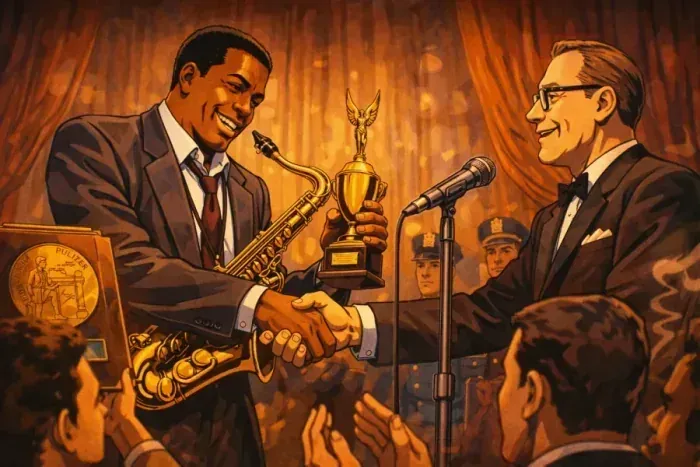
By the 1950s, jazz occupied an uneasy position within American culture. It was increasingly described as serious art, discussed in critical language, and presented in concert halls rather than only in clubs or ballrooms. At the same time, the question of who held cultural authority over jazz remained deeply contested. The music’s roots were unmistakably Black, yet its growing institutional recognition often benefited white musicians, critics, and promoters more visibly.
For many Black artists, jazz represented autonomy and intellectual freedom. Musicians such as Charles Mingus used composition and performance to assert control over their work and to comment, sometimes explicitly, on racial injustice. Mingus’s music carried emotional intensity and structural ambition, refusing to separate artistry from lived experience. His approach challenged the idea that jazz should be detached or purely decorative.
At the same time, white musicians increasingly entered the jazz mainstream, often receiving broader critical acceptance and commercial opportunity. This was not simply a matter of talent, but of access. Integrated bands were more common than in earlier decades, yet the industry continued to privilege whiteness in marketing and media representation. Jazz magazines, college lectures, and festival programming sometimes framed the music as universal while overlooking the social conditions that shaped it.
Cultural authority also played out through language. Jazz was described as sophisticated, modern, or cerebral, terms that carried social weight. These labels helped elevate the genre’s status, but they could also strip it of context. When jazz was presented as abstract art, divorced from the realities of segregation and discrimination, the experiences of its creators risked being softened or erased.
International recognition added another layer. European audiences often embraced jazz as an expression of freedom and individuality, sometimes granting Black American musicians respect they struggled to find at home. Tours abroad offered artistic validation, yet they also highlighted the contradictions of returning to a society that continued to limit opportunity based on race.
Even with those tensions, the elevation of jazz in the 1950s mattered. It expanded the space where musicians could work and be heard, and it encouraged deeper listening and long-term engagement. It also showed that cultural authority is negotiated, not given. Jazz gained prestige while many of its creators were still fighting for recognition and control.
Blues, Country, and Gospel as the Decade's Foundation
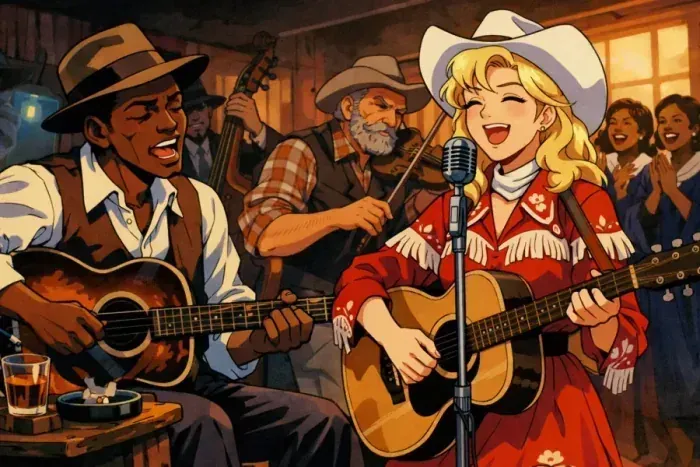
Those traditions deserve attention on their own terms. Jazz, rock and roll, and R&B didn’t emerge from nowhere. Beneath the decade’s innovations lay older traditions with deep regional roots—blues, country, and gospel. These genres had long histories tied to place, work, faith, and community. What changed in the 1950s was how they moved: migration, recording technology, and independent labels pulled regional sounds into national circulation without erasing their local character.
These genres formed the backbone of American popular music, even when they were not always credited as such. Blues adapted to urban life through amplification and new rhythmic emphasis. Country music shifted from rural storytelling to a more commercial, studio-centered sound. Gospel continued to shape vocal technique and emotional intensity, quietly influencing secular styles that would soon dominate the charts.
Regional scenes, small studios, and independent labels created environments where musicians could experiment, survive, and sometimes thrive. They also carried deep inequalities, where creative influence did not always lead to financial security or historical recognition. Those roots help explain why the music of the 1950s felt both grounded and restless, anchored in tradition while still pushing toward something new.
Each of these traditions also preserved different social worlds. Blues carried the memory of southern migration into northern cities. Country songs connected radio audiences to rural speech, working-class routine, and regional identity even as the music became more commercial. Gospel remained tied to church communities, collective discipline, and moral language. When these sounds entered the national marketplace, they did not lose those histories completely. They brought them into new spaces, where listeners could hear older ways of life inside newer musical forms.
That is why the roots matter beyond influence alone. They explain the decade’s emotional range. The toughness of urban blues, the narrative clarity of country, and the spiritual lift of gospel all fed into the records that later came to define the 1950s. Before the decade could sound modern, it had to draw from traditions that already knew how to speak about labor, longing, faith, migration, and survival.
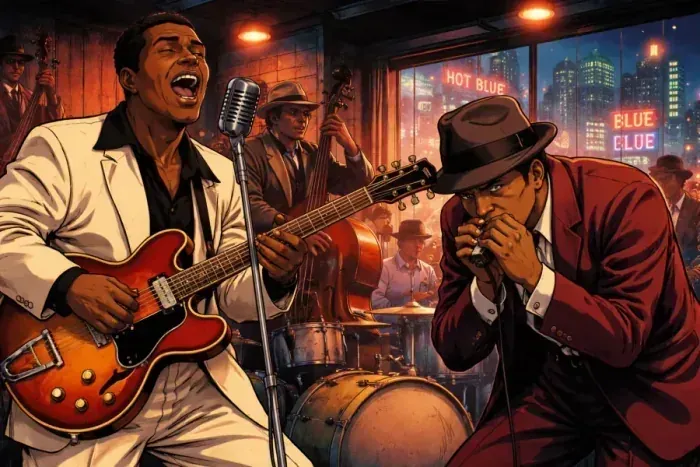
Chicago Blues and the Electric City Sound
The electric blues of the 1950s was shaped as much by geography as by sound. As Black Americans migrated from the rural South to northern cities in search of work and relative safety, they carried musical traditions with them. In urban environments, those traditions changed. Acoustic instruments gave way to amplified guitars, harmonicas, and drums that could cut through the noise of crowded clubs and packed dance floors. The result was a blues that felt harder, louder, and more insistent, mirroring the realities of city life.
Chicago became the most influential center of this transformation. Independent labels recognized both the artistic and commercial potential of the new sound, recording musicians who had honed their craft in the Mississippi Delta and beyond. Muddy Waters was one of the key figures in this shift. His recordings for Chess Records in the early 1950s, including songs like Hoochie Coochie Man and I’m Ready, defined the structure and attitude of electric blues. Waters combined traditional lyrical themes with amplified instrumentation and a commanding vocal presence, creating music that felt rooted yet unmistakably modern.
Another key voice was Howlin’ Wolf, whose raw, gravelly delivery set him apart from nearly every contemporary. His recordings carried a sense of physical force and emotional urgency that resisted polish. Songs such as Smokestack Lightning blurred the line between rhythm and blues and emerging rock and roll, influencing musicians well beyond the blues scene. Wolf’s work demonstrated that intensity itself could be a defining aesthetic.
Electric blues was also shaped by collective experience rooted in labor, displacement, and adaptation. Urban blues lyrics often spoke of crowded streets, unstable relationships, and hard-won confidence. The music favored repetition and groove, allowing listeners to settle into its rhythms while absorbing its emotional weight. These qualities made it especially suited to live performance, where volume and presence mattered as much as subtlety.
Despite its influence, electric blues remained constrained by the structures of the industry. Records were often marketed within segregated categories, limiting radio exposure and crossover success. Financial rewards were modest. Many musicians balanced recording with factory work or touring under difficult conditions. Even so, the reach of the music extended far beyond its immediate audience. White rock musicians listened closely. They absorbed phrasing, riffs, and attitude that would later reappear in altered form.
The electric blues of the urban North laid essential groundwork for what followed. It provided a sonic bridge between rural tradition and modern popular music, preserving emotional directness while embracing new technology. Its legacy can still be heard in later rock and soul, and in the enduring idea that music can adapt to new environments without losing its core truth.
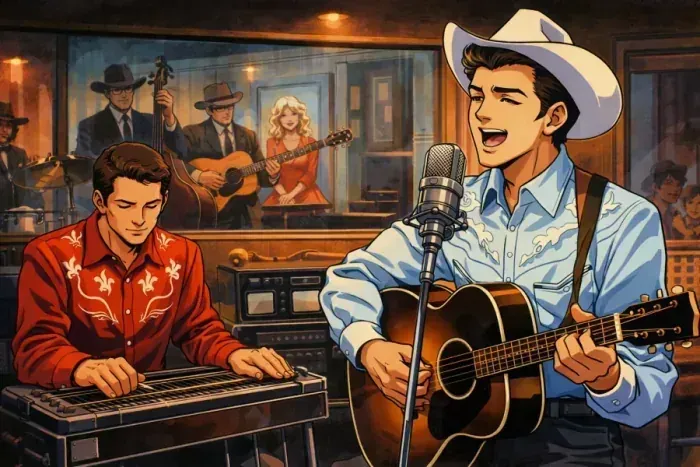
Country Music and the Nashville Shift
Country music in the 1950s was undergoing its own quiet transformation. Often framed as conservative or static, the genre was in fact responding actively to the same social and economic shifts reshaping the rest of American culture. Migration, commercialization, and the growth of the recording industry altered how country music was written, recorded, and heard. While its themes remained closely tied to everyday life, the sound itself was becoming more polished and more widely distributed.
The rise of Nashville as an industry center was central to this change. Recording studios, publishers, and radio stations clustered around a system that prioritized consistency and marketability. This environment favored clear storytelling, steady rhythms, and arrangements that could appeal beyond regional audiences. Artists such as Hank Williams had already demonstrated the emotional power of simplicity before his death in 1953. Songs like Your Cheatin’ Heart and I’m So Lonesome I Could Cry continued to shape the genre throughout the decade, setting a standard for lyrical honesty and melodic restraint.
Honky-tonk remained a vital current within country music, emphasizing themes of heartbreak, alcohol, and working-class struggle. Performers delivered songs with a plainspoken directness that resonated with listeners navigating economic uncertainty and personal loss. Lefty Frizzell emerged as a defining voice of this style, influencing vocal phrasing and song structure across the genre. His relaxed, behind-the-beat delivery brought a sense of intimacy that distinguished him from earlier performers.
At the same time, country music was increasingly intersecting with mainstream pop. String sections, backing vocals, and smoother production began to appear more frequently, especially in recordings aimed at national radio play. This crossover potential expanded audiences but also sparked debate within the genre. Some listeners welcomed the broader reach, while others feared a loss of authenticity. The tension between tradition and commercial adaptation became a recurring theme. By the late 1950s, this polished approach was increasingly recognized as the Nashville Sound, shaped in part by producers such as Chet Atkins and Owen Bradley.
Women also shaped this side of country music in important ways. Kitty Wells, for example, showed that female voices could answer male-centered narratives directly rather than only support them from the margins. Her success helped broaden the emotional and social range of what country songs could say.
Country music’s relationship with race was complex. While the genre was marketed primarily to white audiences, it shared deep roots with blues and gospel traditions developed by Black musicians. These connections were rarely acknowledged openly, yet they shaped rhythmic feel, vocal inflection, and song themes. The separation of genres often reflected social boundaries rather than musical ones.
By the end of the 1950s, country music had secured a stable place within the national media landscape. It may not have generated the same level of controversy as rock and roll, but its influence was lasting. Through its evolving sound and expanding reach, country music helped define ideas of sincerity, regional identity, and emotional storytelling that would continue to shape American popular music in the decades that followed.
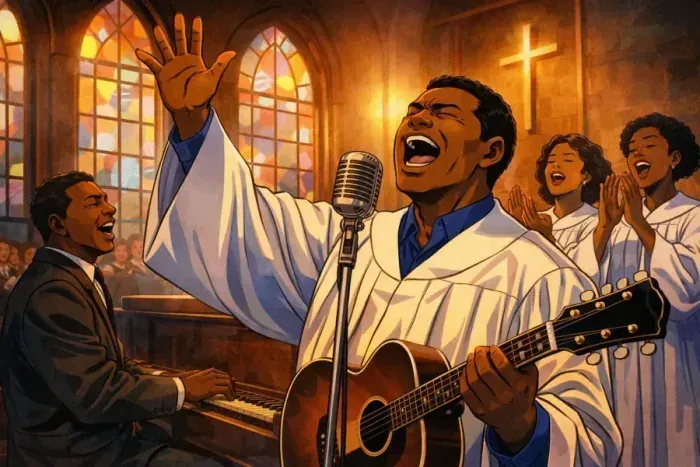
Gospel's Emotional Power
Gospel music remained one of the most powerful and influential forces in the 1950s, even when it was not always visible within the mainstream industry. Rooted in church traditions, gospel emphasized collective expression, emotional release, and spiritual conviction. Its impact extended far beyond religious settings, shaping vocal techniques, rhythmic structures, and performance styles that would become central to popular music across genres.
Churches functioned as both spiritual and musical training grounds. Choirs, soloists, and musicians learned discipline, projection, and the ability to move an audience emotionally. Call-and-response patterns encouraged participation rather than passive listening, reinforcing the idea that music was something shared. That communal energy distinguished gospel from many secular forms and gave performers a deep sense of presence and confidence. For many artists, the church was where their musical identity first took shape. By the start of the decade, gospel was also reaching major concert spaces. Mahalia Jackson’s Carnegie Hall debut in 1950 showed that the music could command national attention beyond church audiences alone. "When you sing gospel you have a feeling there is a cure for what's wrong. But when you are through with the blues, you've got nothing to rest on."
The boundary between sacred and secular music was often contested. Crossing it could provoke controversy, particularly when gospel-trained singers brought religious intensity into popular music. Ray Charles became one of the most prominent figures associated with this shift. By applying gospel phrasing and structure to songs about love and desire, he challenged assumptions about where spiritual expression belonged. His work in the mid-1950s was both celebrated and criticized, revealing deep tensions around faith, morality, and artistic freedom.
Other performers navigated this divide more cautiously. Some maintained parallel careers, performing gospel in church settings while recording secular material under different expectations. That dual existence reflected broader social realities. Gospel offered moral grounding and community support, while secular music provided broader exposure and financial opportunity. Moving between those worlds was rarely simple and often carried a personal cost.
Gospel’s influence was especially audible in vocal delivery. Techniques such as melisma, dynamic shifts, and emotional emphasis became hallmarks of rhythm and blues and early rock and roll. Even when lyrics moved away from religious themes, the intensity of expression remained. Audiences responded to this authenticity, often without recognizing its origins.
Despite its importance, gospel music itself received limited institutional support. Recordings were often made with modest resources. Artists rarely achieved the same commercial recognition as their secular counterparts. However, the genre’s legacy was lasting. Gospel provided the emotional engine behind much of the decade’s most influential music. It infused popular forms with urgency, hope, and resilience.
Gospel’s role in the 1950s shows how deeply connected sacred and secular traditions were. Rather than existing in isolation, they formed a continuous exchange that shaped sound, values, performance, and the emotional language of modern popular music.
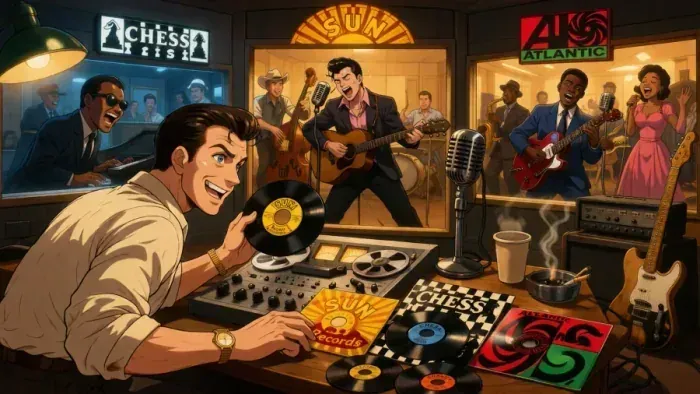
Small Studios, Big Revolution: Sun, Chess, and Atlantic
Much of the most influential music of the 1950s did not originate in major corporate offices or carefully planned marketing campaigns. It emerged from small studios, independent labels, and regional networks that operated close to the musicians themselves. These spaces were often modest, sometimes improvised, but they allowed for experimentation that larger companies were unwilling or unable to support. As a result, they played a decisive role in shaping the sound of the decade.
Regional studios were deeply connected to place. They reflected local accents, musical traditions, and social realities. In Memphis, Sun Records became known for recordings that blended blues, country, and gospel influences with minimal polish. Under the guidance of Sam Phillips, the studio prioritized emotional immediacy over technical perfection. This approach allowed performers to sound unguarded and present, qualities that resonated strongly with emerging rock and roll audiences.
In Chicago, Chess Records documented the evolution of electric blues with a focus on power and clarity. The label’s recordings captured the intensity of urban performance, preserving a sound that might otherwise have remained local. Atlantic Records, operating between regional scenes and national markets, played a similar role for rhythm and blues, helping artists reach broader audiences while maintaining stylistic identity.
These independent labels often worked with limited resources. Recording sessions were short. Promotion budgets were small. Financial risk was constant. Still, this scarcity encouraged flexibility. Musicians were given room to try ideas that might not have fit established formats. Producers listened closely. They adapted to the strengths of individual performers rather than forcing them into predefined molds. The result was a diversity of sounds that larger labels struggled to replicate. Small labels could also move faster than major companies. They responded more quickly to local scenes, regional hits, and shifts in audience taste, which made them especially important when new styles were still taking shape.
Local radio stations, record stores, and live venues formed essential support systems. DJs acted as cultural intermediaries, championing regional hits and introducing new artists to curious listeners. Word of mouth played a large role, allowing music to spread organically before it reached national charts. That grassroots circulation often preceded mainstream recognition, showing how influence could build quietly before becoming visible.
Regional studios mattered for the artists they launched and the values they upheld. They treated music as something rooted in community rather than abstraction. By staying close to everyday experience, these labels preserved forms of authenticity that commercial systems often flattened. Their legacy runs throughout the music of the 1950s.
How Pop Music Organized the Mainstream
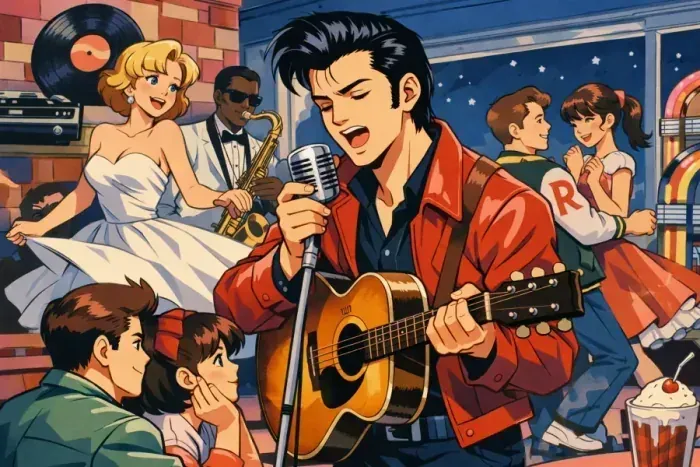
As regional roots moved into wider circulation, another system of popular music quietly defined how songs were written, recorded, and remembered. Pop in the 1950s was a genre and a production system. It relied on carefully crafted melodies, vocal harmony, orchestral arrangements, and an emerging understanding of how records could shape mood over time. It spoke to adult listeners, late-night intimacy, and emotional reflection, offering a counterbalance to the urgency of youth culture.
Crooners, vocal groups, arrangers, and songwriters played central roles in this ecosystem. Their work emphasized songcraft, control, and narrative continuity. The long-playing album became a canvas for sustained emotional storytelling, while harmony groups brought collective voices into the foreground, often reflecting urban life and shared experience. These forms of pop did not reject change. They absorbed it, adapting to new technologies and audiences while maintaining a sense of polish and restraint.
This side of the decade shows that musical change did not come only from disruption. Harmony, arrangement, and songwriting reshaped listening habits and industry practice too. The 1950s changed popular music through design, continuity, and the careful shaping of sound into lasting form.
That mainstream system also helped stabilize the market at a moment of rapid change. Publishers, arrangers, A&R staff, and session players made it possible for labels to release music that sounded dependable even when public taste was shifting quickly. Adult listeners who were less interested in rock and roll still wanted new records, and pop provided them with continuity. In that sense, the mainstream was not the opposite of the decade’s upheaval. It was one of the structures that absorbed upheaval, translated it, and kept the broader record business profitable.
Doo-Wop and the Art of Harmony
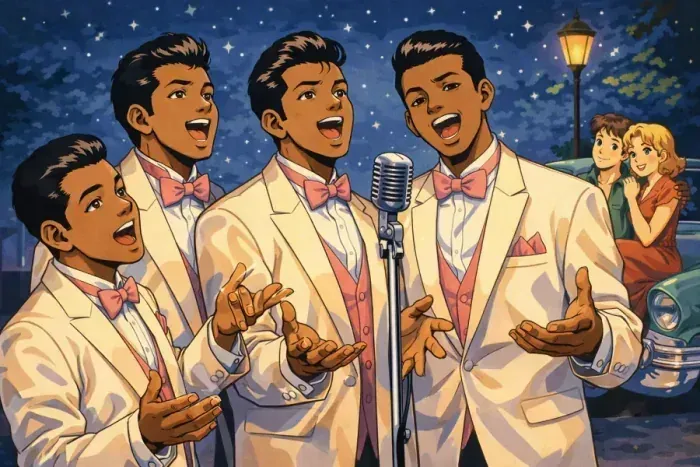
Doo-wop and vocal group music formed one of the most distinctive and emotionally resonant sounds of the 1950s. The style emerged largely from urban neighborhoods and informal settings rather than formal institutions. Street corners, schoolyards, and apartment hallways became rehearsal spaces. Young singers experimented with harmony, rhythm, and call-and-response patterns. Those environments shaped a music that felt communal, immediate, and deeply connected to everyday life.
Vocal groups emphasized blend over virtuosity. Individual voices mattered, but unity was the goal. Simple chord progressions and repeated syllables created space for expressive leads. These songs often sang about love, longing, and uncertainty. Groups like The Platters brought this sound into the mainstream with songs such as Only You and The Great Pretender. Their polished delivery and romantic themes appealed to both teenage and adult audiences, demonstrating that harmony-based music could cross generational lines.
At the same time, other groups maintained a closer connection to their street-level origins. The Drifters blended gospel influence with rhythm and blues. Their recordings felt grounded and emotionally direct. Songs like There Goes My Baby introduced orchestral textures while retaining the group’s expressive core. That reflected how vocal music adapted to changing production styles without losing its identity.
Youth played a central role in this movement. Many performers were teenagers themselves, singing about experiences they were actively living. Frankie Lymon and The Teenagers embodied this immediacy with Why Do Fools Fall in Love, a song whose vulnerability and enthusiasm resonated widely. The success of such records revealed a growing appetite for authenticity, even within carefully produced contexts.
Despite their popularity, vocal groups often faced harsh industry realities. Contracts were restrictive. Royalties were minimal. Group members were frequently treated as interchangeable. Creative control was limited. Long-term stability was rare. The music endured because it fulfilled a social need. It allowed listeners to hear themselves reflected in harmony and to experience collective emotion in a rapidly changing world.
Doo-wop and vocal group music formed a bridge between community expression and commercial pop. Its influence can be heard in later soul and R&B. It also left behind a simple idea: voices joined together can express feelings that no single voice can fully carry alone.
Crooners and the Art of Intimacy
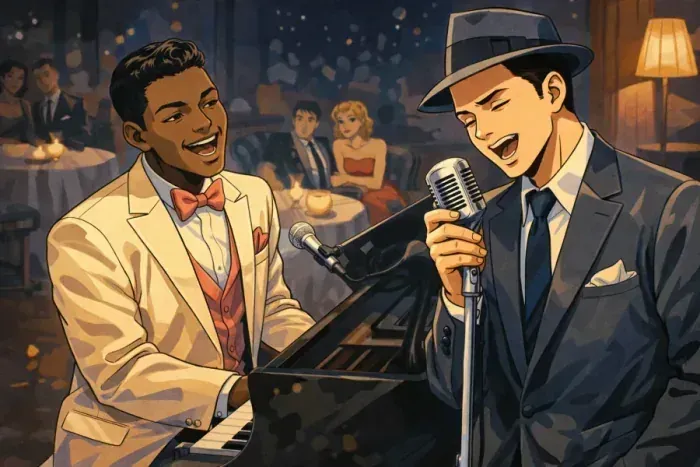
Crooners occupied a central place in the musical life of the 1950s. They offered a form of pop that was intimate, controlled, and carefully shaped for adult listeners. Their appeal did not rest on volume or spectacle. It rested on phrasing, tone, and emotional nuance. These singers addressed listeners directly, often as if in conversation. That created a sense of closeness that suited late-night listening and private reflection.
The long-playing album was crucial to this approach. Unlike singles-driven youth markets, adult pop favored sustained mood over immediate impact. Frank Sinatra was the key figure in defining this form. Albums such as In the Wee Small Hours, released in 1955, presented heartbreak and loneliness not as isolated moments, but as emotional landscapes unfolding track by track. Sinatra’s control over phrasing and timing, combined with thoughtful sequencing, helped establish the album as a cohesive artistic statement rather than a loose collection of songs.
Orchestral arrangements played an equally important role. Arrangers shaped the emotional framework within which crooners worked. They used strings, brass, and subtle rhythmic shifts to support the vocal line rather than overwhelm it. Nat King Cole exemplified this balance. His recordings paired warmth and elegance with restraint, allowing his voice to remain central even within lush arrangements. Albums such as Love Is the Thing, released in 1957, demonstrated how orchestration could deepen emotional impact without sacrificing clarity.
Female crooners also defined the era’s sound. Peggy Lee brought a quieter, more introspective sensibility to adult pop. Her understated delivery challenged the assumption that emotional power required volume. Instead, Lee used space and subtlety, inviting listeners to lean in. Her approach expanded the expressive range of pop music, making room for vulnerability and ambiguity.
Crooners were closely tied to radio and film. These media reinforced their association with sophistication and stability. Their music often accompanied images of romance, urban nightlife, and refined leisure. For many listeners, this sound represented continuity in a decade marked by rapid change. It offered reassurance without stagnation and modernity without rupture.
Adult pop in the 1950s did not compete directly with rock and roll. Instead, it coexisted. It served different emotional needs and life stages. Together, these parallel systems revealed how diverse the decade’s musical landscape truly was. The crooner tradition demonstrated that innovation could occur through refinement as much as rebellion. It shaped how popular music would be heard and understood long after the decade ended.
Songwriters, Producers, and the Hidden Architecture
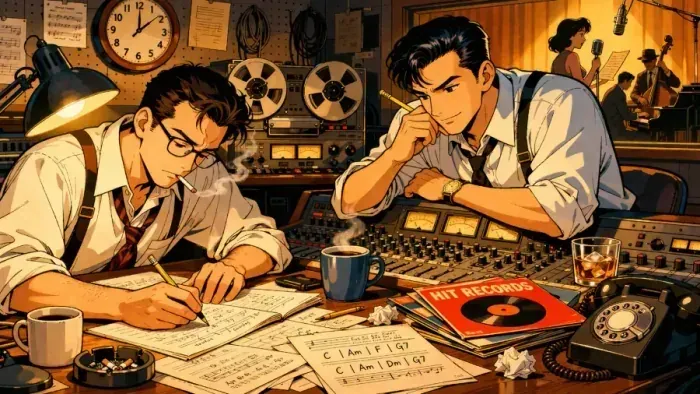
Behind the voices and faces that defined 1950s popular music stood a network of songwriters, producers, and arrangers. Their influence was wide but often understated. They shaped song structure, recording sound, and the way artists were positioned within the industry. Performers received the public recognition, but much of the creative and economic power sat elsewhere: in offices, studios, and publishing houses where decisions were made quietly and decisively.
Songwriting in the 1950s was becoming increasingly professionalized. Teams replaced lone composers. Songs were crafted with specific artists, markets, and formats in mind. One of the most influential partnerships of the decade was Jerry Leiber and Mike Stoller. Their work bridged rhythm and blues, pop, and early rock and roll. Their songs combined sharp observation with musical economy. They created narratives that felt vivid and contemporary. Tracks written for artists like The Coasters demonstrated how humor, character, and storytelling could coexist within commercial frameworks.
Producers played an equally critical role. They mediated between artistic impulse and technical reality. They shaped performances through arrangement, pacing, and sound balance. Mitch Miller was a powerful figure at Columbia Records. He exemplified a more directive approach. His influence extended beyond individual sessions into broader trends. He encouraged sing-along arrangements and tightly controlled production values. His methods were controversial. They reflected the industry’s growing desire for predictability and mass appeal.
Independent producers often operated differently. Figures like Ahmet Ertegun fostered environments where artists were encouraged to bring their own sensibilities into the studio. That flexibility allowed rhythm and blues performers to retain elements of live performance even as recordings reached wider audiences. The contrast between these approaches highlights the diversity of production philosophies active during the decade.
Arrangers, too, left a lasting mark. Their decisions determined whether a song felt expansive or intimate. They determined whether it felt urgent or reflective. They were rarely credited publicly. Their work shaped emotional response. It guided listeners through dynamics and texture without drawing attention to itself.
These invisible architects did not simply support popular music. They structured it. By defining how songs were written, recorded, and presented, they influenced which voices were heard and how long they lasted. The sound of the 1950s was performed, but it was also built decision by decision behind the scenes.

How Recording, Radio, and Labels Shaped the Sound
As pop, jazz, blues, and rock moved through larger markets, the systems behind them became more decisive. The sound of 1950s music was shaped by artists and songs, but also by the mechanisms that recorded, distributed, and promoted them. Technology and industry power worked quietly in the background, but their influence was constant. Decisions about microphones, tape, studio time, contracts, and radio access shaped what listeners heard, and how often they heard it. These forces did not determine creativity, but they framed its possibilities.
The decade saw rapid changes in recording practices and media reach. Advances in tape technology improved sound quality and editing. Radio remained the dominant channel for exposure. At the same time, the growing concentration of power within record labels and broadcasting networks created new forms of control. Artists navigated an environment where opportunity and restriction were closely linked. Success could bring visibility. It could also bring loss of autonomy.
This part of the story follows the mechanics behind the music: recording techniques, ownership models, and the gatekeeping role of radio and charts. Together, these forces help explain why certain sounds flourished, why others struggled, and why debates about fairness and influence became impossible to ignore as the decade progressed.
These mechanics mattered because they shaped more than access. They affected the sound of records at the level of form and feeling. Radio favored concise songs with immediate impact. Studio budgets affected how many takes an artist could afford. Label ownership determined whether musicians could build long-term leverage from their own work. Once music moved through national systems, commercial decisions became part of the art’s final shape, whether artists welcomed that fact or not.
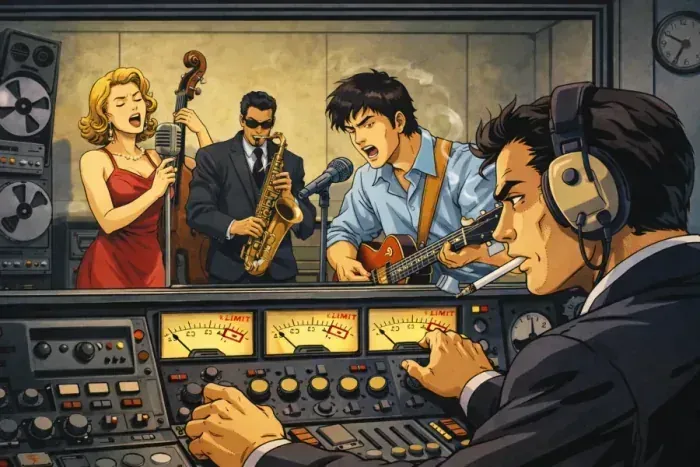
Recording Limits That Became Style
Recording technology in the 1950s imposed clear limits. Those limits became part of the music’s character. Most commercial recordings were made in mono. Musicians performed together in the same room. Balance was achieved through placement rather than post-production. Singers leaned toward microphones. Drummers played with restraint. Guitar amplifiers were positioned carefully to avoid distortion. The result was a sound that felt immediate and human, shaped by physical presence rather than later correction.
Magnetic tape became standard during the decade. It introduced new flexibility. Compared to earlier disc-cutting methods, tape allowed longer takes, splicing, and modest editing. That change mattered deeply for jazz and rhythm and blues. Extended performances and subtle interaction were essential in these genres. Producers could capture a complete feel rather than assembling fragments. Editing remained minimal. Performers were expected to deliver convincing takes in real time, which reinforced discipline and preparation.
Studios themselves had personalities. Room size, wall materials, and equipment varied widely, especially outside major corporate facilities. At Sun Records, the studio’s natural echo became a defining feature. It added depth and urgency to recordings without artificial effects. In contrast, larger studios associated with labels like Columbia Records favored controlled acoustics and orchestral clarity, especially for pop and vocal music.
Microphones played a decisive role in shaping vocal style. Crooners benefited from close-miking techniques. These techniques captured breath and nuance. They encouraged softer delivery. Blues and rock and roll singers adapted by emphasizing presence and attack. They learned how to project intensity without overwhelming the signal. These technical realities influenced phrasing, dynamics, and even songwriting choices. They subtly guided artistic decisions.
Limitations also extended to recording length. The physical constraints of singles encouraged concise structures, often around three minutes. This format favored directness and repetition. It reinforced hooks and clear lyrical ideas. Even when the LP allowed greater scope, many artists carried this economy into longer forms. They maintained focus and clarity.
Technology in the 1950s did not aim for perfection. Noise, slight imbalance, and room sound were accepted as part of the recording. These qualities gave records a sense of place and time, anchoring them in lived experience. Far from being obstacles, technical limits helped define the warmth, immediacy, and honesty that continue to characterize the music of the decade.

Majors, Independents, and the Fight for Power
The 1950s music industry was defined by a clear imbalance of power. Major record labels controlled manufacturing, distribution, and access to national media. Independent producers and small labels operated closer to artists and regional scenes. Both sides played essential roles. Their priorities often differed sharply. Majors sought stability and predictability. Independents thrived on risk, speed, and proximity to emerging sounds.
Major labels benefited from scale. They could press large quantities of records. They could secure radio promotion. They could place artists in films and television. That reach came at a cost to creative freedom. Contracts typically favored the label. They granted ownership of masters and publishing. They limited artists’ control over repertoire and release schedules. For many performers, success meant visibility without security. Royalties were opaque. Accounting was inconsistent. Long-term earnings were uncertain, even for popular acts.
Independent labels filled the gaps the majors left open. Companies such as Atlantic Records and Chess Records built reputations by working closely with rhythm and blues and blues artists. Their producers listened carefully to musicians. They adapted studio practices to capture live energy. That flexibility allowed new styles to develop quickly, but it also exposed artists to financial vulnerability. Limited capital meant limited leverage. Many contracts still transferred ownership away from performers.
Ownership was the central issue. Song publishing, in particular, determined who profited over time. Artists who did not control their publishing often saw long-term income flow elsewhere, even as their songs were covered, reissued, or adapted. Some performers were pressured to assign songwriting credit in exchange for studio time or promotion. These practices were widespread and rarely transparent. They shaped careers in ways that were difficult to reverse.
Producers occupied a complicated position within this system. They could advocate for artists. At the same time, they also represented label interests. Figures like Ahmet Ertegun navigated this tension. He built trust and encouraged artist-led sessions. He still operated within commercial constraints. The difference between supportive collaboration and quiet exploitation was often subtle. Artists did not always realize where they stood until years later.
The divide between major and independent operations defined much of the decade’s creative energy. Innovation frequently began on the margins, where control was looser and experimentation possible. However, lasting financial benefit tended to accumulate at the center. This imbalance would become a recurring point of contention in later decades, but its foundations were firmly laid in the 1950s, shaping careers and the ethical landscape of popular music.

Payola and the Battle Over Airplay
As radio’s influence grew in the 1950s, so did questions about how music reached the airwaves. By the end of the decade, these questions had erupted into public scandal. Payola, the practice of record companies or promoters paying DJs to play certain records, was not new, but its scale and impact became impossible to ignore as rock and roll records began dominating youth culture. What had once been treated as an open secret was suddenly framed as a moral and legal crisis.
Disc jockeys held extraordinary power. A single influential DJ could turn an obscure release into a national hit, especially in the singles-driven market. For independent labels with limited promotional budgets, payola was often seen as a survival tactic rather than corruption. Without access to major-label distribution networks, informal payments became a way to compete. That did not make the system fair, but it helps explain why it became so widespread. The line between promotion and bribery was blurry and was rarely questioned until public scrutiny intensified.
Charts played a central role in amplifying the problem. Rankings were presented as neutral reflections of popularity, yet they were deeply shaped by airplay, retail reporting, and industry influence. A song’s position could determine future radio spins, creating a feedback loop that favored already visible artists. That structure made it difficult for musicians without strong label backing to break through, regardless of audience response.
This system became more centralized on August 4, 1958, when Billboard introduced the Hot 100, a chart that combined several earlier measures of popularity into one national ranking. The change did not eliminate bias or behind-the-scenes influence, but it gave the industry a more uniform language of success. From that point on, chart position carried even more symbolic and commercial power.
The payola hearings of 1959 and 1960 exposed these dynamics to a national audience. High-profile figures were called before Congress, careers were damaged, and public trust in radio was shaken. Some DJs lost their jobs or were forced to sign statements denying involvement in promotional practices. Alan Freed, the disc jockey who helped popularize the term rock and roll and championed Black music, became the scandal’s most prominent casualty. He was fired from WABC radio in November 1959 and later pleaded guilty to commercial bribery charges. His career never recovered. Dick Clark, meanwhile, survived the scandal after divesting his music-industry interests under pressure from ABC. Others adapted by reducing personal influence and allowing stations to take greater control over playlists. The result was a more centralized and regulated broadcasting environment.
The consequences were mixed. On one hand, the hearings highlighted genuine abuses of power and exploitation. On the other, they disproportionately affected independent promoters and DJs who had championed new music, including rock and roll. Major labels, with their legal resources and institutional influence, emerged relatively unscathed. The scandal ultimately strengthened corporate control over radio, reducing the space for individual taste and risk-taking.
For artists, the impact was indirect but real. Access to radio became more standardized and less personal. Breaking a record now required alignment with larger systems rather than relationships with individual champions. While payola was framed as moral failure, the deeper issue was structural: the scandal revealed how tightly music, money, and visibility were intertwined—and how easily claims of fairness could mask shifts in power.
The payola era marked the end of a more informal, if imperfect, system. In its place emerged a regulated industry that would shape popular music for decades, often at the expense of spontaneity and local influence.
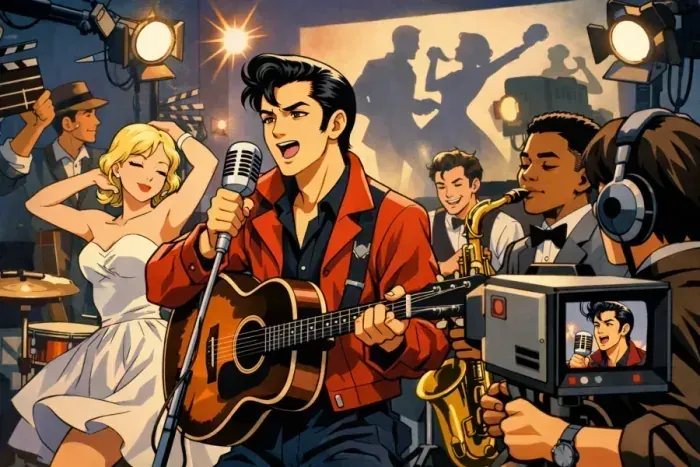
Film and Television Turn Music into Image
But as radio tightened its controls, a new frontier was opening—one where sound alone was no longer enough. By the late 1950s, music was becoming visual. Film and television expanded the reach of popular music while transforming how artists were perceived. A song could now be tied to a face, a gesture, or a carefully framed performance. Musicians were becoming public figures whose appearance mattered almost as much as their voice.
Hollywood had long understood the power of music, but television brought that power directly into living rooms. Variety shows, talk programs, and televised performances created new forms of intimacy—and new forms of control. Artists were welcomed into homes, yet filtered through cameras, scripts, and broadcast standards. Movement was restricted, expressions moderated, spontaneity sacrificed for acceptability. At the same time, these platforms offered unprecedented exposure, reaching audiences far beyond local scenes.
Film and television also reshaped musical stardom in the 1950s. They created new opportunities and new limits, encouraged more deliberate management of public image, and sparked cultural debates about what audiences were allowed to see. Together, these developments show how the decade laid the groundwork for a media-driven music culture in which sound and image became inseparable.
That shift changed the meaning of performance itself. A singer no longer had to reach only the people in a theater or dance hall. One appearance could be replayed in memory, discussed in classrooms and offices, and turned into a national reference point overnight. It also meant that visual codes such as dress, posture, race, gender presentation, and bodily movement were now interpreted as part of the music. In the years ahead, that logic would become normal. In the 1950s, it was still taking shape in real time.
Hollywood, Stardom, and Control
Hollywood had been intertwining music and image long before the 1950s, but during this decade the relationship deepened and became more strategic. Musicals and music-centered films did more than showcase songs. They shaped how audiences understood performers as personalities, bodies, and symbols. Cinema offered scale, color, and narrative, turning musicians into stars whose appeal extended beyond records and radio.
Classic studio musicals continued to thrive in the early part of the decade. Films such as Singin’ in the Rain associated musical performance with elegance, technical mastery, and optimism. Gene Kelly embodied this ideal through movement that felt athletic yet effortless. His performances presented music as joyful expression and disciplined craft, reinforcing the idea that popular song could be elevated through visual storytelling.
At the same time, Hollywood adapted to changing tastes. As youth culture gained influence, studios began casting popular singers whose appeal already existed outside film. Elvis Presley became the most visible example of this shift. His early films were built around his musical presence, often prioritizing performance scenes over narrative depth. These roles softened the rebellious edge of his stage persona, presenting him as approachable and safe for mass audiences while still capitalizing on his popularity.
Female performers also navigated this terrain, though often under stricter expectations. Doris Day exemplified a form of cross-media stardom that blended vocal skill with a carefully managed public image. Her films and recordings emphasized warmth, optimism, and relatability, aligning musical performance with ideals of domestic stability and emotional clarity. While this image limited the range of roles she was offered, it also secured her a lasting presence in both music and film.
Hollywood musicals and music films shaped listening habits as much as viewing habits. Songs featured in films gained extended life through repeated screenings and soundtrack sales. The visual association reinforced emotional connection, making music memorable through scene and story. At the same time, film studios exercised strong control over how music was framed, often favoring spectacle over nuance.
Cross-media stardom in the 1950s was always a negotiation. Film amplified musical reach, but it also filtered expression through commercial and moral expectations. Artists who succeeded in this space learned to balance performance with presentation and authenticity with acceptability. That balance still shapes popular music stardom today.
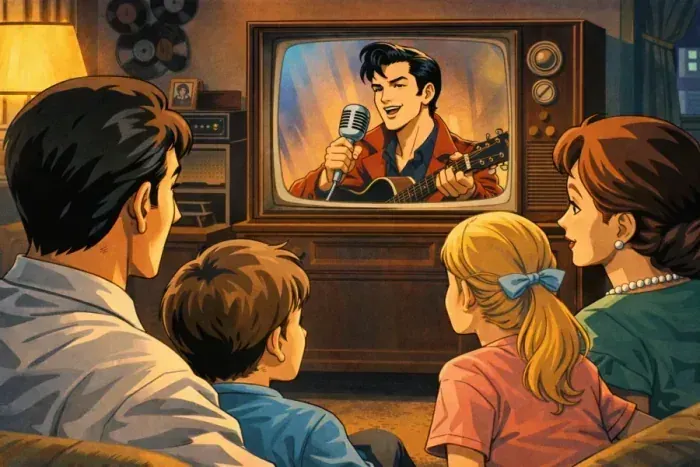
Television Brings Music Home
Television changed the scale and intimacy of popular music in the 1950s. Unlike film, which required audiences to leave their homes, television entered domestic space directly. Performers appeared in living rooms, framed by familiar furniture and daily routines. This proximity altered how music was received. A song was no longer only something to be heard or watched from a distance. It became part of ordinary life, repeated weekly through scheduled broadcasts and familiar hosts.
Variety shows were the primary vehicles for musical exposure. Programs built around comedy, conversation, and performance offered artists access to national audiences that radio alone could not guarantee. Appearances were brief but powerful. A single televised performance could redefine a career, especially for artists whose records were already circulating. However, these opportunities came with constraints. Broadcast standards governed movement, language, and presentation. Producers favored clarity and restraint, shaping performances to fit the expectations of sponsors and network executives.
One of the most influential platforms was The Ed Sullivan Show. Its broad audience made it a cultural gatekeeper. Performers who appeared on the program gained legitimacy across age groups, while those excluded remained marginal to mainstream visibility. When Elvis Presley appeared on the show, camera angles and staging were carefully managed, reflecting anxiety about youth culture and sexuality. The performance still reached millions, but in a form shaped by caution.
Another key force was American Bandstand. The program began in Philadelphia in 1952 and went national on ABC on August 5, 1957, under Dick Clark. Unlike a one-time variety-show appearance, it normalized the sight of teenagers dancing to current records week after week. That repetition mattered. It helped turn youth taste into visible market power and gave labels, artists, and advertisers a clearer picture of which sounds, dances, and personalities were connecting with young audiences.
Television also affected how artists prepared and rehearsed. Timing was strict, errors were highly visible, and spontaneity was limited. Musicians adapted by refining concise arrangements and focusing on visual presence. Clothing, posture, and facial expression became part of musical communication. For some performers, this discipline enhanced clarity and professionalism. For others, it felt like containment, stripping away the rawness that defined their live work.
Despite these limits, television offered unprecedented reach. Jazz musicians, pop singers, and vocal groups all benefited from exposure that cut across regional boundaries. Performances could be discussed the next day at work or school, creating shared cultural reference points. That collective experience helped solidify the idea of national hits and common taste, even as individual preferences persisted.
Television did not replace radio or records, but it reordered their influence. Visibility now mattered as much as sound. Artists were judged on musical ability and on how comfortably they inhabited the screen. By the end of the decade, popular music had become inseparable from visual presentation, and that expectation only grew in the decades that followed.
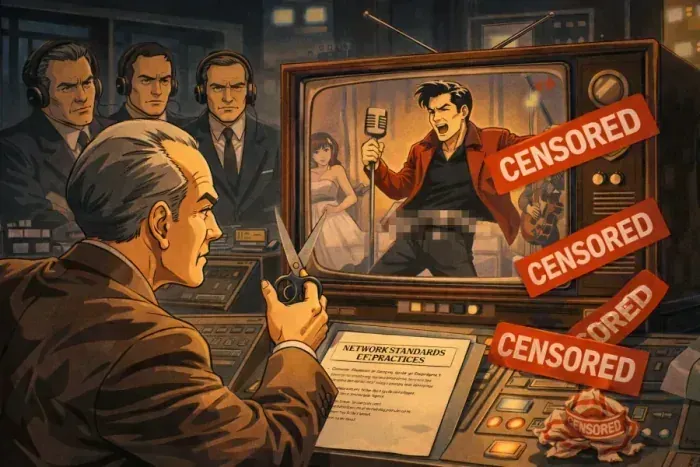
Censorship, Image, and Broadcast Limits
As music became increasingly visible through film and television, control over image grew tighter. The 1950s were marked by a constant negotiation between expression and acceptability, with broadcasters, studios, and sponsors acting as guardians of public morality. Music did not exist outside these concerns. How artists moved, dressed, and even smiled on camera could become the focus of intense scrutiny, often overshadowing the sound itself.
Censorship rarely operated through formal bans alone. More often, it took the form of quiet adjustment. Camera angles were altered, lyrics were softened, and performances were restructured to avoid provoking controversy. These decisions were shaped by assumptions about family values, gender roles, and racial boundaries. Rock and roll artists were particularly affected, as their music was closely associated with youth independence and physical expression. The fear centered on what audiences saw and what adults thought it might encourage.
Female performers encountered a distinct set of pressures. They were expected to appear attractive but not provocative, confident but not assertive. Clothing choices and stage presence were carefully managed to align with ideals of respectability. Deviations could lead to reduced airtime or negative press. That control limited the range of roles women could inhabit on screen, reinforcing narrow definitions of femininity even as their music expressed emotional depth and strength.
Race intensified these dynamics. Black artists faced additional barriers to television exposure, and when they did appear, their presentation was often sanitized to fit white audiences’ expectations. Integrated performances remained rare, and programs avoided visuals that might challenge segregationist attitudes. Music could cross racial lines more easily than images could. The camera, unlike the radio, made difference visible, and visibility was treated with caution.
Public debate followed these practices closely. Editorials, sermons, and political speeches framed music as a battleground for social values. Supporters argued that censorship stifled creativity and misunderstood youth culture. Critics insisted that restraint was necessary to protect social order. These arguments rarely engaged deeply with the music itself. Instead, they focused on symbolism, projecting broader anxieties onto individual performers.
For artists, navigating this environment required constant adjustment. Some complied in order to secure exposure. Others pushed boundaries subtly, using gesture, tone, or lyric interpretation to suggest more than they were allowed to show. The resulting performances often carried a quiet tension, balancing authenticity against survival.
The moral debates of the 1950s did not silence music. They shaped it. By forcing artists to negotiate visibility, they highlighted the power of image in shaping cultural meaning. The decade established patterns of control and resistance that would reappear whenever music challenged social norms, long after the television cameras first began to roll.
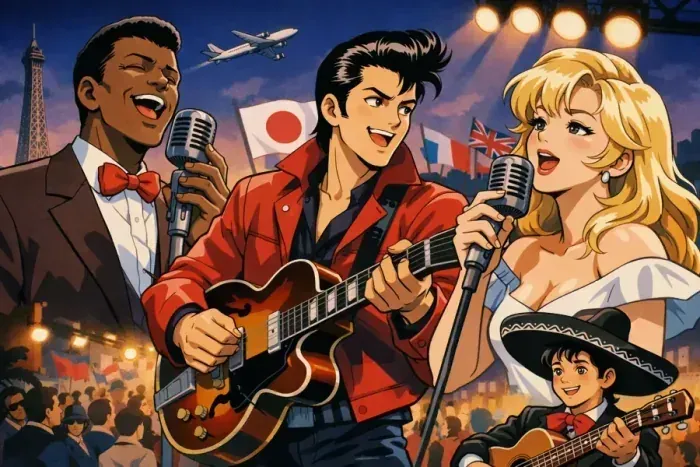
How 1950s Music Traveled and Changed Abroad
The same era of visibility and control also widened the music’s reach. Although much of the industry in the 1950s was centered in the United States, the decade’s sound did not remain contained within national borders. Records traveled, radio signals crossed oceans, and touring musicians carried new styles with them wherever they went. At the same time, international audiences did not simply receive American music passively. They interpreted it through their own cultural experiences, blending it with local traditions and reshaping it in the process.
Jazz, blues, rhythm and blues, and emerging rock and roll found especially receptive listeners abroad. In many cases, these genres were embraced as symbols of freedom, modernity, and emotional honesty. For some artists, international stages offered recognition and respect that remained elusive at home. For others, global exposure highlighted the uneven dynamics of cultural exchange, where influence flowed freely but credit and financial reward did not always follow.
Seen globally, the decade looks less like a national story than a growing exchange. American sounds were adopted, adapted, and transformed in Europe, the United Kingdom, Latin America, and the Caribbean. International performers and audiences also fed ideas back into the wider musical conversation. By the end of the 1950s, popular music was part of an expanding global dialogue.
This circulation depended on specific postwar networks. Records moved through port cities, military bases, specialty shops, film distribution, and radio services that crossed borders more easily than touring artists sometimes could. Migration also mattered. Musicians, workers, and travelers carried songs with them, and local performers rebuilt those songs inside their own musical traditions. The result was not a simple export model. It was a chain of reinterpretations in which the same record could mean one thing in Memphis, another in London, and something else again in Havana or Paris.
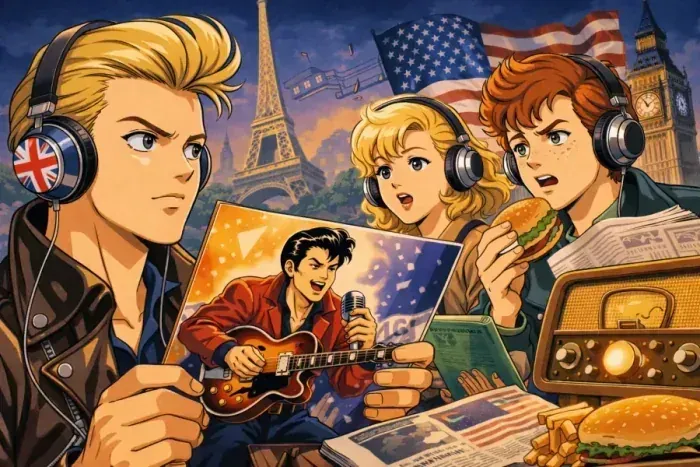
Europe and Britain Hear America Differently
In the years following the Second World War, Europe and the United Kingdom became some of the most attentive audiences for American music. Jazz had already established a foothold before the 1950s, but the decade deepened this relationship and broadened it to include blues, rhythm and blues, and early rock and roll. Records arrived through imports, radio broadcasts, and military networks, carrying sounds that felt both foreign and urgently contemporary.
Jazz musicians often found especially receptive audiences in Europe. Concert halls and clubs treated the music with a seriousness that contrasted with its declining mainstream visibility in the United States. For Black American artists, touring abroad could offer a sense of dignity and artistic validation that was harder to secure at home. Applause came without the same weight of segregation, even if social equality was far from complete. That experience shaped how musicians understood their own work and its cultural meaning.
In the United Kingdom, American records circulated among young listeners eager for alternatives to traditional pop. Skiffle emerged as a local response, blending folk, jazz, and blues influences into a stripped-down style accessible to amateur musicians. This movement encouraged participation rather than passive consumption. Homemade instruments and informal performances created a pathway for young artists who would later play key roles in the development of British popular music in the following decade. Lonnie Donegan’s Rock Island Line helped turn that skiffle impulse into a mass movement, and by the end of the decade Cliff Richard’s Move It had helped establish Britain as a producer of homegrown rock and roll hits.
Blues records, though harder to find, carried particular weight. The rawness and emotional directness of artists such as Muddy Waters resonated with listeners seeking authenticity. These recordings were studied closely, their phrasing and structure absorbed with care. What emerged was not imitation, but interpretation, shaped by different social conditions and cultural histories.
Rock and roll reached European audiences slightly later but spread quickly once it arrived. Films, television appearances, and imported singles created a sense of shared youth culture that transcended borders. The music’s association with freedom and rebellion held particular appeal in societies still recovering from wartime restriction. Dancing, fashion, and slang followed, signaling generational change.
The exchange did not move in only one direction. In 1958, Domenico Modugno’s Volare became an international hit, showing that songs rooted in European popular music could also move outward and shape the decade’s shared musical imagination.
European and British engagement with American music in the 1950s was not one-directional. Enthusiasm abroad helped elevate the status of certain genres and artists, reinforcing their importance within the global imagination. That exchange laid the groundwork for future musical revolutions. Popular music was no longer confined by geography. It was becoming a shared language shaped by movement, curiosity, and connection across borders.
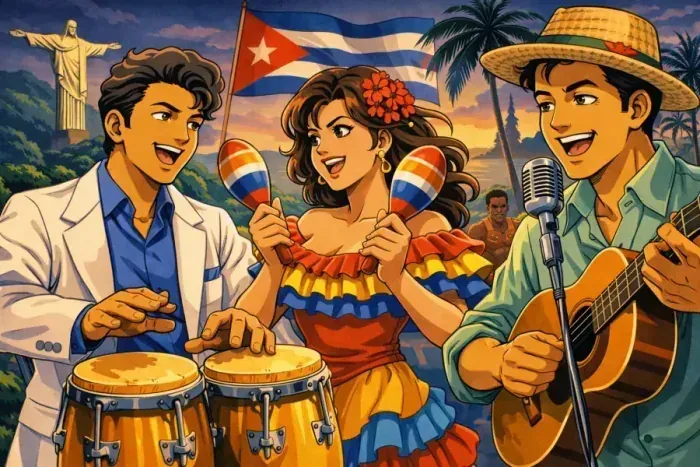
Latin America and the Caribbean: Local Rhythms, Wider Reach
While American popular music traveled outward in the 1950s, it encountered regions with rich musical traditions of their own. In Latin America and the Caribbean, exchange was less about replacement and more about dialogue. Local styles were already deeply embedded in social life, tied to dance, ritual, and collective celebration. When jazz, rhythm and blues, and emerging rock and roll arrived, they entered environments that were musically confident and highly rhythmic, shaping hybrid forms rather than simple imitation.
Cuban music held particular influence during the decade. Mambo and Afro-Cuban jazz gained international visibility, driven by complex percussion, layered rhythms, and an emphasis on movement. Artists and bandleaders such as Tito Puente brought these sounds into dialogue with jazz instrumentation, creating music that appealed across cultural lines. Dance halls in New York, Havana, and Mexico City became spaces where swing, jazz, and Latin rhythms coexisted, sometimes within the same evening.
The Caribbean contributed its own distinctive currents. Calypso from Trinidad reached global audiences through performers like Harry Belafonte, whose recordings in the mid-1950s translated folk traditions into accessible popular forms. Songs such as Day-O (The Banana Boat Song) carried stories of labor and migration, even as they were marketed as light entertainment. That duality reflected a broader pattern in which cultural depth was often softened to meet commercial expectations.
These exchanges were shaped by movement and migration. Caribbean and Latin American musicians traveled to the United States, while American artists absorbed rhythmic ideas during tours and recording sessions. Jazz musicians, in particular, were attentive listeners, incorporating clave patterns and percussive textures into their work. This influence broadened jazz’s rhythmic vocabulary and reinforced its openness to global dialogue.
Political and social context mattered deeply. Colonial histories, economic inequality, and migration framed how music circulated and who benefited from its success. While certain styles gained international popularity, many originators remained marginalized within global markets. Recognition did not always translate into sustained opportunity, and cultural exchange often unfolded unevenly.
Despite these imbalances, the musical conversation of the 1950s expanded possibilities on both sides. Latin American and Caribbean sounds challenged the dominance of four-beat swing and blues-based structures, introducing new rhythmic logic into popular music. In turn, global exposure brought local traditions into wider awareness, even if imperfectly. The result was not a single shared style, but a growing sense that popular music was becoming genuinely international, shaped by encounter, adaptation, and mutual influence.
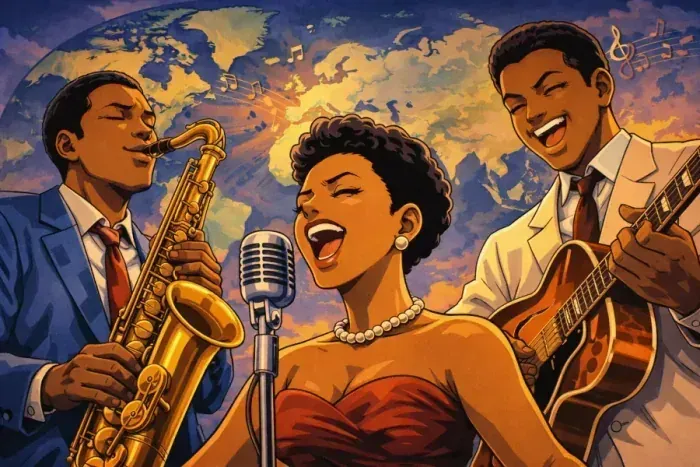
Black Music's Global Language
As American music traveled internationally in the 1950s, it was African-American musical traditions that often left the deepest imprint. Jazz, blues, gospel, and rhythm and blues carried histories of struggle, resilience, and creative innovation that resonated strongly with listeners abroad. In many countries, these sounds were heard as entertainment and as expressions of freedom and emotional truth, shaped by experiences that, while specific to the United States, felt widely understandable.
Jazz occupied a particularly powerful symbolic role. European audiences often framed it as a modern art form, associating it with intellectual independence and cultural sophistication. Concert halls and festivals welcomed musicians who, at home, still faced limited access and persistent discrimination. For Black American artists, this reception could be transformative. Tours through France, Germany, and Scandinavia offered respect and curiosity that contrasted sharply with segregation in the United States. Musicians spoke of being listened to differently, judged by sound rather than skin color, even if racial inequality remained present in other forms.
Blues and rhythm and blues also found dedicated listeners overseas, though often through smaller networks. Imported records circulated among enthusiasts who treated them as objects of study. Lyrics, guitar lines, and vocal phrasing were absorbed carefully, sometimes obsessively. That close listening helped preserve aspects of African-American music that were being commercialized or simplified within mainstream American markets. In some cases, international interest encouraged reissues and renewed attention to artists whose work had been overlooked domestically.
At the same time, global enthusiasm introduced new complications. African-American music was sometimes detached from its social context, presented as timeless or universal rather than historically grounded. While this framing elevated the music’s artistic status, it risked softening the realities that shaped it. Struggles with segregation, economic exploitation, and limited access were not always visible to international audiences, even when they were audible in the sound itself.
Cultural exchange also flowed back toward the United States. Musicians returning from overseas tours brought new confidence and broader perspectives. They had seen their work valued differently and began to assert greater artistic autonomy. In subtle ways, international recognition strengthened claims for respect at home, reinforcing the idea that African-American music was not a niche product, but a central force in global culture.
The global echo of African-American music in the 1950s reveals both possibility and tension. Sound crossed borders more easily than social justice did, and recognition abroad could coexist with inequality at home. Even so, these traditions proved durable across languages and cultures. They became part of a shared global vocabulary that still shapes how popular music is heard and understood.
Early Global Stardom and Cross-Border Careers
By the late 1950s, a small number of artists were no longer defined by a single national market. Their careers unfolded across borders, shaped by touring, recordings, and media exposure that reached multiple continents. These early global figures did not operate within the seamless international infrastructure that would emerge later, but they nonetheless helped establish the idea that popular music could circulate on a truly transatlantic scale.
One of the most striking examples was Eartha Kitt, whose career moved fluidly between music, theater, film, and international stages. Kitt’s multilingual performances and cosmopolitan image resonated strongly in Europe, where audiences often embraced her sophistication and intensity more readily than American media did. Her success abroad highlighted how race, gender, and politics shaped reception differently across cultural contexts. What felt unsettling or difficult to categorize in one country could be celebrated in another.
Another figure whose international presence shaped the decade was Josephine Baker. Although her most influential years were earlier, Baker’s continued visibility in the 1950s symbolized the long-standing transatlantic relationship between African-American performers and European audiences. Her work, activism, and public persona reinforced the idea that artistic freedom and social dignity were often more attainable abroad than in the United States.
Jazz musicians also built transatlantic careers through repeated touring and extended residencies. Performers such as Sidney Bechet, who settled in France, found stable audiences and institutional support that allowed them to work without constant commercial pressure. These environments fostered creative continuity, enabling artists to refine their sound rather than constantly adapt to shifting trends.
Beyond transatlantic exchange, distinct regional voices emerged as powerful forces in their own right. E.T. Mensah, known as “the King of Highlife,” helped popularize Ghanaian highlife music throughout Africa and beyond during the decade. His recordings blended local Ghanaian rhythms with Western brass arrangements, creating a sound that captured both independence and cultural pride. Meanwhile, Umm Kulthum continued her reign as one of the Arab world’s most beloved figures, her voice carrying enormous emotional weight across the Middle East and North Africa. Her recordings and radio broadcasts shaped popular taste throughout the decade, demonstrating that global musical influence in the 1950s was not one-directional from America, but a complex web of regional and cross-cultural exchange.
Transatlantic careers were shaped by practical realities. Travel was demanding. Communication was slow. Promotion was uneven. Still, the benefits were real. International work expanded artistic identity. It reduced dependence on a single market. It offered alternative models of success. For women and Black artists in particular, global mobility could provide relief from restrictive industry expectations at home.
These early global careers did not erase inequality, but they complicated it. Music could create parallel spaces of recognition and belonging. By the end of the 1950s, the idea of an artist existing beyond national boundaries was becoming a viable, if challenging, path.
The Pressure Behind the Decade's Success
That wider reach came with a cost that is rarely visible in the historical record. Behind the energy, innovation, and cultural change of 1950s music lay a quieter story, one that unfolded away from the spotlight. As exposure expanded, so did pressure. Success brought opportunity, but it also carried demands that few artists were prepared to manage. The industry expanded faster than its support structures. Musicians were often left to navigate demanding schedules, financial uncertainty, and public scrutiny on their own. Fame arrived suddenly, sometimes before performers had time to understand what it required of them.
Touring was relentless. Long journeys, uneven pay, and unstable living conditions were common, especially for artists outside the mainstream. Racial segregation added further strain. It turned travel into a daily negotiation of safety and dignity. Even for those who achieved commercial success, rest was scarce and privacy rare. Expectations to perform, record, and promote rarely slowed.
Mental health was rarely discussed openly. Exhaustion, anxiety, and substance use were often treated as personal failings rather than structural consequences of the system. When careers faltered or lives unraveled, the narrative focused on individual weakness instead of collective responsibility.
Records and charts tell only part of the story. The decade’s cultural transformation was carried by people whose struggles were as real as their achievements.
Many of those people were also very young. Teen stars, new vocal groups, and recently signed regional acts were asked to handle contracts, travel, publicity, and adult working conditions with little preparation. The public saw momentum. Behind the scenes, artists often faced unstable income, weak legal protection, and constant pressure to stay visible. The gap between commercial image and daily reality could be enormous.
The burden was not distributed evenly. Race shaped travel risk and access to payment. Gender shaped safety, reputation, and how much emotional control performers were expected to display. Class mattered too: artists from poor backgrounds often entered the industry with the least margin for error. Looking at those pressures directly does not weaken the story of 1950s music. It makes the story more honest.
Touring: Freedom, Exhaustion, and Risk
For many musicians in the 1950s, touring was not a glamorous extension of success, but a demanding and often punishing necessity. Live performance remained one of the few reliable sources of income, especially for artists whose recording contracts offered limited royalties. As a result, schedules were tight and relentless. Nights on stage were followed by long drives, minimal rest, and constant uncertainty about the next booking. The physical toll accumulated quickly, even for young performers.
Segregation shaped these experiences in deeply practical ways. Black artists traveling through the South faced daily obstacles that went far beyond the stage. Finding food, lodging, and safe places to rest required careful planning and reliance on informal networks. The Negro Motorist Green Book offered guidance, but it could not eliminate risk. Musicians often slept on buses, in private homes, or in segregated accommodations far from venues. These conditions were exhausting and isolating, adding emotional strain to already demanding routines.
Touring packages brought multiple acts together, creating a sense of community but also competition. Performers shared stages and buses, learning from one another while navigating uneven pay and billing hierarchies. Younger artists gained exposure, but stability was rare. A successful show did not guarantee fair compensation, and cancellations could erase income overnight. For women, touring added further complexity. Expectations around appearance, behavior, and safety created additional pressure, often without institutional support.
The physical demands of performance were heavy. Rock and roll shows required energy and movement night after night, while jazz and blues musicians often played extended sets that tested endurance. Amplification helped reach audiences but increased volume-related strain, particularly for singers and drummers. Medical care on the road was limited, and injuries or illness could quickly derail a career. Rest was a luxury few could afford.
Even with those conditions, touring remained essential to artistic development. Live performance sharpened skills, built audience connection, and let musicians refine material through repetition. The road functioned as an informal education that passed knowledge between generations of performers. That growth came at a cost that was rarely acknowledged publicly.
The strain of touring in the 1950s was not simply the result of individual choices. It reflected an industry built around constant output without corresponding care. That helps explain why burnout, health problems, and early exits from the spotlight were so common. The music carried joy and excitement, but the lives behind it were often shaped by exhaustion as much as resilience.
Mental Health, Addiction, and Collapse
In the 1950s, conversations about mental health were largely absent from public life. The music industry was no exception. Emotional distress, anxiety, and depression were rarely named or addressed. Instead, they were folded into narratives of temperament, excess, or personal weakness. Artists were expected to perform consistently. They were expected to appear grateful for success and manage pressure privately, an expectation that only grew heavier as demands intensified.
Substance use became one of the most visible responses to these conditions. Alcohol was widely accepted within touring culture, often treated as a tool for relaxation or social bonding after performances. For some musicians, it offered temporary relief from exhaustion and isolation. Others turned to drugs that promised energy, focus, or escape. These habits were rarely questioned as long as work continued. When they became disruptive, the response was often punitive rather than supportive.
Jazz and blues musicians were particularly vulnerable to these dynamics. Late-night schedules, club environments, and extended improvisation fostered a culture where endurance was prized and limits were rarely acknowledged. Artists such as Billie Holiday embodied both the expressive depth of the era and its human cost. Her struggles were publicly visible, yet they were often framed as moral failure and rarely seen as the result of sustained pressure, trauma, and unequal treatment. Sympathy was limited. Intervention came late, if at all.
Silence was reinforced by stigma. Admitting vulnerability risked being labeled unreliable or difficult, a serious threat in an industry with little job security. Women faced additional scrutiny. Emotional expression that might be praised in song could be criticized in life, creating a narrow path between authenticity and acceptability. For many, maintaining a composed public image required constant emotional labor.
The industry itself offered few safeguards. Contracts did not include provisions for rest or care, and management structures prioritized output over well-being. When artists faltered, replacements were readily available. That disposability discouraged openness and reinforced isolation. Personal crises unfolded away from audiences, surfacing only when they could no longer be hidden.
Looking back, it is tempting to romanticize suffering as a source of creativity. The music of the 1950s certainly carries emotional intensity. That intensity came at a price. Recognizing the silence around mental health does not diminish artistic achievement. It restores balance to the historical record. It acknowledges that brilliance and vulnerability often coexisted under conditions that offered little compassion.
This context allows for a more humane reading of the decade. The music was made by people navigating systems that did not yet recognize care as part of success. Their resilience deserves recognition, but so does the cost they paid to sustain it.
Gone Too Soon: Loss and Fragility
The pressures of the 1950s music industry left lasting marks, and for some artists, the consequences were devastatingly final. Early deaths, derailed careers, and long periods of silence were not rare exceptions. They were recurring outcomes of a system that moved quickly, demanded constant availability, and offered little protection when artists began to falter. Talent alone was never enough to ensure longevity.
Several of the decade’s most influential figures saw their careers cut short just as their impact was becoming clear. Hank Williams died in 1953 at the age of 29, leaving behind a body of work that reshaped country music’s emotional language. His songs expressed loneliness, devotion, and self-doubt with disarming clarity, yet his personal struggles were treated largely as cautionary tales rather than signals of a failing support system. The industry continued to profit from his music long after his death, while offering little reflection on the conditions that contributed to it.
Jazz also lost voices whose creative potential remained unfinished. Charlie Parker, whose innovations had transformed the genre, died in 1955 at just 34. His virtuosity was celebrated, but his addiction and instability were often framed as part of his myth rather than as consequences of sustained pressure, racial discrimination, and lack of care. The narrative of genius overshadowed the reality of a life lived under extreme strain.
Women, too, faced abrupt interruptions, though their losses were often less publicly acknowledged. Health issues, burnout, and industry neglect pushed many performers out of the spotlight quietly. When careers stalled, the absence of documentation made it easy for history to move on without them. Success in the 1950s was fragile, especially for artists without institutional protection or financial security.
Interrupted careers did not always end in death. Some musicians withdrew from performance, unable or unwilling to continue under prevailing conditions. Others were replaced by younger acts as trends shifted. The pace of change was unforgiving. An artist who missed a season could lose momentum entirely, regardless of past success.
These losses matter as individual tragedies and as cultural absences. They represent songs never written, recordings never made, and directions never explored. Remembering artists lost too early challenges the idea that the decade’s music unfolded smoothly or inevitably. It reminds us that history is shaped as much by what disappears as by what endures. The cost of cultural progress was often borne quietly by those who made it possible.
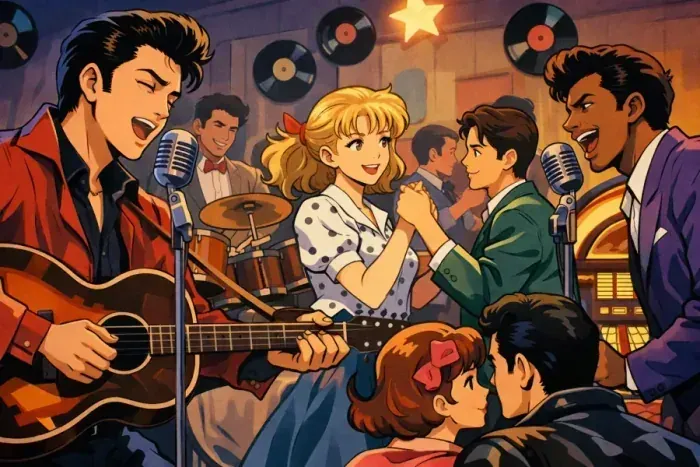
Songs That Defined How the Decade Felt
If artists give music its voice, songs give it memory. Even amid pressure and loss, the 1950s produced songs that often carried meanings far beyond their original context. A three-minute recording could capture a shift in values, a new way of speaking, or a feeling that had not yet found words elsewhere. Long before albums became dominant statements in popular music, songs functioned as cultural markers. They anchored moments of change in sound and language.
These songs mattered for more than sales or chart position. Some articulated youth and desire with a directness that felt new. Others offered intimacy and reflection at a time when emotional restraint was still widely expected. Still others carried subtext, expressing resistance, sorrow, or hope without direct confrontation.
Taken together, they work as social documents rather than isolated hits. Looking closely at lyrics, performance, and reception helps explain how a relatively small number of recordings came to define the emotional and cultural landscape of the 1950s.
Songs mattered in the 1950s because they traveled repeatedly through daily life. A record could appear on radio in the morning, in a jukebox by afternoon, and at a dance or in a bedroom by night. Repetition turned songs into shared reference points. People used them to mark relationships, moods, aspirations, and generational identity. The strongest songs did not merely succeed in the market. They became part of how listeners organized memory.
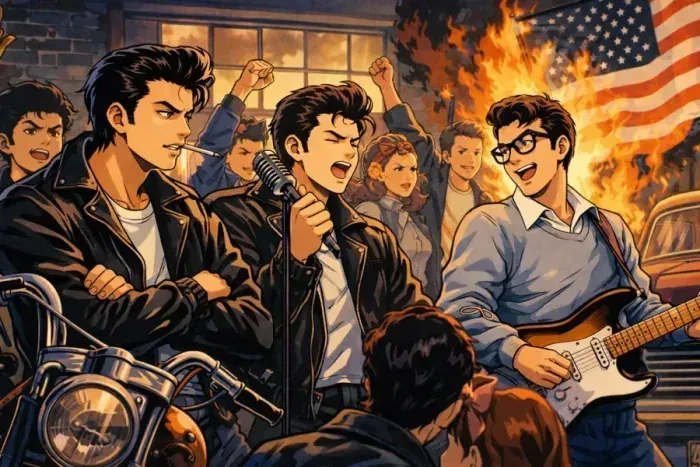
Teen Anthems and the Sound of Rebellion
Few themes defined the 1950s more visibly than the emergence of youth as a cultural force. Music was where this shift was heard most clearly. Songs about young love, restlessness, and independence spoke directly to listeners who were beginning to see themselves as distinct from their parents’ world. These recordings did not always articulate rebellion explicitly. Often, their power lay in tone, rhythm, and attitude rather than in overtly provocative lyrics.
One of the most influential examples was Rock Around the Clock by Bill Haley & His Comets. Its driving rhythm and simple structure made it immediately accessible, and by July 1955 it had reached number one on the pop chart, where it remained for eight weeks, while its appearance in Blackboard Jungle amplified its impact. The song’s success demonstrated that music aimed at young listeners could dominate national charts, challenging assumptions about who popular music was for.
Desire was another central theme. It was often expressed with a directness that unsettled older audiences. Little Richard brought exuberance and ambiguity to songs like Tutti Frutti. In his records, vocal delivery carried as much meaning as the words themselves. The performance invited physical response. It encouraged dancing and release. Its intensity suggested pleasure without apology, a sharp contrast to the restraint expected in much of public life.
Storytelling also played a key role. Chuck Berry captured teenage experience with precision, turning cars, classrooms, and romance into narrative settings. Songs such as School Day and Sweet Little Sixteen reflected everyday routines while hinting at broader desires for freedom and recognition. Berry’s lyrics did not reject society outright, but they reframed it from a youthful point of view.
Female perspectives were present as well, though often filtered through industry expectations. Songs performed by artists like Brenda Lee balanced vulnerability and confidence, expressing emotional intensity within acceptable boundaries. Her voice carried urgency that resonated with young listeners navigating similar feelings.
These songs normalized youthful emotion as worthy of attention. They treated teenage experience not as a phase to dismiss, but as meaningful material. Music became a space where desire and independence could be explored, even as they provoked debate. That shift opened popular music to voices that would keep reshaping it in the decades that followed.
Midnight Ballads and Private Feeling
Alongside the music of youth and outward energy, the 1950s produced a large body of songs that turned inward. These recordings spoke quietly about loneliness, regret, longing, and emotional complexity. They did not seek confrontation or spectacle. Instead, they invited listeners into private spaces, offering recognition rather than release. In a decade often remembered for optimism and surface confidence, these songs revealed the inner lives that existed beneath.
The rise of the long-playing album encouraged this mode of expression, but even individual songs could create an atmosphere of sustained reflection. Cry Me a River, performed by Julie London, became one of the decade’s most enduring statements of emotional distance and quiet defiance. Its restrained delivery and sparse arrangement allowed silence to carry as much weight as sound. Rather than pleading, the song conveyed hurt through composure, redefining strength as emotional control.
Male crooners explored similar terrain. Frank Sinatra transformed vulnerability into a defining artistic quality. Recordings such as In the Wee Small Hours of the Morning framed loneliness as a shared human condition rather than a private failure. Sinatra’s phrasing lingered on hesitation and pause, suggesting thoughts left unfinished. That approach resonated with adult listeners who recognized their own uncertainties in the music.
Intimacy also emerged through simplicity. Songs like Nat King Cole’s Unforgettable wrapped nostalgia and melancholy in gentle melody. Their appeal lay not in dramatic confession, but in suggestion. They turned memory into an emotional space, reminding listeners that longing could be tender rather than painful. Such songs often gained power through repetition, becoming companions rather than events.
Women brought particular depth to this reflective mode. Peggy Lee used understatement to express emotional ambiguity, allowing listeners to project their own experiences into her performances. Her recordings suggested that intimacy did not require exposure. It could exist in restraint, in what was held back rather than declared.
These songs of reflection expanded the emotional vocabulary of popular music. They made quiet feelings legible at a time when public culture favored confidence and control. By giving shape to loneliness and introspection, they offered listeners permission to acknowledge complexity in their own lives. Their endurance lies in that honesty.
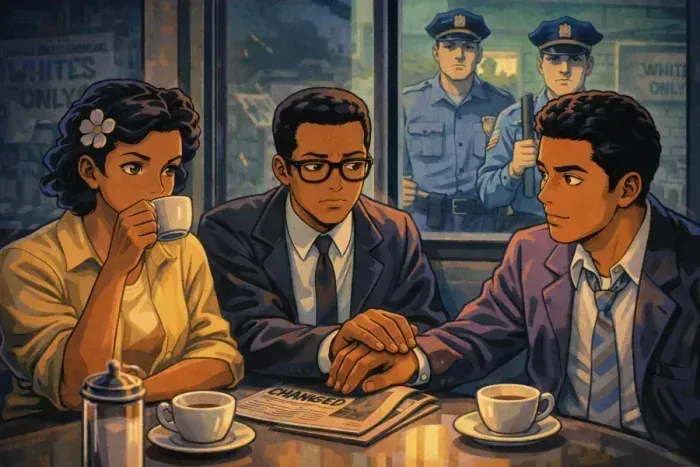
Quiet Resistance and Coded Expression
Not all resistance in the 1950s was loud or confrontational. In an era shaped by censorship, segregation, and strict social expectations, many musicians communicated dissent through implication rather than declaration. Songs carried layers of meaning that could be overlooked by casual listeners but understood clearly by those attuned to their context. That quiet resistance allowed artists to address injustice, pain, and survival without inviting immediate suppression.
One of the most powerful examples of subtext in American music came slightly earlier but continued to resonate throughout the decade. Strange Fruit, associated with Billie Holiday, remained a reference point for what music could confront, even when few were willing to follow openly. Its influence lingered in the way artists approached difficult subjects indirectly, using mood and tone to signal seriousness without explicit commentary.
Gospel music provided another avenue for coded expression. Songs rooted in faith often carried messages of endurance, hope, and eventual justice that resonated far beyond church walls. For Black listeners in particular, these themes reflected lived realities under segregation. When gospel-inflected styles entered secular music, they brought this emotional weight with them. The sound itself became a carrier of meaning, even when lyrics avoided direct reference to social conditions. "Gospel music gave people a way to say things that the world wouldn't let them say out loud."
Blues offered a similarly layered language. On the surface, many songs focused on personal hardship or romantic disappointment. Beneath that surface, they reflected economic struggle, displacement, and resilience. The repetition and insistence of blues forms emphasized endurance rather than resolution. That refusal to offer easy closure mirrored the ongoing nature of inequality. Listeners who shared these experiences heard their own lives echoed back, even when broader audiences missed the deeper resonance.
Jazz musicians, too, engaged in subtle forms of protest through structure and presentation. Complexity itself became a statement. By creating music that demanded attention and resisted simplification, artists asserted intellectual authority in a society that often denied it. Extended improvisation, unexpected harmonies, and collective interaction signaled autonomy. The music did not explain itself. It asked listeners to meet it on its own terms.
Quiet resistance in 1950s music was not passivity. It was a strategy shaped by necessity. Open protest carried serious risk, particularly for artists whose livelihoods depended on access to media and venues. By embedding meaning within sound, musicians preserved space for truth and reflection. Cultural change does not always announce itself loudly. Sometimes it moves through suggestion, persistence, and the refusal to be reduced to silence.
How the 1950s Gave Way to the 1960s
As the 1950s drew to a close, the decade’s influence was already spreading. The sounds that had once felt disruptive or controversial were becoming familiar and foundational. Rock and roll was no longer an intrusion. Jazz had secured artistic legitimacy. Pop had learned to speak in albums as well as singles. Most of all, audiences were listening to music differently and using it to define themselves more openly.
This transition was marked by tension rather than resolution. Some styles lost momentum as tastes shifted and industries consolidated. Others gained new urgency. Younger artists absorbed the lessons of the previous decade and pushed them in new directions. The structures built in the 1950s remained in place. That applied to recording practices and media control alike, though both were tested by new social movements and artistic ambitions.
What follows is less a sharp ending than a handoff. The line into the 1960s was shaped by continuity as much as contrast.
That handoff can be heard most clearly in the late years of the decade. By 1958 and 1959, the Hot 100 had simplified the language of chart success, television had made image management unavoidable, and labels were learning how to build longer careers out of youth markets rather than treating them as temporary novelty. At the same time, artists were already stretching beyond first-wave rock and roll formulas. Soul, modern country crossover, and more album-centered jazz pointed toward a broader and more segmented musical future.
What Was Fading by the End of the Decade
As the 1950s came to an end, certain sounds, images, and industry systems began to lose their hold. The change was gradual rather than abrupt. Musical styles that had once felt current started to sound formal or constrained to younger listeners whose expectations were changing quickly. The transition revealed how closely music was tied to its moment, and how even widely successful forms could feel dated within a few years.
The classic crooner era, while still respected, no longer occupied the cultural center it once had. Orchestral pop continued to appeal to adult audiences, but its emotional language felt increasingly tied to an earlier postwar mood. The intimacy and polish that had defined albums like In the Wee Small Hours now coexisted with a growing appetite for directness and experimentation. The shift did not diminish the artistry of these recordings, but it marked the end of their dominance as symbols of modernity.
Early rock and roll also faced limits. By the late 1950s, some of its first stars encountered career disruptions through military service, legal trouble, industry pressure, or changing public taste. The raw shock of the genre’s arrival had softened. What once provoked outrage was becoming familiar, even commodified. Television and film played a role in this process, smoothing edges and promoting safer versions of rebellion that fit established media frameworks.
Jazz experienced its own form of transition. While the genre had gained artistic prestige, its mainstream audience continued to shrink. Big bands were largely gone, and smaller ensembles appealed to more specialized listeners. Jazz was becoming a music of commitment rather than mass participation. That shift laid groundwork for future innovation, but it also marked the end of an era in which jazz had functioned as a common popular language.
Industry systems changed as well. The aftermath of the payola scandal led to tighter control over radio playlists and reduced influence for individual DJs. Corporate structures gained strength, and promotion became more standardized. Independent labels still mattered, but access to national exposure increasingly required alignment with larger institutions.
What ended in the late 1950s was not creativity, but a particular balance of forces. The decade’s music had thrived on porous boundaries between genres, informal networks, and rapid circulation. As these conditions shifted, so did the sound. The close of the 1950s reminds us that musical eras do not disappear because they fail, but because the world around them moves on, asking new questions that demand new answers.

What the 1950s Made Possible
While certain sounds and systems receded at the end of the 1950s, much of what the decade created carried forward with lasting force. The most obvious inheritance was artistic. Musicians entering the 1960s did not start from nothing. They absorbed the vocabulary, attitudes, and possibilities that had been established only a few years earlier. Rock and roll’s emphasis on rhythm, personality, and direct communication became a foundation rather than a provocation. Jazz’s turn toward artistic autonomy encouraged exploration rather than conformity. Pop’s growing confidence in the album format opened space for sustained expression.
Many artists bridged the transition directly. Ray Charles moved from gospel-inflected rhythm and blues toward a sound that would soon be recognized as soul, carrying forward the emotional intensity and structural daring developed in the 1950s. Miles Davis continued refining ideas introduced during the decade, pushing toward modal and eventually more experimental forms. These careers suggest continuity more than rupture. The future was built from within the decade, not imposed from outside it. Soul, in particular, emerged from the overlap of gospel feeling, rhythm and blues structure, and a stronger focus on personal testimony. Much of what would define the 1960s was already audible in late-1950s recordings.
Ideas also endured. The notion that popular music could express individual identity, rather than simply entertain, had taken hold. Teenagers were no longer a temporary market. They were a permanent audience whose tastes could reshape industries. The belief that records mattered as products and as documents of feeling and intention gained strength. Albums were increasingly treated as statements, even in genres that had once relied almost entirely on singles.
Industry structures, for all their flaws, also carried forward. Independent labels had demonstrated the value of proximity to artists and scenes, influencing how new companies approached development and production. At the same time, the consolidation of power in radio and major labels created conditions that artists would continue to challenge. Debates about ownership, credit, and control did not end with the decade. They became central to the music of the years that followed. The founding of Motown in Detroit in 1959 was one early sign of what would come next: a new model of Black-owned popular music enterprise with national ambitions.
Cultural attitudes shifted as well. The visibility of Black artists, women, and international performers in the 1950s did not resolve inequality, but it made exclusion harder to justify. Audiences had heard these voices and could not easily forget them. Expectations widened, even when progress remained uneven.
What carried forward from the 1950s was not a single sound, but a set of possibilities. The decade taught musicians and listeners that popular music could change quickly, speak honestly, and matter deeply. Those lessons shaped the creative confidence of the 1960s and beyond.
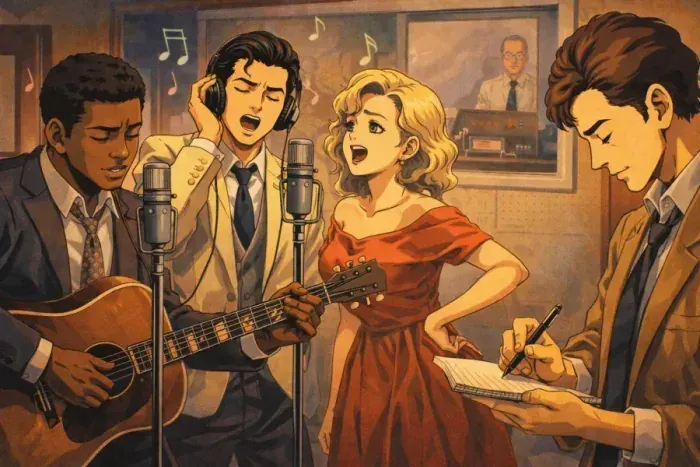
Crossover Covers and Unequal Credit
The crossover story of the 1950s was never only about sound. It was also about access, marketing, and who was allowed to carry a song into the most profitable parts of the mainstream. Black artists created much of the decade’s most influential music, but white performers often reached broader pop audiences faster because labels, radio programmers, and sponsors considered them more commercially acceptable. The result was a music economy in which innovation and reward did not move together.
Cover versions were central to this process. Performers such as Pat Boone recorded songs already associated with Black artists and presented them in forms designed to reassure white middle-class listeners. These recordings sometimes reduced rhythmic tension, toned down vocal intensity, or softened lyrical edges. They helped spread the music further, but they also made it easier for the industry to separate Black creativity from mass-market profit.
The picture was not entirely simple. Some original songwriters benefited from royalties when covers succeeded, and in some cases cover versions brought new attention back to the artists who recorded the songs first. Even so, the broader pattern remained unequal. Visibility, prestige, and long-term economic security tended to accumulate around the most marketable faces rather than the most original voices.
Several high-profile songs show how this worked in practice. Big Mama Thornton’s 1953 recording of Hound Dog established the song years before Elvis Presley turned it into a major pop event in 1956. Pat Boone built chart success from toned-down versions of rhythm and blues hits associated with artists such as Fats Domino and Little Richard. These records did not create crossover from nothing. They moved already proven Black musical ideas through whiter and more sponsor-friendly channels.
This system shaped how the decade was remembered later on. The issue went beyond the fact that certain performers were promoted more aggressively than others. The commercial structure of the 1950s often taught audiences to hear Black musical innovation through white intermediaries. That imbalance would continue to shape debates about ownership, influence, and authenticity long after the decade ended.
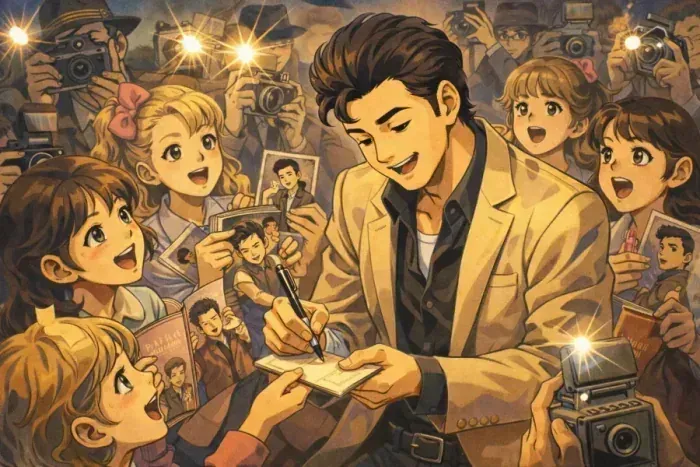
Teen Media and the New Star Machine
The teenage market of the 1950s was built through records, radio, and an expanding media ecosystem that taught young listeners how to attach themselves to artists. Publicity photos, fan clubs, television appearances, and teen-oriented magazine coverage turned singers into daily companions rather than distant celebrities. A favorite performer could now be followed across songs, interviews, fashion cues, and screen appearances, creating a new kind of emotional proximity.
Young women were especially important to this system. Their enthusiasm was often mocked by adults as superficial or excessive, yet it became one of the industry’s clearest signals of market power. Buying records, collecting photographs, writing fan mail, and discussing performers with friends all helped convert private feeling into commercial momentum. The idol economy of later decades was not invented from scratch; its foundations were already visible in the 1950s.
This media environment also changed how artists were managed. Record companies and promoters paid closer attention to hairstyles, clothing, facial expressions, and public behavior because these details now shaped sales as much as the music itself. Stardom became more continuous. It had to be maintained across multiple platforms, not simply earned in a recording studio or on stage.
The deeper shift was in listening itself. Music was no longer only a sequence of songs. It was increasingly tied to identity, fantasy, and the ongoing narration of a performer’s life. That model remains central to popular music culture today, from pop fandom to social media presence, and much of it traces back to fan habits first consolidated in the 1950s.
Television accelerated this system, but print and retail culture mattered too. Teen magazines, record sleeves, in-store displays, and fan-club newsletters taught audiences how to follow artists across media. Young listeners, especially girls, became careful readers of style, gesture, and public narrative. They were not passive consumers. They were active interpreters who helped decide which performers felt trustworthy, exciting, or worth defending. The later language of fandom has digital tools behind it, but its social logic was already visible here.
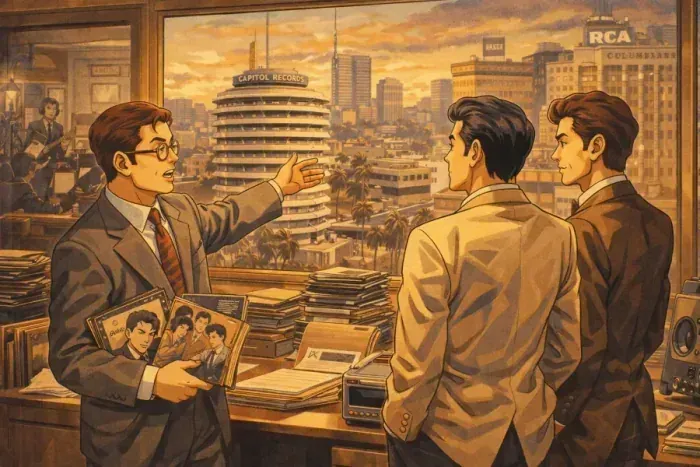
1959: The Industry Taking Shape
By 1959, many of the forces that would define the 1960s were already visible in outline. The decade had not ended in a neat stylistic handoff. Instead, several new business and creative models were beginning to form at once. Soul was emerging from gospel and rhythm and blues. The Nashville Sound was refining country crossover. Independent labels were showing how quickly they could build distinctive brands around regional scenes and tightly focused audiences.
Motown was one of the clearest signs of this next phase. Founded in Detroit in 1959, Berry Gordy’s company pointed toward a more integrated model of songwriting, artist development, production, and branding. It suggested that Black popular music could be presented with both artistic focus and national commercial ambition under Black ownership. That combination would become one of the most consequential developments of the next decade. "Hit-making was a learnable skill. You could teach someone to write a song, to arrange it, to produce it."
The mainstream industry was learning its own lessons from the 1950s as well. Labels wanted reproducible hits, stronger control over image, and more predictable routes from local success to national exposure. Television had made visual polish indispensable. Radio scandals had encouraged tighter oversight. The result was a more organized and more powerful industry, but also one increasingly shaped by formulas that artists in the 1960s would test and resist.
The year 1959 therefore reads almost like a blueprint. Ray Charles’s What’d I Say pointed toward soul and a looser, more visceral relationship between gospel feeling and secular recording. Miles Davis’s Kind of Blue showed how far the jazz album could move from dance music toward concentrated listening. Motown’s founding suggested that artist development, songwriting, branding, and Black ownership could be combined within a single ambitious enterprise. These were not isolated events. Together, they sketched the next decade’s musical map.
Seen this way, the end of the 1950s looks less like a conclusion than a consolidation. The key institutions of modern popular music were coming into focus: youth marketing, cross-platform stardom, highly managed labels, and genre systems flexible enough to absorb constant change. The decade left behind songs, business models, and listening habits that would last well beyond the 1950s.
Why the Decade Still Matters
The 1950s didn’t just produce memorable songs. They changed the conditions under which popular music exists. Before this decade, styles rose and fell, audiences shifted, and technologies evolved. Yet the basic relationship between music, society, and identity remained relatively stable. The 1950s disrupted that balance by turning popular music into a site of cultural tension, personal expression, and social negotiation all at once.
One reason the decade endures is that it established patterns we still recognize: the separation between youth and adult markets, the central role of media exposure, and the importance of image alongside sound. Even contemporary debates about authenticity, ownership, and representation have roots in structures built at mid-century. Many of the questions artists face today are refinements of those first posed when records began moving faster than institutions could adapt.
The 1950s also matter because of whose voices were heard, and whose struggles were revealed. Black musicians reshaped popular music while navigating segregation and exploitation. Women carved out space in an industry that praised their voices but limited their authority. International artists challenged the idea of music as a national possession. These dynamics did not resolve themselves, but they became visible. Even partial visibility changes what can be ignored.
Listening to 1950s music today offers more than historical curiosity. The recordings remain emotionally direct—often because they were made under conditions that demanded clarity and commitment. Technical limits encouraged focus. Social pressure sharpened expression. Songs were built to communicate quickly and honestly, whether through exuberance, sorrow, or quiet resistance. That directness still resonates in a world saturated with sound.
The decade also matters because it reminds us that change is rarely clean or comfortable. The music of the 1950s carried contradictions: freedom alongside inequality, innovation alongside control, joy alongside exhaustion. Those tensions did not weaken its legacy. They gave it depth.
The 1950s stand less as a finished chapter than as a starting point. They mark the moment when popular music became a central language of modern life, capable of carrying identity, conflict, and connection across generations. That role has never disappeared.
The playlist that follows turns that argument into a listening path. It moves from roots to crossover, from intimacy to rebellion, and from local scenes to global circulation.
It also helps correct the decade’s simplified public image. The 1950s are often reduced to a few familiar icons or a single story about rock and roll breaking through. The fuller record is wider and more uneven. It includes church music, club music, orchestral pop, border-crossing records, overlooked women, working musicians, and artists whose influence was felt more clearly later than in their own moment. Keeping that range in view is part of why the decade still matters.
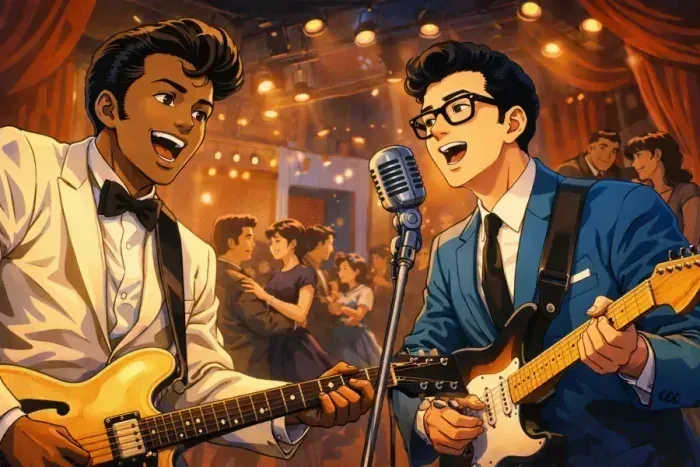
50 Songs That Shaped a Decade
The music of the 1950s transformed popular culture at a fundamental level. Rock and roll emerged as a disruptive force, rhythm and blues crossed social boundaries, jazz evolved into a modern art form, and pop music learned to express intimacy and emotional depth. The playlist below follows that story in sequence, tracing the decade from its gospel, blues, and jazz foundations to the global sounds that helped set up the 1960s. Most entries are 1950s releases, but a few late-1940s recordings remain because they continued to shape the decade’s sound. Each artist appears only once.
The sequence is meant to be read as well as heard. The early entries foreground the roots that fed the decade. The middle sections follow the rise of R&B, rock and roll, harmony groups, and adult pop. The later sections show how jazz modernized, how country and global currents remained active, and how the line into the 1960s was already becoming audible by the end of the decade. It is not a list of the only important songs. It is a guided path through the article’s main argument.
I. Roots & Foundations: Gospel, Blues, and Jazz
This opening group centers the traditions that fed the decade before rock and roll took over the headlines. It begins with sacred intensity, moves through urban blues weight, and arrives at modern jazz as an art of concentration and risk.
- Mahalia Jackson – Move On Up a Little Higher (1947)
- Sister Rosetta Tharpe & Marie Knight – Up Above My Head I Hear Music in the Air (1948)
- Muddy Waters – Hoochie Coochie Man (1954)
- Howlin’ Wolf – Smokestack Lightning (1956)
- Billie Holiday – Lady Sings the Blues (1956)
- Thelonious Monk – Blue Monk (1954)
- Charles Mingus – Goodbye Pork Pie Hat (1959)
II. Rhythm Rising: R&B Takes Over
These records show rhythm and blues becoming sharper, bolder, and harder for the wider market to ignore. They also make clear how much of the decade’s later crossover energy was already present in Black popular music.
- Ruth Brown – Mama, He Treats Your Daughter Mean (1953)
- LaVern Baker – Tweedlee Dee (1954)
- Big Mama Thornton – Hound Dog (1953)
- Bo Diddley – Bo Diddley (1955)
- Fats Domino – Blueberry Hill (1956)
- Ray Charles – What’d I Say (1959)
III. Rock and Roll: The Explosion
This section follows the first wave of rock and roll as it turned local excitement into a national argument. The songs combine backbeat force, teenage storytelling, and performers whose public presence was as disruptive as the music itself.
- Bill Haley & His Comets – Rock Around the Clock (1954)
- Elvis Presley – Heartbreak Hotel (1956)
- Chuck Berry – Johnny B. Goode (1958)
- Little Richard – Tutti Frutti (1955)
- Jerry Lee Lewis – Great Balls of Fire (1957)
- Buddy Holly – Peggy Sue (1957)
IV. Teen Dreams: Harmony and Heart
Here the focus shifts from rebellion to closeness, vulnerability, and the social life of young voices singing together. Harmony groups made teenage feeling audible in a way that felt communal rather than solitary.
- Frankie Lymon & The Teenagers – Why Do Fools Fall in Love (1956)
- The Platters – Only You (1955)
- The Drifters – There Goes My Baby (1959)
- The Coasters – Yakety Yak (1958)
- The Everly Brothers – Bye Bye Love (1957)
V. Late-Night Magic: Intimacy and Elegance
These songs represent the decade’s quieter center: adult pop, torch songs, and records built for private listening rather than public shock. They show how much emotional depth the 1950s could hold outside its loudest styles.
- Julie London – Cry Me a River (1955)
- Peggy Lee – Fever (1958)
- Ella Fitzgerald & Louis Armstrong – Summertime (1958)
- Frank Sinatra – In the Wee Small Hours of the Morning (1955)
- Nat King Cole – Unforgettable (1951)
- Tony Bennett – Rags to Riches (1953)
- Doris Day – Que Sera, Sera (1956)
VI. Country Roads: Stories of the Heart
Country remained one of the decade’s most durable narrative forms. These tracks move from honky-tonk plainspokenness to crossover polish while keeping heartbreak, work, and regional identity close to the surface.
- Hank Williams – Cold, Cold Heart (1951)
- Lefty Frizzell – If You’ve Got the Money I’ve Got the Time (1950)
- Johnny Cash – I Walk the Line (1956)
- Patsy Cline – Walkin’ After Midnight (1957)
- Wanda Jackson – Fujiyama Mama (1957)
VII. Modern Jazz: Sound as Art
By the end of the decade, jazz had become one of the clearest examples of the LP era’s listening culture. These recordings highlight restraint, harmonic invention, and the move toward albums and performances that asked for focused attention.
- Miles Davis – So What (1959)
- Dave Brubeck – Take Five (1959)
- Chet Baker – My Funny Valentine (1953)
VIII. Global Voices: Music Without Borders
The final group widens the frame beyond the United States without leaving the decade’s main story behind. It brings in Europe, Latin music, calypso, British skiffle and rock, and artists whose careers already pointed toward a more international pop world.
- Édith Piaf – Padam… Padam… (1951)
- Domenico Modugno – Nel blu dipinto di blu (Volare) (1958)
- Harry Belafonte – Day-O (The Banana Boat Song) (1956)
- Tito Puente – Ran Kan Kan (1955)
- Pérez Prado – Cherry Pink and Apple Blossom White (1955)
- Lonnie Donegan – Rock Island Line (1956)
- Cliff Richard & The Drifters – Move It (1958)
- Dean Martin – Memories Are Made of This (1955)
- Eartha Kitt – C’est Si Bon (1953)
- Brenda Lee – Sweet Nothin’s (1959)
- Sam Cooke – You Send Me (1957)
This playlist works as a narrative companion to the article, presenting the music of the 1950s not as isolated hits, but as a connected cultural story shaped by emotion, innovation, and social change.