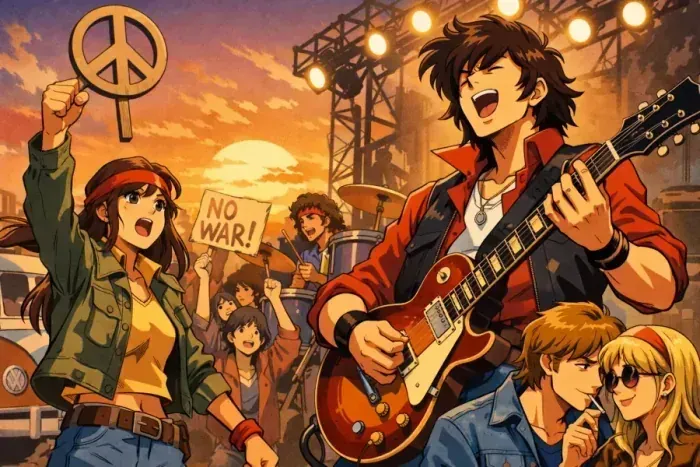
Why the 1970s Still Matter
When people talk about 1970s music, they usually jump to the loudest images: stadium tours, double albums, disco lights, and punk provocation. Those images matter, but they can hide the decade’s real starting point. The early 1970s felt unsettled. The optimism that had shaped so much late-1960s music had weakened, politics looked less trustworthy, and many listeners were less interested in grand promises than in how to get through everyday life.
That mood changed the sound of popular music. Songs became more private. Albums asked for more time. Artists were less likely to present themselves as spokespeople for a whole generation and more likely to speak in a narrower, more personal voice. Even when the music grew bigger, it often carried strain underneath the confidence.
The point of this decade is not that one style replaced another. It is that popular music stopped moving in one obvious direction. The 1970s opened into many parallel scenes at once, and that is why the decade still feels so modern.
That is also why the decade can seem contradictory when heard quickly. It contains some of the most intimate mainstream songwriting of the twentieth century and some of the most grandiose. It contains music built for solitary repeat listening and music built for clubs, arenas, and block parties. It contains artists fighting labels for more control and labels consolidating more power at the same time. The 1970s make the most sense when they are heard as several pressures unfolding at once, not as one clean stylistic story.
That larger tension is part of why the decade still sounds current. Modern listeners are used to a fragmented musical world in which scenes overlap, platforms separate audiences, and artists move between intimacy and spectacle almost by default. The 1970s did not create every aspect of that situation, but they made its basic shape audible much earlier than many retrospective histories admit.
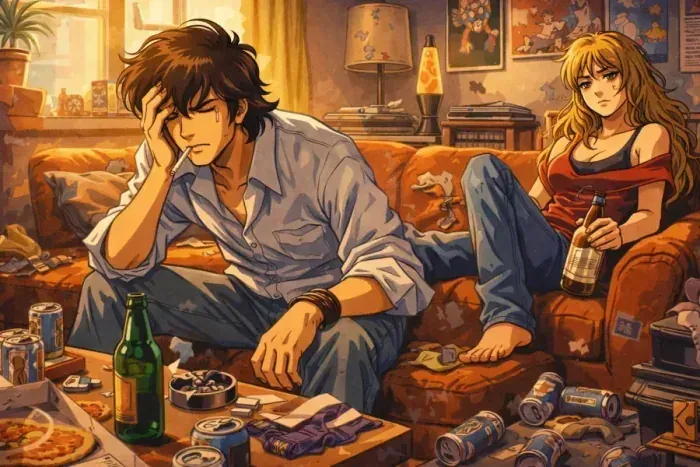
The Morning After: Life After the 1960s
The move from the late 1960s into the early 1970s was not a clean handoff. It felt like a drop in pressure after years of expectation. The Vietnam War continued, the Watergate scandal would soon deepen public distrust, and inflation and recession made daily life less secure. Musicians and audiences did not stop caring about public life, but they often stopped sounding as if history were moving in one clear direction.
The chronology matters here. The Watergate break-in happened on June 17, 1972, and Richard Nixon resigned on August 9, 1974. The oil shock of late 1973 and the recession that followed made economic insecurity harder to ignore. Popular music did not respond with one uniform message, but the broader climate made it harder for musicians to speak as if the future were still moving toward one common goal.
That change is easy to hear in songwriting. Instead of broad declarations, many artists shifted toward fatigue, doubt, and lived detail. Neil Young could move from political anger to exposed personal writing in the same period. Bob Dylan drifted further away from the role of public spokesman and toward harder-to-pin-down storytelling. The music still carried weight, but it no longer depended on slogans.
You can also hear the change in the use of hesitation. Lyrics leave more room for doubt, small detail, and unresolved feeling. What might have sounded evasive in the late 1960s could now sound honest. Doubt stopped feeling like a temporary interruption on the way to certainty and started feeling like part of reality itself.
At the same time, the idea of one dominant youth culture started to break apart. Folk, soul, hard rock, funk, glam, and early electronic music were not answering the same question. Some listeners wanted comfort. Others wanted movement, confrontation, or escape. That split did not make popular music smaller. It made it harder to summarize.
Groups like Crosby, Stills, Nash & Young sit right on that fault line. Their harmonies still carried traces of the late 1960s, but the songs were more likely to dwell on strain than on collective purpose. The early 1970s sound like a culture trying to adjust its expectations, and that honesty gave the decade much of its force.
That is why the early 1970s matter so much for the rest of the decade. Once certainty lost its old prestige, artists could turn inward, outward, or toward pleasure without having to pretend they were all serving the same public mission. The splintering that defines the 1970s begins here.
It is also where a different relationship to time begins. The early decade sounds slower, more hesitant, and often more observant because artists were no longer racing toward a single horizon of change. They were learning how to write from inside aftermath, and that made detail matter more than proclamation.
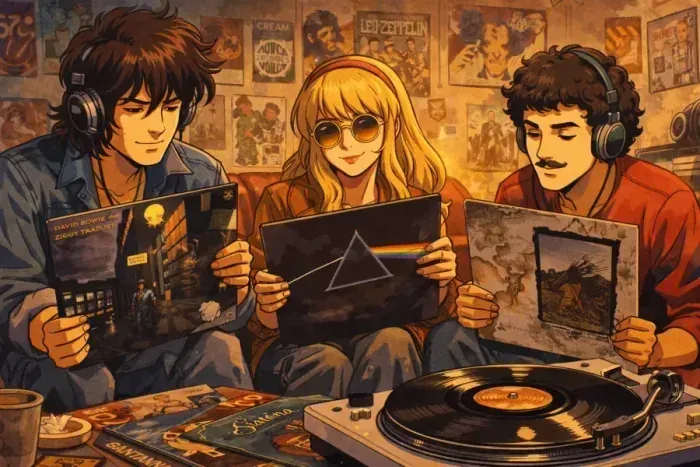
The Album as the Decade's Main Statement
One of the biggest shifts in the early 1970s was the rise of the album as the main unit of meaning. Singles still mattered, but more artists wanted room to build mood, sequence ideas, and let songs speak to one another. The LP was no longer just a container for hits. It was increasingly treated as the work itself.
That shift depended on how people listened. FM radio offered better sound and more room for longer tracks than AM radio. In the United States, free-form FM gradually gave way to album-oriented rock formats, which still favored the LP over the standalone single. Home stereos also mattered. Listening became more deliberate, more domestic, and often more private.
This was a material change as much as an artistic one. The LP had existed for years, but by the 1970s it had become the main format for sustained listening in rock, soul, and many adjacent styles. Better home audio systems made stereo detail more audible, and FM’s higher fidelity helped programmers move listeners toward deeper cuts, longer songs, and stronger album identity.
Albums like Marvin Gaye’s What’s Going On and Joni Mitchell’s Blue still feel complete for that reason. Their power is not only in individual songs, but in pacing, contrast, and emotional buildup. Pink Floyd and Stevie Wonder pushed the same format in different directions, using the album to hold together experimentation, argument, and atmosphere.
Sequencing became part of the craft. The first track could establish a world, middle tracks could complicate it, and quieter songs could gain force because they were heard in relation to what came before and after. The LP rewarded artists who understood contrast as well as melody.
It also changed what it meant to be a listener. Buying a record meant living with it. You learned the quieter tracks, not only the obvious ones. The decade is remembered through huge singles, but much of its real weight sits in albums that unfold slowly.
Records also became objects to study, lend, collect, and debate. That album-centered habit helped create a more sustained kind of musical criticism and a more durable relationship between audiences and artists. Much of modern music culture still assumes that level of attention.
The material object mattered here in ways that streaming-era listeners can easily forget. Gatefold sleeves, liner notes, cover photography, lyric sheets, and side breaks all shaped how a record was understood. The album was not only a bundle of songs. It was also a designed encounter, something to read, hold, replay, and argue over with other people.
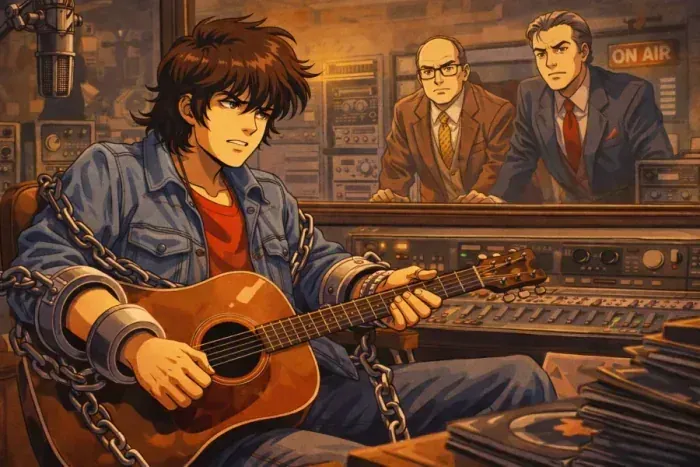
The Industry Tightens Control
As artists stretched out, the business side of music tightened. In the early 1970s, major labels grew larger and gained more control over distribution, promotion, and radio access. Bigger budgets and better studios gave some musicians real opportunities, but the same system also concentrated power in fewer hands.
This was part of a wider shift in entertainment and media. Recording, promotion, national distribution, and tour support were becoming harder for smaller companies to match. Large labels could coordinate radio campaigns, press, retail placement, and studio time at a scale that made success look bigger but also made dependence on the majors harder to avoid.
Long contracts usually favored the label, not the artist. If a record sold, support could look generous. If it did not, that support often vanished quickly. Executives such as Clive Davis could help build careers, but they could also steer them toward safer and more marketable forms. Guidance and control often arrived together.
This is one reason the decade’s freedom was always uneven. A proven seller might be granted space to experiment, but artists without leverage often discovered that “development” had strict commercial limits. The industry could fund ambition while still trying to shape its acceptable form.
Motown shows the tension clearly. Berry Gordy’s system had created major stars, yet by the 1970s artists like Marvin Gaye and Stevie Wonder were pushing for more authority over lyrics, production, and image. Their success made artistic freedom look possible, but only for artists with unusual leverage.
What’s Going On is a useful turning point because the conflict was visible. Motown hesitated at first because the material sounded too political, too inward, and too unlike the label’s usual hit model. When the record succeeded, it proved that album-scale seriousness could work commercially, but it did not remove the underlying struggle over control.
Producers sat in the middle of this system. Some protected the artist’s vision. Others translated between musicians and executives. Quincy Jones is a strong example of someone who could expand a record without draining the person out of it. But that balance was not normal, and the unevenness was sharper for women and for artists of color, who were often judged more quickly as commercial risks.
That is one of the decade’s central paradoxes. Industry concentration helped finance some of the most ambitious music of the period, but it also made access to that ambition more conditional. The 1970s sound expansive partly because so much money moved through them. They also sound tense because that money came attached to power.
This tension shows up across genres, not only in rock. Soul artists fought for production control, disco scenes were mined for crossover success, country performers challenged Nashville polish, and punk built its own alternatives in reaction to the same centralized logic. The industry’s structure is part of the story no matter which musical path you follow through the decade.
Rock Turns Inward: The Singer-Songwriter Movement
Early-1970s rock was not only getting bigger. It was also getting more private. A large group of artists stepped away from public declarations and wrote more directly about relationships, loneliness, disappointment, and self-doubt. The records still sold in huge numbers, but the emotional pitch changed.
Part of the surprise was how ordinary the subject matter could be. A failing relationship, an awkward silence, a private regret, or the fear of emotional exposure could now anchor a major record. This was not niche confession. It was mainstream music treating small-scale experience as culturally serious.
That inward turn was not a retreat from seriousness. It was a different way of being serious. Instead of claiming to speak for everyone, singer-songwriters spoke in the first person and let uncertainty remain visible. The songs often did not solve anything. They made listeners feel recognized.
This also changed the performance ideal. A singer no longer had to appear prophetic or larger than life in the old way. A more conversational voice, a quieter arrangement, or an emotionally exposed lyric could now carry authority.
This worked especially well in the album era. These records asked for attention, sequence, and mood. They set a new standard for authenticity in rock, one built less on public certainty than on emotional precision.
That standard lasted because it changed what later artists could assume. By the middle of the decade, introspection no longer needed to apologize for itself. It had become a credible center of popular songwriting.
The commercial success of that writing mattered too. Once intimate records started selling at a very high level, they stopped looking like a niche alternative to “real” rock ambition. The marketplace itself had to acknowledge that reflection, fragility, and domestic-scale storytelling could sit at the center of popular music rather than at its edge.
That shift also changed radio and criticism. Quiet songs, reflective albums, and exposed voices no longer had to be treated as minor or transitional forms on the way to something bigger. For a substantial part of the decade, they were the bigger thing.
Intimacy as Revolution: Carole King and James Taylor
The singer-songwriter boom did not appear out of nowhere. It grew out of exhaustion with the public weight that popular music had carried in the late 1960s. For many artists, writing about one relationship, one doubt, or one private failure now felt more honest than trying to speak for an entire generation.
That did not make the writing apolitical. It changed the scale at which politics entered the song. Historical pressure was now more likely to appear through fatigue, hesitation, domestic strain, or the fear of emotional exposure than through direct proclamation.
Carole King’s Tapestry is a clear example. When it came out in 1971, it did not announce itself as a revolution. It won people over through calmness, precision, and emotional clarity. Songs like “It’s Too Late” and “So Far Away” stay close to everyday feeling, which is part of why the record landed so hard. It made intimacy sound commercially strong rather than small.
Its scale mattered as much as its tone. Tapestry did not become influential only because critics admired it. It became one of the defining commercial albums of the era, which meant the industry itself had to take seriously the idea that understatement, domestic detail, and emotional patience could hold a mass audience.
King’s background as a Brill Building songwriter also mattered. She arrived with craft, not with a myth of raw discovery. That gave Tapestry a different authority. The record showed that pop professionalism and exposed feeling were not opposites. They could deepen each other.
James Taylor worked a similar vein with a softer edge. His early-1970s records did not push at the listener. They settled in. The relaxed tempos and careful phrasing made the songs feel addressed rather than projected. In a period of public fatigue, that steadiness carried real weight.
That sense of address mattered. Taylor’s songs often sound as if they are trying to keep a human scale intact inside a culture getting louder, faster, and more brittle. They offered comfort, but not false resolution.
The style also depended on how these artists presented themselves. They were not selling heroism. Joni Mitchell is the sharpest example. On Blue, she does not clean up regret, longing, or misreading after the fact. She leaves them exposed. That refusal to simplify is a large part of why the record still feels alive.
There was risk in that kind of writing. The more closely a song stayed to lived experience, the harder it became to separate the work from the person. Some critics dismissed the music as too inward or too private. But that judgment now looks limited. These records widened the idea of what seriousness could sound like in popular music.
Singer-songwriters did not leave rock behind. They changed its emotional center of gravity. After them, vulnerability no longer sounded marginal. It sounded central.
That change reached far beyond this scene itself. Later pop, alternative rock, folk, and adult-oriented songwriting all inherited some version of the singer-songwriter assumption that direct feeling could be artistically serious without becoming grandiose.
The movement also broadened who counted as a credible rock author. A songwriter could be soft-spoken, musically restrained, even visibly uncertain, and still command a large audience. That broke open a performance model that had previously rewarded certainty and public scale above almost everything else.
Women Claim Their Voice
The singer-songwriter story is still told too often through a handful of men. But many of the decade’s strongest claims to authorship came from women working against an industry that still preferred them as interpreters. Writing your own songs was not only an artistic choice. It was also a fight over who got to define female experience in public.
This mattered financially as well as artistically. Songwriting brought publishing control, not just prestige, and it made it harder to reduce a woman performer to image, voice, or market category alone.
Carly Simon helped make that shift visible. Her songs could be sharp without becoming defensive, and “That’s the Way I’ve Always Heard It Should Be” addressed marriage, expectation, and independence with a directness mainstream pop did not usually grant women. Her success showed that reflective writing by women could reach a large audience without being softened into something safer.
Simon’s importance also lies in her point of view. Her songs often let women observe, question, and pull away rather than simply react. That stance widened who could occupy the song’s intellectual center.
Laura Nyro had less commercial security but just as much ambition. Her writing pulled from soul, jazz, and pop in ways that asked for close listening and did not fit neat marketing categories. Musicians heard how important she was even when the business side of music did not know what to do with her.
Nyro’s career is useful because it shows how influence and visibility do not move together. She helped shape the musical imagination of the period without being rewarded by the market at the same level as some of the artists who learned from her.
Judee Sill shows the fragility of that space even more starkly. Her songs brought together religious imagery, technical sophistication, and personal difficulty without making any of that easy. Admiration did not turn into durable support. That gap between critical respect and institutional protection was not unusual for women in the period.
The common thread here is authorship, not style. They wrote from experience without trying to smooth away discomfort, contradiction, or embarrassment. In doing so, they expanded what mainstream popular music could hold and who was allowed to speak with that kind of authority.
They also changed the expectations of listeners. Once audiences heard women writing with this degree of control and emotional exactness, it became harder to pretend that female authorship was exceptional or secondary.
That change did not remove the bias, but it did alter the listening ground. Women writers were no longer rare interruptions to a male narrative of seriousness. By the middle of the decade, they were among the people most clearly redefining what intelligence, intimacy, and musical authority could sound like.
That broader change in listening also fed later industries. Once female authorship became more audible at the center of popular music, it became harder for labels and critics to pretend that women belonged mainly in the role of singer, muse, or commercial interpreter. The resistance stayed real, but the ground under it had shifted.
Regions, Class, and the Shape of Song
As singer-songwriter music spread, it stopped sounding like one unified mode. Place mattered. In the United States especially, region and class shaped the kind of inwardness a song could carry and the kind of future it seemed to imagine.
The point is not that every region had one sound. It is that geography left different pressures on the writing. Songs from Los Angeles, New York, Nashville, or Texas could use similar materials and still imagine success, work, romance, and risk very differently.
On the West Coast, especially around Los Angeles, songs often sounded polished on the surface but uneasy underneath. Jackson Browne is a good example. His writing stays close to ambition, disappointment, and self-scrutiny, even when the music feels open and sunlit. In that world, success is visible, but it never sounds fully secure.
That contrast became one of the region’s signatures. The production can feel warm and wide, yet the songs themselves keep circling fatigue, self-knowledge, and the pressure to hold a life together.
East Coast writers often carried more obvious social pressure in the songs. Billy Joel, for instance, kept returning to working- and middle-class life, family expectation, and money. Even as he grew more successful, he rarely wrote as if ordinary life had become a myth he had escaped.
That grounding in practical pressure matters because it keeps the writing tied to labor and social mobility rather than only to interior mood. The songs stay close to compromise.
Country widened the picture again. Loretta Lynn and Dolly Parton wrote directly about work, marriage, ambition, and dignity, while Willie Nelson and Waylon Jennings pushed back against the industry polish of the Nashville Sound. Their records were less confessional in tone than some coastal singer-songwriter albums, but they were just as invested in autonomy, place, and resistance to formula.
Country is essential here because it shows that authorship in the 1970s was not limited to rock’s vocabulary. Lynn and Parton could be blunt about labor, motherhood, marriage, and self-respect in ways mainstream pop often still avoided. Outlaw country turned control over sound and image into a regional fight against standardization.
These regional differences also changed instrumentation and pacing. West Coast records often used spacious production and easy surfaces to hold unease. East Coast writing could sound more compressed and practical. Country and Southern scenes held tighter to work rhythms, vernacular detail, and public roles shaped by region rather than bohemian detachment.
These differences were not only regional style. They were also class feeling. Across scenes and genres, songs kept circling back to instability, practical pressure, and the gap between making art and making a living. That is one reason so much 1970s writing resists heroic self-mythology. It stays close to strain.
Seen this way, the singer-songwriter decade is less a single style than a map of social position. Similar instruments could carry very different assumptions about money, community, marriage, work, and escape depending on where the song was written from and which audience it expected to recognize itself in it.
Rock Goes Big: Stadiums, Concepts, and Excess
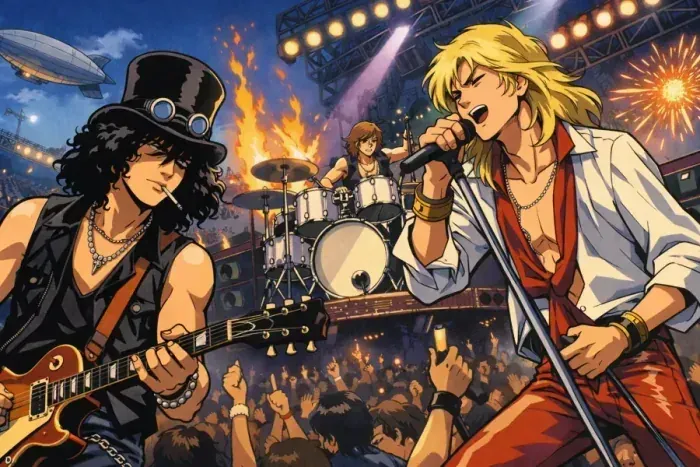
While some artists turned inward, others pushed rock toward scale. Albums got longer, concerts moved into arenas, and more musicians treated rock as a form that could carry large ideas, technical display, and theatrical ambition. This was partly a matter of technology and money, but it was also a change in belief. Rock no longer had to present itself as raw or provisional.
That belief had visible consequences. Lighting rigs grew more elaborate, live sound became more powerful, and the concert itself started to function less like a club performance and more like a staged event. Audiences were not only buying songs. They were buying entry into a total scale of experience that rock had not possessed in quite this way a decade earlier.
That growth brought excitement and backlash at the same time. Some listeners loved the size of it. Others felt the music was drifting away from intimacy and toward institutional self-importance. Both reactions were reasonable. The 1970s are full of records that sound restless, curious, and overextended all at once.
This is one reason debates about authenticity became so sharp in the period. Was ambition expanding the art form, or simply inflating it? Did virtuosity deepen feeling, or replace it? Those questions were not abstract. They shaped how audiences, critics, and later musicians sorted the decade’s music into admiration, suspicion, and backlash.
What mattered is that rock was testing its limits in public. Sometimes that produced masterpieces. Sometimes it produced bloat. Either way, it changed the scale on which popular music could imagine itself.
It also changed what later reactions would have to reject. Punk, post-punk, and various indie cultures all define themselves in part against this expansion. To understand their anger, you have to hear just how large and self-confident rock had become.
This expansion also altered the economics of being a rock band. Bigger stages, longer records, and more elaborate touring raised the cost of participation and made rock feel more professionalized. That professional scale produced some extraordinary work, but it also made exclusion easier to hear.
It changed audience behavior as well. Going to a major rock show increasingly meant buying into an event structure with distance built into it: assigned seats, higher ticket costs, larger crews, more visible hierarchy between performer and crowd. That was part of the appeal for some listeners and part of the problem for others.
Progressive Rock: When Ambition Met Complexity
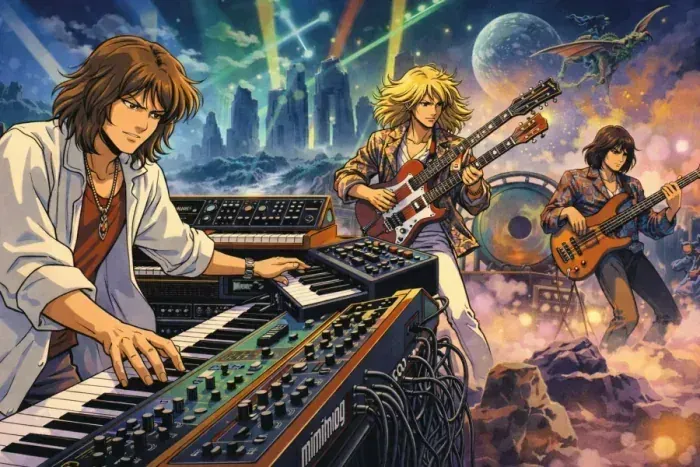
Progressive rock was one of the clearest expressions of 1970s ambition. Its musicians did not accept the idea that a rock song had to stay short, direct, or structurally familiar. They borrowed from classical music, jazz, theater, and literature and treated the album as the natural home for long forms and recurring ideas. Fans heard freedom in that approach. Critics often heard pretension. Both reactions were built into the music.
The form itself encouraged a new kind of listening discipline. Themes could recur across a whole side of an LP. Instrumental passages could stretch far past radio length. A listener was expected to stay with tonal shifts, changing time signatures, and narrative detours that did not resolve immediately. Progressive rock did not merely ask for attention. It asked for patience and trust in structure.
Pink Floyd shows why the style mattered so much. On The Dark Side of the Moon and Wish You Were Here, studio design, lyrical themes, and sequencing all work together. These albums do not feel like collections of songs. They feel built. Their subjects, time pressure, alienation, absence, and mental strain, also fit the decade unusually well.
Their success also matters because it proved that this scale of construction could reach a mass audience. The Dark Side of the Moon was not an isolated cult triumph. It became one of the central commercial records of the decade, which meant the market itself had to make room for unusually cohesive and slow-unfolding work.
That reach helps explain why progressive rock became such a lightning rod. It was not only a niche for dedicated musicians. It became visible enough that listeners who disliked it had to confront it as one of the main public faces of 1970s rock ambition.
Genesis took progressive rock in a more theatrical and literary direction. Albums like Selling England by the Pound use character, satire, and surreal shifts in mood to register British anxiety about class, change, and national identity. The music can sound playful and deeply uneasy at the same time.
Yes pushed harder toward precision and virtuosity. Close to the Edge is full of technical difficulty, but the point was not difficulty alone. The band was testing how far rock structure could stretch before it turned into something else. For some listeners that felt liberating. For others it felt sealed off.
That tension between invitation and exclusion stayed with the genre. Progressive rock could sound like intellectual generosity to people who wanted complexity, and like a closed world to listeners who heard the same detail as distance. Both responses were part of its history.
What links these bands is not one sound, but one assumption: rock could keep expanding. Progressive rock asked listeners to stay with complexity instead of treating it as a flaw. That made the genre influential, and it also made the later backlash almost inevitable.
Its influence lasted even where its prestige did not. Later art rock, metal, soundtrack music, and certain forms of ambitious pop all inherited progressive rock’s comfort with sequence, texture, and long-form construction even when they avoided the “prog” label itself.
Led Zeppelin, Sabbath, and the Birth of Heavy
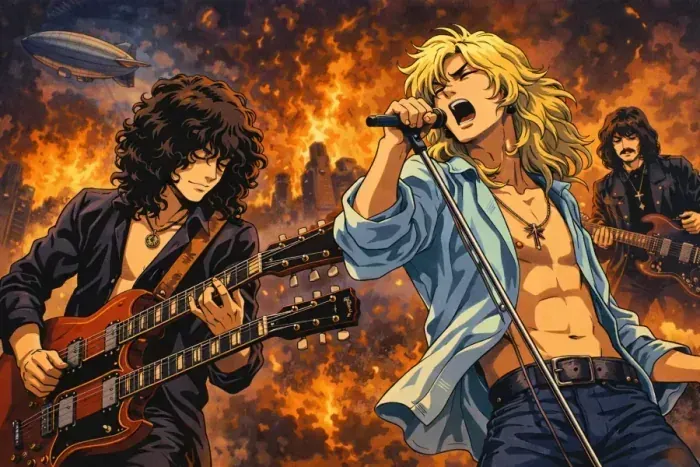
Rock also got heavier. As progressive rock moved toward complexity, hard rock and early metal pushed toward force, impact, and repetition. This music did not ask listeners to decode an elaborate concept before responding. It hit first. In a decade marked by social and economic strain, that physical directness mattered.
The shift was sonic and bodily at once. Volume, riff repetition, and slowed-down weight created a kind of pressure that listeners could feel in the chest as much as hear in the head. Hard rock and metal turned amplification itself into part of the meaning.
Led Zeppelin pushed blues-based rock to a new scale. Their records mixed riff weight, acoustic space, mythic imagery, and long dynamic builds. Led Zeppelin IV is the obvious example, but the larger point is that the band made heaviness feel vast rather than narrow. They also helped define how big a rock audience could become.
That breadth is important. Zeppelin could move from acoustic introspection to sheer force inside the same record, which helped teach audiences that heaviness was not a minor mode of rock but one of its most elastic forms.
Deep Purple moved with more overt virtuosity. The conversation between guitar and organ, the speed of the playing, and the clean attack of songs like “Smoke on the Water” gave hard rock a version of technical confidence that stayed immediate instead of turning abstract.
Black Sabbath took the music somewhere darker. Their early records are full of slow, crushing riffs and a sense of dread that had little precedent in mainstream rock. The surface imagery could look occult or theatrical, but the emotional core is closer to war, industrial collapse, dread, and bodily vulnerability. That is a large part of why Sabbath mattered so much. They did not only make rock heavier. They gave heaviness its own emotional grammar.
That grammar would outlast the band itself. Later metal scenes would change the speed, production, and visual codes, but the basic idea that weight, repetition, and dread could carry serious emotional content remains one of Sabbath’s most durable contributions.
Heaviness also tracked the decade’s industrial mood. The music often sounded urban, smoky, and overburdened even when the lyrics stayed indirect. In that sense, early metal gave form to a wider environment of pressure without needing explicit policy language to do it.
Many critics heard this music as crude or excessive. Audiences heard something else: pressure, fear, power, and release made audible. Hard rock and early metal widened popular music by proving that intensity could be expressive on its own terms.
That is why these records aged so well for later listeners. Once the moral panic and genre snobbery fall away, what remains is an unusually clear lesson in how sound itself can carry social feeling. Heavy music did not need refined surface to say something serious. The weight was the statement.
Southern Rock: Regional Pride, Grit, and Contradiction
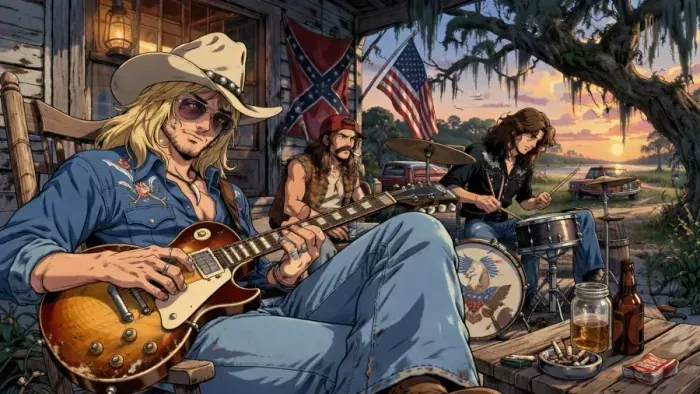
Southern rock offered another regional answer to the decade’s widening map of rock. It drew on blues, country, boogie, and hard rock, but what gave it force was its sense of place. Memory, working life, local pride, and the political contradictions of the American South all sat inside the music.
That sense of place mattered because the South was not a neutral symbol in the 1970s. The region carried the afterlife of segregation, fights over memory and identity, and a strong myth of local authenticity. Southern rock could sound communal and rooted while also carrying unresolved politics inside it.
The Allman Brothers Band brought improvisation and blues fluency to that frame. Their long, patient performances could stretch outward without losing contact with a specific regional feel. Lynyrd Skynyrd was more declarative. Their music turned Southern identity into a public stance, mixing pride, grievance, swagger, and defensiveness in a way that made the band both hugely popular and politically difficult to reduce.
That difference between the Allmans and Skynyrd is useful. One route moved through fluid musicianship and a broad Southern mood. The other made identity itself part of the public message. Together they show how region could be atmosphere in one band and argument in another.
That tension is part of why Southern rock matters. The genre showed that fragmentation did not mean weakness. Rock in the 1970s no longer had one accent, one class position, or one regional story. Southern rock made that impossible to ignore.
It also revealed how unstable “authenticity” could be as a public claim. Southern rock bands could present themselves as close to the land, the road, or ordinary working life while still participating in the same expanding commercial machinery as everyone else. That contradiction is part of the genre’s historical interest.
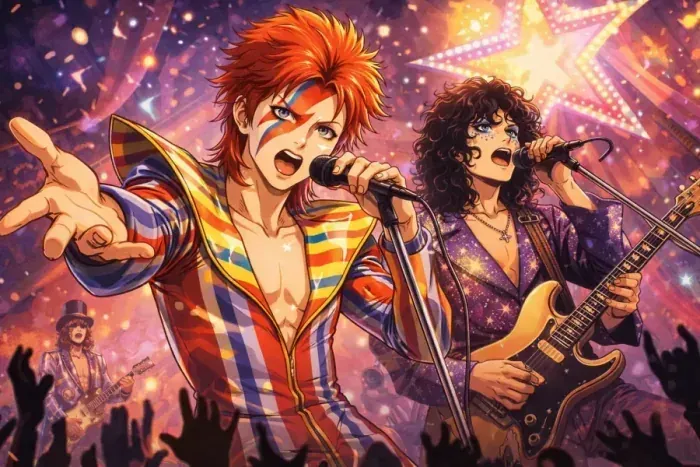
Glam Rock: Bowie and the Theatrical Revolution
If hard rock emphasized force, glam rock emphasized transformation. Glam treated identity as something made, staged, and revised in public. The clothes, makeup, posture, and theater were not extras around the music. They were part of the argument. In that sense, glam challenged rock’s old investment in naturalness and conventional masculinity.
That challenge was stronger in Britain because questions of class performance, style, and social mobility were already so visible in public life. Glam made artificiality legible rather than trying to hide it. It turned style into content.
David Bowie made that clearest. Ziggy Stardust was not just a character placed on top of the songs. The performance was the meaning. Albums such as The Rise and Fall of Ziggy Stardust and the Spiders from Mars blurred fact and fiction to deal with fame, desire, alienation, and self-invention. Bowie showed that honesty in rock did not have to come from plain confession. It could also come through artifice.
That move changed later pop as much as later rock. It suggested that persona was not necessarily the enemy of truth. A deliberately constructed image could expose aspects of desire, fear, or instability that plain autobiographical writing might never reach. "If there wasn't someone who was going to use rock & roll, then I'd do it."
Marc Bolan and T. Rex gave glam much of its pop drive. The songs were compact, catchy, and rhythmic, but they arrived with exaggerated style and playful self-consciousness. That made glam feel open rather than academic, even while it pushed against old ideas of how a male rock performer was supposed to look and act.
The gender politics here were not always simple or uniformly liberating, but they were still destabilizing. Glam made it harder to pretend that stage identity was natural, unchosen, or politically neutral. That alone changed the language of popular performance.
Roxy Music took the style in a more art-school direction. Their records fused rock, electronic texture, irony, and design-minded presentation. In Britain, where questions of class, decline, and modernity were everywhere, glam’s artificiality did not feel empty. It felt diagnostic.
Glam was often misread by critics who equated seriousness with restraint. But its embrace of ambiguity changed rock for good. It widened what could appear onstage and made identity itself part of musical expression. The growth of 1970s rock was not only about scale. It was also about performance, gender, and the freedom to look deliberately made.
That legacy reaches far beyond the acts usually filed under glam. Later pop stardom, new-wave stylization, gender play in alternative scenes, and the broader acceptance of persona as artistic method all owe something to the 1970s decision to make self-invention visible rather than hide it.
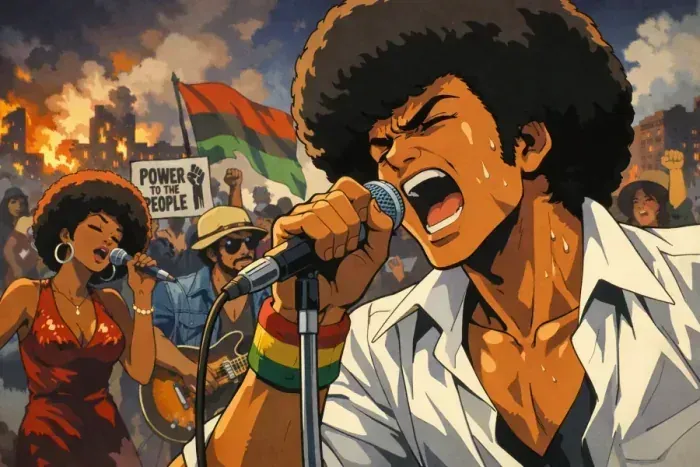
Soul Evolves: From Heartbreak to Revolution
Soul entered the 1970s with deep authority and growing impatience. By then, civil rights victories had not produced economic equality, and many Black artists no longer wanted to stay inside a narrow commercial script of romance and uplift. The music needed more room for anger, grief, doubt, faith, and political thought.
The timing mattered. Soul had already been one of the central public sounds of the civil rights era, so the question was not whether it could carry social weight. The question was whether the industry around it would allow that weight to become more openly complex and less easily packaged.
That is one reason the album mattered so much in soul. Artists used it to connect private feeling with public reality instead of pretending those were separate worlds. A record could move from war to love, from spiritual searching to neighborhood pressure, without breaking its emotional logic.
The decade also sharpened the fight for control. Singers wanted more say over lyrics, sequencing, production, and visual identity. Soul in the 1970s was not only a sound. It was part of a broader struggle over who got to define Black life in public.
That struggle helps explain why album-scale soul feels so consequential. These records were not only making aesthetic claims. They were also contesting who had authority to shape the public emotional and political image of Black experience.
This is one reason 1970s soul feels both intimate and civic at once. It rarely separates the household, the church, the street, and the state as neatly as mainstream criticism once preferred. Private feeling and public structure keep leaking into one another.
That leakage is part of the genre’s realism. Love songs, family pressure, spiritual searching, urban hardship, and institutional violence were not separate topics in ordinary life, so soul increasingly stopped pretending they belonged in neatly separate musical compartments.
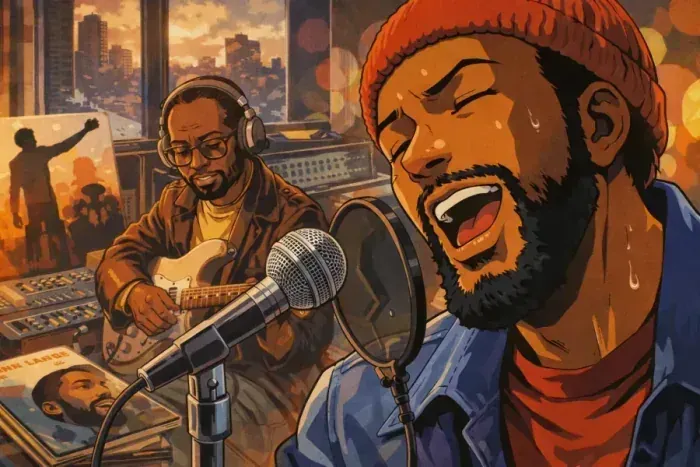
Marvin Gaye, Curtis Mayfield, and the Concept Album
In the early 1970s, several Black artists pushed directly against the limits labels had placed on soul and R&B. For years, executives had favored singles, softened messages, and kept major creative decisions close to the top. That arrangement started to crack when artists demanded more control over lyrics, production, sequencing, and image. The album became one of the main forms through which that struggle played out.
What’s Going On is the clearest example. Released in 1971, it broke sharply with Motown’s hit-first logic. The album moves as one connected work through war, policing, poverty, environmental damage, faith, and everyday exhaustion. Marvin Gaye sings with unusual softness, but the record is not gentle in its implications. Motown hesitated because the material did not fit the label’s usual crossover strategy. Its success showed that a mass audience would stay with a more reflective, more openly troubled kind of soul.
A similar push shaped Curtis Mayfield’s work. His soundtrack for the 1972 film Super Fly is still one of the decade’s sharpest records about seduction, exploitation, and constraint. The film could be read as glamorizing the drug trade. Mayfield’s songs sound far less seduced by that world. They are stylish, but they are also wary and morally alert.
These albums point to a larger change in how Black artists understood their public role. The concept album made room for contradiction instead of smoothing experience into a clean commercial mood. Faith, pride, frustration, skepticism, tenderness, and social anger could sit inside the same work. That felt closer to lived reality than the managed optimism many labels had preferred.
The fight for control was never only about lyrics. It also touched production, sequencing, cover art, and the right to shape a full project rather than deliver isolated songs. Listeners heard the difference. Soul albums could now feel less like product lines and more like sustained arguments about dignity, identity, and power.
That larger shift also changed the authority of the singer. A voice was no longer only the carrier of songs chosen elsewhere. Increasingly, it could be heard as the center of an entire aesthetic position, one that stretched from message and arrangement to mood, sequencing, and visual framing.
This mattered for listeners because it changed how credibility worked. Soul albums could now be heard not simply as collections of performances, but as coherent statements shaped by a specific moral and emotional perspective. That made the form feel closer to testimony than to routine product.
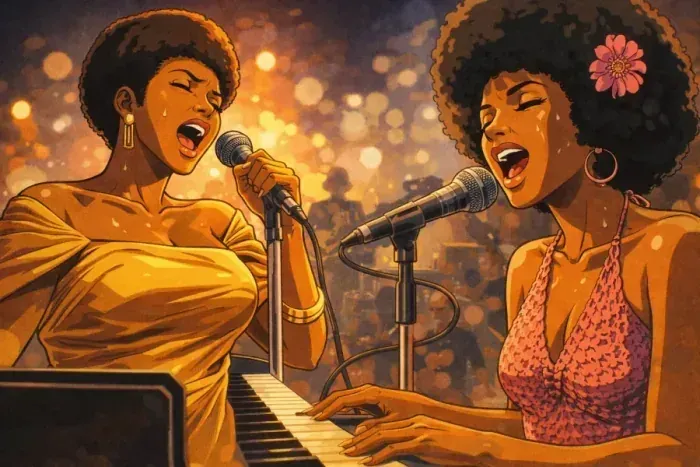
Aretha, Roberta, and Minnie: Soul's Leading Ladies
Women were central to soul in the 1970s, but they still worked under tighter limits than many male peers. As men gained public credit for album-scale authorship, women were often expected to provide emotional depth without gaining the same control over image, schedule, or long-term narrative.
Aretha Franklin began the decade already established, yet her 1970s work kept widening. Young, Gifted and Black and Amazing Grace move across political, spiritual, and personal ground without strain. Franklin did not need constant reinvention to hold authority. She already had it. But her career also shows how often women were expected to carry certainty for the audience even when the culture around them was unsettled.
Roberta Flack offered a very different kind of force. Her records are built on restraint, detail, and control. “The First Time Ever I Saw Your Face” and “Killing Me Softly with His Song” do not overpower the listener. They narrow the emotional field until small shifts feel enormous. That quietness was sometimes misread as passivity, which says more about the critical frame than about the work.
Minnie Riperton faced a related problem. She is still too often reduced to the fact of her range, as if the voice were the whole story. But records like Perfect Angel are carefully shaped, warm, and musically exact. The industry’s tendency to hear her first as a novelty shows how limited its categories could be.
What links these artists is not only talent, but negotiation. Women in soul were allowed to be emotionally open while still being denied full control over the story told around them. Even under those conditions, they expanded the genre’s range and showed that power in soul did not have to arrive in the same form that men had already been allowed to use.
Their different approaches mattered to listeners because they widened the emotional and formal map of soul at once. Franklin could sound monumental, Flack microscopic, and Riperton luminous without any of them occupying a lesser register of seriousness.
That diversity inside women’s soul performance is important because it resists a very limited story about vocal power. Strength did not have to mean volume, and refinement did not have to mean passivity. These artists gave the genre more than representation. They gave it new scales of intensity.
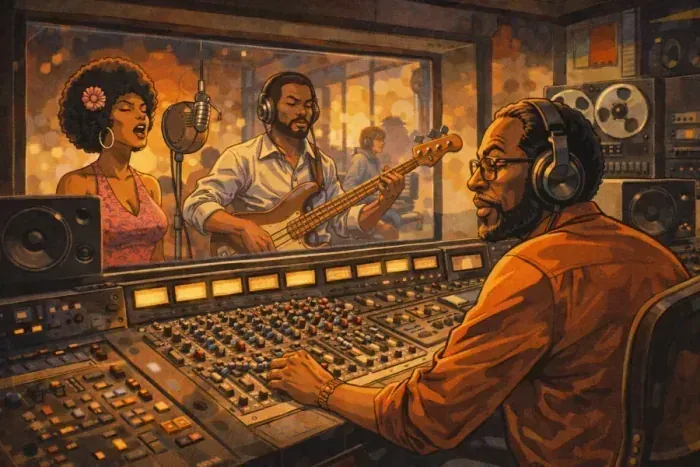
Shaping Soul from the Studio
As soul grew more ambitious, producers and arrangers became harder to treat as background figures. They were shaping not only sound quality, but the emotional and structural logic of the records. At their best, they helped an artist sound more fully like themselves. At their worst, they reproduced the same hierarchy artists were already trying to escape.
This is important because 1970s soul rarely rests on voice alone, even when the vocalist is overwhelming. Strings, horns, rhythm section choices, vocal layering, and studio space all help determine how authority, tenderness, urgency, or release are heard.
Quincy Jones is a good example of production used well. His records from the decade are clear, balanced, and unusually attentive to how a voice sits inside an arrangement. He knew how to frame a singer without crowding them and how to organize musicians around a shared feel without sanding away individual character.
Philadelphia soul offers another model. Through Kenneth Gamble and Leon Huff, the city developed a polished but deeply rhythmic sound in which strings, horns, and groove could support songs that were political, romantic, or built for the dance floor. That balance helped shape mainstream soul and pointed directly toward disco.
Thom Bell was just as important to that language. His arrangements gave records sweep, pace, and emotional contour. Session players mattered no less. Their often uncredited labor created textures that tied songs together across labels and artists, which is one reason authorship in 1970s soul is never a simple story.
To hear this music fully, you have to listen beyond the lead voice. The arrangement is part of the argument. So are pacing, texture, and ensemble feel.
That is also why these records traveled so well between radio, home listening, and club space. The production carried enough detail for close listening, but the rhythmic design kept the songs socially legible in public settings too.
In practical terms, this meant soul could keep moving across spaces without losing identity. A record could feel intimate on headphones, persuasive on radio, and still function physically in a club. That flexibility helped explain the genre’s central place in the decade.
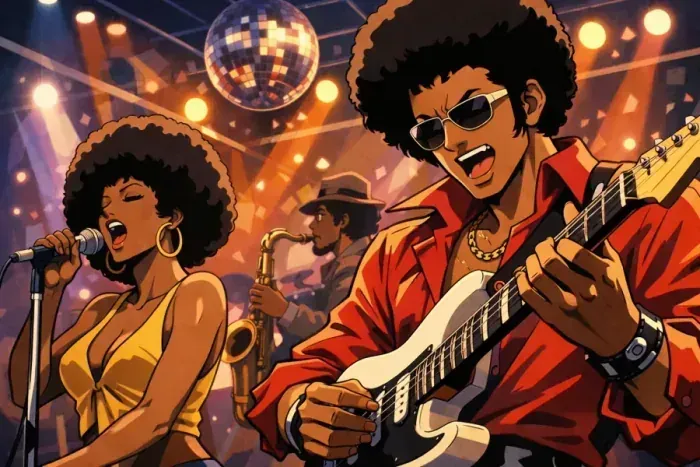
Funk: When the Beat Became the Message
Soul often moved through testimony and reflection. Funk answered with rhythm. It pushed melody and harmonic development to the side and made the groove the main event. Bass, drums, guitar, and horns locked together so tightly that the beat itself became the point.
That shift can sound simple on paper, but it was radical in effect. It changed the center of musical attention. Instead of following a melody line or a lyrical arc first, listeners were pulled into interlocking parts and bodily timing.
That was not a lesser form of seriousness. It was a different one. Funk gave people something physical and collective to hold onto at a moment when public life often felt unstable. The groove was not decoration. It was structure.
Funk also changed the social picture of a band. Even with a strong front person, the music depended on interdependence. You hear a group making time together, and the audience is pulled into that logic almost immediately.
That collective pressure is one reason funk would matter so much later to DJs, producers, and sample-based music. The groove already sounded modular, repeatable, and socially charged.
Funk also redistributed attention within the song. A bass figure, guitar scratch, or drum pattern could become the real event. That change taught later listeners and producers to hear rhythm sections not as background support, but as the place where the record’s identity actually lived.
This also altered how bodies listened. Funk trains attention downward and outward at the same time. You hear the song through your feet and your timing as much as through melody or verbal message. That was a major shift in what mainstream popular music expected from its audience.
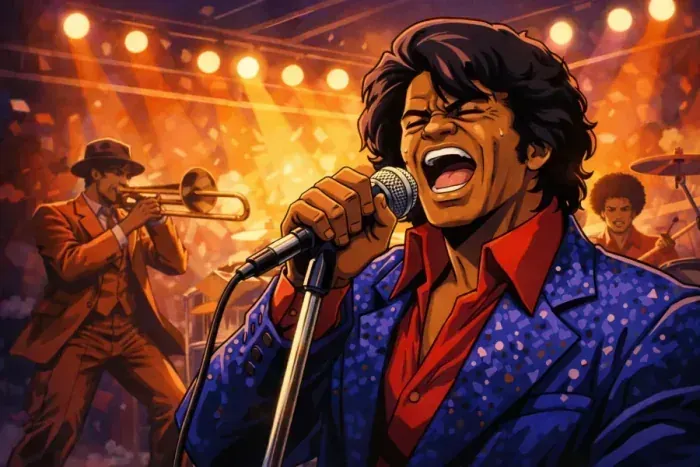
James Brown: The Man Who Changed Rhythm Forever
Funk did not start in the 1970s, but James Brown is one of the main reasons it took such a clear shape there. By 1970 he had already rewritten basic assumptions about rhythm in soul and R&B. Melody moved back. Harmony became punctuation. The groove took command.
Brown’s influence went beyond his own songs. He reorganized the band around rhythmic function. Bass pushed forward, guitar worked like percussion, and horns stopped behaving like carriers of melody and became part of the attack. The result was tightly drilled and volatile at the same time.
That emphasis on timing mattered socially as well as musically. Brown’s bands ran on discipline, but the groove still depended on collective execution. Everyone had to hear everyone else. The audience was pulled into that system too. Funk was not music for passive distance. It wanted a bodily answer.
The durability of Brown’s language became obvious later. The downbeat, the break, the clarity of repeated parts, all of that became foundational to hip-hop. What once sounded minimal to some critics turned out to be an enormous musical resource.
His influence also spread because the records were built for reuse. The breaks felt clear, portable, and structurally decisive. DJs did not have to invent their importance. Brown’s records were already teaching people where the energy of the track was concentrated.

Parliament-Funkadelic: George Clinton's Universe
If James Brown gave funk its grammar, George Clinton widened its imagination. Through Parliament and Funkadelic, he turned the style into a whole world of jokes, science fiction, spectacle, and social thought. This was a very different kind of order from the disciplined snap of earlier funk, but it was still order.
Mothership Connection and One Nation Under a Groove did more than collect songs. They built a mythology. On the surface, the world could look playful, absurd, even chaotic. But the larger move was serious. Clinton refused the idea that Black identity in popular music had to be framed only through pain, uplift, or realism. Fantasy, pleasure, and excess were part of the politics.
Musically, Parliament-Funkadelic thickened everything: overlapping voices, dense rhythm, synthesizers, unstable jams, and shifting personnel. Even with Clinton’s unmistakable presence, the music often feels collective rather than singular.
The live shows pushed that even further. The Mothership landing onstage turned the concert into a shared event rather than a one-way display. Where arena rock often created distance, Parliament-Funkadelic tried to swallow the room whole.
That is why the group mattered so much beyond funk itself. They refused to split pleasure from meaning. Later hip-hop would borrow their sound, but also their sense that building a world around the music could be part of the work.
Parliament-Funkadelic also showed that black futurist imagination could function as a mass popular language rather than a niche avant-garde strategy. The costumes, slogans, and mythology were playful, but they also created a durable public space for reinvention.
That matters because Clinton’s universe offered abundance in a decade still defined by many forms of scarcity. The fantasy was not escapist in a shallow sense. It was a way of claiming pleasure, technology, and theatrical excess as legitimate grounds of Black public expression.
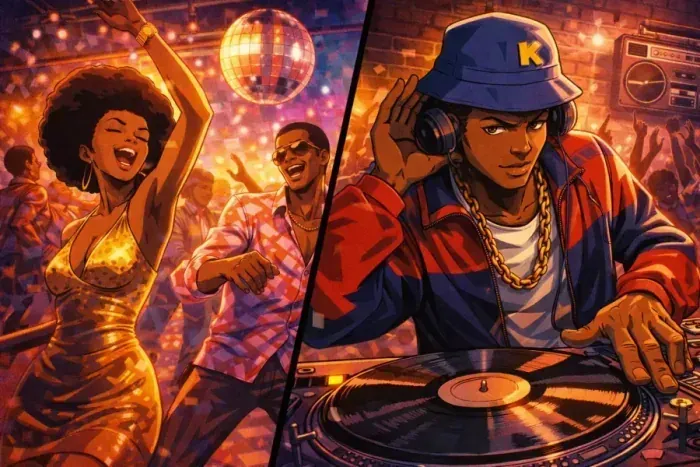
Funk's Legacy: From Disco to Hip-Hop
By the mid-1970s, funk was no longer only a genre. It had become a method. Its ideas about rhythm, repetition, and shared energy moved outward into other parts of popular music because they were structural, not ornamental.
The repeating parts, heavy low end, and strict rhythmic logic made funk unusually easy to reuse. As recording technology improved, those features became ideal material for looping, editing, and recombination. That process started before hip-hop fully stabilized, but it would become one of hip-hop’s deepest inheritances.
Funk also shaped disco, dance music, and later electronic forms by proving that groove could organize collective feeling without a heavy narrative burden. The song did not have to explain everything. The beat could carry social meaning on its own.
Just as important, funk offered a different picture of creativity. It emphasized interdependence over solitary genius, even if the reality was often messier than the ideal. That orientation mattered for later scenes built around crews, DJs, bands, producers, and shared infrastructure. Funk’s legacy is not only a sound. It is a way of thinking about how music works in public.
That is why funk keeps resurfacing whenever later genres need both movement and structure. Its lessons are practical. Build from the bottom, trust repetition, and let collective timing carry meaning that words do not need to explain.
In that sense, funk’s legacy is less about nostalgia than about method. Whenever producers, bands, or DJs need a model for how repetition can stay alive rather than flatten out, they keep finding their way back to the decade’s funk grammar.

Disco: The Revolution on the Dance Floor
Disco is still too often reduced to a cliché of glitter, fashion, and empty excess. That picture misses the point. Disco mattered because it created social space, especially for Black, Latino, and LGBTQ+ communities that were often excluded or policed elsewhere.
It also mattered because it relocated musical authority. The central figure was no longer necessarily the singer or band on a stage, but the DJ shaping time, sequence, and room energy in relation to the crowd.
Its center was the club, not the concert stage. DJs shaped the room. Long tracks and extended mixes held the beat steady instead of pushing toward a single peak. That continuity let dancers stay inside the music and inside one another’s presence. Disco was not a decorative side story to the 1970s. It was one of the decade’s clearest forms of collective release and belonging.
Its move into the mainstream brought money and visibility, but it also stripped away some of the social context that had made the culture so meaningful. The backlash later in the decade makes far more sense once that context is restored.
Disco also changed the emotional logic of popular music. Instead of treating release as a single dramatic chorus or guitar climax, it often built release through continuity, temperature, and duration. The floor was kept open rather than punctured.
That is why disco history becomes distorted so easily when it is told only through film, fashion, or caricature. Without the club context, the music can look decorative. Inside the club context, it looks infrastructural.
It also looks more technically innovative. Continuous mixing, longer edits, sound-system thinking, and producer attention to texture were not side details. They were part of disco becoming one of the main laboratories for later dance culture.
From Clubs to Charts: Disco's Roots
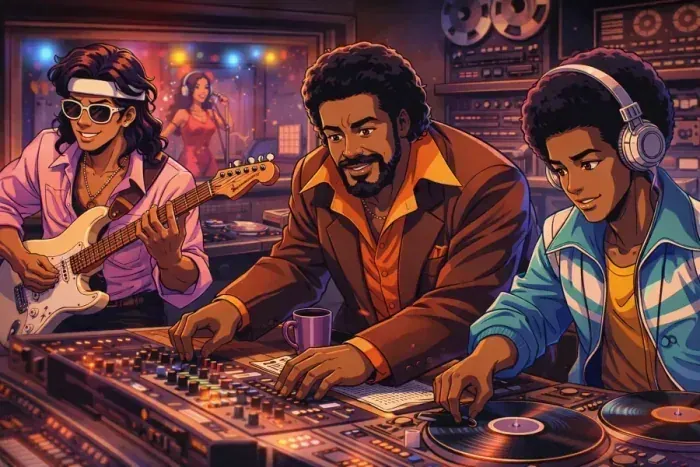
Disco did not begin as a commercial genre with a neat star system. It grew in clubs where the point was not to face a stage, but to enter a room together. Black, Latino, and LGBTQ+ communities helped shape those spaces, not just as audiences but as the people who made the social meaning of the night. Dancing mattered, but so did being present somewhere on your own terms.
The timing mattered too. After the Stonewall uprising began on June 28, 1969, gay liberation entered public life with more force, and nightlife in New York carried a different political charge. Clubs were never free from police pressure or exclusion, but they still offered a kind of collective visibility that many people could not find elsewhere. Disco grew inside that tension.
Disco also changed the center of attention. In rock, the eye usually moved toward the stage. In disco, the dance floor mattered more. The DJ shaped the night by linking records into a continuous flow instead of presenting songs as isolated events. The goal was not a single dramatic peak. It was immersion.
David Mancuso’s Loft parties helped define that approach. Sound quality, trust, and the room’s social atmosphere mattered more than spectacle or status. Records moved according to the crowd rather than according to a promoter’s script. That sounds simple, but it was a real reordering of musical authority.
Larry Levan would later sharpen that logic at the Paradise Garage. He treated the DJ as a builder of emotional sequence, adjusting pace and intensity in real time. In that setting, records were not fixed statements. Their meaning changed through placement, timing, and how they moved a room full of people.
Musically, disco kept funk and soul’s rhythmic force but adapted it for longer stretches of dancing. Steady bass, regular drums, orchestral sheen, and vocals used as atmosphere as much as narrative all helped the music stay in motion. Before disco was branded or mocked, it was a social practice of repetition, belonging, and shared release. That history matters if the later backlash is going to make sense.
The 12-inch single was crucial to that development. Longer versions gave DJs more room to build nights and gave producers a format that rewarded structure, breakdown, and mix clarity rather than just radio brevity. Disco was not only a style of songs. It was also a format culture.
That format culture changed business expectations too. A record could matter in clubs before it dominated radio, and DJs could help decide what spread outward. The route from scene to market was still unequal, but it was no longer controlled only by the old single-release model.
Bee Gees, Chic, and the Mainstream Explosion
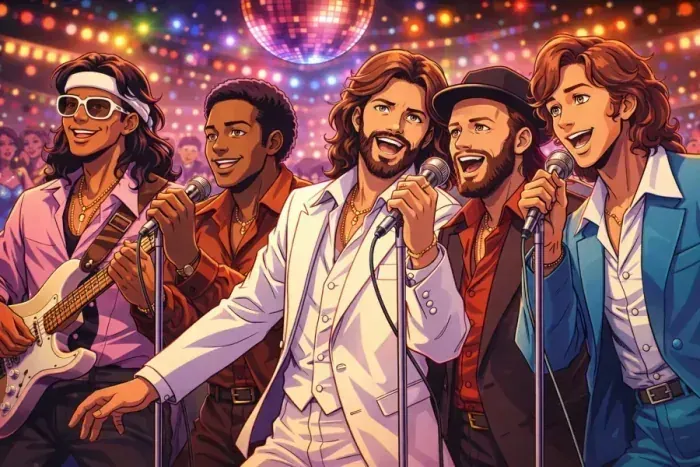
Disco began as a scene and then became a mass language. That shift depended on studio technology, producer power, and an industry eager to turn club energy into records, radio play, and film.
Giorgio Moroder was central to that shift. His work with Donna Summer, especially on “I Feel Love,” pushed disco toward a more synthetic and futuristic sound. The pulse is exact, the texture immersive, and the repetition almost architectural. It pointed toward electronic dance music long before that label settled.
Chic took another route. Nile Rodgers and Bernard Edwards fused funk precision with pop clarity so completely that songs like “Le Freak” and “Good Times” sounded effortless even though they were built with great care. Their records proved that disco could become hugely popular without turning rhythm into something generic.
The Bee Gees and Saturday Night Fever made disco visible on a completely different scale. The soundtrack and the film turned the style into a global image in which music, fashion, dance, and nightlife all collapsed into one polished story. That visibility brought in millions of listeners, but it also cleaned up disco’s origins and made the culture easier to package.
As disco spread, local scenes changed it. Some producers leaned into synthesizers and tight European precision. Others kept the music closer to orchestration, percussion, or funk. That flexibility was part of disco’s power.
This flexibility is why disco cannot be reduced to one texture. Philadelphia elegance, Munich machine pulse, New York club continuity, and crossover pop polish all sat under the same umbrella while still carrying different assumptions about space, body, and audience.
But the mainstream breakthrough was also a turning point. The bigger disco became, the more it risked losing contact with the communities and rooms that had given it meaning in the first place.
Disco Demolition: When Success Brought Hate
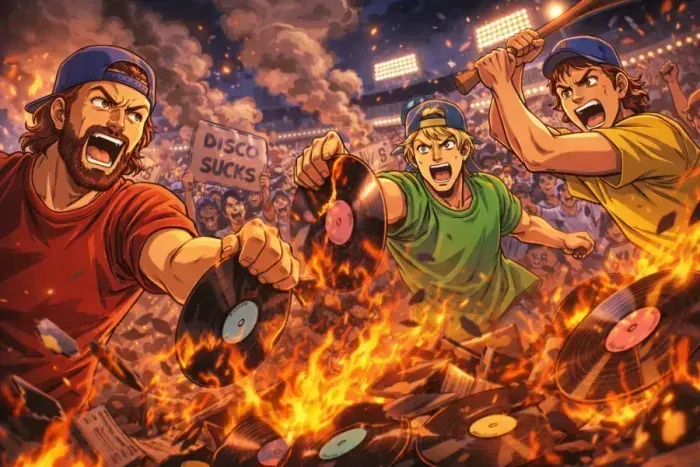
By the late 1970s, disco had moved from particular clubs into radio, film, television, and mass marketing. The backlash that followed was often framed as resistance to commercial overkill, but it was never only about overexposure. The people, spaces, and forms of pleasure associated with disco were also being rejected.
Rock critics often called the music repetitive, artificial, or unserious. That judgment usually relied on rock’s own values: visible authorship, dramatic climax, and the central performer. Disco worked differently. It cared more about continuity, collective movement, and atmosphere. Judging it by rock’s standards almost guaranteed that critics would miss what made it work.
Disco Demolition Night in 1979 is still the clearest symbol of that hostility. It was sold as a joke, but the uglier undertones were hard to miss. Because disco was so closely tied to Black, Latino, and LGBTQ+ communities, it became an easy target in a culture already tense about social change.
Artists caught in the backlash had to adapt quickly. Donna Summer and others found their records treated as disposable almost as soon as the mainstream had embraced them. Some musicians distanced themselves from the word “disco” even when their music still depended on its rhythms and production logic.
But disco did not vanish. Its methods moved into pop, club culture, dance music, and emerging electronics. DJs kept building nights around flow, texture, and continuity. The name lost status in some spaces, but the form survived.
That survival is one reason backlash narratives can be misleading. Disco was declared dead at exactly the moment its tools were being absorbed into pop production, post-disco club music, early electronic dance forms, and the broader logic of DJ-led sequencing.
Looking back, the backlash says less about disco’s supposed emptiness than about the limits of mainstream tolerance. Disco had changed who public music spaces were for and what shared pleasure could look like. That was exactly why the resistance became so intense.
The Bronx, the DJ, and Hip-Hop's First Shape
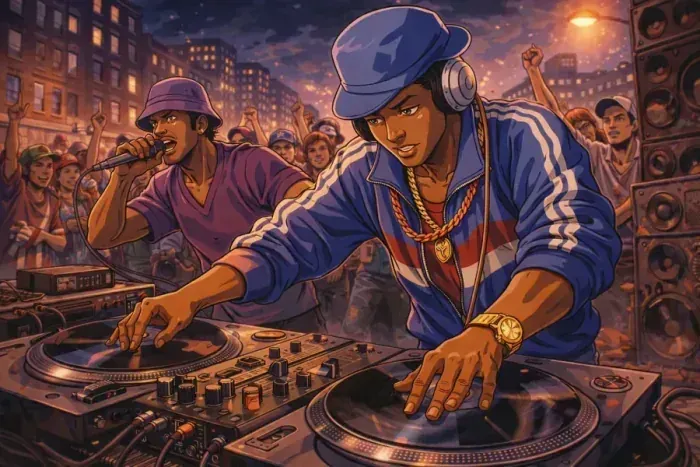
By the end of the 1970s, another culture was taking shape in New York, especially in the Bronx. It had not yet taken over the recording industry, but it was already changing how music could be assembled, shared, and experienced. Early hip-hop came out of block parties, park jams, DJ technique, MC performance, dance, and neighborhood rivalry. It belonged to social space before it belonged to the studio.
That distinction matters because early hip-hop was not born first as a product category. It was a local cultural system. Music, speech, dance, competition, and neighborhood identity all developed together before the major labels understood what they were hearing.
DJ Kool Herc’s parties were foundational because they shifted attention toward the break, the most rhythmically charged part of the record. By extending those passages and moving between copies of the same track, DJs turned existing funk and soul recordings into material for something else. A record no longer had to stay fixed. It could be cut open in public and rebuilt in real time.
That move was simple and transformative at once. It changed the status of the existing record from finished object to usable material. In that sense, early hip-hop belongs not only to late-1970s urban culture, but to the wider decade-long shift toward remix, reassembly, and scene-based innovation.
That move gathers several 1970s lessons at once. Hip-hop drew on funk’s rhythmic logic, disco’s emphasis on the DJ and the room, and punk’s do-it-yourself relationship to infrastructure. It also grew out of communities facing disinvestment and forced resourcefulness. Long before it became a dominant commercial genre, hip-hop was already showing what the next era of popular music would sound like: local, modular, beat-driven, and radically inventive.
The urban context matters here. The Bronx of the 1970s was shaped by disinvestment, arson, highway planning, landlord abandonment, and shrinking public support. Early hip-hop did not rise from romantic scarcity. It rose from communities building culture where institutions had withdrawn, which makes its inventiveness more concrete and less mythic.
Punk: Burn It Down, Start Again
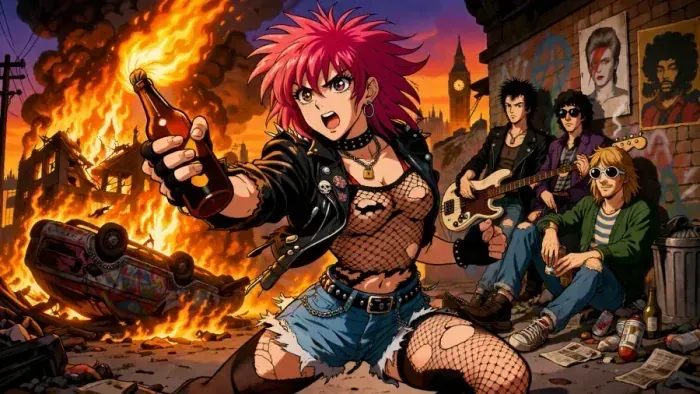
By the mid-1970s, many young listeners felt shut out of both the music industry and the social order around it. Arena rock looked remote, progressive rock could feel sealed off, and mainstream disco often seemed cleaner than the rooms it had come from. Punk arrived as a direct answer to that distance.
Its force was immediacy. Short songs, cheap gear, small rooms, and rough performance all carried the same basic claim: culture did not need permission. Punk rejected the idea that seriousness depended on polish, money, or institutional approval.
The pressures behind it differed between the UK and the US, but both scenes stripped rock back down and turned it toward confrontation. Punk did not replace the decade’s dominant sounds. It exposed what those sounds could no longer carry.
That exposure was social as much as musical. Punk looked at bloated tour circuits, rising ticket prices, and media-approved celebrity and answered with a scene where nearness was part of the point. You could see the band, touch the room, and imagine starting your own. That change in scale is one reason punk still feels more disruptive than its basic musical materials might suggest on paper.
It also changed what counted as competence. In many earlier rock cultures, mastery meant virtuosity or formal complexity. Punk argued that urgency, clarity, and conviction could be their own standard. This did not abolish skill. It relocated it. The crucial question became whether the song could deliver force under conditions of scarcity.
That is why punk belongs to the broader history of the 1970s rather than standing outside it as a pure break. It absorbed the decade’s arguments about access, authorship, and infrastructure and pushed them into a harsher, more compressed form.
The Conditions That Created Punk
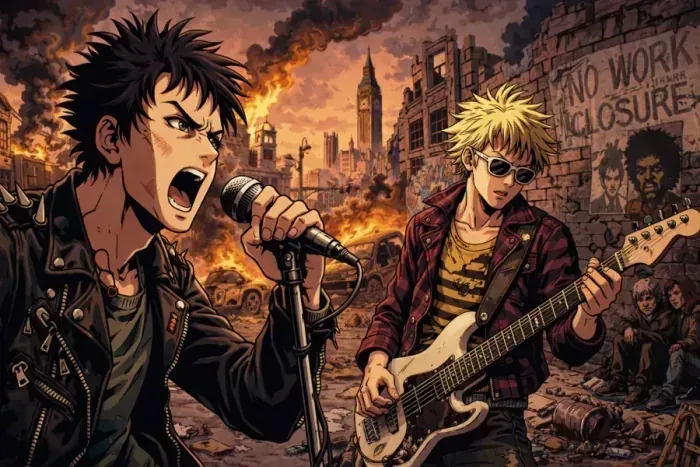
Punk did not appear only because rock had grown too complicated. It appeared because many young people no longer believed the world around them had a place for them. In the mid-1970s United Kingdom, unemployment, economic decline, and blocked social mobility made older promises about stability sound hollow. Under those conditions, music built on virtuosity, wealth, or transcendence could feel unreal.
Punk answered that gap with bluntness. It argued that cultural value did not have to be earned through training, polish, or institutional approval. Bands like the Sex Pistols made that stance impossible to miss. Their songs were short, abrasive, and openly contemptuous of authority, national pride, and social respectability. Punk did not offer a program. It offered refusal.
That refusal was sharpened by the political mood. In Britain, strikes, inflation, housing pressure, and a fraying welfare consensus created an atmosphere in which official language often sounded detached from ordinary experience. Punk did not solve those conditions, but it gave them a sound that felt proportionate to anger, boredom, and blocked mobility.
The sound was shaped by material limits as much as attitude. Cheap instruments, small venues, and little studio access encouraged directness and repetition. Those constraints were not hidden. They became proof of who the music belonged to.
This is one reason punk aesthetics spread so quickly across posters, clothes, sleeves, and fanzines. The rough edges were not accidents waiting to be corrected. They signaled a refusal to mimic institutional polish and made low-cost reproduction part of the scene’s visual and social identity.
In the United States, the setting was different, but the emotional pressure was similar. Urban decline, boredom, and distance from mainstream culture fed early scenes in New York. The Ramones reduced rock to speed, repetition, and blunt melody. Even without overt politics, that reduction was its own critique.
CBGB became one of the key spaces in that process. Opened in lower Manhattan in 1973, it gave a local scene a physical center. It was cramped, unstable, and unglamorous, which is part of why it mattered. It let an alternative infrastructure become real.
Punk took social blockage, material limitation, and cultural exclusion and turned them into style, structure, and value.
The point is not that poverty automatically creates good art. It is that punk made resourcefulness visible instead of hiding it. A scene built from cheap rehearsal spaces, photocopied pages, and borrowed equipment turned limitation into a practical method for making culture quickly.

UK vs. US: Two Scenes, One Attitude
Punk in the UK and the US shared an attitude, but not the same emotional target. It was never one style moving cleanly in one direction. It was a set of local reactions to different forms of exhaustion.
In the UK, punk was openly antagonistic toward authority, class hierarchy, and national myth. The Sex Pistols aimed for outrage, not persuasion. The Clash kept the urgency but connected it more clearly to race, empire, and international politics, proving punk could be politically expansive without losing force.
That difference inside the UK scene matters. The Sex Pistols treated scandal and collapse as part of the message. The Clash sounded more outward-looking and historically alert, making room for reggae, migration, and anti-racist politics inside punk’s sharp frame. The British scene was never only nihilist. It was also argumentative.
In the United States, punk formed in a more fragmented cultural landscape. New York’s scene was built around clubs, neighborhoods, and small networks rather than around a broad public argument. The Ramones turned repetition and speed into a complete aesthetic. Patti Smith brought in poetry, intensity, and a different kind of seriousness, widening the sense of what punk could sound like and who it could include.
Television complicated the picture further. Their long, interlocking guitar lines and tense urban atmosphere showed that punk-adjacent music did not have to reject intricacy outright. It could strip away arena scale while keeping formal ambition on a smaller, more volatile level. "Three-chord rock merged with the power of the word."
These differences matter. In the UK, punk often sounded like a public argument. In the US, it could feel more like a local refusal. What held the scenes together was not a fixed sound, but the belief that music had to answer the conditions people were actually living through.
That shared belief is why later post-punk, hardcore, and indie scenes could inherit punk without copying one exact template. The durable legacy was not one guitar tone or one set of clothes. It was the expectation that form should answer circumstance directly.

DIY Forever: Punk's Real Revolution
Punk’s most lasting contribution was not only its sound or its visual code. It was the set of systems it built. Punk treated infrastructure as part of the message. Independence was not a slogan pasted onto the music after the fact. It was the way the scene functioned.
In both the UK and the US, punk relied on small venues, local initiative, and informal networks. Musicians, friends, fans, and sympathetic organizers did work that the mainstream industry usually kept to itself. That looseness made it easier to try things, fail fast, and keep moving.
Independent labels were central because they could move quickly and without layers of approval. Zines, flyers, and cheap print culture mattered for the same reason. They gave the scene its own circulation system and its own vocabulary. The roughness of the format was part of the point.
Mail order, local record shops, college radio, and informal promotion networks mattered here too. Punk scenes stayed alive because they learned how to move information and objects without waiting for major institutions to validate them first. Distribution was not a secondary business question. It was one of the scene’s main creative achievements.
This infrastructure changed ideas of success too. Punk bands were rarely built around long, stable careers. Impermanence was normal. Scenes renewed themselves through turnover, and the network mattered more than any single group.
That emphasis on network over permanence also made the scene unusually fertile. People could start bands, fail, join other projects, publish a zine, book a show, or launch a tiny label without needing a single stable professional identity. Punk made cultural labor look mobile and collective.
That model lasted. Alternative, indie, and underground culture all borrowed from punk’s assumptions about scale, autonomy, and the possibility of building something meaningful outside the mainstream.
It also changed the mainstream indirectly. Once punk proved that low-cost scenes could generate intense loyalty and new ideas, larger companies had to pay attention to local cultures they had previously ignored.
Global Voices and New Centers of Sound
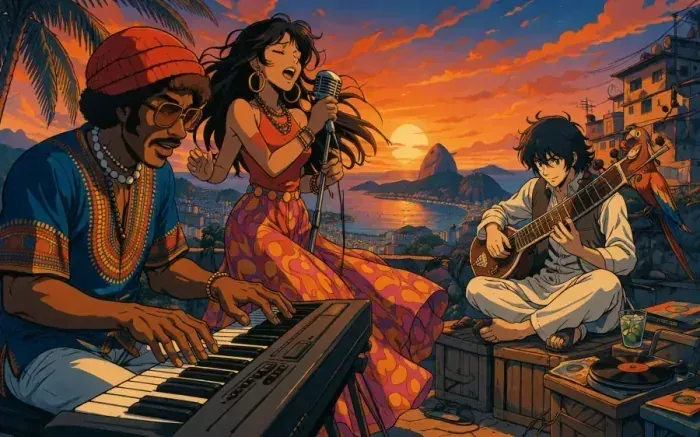
By the 1970s, popular music was no longer just a conversation between the United States and the United Kingdom, even if Anglo-American labels still controlled much of the market. The Caribbean, Africa, Latin America, and continental Europe were all generating sounds that changed the decade’s direction.
Migration, political conflict, and expanding recording and touring networks all fed that shift. Musicians carried local traditions into new settings and mixed them with rock, soul, funk, and electronics without simply copying Western formulas. These were not side stories. They were central developments in the shape of modern popular music.
The mechanism was not abstract globalization in the modern corporate sense. It was people moving through postcolonial cities, touring circuits, radio systems, record shops, and diaspora communities. Sounds traveled because musicians, migrants, DJs, and audiences were already remaking urban life across London, Lagos, Kingston, Paris, New York, and beyond.
The imbalance in visibility still mattered. Western labels, festivals, and critics often decided what counted as “global” success. But the decade makes less and less sense if it is told as an Anglo-American story with an international footnote.
That matters especially because many innovations that later became central in pop, electronic music, and hip-hop were being worked out in these supposedly peripheral spaces: deep bass culture, versioning, long-form groove, hybrid percussion languages, and more flexible ideas of what a modern song could be.
Bob Marley and the Rise of Reggae
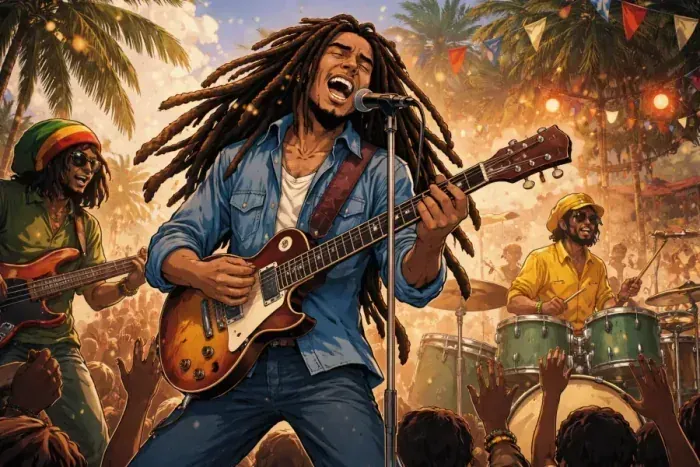
Reggae became one of the clearest examples of music from outside the usual Western centers reaching a global audience in the 1970s. Rooted in Jamaican politics, spirituality, and daily struggle, it spoke about poverty, oppression, exile, and faith with unusual directness. Much of its force came from saying things plainly.
Bob Marley and the Wailers were central to that breakthrough. Records like Catch a Fire and Exodus showed that music could stay grounded in Jamaican experience and still travel widely. Marley joined political urgency to Rastafarian belief without flattening either one.
The timing of that breakthrough is important. Jamaica had been independent since August 6, 1962, but the 1970s were marked by severe political violence, party rivalry, and economic strain. Reggae emerged to a global audience not from stability, but from a society under pressure. That gave the music’s calm surface and moral force a different weight.
Reggae’s sound mattered as much as its subject matter. The offbeat pulse, the heavy melodic bass, and the amount of space inside the arrangement gave the music a different sense of time. It moved forward, but it did not rush.
That spaciousness mattered politically as well as musically. Reggae made room for witness, meditation, and warning. The bass did not simply support the song. It carried authority. Drums, guitar chops, and organ stabs helped create a measured forward motion that could sound patient and urgent at once.
Its spread depended on migration as much as media. Jamaican communities in the UK helped create new settings in which reggae crossed with punk, soul, and sound-system culture. The music spoke beyond Jamaica not because it became generic, but because its local force stayed intact.
Marley’s international visibility can make reggae history look too singular, so it is worth remembering that the wider scene included groups and producers such as Burning Spear, Toots and the Maytals, Culture, and Lee “Scratch” Perry. Marley became the most recognizable global figure, but the genre’s depth came from a much larger Jamaican musical ecosystem.
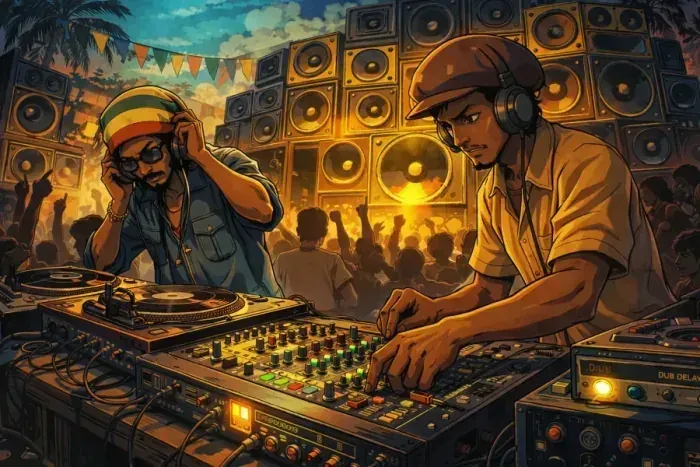
Dub and Sound System Culture: The Remix Before Digital
Alongside roots reggae, Jamaica also produced one of the decade’s boldest ideas about recorded sound. Dub stripped tracks down, pushed bass and drums forward, and treated echo, delay, dropout, and space as compositional material. Producers like King Tubby and Lee “Scratch” Perry turned the studio into an instrument.
Dub came out of sound-system culture, where records were tested, versioned, and reshaped for particular crowds. A song could return with the vocals removed, the rhythm pushed forward, and the whole spatial feeling changed. The goal was not fidelity to an “original.” The goal was to find out what else the track could do.
That practice depended on local infrastructure: custom sound systems, selectors, engineers, dub plates, and competitive public listening. Tracks were not treated as closed art objects. They were tools in an ongoing conversation between studio and street, between producer intention and crowd response.
Dub matters far beyond Jamaica. It offered an early practical model for remix thinking: technology, repetition, and public listening treated as shared creative ground. Long before digital editing became ordinary, dub had already shown that popular music’s future might depend as much on reworking existing material as on writing new songs.
Its influence reached widely even when credit did not. You can hear dub’s spatial logic in post-punk bass lines, in later club music’s trust in low end and echo, and in hip-hop’s comfort with versioning, fragments, and producer-led authorship. Dub helped move modern music toward the mix as a site of invention.
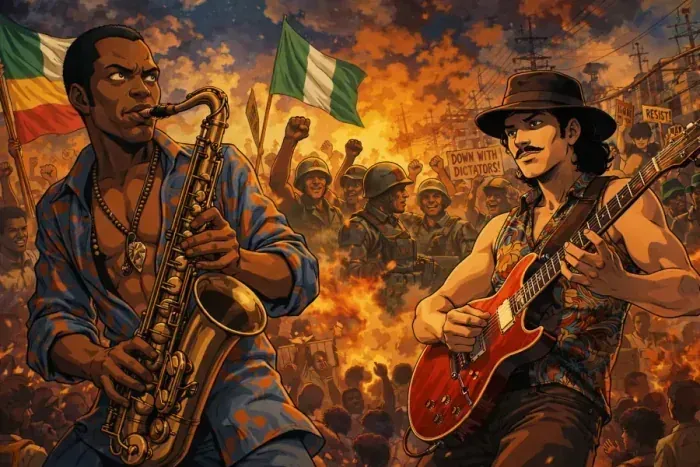
Fela Kuti and Santana: Political Grooves
Reggae was one major global voice, but it was not the only one. Elsewhere, artists were building hybrids that joined local traditions to rock, jazz, and funk without stripping out their political weight.
Fela Kuti’s Afrobeat is one of the strongest examples. Drawing on West African traditions, jazz, and funk, he built long, slowly accumulating tracks that attacked corruption, military rule, and foreign power with unusual directness. The politics were not only in the lyrics. They were also in the scale, repetition, and pressure of the music itself.
The Nigerian context matters here. Fela’s work developed amid coups, censorship, and state violence, and his Kalakuta Republic became both a creative center and a political target. When soldiers attacked the compound in 1977, the brutality confirmed that Afrobeat was not being received as harmless entertainment by the authorities it confronted.
Santana offered another model from the Americas. On records like Abraxas, blues-based guitar and Afro-Latin percussion meet as equal forces rather than as decoration and lead. The result is expansive and rhythmic, but also shaped by histories of migration and cultural mixing.
Santana’s breakthrough also mattered inside the United States because it made Latin musical presence central to mainstream rock-era listening rather than peripheral. The band did not invent Afro-Latin fusion, but it helped make a wider rock audience hear percussion, groove, and modal openness differently.
Afrobeat and Latin rock did not sound alike, and they did not need to. What they shared was the refusal to separate musical form from lived history.
That shared refusal is what links them to reggae and dub as part of the same decade-wide shift. Across different regions, musicians were building modern popular forms that did not need to pass through Anglo-American rock norms to sound contemporary, ambitious, or international.
Kraftwerk, Can, and the Electronic Revolution
In Europe, many 1970s musicians responded to Anglo-American rock not by trying to beat it at its own game, but by questioning the assumptions under it. Did rock have to stay tied to blues heritage? Did songs have to move in familiar shapes? The answers produced some of the decade’s most important experiments.
In Germany, bands later grouped under the label “Krautrock” moved toward repetition, texture, process, and long-form development. Can is a strong example. Their music often seems to build itself while you listen, as if groove and structure were being discovered in real time rather than imposed in advance.
Kraftwerk took that impulse in a colder and more precise direction. Autobahn and Trans-Europe Express treat machines as collaborators in a sound world shaped by transport, infrastructure, and communication. Where much 1970s rock pushed feeling outward, Kraftwerk worked through distance, control, and deliberate surface.
That surface was more radical than it first appeared. Kraftwerk were not removing emotion from music so much as relocating it into repetition, timbre, timing, and a distinctly modern experience of movement through systems. Highways, trains, radios, and terminals became part of the emotional landscape.
ABBA shows a different European answer. Their records proved that meticulous pop craft could matter without borrowing rock’s self-image. The melodies are immediate, but the construction is exact.
Can and Kraftwerk also mattered because they loosened the link between rock authenticity and blues lineage. In postwar West Germany, that was not only a stylistic choice. It was also a cultural search for new forms not entirely dependent on American and British precedent.
ABBA’s achievement belongs in the same conversation because it demonstrated another route out of rock hierarchy. Studio exactness, melodic architecture, multilingual circulation, and global pop intelligence could produce work every bit as durable as more canonized album-rock statements.
These artists did not sound alike, but they shared a belief that popular music could be designed as well as expressed. Later synth-pop, electronic dance music, and techno all owe something to that shift.
Technology: The Studio Becomes an Instrument
The 1970s cannot be explained without the studio. Technology did not only make records cleaner. It changed how musicians imagined songs in the first place. More tracks, better editing, and new electronic tools turned recording into a form of construction rather than simple documentation.
That also shifted power. Producers and engineers mattered more, and artists who could afford long sessions could shape records layer by layer. The studio opened creative possibilities, but it also rewarded money, time, and access.
This was one of the decade’s quiet structural divides. Artists signed to powerful labels or able to demand longer sessions could experiment with texture, overdubs, and sequencing in ways that others simply could not afford. So the studio was both a creative breakthrough and a new filter for inequality.
Listeners changed with it. Repetition, silence, and slow development stopped sounding like empty space and started sounding intentional. One of the decade’s quiet truths is that new technology often made music slower, not faster.
That slowdown mattered. Songs could now be assembled, revised, and colored over days or weeks, with musical decisions made after the first take rather than locked into it. Performance, composition, and editing started to overlap in new ways.
That overlap also changed the idea of authenticity. A record no longer had to prove itself by sounding like something that happened naturally in one room. It could sound obviously constructed and still feel truthful, as long as the construction deepened the musical world rather than merely decorating it. "I thought it was the instrument that would be used in the future."
Synthesizers, Multitracks, and the Producer's Power
In the 1970s, recording studios stopped being places where musicians simply recreated live performance. They became places where records were conceived from the ground up. Multitrack recording made it possible to isolate, revise, and build sound in layers. Technical flexibility changed not only how albums sounded, but how they were imagined in the first place.
That mattered for labor inside the studio too. Parts no longer had to be captured in a single decisive moment. Musicians could overdub, replace, re-balance, and reshape material after the fact. Records increasingly reflected accumulated decisions rather than one finished performance.
Synthesizers were central to that transformation. Early instruments like the Moog and ARP were expensive, temperamental, and difficult to master, yet they opened sonic territory that traditional instruments could not easily reach. Artists like Stevie Wonder used them not as novelty devices but as expressive tools. On albums such as Music of My Mind and Innervisions, electronic textures deepen feeling rather than distracting from it.
Producer authority also expanded. Brian Eno, for example, treated the studio as a field of possibility rather than a neutral recording space. His emphasis on process, atmosphere, and chance complicated older notions of authorship and helped redefine what a producer could be.
Stevie Wonder’s early-1970s run showed another side of that change. By negotiating unusual creative control around albums such as Talking Book, Innervisions, and Songs in the Key of Life, he demonstrated that technology could serve individual vision rather than only label routine. The result was not machine music in a narrow sense. It was a broader model of the artist as composer, performer, and studio architect at once.
That increased control came with tension. Extended studio experimentation required time and money, which meant that technological freedom was never evenly available. Even so, the results permanently changed the relationship between record and performance. Albums no longer had to be documents of a band’s stage identity. They could become definitive works in their own right.
You can hear that shift in very different corners of the decade. Stevie Wonder used synthesizers to thicken feeling instead of draining it away. Giorgio Moroder moved machine pulse and sequenced regularity toward the center of the record. Dub producers treated the mix itself as composition. The key change was not one device, but the expanding number of musical decisions that could now happen after the first performance had ended.
This is one reason the 1970s remain so central to later production culture. They turned the recording process into a site of authorship visible enough that later pop, electronic music, hip-hop, and alternative rock could all take it for granted.
Long Songs, Slow Albums: Patience as Expression
One of the clearest features of 1970s music is its sense of duration. Songs take time, albums ask to be heard in order, and repetition is treated as meaningful rather than as a problem to be fixed.
Long tracks mattered because they let ideas gather weight slowly. Pink Floyd is one obvious example, but the larger point is broader than one band. Across the decade, records invited repeat listening and attention to internal movement rather than quick takeaway.
This applied in different ways across genres. Progressive rock used duration for formal architecture. Funk used repetition to deepen groove. Dub used space and return to alter the listener’s sense of the track. Singer-songwriter albums used sequencing to let mood and lyrical perspective accumulate across a whole record. Slowness in the 1970s was not one thing. It was a family of techniques.
Live music followed the same logic. Long sets, extended improvisation, and slow builds made time part of the experience. That kind of scale depended on resources, so it was never equally available, but it changed how audiences heard patience and spaciousness.
It also changed criticism and collecting. Albums were now reviewed as statements with arcs, side-long pieces, and internal coherence. Fans compared pressings, cover art, liner notes, and track order. Listening became interpretive work as much as casual consumption.
It also changed standards of attention. A song did not have to make its full case in three minutes. Listeners were expected to stay with atmosphere, sequencing, and gradual emotional change. In the 1970s, slowness could sound like seriousness rather than indulgence.
That expectation did not reach every listener in the same way, but it changed the upper end of mainstream listening enough to matter. A mass audience could now be asked for patience, and sometimes it answered yes.
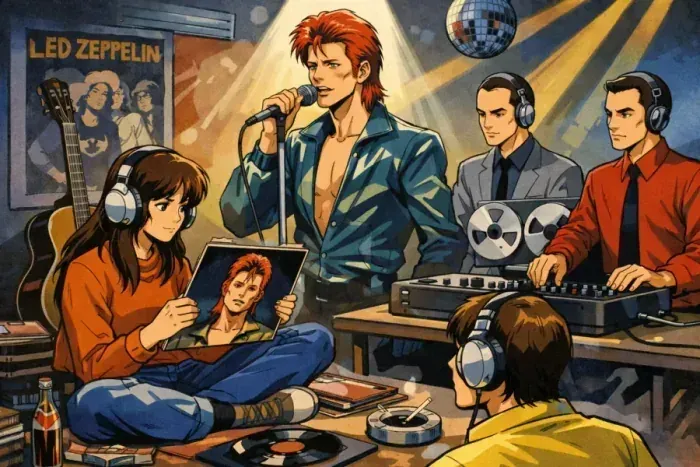
Listening Conditions: Who Heard What and Why
The story of 1970s music is also a story about listeners. Who could buy records, afford tickets, spend time in clubs, or listen alone at home shaped what the music meant. There was no single audience for the decade.
Music moved through ordinary routines and sounded different in each setting: in a car, through bedroom headphones, on FM radio, on a crowded dance floor, or in a stadium. The same record could mean escape, status, comfort, or recognition depending on who heard it and under what conditions.
That variety of listening environments helps explain why the decade produced such different recording styles. Some albums chased hi-fi detail for home stereos. Some singles were mixed to hit through car speakers or radio compression. Club records were built around low end, continuity, and physical response in a room full of bodies rather than close textual attention.
Late in the decade, cassettes pushed listening toward something more portable and more personal. Home taping widened access, and Sony introduced the first Walkman on July 1, 1979. That belongs partly to the next decade, but it shows where everyday listening was going.
By then, listening was already split between mass culture and private routine. The same decade that filled arenas also normalized solitary listening, repeat listening, and music as a personal environment. That split still shapes how popular music is heard.
It also helps explain why albums mattered so much. An LP could soundtrack a room, a mood, or a whole stretch of time in someone’s day. Listening was becoming part of ordinary private life rather than only a public event.
That private use changed memory too. People did not only remember songs from chart positions. They remembered where a record sat in the room, when they flipped the side, who they taped it for, or which stretch of night it carried. The material routine of listening became part of what gave 1970s music its staying power.
This is also why generational memory of the decade can be so intense. Records attached themselves to repeated settings rather than just one public moment. The music lived in furniture, routines, cars, friendships, parties, and solitary nights, which made it feel less like passing entertainment and more like part of daily structure.
Jobs, Dreams, and the Music of Escape
In the 1970s, music sat close to everyday survival. Economic uncertainty and unemployment did not disappear when a record came on, but music could still offer release, steadiness, and temporary escape.
Different genres did different work for different listeners. Singer-songwriter albums could offer recognition and calm. Hard rock and metal gave anger and pressure a form. Disco and funk created spaces where expression happened through movement as much as through words.
Country, soul, and soft rock did their own daily work as well. They could hold domestic strain, work fatigue, and ordinary aspiration in a form that felt manageable. This is why a decade often remembered through spectacle was also so bound up with kitchens, cars, late shifts, bedrooms, and neighborhood bars.
Live music changed the effect again. Stadium shows offered scale and collective release. Smaller clubs offered proximity. Punk rooms, especially, made participation feel possible instead of imaginary.
Class shaped all of this. Not everyone could afford tickets, large record collections, or good stereo equipment, which is one reason radio remained so important. Music was not only entertainment. It helped people manage the gap between the lives they had and the lives they had been promised.
That is one reason genre mattered so much at the level of everyday use. Soft rock could sound like order. Metal could sound like pressure released into form. Disco could offer a temporary freedom that was real even if it lasted only for a night. People were not just choosing styles. They were choosing emotional functions.
That is also one reason the decade’s fragmentation did not weaken music culture. Different styles were answering different daily needs. The split into scenes was also a split into uses.
That practical side of genre is easy to lose in retrospective canon-making. People were not choosing between abstract artistic schools. They were often choosing what could carry a drive home, a night out, a breakup, a job they hated, or a hope that still felt barely within reach.
Radio, Records, and the Color Line
Access to music in the 1970s was never just a matter of taste. Race, class, and geography shaped who heard what, how early they heard it, and whether they had the means to follow it further.
Radio was central to that unevenness. FM stations opened listeners up to new rock, soul, and album tracks, but programming still sorted sounds into racial and commercial categories. Artists who crossed those lines often met resistance before audiences did.
Trade publications, chart formats, and retail bins reinforced the same structure. Music was routinely separated into market categories that did not simply describe sound. They also organized race, class assumptions, and ideas about who a record was for.
Record stores and live venues mattered too. In wealthier places, listeners usually had wider access to imports, full catalogs, and new scenes. Elsewhere, the options could be much narrower. Cultural knowledge worked the same way. Knowing which records mattered and how to talk about them was itself a form of access.
Even so, music created moments of contact across those divides. Dance floors, radio hits, punk clubs, and sound-system spaces could bring people into the same room or the same song. But the structures around that access remained uneven, and they helped determine what the decade later remembered.
Disco is one clear example. It was central to urban nightlife, radio crossover, and later dance music history, yet it was often archived with less seriousness than album rock. The same pattern shaped how soul women, disco performers, and many non-Anglo-American artists were discussed while the decade was still unfolding.
That unevenness shaped the canon as well. Genres treated as serious were archived, reviewed, and taught differently from genres dismissed as disposable, feminine, racialized, or merely commercial. The story later generations inherit is part of the same structure.
That matters especially in the 1970s, because some of the decade’s most important music was still being ranked unevenly while it was actually happening. What later looked central did not always look central at the time.
That is part of why a history of the decade has to keep returning to infrastructure and access. What survived into the canon was shaped not only by musical value, but by who had archival support, radio replay, critical legitimacy, and the social permission to be remembered as serious.
The Hidden Cost of Fame
The decade’s mythology still talks a lot about ambition and freedom. It talks less about fatigue. As the industry grew, artists were expected to keep touring, recording, and staying visible with very little protection against burnout, addiction, or mental strain.
Long schedules and constant travel were often treated as proof of commitment. Substance use and emotional collapse could be folded into the image of the serious artist instead of being recognized as danger. That pressure did not land evenly. Musicians with stronger financial and institutional support had a better chance of surviving it. Others vanished more quietly.
If some 1970s records sound tired, brittle, withdrawn, or hungry for escape, that is not just atmosphere. It is also pressure made audible.
The decade’s mythology still tends to romanticize that cost. But a great deal of what gets called excess was simply a system without adequate brakes. The music can still sound powerful without requiring us to mistake damage for glamour.
That distinction matters if the decade is going to be remembered honestly. The 1970s were full of freedom in a real sense, but that freedom was often extracted through bodies and psyches that the industry treated as renewable resources.
Touring, Addiction, and the Myth of Genius
Many successful artists in the 1970s were expected to live at an unsustainable pace. Months-long tours ran into promotion and studio work with little room for rest. The system treated endurance as professionalism and stopping as failure.
The growth of arena circuits intensified that pressure. Once tours required larger crews, heavier logistics, and bigger financial expectations, there was more incentive to keep the machine moving even when artists were exhausted. Success expanded the schedule before it expanded protection.
Life on the road also produced isolation. Crowds did not cancel out the lack of privacy, routine, or recovery. Substance use often became part of how artists managed boredom, anxiety, pain, and the crash after performance. The language around addiction was still limited and moralizing, which made honesty harder.
Myths about genius made the problem worse. Breakdown could be folded into stories about authenticity and excess instead of being treated as warning. That framing suited an industry that needed uninterrupted output.
Not everyone had the same chance of surviving that pressure. Artists with money, strong management, or room to step back were more likely to recover. Others were easier to replace. Some of the decade’s withdrawn, tired, or escape-hungry moods make more sense once that pressure is heard in the background.
The inward turn of the decade looks different in that light. Privacy, retreat, and exposed feeling were not only aesthetic choices. For some artists, they were ways of writing from inside depletion instead of pretending depletion was not there.
That does not explain every quiet record of the period, but it does make the decade’s recurring themes of distance, self-protection, and fatigue feel less abstract.
It also complicates the mythology of excess. Some artists embraced spectacle willingly, but many were simply working inside a business that treated constant visibility as normal and recovery as optional.
Unequal Ground: Who Lasted and Who Didn't
The pressures of the 1970s industry did not land evenly. Women faced additional risks in touring, promotion, and career control, and success often made those pressures more intense rather than less.
Travel could be unsafe, boundaries were unstable, and saying no could carry obvious career costs. Even commercially successful women were less likely to control production, scheduling, or long-term planning. Interruptions caused by illness, motherhood, or mental strain were often treated as personal weakness instead of structural failure.
Joni Mitchell protected her independence with unusual force. Karen Carpenter’s later story showed how destructive scrutiny around image and discipline could become. Those cases were not exceptions. They exposed a system with very little room for vulnerability, care, or return.
That unevenness matters because talent alone was never enough. Support mattered too, and women usually had less of it.
The same pattern applied across race and class lines. Artists with stronger management, better contracts, and more institutional patience had more room to survive a difficult period. Others could deliver remarkable work and still be left without the protection that made a long career possible.
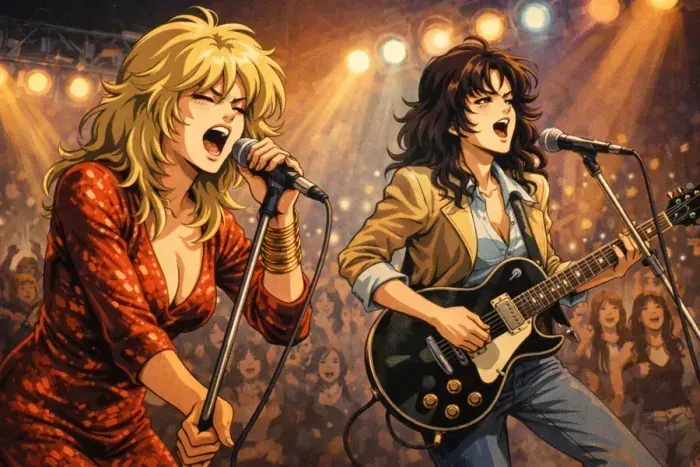
Women Reshape the Decade
Women were not a side note in 1970s popular music. They were central to its sound, its writing, and its arguments about authorship. Across singer-songwriter records, soul, disco, funk, and pop, women expanded what mainstream music could say about desire, work, self-definition, pleasure, fatigue, and power.
The change was real, but it was never smooth. Creative authority still had to be claimed again and again in an industry that preferred women as voices, faces, or interpreters more than as full authors. Progress and resistance often existed inside the same career.
That tension is part of why the decade still feels current. Women helped redefine popular music in the 1970s, even when the business around them was slow to admit how much had changed.
They also changed what listeners expected a woman artist to be. Not just a voice or a public image, but a writer, arranger, bandleader, conceptual thinker, and full author of her own work.
That shift cut across more than one genre. It moved through folk-derived songwriting, soul, funk, disco, and pop, which is one reason it changed the larger culture instead of remaining one specialized exception.
It also changed the questions later women artists could ask of the industry. Once the decade had made female authorship this visible, later generations could demand not only the right to sing, but the right to decide concept, production, collaboration, image, and career shape.
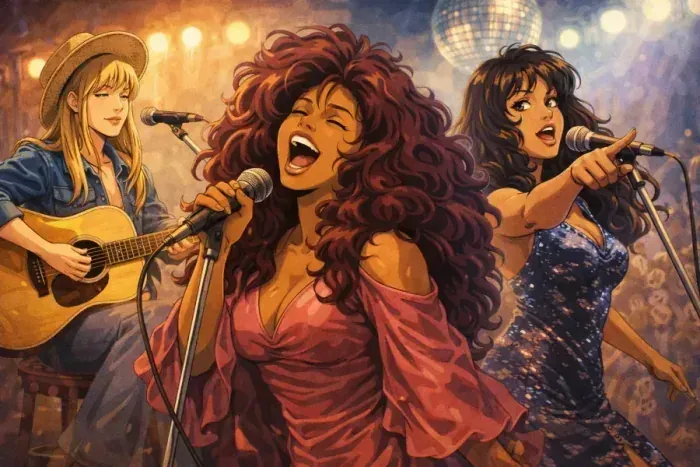
Joni Mitchell, Chaka Khan, Donna Summer: Taking Control
By the 1970s, many women were no longer willing only to perform within existing limits. They wanted to define the work itself: the writing, the sound, the arrangement, and the range of experience a song could hold.
Joni Mitchell is one of the clearest cases. Court and Spark, The Hissing of Summer Lawns, and Hejira all push against stasis in different ways. She widened her harmonic language, worked with jazz musicians, and kept asking the audience to move with her rather than waiting for her to simplify.
Chaka Khan offered a different kind of authority. Her voice brought scale, power, warmth, and control without accepting softness as the default frame for femininity. Donna Summer did something else again. She turned repetition, desire, and studio precision into a deliberate performance language that still gets reduced too often to stereotype.
What links them is not genre but self-definition. They did not wait to be granted full authority. They used the space they had and widened it.
Each of them also modeled a different route to control. Mitchell did it through harmonic adventure and lyrical precision, Khan through vocal command inside groove-based music, and Summer through collaboration with producers while still shaping one of the decade’s most distinctive performance identities.
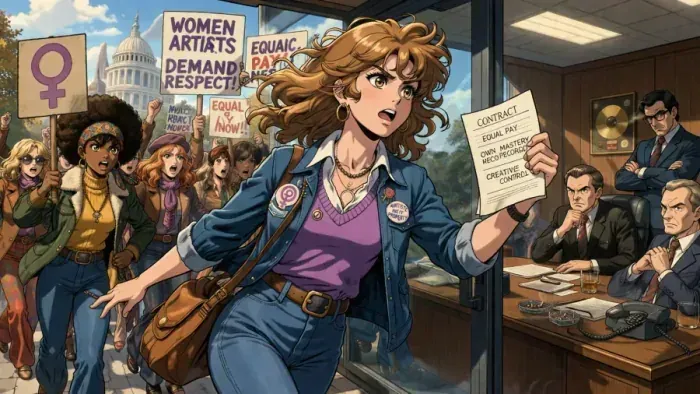
Barriers and Breakthroughs: The Fight for Independence
Claiming authority did not mean the system accepted it. Women made real gains in the 1970s, but those gains stayed fragile because contracts, image management, radio, and criticism still treated female authority as conditional.
Experimentation was often read as risk rather than growth. Marketing created double binds: approachable but not threatening, sexual but not “too sexual,” ambitious but not difficult. Donna Summer ran straight into those contradictions, and she was not alone.
The criticism women received often revealed the structure clearly. When male artists changed direction, the move could be framed as development. When women did the same, it was more likely to be treated as instability, calculation, or overreach. The standard was not evenly applied.
Women built ways of surviving inside that system through alliances, professionalism, smaller platforms, and strategic choices about control. Those tactics did not remove the barriers, but they help explain the discipline and self-possession in so much of the work.
Some artists protected themselves by narrowing their circle of collaborators. Others leaned on touring bands, family structures, trusted producers, or selective release schedules. Those strategies mattered because independence in the 1970s was rarely absolute. It was often a matter of building temporary zones of control inside an unstable system.
That point is important because it keeps the story grounded. Independence was not a romantic state that an artist either possessed or lacked. It was usually negotiated in pieces: one contract clause, one trusted arranger, one band, one studio ally, one refusal to accept the default story told around the work.
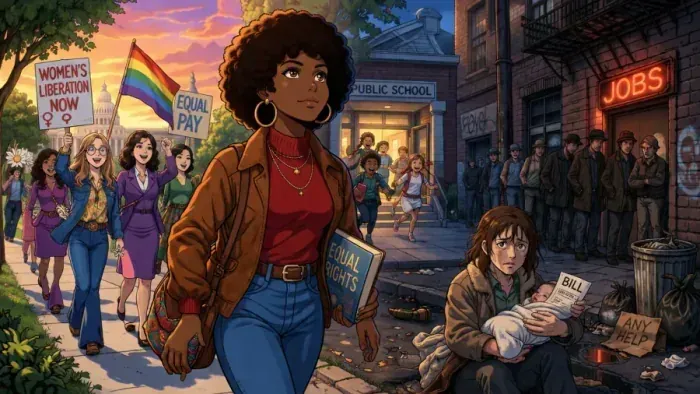
Progress That Lasted, Inequality That Remained
The impact of women reshaping popular music in the 1970s is not measured only in sales or awards. It is also in the range of possibilities they made visible.
Later artists inherited a broader model of authorship, emotional range, and sonic control. Writers in the 1980s and 1990s did not invent those freedoms from nothing. Much of the ground had already been cleared.
You can hear that legacy in multiple directions at once: in the confessional precision of later singer-songwriters, in the confidence of women shaping pop and R&B production, in the centrality of female club records to dance culture, and in the expectation that a woman artist could be not only the face of a project but its conceptual center.
Many of the structural problems stayed in place. Access to production roles, fair contracts, and long-term support continued to lag behind the work itself. That unfinished quality is part of the legacy too.
The gains and the limits belong together. That is part of why this history still feels alive rather than settled.
Later artists inherited not a solved problem, but a larger field of possibility. That is a more accurate way to describe the legacy.
That larger field is one of the decade’s most durable achievements. The work did not make the industry fair, but it made later inequities easier to name because women had already demonstrated so clearly what full authorship could look and sound like.
Why the 1970s Still Matter Today
It is easy to turn the 1970s into a gallery of famous album covers and familiar radio tracks. It makes more sense when you hear it as an argument still in progress.
Artists were testing how much freedom they could claim, how much contradiction audiences would accept, and how far a genre could stretch before it broke. Those questions still sound current because they were never settled.
Many of the assumptions now taken for granted also became widely legible here: the album as a statement, the producer as co-author, the DJ as a central figure, genre crossover as normal practice, and artistic autonomy as something worth fighting for even when it stayed unevenly distributed.
That is also why the decade resists tidy nostalgia. It was productive partly because it was uneven, unresolved, and full of friction.
Singer-songwriter intimacy, progressive scale, soul’s demand for control, disco’s social space, punk’s refusal, and the global expansion of the map were not separate chapters that lined up neatly. They overlapped, contradicted one another, and often developed at the same time. That is part of what gives the decade its shape.
The decade also matters because it made later music industries easier to recognize in advance. You can already hear the rise of producer-centered authorship, scene-based cultures, genre crossover, backlash politics, market segmentation, and the split between private listening and mass spectacle. The 1970s did not simply leave behind classic records. They left behind working models for how modern music culture would keep operating.
That is why the decade can support so many later histories at once. You can hear the roots of alternative culture, contemporary pop maximalism, DJ-led dance music, confessional songwriting, remix logic, prestige album culture, and the politics of canon formation all emerging within the same broad period.
From Funk to Hip-Hop, Disco to EDM
You can hear the 1970s in what came after, but not only as a set of familiar sounds. The decade passed on working methods. Hip-hop inherited funk’s loops, breaks, and sample logic. Dance music inherited disco’s long build, DJ-centered flow, and sense of the track as part of a larger night. Indie and alternative rock absorbed punk’s DIY infrastructure and the singer-songwriter tradition of direct personal voice.
Even mainstream pop still carries 1970s assumptions: the album as statement, the producer as creative partner, and the idea that genre boundaries are there to be crossed. The decade did not invent every later form, but it made many later forms easier to imagine.
That influence lasted because the period stayed open. It treated popular music as a field of arguments, experiments, and partial solutions rather than as a settled formula.
Some of the inheritance is very direct. Hip-hop producers built from funk breaks and bass logic. Dance music inherited disco’s trust in flow, mix structure, and the DJ as a maker of collective time. Alternative scenes inherited punk’s low-cost infrastructure and its skepticism toward gatekeeping. Later pop inherited the 1970s confidence that mass reach and strong formal control could live together.
The afterlife is also conceptual. Later musicians inherited permission to think in albums, scenes, personas, mixes, and cross-genre methods rather than only in songs. The decade expanded the scale on which popular music could imagine itself.
Freedom Was Never Free
The 1970s are often romanticized as a decade of unlimited freedom. The records tell a more useful story. Freedom was usually partial, conditional, and expensive. Artists had to win space inside labels, radio systems, touring cycles, and public expectations that could turn against them quickly.
Some musicians used that space to make unusually ambitious work. Others pulled back, changed direction, or accepted commercial risk to protect their independence. Stevie Wonder and Neil Young took different paths, but both show that autonomy was something to be negotiated, not something simply granted.
That freedom was never evenly distributed. Gender, race, money, and institutional backing all shaped who could afford to fail and who could recover from a difficult record or a bad tour. One reason the decade stays so useful is that it makes the cost of artistic independence visible instead of hiding it behind legend.
It also reminds listeners that autonomy and infrastructure are never opposites. Artists needed labels, engineers, bands, promoters, radio support, and audiences even when they were pushing back against those same systems. The decade’s most interesting work often came from that friction rather than from total independence.
Looking Back Without Rose-Colored Glasses
Listening to the 1970s well means resisting nostalgia. Nostalgia is not wrong, but it is incomplete. Once the decade is flattened into canonical albums and familiar radio tracks, you lose the instability that made the music matter in the first place.
What still feels striking is how openly uncertainty entered popular music. Artists changed direction, contradicted themselves, stalled, recovered, and sometimes disappeared. The decade was not a golden age. It was a period of argument, pressure, unequal power, and unusually public experimentation.
It is also important to remember what the music did not solve. Women still fought for authority that remained fragile. Artists of color generated many of the decade’s new ideas while carrying more risk than they should have. Mental health struggles were often romanticized instead of addressed. Those absences belong to the history too.
What lasted is real. Popular music became more emotionally and formally open. Albums could be intimate, political, contradictory, and slow. Genres could collide without apology. A lot of what now feels standard in modern music first became widely legible here.
The decade also leaves a lesson about listening. Many of these records ask for patience. They reward repeat listening, unresolved tension, and attention to pacing. That can feel unfamiliar in a culture built on instant reaction, but it is part of why 1970s music still holds up.
To hear the decade well is to hear both the achievement and the strain. The best records are not great because the era was easy or unified. They are great because so many artists managed to turn instability, pressure, new technology, and social contradiction into forms that still feel alive.
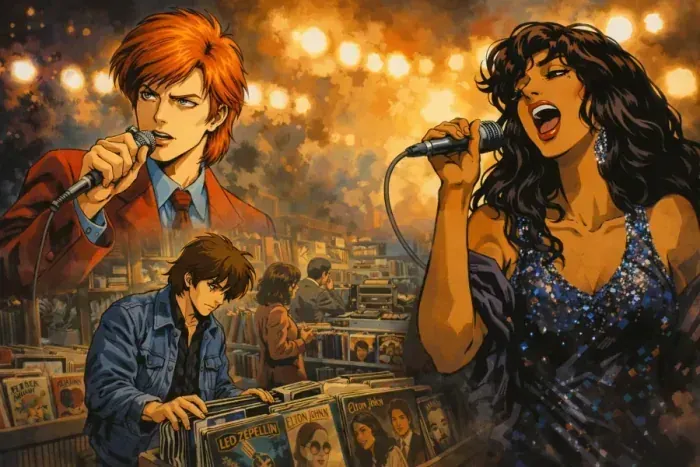
50 Songs That Shaped the 1970s
The 1970s reshaped modern music through political disillusionment, economic pressure, studio technology, and changing ideas about identity and authorship. Artists no longer spoke with one voice. They moved between intimacy, excess, pleasure, doubt, resistance, and reinvention, sometimes within the same record.
Rock turned inward and outward at once. Soul and funk gave rhythm new political and bodily force. Disco remade the dance floor as a social world. Punk attacked hierarchy and polish. Country sharpened regional authorship, while hip-hop and Jamaican dub pointed toward sampling, remix, and DJ-led culture. Reggae, Afrobeat, Latin rock, and European electronic music pushed the decade far beyond its Anglo-American center.
The list below is not meant to reduce all of that into one sound. It is meant as a path through the decade’s tensions, heard track by track.
It also works as a listening route through different scales of experience. Some songs were built for headphones and close reading. Some were made to shake clubs, cars, or arenas. Some changed later music because of their immediate popularity. Others did it by quietly altering what musicians, DJs, and producers thought a song or a record could do.
That is why the list moves between hits, scene records, crossover tracks, and songs whose importance lies partly in what later musicians heard in them. The point is not to flatten all influence into chart size. It is to let the decade’s actual movement become easier to hear.
I. Waking Up: Songs of Reflection
These songs capture the early-1970s move away from late-1960s certainty. The writing gets more inward, but not less serious. Personal feeling, social critique, and spiritual doubt often sit side by side.
The sequence begins with Marvin Gaye and Curtis Mayfield because soul and R&B were among the first places where this shift became unmistakable. From there, Joni Mitchell, Carole King, Neil Young, and Gil Scott-Heron show different ways private writing and public pressure could occupy the same decade.
Listening to these tracks in order makes the early decade sound less like a retreat than a recalibration. The public voice becomes more fractured, but also more exact. Social pressure does not disappear. It moves inside confession, testimony, and moral witness.
- Marvin Gaye – What’s Going On (1971)
- Curtis Mayfield – Move On Up (1970)
- Joni Mitchell – River (1971)
- Carole King – It’s Too Late (1971)
- Neil Young – Heart of Gold (1972)
- Gil Scott-Heron – The Revolution Will Not Be Televised (1971)
- Aretha Franklin – Rock Steady (1971)
II. Rock’s Grand Ambitions
This section follows the decade’s push toward scale. Long forms, technical display, conceptual thinking, and heavier sound all expanded what rock audiences were asked to hear as serious.
The point is not that all ambitious rock sounded alike. Led Zeppelin and Pink Floyd made scale feel immersive and monumental in different ways, while Genesis, Yes, Sabbath, and Deep Purple show how theatricality, virtuosity, heaviness, and precision all widened the field.
Together, these tracks show that “big” in the 1970s could mean several things at once: technical ambition, stage scale, sonic weight, and an appetite for records that felt built rather than casually assembled.
- Led Zeppelin – Stairway to Heaven (1971)
- Pink Floyd – Time (1973)
- Genesis – The Carpet Crawlers (1974)
- Yes – Roundabout (1971)
- Black Sabbath – War Pigs (1970)
- Deep Purple – Smoke on the Water (1972)
III. Identity on Stage: Glam and Beyond
These tracks sit where performance, image, and songwriting start to blur into one another. The stage becomes a place to test gender, irony, celebrity, and self-invention rather than simply present a fixed persona.
This section matters because the decade’s performance revolutions were not just visual. They changed what counted as honesty. Bowie, Roxy Music, and Lou Reed all show that a constructed persona could reveal social truth rather than hide it.
- David Bowie – Heroes (1977)
- Roxy Music – Love Is the Drug (1975)
- Lou Reed – Walk on the Wild Side (1972)
- Elton John – Goodbye Yellow Brick Road (1973)
- Fleetwood Mac – Dreams (1977)
IV. Funk & Soul: The Body Speaks
By the middle of the decade, groove itself had become a way of carrying argument, pleasure, authority, and collective force. These songs show how rhythm could organize meaning without giving up emotional depth.
That is why James Brown sits next to Sly and the Family Stone, Chaka Khan, Minnie Riperton, and Gladys Knight. The section is less about one stable sound than about how the body, the voice, and the groove were all being renegotiated at once.
These songs also show how much 1970s soul and funk depended on arrangement. The authority is in the voices, but also in the bass placement, horn attack, rhythmic pocket, and the way each record controls tension and release.
- James Brown – Get Up (I Feel Like Being a) Sex Machine (1970)
- Sly & The Family Stone – Family Affair (1971)
- Rufus featuring Chaka Khan – I’m Every Woman (1978)
- Minnie Riperton – Lovin’ You (1975)
- Gladys Knight & The Pips – Midnight Train to Georgia (1973)
V. Disco: Freedom on the Floor
This group traces disco from club logic to crossover visibility. What links them is not just danceability, but the use of repetition, sheen, and flow to create social space.
Donna Summer and Chic anchor the section because they clarify two central poles inside the genre: machine-led futurism and groove-led elegance. The Bee Gees, ABBA, and Blondie show what happened when disco’s structures moved outward into global pop and new wave.
Taken together, the tracks trace disco’s movement from scene practice to common musical language. By the end of the decade, even artists who were not “disco acts” in a narrow sense were working with its pulse, sheen, and dance-floor timing.
- Donna Summer – I Feel Love (1977)
- Chic – Good Times (1979)
- Bee Gees – Stayin’ Alive (1978)
- ABBA – Dancing Queen (1976)
- Blondie – Heart of Glass (1979)
VI. Punk: Breaking Everything
These songs mark punk’s break with polish, hierarchy, and inherited rock prestige. They do not all sound the same, but they share compression, urgency, and distrust of cultural distance.
Keeping Patti Smith and Television beside the Ramones and the Clash matters here. Punk was never only one blunt sound. It also included poetry, tension, elongation, and art-school intelligence under the same larger pressure to strip away old prestige.
The section is arranged to preserve that breadth. Punk was a compression of resources and a compression of social patience, but not a collapse into one monochrome mood.
- Ramones – Blitzkrieg Bop (1976)
- Patti Smith Group – Because the Night (1978)
- Television – Marquee Moon (1977)
- The Clash – London Calling (1979)
VII. Global Rhythms
This section points beyond the usual Anglo-American map. The songs here are not included as “international flavor,” but because they changed how the decade sounded and how political music, dance music, and hybrid forms traveled.
Bob Marley, Fela Kuti, Santana, and Manu Dibango each represent a different route through that change. Reggae, Afrobeat, Latin rock, and pan-African dance records were not outside the decade’s main story. They were part of what made the story global.
What links them is not a single political position or one rhythmic formula. It is the fact that each track carries a local history strongly enough to travel without being flattened.
- Bob Marley & The Wailers – No Woman, No Cry (1974)
- Fela Kuti – Zombie (1976)
- Santana – Black Magic Woman / Gypsy Queen (1970)
- Manu Dibango – Soul Makossa (1972)
VIII. The Future Arrives: Synths and Experiments
These recordings show where the next decades were already being sketched. Repetition, electronics, nervous art-rock, and post-punk minimalism all start pulling popular music toward new textures and new structures.
Can and Kraftwerk matter here because they changed the terms of repetition and machine sound. Talking Heads and the Police show what happened when some of those experiments began moving back into more compact, mobile song forms.
This is the point in the list where the decade starts handing material to the 1980s. The mechanical pulse, clipped guitar patterns, nervous minimalism, and producer-shaped space all point forward without ceasing to sound rooted in the 1970s.
- Can – Vitamin C (1972)
- Kraftwerk – Autobahn (1974)
- Talking Heads – Psycho Killer (1977)
- The Police – Roxanne (1978)
IX. Echoes That Never Faded
The final group gathers songs whose afterlives have been unusually long. Some became radio fixtures, some became touchstones for later musicians, and some condensed the decade’s contradictions into a single unforgettable recording.
No list of fifty songs can fully contain a decade this fractured and productive. The aim here is narrower and more practical: to give readers a sequence that lets them hear the major tensions of the period rather than just its most familiar trophies.
That is why the closing stretch mixes very different kinds of endurance. Some of these tracks lasted through radio repetition. Others lasted because later musicians kept using them as models, reference points, or arguments about what popular music could hold.
Ending here also keeps the decade’s contradictions intact. The last group moves between intimacy, grandeur, softness, menace, pop exactness, and communal funk because the 1970s never resolved those tensions into one winner.
- Janis Ian – At Seventeen (1975)
- Roberta Flack – Killing Me Softly with His Song (1973)
- Al Green – Let’s Stay Together (1971)
- Stevie Wonder – Living for the City (1973)
- AC/DC – Highway to Hell (1979)
- Eagles – Hotel California (1976)
- Paul McCartney & Wings – Band on the Run (1974)
- Kate Bush – Wuthering Heights (1978)
- Parliament – Give Up the Funk (1975)
- Queen – Bohemian Rhapsody (1975)
Why This Order Tells a Story
This is not a ranked list of the “best” songs. It is a listening path through the decade’s main tensions. The order moves from post-1960s reflection into scale, identity, groove, club culture, rupture, global exchange, and early futures.
Women artists and international voices are part of the main line of the story, not side notes. The categories overlap because the decade itself did. That is the point. The 1970s did not move in one clean sequence, but these songs show how its arguments connected.
Some songs are here because they were major hits. Others are here because they changed form, language, production, or scene culture in ways that later music kept building on. Taken together, the list is less a canon than a route through the decade’s competing energies: intimacy and spectacle, groove and critique, local scene and global circulation, freedom and control.
That also explains a few choices that may look unusual beside bigger chart staples. The goal was not to mirror radio memory exactly, but to keep historical pressure on the list: songs that opened doors, clarified scenes, or made later developments easier to hear.
It also explains some omissions. No fifty-song list can fully cover a decade this wide, so the standard for inclusion had to stay structural rather than encyclopedic. The question was not only “Was this famous?” but also “Does this help a reader hear a larger movement more clearly?”
Read that way, the list works best as movement rather than inventory. Each section changes the terms of listening for the next one, which is also how the decade itself unfolded: slowly, unevenly, and through scenes that kept borrowing from and reacting against one another.