Why the 1990s Still Matter
The 1990s did not settle around one dominant sound. Earlier decades are often remembered through a few central styles. The 1990s were harder to reduce. Grunge, hip-hop, teen pop, electronic dance music, metal, and singer-songwriter records all grew at the same time, often for different audiences and under very different rules.
What connected those scenes was less a shared style than a shared pressure. By the 1990s, polished spectacle no longer felt convincing to everyone. Many listeners wanted music that sounded less controlled, less heroic, and closer to real confusion. That could mean Nirvana’s strain, Tupac Shakur’s emotional volatility, Madonna’s constant reinvention, or Radiohead’s unease. The sounds were different. The distrust of easy answers was not.
The decade also moved faster than earlier pop histories often suggest. A song could still become a global hit through radio, MTV, or CD sales, but the culture around music was no longer moving in one line. Lollapalooza, rave flyers, regional rap scenes, teen-pop marketing, Britpop tabloid drama, and early internet fan communities all pulled attention in different directions. The result was not exactly chaos. It was a new kind of map, with many centers competing at once.
That is why the decade still matters. The 1990s did not resolve old tensions inside music. They made them harder to hide. Questions of authenticity, industry power, identity, and technology moved closer to the surface, and listeners began to expect music to carry that complexity instead of smoothing it away.
That expectation still shapes how people listen now. We take it for granted that one year can contain a grunge anthem, a glossy boy-band single, a rap record full of neighborhood detail, and an anonymous club track built for a warehouse at 4 a.m. The 1990s helped make that coexistence normal. They taught audiences to live with musical plurality rather than wait for one style to settle the argument.
No More Dominant Sound: A Fragmented Decade
By the early 1990s, popular music no longer moved around one center. Earlier decades had their dominant reference points, even when listeners argued over them. In the 1990s, that shared frame weakened. There were still stars and major hits, but fewer styles could claim to speak for everyone at once.
Instead, the decade split into smaller publics. Cable television, specialist magazines, college radio, local scenes, and record-store culture all pushed listeners toward more defined tastes. MTV still mattered, but it no longer organized the whole field on its own. Music became a sharper marker of identity. What mattered was not simply whether a song was popular, but whether it belonged to your people, your place, or your mood.
That shift could be felt in ordinary listening habits. A teenager might buy a grunge CD, a West Coast rap cassette, a dance compilation, and a glossy pop single in the same year, but those purchases did not necessarily belong to one common scene. They belonged to different social codes. Genre stopped being only a matter of sound and became more clearly bound up with clothing, politics, class signals, and ideas of authenticity.
That change matched a broader shift in culture. The Cold War was over, old political certainties were weaker, and many institutions inspired less trust than they once had. Economic growth existed, but so did instability around work, class, and social belonging. Music absorbed that uncertainty. Lyrics often became more inward, more defensive, or more openly contradictory.
Rock made the shift easy to hear. Nirvana’s breakthrough did not unify rock audiences. It showed how ready they already were for a rougher and less triumphant emotional language. At the same time, R.E.M. kept building reflective album-length statements, while Blur and Oasis turned British identity into a central part of their appeal.
Hip-hop changed in the same direction. As rap grew, it became harder to compress it into a single story. East Coast and West Coast scenes developed different priorities. Political rap, street narratives, jazz-informed production, and more commercial releases all gained ground at once, often in tension with one another.
That lack of agreement was not a weakness. It was one of the decade’s defining facts. In the 1990s, popular music stopped pretending to speak with one voice. Listeners moved among competing scenes, and those scenes helped people draw social lines, test identities, and make sense of a culture that felt less stable than before.
It also changed how memory worked. Earlier decades are easier to summarize because the market and the media pushed harder toward a shared center. The 1990s left behind a messier archive: scenes remembered through local clubs, VHS recordings, zines, CD booklets, festival lineups, and regional radio rather than through one universal sequence of stars. That messiness is part of the decade’s truth.
The Industry at Its Peak Power
The 1990s were also the high-water mark of the old record-business model. Major labels were powerful, compact discs were hugely profitable, and global distribution systems were already in place. For a while, the industry looked stable enough to feel permanent.
The end of the Cold War helped widen that confidence. Western music companies pushed more aggressively into international markets, licensing expanded, and English-language pop and rock circulated with fewer political barriers than before. Executives such as David Geffen and Clive Davis came to represent a system that no longer treated commerce and artistry as opposites. Success meant sales, but it also meant market reach, catalog strength, and lasting name recognition.
The industry also became highly skilled at selling resistance. Labels learned how to market music that looked rebellious, local, or anti-commercial through national and global systems. Alternative rock, hip-hop, and even parts of dance culture could be packaged for large audiences without immediately losing the language of independence. That was good business. It also put artists under pressure to look honest inside a system built to scale them up.
MTV helped hold that system together. Videos still shaped how artists were introduced, ranked, and remembered. Sound mattered, but so did image, persona, and visual discipline. Artists who fit that logic could gain leverage quickly. Artists who resisted it were often described as difficult, uncooperative, or hard to market.
This was also the era when giant first-week launches, prestige videos, and worldwide CD rollouts started to feel normal for major acts. Labels could coordinate radio promotion, press, retail placement, and television exposure at a scale smaller scenes could not match. The gap between independent infrastructure and major-label machinery remained huge, even when underground styles were suddenly appearing on the charts.
Even so, the cracks were visible. Independent labels survived by serving scenes rather than chasing maximum reach. More artists were paying attention to contracts, ownership, and creative control. The album still mattered, but it now had to live alongside singles, videos, press cycles, and tour-ready branding.
What defined the 1990s industry was not just power, but confidence in its own durability. For most of the decade, it was still hard to imagine the system itself breaking. Digital disruption felt far away. In retrospect, though, the 1990s look less like a settled order than like the final peak before the model started to give way.
That matters because the decade’s music was shaped by abundance at the exact moment before abundance changed meaning. Labels still assumed they could control manufacturing, distribution, pricing, shelf space, and promotional tempo. Albums could be treated as large-scale events. Careers could still be planned around long release cycles. The certainty of that machinery gave 1990s pop its scale, even as the first cracks were already opening underneath it.
The Authenticity Generation
By the mid-1990s, many young listeners were no longer looking for traditional heroes. The smooth confidence of the 1980s now felt staged to a generation living with media saturation, economic uncertainty, and less faith in institutions. Music moved closer to exposed feeling. Big declarations gave way to strain, hesitation, and voices that sounded less resolved.
That shift is often described with the word authenticity, but the term changed in the 1990s. It no longer meant control, polish, or moral certainty. It meant sounding exposed without pretending that exposure solved anything. Artists were valued less for authority than for how honestly they carried confusion, discomfort, or contradiction.
Rock made this easy to recognize. Many artists sounded uneasy with fame itself, and Kurt Cobain became the clearest symbol of that discomfort. He did not perform alienation from the outside. He seemed trapped inside the role he had been given, and many listeners recognized that tension immediately.
Hip-hop offered a different version of the same demand for emotional truth. Tupac Shakur, for example, could move between anger, fear, tenderness, and defiance without flattening those states into one message. That emotional range often felt more truthful than the simpler optimism still circulating elsewhere in mainstream culture.
Women artists pushed this shift further. PJ Harvey and Tori Amos wrote with intensity that did not ask to be softened or excused. Their music made clear that vulnerability did not have to sound passive, comforting, or morally neat. In the 1990s, being real could sound abrasive, volatile, or confrontational.
This new authenticity also changed how success looked. Earlier pop fantasies often treated stardom as the point where conflict disappeared into glamour. In the 1990s, stars often looked burdened, self-conscious, overstimulated, or skeptical of the machinery around them. Even polished artists had to negotiate a public increasingly fluent in media image and increasingly suspicious of anything that felt too clean.
What linked these artists was a shared suspicion of spectacle. By then, audiences already understood branding, performance, and media manipulation well enough to hear when they were being oversold. That did not make them reject pop. It made them more alert to the gap between image and feeling.
Music became one of the places where contradiction could stay visible. Pain did not have to become a lesson. Success could still feel hollow. Identity could remain unfinished. In the 1990s, many listeners were no longer asking for certainty. They were asking to hear complexity without disguise.
This is one reason the decade can still feel emotionally contemporary. It normalized a voice that sounded self-aware, uneasy, and only partly resolved. Whether the setting was a rock song, a rap verse, or a confessional pop record, artists increasingly sounded like people speaking from inside pressure rather than above it. That tone would outlast most of the decade’s fashions. "The lyrics are just so honest and from where my life was at that time."
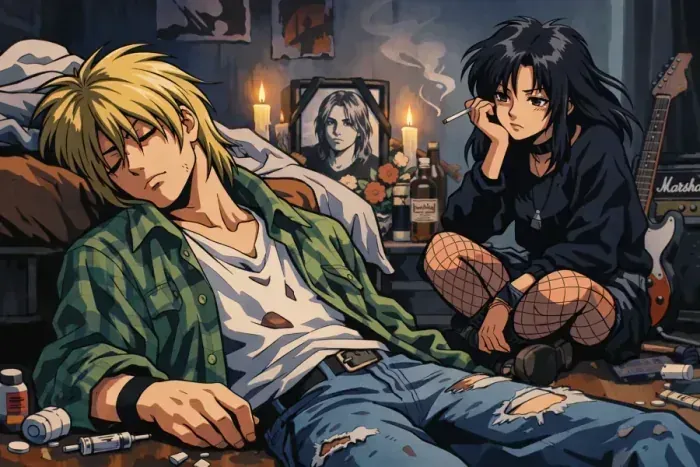
Grunge: Rock After Glamour
When alternative rock broke through in the early 1990s, it did not simply replace one rock style with another. Music that had grown in clubs, college radio, and independent labels was suddenly pulled into a media system built for mass exposure. That changed the sound of mainstream rock, but it also changed what a rock star was allowed to look like.
Grunge is often remembered as a sudden break, but it had been building for years. Bands from the Pacific Northwest pushed toward weight, abrasion, and emotional directness at a time when 1980s rock spectacle looked tired to many listeners. Their records felt heavy in mood as much as in volume. When fame arrived, many of those musicians looked uneasy inside it, and that discomfort became part of grunge’s appeal.
Seattle became the symbol, but the shift ran wider than one city. Across the United States and the UK, alternative rock pushed rock toward doubt, self-consciousness, and emotional instability. Its mainstream moment was relatively brief. Its effect on how rock audiences imagined sincerity, credibility, and fame lasted much longer.
The visual language mattered too. Flannel shirts, worn jeans, thrift-store layers, messy hair, and a general refusal of 1980s glamour became part of grunge’s public meaning. Some of that style was practical and regional rather than programmatic, but once magazines and MTV picked it up, it became a national code for credibility. Listeners were not only hearing a new kind of rock star. They were learning to recognize one on sight.
That visual code spread so quickly because it seemed to promise an exit from performance, even though it became a performance of its own. Looking underdressed, tired, or uninterested in fame became a new way of signaling seriousness. The irony is central to grunge’s mainstream success: anti-glamour turned into a marketable image almost as soon as the culture learned how to read it.
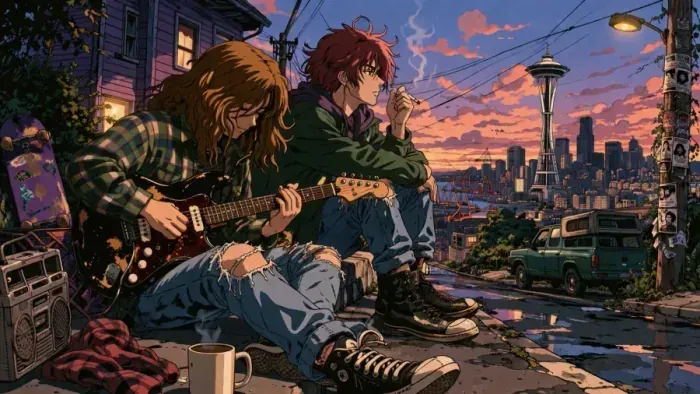
Seattle Before the World Was Watching
People often talk about grunge as if it appeared overnight. The Seattle scene did not work that way. The Pacific Northwest sat far from Los Angeles and New York, and that distance gave local clubs, labels, and bands room to develop without immediate pressure to match national trends.
Sub Pop was central to that ecosystem. Bruce Pavitt and Jonathan Poneman did not invent a single fixed sound. They gathered a loose group of heavy, rough, emotionally direct bands and gave them a visual identity that traveled well. Through sleeves, press, limited releases, and scene-building, Sub Pop helped turn Seattle into a story the wider music press could recognize.
Bands such as Soundgarden, Mudhoney, and Alice in Chains did share some obvious traits: thick guitar tones, slower tempos, and a rougher surface than most mainstream rock. But their differences mattered too. Some drew more from metal, others from punk, hard rock, or psychedelia. “Grunge” worked better as a media label than as a precise musical description.
When Nirvana broke through, that loose scene was compressed into one marketable category. The term grunge became useful to journalists, labels, and retailers even while many of the musicians attached to it disliked the label. What had been a local network suddenly looked from the outside like one coherent movement.
That is the myth that lasted. Grunge is often remembered as a unified style with a stable worldview, but it was really a temporary convergence of local infrastructure, independent ambition, and major-label demand. Some of the roughness audiences heard as authenticity came from aesthetics. Some of it also came from budget limits, geography, and the way the scene had grown before the whole industry noticed it.
Seattle also mattered as a practical ecosystem. Smaller venues, regional press, local word of mouth, and a label like Sub Pop gave bands enough structure to become visible without becoming polished too early. That kind of scene-building is easy to flatten into myth after the fact, but it shaped what audiences later heard as organic emergence. The city did not magically produce grunge. It gave certain bands enough room to become themselves before national attention arrived.
Once major labels rushed to sign similar acts, the original conditions started to change. Attention brought money and reach, but it also brought expectation. A scene that had grown locally was suddenly asked to represent an entire generation. That pressure helps explain both grunge’s force and the speed with which it hardened into cliché.
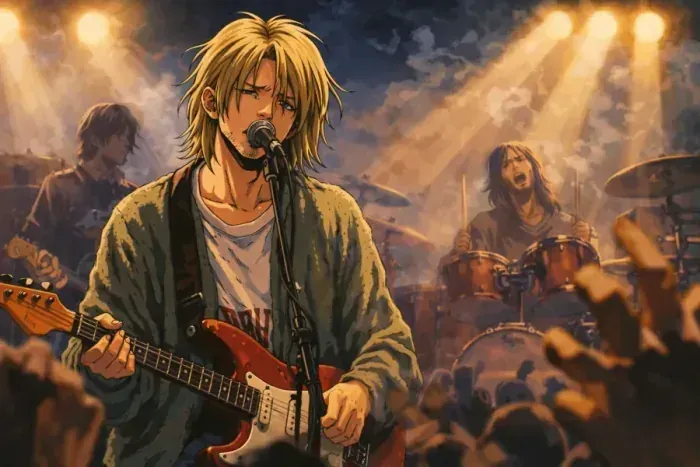
Nirvana: The Voice Kurt Cobain Never Wanted
Nirvana became famous faster than the band could reasonably absorb. When
Nevermind arrived in 1991, it was not framed as a generational manifesto. It was a major-label album built on the underground reputation of Bleach. Its success exceeded almost every expectation and pushed the band into a level of visibility they were not equipped to manage.
For many listeners, Nirvana came to represent refusal. The songs sounded raw, wounded, and uninterested in polish. Very quickly, that sound was turned into a larger cultural role. Kurt Cobain was cast as a spokesperson for alienated youth even though he often seemed deeply uncomfortable with that position in interviews, performances, and public life. Fame did not calm the band. It made the strain around them harder to miss.
That strain grew sharper with In Utero in 1993. Its harsher production and more confrontational tone were widely heard as a pushback against mainstream expectation. But the album still sold at a mass level, showing how easily resistance itself could be folded back into the market. For Cobain, that was not an abstract contradiction. It was daily life.
The media made the pressure worse. Cobain’s politics, addiction, and relationship to fame were often discussed as if they formed one clean story, which they did not. A complicated person was compressed into a symbol. Nirvana were no longer treated simply as musicians. They were expected to carry a broader cultural mood and to do so consistently.
That burden did not stop with Nirvana. Their success changed what labels wanted from alternative artists and what audiences thought authenticity should sound like. The industry began looking for the next act that could sell discomfort, while musicians learned that even visible unease could become part of a brand.
Nirvana’s story is often reduced to tragedy, but that can make the surrounding conditions look smaller than they were. The band was caught at the point where the industry wanted to sell disaffection and the media wanted faces that could embody a wider generational mood. Nirvana mattered because of the songs, but also because their rise showed how much weight a culture can place on artists once it starts asking them to stand for more than themselves.
That is why Nirvana’s breakthrough still reads as more than a chart event. It marked the moment when underground signals, major-label distribution, MTV repetition, and generational projection all locked together at once. The songs were strong enough to carry that burden, but the burden itself became part of the story. That is one reason the band’s meaning kept growing even as the space around it became harder to live in.
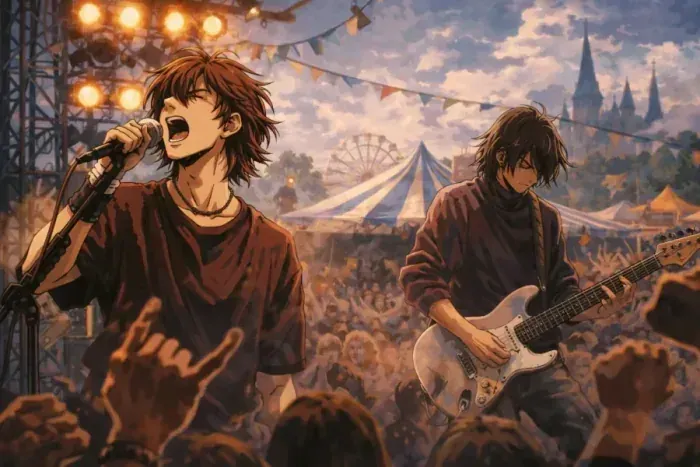
Alternative Rock Spreads Far Beyond Seattle
Seattle became the symbolic center of alternative rock in the early 1990s, but the larger shift was much broader than that story allows. Before grunge became a media obsession, alternative rock was already taking shape in different cities, scenes, and styles. Seattle’s visibility did not create those movements. It changed how the industry grouped them, marketed them, and sold them back to listeners.
In the United States, R.E.M. offered one model of what alternative success could be. Their run from the late 1980s into the 1990s showed that a band could reach a large audience without giving up ambiguity, emotional depth, or album-level ambition. Records such as
Out of Time and Automatic for the People leaned toward melody, reflection, and low-key political unease rather than open confrontation.
Other bands stretched the sound in different directions. The Smashing Pumpkins paired abrasive guitars with melodrama and fragility. Siamese Dream and
Mellon Collie and the Infinite Sadness treated pain as something huge, public, and theatrical. That was far from the stripped-back image associated with grunge, but it spoke to many of the same anxieties.
In the UK, alternative rock developed under different pressures. Blur and Radiohead dealt more directly with class, estrangement, and national identity. Britpop partly defined itself against American dominance and revived a specifically British pop language. Radiohead’s early work, especially The Bends, belonged to that same decade of unease even while pointing toward something stranger and less easily categorized.
What linked these scenes was not one sound, but a weakening faith in older rock myths. The rock star as a figure of easy authority no longer looked convincing. Doubt, self-consciousness, and vulnerability moved closer to the center. Success did not remove that tension. Often it made it harder to hide.
By the middle and late 1990s, the word alternative had become harder to pin down. It described music that was no longer fully marginal but still wanted to signal distance from the center. That contradiction mattered. Alternative rock did not simply replace mainstream rock. It fed it, unsettled it, and slowly became part of it.
The commercial category eventually became broader than the original idea. Radio formats, record stores, and magazines could label very different artists as alternative as long as they seemed more introspective, artful, or uneasy than older arena rock. That looseness helped the music travel, but it also turned a once-sharp cultural distinction into a market segment. The shift says a lot about the decade as a whole: resistance was not outside the system for long.
Lollapalooza and the Festival as Cultural Map
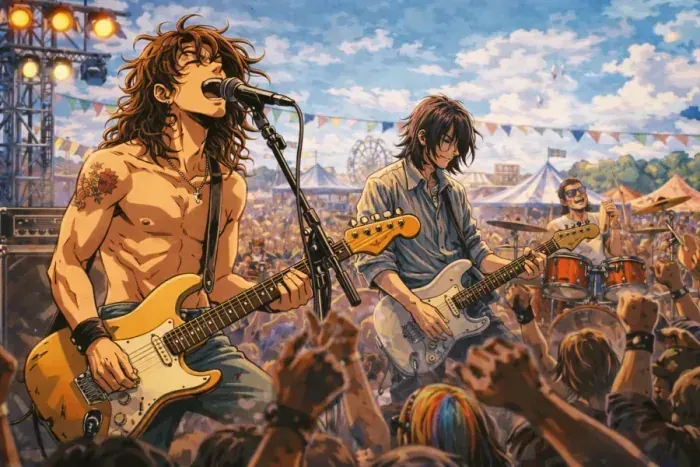
If alternative music redrew the map of rock, festivals made that map visible. Lollapalooza was the clearest example. What began in 1991 as Jane’s Addiction’s farewell tour quickly became a traveling snapshot of youth culture, where alternative rock, industrial music, hip-hop, metal, performance art, and political messaging could share the same space without pretending to belong to one clean identity.
The festival did more than book artists. It staged a whole environment. Scenes that might otherwise have stayed regional, press-defined, or socially separate were placed next to each other among merch booths, activist tables, media crews, and audiences crossing from one style to another. In that setting, fragmentation did not disappear. It became something people could move through together.
Lollapalooza also showed how quickly alternative culture could become organized business. What looked anti-corporate, or at least suspicious of the mainstream, was already turning into a youth market with its own infrastructure. That did not erase the festival’s cultural power. It did expose one of the decade’s central contradictions: scenes built on distinction could still be packaged and sold at scale.
That mix was part of the event’s draw. Fans were not just buying tickets to see one band. They were entering a temporary social map where industrial acts, rappers, metal bands, activists, skaters, and art-school sensibilities met in the same physical space. For many young listeners, festivals became one of the first places where the decade’s fragmentation felt visible rather than abstract.
It also changed how youth culture was sold back to itself. A festival could now function as a brand, a lifestyle signal, and a touring marketplace all at once. That did not erase the excitement of seeing unexpected artists share a bill. It simply meant that counterculture and commerce were no longer easy opposites. In the 1990s, they often arrived in the same parking lot.
Women Reframed the 1990s
As alternative rock reshaped mainstream expectations, women were also changing who could take up space in popular music and on what terms. The old barriers did not disappear, but they were challenged more openly and across a wider range of styles. Women appeared as punk frontwomen, singer-songwriters, experimental pop artists, and chart-dominating stars, often while fighting the same industry systems that profited from them.
What linked these different paths was a stronger claim to authorship. Writing songs, controlling image, and speaking directly about desire, anger, trauma, and power became more central to how women artists defined their work. None of that came easily. Women still faced harsher scrutiny, and their authority was still treated as less secure than men’s. But in the 1990s, those double standards became harder to deny.
From feminist punk to global pop stardom, women changed the decade’s sound, visibility, and idea of power. Sometimes that power was loud and collective. Sometimes it was intimate and hard to package cleanly. In both cases, it shifted what popular music could say and who got to say it.
The shift mattered at several levels at once. It changed lyrical subject matter, because desire, rage, bodily autonomy, and self-definition were being voiced differently. It changed authorship, because more women insisted on writing, arranging, producing, or visually directing their own work. And it changed critical debate, because the old habit of treating women as interpreters rather than central makers became harder to sustain.
The change was not uniform, and the backlash never disappeared, but the center of gravity moved. Women were no longer appearing only as exceptional figures inside male-defined genres. They were setting the terms of whole conversations about anger, sexuality, confession, authorship, and the business of fame. That shift is one of the clearest reasons the decade still feels structurally important.
Riot Grrrl: When Punk Met Feminism
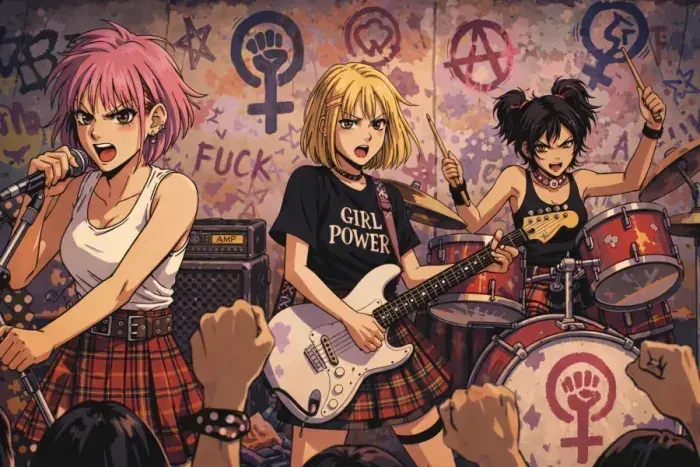
Riot Grrrl was less a genre than a response to exclusion inside punk itself. Many women in those scenes recognized that spaces claiming to reject mainstream power still reproduced familiar hierarchies. In the early 1990s, young women across the United States built their own networks through small shows, meetings, handmade zines, and local organizing. Music was central, but it was never separate from activism, conversation, or community.
Bands like Bikini Kill, Bratmobile, and later Sleater-Kinney used punk’s rawness as a tool rather than a style pose. Their songs were often short, loud, and direct. The point was not technical complexity. It was force, address, and refusal. Lyrics confronted sexual violence, bodily autonomy, anger, friendship, and survival without softening themselves to make listeners comfortable.
Kathleen Hanna became a key figure not because she pursued conventional stardom, but because she said openly what rock culture often pushed aside. Her practice of asking women and girls to move to the front of the crowd was practical, symbolic, and necessary. Riot Grrrl was about changing what music said, but also about changing how musical space worked.
Zines were part of that same effort. They carried personal stories, political writing, art, and scene information through a low-budget media network outside the mainstream press. That mattered because participants could represent themselves instead of being translated through journalists or industry gatekeepers.
When the mainstream press did take notice, it often flattened the movement into caricature. Riot Grrrl was dismissed as angry, naive, or exclusionary, which erased how internally varied and self-critical the scene actually was. Many participants responded by withdrawing from the media. That narrowed public understanding, but it also made the movement harder to absorb and repackage.
Riot Grrrl was messy, uneven, and often internally conflicted. That is part of the point. Its force lay less in formal unity than in permission. It made room for women to be loud, unfinished, and uncompromising, and it widened who could use music to speak that directly.
Its afterlife reached beyond the original scenes in Olympia, Washington, and Washington, D.C. Later feminist punk, indie rock, DIY publishing, and youth activism all drew from its methods, even when they rejected parts of its politics or demographics. Riot Grrrl did not solve the exclusions inside rock culture. It made them harder to ignore and gave younger artists a vocabulary for naming them.

Tori, Alanis, PJ Harvey: Anger Without Apology
Alongside feminist punk, another shift took shape through songwriting. A generation of women singer-songwriters entered public life with unusual force and without much interest in softening conflict for easier consumption. Personal experience was not treated as mere confession. It became a way of knowing, arguing, and pushing back.
Tori Amos, Alanis Morissette, and PJ Harvey all approached that territory differently, but none of them treated vulnerability as something that had to sound gentle or reassuring. Amos wrote openly about sexual violence, religion, and power, often through the piano-led intensity of Little Earthquakes. The songs did not offer neat solutions. They asked listeners to sit with discomfort.
Jagged Little Pill reached a huge audience without sanding down Alanis Morissette’s anger. Songs like “You Oughta Know” were often reduced to revenge or release, but their force came from how openly they claimed public space. Morissette let anger, confusion, and vulnerability stay in the same voice.
PJ Harvey worked from another angle. Her songs were not always plainly autobiographical. She used characters, sharp imagery, and unstable points of view to explore desire, violence, and power. Records like Rid of Me and To Bring You My Love asked listeners to stay alert rather than settle into easy identification. Emotional honesty, in her work, did not need to be literal to feel real.
What these artists shared was not one style, but control over their own terms. They wrote their songs, shaped their sound, and defined a public identity that felt authored rather than assigned. In an industry that often treated female feeling as content, that control changed how sincerity was heard. Emotional openness no longer had to read as weakness. It could register as authority.
The shift also reached the live business. In 1997, Sarah McLachlan cofounded Lilith Fair, creating a major touring platform at a time when parts of the industry still treated women-led lineups as commercially risky. The festival did not solve deeper inequalities, but it made one fact harder to deny: women were not a niche category. They could anchor a large live-music economy on their own terms.
That mattered because the old industry excuse had been practical as much as ideological. Promoters and radio programmers often claimed that audiences would not support multiple women on the same bill or women-centered formats at scale. Lilith Fair exposed how weak that assumption was. The demand had been there. The gatekeeping had been cultural and industrial, not natural.
It also changed the optics of scale. Women had always been central to popular music, but they were still regularly discussed as if they belonged to separate categories rather than to the core of the business. A touring institution like Lilith Fair made that argument harder to maintain. It showed that women could shape not only songs and albums, but the economics of live music, sponsorship, and audience formation.
Madonna, Janet, Björk: Reinvention as Power
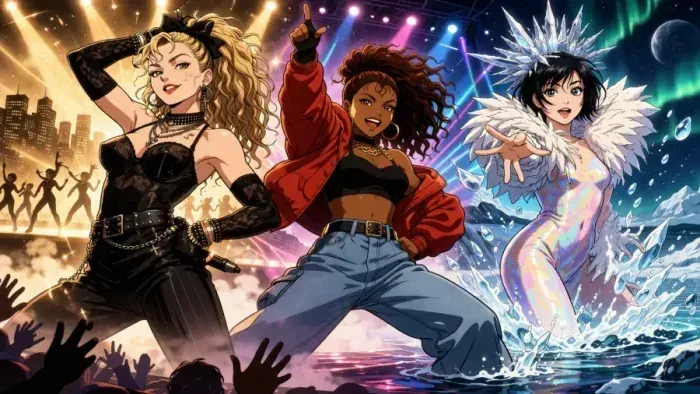
While alternative scenes and singer-songwriter traditions changed ideas of intimacy and authorship, mainstream pop was also being redefined by women with unusual command over visibility. In the 1990s, being a female pop star was not simply about presence. It was about control, negotiation, and strategic reinvention inside an industry that still often treated women as interchangeable.
No one illustrated this more clearly than Madonna. Already globally famous by the start of the decade, she refused to stabilize her image. Projects like Erotica and Sex confronted public discomfort directly, blurring provocation, critique, and self-authorship. The backlash was immediate and intense, but it also exposed how narrow the acceptable range of female expression remained.
Janet Jackson represented a different kind of power. Across the transition from Rhythm Nation 1814 into her 1990s work on janet. and later The Velvet Rope, she joined technical precision to emotional openness. Working with Jimmy Jam and Terry Lewis, Jackson emerged not as a passive star, but as a central creative force.
Elsewhere, Bjork pushed pop in another direction. Drawing on electronic, alternative, and art-pop traditions, she treated pop as something flexible rather than fixed. Albums like
Debut and Post paired accessibility with risk and made more room for artists who did not fit familiar ideas of femininity, restraint, or polish.
What linked Madonna, Janet Jackson, and Bjork was not genre, but control over exposure. Each had to work inside a system that demanded constant visibility while offering limited protection. Reinvention, collaboration, and ambiguity were not style flourishes alone. They were practical ways to keep agency inside stardom.
The power dynamics around female fame were still unequal, but these artists widened what women could publicly say, stage, and control in pop. Their influence reached style, the business itself, and the larger public idea of who a female star could be.
They also showed that female stardom in the 1990s was never one simple model. Madonna used provocation and theory-literate control over image. Janet Jackson worked through rhythm, sensuality, choreography, and emotional precision. Bjork pushed art-pop experimentation into mainstream visibility without adopting the usual scripts of polish or compliance. Taken together, they made it much harder to pretend that women in pop were interchangeable.
They also changed the terms on which risk could appear in mainstream pop. Madonna could force public arguments about sex and authorship. Janet Jackson could make interiority and vulnerability feel central inside a highly choreographed star image. Bjork could pull electronic textures, odd phrasing, and art-school unpredictability into spaces that were still recognizably pop. Their careers widened the mainstream by refusing to let it settle into one acceptable script of womanhood.
Hip-Hop Takes the Throne
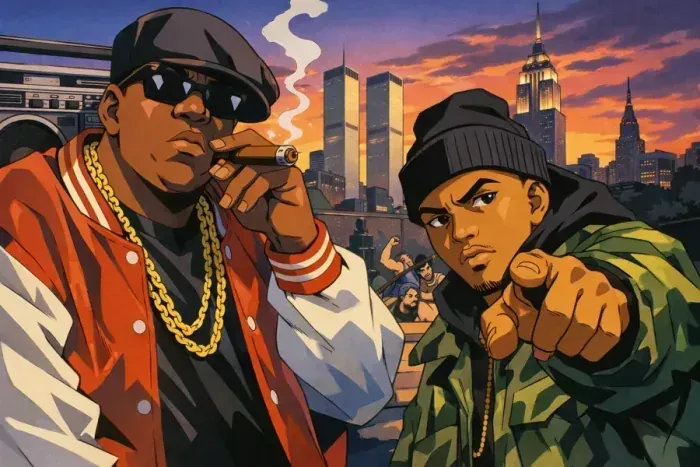
At the same time, hip-hop moved from the edge of popular culture to the center of it. What many gatekeepers had once treated as regional, local, or temporary became one of the defining musical languages of the decade. That rise brought money, reach, and artistic ambition. It also brought new pressure.
As hip-hop expanded, it was asked to do several things at once. It had to stay legible to the communities that made it, reach larger audiences, carry political meaning, survive commercial growth, and resist being reduced to stereotype. Different artists answered those pressures in very different ways. Some leaned into direct politics. Others pushed storytelling, regional identity, production craft, or lyrical precision.
Public Enemy, Nas, and Tupac Shakur each worked inside that changing field. Major-label investment, wider media attention, and sharper public scrutiny all changed what the genre could say and how it would be heard. Hip-hop’s arguments about power, visibility, and representation did not stay inside rap. They became part of the decade’s larger argument about public culture.
That rise also changed everyday listening. Rap was no longer only something discovered through specialist radio, dubbed tapes, or local reputation. It was increasingly present on MTV, in shopping malls, in movie soundtracks, in suburban bedrooms, and in the broader language of youth style. Once that happened, hip-hop stopped being legible only as a scene. It became one of the main ways the decade heard confidence, narrative, conflict, and public speech.
That move to the center did not flatten the genre, but it did raise the stakes of every internal argument. Questions that had once played out within scenes now played out in full public view: who counted as authentic, who got called commercial, whose politics were praised, whose anger was feared, and how labels packaged local realities for wider consumption. The bigger hip-hop became, the harder it was to separate artistic debate from economic power.
The Golden Age Goes Mainstream
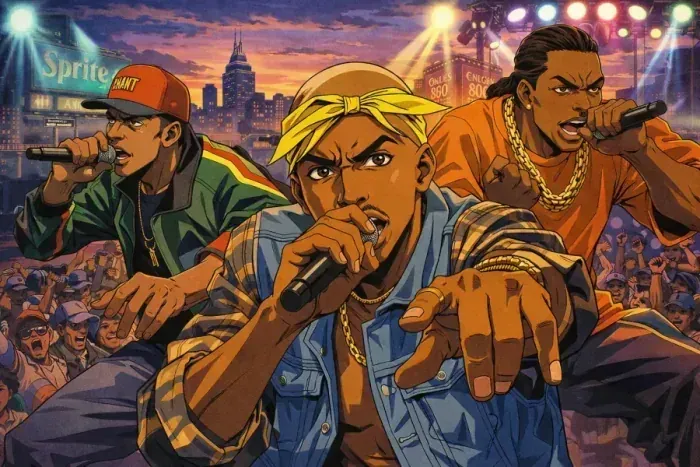
By the early 1990s, hip-hop already had enough history to argue with itself. The Golden Age had set a high standard for lyricism, politics, and sonic invention. Rap no longer had to prove it could be serious. The next question was whether it could grow without losing its force.
A Tribe Called Quest answered that question with unusual ease. Albums like
The Low End Theory paired jazz-shaped production with conversational intelligence and formal control. Their music suggested that expansion did not have to mean shouting louder. Even as rap reached bigger audiences, subtlety could still carry.
Nas took a more compressed route. Illmatic, released in 1994, was not built like a conventional radio blockbuster, yet it became one of the decade’s central rap records. Its force came from specificity. Instead of generalizing, Nas filled his writing with voices, scenes, and pressures from Queensbridge. The album raised the bar for what rap lyricism could do, regardless of chart scale.
Meanwhile, the business of hip-hop was changing fast. Once rap’s cultural and commercial power became impossible to ignore, major labels invested harder. That expanded production, distribution, and visibility, but it also changed the terms. Singles, videos, and marketable identity became more important. Success was measured more often through charts, airplay, and broad recognizability.
Public Enemy made that tension especially clear. Their earlier records had established rap as a vehicle for direct political confrontation. As hip-hop reached larger audiences, it became harder to sustain that same level of militancy inside the mainstream. Audiences often wanted the image of radicalism more readily than its substance. The question was no longer whether hip-hop could be political. It was how much politics mass culture would actually allow to circulate. "Rap is an introduction. If people really want to learn something, they got to pick up some books."
The move from Golden Age autonomy to Billboard visibility was not just a story of compromise. Many artists used a larger platform to sharpen rather than dilute their work. But the audience had changed. Hip-hop was no longer speaking mainly to itself. It was being heard by larger publics that did not always share the experiences, stakes, or local knowledge behind the music.
That set the tone for the rest of the decade. Hip-hop’s rise was undeniable, but so were the questions that came with it: who gets represented, who gets simplified, and what it costs a culture once the center starts paying attention.
What made the period so fertile is that growth did not erase argument. Rap became larger without becoming settled. New audiences arrived, but older pressures remained. The music kept carrying neighborhood detail, regional pride, political anger, entrepreneurial drive, and formal experimentation all at once. That tension is part of why the decade’s rap still sounds alive rather than simply canonical.
East vs. West: When Rivalry Turned Tragic
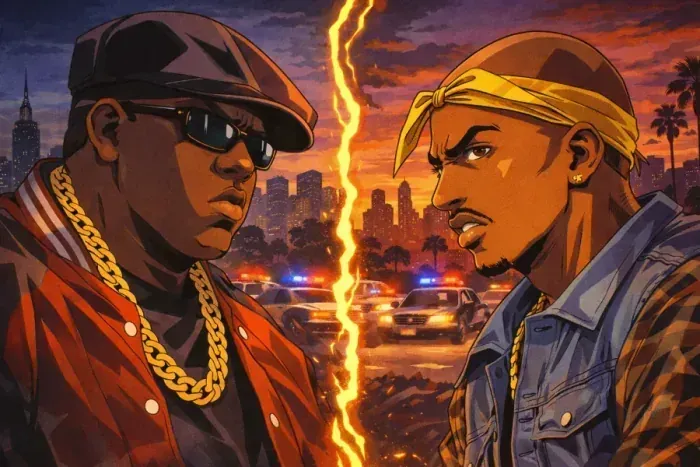
As hip-hop’s audience grew in the mid-1990s, regional difference became one of its most visible lines of conflict. Scenes had always been distinct, but national media, major labels, and a story-hungry industry amplified those differences into a simpler drama. East Coast and West Coast were framed as rivals rather than as broad, overlapping traditions.
On the West Coast, Tupac Shakur brought emotional intensity and political contradiction into full public view. His music moved between vulnerability and aggression, empathy and rage. Albums like Me Against the World and All Eyez on Me carried the pressure of structural injustice, personal conflict, and extreme visibility. That complexity helped make him iconic, but it also made him easy to reduce to symbol. "Every time I speak, I want the truth to come out."
On the East Coast, The Notorious B.I.G. projected a different kind of authority. His storytelling was detailed, rhythmically assured, and darkly funny about ambition and consequence. Ready to Die made survival, compromise, and desire legible without turning them into moral lessons. His force came from precision.
The rivalry was shaped as much by the machinery around the music as by the music itself. Magazines, radio, and television turned regional difference into personal conflict because conflict drew attention. Labels benefited from the visibility, and artists were pushed to perform loyalty in public. Nuance had a hard time surviving inside that setup.
It is also easy to forget how many artists never fit the binary at all. West Coast hip-hop was never one sound, and East Coast rap was never one politics. But once the rivalry became narratively useful, the story started reshaping reality.
The deaths of Tupac Shakur and The Notorious B.I.G. remain among hip-hop’s deepest wounds. They are often framed as cautionary tales, but that can make the surrounding structures look smaller than they were. These were personal tragedies, but they were intensified by an industry that blurred representation and exploitation and by a media culture that treated conflict as content.
That period forced hip-hop to confront the cost of visibility itself. The genre had become central to popular culture, but centrality brought distortion with it. Regional pride turned into competitive branding, and personal expression became a symbolic burden.
The tragedy of the rivalry is not only that it ended in death. It is that a complicated musical map was turned into a digestible morality play for national consumption. That distortion left a mark on how hip-hop would be covered for years. It taught labels and media how profitable conflict could be, and it taught artists how hard it could become to control the story once the story itself started generating money.
Lauryn Hill, Missy Elliott, Queen Latifah: Breaking the Boys' Club
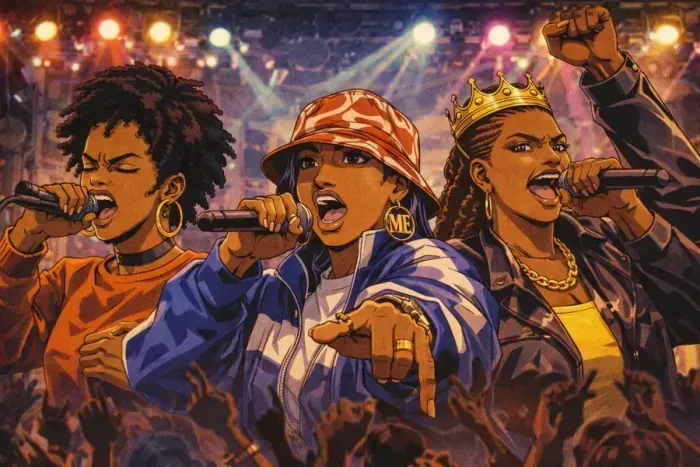
As hip-hop grew in cultural and commercial power, women artists ran into a familiar problem. Visibility increased, but authority did not automatically follow. Female MCs were still often treated as exceptions rather than as central contributors. Even so, their work expanded the genre’s emotional and political range in lasting ways.
Queen Latifah challenged those limits early and directly. Her music combined social criticism with confidence and rejected the idea that strength had to sound hard or emotionally closed. Songs like “U.N.I.T.Y.” addressed misogyny without relying on shock value. They made respect sound basic rather than rhetorical.
Lauryn Hill brought another kind of authority. Her work with the Fugees and then
The Miseducation of Lauryn Hill fused rapping and singing in ways that widened hip-hop’s emotional vocabulary. Her writing kept returning to identity, faith, love, and self-worth. The album expanded her reach immediately, but it also placed a huge set of expectations on her almost at once.
Missy Elliott came in from another angle. Emerging late in the decade, she brought humor, strangeness, and visual invention into the center of rap and R&B. Her work with Timbaland used rhythms and textures that sounded unfamiliar on mainstream radio, while her videos rejected more conventional ideas of femininity. With Missy, authority could come through play, distortion, and formal daring as much as through confrontation.
What connected these artists was not a single style, but a refusal of the narrow roles the industry kept offering them. Queen Latifah made dignity sound nonnegotiable. Lauryn Hill made emotional and spiritual seriousness commercially undeniable. Missy Elliott made radical playfulness impossible to dismiss as lightweight. Each of them changed the genre’s range by proving that women in hip-hop did not have to choose between intellect, performance, vulnerability, humor, and technical command.
Even with those breakthroughs, the structural limits remained obvious. Women were still asked to stand in for all women in hip-hop, a burden male artists rarely carried. Support was uneven, and recognition was inconsistent. Success was still too often described as an exception instead of evidence that the system itself was narrow.
Women changed 1990s hip-hop by changing how respect, intimacy, wit, joy, and doubt could sound inside the genre. By the end of the decade, representation was still unequal, but the conversation had shifted too far to reverse. Rap’s future could no longer be imagined without them.
That shift was musical, visual, and structural at once. These artists changed how verses could move, how videos could stage female presence, and how authority itself could sound. They made it harder for the genre to keep mistaking male experience for universal experience. Once that happened, the limits of the old boys’ club were no longer invisible.
Pop and R&B: Emotion Meets Industry
While hip-hop was expanding, pop and R&B were becoming the decade’s dominant commercial forms. Their success came not only from songs, but from systems: songwriting teams, producer networks, international studios, and tightly managed release schedules. By the 1990s, pop feeling was often built through highly organized machinery.
That did not make the music emotionally thin. Quite the opposite. Some of the decade’s biggest pop and R&B records were also some of its most direct. Artists like Mariah Carey, TLC, and Boyz II Men sang about intimacy, vulnerability, and desire in ways that felt immediate even when the records were shaped by large professional systems.
The decade also pushed pop production further across borders. Scandinavian studios, European dance influences, and transnational collaborations increasingly shaped the mainstream. Pop and R&B became places where emotional closeness and industrial precision had to live side by side, and that made questions of authorship and control harder to ignore.
This was also the decade when mainstream radio became unusually dense with different kinds of polish. Adult-contemporary ballads, radio R&B, dance-pop, slow jams, vocal groups, and teen-oriented singles all shared space, but they did not sound interchangeable. The hit system worked because producers and labels learned how to target very specific emotional registers. One song promised romantic safety. Another promised glamour. Another promised heartbreak, healing, or group belonging. The market became more segmented, but it also became better at making each segment feel personal.
That tension gave 1990s pop and R&B much of their force. A song could be the result of committee-level planning and still become part of somebody’s private life. A ballad built through layers of co-writing, label input, and expensive studio time could still become the song someone played after a breakup or during a long bus ride home. The machinery was real, but so was the feeling.
That duality helps explain why the era still holds up. The records were often carefully built, but they rarely sounded emotionally distant at their best. A Mariah Carey single, a TLC record, or a Boyz II Men ballad could feel both massively engineered and startlingly close. The decade did not resolve that tension. It perfected it.
Producers Become Stars: The Architects of Pop
One of the biggest changes in pop and R&B happened behind the microphone. Performers still mattered, but more creative power now sat with producers, songwriting teams, and studio systems designed to make hits reliably. That changed how records were made and how success was measured.
Jimmy Jam and Terry Lewis are one of the clearest examples. Their long partnership with Janet Jackson showed that production could shape an artist’s identity over years rather than simply deliver the next single. Albums like janet. and
The Velvet Rope were highly structured records, but they still felt emotionally open and specific.
In Stockholm, another powerful system was taking shape. Producers like Denniz Pop and Max Martin built songs around melodic efficiency, clean structure, and instant emotional readability. Their records moved easily across markets because they were built to travel.
That did not mean they were generic. The skill was in compression. A great pop producer in the 1990s learned how to make the first seconds of a song count, how to pace pre-chorus lift, how to give a chorus just enough repetition to feel obvious without feeling dead. Most listeners were not thinking in those technical terms, but they felt the result. Songs arrived already optimized for recall.
That approach changed the economics of pop. Songs became more modular and more portable. Artists could enter an existing hit-making framework instead of building every element from scratch. That gave some performers faster access to visibility, but it also raised sharper questions about replaceability and authorship.
R&B felt these changes strongly. The genre had always depended on strong writers and producers, but those collaborative systems became even more central in the 1990s. At the same time, artists like Mariah Carey fought for more say over writing and production even as records involved more people behind the scenes.
The producer era did not remove personality from music. It changed where that personality was assembled. Emotion still mattered, but it was shaped with much more precision. Hooks were built to stay in the ear. Choruses were built to land fast and feel inevitable. By the end of the decade, this logic had become foundational to mainstream pop.
Another late-1990s shift came through vocal processing. Auto-Tune was introduced in 1997, but it became unmistakably audible in mainstream pop after Cher’s “Believe” in 1998. The effect did more than smooth pitch. It made studio intervention easier to hear and, in some cases, easier to enjoy. In a decade already questioning what counted as authentic, technology no longer had to hide in the background. It could become part of the sound’s expressive surface.
By the end of the decade, listeners were hearing the producer’s hand more clearly than before, even if they did not always know the names behind the records. Pop was no longer just singer-centered. It was architecture. The arrangement, drum programming, vocal stack, and mix balance were becoming as culturally decisive as the star at the microphone.
That change shaped careers at every level. A singer could become famous by entering an already refined production world, but that same refinement made the question of authorship harder to ignore. Who was making the emotional impact: the vocalist, the songwriter, the producer, the mix, or the whole machine working together? The 1990s did not answer that cleanly. They made the question impossible to avoid.
R&B's Balance of Intimacy and Scale
R&B held a special place in the 1990s because it was both intimate and highly commercial. It stood in a long line of Black musical expression, but it also sat near the center of the global industry. Many R&B artists learned how to keep emotional closeness intact even inside very large commercial systems.
Mariah Carey is one of the clearest examples. She first broke through with ballads and sheer vocal force, but over the decade her music absorbed more hip-hop rhythm, contemporary production, and more explicit expressions of desire. Albums like
Music Box and Daydream made it harder to treat her as just a great voice. She was also an increasingly assertive writer and arranger in an industry that often downplayed her authorship.
Boyz II Men gave the genre another kind of scale. Their mix of gospel-shaped harmony, classic soul feeling, and polished 1990s production made vulnerability sound mainstream at a time when cynicism often carried more critical prestige elsewhere.
TLC made the picture more complicated in a productive way. Their music joined playful confidence to direct talk about safe sex, financial independence, and self-worth. Albums like CrazySexyCool and FanMail were accessible and sharply commercial, but they also carried critique. Their contract disputes showed how limited the promised freedom of pop stardom could still be.
What made 1990s R&B so durable was that it held several emotional temperatures at once. It could be polished without feeling empty, sensual without becoming anonymous, and technically exact without losing the grain of a real voice. Producers were refining drum programming, vocal layering, and harmonic pacing, but the best records never felt like engineering exercises. They felt inhabited.
Toward the end of the decade, R&B also turned more inward. The Miseducation of Lauryn Hill was a key moment not only because it sold so well, but because it made faith, doubt, vulnerability, and self-definition feel central rather than secondary.
What defined 1990s R&B was this balance between emotional truth and professional control. The genre never pretended that feeling and business were separate. It kept asking whether real intimacy could survive inside large-scale commercial systems, and for much of the decade the answer sounded like yes.
That is why the genre became such a powerful bridge between scenes. R&B could absorb hip- hop production, keep soul’s emotional inheritance, and still operate inside pop’s global circulation. It connected the personal to the professional more gracefully than almost any other mainstream form of the decade. In doing so, it helped define what modern pop emotion would sound like.
Teen Pop Takes Over the World
By the late 1990s, teen pop had become one of the industry’s strongest forms. It is often dismissed as shallow or manufactured, but that misses how precisely it fit its moment. Teen pop did not pretend to be spontaneous. It offered a managed version of relatability that balanced innocence, ambition, and emotional accessibility for listeners, parents, labels, and advertisers at the same time.
Britney Spears became famous inside exactly that kind of system. Her debut album,
…Baby One More Time, turned teenage desire, uncertainty, and longing into hooks that felt immediate without sounding too threatening to the adults controlling the market. What looked effortless on screen was the result of deliberate work in songwriting, choreography, styling, and media training.
Groups like the Backstreet Boys and the Spice Girls helped make that model global. The Backstreet Boys emphasized harmony, polish, and emotional clarity. The Spice Girls used distinct public personas and the language of “girl power” to build a pop identity that was playful, accessible, and commercially sharp, even when it simplified feminist politics.
Teen pop also forced a different conversation about authenticity. Critics often dismissed these artists as lacking depth or control, but many of them were managing extraordinary scrutiny while still very young. In this world, authenticity had as much to do with performance as with authorship. Listeners were asked to believe in emotional sincerity while fully accepting that the product was carefully constructed.
By the late 1990s, the production system behind pop was fully integrated. Songwriters, choreographers, image consultants, publicists, and marketing teams all worked to keep the music, the videos, the tours, and the public image aligned. MTV’s Total Request Live, which launched in 1998, helped turn that alignment into a daily promotional loop built on video rotation, fan voting, and after-school visibility. Inside that system, mistakes, aging, or visible discomfort were often treated as management problems instead of normal parts of growing up.
Teen pop also understood branding with unusual clarity. The Spice Girls were presented as distinct personalities that fans could sort themselves into. The Backstreet Boys and NSYNC turned group dynamics into an emotional sales structure, where each member offered a slightly different fantasy of charm, sensitivity, rebellion, or romantic safety. These acts were carefully managed, but their appeal was not hollow. They gave young listeners repeatable emotional scripts and social language.
Teen pop showed how efficiently emotion could be packaged and distributed at scale. It also exposed the cost of doing that to very young performers. Many artists who passed through this machinery later spoke openly about burnout, control, and the pressure to stay constantly available.
That is why teen pop matters beyond nostalgia. It worked as a mirror of its time. It showed a culture growing comfortable with the idea that realness itself could be staged, managed, and sold.
It also trained the next era of pop consumption. Fan clubs, countdown shows, merchandise, carefully managed interviews, and the constant circulation of celebrity images helped build habits that would later intensify online. In that sense, late-1990s teen pop was not only an endpoint for old-school promotion. It was a bridge to the more continuous fandom economy that followed.
The scale of the phenomenon also changed how the industry thought about youth itself. Teenagers were no longer only a demographic to be reached through radio. They were an integrated commercial world of television, mall retail, magazines, concert tours, merchandise, and school-day conversation. Teen pop worked because it linked all those spaces together. The songs mattered, but so did the posters, the choreography, the interviews, and the shared language of crushes, allegiance, and identity.

Heavy Music's Crisis of Identity
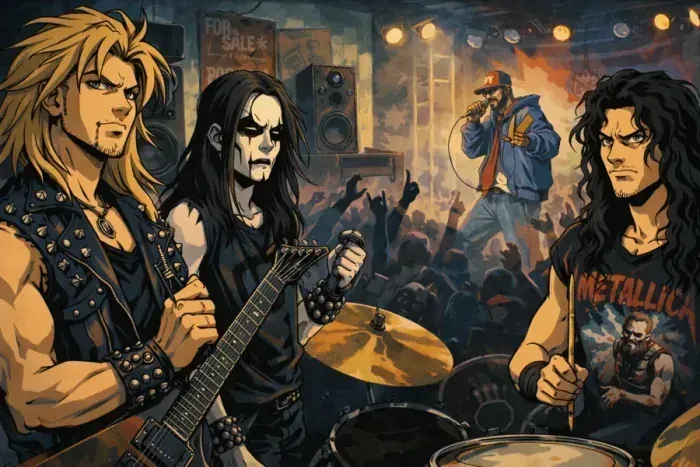
Away from chart-centered pop, heavy music did not disappear in the 1990s. It had to change. Metal and hard rock were suddenly facing new expectations around masculinity, spectacle, and emotional credibility, and not every older form of heaviness survived that pressure well.
Many critics now heard traditional metal as stiff, overperformed, or emotionally empty, even while it kept a large audience. Younger listeners were moving toward music that dealt more openly with frustration, alienation, and vulnerability. Heavy music responded by absorbing new influences, stripping away some of its showier habits, and shifting emphasis from virtuosity to mood and impact.
Metallica, Nine Inch Nails, and Tool each pushed that change in different ways. Their music still carried force, but heaviness now sounded less like conquest and more like strain, pressure, or self-conflict.
That mattered because heavy music became one of the places where masculinity stopped looking automatic. Anger stayed central, but it increasingly sat next to fragility, obsession, doubt, and emotional exposure.
The old divide between “serious” heavy music and supposedly less credible forms also began to crack. Industrial textures, hip-hop rhythms, slower grooves, and more openly damaged vocal performances entered the frame. What counted as heaviness was expanding. It no longer depended only on speed, technical showmanship, or heroic posture. It could come from mood, repetition, psychological pressure, or sheer bodily weight.
This made the genre harder to map from the outside, but more revealing from the inside. Heavy music in the 1990s was no longer arguing only about riffs or skill. It was arguing about what kind of masculinity still felt believable, what kind of anger still felt earned, and whether power had to sound triumphant in order to sound real. Those arguments gave the music a different emotional charge than it had carried in much of the previous decade.
Metal Adapts or Fades Away
In the early 1990s, metal was still commercially strong, but parts of it had hardened into routine. Musical codes that once signaled prowess and confidence now felt stale to many critics and younger listeners. Metal did not vanish. It had to recalibrate.
Metallica made the adjustment in the clearest mainstream way. Their 1991 self-titled album, usually called The Black Album, favored simpler structures, tighter production, and weight over speed. Some fans heard that as a sellout move. But it also matched a broader shift in taste toward directness and impact over technical excess. The album proved that metal could become leaner without becoming weak.
Other bands changed course differently. Megadeth kept pushing precision even as the sound grew more streamlined. Pantera moved toward a harder, more bodily sense of force.
Vulgar Display of Power stripped away polish and made anger feel immediate rather than stylized. That appealed to listeners who felt disconnected from both mainstream optimism and alternative cool.
Outside the United States, metal was also mutating in ways the mainstream often missed. Sepultura, especially on Chaos A.D., fused groove, percussion, and political charge in ways that challenged the idea of metal as either purely Western or politically empty.
Not every response meant crossover. Some corners of the metal world simply pulled back from mainstream visibility and invested more fully in self-sustaining subcultures. That made the genre harder for outsiders to read, but it also protected its internal range.
That retreat mattered. As alternative rock and hip-hop dominated wider cultural conversation, metal scenes often became more self-conscious about who they were for and what kinds of loyalty they expected. Fanzines, specialist press, touring circuits, and word-of-mouth scenes kept carrying music that the broader market no longer centered. The genre survived not by staying culturally dominant, but by becoming more internally diverse.
Across all these paths, one thing had changed: metal could no longer rely on sheer impressiveness. It had to mean something emotionally again, or at least feel urgent in a new way.
That urgency could take very different forms. In one band it sounded disciplined and lean. In another it sounded bruised, political, claustrophobic, or physically overwhelming. The important change was that heaviness had stopped being self-justifying. It now had to carry some larger pressure with it, whether social, psychological, or bodily.
Alternative Metal: Heavy Music Looks Inward
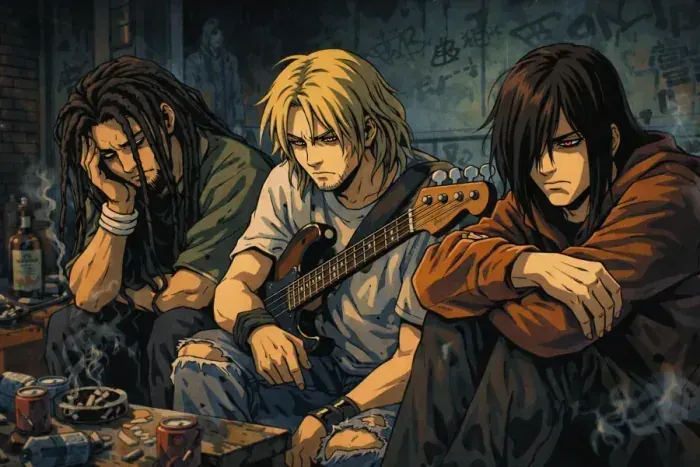
As metal reworked itself, another kind of heaviness moved into focus. Alternative metal was not anti-metal. It was metal turned inward. These bands used distortion, repetition, and volume to carry anxiety, obsession, and vulnerability rather than simply stage power.
Nine Inch Nails were central to that shift. Trent Reznor fused industrial textures with confessional writing, and records like The Downward Spiral treated self- destruction as an ongoing process rather than a dramatic pose. The music stayed abrasive and unresolved. It did not pretend pain had already been mastered.
Tool worked differently. Their long, controlled structures stretched tension instead of releasing it quickly. The lyrics kept returning to power, spirituality, and self-scrutiny without collapsing into slogans. On AEnima, heaviness came through focus and pressure rather than through speed or excess alone.
Faith No More pushed against expectation by refusing stylistic stability. They moved among metal, funk, pop, and noise in ways that made coherence itself feel unstable. Mike Patton’s voice could switch from aggression to irony to vulnerability without settling into one masculine role.
Industrial music fed this shift too. Ministry and related acts had already shown that mechanized rhythm, sampled abrasion, and authoritarian imagery could be repurposed into a different kind of heaviness, one shaped as much by modern alienation as by rock tradition. By the mid-1990s, heavy music was borrowing from machines, cinema, and psychological horror as much as from blues-based riff history.
Deftones opened another lane. Their music paired weight with desire, atmosphere, and uncertainty. Albums like Around the Fur suggested that aggression and intimacy could sit in the same sound, which helped pull in listeners who felt alienated by both traditional metal’s rigidity and alternative rock’s cool detachment.
What made alternative metal matter was not novelty on its own. It gave heavy music new emotional room. Masculinity no longer had to sound sure of itself. It could sound wounded, searching, or unstable, and that change carried well beyond the 1990s.
That expansion of emotional room is one reason so much later heavy music still traces back to the decade. The inward turn did not make the music less forceful. It made force feel more psychologically dense. The scream, the riff, the loop, and the breakdown were no longer only demonstrations of aggression. They became ways of staging obsession, alienation, self-disgust, or spiritual confusion.

Nu Metal: The Genre Critics Loved to Hate
By the late 1990s, heavy music’s internal tensions were fully visible to a mass audience. Nu metal emerged from a mix of styles, frustrations, and social pressures that many critics were quick to dismiss. It sold extremely well, but it was also treated as crude, regressive, or self-pitying. That reaction said as much about taste hierarchy as it did about the records themselves.
Korn made heaviness sound more vulnerable, raw, and unresolved. Their early records used down-tuned guitars and repetitive grooves to create a sense of confinement, while Jonathan Davis sang in a voice that felt painfully direct rather than distant or coded. That blunt emotional register connected with listeners who felt shut out of more ironic or more prestigious scenes.
Limp Bizkit represented a different side of the same world. Their mix of metal, hip-hop, and open provocation tapped into resentment and defiance that many critics wrote off as tasteless or juvenile. But the size of their audience showed those feelings were socially real. Nu metal drew heavily from working-class listeners and suburban kids who often felt mocked by cultural gatekeepers.
By the decade’s edge, nu metal was already moving toward a more melodic mainstream shape. Linkin Park’s Hybrid Theory arrived in October 2000, just outside the decade, but it shows where some of this tension was heading: toward a heaviness built as much from emotional strain and introspection as from confrontation.
Nu metal became a target partly because of its sound and partly because it refused existing taste hierarchies. It mixed genres freely, ignored many critical rules, and talked about pain in blunt language. Many listeners heard that as honesty. Many critics heard it as failure.
Its visual language mattered as well. Sportswear, Adidas tracksuits, piercings, oversized silhouettes, and a deliberate refusal of classic-rock cool made the genre look closer to school corridors, skate culture, and suburban frustration than to older rock mythology. That made it easier for audiences to recognize themselves in the music and easier for critics to dismiss it as culturally low-status.
The contempt aimed at nu metal was rarely just about aesthetics. Its audience was often described as uneducated, regressive, or emotionally undisciplined. Those judgments ignored the conditions from which the genre grew: economic uncertainty, social division, and the feeling that earlier promises of authenticity had simply hardened into new forms of exclusion.
Nu metal did not offer elegant solutions. It offered recognition. That is why it mattered. It showed that heaviness was never only about sound. It was also about class, masculinity, legitimacy, and who got to feel publicly understood.
That recognition was often embarrassing to cultural gatekeepers precisely because it was so direct. The genre was not interested in sounding tasteful. It wanted to hit the listener quickly, physically, and without much protective irony. For a lot of teenagers at the end of the decade, that bluntness was not a flaw. It was the point.
Electronic Music Changes the Social Map
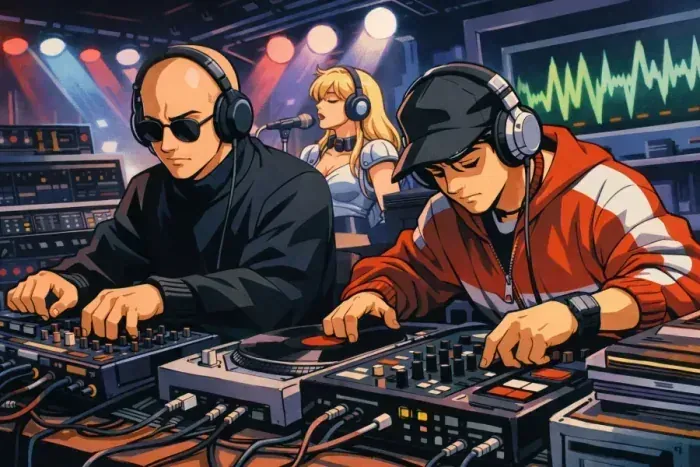
In the 1990s, rock, pop, and hip-hop dominated most mainstream narratives. At the same time, another musical world was spreading through clubs, warehouses, temporary venues, and informal circuits. Electronic music changed not only what people heard, but how they used music socially and physically. For many listeners, its meaning had less to do with artist biography than with atmosphere, movement, and shared time.
Dance culture offered something other parts of popular music were starting to lose: immersion in a collective experience. DJs, producers, and promoters cared more about flow, sound, and the room than about individual stardom. Records worked as tools rather than finished statements, and anonymity could be an advantage rather than a weakness.
That growth also triggered suspicion. News coverage often reduced electronic music culture to panic about drugs, crowds, and loss of control. Governments responded with rules and policing that rarely showed much understanding of the music or the communities built around it. Even so, the culture kept moving, often half-hidden, while spreading internationally.
Clubs, DJs, and scenes were not side stories in the 1990s. They changed everyday musical life in ways that mainstream history often noticed too late.
They also changed ideas of authorship and memory. A huge part of electronic culture lived in nights, rooms, and sequences that were not easily captured by album reviews or chart positions. The important unit was often the set, the party, the mix, the flyer, the rumor, or the feeling of a room at a specific hour. That made the culture harder for old media to summarize, but no less central to the decade.
Electronic music also helped shift value away from the song as confession and toward sound as environment. In many other 1990s genres, listeners were still trained to ask who was speaking and what a lyric meant. Dance culture often asked different questions: how long a track could hold a floor, how a bassline could alter a room, how sequencing could produce collective momentum, and how anonymity could become a kind of freedom rather than a marketing problem.

Club Culture: The Nights That Changed Everything
Electronic dance music began well before the 1990s, but in this decade house and techno became part of everyday life for millions of people. They were more than genres. They were ways of gathering, moving, and spending time together, built around clubs rather than charts and around DJs rather than stars.
In Chicago, house music grew out of Black and queer club culture in the 1980s. Figures like Frankie Knuckles helped shape a sound built for long nights and emotional release. By the 1990s, house had spread internationally, but its core logic stayed the same: repetition, groove, and shared experience. It was made first for the dance floor, not for detached listening. "disco's revenge"
Detroit techno followed a different but related path. Juan Atkins, Derrick May, and Kevin Saunderson described their music in futurist language, but it stayed rooted in the social and economic reality of postindustrial Detroit. Its precision and controlled emotion came from a city shaped by technology, loss, and resilience.
In Europe, especially in Berlin, London, and Manchester, these sounds were taken up in new ways. Clubs became meeting points for different scenes and youth cultures. After the fall of the Berlin Wall, abandoned buildings and temporary freedoms helped techno culture grow quickly. DJs like Jeff Mills brought Detroit’s intensity into those spaces, reinforcing the sense that techno was not tied to one city alone.
One of the key differences between club music and radio pop was time. Club tracks unfolded slowly. DJs blended records into long arcs rather than presenting one discrete moment after another. That created a different way of listening: less analytical, more physical, and more responsive to the room. A DJ’s authority came from timing and sensitivity, not from constant visibility.
For many dancers, this was the first musical world in which waiting was part of the pleasure. Tracks did not need to explain themselves immediately. A hi-hat pattern might hold for minutes, a bassline might arrive late, a vocal might appear only as a fragment. Meaning came from accumulation. The floor learned patience, and patience changed taste.
These scenes were never perfect. Access was uneven, and commercialization arrived quickly once success became visible. Even so, house and techno offered a real alternative to the decade’s growing fixation on image and biography. In the club, identity could blur. Rhythm often mattered more than explanation. For many people, that was not an escape from reality so much as a temporary remaking of it.
That temporary remaking mattered politically as well as emotionally. Clubs could gather people across lines of class, sexuality, nationality, and style that looked more rigid in daylight. They did not erase inequality, but they did create short-lived social worlds in which hierarchy worked differently. For many dancers, that was part of the promise: not utopia, but a different arrangement of attention, body, and belonging.

The DJ as Curator: When Anonymity Meant Power
One of the most radical things about 1990s electronic culture was how it treated authorship. In later decades, dance music would become much more tied to branding and personality. In the 1990s, many DJs built authority more slowly and less visibly, through trust on the dance floor.
Club DJs were not expected to perform in today’s spotlight-heavy way. There was no fixed set list and no need to dominate the room as a personality. DJs read the crowd and adjusted pace, texture, and intensity as the night developed. The point was continuity, not a single peak moment.
That required a different skill set than the later festival-era image of the DJ as a front-facing icon. A strong selector had to know when not to force energy, when to let a groove reset the room, when to move sideways instead of upward. The work was part memory, part instinct, part social reading. It rewarded attention more than self-display.
That relative anonymity was deliberate. Many DJs saw celebrity as a distraction from the communal nature of the event. Vinyl records were tools to be layered, mixed, and repurposed. The identity of a track often mattered less than what it did inside the set. Ego was never gone, but it was pushed into the background.
That is one reason 1990s club culture can look elusive in retrospect. It did not always leave behind obvious star narratives. A legendary night might survive mostly in memory, in flyers, in a half-worn record bag, or in stories about how the room turned at 3 a.m. The ephemeral quality was not an accident. It was part of the ethic.
Jeff Mills is a good example. He became known for extreme precision and intensity, yet the focus stayed on motion, tension, and the room rather than on a personal mythology. More broadly, many house and techno DJs practiced a form of authority that felt guiding rather than dominating.
That stood apart from a wider 1990s culture obsessed with music-video visibility, magazine covers, and star identity. In clubs and warehouses, the dance floor could become a temporary community organized less by biography than by rhythm, timing, and collective attention.
The scene still had its own contradictions. As electronic music became more visible, certain DJs became stars and large events pushed the culture toward hierarchy and spectacle. But smaller clubs, local nights, and underground parties kept a different ethic alive: atmosphere over show, trust over celebrity.
That tension between intimacy and spectacle would shape dance culture long after the 1990s. The decade did not preserve a pure underground. It produced a moving border between commercial visibility and local practice. Some nights leaned toward celebrity. Others protected a more anonymous ideal. The argument between those two poles became part of the culture’s identity.
The Remix, the B-Side, and Alternate Versions
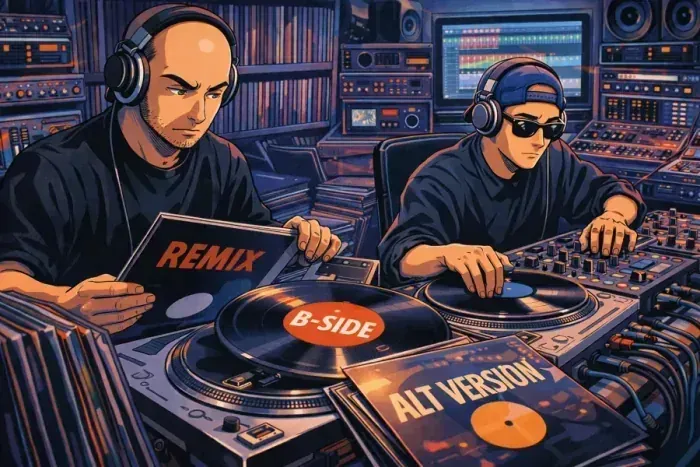
Another important 1990s shift happened through versions instead of originals. Maxi-singles, remixes, radio edits, club mixes, dub versions, and B-sides all made it harder to treat a song as one final object. Dance culture had already been pushing in that direction in the 1980s, but the 1990s normalized it much more broadly. A track could now have different lives on radio, in clubs, on compilations, on imported CD singles, or in fan circulation.
That changed the meaning of a song. A remix was not always a leftover. It could move a song from private listening to the dance floor, shift its emotional center, or introduce it to a different audience. B-sides did something similar by giving artists room for rough edges, experiments, and songs that did not fit the main release. Listeners got used to thinking of music as variation, context, and afterlife, not just as the official version.
This mattered commercially and culturally. Record stores stocked import singles because fans wanted the version that was harder to find, longer, stranger, or better suited to a club system. DJs hunted for alternate mixes that radio listeners might never hear. Pop fans learned that the “real” song might not be the one on the album. That loosened older ideas about canon and made listening more exploratory.
That logic helped prepare listeners for digital culture. Once songs were already understood to exist in multiple forms, it became easier to imagine music as fluid and portable rather than fixed in one canonical release.
It also changed how fans valued scarcity. The sought-after version might be the import, the white-label remix, the B-side, or the promo mix somebody had taped from a club set. That economy of partial access made listeners more active. They were not only consuming a final product. They were hunting, comparing, and building their own private hierarchies of version and authenticity.
Rave Culture vs. the Authorities
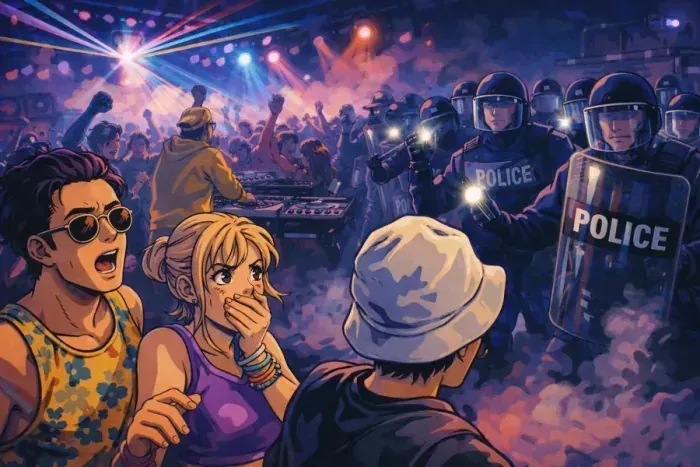
As electronic music and rave culture spread through the 1990s, public attention followed a familiar pattern. Local gatherings built around sound and movement were increasingly framed as a social problem. News coverage focused less on music or community than on danger, excess, and moral breakdown. The panic around raves repeated older fears about youth culture, drugs, and collective behavior, just in a new setting.
In the UK and across Europe, newspapers and television often described dance events as chaotic sites of lost control. The music itself was reduced to vague, dehumanizing terms: repetitive, mechanical, threatening. That language made it easier to treat genres as problems to be controlled instead of cultures to be understood.
That anxiety quickly moved into law. In the UK, the 1994 Criminal Justice and Public Order Act became the clearest example. Its wording about gatherings featuring “repetitive beats” showed how little lawmakers understood about the culture they were targeting. The law gave police broader power to break up events and disperse crowds, treating certain musical gatherings as quasi-criminal forms of assembly.
Similar patterns appeared elsewhere. Clubs and temporary venues across Europe and North America came under heavier surveillance, and electronic music was repeatedly tied to drug discourse with little interest in the wider context. Other musical cultures had long histories of substance use too, but electronic music was treated as uniquely suspect, partly because it did not fit older ideas of authorship, performance hierarchy, or visible stardom.
The reaction revealed a deeper discomfort with self-organized youth space. Raves often operated outside the usual cultural gatekeepers: outside concert halls, outside heavily branded venues, outside the normal schedule of civic life. They brought together bodies, sound systems, informal networks, and temporary geographies that authorities found harder to predict. The backlash was partly about noise, but it was also about control.
Inside the scene, that hostility made autonomy feel even more important. Events became less visible, locations less permanent, and communication more dependent on trust. Rather than collapsing, dance culture adapted by becoming more mobile and harder to map from the outside.
The panic around electronic music was never only about noise or drugs. It was also about independence, collective pleasure, and bodies moving together without a single visible leader. By the late 1990s, electronic music had survived the backlash and moved deeper into global culture, but the backlash itself showed where social tolerance still ended.
That episode matters because it reveals how often musical panic is really social panic. A beat becomes threatening when it organizes strangers, extends the night, and creates a form of assembly that looks insufficiently supervised. In that sense, rave culture was never only targeted for what it sounded like. It was targeted for the kind of public it made possible.
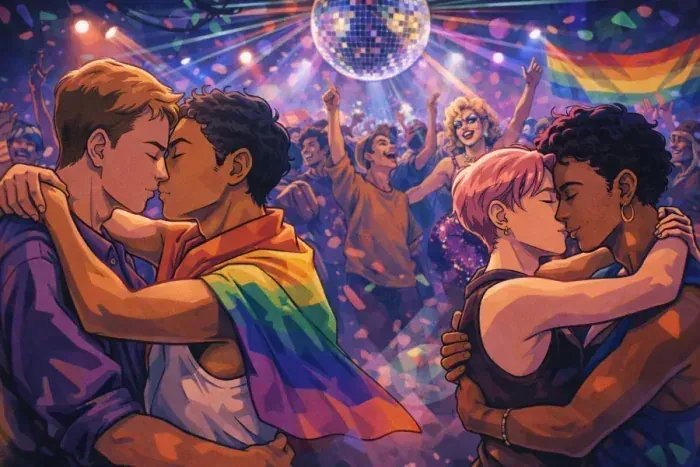
Queer Dance Floors After AIDS
To understand 1990s club culture fully, it is not enough to speak about freedom in the abstract. Queer dance floors carried the memory of the AIDS crisis even as they remained places of pleasure, style, and release. These spaces did not simply survive the losses of the previous decade. They had to rebuild trust, collectivity, and emotional endurance in public worlds that still offered uneven safety.
That gave queer club life in the 1990s a different charge from the older fantasy of the club as pure escape. Dancing could still mean pleasure, erotic play, and reinvention, but it also carried grief, memory, and mutual care. The room became a place where survival and celebration were not opposites.
The influence of those spaces moved far beyond queer communities alone. Club aesthetics, vocal styles, and ideas of reinvention traveled outward into mainstream pop even when the work of those scenes was rarely named. Queer dance floors helped imagine what continued life, intimacy, and collective presence could still feel like after loss.
That influence was often filtered before it reached mass culture. Fashion, house vocality, camp stylization, and forms of bodily expressiveness were borrowed more easily than the politics of mutual care that sustained the spaces where they emerged. Still, the source matters. Much of what the wider decade called freedom in dance culture had already been tested, protected, and emotionally paid for in queer rooms.
Remembering that source matters historically. It keeps the story of dance music from hardening into a generic tale of youth freedom and brings back the communities that built the forms later borrowed by mainstream culture. Without those rooms, much of the decade’s language of reinvention would have sounded different or might not have existed at all.
It also changes how we hear pleasure itself in the decade. The joy in these spaces was not simple innocence. It was joy made more urgent by grief, risk, memory, and the practical work of keeping one another alive. That combination gave queer dance culture a depth that mainstream retellings often flatten.
Trip-Hop, Downtempo, and Urban Atmosphere
Not all electronic music in the 1990s chased speed or ecstatic release. Another strand slowed things down and turned club logic inward. Trip-hop, downtempo, and related forms built tracks from bass weight, sampled texture, dub space, and urban after-hours melancholy. These records often sounded like the rave’s aftermath rather than its peak.
Massive Attack, Portishead, and similar acts helped define that mood. Their music drew from hip-hop production, sound-system culture, soul, soundtrack thinking, and postindustrial atmosphere without settling comfortably into one genre. Instead of treating dance music as pure release, they explored fatigue, paranoia, memory, and seduction.
Trip-hop did not need the dance floor in the same way house or techno did, but it came out of the same world of remix logic, studio construction, and genre mixing. It also pointed toward a broader truth about the decade: some of the most important 1990s sounds came from overlap and exchange rather than from one dominant scene.
It also changed the pace of late-night listening. These records suited headphones, empty streets, film soundtracks, and introspective private time as much as any club. In that sense, trip-hop and downtempo helped map a different urban emotional geography for the 1990s: slower, more suspicious, more sensual, and more comfortable with ambiguity.
That mood mattered because it captured a part of the decade that neither Britpop swagger nor rave euphoria could fully express. Trip-hop gave shape to fatigue, voyeurism, after-hours melancholy, and the strange intimacy of mediated city life. It made atmosphere feel like a serious musical argument rather than a decorative extra.
It also worked as a bridge between club culture and more solitary listening. These records could live in cafes, bedrooms, films, headphones, and late-night radio as easily as in DJ sets. That portability helped them travel across audiences who might never have identified themselves as part of one scene, yet still recognized the same foggy emotional weather.
Global Sounds: Music Beyond the Anglo-American Center
As scenes became more connected, the story of 1990s music was still often told from American and British perspectives. That frame misses how deeply the decade reshaped popular music elsewhere. Regions outside the Anglo-American center were building their own relationships to international markets, rooted in local histories, audiences, and priorities rather than imitation alone.
Several forces helped drive that change. Satellite television expanded, multinational labels grew more active, and music moved more easily across borders. At the same time, local scenes gained confidence. Artists increasingly embraced language, accent, and cultural reference instead of stripping them away for broader acceptance.
The result was not simple globalization in the flattening sense. It was a more uneven exchange. International formats traveled, but they were reworked inside local industries with their own stars, media habits, and expectations. A dance rhythm could move from one country to another while changing social meaning along the way. A pop structure could be borrowed without giving up linguistic identity. The 1990s made that kind of adaptation more visible.
From Latin America to Europe and across parts of Asia, the decade produced pop, rock, and dance music that spoke directly to local realities while also engaging global sounds. These scenes were not marginal footnotes. They shaped the decade’s rhythms, aesthetics, and business logic in ways that became even clearer later.
What follows traces regional infrastructures, language choices, and hybrid forms that emerged when global circulation met local expression. Taken together, they shift the decade away from a narrow Western narrative and toward a more uneven but more connected musical history.
That shift matters because the 1990s were one of the last decades often summarized in English-language pop history as if the main story still ran mainly through the United States and the UK. The reality was already wider. Local industries were not waiting to be discovered. They were building their own stars, formats, and internal canons with or without Anglo-American attention.
Once that wider reality comes into view, the decade looks less like a story of export from one center and more like a story of parallel growth. Global circulation mattered, but so did local television, touring circuits, retail systems, regional magazines, and language communities large enough to sustain stars on their own terms.
Latin Pop Before the Crossover Moment
Before Latin pop exploded in the United States at the end of the decade and into the 2000s, it was already large on its own terms. The 1990s did not create that scale. They strengthened the regional industries, touring circuits, and Spanish-language confidence that made later crossover easier to see.
Across Latin America, artists built major careers without waiting for US validation. Soda Stereo filled stadiums across the region with a mix of rock, pop, urban tension, and generational restlessness. Their success showed that scale did not require abandoning local language or identity.
Caetano Veloso remained crucial for a different reason. In the 1990s, he kept adapting older Brazilian traditions to new conditions while staying recognizably tied to Brazilian musical history. That offered another model of internationalism: rooted, flexible, and self-assured rather than export-shaped.
Shakira’s early rise made the same point from a younger angle. Pies Descalzos established her inside Spanish-speaking markets before any English-language crossover. Its mix of rock instrumentation, Latin rhythm, and direct personal writing showed that Latin pop could grow outward without first asking for Anglo approval.
The infrastructure mattered too. Regional labels, radio networks, television formats, and cross-border touring circuits built fame inside Latin America itself. Artists could develop durable audiences over time instead of depending on sudden recognition elsewhere.
That regional confidence also changed the sound of ambition. Artists did not have to treat English as the inevitable language of scale. Spanish and Portuguese remained central not as barriers, but as the medium through which intimacy, irony, and local detail could travel. The market was already large enough to reward that choice.
That is why the famous crossover moments at the end of the decade were not discoveries. They were delayed recognitions. By 1999, Ricky Martin’s Grammy performance and the success of Livin’ la Vida Loca made that impossible to ignore in the United States, but the foundation had already been built earlier in the decade.
That wider foundation helps explain why Latin pop’s later global breakthrough felt so immediate once it arrived. The artists, audiences, and circuits were already there. What changed was not the music’s existence, but whose attention was finally forced to catch up.
Europe's Pop Renaissance: From Britpop to Eurodance
In the 1990s, European pop scenes grew more confident about sounding local rather than flattening themselves for export. Political change after the Cold War and expanding media networks helped music travel without fully losing regional specificity.
In the UK, Britpop answered American dominance in openly local terms. Bands like Blur brought class, place, and everyday British life back into pop’s foreground. Regional accents and ordinary speech were part of the point, not obstacles to be hidden.
Elsewhere in Europe, pop and dance worked differently. Eurodance is often treated as pure formula, but it showed how rhythm, repetition, and momentum could cross borders even when language mattered less. Acts like 2 Unlimited and Snap! helped build a transnational club-radio mainstream.
France developed strong local rap and pop vocabularies of its own. Artists like IAM and MC Solaar showed that French-language rap could be poetic, political, and rooted in local reality without copying American models. The global genre gained force through adaptation.
Political change mattered here too. The end of the Cold War did not produce one unified European culture, but it did widen movement, media exchange, and the sense that a continental music market could exist without erasing local character. Pop from Europe increasingly sounded like many Europes at once: regional, mobile, and commercially alert.
Sweden and the broader Scandinavian region also reshaped Europe’s pop infrastructure. Their producers would become globally dominant later, but the 1990s were already a period of system-building and refinement. Northern Europe was becoming a key engine of the international pop economy.
What linked these scenes was not one European sound. It was a growing refusal to disappear inside American pop logic. By the late 1990s, cultural neutrality no longer looked like the only path to success. Music could travel precisely because it knew where it came from.
That confidence would matter enormously later, when European producers, DJs, and local rap scenes became even more central to global pop. The 1990s were a rehearsal space for that shift. They showed that translation did not require erasure and that locality could be an asset rather than a barrier.

Asian Pop: Building a World of Its Own
In the 1990s, East Asian music industries were already highly developed even if Western music coverage barely registered them. Long before phrases like global K-pop became common, artists, labels, and media companies in Japan, South Korea, and elsewhere were building large domestic systems that combined local traditions with modern pop production.
Japan’s industry was the most established. J-pop in the 1990s ran through a dense domestic network of major labels, television, magazines, and live performance. Artists like Namie Amuro and Utada Hikaru became central within that home market first. The focus was on fan loyalty, consistency, and long career arcs rather than on Western crossover.
South Korea’s pop industry was earlier in its development, but it was already changing fast. Seo Taiji and Boys were crucial to that shift. They mixed hip-hop, rock, and dance with Korean-language lyrics in ways that broke from older ballad traditions and proved that Western genres could be translated rather than copied.
These artists were supported by increasingly organized systems of training, media exposure, and audience management. Later criticism would focus on how intense those systems could become, but in the 1990s they were also practical responses to competitive media markets and relatively small domestic audiences.
What these industries understood early was that scale did not have to begin with the West. Domestic television, idol systems, fan clubs, magazine culture, and retail networks could generate their own momentum. Pop authority could be built internally first and only later be recognized elsewhere, if at all. That reversed the usual Western assumption that international legitimacy always flowed outward from the United States or Britain.
Elsewhere in Asia, related developments were happening at different scales. In Hong Kong and Taiwan, Mandarin-language pop grew through tight links among music, television, and film. Artists moved easily between acting and recording and built fame without needing Western charts to certify it.
Western music discourse mostly failed to register this activity. That was not because the music lacked innovation. It reflected a narrow idea of where pop authority was supposed to come from. By the time Asian pop became more visible globally, much of its infrastructure and audience logic had already been built.
That is why later narratives of sudden emergence can be misleading. Industries in Japan, South Korea, Hong Kong, and Taiwan were not starting from nowhere. They were refining models of training, promotion, cross-media celebrity, and fan organization that had been tested domestically long before Western outlets began paying close attention.
Jazz and Neo-Soul Slow the Decade Down
Alongside these global pop circuits, other traditions kept moving without much headline drama. Jazz and neo-soul were rarely treated as the decade’s central youth stories, yet both mattered to its emotional depth and musical continuity. Their influence was quieter, but it lasted.
Jazz spent much of the decade being described as irrelevant, even while it kept changing through reinterpretation, collaboration, and quiet adaptation. Neo-soul grew out of a related impulse. Drawing on soul, gospel, and jazz, it favored intimacy, reflection, and historical memory over obvious commercial urgency.
Both forms also offered a rebuttal to the decade’s speed. At a time when mainstream pop was becoming more compressed and more tightly marketed, jazz and neo-soul protected duration, ensemble listening, and tonal subtlety. They asked audiences to stay with a feeling rather than chase immediate payoff.
Together, these movements gave the decade another tempo. Not every important change in the 1990s arrived as rupture. Some arrived through persistence and deep listening.
That slower tempo mattered in a decade often remembered for noise, speed, and media overload. Jazz and neo-soul kept open a space where groove could breathe, arrangements could unfold gradually, and seriousness did not need to announce itself through spectacle.
They also preserved lineages that the louder parts of the decade could easily obscure. In jazz, older traditions remained in conversation with new textures and technologies. In neo-soul, Black musical memory stayed active rather than merely archival. Both forms insisted that continuity could be creative rather than conservative.
They also preserved lineages that the louder parts of the decade could easily obscure. In jazz, older traditions remained in conversation with new textures and technologies. In neo- soul, Black musical memory stayed active rather than merely archival. Both forms insisted that continuity could be creative rather than conservative.
Jazz Refuses to Fade Away
During the 1990s, jazz was often framed as museum music: respected, but detached from the present. That missed what was actually happening. Jazz no longer fit the decade’s dominant marketing logic, but it kept changing in real ways.
Herbie Hancock remained one of the clearest examples. Rather than hardening into a legacy act, he kept exploring how jazz could speak to technology and popular music without losing its intelligence. Pat Metheny broadened the field differently, combining improvisation with lucid composition and a sound that reached listeners beyond the core jazz audience.
Cassandra Wilson widened jazz’s emotional and stylistic range even further. Her music drew from jazz, blues, folk, and soul without treating genre as sealed off. Albums like
Blue Light ‘Til Dawn made jazz feel grounded in lived life rather than distant prestige.
That mattered because jazz in the 1990s often had to survive through intelligence rather than hype. It lived in festival bookings, small labels, educated audiences, and musicians committed to dialogue across generations. Younger players absorbed the tradition while testing its edges. Older artists kept proving that maturity did not mean repetition. The scene was not loud, but it was active.
Jazz in the 1990s often felt less like a mass statement than like an ongoing conversation between musicians and attentive listeners, happening in clubs, concert halls, festivals, university programs, and independent-label records built for duration. Its quieter place in the culture was not simple decline. It was another form of endurance.
Neo-Soul: Soul Memory in a Faster Age
Neo-soul emerged in the 1990s as a deliberate alternative to the more standardized edges of mainstream R&B and hip-hop. The label was not always consistent at first, but the impulse was clear. This music preferred intimacy to spectacle, texture to polish, and reflection to speed. It did not reject modern production. It refused to let production flatten feeling.
The movement was led by artists who treated history as alive rather than decorative.
Brown Sugar by D’Angelo drew deeply from soul, funk, and gospel while sounding fully current. Its loose groove and understated vocals suggested a confidence in subtlety far from the tighter surfaces of late-1990s pop.
Erykah Badu expanded that language through humor, spirituality, and observation.
Baduizm made reflection feel communal rather than sealed off. Lauryn Hill held a singular place in the movement. The Miseducation of Lauryn Hill moved easily across hip-hop, R&B, and soul without treating them as separate rooms, and its emotional clarity reached a huge audience without giving up depth.
There was also a visual and social grammar to neo-soul. Natural textures, live-band performance, 1970s references, spiritual language, and Black cultural memory all became part of the atmosphere around the music. That atmosphere could be marketed, but it was not merely styling. It expressed a desire for continuity in a decade that often rewarded speed, surface, and replacement.
Neo-soul mattered because it resisted reduction. Songs were allowed to unfold slowly, repeat, and linger. Silence and space could matter as much as hooks. Live instruments, ensemble interplay, and small imperfections were not treated as flaws to be erased. The point was not nostalgia. It was a refusal to let speed and market scale flatten interior life.
That refusal gave the movement unusual staying power. Even when neo-soul was turned into a market category, its best records still sounded like arguments against disposability. They asked for patience, memory, and repeat listening in a marketplace increasingly built around quicker recognition.
Who Gets Heard: Class, Voice, and Visibility
Across these scenes, it became increasingly clear that music was about more than sound or style. It was also about who was allowed to speak, in what voice, and under which conditions. Many of the decade’s most important developments were shaped by class, language, and visibility, whether or not they named those pressures directly.
Class shaped both access and reception. Some forms of anger or vulnerability were treated as profound, while others were dismissed as excessive or embarrassing. Language worked the same way. Accents, dialects, and local slang stopped fading quietly into the background and became signs of belonging, pride, and defiance. That visibility also made artists more exposed to ridicule, especially when their voices clashed with middle-class or metropolitan expectations.
Queer visibility followed a similar pattern. The decade offered more openness, but that openness was conditional. Some artists could speak clearly; others were tolerated only if their identities remained legible in safe, limited ways. Visibility did not guarantee safety.
Taken together, these tensions show how class, voice, and queerness shaped musical meaning throughout the 1990s. These were not side issues. They were central forces in determining whose stories were heard, how they were framed, and what they were allowed to mean.
They also shaped critical prestige. Certain emotions were easier for institutions to call serious, and certain voices were easier for reviewers to call authentic. The decade did not create those hierarchies, but it exposed them more clearly because so many artists were now speaking from positions that older pop criticism had not been built to hear well.
That is why these questions matter beyond identity as a topic. They affected distribution, review coverage, radio assumptions, festival bookings, and the whole vocabulary through which some music was elevated while other music was treated as embarrassing, dangerous, or minor. The politics of listening were also politics of access.
Music as Class Struggle
Class was one of the decade’s deepest forces, even when it was not named directly. It shaped access, authenticity, and which forms of expression were treated as legitimate rather than suspect. The 1990s may have spoken constantly about emotion and identity, but those categories were always tied to material conditions.
Grunge, for example, was not only a style. It also signaled classed discomfort with excess and with the performance of prosperity. Flannel, roughness, and visible unease around success helped make certain artists legible as accidental stars rather than nakedly ambitious ones.
Hip-hop addressed class more directly, but media narratives often turned those realities into spectacle. Scarcity, surveillance, and limited opportunity were consumed as imagery rather than understood as structural conditions. Even the desire for money and luxury was often misread as moral failure rather than a response to systemic deprivation.
Britpop offered another angle. Bands like Blur turned ordinary British life, housing, boredom, and class tension into central subject matter, suggesting that the everyday could carry as much meaning as heroic aspiration.
Nu metal made class bias especially visible at the end of the decade. Its audience was often mocked as unsophisticated, overemotional, or culturally backward. That reaction said as much about taste hierarchy as it did about the music itself.
Across these examples, one pattern keeps returning: selective validation. Some forms of struggle were romanticized. Others were treated as tasteless, excessive, or threatening. Middle-class discomfort often received the language of depth, while working-class anger was more readily cast as danger.
The 1990s did not resolve these tensions. If anything, they sharpened them. To understand class in the music of the decade, it is not enough to read lyrics or aesthetics. You also have to ask who received a sympathetic hearing and who did not.

The Politics of Accent: Who Gets to Speak
One of the quieter but more revealing shifts of the 1990s was the decline of the neutral voice. Earlier pop often favored accents that could move smoothly across radio formats and international markets. In the 1990s, artists and audiences became more willing to push speech itself into the foreground. Accent and dialect started to sound like expression rather than inconvenience.
That was especially clear in the UK. Britpop’s regional speech was not just a style gesture. Bands like Blur and Pulp brought ordinary phrasing and local inflection into the middle of pop. Jarvis Cocker’s voice, for example, did not perform authority. It narrated awkwardness, class tension, and everyday life from the inside.
Hip-hop pushed the principle even further. Rappers did not represent cities in the abstract. They marked neighborhoods, regional history, and social pressure through rhythm, slang, and vocal character. Accent became evidence of presence. A neutral voice could sound distant or even suspicious.
Elsewhere, the politics of voice took other forms. Across continental Europe, more artists worked in local languages rather than defaulting to English. French rap gained force precisely by refusing translation.
Accent also shaped judgment. Some voices were heard as witty, inventive, or intelligent. Others were treated as abrasive, unruly, or less legitimate. Those judgments were never neutral. They were tied closely to class and race.
By the 1990s, hierarchies around voice had not disappeared. They had simply become harder to hide. Once local speech moved into the foreground, listeners could no longer pretend that voice floated free of place, labor, and belonging.
That change also altered what counted as polish. A distinctive accent no longer had to be scrubbed away to sound professional. More artists could make local speech part of their authority rather than a flaw to be corrected, and that widened the social range of pop itself.

Queer Voices: Visibility With a Cost
The 1990s are often remembered as a decade of greater queer visibility in popular music, and that is true up to a point. More artists could speak openly, or at least less evasively, about identity and desire. But visibility was not the same as safety, stability, or support. For many artists, openness still carried professional risk and public cost.
k.d. lang challenged norms through poise rather than shock. Her public coming out in the early 1990s quietly changed assumptions about gender, sexuality, and genre, even while the industry kept treating openness as a liability. Melissa Etheridge faced a related problem: the public often treated her openness as both bravery and exception, which meant she was asked to stand in for queerness itself.
For male pop artists, the terms were often harsher. George Michael’s 1990s career made clear that visibility could be forced rather than chosen, and that queerness was often more tolerable as abstraction than as lived public reality.
Queer spaces remained crucial. Clubs, especially in house and techno scenes, offered forms of belonging and safety that mass media rarely did. Music there was not mainly about public representation. It was about survival, connection, and being present with other people.
That is why the decade’s queer visibility remained conditional. Artists were often accepted only as long as they did not unsettle dominant comfort too directly. The gains were real, but they were fragile. Being seen did not mean being safe.
That fragility shaped careers as much as public image did. To be visible often meant carrying explanatory labor, symbolic burden, and a level of scrutiny that straight artists did not face in the same way. The decade opened doors, but many of them still had guards at the threshold.
That is why queer visibility in the 1990s cannot be measured only by counting public figures. The more revealing question is what kinds of queerness were welcomed, who had to stay coded, and who paid a professional price for becoming legible. Once those questions are asked, the decade looks more mixed: real gains, real courage, and still very narrow conditions of acceptance.
How We Learned to Listen Differently
All of these shifts changed not only how music sounded, but how it was lived with. Listening no longer centered on radio or television in quite the same way. It became more private, more portable, and more fragmented. Technology did not just increase access. It changed the texture of everyday listening.
Compact discs encouraged people to own music as durable objects. Music television turned songs into visual narratives. Early digital networks introduced new forms of exchange that would soon challenge the industry’s control. Each format brought convenience, but also new distance. Music became easier to access, easier to carry, and easier to turn into background.
Listening also became more individualized. Shared radio still mattered, but more people were curating private routines through shelf collections, personal mixtapes, CD wallets, and headphone time. That changed what a favorite song could be. It no longer needed to belong to a whole generation at once. It could belong to a smaller mood, a private ritual, or a very specific social group.
That shift in scale is easy to overlook, but it changed everyday musical life. The 1990s did not end shared culture. They made private listening more decisive inside it. A person could still know the big hits, but their emotional life with music increasingly happened in bedrooms, buses, bedrooms after school, and solitary walks with headphones on.
That made listening feel more companion-like and less ceremonial. Music was still social, but it also became something people carried into daily repetition: homework, travel, waiting, boredom, recovery, daydreaming. The soundtrack of the decade was often built one private routine at a time.
That everydayness changed musical attachment. A favorite song was no longer only the one everyone knew. It could be the track attached to a private mood, a borrowed CD, a bus ride, or the hour after school when a person finally had headphones on. The 1990s deepened the habit of making identity through repeated private use rather than only through public display.

The CD Era: Music Becomes Collectible
The compact disc quietly transformed everyday listening. By the 1990s, CDs were becoming the dominant format in many major markets, overtaking vinyl and gradually pushing cassette aside. They were sold as cleaner, more durable, and more precise, promises that matched the decade’s wider faith in technological improvement.
CDs made music feel fixed and collectible. They did not wear down in the same visible way as vinyl or cassette, and that encouraged listeners to treat albums as things to own, catalog, and preserve. Liner notes, artwork, and hidden tracks became part of the ritual.
The ritual mattered. Going to a record store, comparing editions, reading production credits, and deciding which album deserved full price all shaped how people valued music. The CD era rewarded completionism. Boxy shelving systems, binders of discs, and careful alphabetizing were part of musical identity for a large part of the decade’s audience.
Portability deepened that privacy. Devices like the Sony Discman carried music into walks, commutes, and private time outside the home. Headphones made the boundary between listener and world feel sharper.
Digital sound also changed expectations. CDs made certain details easier to hear than older consumer formats did. Some listeners found that clarity exciting. Others thought it sounded cold. Either way, the format sharpened the argument about what technology added and what it took away.
CDs also reinforced label power. Their margins were high, and full-price albums remained the norm even when listeners really wanted only two or three songs. The model favored major companies and established artists while reducing room for risk.
For many listeners, though, the CD era still felt like a high point of ownership. Shelves filled up, collections grew, and musical identity became tied to the objects people kept close. That balance would not last. By the end of the decade, new technologies were already challenging the idea that music had to be owned in physical form.
That is one reason the format remains so charged in memory. CDs were not only a delivery system. They were a way of proving commitment, taste, and personal history through objects. The 1990s turned music collecting into a visible domestic landscape before digital abundance began dissolving that relationship.
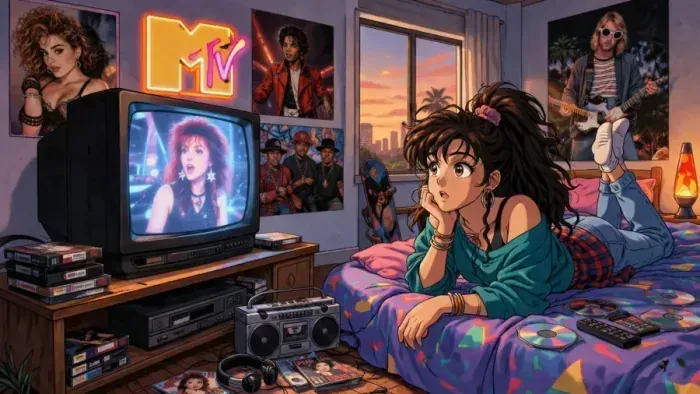
MTV and the Visual Music Revolution
By the 1990s, music television was still one of the main forces shaping how artists were understood. MTV was more than a promotional outlet. It turned sound into image and story and helped decide how music would be remembered.
Videos became more cinematic and more concept-driven. In a few minutes, they were expected to establish mood, define character, and create a narrative strong enough to survive heavy rotation. For some artists, that opened real expressive possibilities. For others, it created another layer of pressure.
That pressure was unevenly distributed. Artists who controlled visual storytelling could shape public meaning more directly. Artists who resisted could be defined by managers, channels, or press. The camera also intensified judgment, especially for women and already marginalized artists. Age, body, style, and supposed authenticity were scrutinized almost as closely as the songs.
MTV also segmented audiences more aggressively as the decade went on. Programming blocks tied music more tightly to mood, fashion, identity, and belonging. By the late 1990s, the channel’s centrality was already weakening, but its effect on the decade was secure: audiences learned to expect music with a visual narrative attached, and artists learned to think of image as part of authorship.
That shift changed performance itself. Artists no longer just had to sound distinctive. They had to know what color palette, body language, editing speed, and symbolic world would make the song legible in visual culture. A memorable video could redirect an entire career. A weak one could make a strong single feel smaller than it was.
It also changed how audiences remembered songs. For many listeners, the video was not a secondary layer. It was part of the song’s identity. Costumes, gestures, color schemes, and narrative fragments became inseparable from the track itself. The 1990s deepened the habit of hearing with the eyes.

Independent Cinema, Soundtracks, and the 1990s Mood
The 1990s also tightened the relationship between music and film. Soundtracks were no longer just bundles of songs attached to a movie. They often became part of the movie’s identity and part of how a subculture recognized itself.
Trainspotting, The Crow, Romeo + Juliet, and Pulp Fiction mattered for exactly that reason. Their soundtracks did not merely accompany scenes. They circulated as portable versions of a mood or worldview, carrying irony, danger, coolness, melancholy, or romantic excess back into everyday listening.
Film also brought together strands of the decade that might otherwise have stayed separate. Alternative rock, Britpop, electronic music, catalog tracks, and newer pop could all sit in the same emotional frame. That reinforced a 1990s habit of hearing music through mood, image, and social scene rather than through strict genre boundaries.
Soundtracks also worked as cultural shortcuts. Buying one could feel like buying entry into a sensibility: jaded, romantic, urban, dangerous, art-school, or defiantly teenage. They let listeners inhabit a film’s emotional world after the credits ended, and they helped train the decade to hear songs as scene-setting devices rather than isolated works.
That is part of why the era’s soundtracks remain unusually memorable. They did not just collect successful songs. They organized atmospheres. They taught audiences to move across genre lines through shared mood, which in turn made later playlist culture easier to recognize.

The Internet Arrives: Everything Is About to Change
Toward the end of the 1990s, the industry’s power structure started to shift in ways that were hard to read at first. The internet did not arrive as one dramatic break. It spread through message boards, fan pages, email lists, and early file-sharing networks that still looked small enough to dismiss.
Online forums let fans talk directly to one another, compare recordings, debate albums, and share information that had once moved mainly through radio, magazines, or record stores. That weakened older gatekeeping, especially around niche genres and international scenes.
File sharing accelerated the shift. Services like Napster, launched in 1999, detached songs from physical objects and let them move freely between computers. To listeners, that often felt like freedom. To the industry, it felt like the beginning of collapse. The argument was never only about legality. It was about who controlled value and distribution.
It is easy to forget how uncertain that moment felt. Most users did not think of themselves as revolutionaries. They were responding to convenience, curiosity, and the growing sense that digital information ought to be shareable. CDs still sold and concerts still mattered, but listeners were beginning to imagine music outside the industry’s permission structure.
Artists responded in mixed ways. Some saw online sharing as a direct threat, especially under already unequal contracts. Others saw a chance for more direct contact with fans. Early websites made it possible to circulate demos, tour dates, and personal updates without older media channels.
The social change mattered as much as the technical one. Fans no longer had to wait for a magazine editor, radio host, or retailer to tell them what mattered. Recommendations could move laterally through communities. Obsession became easier to organize. So did niche knowledge. Once that habit formed, the old top-down model of discovery looked slower and less necessary.
The industry responded defensively, with warnings, lawsuits, and older ideas of scarcity. That slowed change, but it could not reverse the new habit of thinking. Once listeners started treating music as searchable, shareable, and discussable at will, the old model of controlled access was already weakening.
The deeper shift was imaginative. Even before streaming existed, people were beginning to picture music as data: movable, copyable, sortable, and no longer permanently tied to the objects that labels had spent a decade selling at premium prices. Once that picture took hold, the older business model could survive for a while, but it could no longer feel inevitable.
That mental shift may have mattered even more than the first round of lost revenue. Once listeners understood music as something that could circulate outside official channels, the idea of access itself changed. Ownership, collecting, fandom, and recommendation would all be reorganized around that new assumption in the years that followed.
The Dark Side of Fame: When Visibility Became Dangerous
As the 1990s went on, the gap between public visibility and private stability became harder to ignore. Music culture celebrated openness, intensity, and emotional honesty, but the structures around artists were rarely equipped to handle what that exposure demanded. Success brought access and recognition, but it also intensified pressure, isolation, and surveillance in ways the industry barely knew how to name.
People did speak more openly about mental health than in earlier decades, but not in a careful or structurally serious way. Struggle could be romanticized, collapse could be turned into spectacle, and recovery rarely received the same narrative attention. Artists were cast as symbols of excess, rebellion, or failure rather than as people moving through unstable systems.
Scandals followed predictable patterns. Personal crisis became entertainment while root causes were pushed aside. Addiction, burnout, and breakdown were treated as individual flaws rather than consequences of constant exposure and unequal power. The audience was positioned to judge, not to understand.
The decade had a particular appetite for visible contradiction. It wanted artists to be raw but marketable, difficult but productive, damaged but photogenic, rebellious but still usable inside promo cycles. Those demands were nearly impossible to satisfy for long. When people failed under them, the failure was personalized instead of traced back to the system that had engineered the pressure.
Seen from that angle, the decade’s handling of mental health, controversy, and public failure becomes clearer. Artists were asked to carry cultural meaning, while institutions replaced responsibility with moral projection. The 1990s talked about pain often, but had very little practice in dealing with it.
That gap between language and care is one of the decade’s darker legacies. The culture became more fluent in confession, trauma, and collapse, but institutions stayed invested in output, image management, and endurance. In that sense, the 1990s made suffering more visible without making support much stronger.
When the Industry Failed Its Artists
The 1990s produced a paradox the music industry was slow to admit. Artists were encouraged to be emotionally exposed, to turn personal pain into art, and to make vulnerability part of their public appeal. But there were few structures ready for what happened when that openness collided with fame, scrutiny, and financial pressure. Visibility increased. Care did not.
The pattern appeared across genres. In alternative rock, distress was often read as proof of authenticity. People could talk endlessly about artists like Kurt Cobain while saying much less about what actual safety or support might have required. In hip-hop, the pressures looked different but were no less serious. Artists were asked to represent whole communities while navigating violence, legal exposure, surveillance, and industry demand.
Pop culture had its own version of the same failure. Teen stars and young performers were watched with extraordinary intensity. Mistakes became public events, while exhaustion and distress were often treated as attitude problems instead of warning signs.
The decade was especially dangerous because the language of mental health had started to circulate without much institutional follow-through. Therapy still carried stigma. Breakdowns were often treated as private weakness rather than as signals that something in the system had gone wrong. Management structures stayed focused on output, exposure, and endurance.
Contracts made the situation worse. Many artists had little room to step back even when the pressure was clearly damaging them. Touring, promotion, and constant visibility were built into the job, and when artists broke down, the industry often replaced them instead of repairing the conditions around them.
That logic was especially brutal because the decade kept celebrating individuality while running artists through increasingly standardized pressure systems. Label schedules, magazine cycles, touring demands, and visual branding all accelerated at once. An artist could be told they were unique while being managed as a throughput problem.
Not everyone moved through the decade in the same way, and some artists did have real support. But the larger pattern is hard to miss. Fame expanded faster than institutions understood its cost, and emotional labor was extracted without being named as labor at all.
That pattern still feels contemporary because the underlying bargain has not disappeared. Artists are invited to turn private instability into public meaning, but the systems around them still too often reward disclosure more than care. The 1990s did not invent that problem, but they made it legible in a modern media form.
Scandals and Moral Panic: Music as Scapegoat
In the 1990s, personal struggle and moral panic circulated side by side. Music kept becoming a screen onto which broader social anxieties were projected. Instead of facing structural change directly, media and political actors often focused on artists, lyrics, and scenes that could be framed as threats to order or morality.
Hip-hop was a frequent target. Explicit lyrics were treated as proof of cultural decline, often stripped of context and intent. Songs about violence, poverty, or anger were read as endorsements rather than as description or critique. The Parental Advisory label may have been sold as consumer information, but it quickly became a symbol of danger shaped heavily by race, class, and respectability politics.
Rock and metal faced similar treatment. Distortion and anger were often discussed as causes of violence rather than expressions of social strain. Pop scandals worked differently, but they followed the same logic. Female sexuality could be praised or condemned depending on how manageable it seemed. Provocation was tolerated only as long as it stayed legible and under control.
What tied these moral panics together was personalization. Instead of confronting industry power, economic inequality, or the incentives of modern media, public blame settled on individual artists. Outrage generated ratings, attention, and regulation while sparing institutions more serious self-examination.
The mechanism was efficient because music condensed wider fears into recognizable figures. An angry rapper, a sexually explicit pop star, or a confrontational metal band could be presented as the cause of social disorder more easily than poverty, censorship, racism, or institutional neglect could. Panic simplified complexity into a face and a headline.
That produced a double bind. Audiences claimed to want honesty, but often punished music when it became too direct. Artists were encouraged to provoke, but only within boundaries that shifted constantly according to genre, race, gender, and class.
Looking back, the pattern feels familiar because it never really disappeared. The targets change, but the mechanism remains easy to recognize.
The 1990s matter here not because they were uniquely hysterical, but because they helped standardize a pattern that still recurs: when broader social anxiety rises, music becomes one of the first places onto which blame is projected. Artists become easier to punish than structures become to reform.
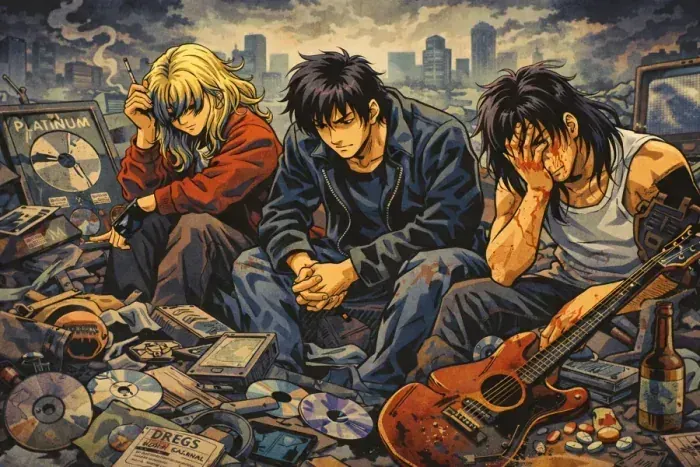
The 1990s Legacy: What the Decade Left Behind
By the end of the decade, there was no neat sense of closure. The 1990s did not end with one dominant sound, one agreed movement, or one shared conclusion. They left behind open questions about authenticity, power, access, and control, and that unfinished quality is part of why the decade still feels close.
By then, music was more fragmented, more international, and more entangled with technology than before. Artists could become visible quickly, but holding attention was harder. Genre boundaries had loosened, industry structures were starting to wobble, and listeners were getting used to abundance instead of scarcity.
That mix of abundance and instability is one of the decade’s clearest inheritances. The 1990s did not hand the future a stable model. They handed it competing logics: authenticity and branding, freedom and concentration, intimacy and scale, local identity and global circulation. The 21st century would inherit all of them at once.
The decade left behind more than famous songs or famous stars. It left new habits of listening, new arguments about authorship, and a stronger expectation that music should feel personal even when built inside large systems.
It also left behind a new normal for cultural complexity. Popular music no longer needed a single center to feel historically important. By the end of the 1990s, fragmentation itself had become part of the story.
That matters because later decades would inherit not one dominant template, but a field of competing ones. The 1990s did not choose between intimacy and scale, underground prestige and mass visibility, local identity and global reach. They left all of those pressures active at once.
That unfinished inheritance is part of why the decade resists nostalgia even when people try to package it that way. The 1990s did produce iconic looks and famous songs, but their deeper legacy is structural: a crowded musical world in which old gatekeepers still matter, new channels keep appearing, and no single story can absorb the rest for long.
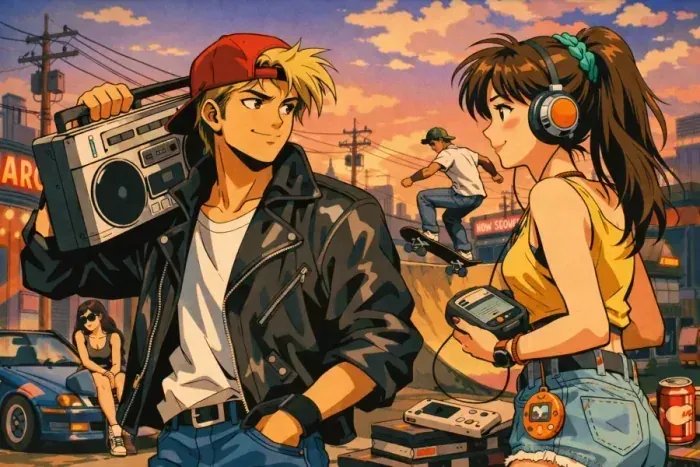
The Decade That Never Really Ended
The 1990s resist summary because they never really settled into one story. There was no single sound carrying everyone into the next era and no closing statement that felt shared. By the late 1990s, fragmentation no longer looked temporary. It had become one of the basic conditions of popular music.
Styles coexisted, audiences moved between them, and no one narrative could organize the whole field. Technology made that instability even stronger. Digital tools promised freedom and access while also undermining older ways of releasing, discovering, and valuing music. The album still mattered, but its authority was no longer secure.
It also changed what audiences meant by authenticity. The word moved away from mastery and toward emotional credibility, even though that credibility was still shaped by marketing, media, and visibility. Artists were expected to sound personal, but not so difficult that they became unreadable.
That is why so much later culture still feels 1990s-coded even when the surface details have changed. Streaming, social media, global fan communities, and playlist culture all extend dynamics that were already taking shape then. The tools are newer. The underlying questions are not.
That lack of resolution is easy to mistake for failure. It was also a kind of honesty. The 1990s did not pretend that inequality, inner conflict, or cultural difference could be solved by style alone.
That honesty is one reason the decade remains difficult to package neatly. It produced too many centers, too many scenes, and too many incompatible dreams to fit comfortably into one triumphalist narrative. That mess is not a weakness of the history. It is the history.
And that mess is exactly what later culture inherited. The 2000s and 2010s did not have to invent fragmentation from scratch. The 1990s had already made it musically normal, commercially viable, and emotionally legible.
It also made contradiction easier to inhabit without immediately resolving it. An artist could be massive and uncomfortable, intimate and highly produced, politically serious and commercially visible, local in voice but global in circulation. The decade normalized that kind of unstable mixture, and later pop never really moved back to cleaner categories.

Why We Still Live in the 90s
The 1990s still shape 21st-century music in ways that go well beyond revival aesthetics or a handful of familiar sounds. Their deepest influence lies in how music is organized, heard, and judged.
One lasting effect is hybridity. The 1990s loosened older rules about what kinds of sounds could belong together, which helps explain why today’s scenes are often organized more by mood, identity, or audience context than by strict genre.
The decade also changed what “real” sounded like. It shifted away from mastery and toward emotional credibility. Private, portable listening anticipated individualized streaming culture. Early online communities pointed toward the participatory logic of contemporary fandom. Producer-driven systems, global pop infrastructure, and tightly managed branding all foreshadowed arguments we still have about ownership, agency, and sustainability.
Even current genre-blurring owes a debt to the 1990s. Artists now move between rap, electronic production, indie songwriting, R&B atmosphere, and pop hooks as if that were normal because the decade made cross-scene listening routine. It trained audiences to live with multiplicity.
The decade survives not because every one of its sounds came back, but because so many of its organizing problems never left. How public should emotion be? How local can music stay once it scales? Who controls authorship in collaborative pop? What does sincerity sound like inside a marketing machine? Those are still 1990s questions.
The failures lasted too. Weak mental-health support, unequal power, and recurring moral panic did not end with the decade. In that sense, the 1990s feel less like a closed chapter than like the training ground for the present.
That is why the decade still returns in contemporary debates about streaming, branding, genre, fandom, and artistic control. We are still living inside many of the arrangements it normalized. The platforms changed. The basic tensions did not.
That is also why the decade remains easy to re-enter from different angles. Someone might come back through a Nirvana song, a Missy Elliott video, a Massive Attack record, a Britney single, a rave memory, or a Napster anecdote and still arrive at the same larger truth: the 1990s were not unified, but they were intensely formative.
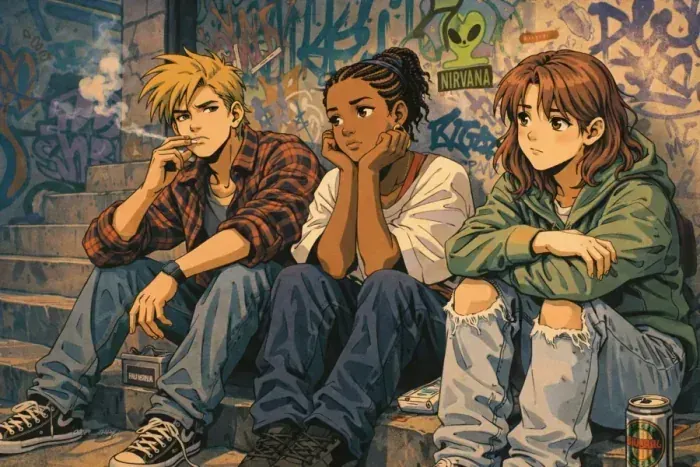
What the 1990s Taught Us About Being Real
In hindsight, the music of the 1990s cannot be reduced to a playlist, a fashion cycle, or one dominant mood. What matters most is the set of conditions it made normal. The decade treated fragmentation not as a temporary problem, but as part of modern cultural life.
That came at a cost. Inequality, burnout, and unequal power did not disappear. But the best music of the decade often refused to hide them. It let discomfort stay visible. In doing so, it changed what audiences expected from popular culture. Music no longer had to unify or reassure in order to matter.
It showed that contradiction could be artistically productive. A song could be commercial and wounded, polished and suspicious, danceable and grieving, local and global at the same time. The decade did not invent contradiction, but it made it easier to hear without treating it as failure.
That is one reason the decade still feels alive. It does not offer clean answers. It shows what it sounds like when a culture learns to live with contradiction in public.
That may be its deepest lesson. The 1990s did not solve the conflict between art and industry, self-expression and market logic, intimacy and spectacle. They made those conflicts impossible to ignore and gave them durable musical forms.
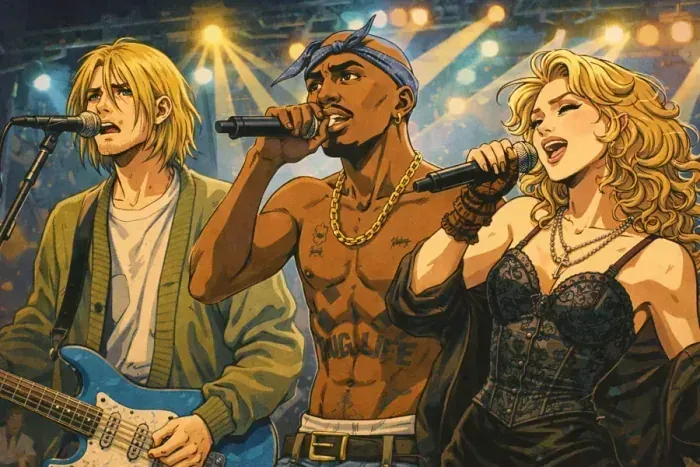
50 Songs That Captured the 1990s
To make that landscape concrete, this playlist brings together different sounds, genres, and movements from the 1990s. Scenes developed beside one another rather than inside one shared center. Rock lost its old authority. Hip-hop became a global language. Pop became more system-driven. Electronic music changed how people gathered and listened.
This is not just a list of big hits. It is a cross-section of the decade: rupture, reflection, local identity, global circulation, and the unstable systems that replaced older certainties. Heard together, these songs show how much 1990s music could hold at once.
The order matters too. Heard across the whole list, the decade stops sounding like one genre replacing another and starts sounding like coexistence under strain. That is closer to how the 1990s actually felt: not unified, not cleanly broken apart either, but crowded with overlapping claims about what popular music should be.
Taken in sequence, the playlist also shows how quickly the ground kept shifting. Early 1990s alternative rock does not solve the questions raised by hip-hop, and teen pop does not erase rave culture or neo-soul. The decade kept multiplying rather than settling. That is the point of the list: not consensus, but coexistence under pressure.
I. The Rupture: Rock Gets Real
- Nirvana – Smells Like Teen Spirit (1991)
- R.E.M. – Losing My Religion (1991)
- Beck – Loser (1993)
- Pearl Jam – Jeremy (1991)
- Radiohead – Paranoid Android (1997)
II. Women Find Their Voice
- Alanis Morissette – You Oughta Know (1995)
- Tori Amos – Silent All These Years (1992)
- PJ Harvey – Down by the Water (1995)
- Lauryn Hill – Doo Wop (That Thing) (1998)
- Queen Latifah – U.N.I.T.Y. (1993)
III. Hip-Hop Tells the Truth
- A Tribe Called Quest – Scenario (1992)
- Dr. Dre – Nuthin’ but a ‘G’ Thang (1992)
- The Notorious B.I.G. – Juicy (1994)
- Tupac Shakur – Changes (1998)
- Nas – N.Y. State of Mind (1994)
IV. Love, Desire, and Vulnerability
- Tracy Chapman – Give Me One Reason (1995)
- k.d. lang – Constant Craving (1992)
- Melissa Etheridge – Come to My Window (1993)
- Sade – No Ordinary Love (1992)
- Mariah Carey – Fantasy (1995)
V. Pop Stars Take Control
- Madonna – Vogue (1990)
- Janet Jackson – That’s the Way Love Goes (1993)
- TLC – Waterfalls (1995)
- Missy Elliott – The Rain (Supa Dupa Fly) (1997)
- Björk – Hyperballad (1996)
VI. Heavy Music Collapses and Rebuilds
- Metallica – Enter Sandman (1991)
- Nine Inch Nails – Hurt (1994)
- Deftones – Be Quiet and Drive (Far Away) (1997)
- Korn – Freak on a Leash (1998)
- Red Hot Chili Peppers – Under the Bridge (1991)
VII. Britpop and Beyond: Europe Speaks
- Blur – Girls & Boys (1994)
- Pulp – Common People (1995)
- Oasis – Don’t Look Back in Anger (1996)
- Massive Attack – Teardrop (1998)
- Portishead – Glory Box (1994)
VIII. The Dance Floor Revolution
- Daft Punk – Around the World (1997)
- The Prodigy – Firestarter (1996)
- Underworld – Born Slippy (Nuxx) (1996)
- Aphex Twin – Windowlicker (1999)
- Stardust – Music Sounds Better With You (1998)
IX. Music Goes Global
- Soda Stereo – De Música Ligera (1990)
- Shakira – Estoy Aquí (1995)
- Caetano Veloso – Sozinho (1998)
- IAM – Demain, c’est loin (1997)
- MC Solaar – Bouge de là (1991)
X. Open Futures: What Came Next
- Utada Hikaru – Automatic (1998)
- globe – DEPARTURES (1996)
- Seo Taiji and Boys – I Know (1992)
- George Michael – Freedom! ‘90 (1990)
- Jeff Buckley – Last Goodbye (1995)
Why This Playlist Captures the Decade
This playlist does more than collect famous songs. It traces the decade in motion. Across these tracks, music answers uncertainty with exposure instead of easy resolution and builds connections without one single cultural center. That is one reason the 1990s still feel so close: they taught listeners how to hear complexity in public.