The 2010s: When Listening Stopped Feeling Shared
The 2010s did not arrive with one defining sound. No single movement announced the decade, and no shared rhythm seemed to pull everyone into the same room at once. Music entered the decade already in transition. Older structures were still visible, but they were losing their hold. Albums still mattered, but playlists were gaining ground. Charts still existed, but they no longer felt like reliable maps of shared experience.
For artists and listeners alike, the decade often felt unstable. New platforms promised access and freedom, yet they also quietly reorganized who could be heard and who would be missed. Ideas of success, failure, and staying power started to change. Some musicians adapted quickly. Others resisted. Many were caught somewhere in between.
The 2010s are hard to summarize because too much shifted at once. Music stopped moving in one clear direction and spread outward instead. Scenes multiplied. Audiences fragmented. Taste became more individualized and, in many ways, more private. More than by any single signature sound, the decade is best understood through changing habits of listening, making, and circulation.
When Albums Lost the Center
At the start of the 2010s, the album still carried prestige. Releasing a full-length record remained one of the clearest ways for artists to define themselves and shape how they wanted to be heard. But the ground beneath that tradition was already shifting. Digital downloads had already loosened the old release cycle, and streaming was about to change listening even more deeply. Music was becoming less something people owned than something they opened on demand.
Artists who had built their careers around albums felt that tension early. Before the decade even began, Radiohead had already experimented with alternative release models, pointing toward a future in which presentation and distribution mattered almost as much as the music itself. Others responded differently. Kanye West treated albums as major cultural events, but he also blurred the line between finished work and ongoing process. Projects like My Beautiful Dark Twisted Fantasy and later The Life of Pablo showed how updates, revisions, and online conversation could become part of an album’s public life.
Pop felt the shift just as sharply. Lady Gaga entered the decade as a star built through singles, radio saturation, and strong visual identity. But as streaming grew, her work circulated alongside fan edits, remixes, reaction clips, and social media fragments beyond the control of traditional promotion. Albums still arrived, but their meaning was increasingly shaped by how individual songs traveled online.
Some artists responded by doubling down on album form. Arcade Fire, for example, continued to build records as immersive environments rather than collections of interchangeable tracks. Their success suggested that albums still mattered, but no longer as the default way people listened. They had become more of a commitment than a habit.
Listeners felt that change in ordinary life. Playlists replaced shelves. Songs resurfaced months or years after release, detached from their original sequence or context. Discovery became less about waiting for a shared event and more about dropping into an endless stream. The album era did not end all at once, but it stopped sitting at the center. What replaced it was less a single new format than a new habit of listening: faster, more portable, more flexible, and less tied to one stable frame.
The Last Shared Moments: How the Mainstream Broke Apart
For much of popular music history, the mainstream felt relatively easy to identify. Even listeners with very different tastes usually shared a rough sense of what counted as important. Radio repeated the same hits, charts reflected a narrower field, and a small number of media outlets helped define common reference points. By the early 2010s, that shared center was already thinning out. Streaming did not create the shift on its own, but it accelerated one that had been building for years.
Big stars still reached large audiences, but they did so under different conditions. Adele was one of the last artists who could make a new release feel like a broad shared event. 21, released on January 24, 2011, became one of the clearest examples of old-style mass cultural concentration in the decade. Its scale of success felt remarkable precisely because it already seemed exceptional.
Other artists adapted more naturally to the new landscape. Drake, for example, did not depend on long gaps between carefully separated album cycles. His presence stretched across features, singles, guest verses, online conversation, and frequent releases. Songs moved through playlists and social feeds as much as through album context. Popularity started to depend less on one dominant moment than on remaining continuously present.
Pop stars like Taylor Swift and Rihanna stood at a similar crossroads. Both remained clearly mainstream figures, yet their audiences were increasingly engaging with the music through fragmented, personal channels. Fans followed style, narrative, and online persona alongside the songs themselves. A hit no longer meant everyone encountered it in the same place or for the same reason.
As the decade continued, charts started to feel more abstract. They still measured success, but they no longer explained cultural experience on their own. A song could be enormously successful on streaming platforms without dominating public conversation in the older sense. At the same time, dedicated audiences formed around artists who barely touched traditional media at all. Music became more personal, but also more dispersed.
The mainstream did not vanish in the 2010s. It became thinner and less stable. What replaced it was a set of parallel worlds, each with its own stars, values, and rituals. Listeners gained more choice, but lost some of the common moments that had once helped define popular music. That tension helps explain why the 2010s can feel both familiar and strangely difficult to pin down.
2010–2012: Dancing Through the Transition
The early 2010s were a strange mix of confidence and hesitation. Many of the sounds ruling radio and charts still felt inherited from the late 2000s rather than fully new. Dance-pop remained bright, loud, and built for large spaces. Electronic drops moved into mainstream pop with little resistance. The future seemed full of possibility, but it had not yet settled into a stable shape.
Artists like Katy Perry thrived in that environment. Songs such as “Teenage Dream” and “Firework” followed the familiar logic of huge hooks and maximal feeling, designed for radio, arenas, and broad sing-along appeal. Their success showed that established pop formulas still worked, even as the systems around them were starting to shift.
Party-oriented acts like LMFAO captured the period’s gleeful excess. “Party Rock Anthem” spread rapidly through clubs, YouTube clips, and early social media circulation. Its power did not depend on narrative depth or long-term context. It depended on immediate recognition. For a brief moment, virality still felt playful rather than fully optimized.
Electronic production was also reshaping how established pop acts sounded. The Black Eyed Peas blended EDM textures with hip-hop and mainstream pop, building songs designed for festivals and mass events. Their success showed how fluid genre boundaries had become, even when the results still felt transitional rather than fully settled.
Below the surface, smaller changes were already gathering force. Streaming was becoming more common. Singles traveled faster than albums. Discovery began to feel more personal and less collective. Radio still mattered, but it was no longer the only path by which a song could matter.
In hindsight, these years look like a waiting room before a larger break. The industry was testing new models, audiences were changing habits, and artists were adjusting in public. Nothing had fully collapsed, but nothing felt stable either. The early 2010s were not yet a new era with a clear identity. They were a period of preparation, visible experimentation, and gradual departure from assumptions that had shaped popular music for generations.
Streaming Becomes the System
Once streaming became routine, it offered more than another listening option. It changed the balance of power across the music industry. What began as a response to piracy and downloads eventually became the main route through which music reached listeners. Apple Music launched on June 30, 2015, and in its 2016 year-end report the RIAA said streaming generated the majority of US recorded-music revenue for the first time. By the middle of the decade, Spotify and Apple Music were no longer side platforms. They were basic parts of the infrastructure.
For listeners, streaming felt expansive. Almost everything seemed available at once, ready to be explored with little cost or commitment. For artists, the situation was more complicated. Access increased, but clarity often decreased. Songs from different eras, genres, and contexts circulated side by side. A release no longer arrived as one clearly marked event. It entered a continuous flow.
Labels adapted quickly, learning to work with data, playlists, and platform relationships. Musicians had to adjust just as quickly, often without clear guidance. Some embraced the new rules. Others resisted them. Many felt caught between opportunity and exhaustion.
Streaming matters here as a system, not just as a listening format. The key issue is how platforms changed discovery, artist income, and creative decision-making, and how those changes still shape how music is made, shared, and valued.
Playlists as Power: The New Gatekeepers
Streaming platforms did not simply replace older formats. They also took over functions once handled by radio programmers, retail buyers, and music editors. Access to listeners was increasingly managed through playlists, recommendation systems, and internal editorial choices that remained mostly invisible to the public. For many artists, success depended less on who discovered the music than on where it was placed.
Playlists became one of the decisive structures of the decade. Placement on a major list could push a song toward global visibility at extraordinary speed. Without that support, many artists remained difficult to find no matter how strong the work was. Unlike older radio systems, playlists changed quickly and operated through a mix of human editing and behavioral data. The result felt both open and opaque. In theory, anyone could break through. In practice, very few did.
Labels adapted faster than most artists. Relationships with platforms became central to release strategy. Songs were sometimes shaped with playlist logic in mind: shorter intros, faster hooks, steadier moods, and fewer barriers to immediate engagement. The skip button changed musical thinking long before many people admitted it. "Over the past two decades, streaming has fundamentally changed the audio ecosystem."
Listeners often experienced the shift as convenience. Discovery felt smooth, personalized, and emotionally intuitive. But that comfort had limits. Recommendation systems tended to return listeners to sounds adjacent to what they already liked. Exploration still happened, but often within corridors narrower than they first appeared.
Artists who understood the system learned to work with it. Frequent releases helped them remain visible. Collaborations widened access to neighboring audiences. Others struggled because they lacked strategy, industry support, or both. Songs could travel far while their context disappeared. A track might become familiar before anyone learned much about the artist behind it.
The rise of streaming created new gatekeepers who rarely described themselves that way. Their power was rarely absolute, but it was continuous. They shaped taste through placement, suggestion, and repetition rather than direct command. By the end of the 2010s, understanding how platforms worked had become almost as important to a career as writing songs, touring, or traditional promotion.
Living by the Numbers: When Metrics Took Over
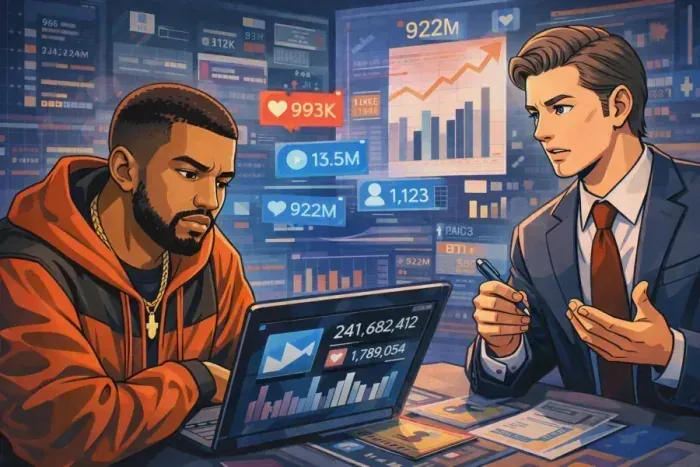
As streaming became routine, numbers started to shape musical judgment more directly. Artists learned to talk about their work through play counts, monthly listeners, saves, and skips. These figures were visible, immediate, and impossible to ignore. They offered precise feedback, but rarely enough context. A song’s value could suddenly be reduced to how long someone listened before moving on.
For established artists, data became both a tool and a pressure. Drake fit this system especially well. He released music consistently, stayed present across features and singles, and turned continuity into a form of dominance. Albums still arrived, but they sat inside a larger stream of appearances that kept attention from drifting elsewhere.
Pop artists felt the pressure just as much. In Ariana Grande’s case, fan response, chart position, and online reaction often collapsed into one live feedback loop. Songs were judged within hours of release, sometimes within minutes. That speed made experimentation harder. Risk was no longer tested slowly. It was measured in public almost immediately.
The data-driven environment also helped new stars rise. Post Malone benefited from a system that rewarded repeat listening, cross-genre familiarity, and playlist flexibility. His songs moved easily between pop, hip-hop, and rock-adjacent spaces, showing how streaming often favored music that could fit several moods at once.
But the numbers never told the whole story. A song could open big and vanish quickly. Another could spread slowly and keep growing for months. Those patterns were harder to defend in a culture trained to value immediate results. Many artists released more often not because they preferred that rhythm, but because disappearing had become risky.
For listeners, these changes were mostly invisible, but they were still easy to feel. Music arrived quickly, stayed briefly, and then slipped into an enormous catalog. For artists, dashboards became part of the job. Creative intuition now had to coexist with measurement, and success was redefined in the process.
The Streaming Economy: Who Wins, Who Loses
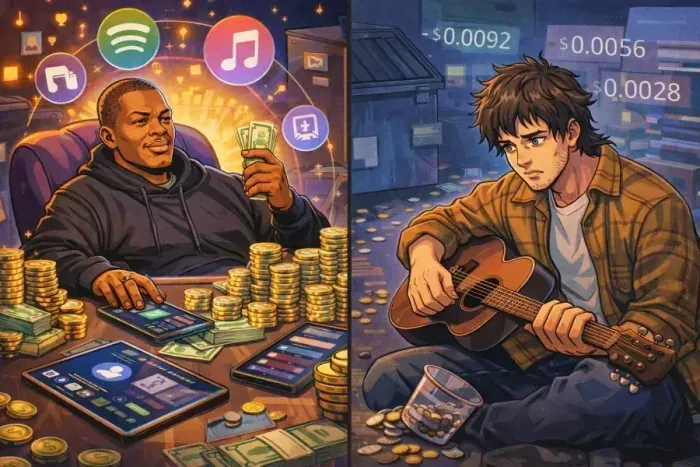
Streaming fulfilled part of its promise. Music became easier to access, easier to carry, and easier to circulate across borders. But those gains were distributed unevenly. A small group of artists benefited enormously, while many others found that greater visibility did not translate into sustainable income. The streaming economy expanded access while also deepening inequality.
Artists who were already popular had an advantage when they entered the new system. Big record companies could secure playlist placements, marketing support, and steady public visibility. The streaming reward model amplified this effect: once a song gained momentum, platform systems pushed it further, creating a feedback loop of repeated exposure. The rich often got richer because the system favored consistency and volume, not because of any hidden conspiracy.
Some artists used streaming to bypass older structures. Chance the Rapper became one of the clearest examples of that possibility in the decade, showing that major visibility could be built outside a traditional label system. But his success was notable partly because it was difficult to reproduce. For every widely cited breakthrough, many other artists found that independence still came with severe structural limits.
Independent platforms offered a different value system. Bandcamp, for example, let artists sell music and merchandise directly to listeners while making payment terms more legible. It appealed to fans who wanted active support rather than passive consumption. But it never matched the scale of the largest streaming services. Choosing independence often meant accepting a smaller reach.
The payment model deepened those inequalities. Per-stream economics favored high-volume listening and genres built for repetition, ambient fit, or constant replay. Artists with smaller but devoted audiences often struggled to turn that loyalty into stable income. For many musicians, even large streaming numbers translated into surprisingly little money once costs were accounted for.
Class and geography shaped the picture further. Artists with financial support could release more often, spend on promotion, and survive long enough to wait for momentum. Those without that cushion faced much harsher tradeoffs. Time spent creating competed directly with time needed to survive. Streaming did not invent that pressure, but it made it harder to ignore.
By the end of the decade, streaming was rarely understood as fair, but it was widely treated as unavoidable. It offered exposure more reliably than security. Some artists learned to treat it as one tool among many, combining it with touring, merchandise, direct support, and other income streams. Others burned out trying to turn visibility into stability. Streaming changed how music was heard, but it also forced a harder question: being seen online does not automatically mean being able to keep making it.
Pop Music After the Monoculture
Pop did not disappear in the 2010s. It lost some of its old certainty. A form that had once depended on broad agreement now had to operate inside a landscape shaped by personal feeds, private listening, and fragmented attention. Even as some artists reached enormous audiences, it became harder to say what still counted as universally popular.
That shift changed both how pop stars presented themselves and how songs circulated. A track could live simultaneously as a playlist staple, a visual object, a meme, a live moment, and a fan-made remix. Music no longer moved through one channel or one narrative. Image and sound became more tightly linked, especially on platforms that rewarded constant engagement and quick visual recognition.
Pop also opened outward. Languages mixed more freely, regional sounds crossed borders more easily, and many women took greater control over writing, production, timing, and public narrative. The genre could still speak to millions, but it no longer spoke from one stable center.
2010s pop did not stop being central. It learned how to function without one stable center. Stars rebuilt influence under new conditions, and audiences followed in more fragmented, more self-directed ways.
Reinventing the Pop Star: Change or Fade Away
By the 2010s, being a pop star meant more than releasing successful songs. Visibility had become continuous, and identity could no longer be managed only around an album cycle. Artists were expected to speak, react, and evolve in public. Reinvention stopped being a special event and became part of the job.
Taylor Swift offers one of the clearest examples. At the start of the decade, she was still working with country-pop textures and confessional songwriting. As her audience expanded, she shifted into full pop while also managing public debates about authorship, ownership, and fan intimacy. The change was not abrupt. It came through careful, visible adjustments that let her evolve without giving up control of the narrative.
Others made flexibility itself central to their identity. Rihanna treated pop less as a fixed style than as a space of movement. Her music shifted easily between dance, R&B, and global influences, while her public presence projected control without constant explanation. Her career made one thing clear: consistency did not require repetition. It required a strong enough center to keep moving without looking lost.
For stars like Justin Bieber, reinvention carried a different weight. When a life unfolds in public, correction is hard to separate from exposure. Musical shifts became entangled with narratives of maturity, instability, repair, and self-definition. Fans followed those changes not only through songs, but through interviews, posts, and silence. The boundary between personal growth and public performance became harder to hold.
In pop, control over image became nearly as important as control over sound. Social platforms let artists speak directly to fans, but they also made constant availability feel expected. Fans wanted access to something real, even when what they were receiving was always partial. A pop career increasingly depended on handling that tension without appearing either distant or overexposed.
What changed most in the 2010s was not ambition, but durability. Pop careers were no longer defined by one peak alone. They depended on adaptation and on the ability to stay visible without overexplaining every shift. Reinvention stopped looking like one dramatic break and became a recurring public skill.
Beyoncé, Lorde, Billie Eilish: Women Redefining Pop Power
Women in pop entered the 2010s carrying a long history of scrutiny around appearance, authorship, and control. The pressure did not disappear over the decade. What changed was the way artists answered it. More of them asserted authority openly, not by fitting more neatly into expectation, but by redefining the terms on which they would be seen and heard.
Beyoncé sits near the center of this shift. In the 2010s, her albums were not just song collections but tightly staged statements, released on her own schedule and framed with a clear visual and political logic. She showed that mass visibility did not have to mean creative looseness. In her case, authority came from control, preparation, and timing.
Lorde represented a different form of authority. She arrived early in the decade as a pop artist who did not perform pop in the expected way. Her writing was controlled, observational, and slightly distant. That stance resonated with listeners tired of excess and overexposure. In her case, authority came partly through refusal. She showed that stepping back could itself move a career forward.
Later in the decade, Billie Eilish pushed that logic further into the mainstream. Her music and visual world emphasized intimacy, restraint, and controlled discomfort instead of spectacle. Oversized clothing, close-miked vocals, and minimalist production helped reframe what feminine presence could look and sound like in pop. The effect did not feel performatively rebellious so much as carefully bounded, which many listeners experienced as honesty. "People underestimate the power of a young mind."
Others built authority through craft and strategic distance. Sia, for example, emphasized songwriting and production over personal exposure. By centering the work rather than the self, she built a durable career that protected space for invention.
Across these approaches, one point became hard to miss. Timing, authorship, and narrative control mattered as much as chart position. Women in pop did not have to perform authority in one approved way. It could be quiet, exact, withholding, theatrical, or deliberately hard to read. The pressure did not disappear, but the range of available responses widened.
Global Pop: When Borders Stopped Mattering
By the middle of the 2010s, pop was moving through a weaker hierarchy than before. For decades, artists seeking international success often had to pass first through the US or UK. Streaming and social media loosened that structure. Songs could now spread through playlists, fan communities, and online video circulation without following the old route. Language no longer worked as a barrier in quite the same way.
Artists outside the English-speaking pop core gained new kinds of visibility. Shakira had already built a multi-market career, but the 2010s made it clearer how normal bilingualism and crossover had become inside mainstream pop. Her collaborations and releases matched how many audiences were already listening, moving naturally between Latin pop, global dance, and international chart culture.
The clearest late-decade signal came in 2017, when Luis Fonsi and Daddy Yankee’s “Despacito” became a global event rather than a niche crossover. It showed that a Spanish-language hit could dominate international listening without surrendering its core identity. Later, artists like Bad Bunny pushed that logic further. His rise did not come from fitting Anglo-pop expectations. It came from listeners adapting to his world. Streaming made it possible for Spanish-language songs to appear next to English songs in the same listening spaces, which made multilingual listening feel normal rather than exceptional.
European pop shifted too. Rosalía’s work combined flamenco reference points with modern pop and experimental production, provoking debate about ownership, tradition, and the terms of reinvention. That discussion unfolded across borders and in real time, without waiting for gatekeepers to authorize it.
These shifts did not erase power imbalances. English-language music still carried structural advantages, and visibility remained unevenly distributed. But the terms of inclusion had changed. Pop no longer needed one accent, one visual code, or one approved route into the conversation.
This shift changed listening itself. A playlist could move from American pop to Latin trap to European art-pop within minutes. For artists, that meant opportunity without any guarantee of fairness. Resonance started to matter more than translation, and the decade did not settle into one global sound.
Producer-Platform Pop and the Songwriting Camp System
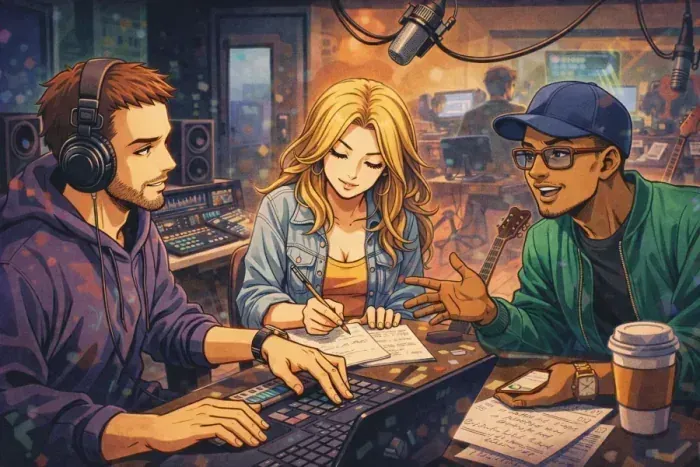
As pop became more global and more data-driven, the architecture behind it also changed. Big songs were increasingly built through distributed systems of producers, topliners, co-writers, and writing camps that could stretch across cities and time zones. This did not mean artists stopped mattering. It meant authorship became more layered and often less visible to listeners.
The camp model suited the decade’s pace. Labels and management teams wanted songs that could move quickly across playlists, radio, short-form clips, and international markets. Writing camps gathered specialists who were good at different parts of that process: melody, track-building, lyrics, hooks, vocal production, or arrangement. A finished pop song could emerge from shared labor rather than from a single private inspiration.
That structure helps explain why so much 2010s pop felt simultaneously polished and modular. Songs had to be emotionally legible, adaptable across platforms, and flexible enough to travel across borders. The producer’s role expanded accordingly. Figures such as Max Martin, Stargate, and later Jack Antonoff or Frank Dukes did not simply shape sound. They also shaped tempo, scale, mood, and even how a star’s public persona might be translated into music.
What changed was not just who wrote songs, but how creative authority was described. Listeners still attached songs to the face at the center, yet the work increasingly depended on networks of collaborators whose fingerprints were everywhere. The tension between personal voice and industrial coordination ran through a great deal of 2010s pop.
The system could create extraordinary craft, but it also rewarded repeatable formulas. Songwriting camps made it easier to build hits efficiently, while making it harder to draw clean lines around ownership. In the 2010s, pop often sounded intimate even when it was built by teams. That was part of its achievement and part of its illusion.

Seeing Music: When Images Became the Song
In the 2010s, music rarely arrived alone. It came with images, moods, and visual cues that helped shape understanding before the song even started. Social media made listening more visibly mediated. Artwork, clips, stills, and carefully staged fragments could carry as much meaning as melody or lyric. For many artists, presence was something built piece by piece.
Platforms like Instagram, Tumblr, and YouTube accelerated that change. They rewarded mood, recognizable imagery, and fast circulation. One image could define an era of an artist’s work, and a short video could shape expectations for an entire release. Visual identity became part of the music rather than an optional extra.
This made expression and presentation harder to separate. Artists communicated emotion through color, posture, pacing, and sequence, often without explaining any of it directly. Audiences learned to read those cues quickly and repeat them in turn. The result was a culture in which carefully staged feeling could seem more truthful than open confession.
Images shaped musical style throughout the 2010s. Artists built worlds around releases, and seeing music became part of everyday listening.
Instagram, Tumblr, and the Visual Language of the 2010s
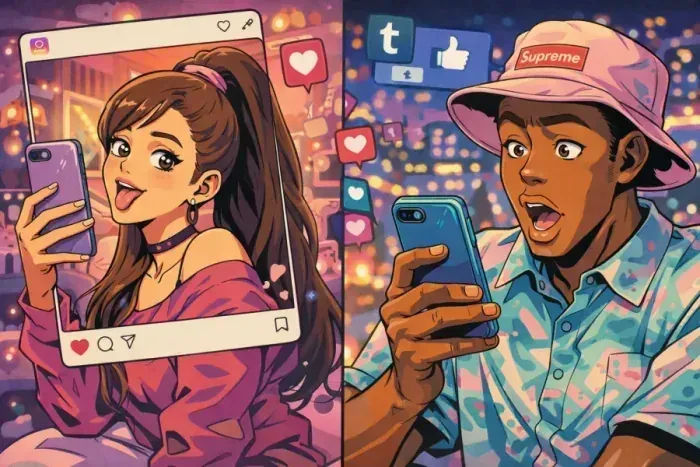
Many listeners already knew how they expected the music to feel before they pressed play. Instagram and Tumblr trained users to read atmosphere quickly. Color, clothing, typography, and posture all carried meaning. Music became part of a total mood rather than a standalone object.
Lana Del Rey became one of the defining figures of this visual logic. Her early-2010s world of nostalgia, faded glamour, and quiet cinematic sadness circulated almost as widely through images as through songs. The visuals did not simply illustrate the music. They prepared the listener for it, building intimacy before the sound arrived.
A version of this visual storytelling that was darker and more urban appeared in The Weeknd’s work. At first, he used shadows, distance, and mystery in his visuals. Faces were hidden. Rooms felt empty. Emotions were suggested rather than stated directly. Tumblr users helped spread that style. They reposted fragments until they became symbols. The music gained force through repetition and suggestion rather than explanation.
For artists like Grimes, visual culture became a site of experimentation rather than coherence. Her online presence combined fantasy, technology, and fragility without clear boundaries. The images were not always polished, but they were intentional. They suggested process rather than finished product, which suited a decade in which unfinishedness could feel more honest than perfection.
These platforms also changed how fans participated. Listeners were not just looking at images. They remade them. Screen captures, edits, GIFs, and reposted fragments circulated next to official material and sometimes traveled even further. A song could pick up a visual life the artist had not fully authored.
This visual language privileged feeling over clarity. It relied on suggestion, repetition, and atmosphere. Albums no longer needed a single iconic cover to define them; a sequence of images could do that work instead. Visual identity became more fluid, shaped through ongoing exchange between artists and audiences. Music was not only heard. It was watched, paused, saved, reposted, and remembered through images that often lingered longer than the sound itself.
Music Videos After MTV: YouTube Takes Over
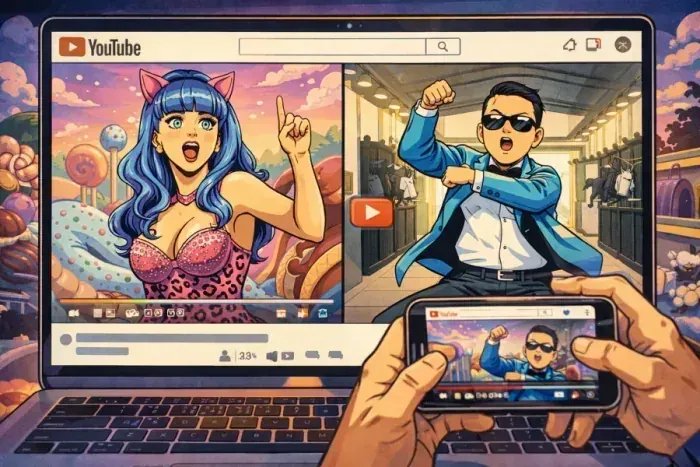
By the time the 2010s began, music television was no longer the main route through which people found new songs. MTV still existed, but its earlier authority had weakened. Music videos did not disappear. They migrated. YouTube became their central platform and changed both how videos circulated and how they were understood.
Videos gained freedom when there were no limits on airtime or format. Some artists made their work bigger and more ambitious. Beyoncé used video as an artistic form, not merely as promotion. Projects like Lemonade linked individual songs through recurring images, locations, and themes. The visuals created context around race, gender, and intimacy without needing to spell everything out. Viewers did not just watch a clip. They entered a sequence.
Other artists used video to sharpen one idea. Childish Gambino released “This Is America,” a song with striking images that invite close interpretation. The video spread quickly and was analyzed closely on social media. Its reach came from its density, not its polish. Meaning emerged through comparison, surprise, and repetition, and online conversation made that process even stronger.
FKA twigs worked in a different visual language. Her videos used the body itself as a site of meaning, combining dance, vulnerability, and control without relying on a simple plot. Movement replaced explanation. The camera stayed close to effort, tension, and stillness, and the work rewarded attention rather than spectacle.
YouTube also changed how audiences engaged. View counts were public, and comments, edits, and reaction clips appeared almost immediately. Once a video was released, it entered a shared interpretive space. Artists had to expect pause, rewind, annotation, parody, and close reading from the start.
After MTV, music videos no longer needed one unified style. Some were cinematic, some deliberately loose, some legible at once, and others built around ambiguity. What linked them was their function. They became spaces where music and image could be encountered together, paused, replayed, and argued over. They were no longer interruptions in a programming schedule. They became destinations in their own right and shaped how songs were remembered long after the first listen.
Authenticity as Performance: The Paradox of Being Real
By the middle of the 2010s, authenticity had become one of the most prized values in popular music. Listeners wanted artists who felt real, accessible, and emotionally legible. But this demand carried a contradiction. Authenticity was no longer something discovered slowly. It was expected in advance and judged in public.
Artists handled this tension in different ways. Lorde built a persona defined by distance, restraint, and selective speech. She let silence do part of the work. That reserve read as sincere precisely because it refused the constant access listeners were beginning to expect. In her case, authenticity came from boundaries, not total disclosure.
Others focused on being close. Billie Eilish came onto the scene in a space where fans expected her to be emotionally open, but she was careful to control how she presented that openness. The interviews, visuals, and lyrics showed vulnerability without explaining too much or offering excuses. Her tone suggested that she was comfortable with discomfort. What felt honest was not confession, but consistency. The emotional tone held across different platforms.
For Frank Ocean, being real often meant staying quiet. Long gaps between releases, rare appearances, and limited public explanation pushed attention back toward the music itself. When new work arrived, it felt deliberate rather than demand-driven. Listeners filled the silence with interpretation, turning absence into part of the meaning.
Social media intensified the problem. Platforms rewarded constant interaction and often penalized disappearance through reduced visibility. Artists who shared more could feel closer, but they also risked exhaustion and misreading. A casual post could become evidence. A delay could be read as evasion. Authenticity became a performance under continuous observation, shaped as much by audience expectation as by the artist’s own intent.
Fans were part of this process too. They tracked tone, timing, language, and continuity across platforms, and they often treated sudden shifts with suspicion. Growth was expected, but it had to look legible and emotionally coherent. There was less room for change that happened offstage.
The 2010s did not invent performance in pop, but they changed its scale and emotional texture. Being real no longer meant revealing everything. It meant managing visibility in a way that still felt emotionally believable. Authenticity became something artist and audience built together, and it never stayed fully stable.
Hip-Hop's Rise: From Margins to Center Stage
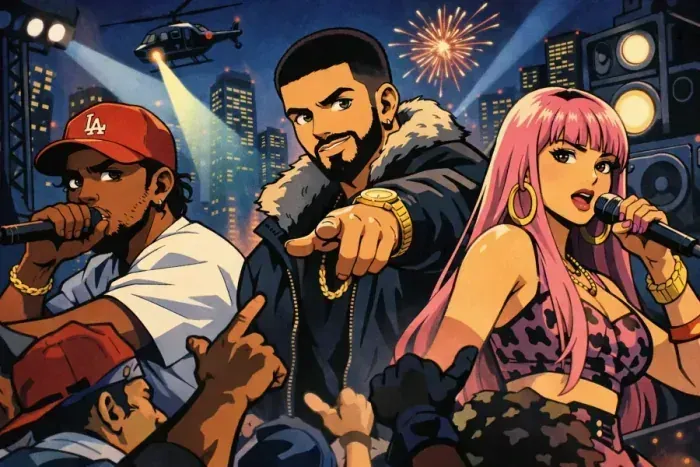
Hip-hop did not move to the center of popular music through one dramatic turning point. It happened gradually, until the shift became impossible to miss. What had long shaped culture from the margins moved into the center and stayed there. By the middle of the decade, hip-hop was not just influencing the mainstream. It was helping set its terms. By 2017, Nielsen reported that R&B/Hip-Hop accounted for the largest share of total music consumption in the United States, putting numbers to a shift listeners had already been hearing.
This change was not only about charts or visibility. Hip-hop fit the conditions of the decade unusually well. It adapted quickly to streaming, worked easily through singles and features, and moved naturally through online culture. Scenes formed in public, styles shifted in real time, and listeners followed artists across a constant flow of releases instead of waiting for one carefully separated album cycle.
Hip-hop also spoke directly to the decade’s wider mood. Questions of race, power, success, pressure, and vulnerability were often addressed without softening the language or hiding the stakes. The music could be aspirational and deeply anxious at the same time, which is part of why it resonated so widely.
Hip-hop moved from cultural force to cultural foundation in the 2010s. It reshaped not only its own future, but also the release logic, language, and sound of popular music more broadly.
Drake, Kendrick, J. Cole: Hip-Hop's New Center
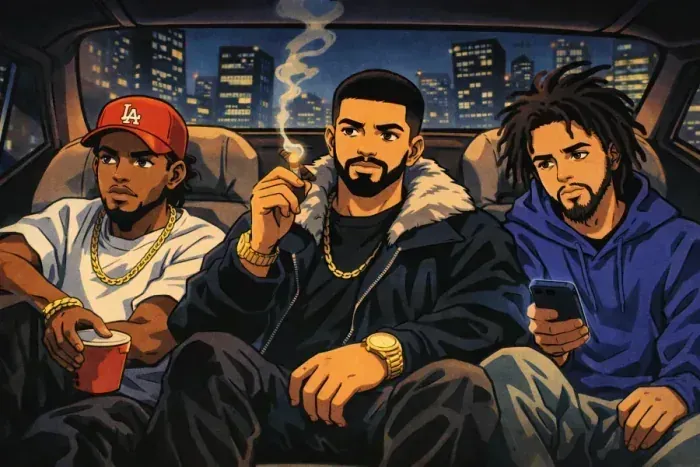
Hip-hop’s rise to the center of the industry did not come from one stylistic change. It came from accumulation. Years of cultural influence, entrepreneurial thinking, and audience loyalty finally met platforms that rewarded constant output and direct connection. By the 2010s, hip-hop no longer needed validation from other genres. Other genres were adapting to its logic instead.
Drake is one of the clearest examples. He moved easily between rap, R&B, and pop while remaining central to hip-hop’s own conversation. Songs could sound diaristic, radio-ready, and playlist-friendly at once. That flexibility fit a listening culture organized less by genre loyalty than by mood, repetition, and constant presence.
A different kind of centrality emerged with Kendrick Lamar. His albums used hip-hop as a form capable of literature, politics, and spatial memory. Good Kid, M.A.A.D City and To Pimp a Butterfly showed that the album could still carry weight even inside a fast-moving system built around constant circulation. Kendrick’s success showed that depth, structure, and ambition still had room to matter. "When you get a concept album from a new artist it shows that it still lives in the game."
J. Cole offered another model. He built his career around consistency, self-production, and direct reflection on class, doubt, and responsibility without leaning on spectacle. His appeal came partly from steadiness. Hip-hop’s dominance did not depend on one voice or one method. It depended on how much range the form could hold.
The industry began adjusting itself around these artists rather than the other way around. Release schedules loosened. Features became more central than older promotional rhythms. Pop stars sought credibility through proximity to hip-hop, while rap artists no longer needed pop approval to reach a mass audience.
Hip-hop also changed how authorship was understood. Producers, writers, and collaborators became more visible as parts of creative ecosystems rather than as invisible background labor. That shift fit a decade increasingly preoccupied with identity, perspective, and personal voice.
By the end of the 2010s, calling hip-hop only a genre no longer felt sufficient. It had become something closer to an operating system for popular music, shaping release logic, career structure, and listening habits alike.
Trap, SoundCloud Rap, and the DIY Pipeline
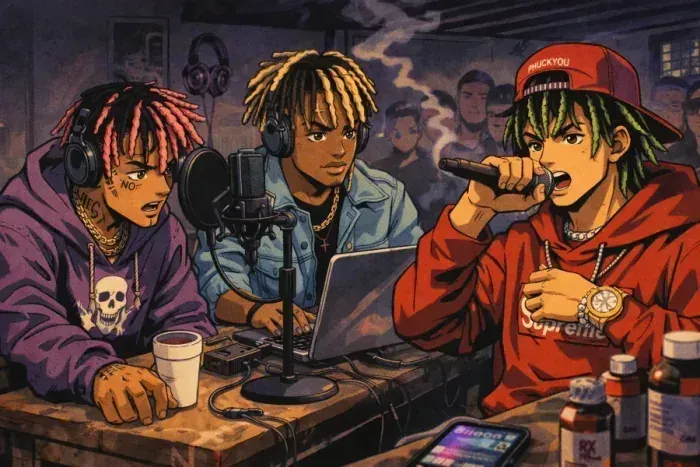
Hip-hop had moved to the industry’s center, but newer artists still found ways to stress its edges. Trap and the SoundCloud ecosystem developed through a different pipeline than older industry models of label, radio, and press. They grew quickly, unevenly, and often in the same online spaces. The result felt unstable, improvised, and very alive.
Trap began in specific regional scenes, especially in the American South, but the internet accelerated its reach dramatically. Producers and rappers circulated ideas quickly, sometimes releasing tracks before they felt fully settled. That looseness became part of the aesthetic. Heavy bass, clipped melodies, and repetitive structures worked well for phone listening, distracted listening, and immediate replay. Songs often landed before their full context did.
Artists like Future helped define this style. He used melody, repetition, and emotional ambiguity to widen the expressive range of rap vocals. Pain, bravado, numbness, and detachment could all sit in the same verse, and that blur spread well beyond trap.
Groups like Migos turned trap into a highly shareable rhythmic language. Cadence, flow patterns, and vocal phrasing became widely recognizable and easily repeatable. Songs spread through short clips and social media circulation, building momentum through repetition more than explanation. Success often felt as collective as it did individual.
SoundCloud sped the process up further. It let artists upload immediately, test reaction in public, and build followings without traditional intermediaries. For listeners, discovery felt live. Artists such as Lil Uzi Vert and XXXTENTACION gained visibility before a conventional infrastructure had fully formed around them, which showed how quickly urgency itself could attract attention.
This pipeline came with real costs. Careers developed in public before artists had time to stabilize. Audience expectations grew faster than support systems. Artists were expected to release constantly, often at the expense of health and long-term craft. The same speed that enabled discovery also increased pressure and scrutiny.
The impact lasted well beyond the moment itself. Trap and SoundCloud changed how labels searched for talent, how producers collaborated, and how much roughness audiences were willing to accept. The threshold for entry dropped, but the pressure to remain present rose just as quickly.
TikTok Before TikTok: Vine, Memes, and Short-Form Music Discovery
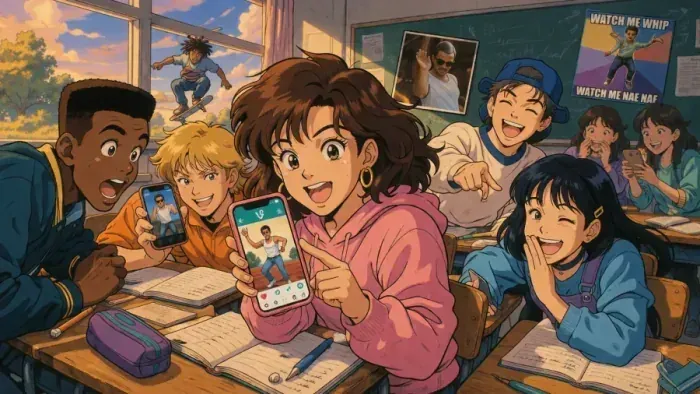
Long before TikTok became the dominant story about short-form music culture, the 2010s were already training listeners to encounter songs in fragments. Vine loops, meme edits, YouTube compilations, dance challenges, and reposted clips taught audiences to recognize a track through a few seconds rather than a full listen. Hooks did not replace songs, but they often became the first point of contact.
This changed how tracks circulated. A line, beat drop, or vocal inflection could travel widely before listeners knew much else about the artist behind it. Songs spread through humor, repetition, and context collapse. What mattered at first was not always narrative depth, but immediate recognizability and replay value.
Hip-hop and pop adapted quickly to that environment. Catchphrases, quotable lines, and sharply legible rhythmic moments worked especially well in spaces built for looping and remixing. Viral circulation could turn a local track into a broad cultural reference with almost no warning. The infrastructure looked informal, but its effect on discovery was structural.
This fragment logic also changed listening habits. Audiences became comfortable knowing a moment before they knew a song, and knowing a song before they knew an album. The economy of attention favored tracks that could survive excerpting without losing identity. That did not make the music shallow by definition, but it did reward immediacy in new ways.
By the end of the decade, short-form discovery already felt normal. TikTok would later make that system more visible and more powerful, but the habits were formed earlier. The 2010s taught listeners to hear virality in miniature.
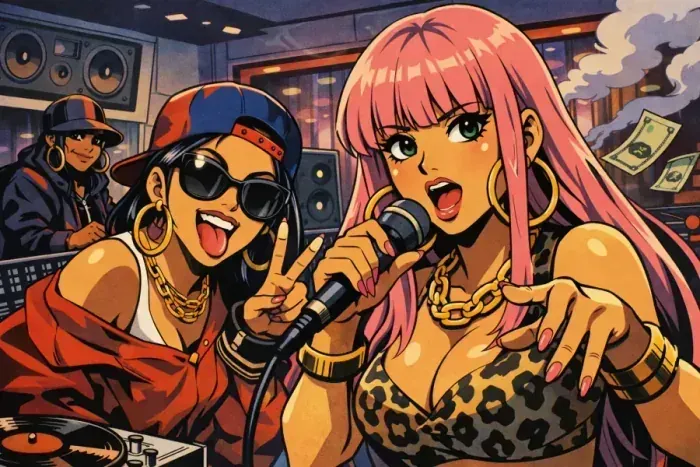
Nicki Minaj, Cardi B, Megan Thee Stallion: Women in Hip-Hop
Women in hip-hop entered the 2010s into a field that was more visible than before but still deeply unequal. The genre’s expansion brought more attention and more conversation, but it did not automatically resolve questions of credit, authority, or respect. What changed was how openly those tensions were discussed.
Nicki Minaj was one of the defining figures of the early decade. Her technical range, vocal flexibility, and control over persona made it impossible to dismiss her as a novelty. She moved between aggressive rap performance and pop structure without surrendering either. That visibility also intensified a kind of gendered scrutiny that male peers rarely faced.
Later in the decade, Cardi B rose through a different route. Her social-media presence and plainspoken style were not separate from her music; they were part of the same voice. That openness connected with listeners alienated by smoother industry narratives. Her success also triggered wider debates about authenticity, class, respectability, and taste.
Megan Thee Stallion added another model. Her work combined confidence, humor, and self-definition while speaking directly about education, independence, contracts, and control. With her, business language became more public instead of staying hidden behind industry walls.
These artists worked differently, but the pressures around them overlapped. Sexual expression was judged more harshly. Authority was questioned more quickly. Success was often met with suspicion rather than ease. At the same time, hip-hop’s size gave them visibility and leverage that earlier generations had rarely been allowed.
Fans played an active role in shaping this environment. Support could be intense, but so could backlash. Online spaces amplified both, and they often made artists feel they had to answer immediately or step back completely for a while.
The 2010s did not solve hip-hop’s gender imbalance. They did make the power struggle more visible. Women were no longer framed as occasional exceptions. They were central to the sound, the language, and the business of the genre, even as their authority remained contested.
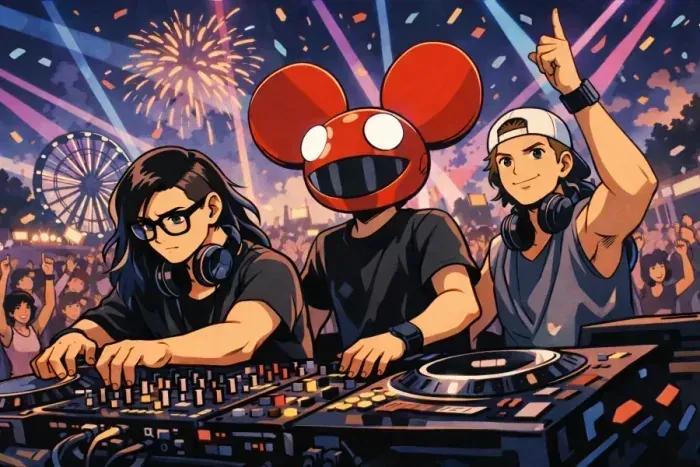
Electronic Music: EDM, Festivals, and the Dance Floor
Electronic music became far more publicly visible in the 2010s. Sounds once associated with clubs and late-night radio moved onto massive daytime festival stages. What had been subcultural became, for a time, one of youth culture’s most recognizable public languages, built around energy, release, and scale.
That visibility came with tension. EDM pushed electronic music deeper into pop culture, but it also flattened distinctions that had once mattered to specific scenes. Producers moved to the center. Drops often replaced gradual development. For some listeners, this felt liberating. For others, it felt reductive.
At the same time, electronic music never left its roots entirely. Local scenes continued to evolve through clubs, labels, and communities that still valued experimentation, duration, and resistance to simplification even as public attention moved elsewhere.
The 2010s story of electronic music sits between scale and intimacy. EDM changed public expectation, underground scenes pushed back, and the genre kept moving between mass visibility and smaller, more durable spaces.
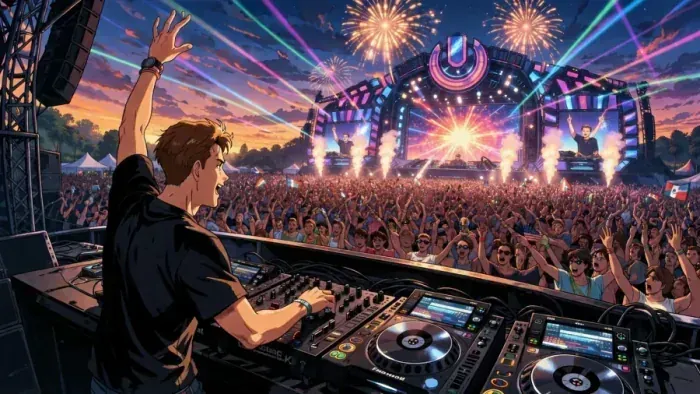
The EDM Boom: When Electronic Went Massive
The early and mid-2010s saw electronic dance music become a mainstream force. Festival lineups elevated DJs to headline status, crowds expanded dramatically, and electronic tracks moved deep into pop radio. EDM offered a sense of scale that matched the moment. Big drops, simple builds, and immediate emotional payoffs worked well in open-air spaces built for spectacle.
Artists like Avicii were central to that shift. His gift was to fold folk-pop melody into festival-scale production without flattening the emotional core of the song. Tracks like “Levels” and “Wake Me Up” worked in clubs, on radio, and on huge outdoor stages, which is why they became such powerful crossover records.
Producers like Calvin Harris pushed the same model from another angle, building collaborations with major singers that could thrive on pop radio without losing club energy. The producer was no longer a background figure. Name recognition, public image, and sonic signature all became part of the appeal.
Festival culture intensified the effect. Events like Tomorrowland and Ultra turned EDM into a global ritual of repetition and release. People from different places gathered around shared structures of build, drop, and emotional payoff. In a decade otherwise marked by fragmentation, that sameness was part of the appeal.
But the limits of the boom became clear soon after. As lineups grew more similar, critics and longtime fans started to wonder what had been lost. Subtlety gave way to a more predictable, formulaic approach. Sets were timed and designed for maximum impact, which left little room for error. Some producers felt they had less creative freedom because the pressure to make hits had become so strong.
The human cost became harder to ignore as well. Touring intensified, expectations rose, and personal boundaries were tested. The public saw celebration, but also exhaustion and isolation. Later in the decade, Avicii’s death sharpened difficult conversations about mental health, labor, and care within electronic music culture.
By the late 2010s, EDM no longer felt culturally unavoidable. Its sounds remained in pop, but the peak festival formula had lost some of its force. What lasted was the lesson that electronic music could scale up dramatically, and the reminder that scale alone was not enough. Many listeners returned to intimacy, variation, and slower forms of tension.
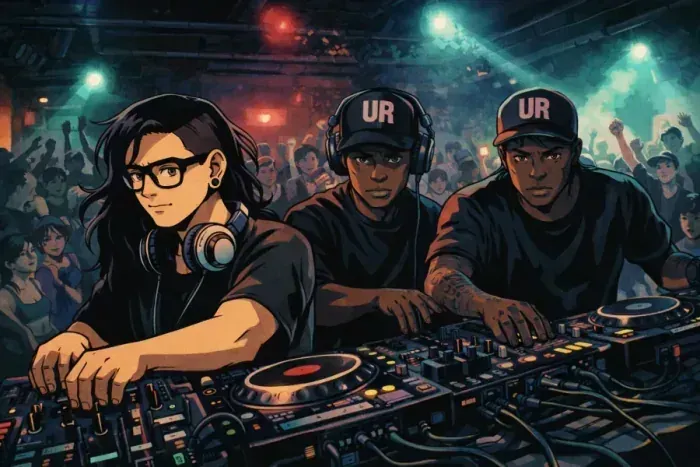
Underground Resistance: Keeping Electronic Music Alive
While EDM dominated festival visibility, underground electronic music continued to develop on its own terms. These scenes did not reject visibility entirely, but they resisted simplification. Clubs, small labels, and local communities remained committed to sound systems, long sets, and gradual stylistic evolution. Their influence was quieter, but also more consistent.
Cities with strong electronic infrastructures adapted in different ways. Berlin remained a clear example of a culture built around duration, immersion, and long-form attention. DJs like Ben Klock embodied that approach, shaping sets around gradual transition rather than sudden climax. The experience rewarded patience, which set it apart sharply from festival logic.
Artists like Nina Kraviz showed that wider visibility did not have to erase underground strangeness. Her sets and productions mixed techno’s physical force with odd textures, fragility, and a refusal of easy categorization.
A harsher edge came through artists like Helena Hauff. Her work drew on electro, industrial, and early techno while keeping raw textures and analog roughness intact. In a moment obsessed with polish, that abrasion mattered. It pointed back to electronic music’s longer relationship with risk, friction, and unpredictability.
Underground spaces also preserved social practices that festival culture often thinned out. Long sets let DJs respond to the room instead of following a fixed schedule. Clubs supported communities built on repetition, trust, and relative anonymity. In those spaces, the music still mattered more than the performer.
Online tools were also used, but in a different way. Platforms helped spread mixes and recordings, making local scenes more visible without replacing in-person events. Fans discovered artists online and then looked for places where they could hear the music in person.
The 2010s did not erase this underground. They made the contrast within electronic music more visible. EDM carried the genre outward, while smaller scenes protected its slower, more exploratory forms. The balance remained delicate, but it held because communities kept choosing patience over simplification.
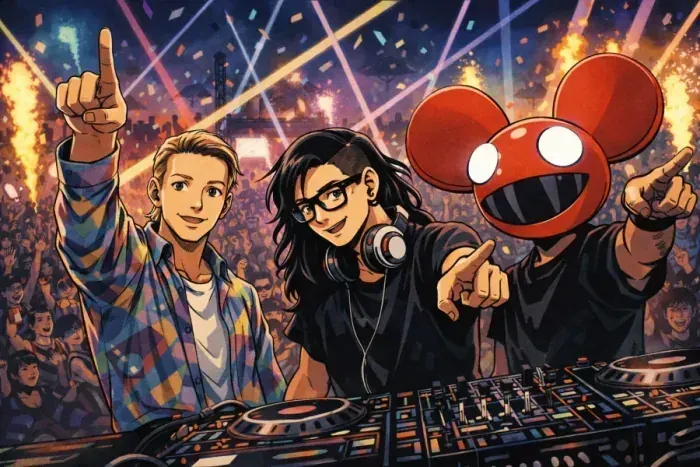
Skrillex, Diplo, Deadmau5: Producers as Pop Stars
The 2010s changed how producers were seen and how they understood their own role. Where many producers had once remained largely behind the scenes, they now became visible public figures, collaborators, and sometimes the main attraction. Their names mattered, and their sound functioned almost like a brand.
Skrillex is one of the clearest examples. His rise made production itself a public topic, both sonically and as persona. Harsh textures, dramatic drops, and instantly recognizable sound design turned process into spectacle.
Diplo represented a more mobile kind of authorship. He moved across pop, dancehall, hip-hop, and global club music, connecting scenes rather than staying inside one sonic identity. That flexibility reflected a decade in which access and adaptability became forms of power.
Deadmau5 represented a different model again, one built around technical control, recognizable visual branding, and a coherent world around the music. The producer was not just making tracks. He was building an authored environment that fans could follow across records, performances, and online persona.
This visibility altered the creative process itself. Producers now spoke directly to labels, artists, and audiences. They toured as headliners, released under their own names, and maintained public personas that shaped reception. For some, that freedom opened new space. For others, it created fresh pressure to turn technical skill into a permanent public identity.
At the same time, heavy producer branding could obscure the collaborative networks that had always driven electronic music forward. Once names became brands, sound design itself started to look more like proprietary capital than shared practice.
The decade did not resolve that tension. It exposed it. Producers became both makers of sound and public figures competing for attention in a crowded visual culture, and that shift changed the broader idea of authorship.
Rock's Reinvention: Guitar Music Finds New Life
Rock remained present in the 2010s, but it no longer occupied the center. Guitar music had to reconsider what relevance meant once it stopped functioning as the default language of youth, rebellion, or authenticity. By the start of the decade, charts had moved elsewhere, and younger listeners often discovered rock through older catalog rather than through new releases.
That shift forced adaptation. Some bands leaned into touring and long-term audience connection. Others reshaped rock to fit a quieter, more reflective mood. Instead of trying to dominate, many artists turned inward. Lyrics narrowed toward uncertainty, adulthood, and daily emotional friction. Guitar music stopped trying to outcompete pop and hip-hop on their terms and moved into smaller, more intimate spaces instead.
Digital platforms complicated the picture. They made rock easier to find, but also placed it beside genres built for faster reward. Rock survived by becoming more selective, reflective, and clearer about what it could still offer.
Rock and alternative in the 2010s are best understood through adaptation: artists adjusted their sound, scale, and goals to stay meaningful in a new musical landscape.
Rock's Decline: When Charts Stopped Caring
By the early 2010s, rock’s relationship with the charts had already changed. Guitar-driven music still had fans, but it was no longer as influential in popular culture as it had once been. The change happened gradually. It was not sudden, and it was not just the result of one trend replacing another. It reflected bigger changes in how music was shared and how listeners got used to hearing it.
Bands like Foo Fighters kept releasing successful records and filling major festival slots. That endurance showed that rock had not lost its audience, but its center of gravity had shifted. Success depended more on touring, reputation, and long-term loyalty than on streaming spikes or viral momentum. For many acts, the album became a way to renew the live circuit rather than to redefine the public conversation.
Younger rock bands had different challenges. In the early 2010s, groups like Kings of Leon had some success on the radio, but this became harder to sustain as listening habits changed. Guitar music struggled on playlists that prioritized mood and immediacy over a wider dynamic range. Long introductions, shifting structures, and album-based storytelling did not always fit the new logic.
Even bands with large international audiences felt the shift. Muse remained powerful as a live act, but that power registered more clearly onstage than in the metrics. For rock, the concert became a stronger proof of relevance than the chart.
Media narratives hardened around those numbers. As hip-hop and pop dominated the charts, rock was increasingly framed as heritage or niche culture rather than as a living center of innovation. Younger listeners often encountered it through older records first, which changed the sense of where the genre’s present actually was.
Lower chart visibility did not mean rock had run out of ideas. It meant expectations had changed. The genre no longer claimed to speak for everyone. It spoke more clearly to the listeners who still lived inside its language, whether through force, reflection, or shared memory.
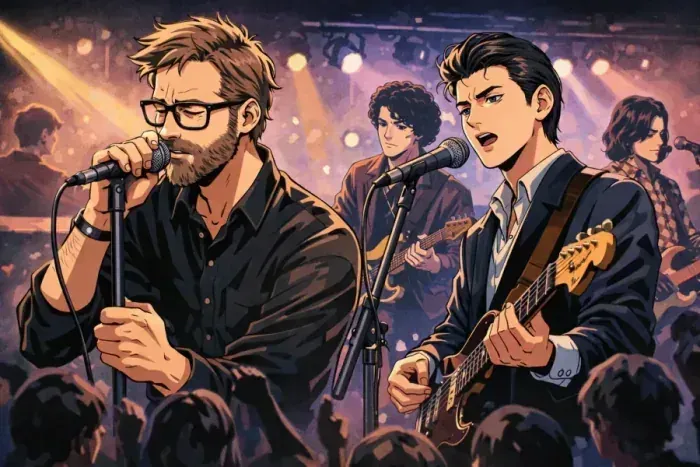
Indie's Turn: The National, Arctic Monkeys, and Emotional Honesty
As rock’s public dominance weakened, indie and alternative increasingly turned toward intimacy rather than scale. Music that felt personal, conversational, and grounded in ordinary feeling gained power. Instead of competing through loudness or speed, many artists chose restraint. Songs moved more slowly. Lyrics stayed close to uncertainty, memory, and the small labor of getting through daily life.
Bands like The National built their reputation on that exact mode. Slow tempos, detailed writing, and themes of adulthood, anxiety, and emotional distance gave their records a durability that did not depend on instant impact. The songs deepened with repetition, and that steadiness mattered in a decade built around acceleration.
Arctic Monkeys moved differently. Over the decade, they shifted from swagger and velocity toward a more stylized, self-aware mode. Records like AM and later Tranquility Base Hotel & Casino showed a band willing to test its own image instead of simply repeating it.
A newer voice emerged through artists like Phoebe Bridgers. Her songs treated sadness, uncertainty, and care with unusual plainness, without turning confession into performance. The writing felt intimate because it left room for pauses, half-finished thoughts, and ordinary emotional detail.
Digital spaces helped this turn toward emotional candor travel. Bedroom recordings, sparse arrangements, and rough vocals moved easily through streaming and social sharing. The intimacy fit late-night listening especially well. Indie no longer needed to compete for mass attention to matter. It could resonate through recognition rather than scale.
Success was measured differently too. Tours centered on theaters instead of arenas. Audiences bonded through shared feeling rather than mass consensus. Indie and alternative did not try to replace old rock centrality. They offered another listening mode entirely, one that made room for vulnerability, patience, and the possibility that music could meet people where they actually were.
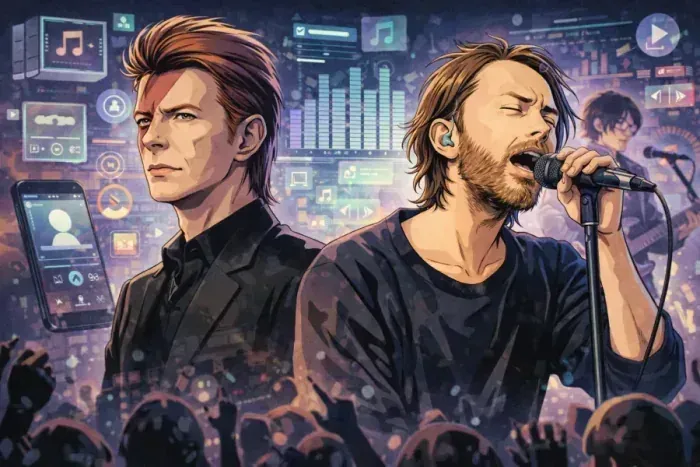
Legacy Acts: David Bowie, Radiohead, and the Streaming World
For artists whose careers began long before the 2010s, the challenge changed. The question was no longer how to stand out, but how to remain meaningful in an environment shaped by speed, playlists, and constant novelty. History could deepen the work, but it could also trap it.
Some artists used the decade reflectively rather than competitively. David Bowie did this most strikingly with Blackstar, a record that refused nostalgia and instead treated aging as creative transformation. Its mixture of jazz, electronics, and abstract songwriting trusted listeners rather than chasing current trend logic.
Others ran into the limits of legacy in a platform era. U2 still had enormous global recognition, but the decade often pushed discussion toward distribution strategy and brand meaning rather than toward new artistic direction. Even for a band that large, attention could feel surprisingly fragile once the surrounding media logic changed.
Some artists embraced digital flexibility without giving up the album as a form. Radiohead kept experimenting with presentation, pacing, and sound, and records like A Moon Shaped Pool argued for restraint in a decade that usually rewarded immediacy.
Legacy artists also had to accept that younger listeners often encountered them through playlists and recommendations rather than through original context. A song’s texture could matter more than its history. For some artists that felt like loss. For others, it opened a more unexpected kind of freedom.
The most compelling legacy responses were the clearest. They did not try to relive the past so much as decide what from it still mattered in the present. In a decade of constant change, durability did not mean staying visible everywhere. It meant knowing what to carry forward and continuing to create without pretending time had stood still.
The Sound of the 2010s: Intimacy and Minimalism
If the 2010s struggled to settle on one dominant style, they did converge around a shared attitude. Songs grew closer, quieter, and more exposed. Production shifted away from sheer scale and toward emotional precision. Silence, breath, restraint, and room tone became expressive tools.
Technology made that possible without requiring large institutional support. Affordable software and home recording setups let artists shape sound with unusual control. Choices that might once have felt like limitations became aesthetic decisions. A soft vocal, a muted drum, or a sparse arrangement could carry more force than a fully maximal mix. Private listening habits reinforced that turn. Headphones changed how songs were built.
Producers and songwriters responded by making tracks that revealed themselves gradually. Hooks did not always announce themselves immediately. Choruses often softened instead of exploding. Atmosphere carried as much weight as lyric.
What follows is less about one genre than about a larger production logic: why intimacy, minimalism, and emotional closeness became some of the decade’s strongest sounds.
Minimalism: When Silence Became the Loudest Sound
One of the most striking changes of the decade was a new tolerance for sparseness. Songs did not need to be loud to feel powerful. Many artists chose to leave space open so that silence and restraint could carry meaning. The result was not emptiness, but trust in the listener’s attention.
Artists like James Blake played a central role in shaping this attitude. His music often consisted of a few notes on the piano, short vocal phrases, and sudden quiet periods. The gaps between the notes were as important as the notes themselves. The songs felt personal, almost as if they could fall apart at any moment. That tension was part of the appeal.
A similar sensitivity appeared in the work of Frank Ocean. His albums focused more on building mood than on following a traditional structure. The music blended spoken parts, melodies, and ambient passages without being easy to define as either verse or chorus. That looseness encouraged listeners to focus on feeling instead of structure. Silence was not empty space. It was a frame.
Later in the decade, Billie Eilish brought this minimalism into the center of pop itself. Soft percussion, muted bass, and almost-whispered vocals stood against the maximal energy of earlier years. The recordings felt less like performance than like close address.
The production choices supported that closeness. Reverb was restrained. Vocals often sat right at the front with all their breath and grain intact. Arrangements left room for the listener to do some emotional work rather than spelling everything out. Headphones pushed that intimacy even further.
This turn toward minimalism also made sense inside the wider decade. Noise, speed, and visibility were everywhere, which made quiet feel newly valuable. Listeners learned that power did not always have to arrive as impact. It could come through pause, space, and the confidence to let a song speak softly without disappearing.
Autotune: From Correction to Emotional Expression
Auto-Tune had been part of popular music before the 2010s, but during this decade it became fully normalized as both tool and effect. Its role changed. Rather than hiding perceived imperfection, many artists used it to shape feeling. The technology was used not to erase emotion, but to refract it.
The groundwork had been laid earlier, especially by Kanye West, but the 2010s normalized the idea that Auto-Tune could reveal feeling rather than hide it. It stopped reading as a mere correction tool and became part of the expressive surface of the voice, capable of adding distance, fragility, or strain.
Artists like Future pushed that shift dramatically. His use of Auto-Tune blurred the line between speech and melody, making exhaustion, distance, and pain audible through the technology itself. The ambiguity became part of the message, and its influence spread far beyond trap.
Bon Iver used it differently. Digital processing bent the voice until language sometimes blurred into texture, but the emotional effect remained strong. The manipulation did not empty the songs out. It changed the angle from which feeling was heard.
In both pop and hip-hop, Auto-Tune became a way to express states that felt difficult to voice directly. It created a buffer between feeling and exposure. In an era of constant visibility, that distance could function as protection without draining the emotion away.
Listeners adapted quickly. What had once sounded artificial began to feel native to a decade shaped by screens, software, and mediated forms of closeness. The processed voice came to sound less fake than historically specific.
The 2010s did not normalize Auto-Tune by pretending it was invisible. They normalized it by letting it remain audible. Used well, it became a way to express uncertainty, exhaustion, desire, and emotional distance at the same time.
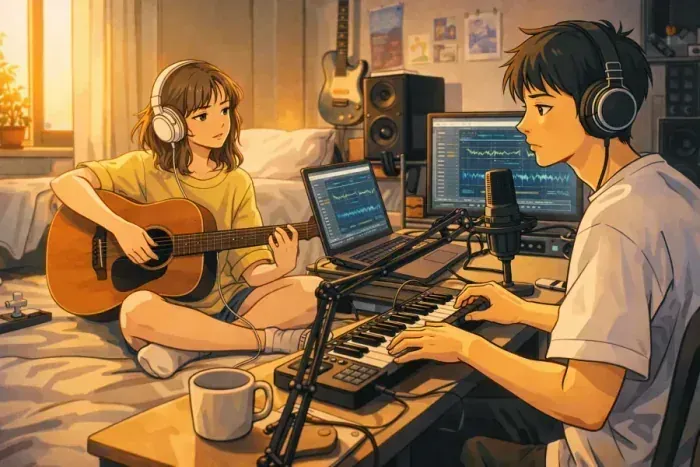
Bedroom Production: Clairo, Rex Orange County, and Home Recording
The 2010s were shaped not only by aesthetic choices but also by physical space. Music was made not just in expensive studios, but in bedrooms, shared apartments, and improvised home setups. That shift did more than lower cost. It changed the feel of recordings. The room itself became part of the message.
Artists like Clairo became closely associated with this mode. Early recordings were simple, soft, and immediate. Songs felt like private thoughts shared quietly rather than performances projected outward. That tone fit naturally inside a streaming culture built around solitary listening.
A similar intimacy shaped Rex Orange County’s work. His songs mixed pop, jazz, and indie without polishing away their uncertainty. Vocals often sat close to the listener, and the arrangements left room for hesitation, warmth, and small imperfections. The production did not erase fragility. It made it part of the song’s appeal.
For artists like Troye Sivan, home-oriented production also supported a careful kind of self-definition. His songs addressed desire, identity, and exposure with softness rather than spectacle. The production matched that tone, favoring clarity, warmth, and emotional control over sheer force. The intimacy was deliberate, not accidental.
Technology made this approach possible, but it did not guarantee success. What mattered was how artists used limitation as a creative choice. Many left in breaths, pauses, room tone, or rough edges that earlier studio cultures might have corrected. Those details made the recordings feel inhabited. The listener could almost picture the room where the song was made.
This closeness changed expectations. Loudness and polish no longer guaranteed authority. Listeners increasingly valued honesty, even when it arrived in unfinished or low-pressure form. Bedroom production did not replace every other model, but it gave the decade one of its clearest emotional textures.
A central contradiction of the decade sits here: a song made in a small room could reach millions without losing its closeness. The scale grew, but the sound often stayed near.
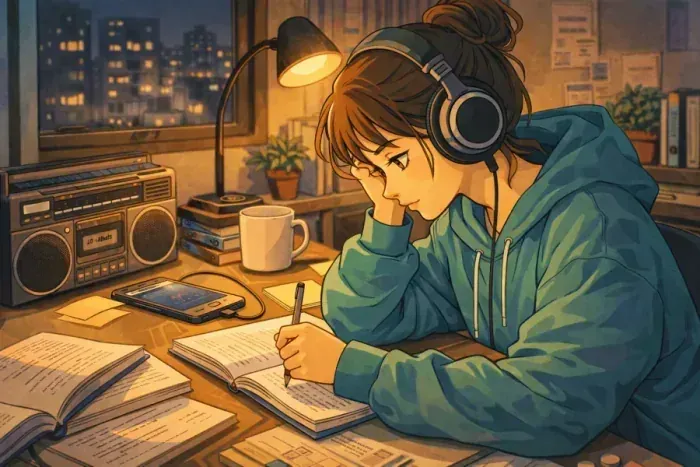
Lo-Fi, Study Music, and Functional Listening
Not all 2010s listening was built around spectacle, confession, or virality. A quieter form of music culture also spread across the decade, centered on concentration, calm, and mood maintenance. Lo-fi playlists, ambient beats, and instrumental study streams treated music less as an event than as an environment.
Streaming made that shift easier to sustain. Platforms sorted music by function as much as by genre: sleep, focus, reading, coding, commuting, unwinding. Listeners increasingly chose songs not only for what they said, but for what they helped make possible. Music became part of everyday emotional regulation.
That did not make the music empty. Lo-fi and related styles often carried intimacy, nostalgia, and quiet melancholy through texture rather than explicit statement. Tape hiss, soft drums, jazz fragments, and muted loops created a sense of companionship that fit a decade marked by overstimulation and fractured attention.
Functional listening also changed ideas about value. A song did not need to dominate a room to matter. It could live beside work, study, or rest and still shape memory and habit. That subtlety broadened what counted as meaningful listening in the streaming era.
By the late 2010s, playlists built for focus and atmosphere had become part of daily life. They revealed another side of the decade’s musical culture: less about public identity and more about private maintenance. The 2010s did not just amplify music. They also taught it how to stay near without taking over the whole room.
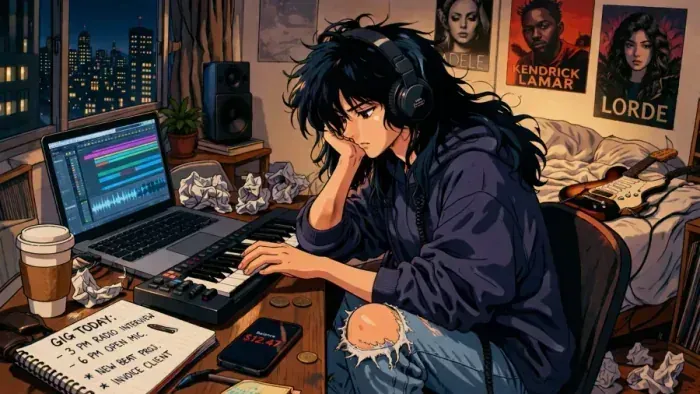
Making Music, Making a Living: The Precarity Era
The 2010s were full of sound, but they also exposed a quieter reality. Making music became easier in many technical ways, while making a living from it often became harder. The decade promised access, reach, and independence, yet it also blurred the line between creative work and constant self-management. Artists were no longer only musicians. They were also marketers, content producers, tour managers, and community moderators, often without stable support.
Streaming expanded audience access, but it rarely created stability on its own. Income arrived in small amounts, spread across platforms and activities. Touring, merchandise, teaching, freelance work, and brand partnerships helped fill some gaps, but they also required time, planning, and upfront resources. Many musicians found that visibility depended on staying active, present, and responsive almost all the time.
This pressure changed how careers developed. Some artists broke through quickly but lacked the support needed to sustain that visibility. Others built slow, careful careers that rarely looked dramatic from the outside. In both cases, class, geography, and access to networks mattered far more than the decade’s rhetoric of openness suggested.
One of the decade’s central contradictions sits here: music became more available than ever just as a stable music career became harder to define. Access expanded. Security did not.
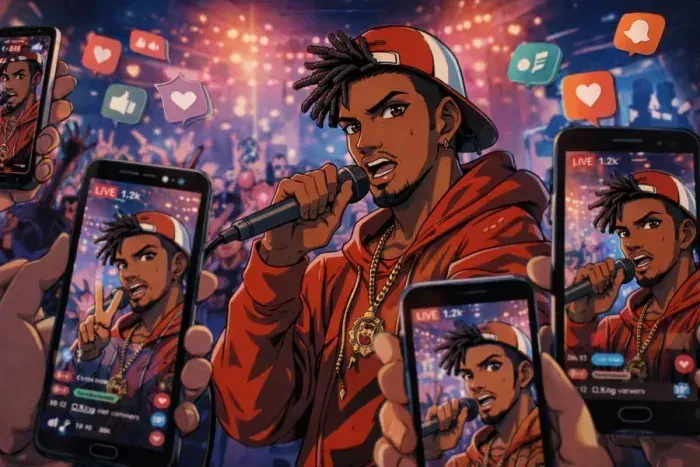
Always On: Self-Promotion as Unpaid Labor
In the 2010s, the work did not end when the music was finished. Visibility became a form of labor in its own right, requiring regular updates, interaction, and performance across multiple platforms. Social media made direct connection possible, but it also made constant availability feel mandatory. Silence could be read as absence. Stepping back could look like irrelevance.
This expectation changed daily life. Musicians timed releases around posting rhythms, tracked engagement alongside rehearsal, and learned the habits of platforms that were never built with rest in mind. Announcements, behind-the-scenes clips, casual comments, and personal reflections all became part of the job. Even artists skeptical of branding had to reckon with it. Presence became something that had to be maintained.
Independent musicians felt this pressure most sharply. Without label teams to manage promotion, writing songs had to compete with answering messages, cutting clips, updating calendars, and learning platform habits. The line between genuine connection and necessary performance blurred quickly. Fans often treated access less as a gift than as an expectation.
For artists with larger audiences, the scale changed but the dynamic remained familiar. Posts were analyzed, misread, amplified, or criticized within minutes. A joke could become news. A pause could trigger speculation. Tone mattered almost as much as content, and cross-platform coherence became a professional skill learned mostly through trial and error.
Some musicians adapted by creating distance. They posted less, delegated parts of their online presence, or limited personal disclosure in order to protect focus. Others made the strain itself visible and spoke openly about burnout. Neither approach guaranteed stability. Algorithms changed suddenly, and even strong work could disappear into the feed.
What made this labor especially demanding was how personal it was. Promotion asked artists to draw from their own lives, feelings, and identities. It required energy that was hard to separate from the self. Unlike touring or recording, there was no clear line between professional and personal life.
By the end of the decade, constant presence had become normal. It was often described as an opportunity, but many artists experienced it as a burden. The promise of direct connection reshaped artistic labor by making it look continuous, public, and never fully complete. In the 2010s, making music increasingly meant being seen making it again and again, without a reliable place to stop.
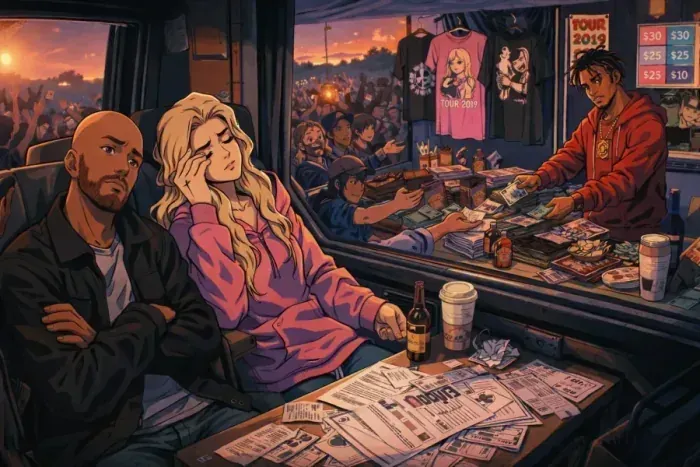
Touring and Merch: The Real Economics of Music
Because streaming payouts were unreliable, many artists relied more heavily on touring and merchandise. Live shows offered what streaming could not: a direct exchange of attention, presence, and payment. Tickets sold, shirts moved, and rooms filled. For a moment, the value of being there felt legible again.
But touring in the 2010s brought new risks. Transportation, lodging, visas, crew costs, and day-to-day expenses piled up before any profit was guaranteed. For mid-level and emerging artists, a tour often required significant upfront investment. Playing more shows did not always mean earning more money. It often meant carrying more risk.
Festival circuits offered visibility and, sometimes, higher fees, but access was limited. The biggest lineups favored established names or artists who already carried strong online momentum. Smaller venues remained essential for development, yet their margins were often thin. Even a sold-out room could leave little money after expenses.
Merchandise helped close some of those gaps. Fans could support artists more directly by buying shirts, vinyl, and limited editions, and merch tables often became points of real contact. But merchandise also required cash, storage, forecasting, and logistical skill. Unsold stock tied up money that many artists could not afford to lose.
Some artists also relied on partnerships and sponsorships. Brands offered support in exchange for visibility, which made the line between art and promotion harder to keep clean. For some, those deals created needed stability. For others, they raised difficult questions about image, autonomy, and long-term identity.
Touring was also emotionally exhausting. Living on the road disrupted daily lives, friendships, and well-being. Over time, the stress built quietly. Exhaustion was often treated as a sign of commitment, not a warning. Artists were rarely expected to slow down before burnout.
What emerged was a survival economy built on motion. Artists learned to combine revenue streams and keep adjusting as conditions changed. Even careers that looked solid from the outside were often much less secure underneath.
Class, Access, and Who Really Gets to Make It
The language around music in the 2010s often emphasized openness. Anyone could upload a song. Anyone could, in theory, find an audience. That promise contained some truth, but it also obscured the inequalities that continued to shape who could sustain a career. Access was never evenly distributed, and participation remained expensive even when entry looked free.
Money was not the only issue, but it shaped almost everything else. Artists with savings, family support, or flexible work could spend longer building an audience without immediate financial return. They could absorb tour losses, buy equipment, and wait for momentum. Others faced much harsher tradeoffs. Time spent making music competed directly with time needed to survive.
Geography made the picture more uneven. Musicians in major cultural centers often had closer access to venues, collaborators, managers, and press. Artists outside those hubs could reach audiences online, but they often lacked local infrastructure. Crossing borders introduced visa costs, administrative delays, and other barriers that hit unevenly.
Education and cultural capital mattered too. Many artists learned contracts, promotion, and technical systems informally, through advice or costly mistakes. Those with mentors or professionally literate networks could navigate the industry more safely. Others signed deals without fully understanding the long-term consequences.
These inequalities also shaped which scenes could convert cultural influence into durable careers. Working-class and marginalized communities often generated new sounds first, yet they were less likely to capture long-term financial reward from that innovation. Visibility did not automatically lead to safety or ownership.
The decade also showed how race and gender interacted with class. Artists from marginalized backgrounds were watched more closely and had fewer resources available to them. Their success stories were often framed as special cases, even when they reflected extraordinary effort rather than equal opportunity.
None of this makes the work less impressive. It makes the conditions around it harder to romanticize. As access expanded, it became easier to see that talent and audience response were never the whole story. Resources still shaped who could endure the long, uncertain process of making music in public.
Identity, Mental Health, and the Emotional Cost of Fame
In the 2010s, music moved closer to the inner lives of the people making it. Artists spoke more openly about anxiety, depression, addiction, and uncertainty, not as abstract themes, but as lived experience. That openness did not emerge on its own. It reflected a decade of shifting boundaries, constant exposure, and pressure to remain visible while still functioning.
Talking about mental health in music was not new, but the context had changed. Social media collapsed distance between artists and audiences, turning private struggle into public conversation. Fans valued honesty, but sometimes treated access as if it were the same as care. Artists were praised for vulnerability while often being left alone with its consequences.
Emotional labor became part of the job. Musicians were asked to explain themselves, soothe audiences, and stand in for larger conversations about identity. They were often expected to do this without preparation or support. Silence could be read as avoidance, yet speaking carried its own risks.
Identity and mental health were not just lyrical themes in the 2010s. They were part of the structure of public music culture itself, shaping who was allowed to struggle, how that struggle was received, and what vulnerability cost.
Kid Cudi, Demi Lovato, Logic: The Price of Public Vulnerability
In the 2010s, more artists spoke directly about anxiety, depression, addiction, and self-doubt than in earlier decades. Audiences often responded with gratitude and recognition. For a moment, it could feel as if honesty itself created intimacy between performer and listener.
Artists like Kid Cudi were central to this shift. His work treated mental health not as a redemption arc but as an ongoing struggle. The songs named loneliness and despair without forcing them into a lesson, which is part of why so many listeners felt recognized by them.
Demi Lovato used her visibility to talk about addiction, recovery, and relapse. These conversations happened through songs, interviews, and social media posts. They blurred the line between art and autobiography. Openness brought support, but it also invited close scrutiny. Every step forward was watched, and setbacks were judged in public.
Other artists approached vulnerability through direct address rather than autobiography. Logic, for example, often treated his music as communication with listeners who felt overwhelmed or isolated. Part of the appeal lay in that clarity.
But this openness had a cost. Speaking about pain created expectations to keep talking, to stay available, and to answer questions that had no clear end. Vulnerability became part of an artist’s public role, not always by choice. Moments of silence could feel like withdrawal, even when they were necessary.
Fans often responded with real empathy, but they also brought needs of their own. Support could become dependence. Artists found themselves cast not only as creators, but as caretakers for feelings far larger than any single song could hold.
The connection could be real, but the cost was real too. Openness did not protect artists from pressure. It changed the form of that pressure, turning private pain into something that had to be managed publicly over time.
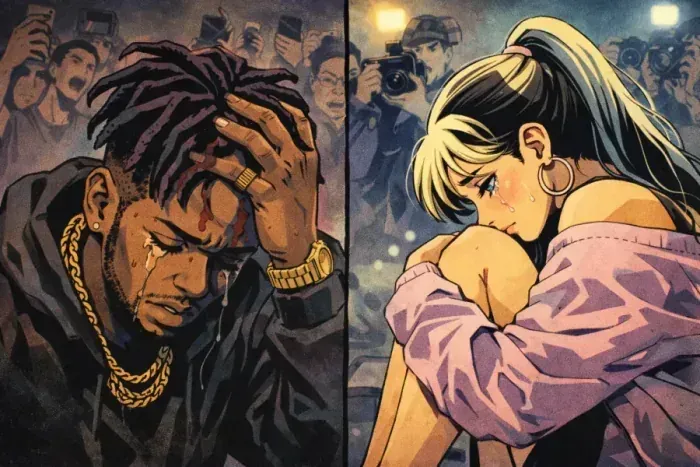
Gender, Race, and Who Gets to Express Pain
The freedom to speak openly in 2010s music was never distributed evenly. Identity shaped how vulnerability was received. Gender and race influenced which emotions were treated as insightful, which as excessive, and which as suspect.
For many women artists, emotional honesty remained double-edged. Anger, grief, and desire were often read as instability rather than insight. Solange moved through that space with particular precision. Her work explored Black identity, family, and selfhood without turning complexity into spectacle. The music asked listeners to pay close attention instead of rewarding quick judgment.
Janelle Monáe used concept and image differently. Science fiction, futurism, and theatrical framing gave her ways to address gender, race, and freedom without reducing them to simple autobiography. Her work showed that emotional truth did not need to arrive as plain confession in order to feel real.
In hip-hop, race also shaped which forms of vulnerability were considered legible or acceptable. Artists who expressed doubt could still be read as weak or suspect. Kendrick Lamar challenged that expectation by linking personal struggle to structural critique. In his work, vulnerability did not weaken political force. It sharpened it.
Public response often mirrored larger social bias. Anger from marginalized artists was scrutinized more heavily. Sadness could be sentimentalized or dismissed. Joy itself could be read as defiance rather than simple feeling. Those reactions shaped how artists chose to speak, and sometimes whether they spoke at all.
The 2010s made these inequalities harder to ignore without resolving them. Music became a public space where identity and emotion were read politically, whether artists intended that or not. Power shaped not only who got to speak, but whose pain was treated as credible when they did.
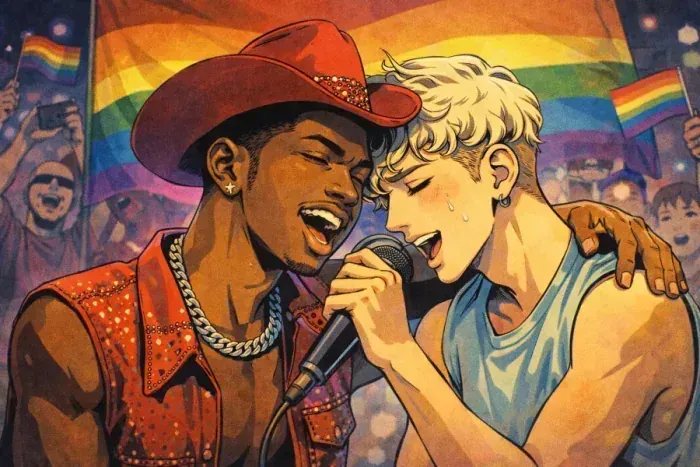
Queer Visibility Beyond Representation
Queer visibility in 2010s music mattered for more than optics. The decade did not simply add more openly queer artists to an unchanged mainstream. It also made queer aesthetics, emotional vocabularies, and ways of staging intimacy more central to popular music’s language.
Artists such as Frank Ocean altered the field not by making identity the only subject, but by refusing to separate it from craft, vulnerability, and atmosphere. His work moved with unusual quiet confidence, allowing desire, uncertainty, and memory to remain specific without turning them into explanation. That approach widened what emotional candor could sound like in the mainstream.
Others changed the visual and performative space around pop. Janelle Monáe, Years & Years, Troye Sivan, Hayley Kiyoko, and later Lil Nas X each approached queerness differently, but all helped normalize a world in which gender performance, erotic address, and self-staging were less constrained by older pop expectations. Visibility no longer had to mean neat respectability in every case. It could also mean play, friction, style, and open contradiction.
This shift mattered especially after the previous decade’s losses and silences around queer life. Club culture, online fandom, and niche communities had long preserved those spaces, but the 2010s brought more of that emotional and aesthetic knowledge into broad circulation. Queer artists were still burdened by scrutiny and market pressure, yet they were also shaping the center rather than standing only at the edge.
What changed, then, was not only who was seen. It was what mainstream music was allowed to sound and feel like. Desire could be less coded. Gender could be less fixed. Intimacy could be staged without pretending everyone was speaking from the same social position. Constraint did not disappear, but queer influence became harder to push to the margins.
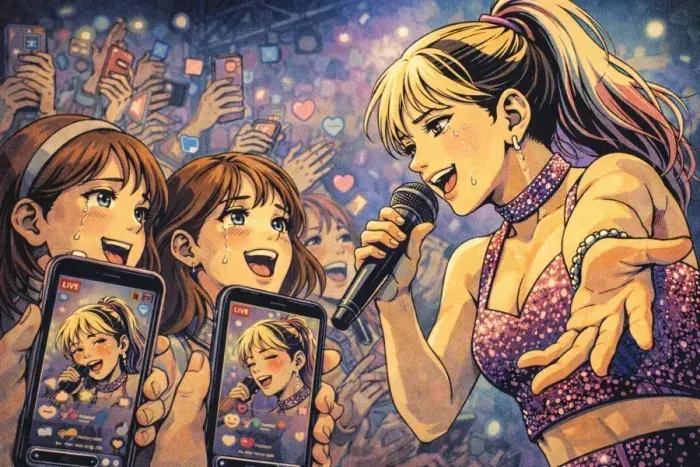
Parasocial Relationships: When Fans Feel Like Friends
In the 2010s, the distance between artists and audiences narrowed, and the relationship often felt more personal as a result. Social media offered glimpses into daily routines, creative process, and emotional state. Many fans experienced that access as meaningful. It deepened loyalty, care, and identification. It also created new forms of pressure.
Parasocial relationships were not new, but they became more intense. Fans followed artists across platforms, reading meaning into captions, timing, mood, and absence. A post or a silence could trigger waves of interpretation. Support was often sincere, but it could also carry an expectation of reciprocity. Availability became one way of measuring what counted as real.
Artists had to negotiate those boundaries carefully. Openness could deepen connection, but it could also invite overreach. Fans often wanted more than music. They wanted reassurance, recognition, and personal acknowledgment. The emotional labor involved in responding was real, yet it often went unrecognized.
Younger artists often felt this pressure first and most intensely. Sudden visibility rarely came with training in how to manage collective attention. Fan communities formed quickly around shared vulnerability and identification. Those spaces could be generous, but they could also place symbolic weight on artists that they had never chosen to carry.
At the same time, fans found these connections valuable. Music was there for moments of isolation, anxiety, and growth. Being seen through an artist’s work could matter deeply. The challenge was to build relationships that respected both distance and care.
The platforms themselves encouraged closeness without assuming responsibility for its effects. Emotional posts traveled further. Stepping back risked invisibility. Staying present required ongoing energy. The system rewarded participation, not sustainability.
The decade made clear that closeness and imbalance can coexist. Parasocial bonds often felt emotionally real even when they ran in only one direction, and artists had to manage connection, appreciation, intrusion, and exhaustion at once. Songs expressed emotion, but the surrounding systems increasingly expected artists to perform emotion as well.
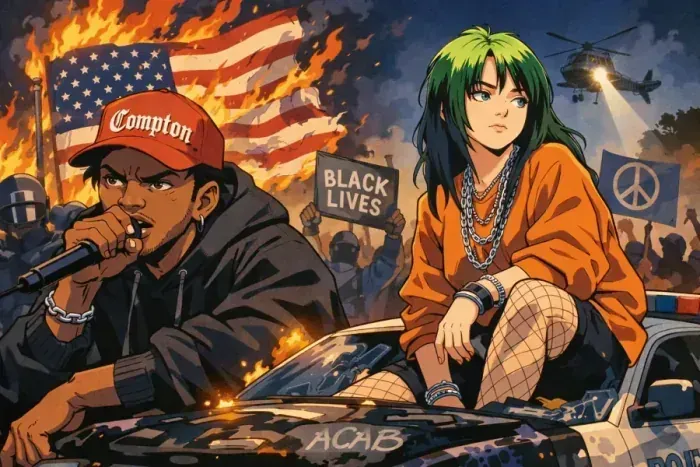
Music and Politics: Art in the Age of Visibility
Music has always been political, whether explicitly or not. During the 2010s, that relationship became harder to avoid. More was visible, platforms reacted faster, and silence became nearly as legible as speech. Artists were increasingly asked not only what their music sounded like, but what it stood for.
This pressure did not come only from institutions or the media. It also came from listeners who experienced music as part of social reality. Songs moved alongside news, protest footage, and online debate. A lyric could become a slogan. A performance could be read as alignment, refusal, or evasion.
For many musicians, political expression was not a separate project. It came from lived experience shaped by race, gender, migration, class, or exclusion. Others felt pressure to respond but were unsure what response would be adequate. Speaking carried risk. Staying quiet carried a different kind of risk.
The political dimension of 2010s music appears here through power, inequality, and interpretation: how artists framed these issues, how listeners received them, and why music became a key site of cultural disagreement.
Kendrick, Beyoncé, Run the Jewels: Protest Without One Sound
The 2010s did not produce one protest sound. Political expression appeared across styles and through multiple strategies. Some artists spoke directly. Others worked through symbol, atmosphere, or refusal. What linked them was not genre, but purpose. Music became a way to hold tension, anger, grief, and defiance without forcing them into one form.
Hip-hop played a central role, continuing a long tradition of social commentary. Kendrick Lamar addressed racism, surveillance, faith, and internalized pressure through storytelling rather than slogans alone. In his work, the personal and the political were inseparable. The songs did not ask for easy agreement. They asked for attention and interpretation.
In popular music, political engagement often came through size and symbolism. Beyoncé used visibility itself as a tool. She put Black history, identity, and resilience at the center of mainstream conversation. The performances and visuals had many layers. They invited discussion rather than explanation. Meaning moved through images, gestures, and context, and public response strengthened it further.
Other artists chose direct confrontation. Run the Jewels spoke plainly about police violence, inequality, and state power. Their work mattered not only for what it said, but for its refusal to soften urgency into something polite or abstract.
Protest also appeared through mood, staging, and refusal. Not every political work sounded like a march or a manifesto. Some songs disrupted expectation more quietly, using absence, ambiguity, or tension as part of their force. In a decade saturated with commentary, that kind of restraint could still register powerfully.
Public response helped determine how these works were understood. Songs were chanted at marches, debated online, replayed in moments of crisis, and folded into collective memory in ways artists could not fully control. Music entered politics not as a textbook, but as a medium through which people organized feeling and meaning together.
The lack of a single protest sound reflected the conditions of the 2010s. Conflict appeared on many fronts, and music answered through storytelling, symbolism, repetition, mourning, confrontation, and refusal. What mattered was not sonic unity, but the fact that music remained one of the places where pressure could still be felt and named.
When Not Speaking Becomes a Statement
Under the political pressure of the 2010s, audiences learned to read more than open statement. Silence became legible. Absence, delay, and restraint could all take on meaning. In a culture built on reaction, not responding could feel almost as loud as protest.
Some artists stayed quiet to limit backlash or protect themselves. In a politically polarized environment, public speech could affect not only reputation but touring, personal safety, and mental health. Critics sometimes read silence as avoidance, but it could also be a realistic assessment of risk.
For others, silence was a way to set boundaries. Artists who did not give interviews, avoided social media, or did not talk about current events were not necessarily disengaged. They refused to act as if musicians should be spokespersons for every difficult situation. They questioned the idea that being visible meant automatically being responsible for explaining things to the public.
Silence also exposed unequal expectations. Marginalized artists were often asked to speak more quickly and more clearly, while others were still granted the comfort of neutrality. One artist’s privacy could be read as another’s complicity. Those readings reflected larger hierarchies, not just individual choices.
Fans often found this difficult to parse. For listeners who treated music as a form of relationship, silence could feel like abandonment. Others saw restraint as respect for complexity. Platforms intensified both responses, turning personal choices into public debates about timing, tone, and responsibility.
Some musicians used silence strategically, choosing to donate, collaborate, or support others without centering themselves. Those actions were less visible than a statement, but they showed that political involvement did not always have to take the form of immediate public speech.
The 2010s made clear that silence is never neutral. It is read through circumstance and power. Deciding when not to speak became almost as consequential as deciding when to speak, especially in a culture that treated instant reaction as the default.
National Politics, Global Audiences: Music Crosses Borders
In the 2010s, music moved across borders more easily, which made political meaning harder to contain. A song written in response to one national moment could resonate with listeners shaped by very different histories and pressures. What felt urgent and clear in one context could be heard very differently in another.
This tension was especially visible around American politics. Music responding to police violence, racial injustice, or elections spread quickly beyond the United States. Listeners elsewhere often felt its urgency without sharing the same immediate context. Songs became starting points for broader conversations and sometimes acquired meanings their makers had never intended.
At the same time, musicians outside the US used global platforms to address migration, austerity, corruption, and identity from within their own local realities. Their songs reached listeners living under very different conditions, yet recognizable patterns of power and exclusion often traveled across those differences. Global reach did not erase local identity. It placed local stories into a wider conversation.
This wider reach also created new distortions. Artists were often asked to stand in for entire countries, scenes, or communities once international attention arrived. That pressure simplified identities that were already more complicated than the coverage around them.
Language complicated matters further. English still carried structural advantages, but non-English songs increasingly traveled without full translation. Listeners often responded to sound, tone, and emotional force before they understood every word. That could create solidarity, but it could also produce misunderstanding.
Platforms did little to soften these tensions. Algorithms rewarded engagement, not nuance. Controversy often traveled faster than clarification. A phrase detached from its original context could be interpreted very differently across cultures, and artists rarely had much control over what happened once a song entered public circulation.
The decade showed how political music moved through a global public sphere shaped by uneven power. Songs could travel far beyond their point of origin, but meaning did not travel cleanly with them.
The Global Sound: When Music Stopped Belonging to One Place
By the end of the 2010s, it was clear that popular music was no longer centered in one place. Sounds moved in multiple directions at once, shaped by migration, online community, and platform-driven circulation. Everyday listening combined local history with global movement so thoroughly that the two could become hard to separate. Music did not lose its roots. It carried them outward.
Genres once treated as regional reached international audiences without first passing through older gatekeepers. Artists built careers across continents, and fans found them through playlists, clips, and community networks rather than radio or print. Language remained important, but feeling, rhythm, and repetition often traveled first.
The decade did not eliminate imbalance. English-language pop still held structural advantages, and global visibility remained uneven. But the 2010s marked a real shift. Success no longer required full assimilation into a narrow mainstream sound. Different voices could remain distinct while still reaching large audiences.
The global turn changed not just who could break through, but what everyday pop listening actually sounded like.
BTS, BLACKPINK: K-Pop Moves Into the Global Mainstream
K-pop’s global rise in the late 2010s is often described as sudden, but it had been building for years. Long before Western media paid sustained attention, South Korean pop had already developed a highly organized infrastructure of training, visual identity, and fan engagement. The 2010s expanded its reach. They did not invent its ambition.
Groups like BTS emerged from this system with a sound that mixed hip-hop, pop, and electronic production, but also with an emphasis on emotional openness and serialized storytelling. Their rise did not depend primarily on radio or traditional Western promotion. It grew through online platforms, fan translation networks, and social media circulation. International listeners were treated as part of the core audience from the start, not as an afterthought.
What made this moment different was visibility, not intention. Western media began treating K-pop as a major global force only after the infrastructure was already in place. By June 2018, BTS had become the first K-pop act to top the Billboard 200, a milestone that confirmed what fans already understood: the audience was already international, organized, and powerful.
Visual planning mattered deeply too. Groups like BLACKPINK combined polished pop with highly legible imagery built for circulation across platforms. Fashion, choreography, and sound worked together to create a complete world that did not require translation to be understood as pop.
At the same time, Western attention brought new pressures. Media coverage often simplified the genre, and global exposure intensified questions about labor, authorship, and creative control. Fans responded in more than one direction. They defended artists, but they also amplified critique. The genre’s expanding influence increased both admiration and scrutiny.
The 2010s changed how global success looked. K-pop did not need to become Western in order to become central. It arrived with its own structures and asked the rest of the world to adjust. It was one of the clearest signs that global pop no longer moved in only one direction.
Latin Trap, Reggaeton, and the Late-Decade Shift
By the late 2010s, one of the clearest shifts in global popular music came through Latin trap and reggaeton. These sounds had deep histories before the decade, but streaming helped move them from regional and diasporic strength into unmistakable global centrality. What changed was not only scale. It was the balance of cultural gravity.
Artists such as Bad Bunny, J Balvin, Ozuna, and Karol G helped define this turn. Their music did not succeed internationally by disguising itself as Anglo-pop. It traveled on its own rhythmic terms, carrying dembow patterns, local slang, and regional references into the same listening spaces as American rap, EDM, and mainstream pop.
Collaborations accelerated the shift, but they did not fully explain it. The deeper change came from audiences who had already grown more comfortable with multilingual listening. Streaming playlists, club circulation, and social media clips made it easier for Spanish-language songs to live at the center of youth culture rather than at its margins.
This rise also exposed familiar tensions around ownership and crossover. Latin music could be celebrated globally while still being framed through outside platforms or simplified for broader consumption. Yet the late 2010s made something newly difficult to ignore: reggaeton and Latin trap were not side currents feeding the mainstream. They were part of the mainstream’s new shape.
The shift mattered because it changed expectations. Global success no longer required translation into older pop norms. A song could arrive with a strong local rhythm, language, and identity and still become unavoidable.
Wizkid, Burna Boy, and the African Diaspora Sound
African and Caribbean music shaped the 2010s both visibly and less visibly. Long before global charts fully reflected that influence, rhythms and vocal approaches from these regions were already circulating through clubs, local radio, and diaspora communities. The decade did not create that exchange. It amplified it.
Afrobeats offers a clear example. Artists like Wizkid and Burna Boy built careers that combined strong regional grounding with growing international reach. Their music brought West African rhythmic frameworks into dialogue with hip-hop, pop, and R&B without erasing their local identity.
The Caribbean mattered just as much. Dancehall rhythms, vocal phrasing, and production ideas continued to shape mainstream pop throughout the decade. Collaborations increased their visibility, but they did not always preserve credit or context. Diaspora influence was obvious, even when the public language around it remained uneven.
Some global stars played visible roles in this exchange. Drake’s engagement with Caribbean and African sounds helped widen their reach, but it also reopened questions about credit, ownership, and the unequal power between global platforms and regional scenes.
What made the 2010s different was how audiences changed. Listeners grew more comfortable with unfamiliar rhythms and languages that were not explained in advance. Movement, repetition, and tone could carry meaning across distance. Playlists placed African pop beside American rap and European electronic music as part of the same everyday listening environment.
At the same time, artists from these regions gained more leverage. Tour networks expanded, festivals booked acts on their own terms, and international coverage slowly improved. The process was uneven, but the direction of change was clear.
By the end of the decade, these sounds no longer registered as occasional borrowings from the margins. They were part of popular music’s active present, audible in everyday listening and central to how global pop moved.
Language, Platforms, and the End of the English Monopoly
One of the decade’s most important shifts was the weakening of language as a strict gate. For much of the 20th century, international success was strongly shaped by language, especially by English. Streaming and social media loosened that logic, not through one formal rule, but through everyday listening habits.
Playlists put songs next to each other without forcing listeners to sort them first by language. A listener might hear Spanish, Korean, French, or Yoruba in the same session without understanding every lyric. Rhythm, tone, and atmosphere often arrived before full semantic understanding.
Platforms rewarded engagement more than translation. A song that caught the ear could travel regardless of language, and repeated exposure made unfamiliar sounds feel more normal. Listeners often let sound lead first and meaning follow later.
Artists adapted to this environment in different ways. Some mixed languages naturally, reflecting bilingual or diasporic reality rather than market strategy. Others stayed with one language, trusting sound to carry enough information on its own. In both cases, music no longer needed to explain itself in order to travel.
Algorithms played a mixed role. They often reinforced dominant languages and existing momentum, but they could also help unexpected songs travel quickly when fan activity, clips, and platform timing aligned.
This reach came with tension. Artists sometimes felt pressure to simplify language, soften local specificity, or use more familiar structures in order to travel further. Others resisted that pull. Those choices were never neutral. They shaped how cultures were heard, translated, and represented.
By the end of the 2010s, language no longer functioned as a gate in the same way. It still mattered, but it no longer determined reach as strictly as it once had. Platforms had taught listeners to trust sound before full explanation.
The field did not become equal. Power still shaped who could be seen and sustained. But the decade did widen the idea of who could be heard without translation, and that changed what popular music could comfortably include.
Nostalgia and Retro Culture: Looking Back to Move Forward
The 2010s introduced new tools, new platforms, and new listening habits, but they also kept looking backward. Nostalgia was everywhere, not simply as escape, but as a way to find orientation. Older sounds, images, and references returned less as exact revival than as material to sample, reframe, and reuse.
This backward glance reflected uncertainty as much as affection. Rapid technological and social change made the present feel unstable, so artists and listeners turned to familiar materials for orientation. 1980s synths, 1990s pop structures, and early-internet imagery offered recognition without requiring exact revival.
Artists did not turn to nostalgia because they lacked ideas. They used it to build connection in a fragmented culture. Familiar references gave listeners a point of entry, making new songs feel legible even when everything else around them seemed to be changing.
In this decade, nostalgia often felt less conservative than practical. It gave artists a way to move forward without pretending the present felt stable.
80s, 90s, Y2K: The Past as Present Tense
In the 2010s, artists rarely tried to recreate earlier decades faithfully. The past functioned less as a rulebook than as a palette. Sounds and images from the 1980s, 1990s, and early 2000s were detached from their original context and reshaped for contemporary moods. What emerged felt familiar without belonging to one exact historical moment.
A clear example was the return of 1980s textures. Synthesizers, gated drums, and neon-coded imagery came back, but they carried a different emotional charge. In The Weeknd’s work, those surfaces often felt less celebratory than haunted, turning older pop gloss into a frame for loneliness, excess, and distance.
Pop artists reworked the 1990s differently. Clear song structures, smooth chord movement, and direct melodic writing returned in polished new forms. Dua Lipa embraced those references confidently, reviving dance-pop energy without turning it into a joke. The past became a source of pleasure rather than a trap.
The early 2000s returned more subtly. Their influence came as much from internet memory as from radio memory: glossy minimalism, bright digital textures, and a renewed belief in cleanly made pop. Carly Rae Jepsen worked productively in that space, treating precision, craft, and emotional directness as modern strengths rather than dated ones.
What connected these approaches was intention. Artists chose elements that could carry a modern meaning instead of copying entire styles. Technology made this easier. Digital tools let producers revisit older sounds and reshape them for contemporary ears. Nostalgia worked more like a modular toolkit than a full revival.
Listeners were drawn to these references partly because they offered orientation. In a fast-changing decade, familiar sounds could stabilize the ear without freezing the song in the past. The pleasure came from reuse, not simple recall.
The result was a decade in which retro style could still feel current. Earlier eras became resources rather than destinations, and the past stayed useful not as shelter, but as a conversation partner.
Sampling, Quoting, and Cultural Memory
In the 2010s, nostalgia often worked through sound itself, not just through visual style. Sampling, interpolation, and quotation became ways of carrying cultural memory forward without freezing it. These practices were not new, but they changed meaning in a decade where archives were easily searchable and always close at hand.
Sampling had always been central to hip-hop, but the 2010s made its archival dimension especially visible. Kanye West continued using samples not only for texture, but for emotional memory, connecting personal narrative to larger histories of soul, gospel, and pop. Familiar voices made the past feel active inside the present.
Pop artists used related strategies more subtly. In Beyoncé’s work, references to earlier songs often functioned as threads connecting her music to Black traditions stretching from soul to early hip-hop. Those gestures were rarely announced. They rewarded close attention without excluding listeners who missed them.
Tyler, The Creator approached quotation differently. His sampling often felt playful, restless, and slightly disorienting, drawing from unexpected sources and reshaping them in ways that emphasized curiosity over reverence. In his hands, the past became material for possibility rather than a museum object.
Digital culture intensified these practices. Fans identified samples quickly, shared their origins on forums and social platforms, and turned listening into a kind of public research. Songs became pathways back into older catalogs, bringing neglected tracks into circulation again. Cultural memory felt collaborative rather than institutional.
This accessibility also raised questions. As sampling spread to different types of music, people started talking more about who owns what and why. Not all references carried the same weight, and some borrowings were not handled fairly. Easy access to older material made it clearer that homage and extraction were different, especially when power was uneven.
In the 2010s, sampling and quotation reflected how culture itself was starting to feel: layered, searchable, and permanently available. Nostalgia here was not really about going back. It was about keeping the archive active in the present.
Why Nostalgia Felt Safe in an Unstable Decade
Nostalgia intensified in the 2010s because the present often felt unstable. Technology was changing quickly, politics felt volatile, and the future appeared difficult to trust. In that environment, familiar sounds offered orientation without pretending to solve anything.
Listeners did not need to identify every reference for nostalgia to work. A synthesizer associated with the 1980s or a familiar 1990s pop structure could create emotional orientation almost instantly. That ease mattered in a period saturated with information, when attention itself often felt unstable.
Artists understood this instinctively. Familiar textures could build trust quickly and open listeners to new material that might otherwise have felt distant or difficult. Nostalgia worked less like retreat than invitation. For many listeners, it offered a way into music that felt emotionally legible inside a world that rarely slowed down.
The feeling of nostalgia also changed with generation. Millennials moved into adulthood during the 2010s and encountered sounds that echoed their own early memories at a moment when stability often felt harder to reach. Looking back was not simply a refusal of change. It was also a way of reconnecting with older emotional coordinates while moving through new uncertainty.
Digital culture made this even stronger. Archives were easy to access, and algorithms made it easy to rediscover old material. Old songs appeared alongside new releases, which made it hard to keep track of when things happened. Memory became something experienced in the present rather than stored in the past. The past felt close, useful, and alive.
But nostalgia in the 2010s rarely stayed fixed for long. Most artists did not remain in a single retro pose. References shifted, mixed, and evolved inside newer production styles. The comfort came from recognition, not from permanent repetition.
Nostalgia did not automatically mean creative exhaustion. In many cases, it was a way of navigating transition. Familiar sounds offered temporary shelter without stopping change altogether.
Geography in a Digital Decade: Scenes Without Cities
For most of modern music history, artists and scenes were closely tied to place. Cities shaped sound, attitude, and opportunity. In the 2010s, that relationship changed. Geography still mattered, but it no longer determined access in quite the same way.
The cost of living, urban change, and economic pressure pushed many musicians away from traditional cultural centers. Online platforms also made it possible for people to work together even when they were not in the same place. People bonded over shared beliefs and values, not by living in the same neighborhood. Music spread more quickly than people did, so influence no longer depended on physical location.
This did not mean cities stopped mattering. It meant their role changed. Clubs, studios, and informal networks became more valuable precisely because they were harder to sustain.
Music and place changed sharply in the 2010s. The old idea of the dominant music city weakened, borderless scenes grew, and physical spaces became scarcer and more valuable at the same time.
The Death of the Music City Myth
For years, certain cities functioned almost as myths in music culture: places where scenes formed, labels watched closely, and careers seemed possible simply through proximity. In the 2010s, that belief weakened. Cities remained important, but they became less accessible and less automatically decisive.
Economic pressure was a big part of it. Rising rents and living costs changed urban life in cities around the world. Cities like New York City and London were still important, but it became harder to live there and be creative without help from outside. Rehearsal spaces closed, small venues struggled, and informal networks became weaker. What had once felt natural started to feel uncertain.
Berlin functioned for a time as a symbol of what other cities were losing: affordability, experimentation, and room to linger. But even there, rising costs narrowed the gap between myth and daily reality.
Digital tools also reduced the need for physical concentration. Artists no longer had to move to a new city to be heard. They could write, record, and release music from almost anywhere. Collaboration happened across time zones. Exposure came from playlists and sharing, not from the local press. The idea that talent needed one specific place became less convincing.
The industry followed suit. Labels and media companies looked for talent online instead of in person. Discovery moved away from venues and toward metrics. A viral track mattered more than a residency. For new artists, success could feel detached from place. These scenes were easier to recognize aesthetically than geographically.
Cities did not disappear from music culture. They simply stopped acting as automatic engines of opportunity. They still offered history, community, and infrastructure, but they no longer guaranteed access on their own.
The old “music city” myth weakened as culture spread outward. Opportunity dispersed, but stability did not. By the 2010s, artists could emerge from almost anywhere, yet building a life around music was still unevenly difficult. Cities became options and meeting points, not mandatory checkpoints on the way to legitimacy.
Online Scenes: Communities Without Borders
As traditional music-city mythology weakened, new forms of scene emerged that were not tied to one physical place. These communities were organized more around shared taste, mood, and value than around neighborhood or local accent. The internet did not merely connect existing scenes. It created conditions in which scenes could exist without a single geographic anchor.
Platforms like SoundCloud, Bandcamp, and, later, Discord helped artists and listeners build community through repeated listening, shared references, and mutual recognition. A song uploaded from one bedroom could find sympathetic listeners thousands of miles away within hours. Belonging started to depend less on location than on recurring patterns of taste.
These online groups often developed strong internal identities. SoundCloud rap, lo-fi beat culture, vaporwave, and experimental pop each carried recognizable moods, visual codes, and ways of speaking. Participants recognized one another through aesthetics, references, and shared habits rather than through neighborhood or accent. That looseness allowed artists to move between scenes without leaving home, and influence spread quickly in several directions at once.
This structure lowered some barriers while introducing others. Artists outside major cultural centers could reach a global audience without relocating, and collaboration became easier for people who felt isolated in their local scenes. For many, online spaces offered forms of validation that physical environments had denied them.
But communities without a physical base also lacked some of the protections that physical space can provide. There were fewer chances for informal mentorship, fewer shared norms, and fewer ways to absorb conflict slowly. Misunderstandings could escalate fast, and attention could vanish just as quickly. Scenes often felt intense, productive, and temporary all at once.
Economic support was still not spread evenly. Online recognition did not always lead to more money or better facilities. Artists still needed money to tour, record, and take care of themselves. Scene-specific visibility was possible, but not stability. These spaces focused on quick connections instead of building long-term systems.
Despite those limits, online scenes changed how belonging worked in music culture. They shifted it away from geography and toward shared taste, emotional vocabulary, and repeated interaction. That model felt natural to a generation already used to living socially through networks as much as through place.
The decade revealed both the promise and the fragility of scenes without a fixed home. Online communities made new forms of belonging possible, but digital intensity alone could not replace the continuity, accountability, and trust that physical spaces still support.
Why Physical Spaces Still Matter
Even as online community expanded, physical space remained essential. Its meaning changed, but not its importance. Clubs, rehearsal rooms, studios, and small venues became harder to maintain and therefore more valuable. In a decade defined by screens and distance, being in the same room mattered even more.
In-person spaces offered experiences that digital connection could not fully reproduce. Sound behaved differently in a room, bodies responded together, and time moved according to collective attention rather than algorithmic pacing. For many artists, a show remained the most direct form of communication. A room either responded or it did not.
Physical scenes also supported artistic development. Informal mentorship happened in rooms, not just in messages. Artists learned by watching others play, fail, recover, and adapt, and trust accumulated through repeated in-person contact.
The struggle to keep these spaces open became one of the quieter cultural crises of the decade. Rising rents and redevelopment threatened venues in many cities, and audiences often understood those closures as the loss of memory as well as infrastructure. When a room disappeared, so did the experiments, friendships, and local histories attached to it.
Some communities responded creatively through pop-up shows, temporary studios, DIY venues, and cooperative models. Artists shared tools, knowledge, and risk in order to keep local culture alive even when permanence no longer felt realistic. Those efforts rarely became headline stories, but they mattered deeply.
Festivals and larger events were different. They brought together people from different backgrounds, offering moments of shared experience that online scenes could not provide. But their size often made intimacy harder to find. Smaller spaces still mattered for taking risks and making discoveries.
The decade made it clear that music could travel almost anywhere, but it still needed rooms where people could gather, test ideas, and build trust. In a culture that often flattened context, those spaces mattered because they were alive, not because they were nostalgic.
The 2010s: A Decade Between Eras
In hindsight, the 2010s resist closure. They do not fit easily into one story or one sound, and that unsettled quality matters. The decade was not a clean beginning. It was a period in between. Older structures weakened without disappearing. New systems arrived without becoming fully stable.
Artists learned to work without knowing exactly how the system would reward them. Careers became less linear, success looked more fragile, and the value of music became harder to measure by any single standard. What counted depended increasingly on platform, context, and point of view.
The decade also taught listeners to live with plurality. Different scenes coexisted without a stable hierarchy, and personal pathways through music became more important than shared consensus. Even massively popular songs were often encountered in private, through headphones, feeds, and playlists rather than in one obvious common space.
The decade makes more sense as a transition than as a finished era. Its changes lasted. Its tensions did too.
A Decade Without One Sound: The Fragmentation Era
People often begin by asking what the 2010s sounded like. The difficulty of answering that question tells you something important. By then, one defining sound was no longer necessary. What emerged instead was a landscape shaped by overlap, coexistence, and personal routes through music.
Earlier decades are often remembered through a small number of dominant styles because radio, television, retail, and print narrowed what most people encountered. In the 2010s, those conditions no longer held. Streaming, social platforms, and affordable production tools allowed many sounds to exist at once without fighting for one limited slot. A listener could move from trap to indie folk or from K-pop to experimental electronic music without treating one as culturally illegitimate. Taste widened rather than converged.
This change affected how artists positioned themselves. Fewer tried to represent an entire generation or movement. Most tried to build a recognizable voice inside a crowded system. Genre boundaries loosened, and cross-style collaboration began to feel normal rather than special. Context often mattered as much as lineage.
This shift also changed memory. Without one stable mainstream, the decade is harder to recall as a single public experience. People often remember it through personal context rather than through one collective soundtrack. The playlist replaced the event as one of the era’s main containers.
Some listeners experienced this as a loss because older forms of shared culture weakened. But something else emerged in their place. More artists could be heard without first conforming to one dominant standard, and quieter voices could exist beside louder ones without being forced into the same mold.
The 2010s showed that coherence does not require sameness. Music could matter deeply even without expressing one shared public feeling. What counted was less centralized, more distributed, and often more provisional than before.
What Lasted Beyond the 2010s
Some changes from the 2010s will last even as platforms and tastes continue to move. The decade altered how music is made, shared, and valued. Those changes did not come from one single invention. They settled in gradually, becoming habits before they became norms.
Access is one lasting change. Listeners grew used to near-total availability and to the idea that almost any song could be reached immediately. That expectation changed patience, attention, and the social meaning of waiting. Discovery became continuous instead of event-based.
The role of the artist changed too. Careers became less about one peak and more about sustained presence. Visibility had to be managed, not merely achieved once. Even artists who resisted that logic had to account for it. Long disappearances became riskier, not because audiences stopped caring, but because the systems around them stopped remembering.
Production changed in lasting ways. Intimacy, once associated with demos or side projects, moved into the center of popular music. Softness, rough edges, and quiet detail no longer read automatically as unfinished. They became valid final forms.
Global circulation also became ordinary. Hearing unfamiliar languages no longer felt like a special event. That habit changed what success could look like and who could claim it. Inequality remained, but the assumption that global reach required assimilation weakened.
Perhaps the most lasting shift was how deeply music folded into daily life. It became less a formal event and more a constant companion for work, travel, exercise, solitude, and private feeling. Music remained important, but that importance often became ambient rather than ceremonial.
The 2010s did not turn these shifts into a stable model. They turned them into everyday expectation. What came next had to build on that foundation or push against it.
Why the 2010s Feel Unfinished
The 2010s often feel like a sentence that stops mid-thought rather than a finished chapter. That incompleteness does not come from a lack of influence. It comes from a decade fast enough to loosen old structures without fully stabilizing the new ones that followed.
Streaming made this unfinished quality especially clear. It became the default way to listen, but it never answered the questions it raised. Artists gained access without security. Listeners gained abundance without much clarity. Metrics supplied constant feedback, but not always understanding. The system worked, yet rarely explained itself. Music was everywhere, but the logic behind its movement often remained opaque. That uncertainty still shapes how the decade is remembered.
In many areas, the 2010s opened arguments rather than closing them. Debates about identity, power, mental health, labor, and representation grew sharper, but they rarely settled into consensus. Music mirrored that condition. Songs often carried doubt, exhaustion, curiosity, and pressure more readily than resolution.
The absence of a shared endpoint also changed memory. Earlier eras often seem to conclude with a recognizable break: a movement fades, a dominant style weakens, a new medium takes over. The 2010s changed more gradually. Platforms shifted step by step, many artists remained active across the whole decade, and styles overlapped instead of replacing one another cleanly. Time felt layered rather than sequential.
This unfinished quality is not a flaw so much as a defining feature of the decade. The 2010s sat between older models and unresolved futures. Music was made and shared without stable hierarchies or broad agreement about value, and listeners grew used to navigating options instead of following one dominant map.
The unresolved feeling comes less from the music itself than from the systems around it. Questions about fairness, sustainability, authorship, and care remained open. The decade did not solve those problems. It made them harder to ignore.
The 2010s feel unfinished because they opened systems and arguments that did not close on schedule. Music did not arrive at one new destination. It learned to keep moving without a shared map, and that openness remains part of what still feels true about the decade.
Still Living in the 2010s: Why the Decade Never Ended
Remembering the 2010s is difficult partly because the decade never entirely ended. Its platforms remain, its habits persist, and many of its artists, debates, and listening patterns continue with only minor adjustment. The era did not conclude cleanly. It folded into the present.
Part of the reason is speed. Music spread so quickly that it rarely had time to settle. A song could spike, disappear, and return within months. Discovery felt constant, while memory became more fragmentary. Instead of one broadly shared release calendar, many listeners remember the decade through playlists, places, relationships, and moods.
Digital archives intensified that effect. Old releases never fully disappeared, and new ones rarely felt final. Songs could return years later through playlists, memes, sync placement, or platform discovery. The line between “then” and “now” blurred. Musical time started to feel more like a loop than a line.
The wider cultural conversation followed the same pattern. Debates about identity, representation, and power accumulated instead of concluding, and the music reflected that unfinished state. Songs often carried uncertainty forward rather than resolving it.
There is also a generational dimension. Many people who came of age in the 2010s still listen through habits formed in that period. Musical history reaches them through recommendations, clips, and shared links more often than through tidy decade-based storytelling. For them, the 2010s are less a closed chapter than part of an ongoing personal timeline.
This does not mean the 2010s lacked direction. Their shape was simply more diffuse than earlier narratives tend to allow. The decade taught listeners to live with fluctuation, to accept that something could matter intensely for a moment and then recede without disappearing entirely.
Trying to summarize the decade while still living inside its structures reveals a deeper change. Cultural time no longer moves neatly from one phase to the next. It stretches, folds, and loops, and the 2010s taught listeners how to hear within that condition.
The decade is remembered less through one shared event than through accumulated personal experience. Music stayed close to daily life without insisting on one fixed meaning. That resistance to neat summary is part of its legacy.
Loss and Legacy: When Icons Left Us
The 2010s were marked by repeated loss. These losses shaped not only music history, but how that history felt in real time. They were the deaths of major artists, but also the quiet closing of cultural chapters. Taken together, they revealed a pattern: endings were arriving inside the same continuous stream as everything else.
David Bowie’s death on January 10, 2016, only two days after the release of Blackstar, was especially striking. The album felt reflective without becoming nostalgic, and for many listeners it changed what artistic closure could look like in a culture that rarely paused long enough to absorb an ending.
Other losses followed with different meanings. Prince’s death on April 21, 2016, revived questions about ownership, archives, artistic control, and the relationship between a catalog and the person who shaped it. His absence reminded listeners that authorship is not only audible. It also lives in decisions about access, stewardship, and context.
Later in the decade, the deaths of younger artists landed differently. Avicii died on April 20, 2018, and Mac Miller on September 7, 2018. In both cases, listeners returned to music already marked by exhaustion, pressure, and vulnerability. Those losses intensified conversations about mental health, labor, and care, but they also exposed how reactive those conversations often were.
What marked these losses was their public timing. News spread instantly, and mourning unfolded alongside social feeds, recommendations, tributes, and ongoing promotion. There was very little protected space for slowness. Legacy was being shaped in systems that rewarded speed more reliably than reflection.
These losses did not define the decade, but they clarified one of its harshest truths: creativity and fragility were often being managed inside systems that rewarded exposure and output more reliably than care. They pushed listeners toward harder questions about responsibility, myth, and the cost of treating suffering as part of artistic seriousness.
The 2010s did not offer clear rituals for saying goodbye. Loss was folded back into daily listening, where absence had to compete with the next recommendation, the next tribute, the next release.
50 Songs That Defined the 2010s
The 2010s changed how music was made, shared, and heard. Older forms of consensus weakened. Streaming, social media, and global circulation reshaped not only distribution, but listening itself. Music became more personal, more contextual, and often more private even as access expanded.
Streaming became the default route in. Discovery was increasingly shaped by platforms, feeds, and recommendation systems rather than by a small number of shared gatekeepers. Listeners moved easily across genre, language, and scene. Hip-hop became one of the decade’s clearest cultural centers. Pop grew more inward and more fragmented. Electronic music moved between festival-scale spectacle and durable underground life. Artists outside the traditional US-UK axis reached wider audiences than ever before.
The playlist below follows that redistribution. It is not just a chart recap or a nostalgia reel. It moves from the last strong traces of shared mainstream pop toward a world of fragmentation, global exchange, and more private forms of meaning. Each artist appears once. Every song was released between 2010 and 2019.
A Journey Through the 2010s: 50 Songs That Defined a Decade
I. Transition: The Last Days of Shared Pop
- Adele – Rolling in the Deep (2011)
- Robyn – Dancing On My Own (2010)
- Kanye West – Runaway (2010)
- Bon Iver – Holocene (2011)
- Lana Del Rey – Video Games (2011)
II. Intimacy: Pop Finds Its Quiet Voice
- Lorde – Royals (2013)
- Frank Ocean – Thinkin Bout You (2012)
- James Blake – Retrograde (2013)
- Sia – Chandelier (2014)
- The National – Bloodbuzz Ohio (2010)
III. Fragmented Pop: Hits in a New World
- Drake – Hotline Bling (2015)
- Taylor Swift – Blank Space (2014)
- Bruno Mars – Locked Out of Heaven (2012)
- Dua Lipa – New Rules (2017)
- Pharrell Williams – Happy (2013)
IV. Hip-Hop Takes the Throne
- Kendrick Lamar – Alright (2015)
- Nicki Minaj – Super Bass (2011)
- Macklemore & Ryan Lewis – Thrift Shop (2012)
- Tyler, The Creator – EARFQUAKE (2019)
- Cardi B – Bodak Yellow (2017)
V. Identity, Politics, and the Public Voice
- Beyoncé – Formation (2016)
- Childish Gambino – This Is America (2018)
- Hozier – Take Me to Church (2013)
- M.I.A. – Bad Girls (2012)
- Solange – Cranes in the Sky (2016)
VI. Electronic Music: Festival Anthems and Dance Floors
- Daft Punk – Get Lucky (2013)
- Avicii – Levels (2011)
- Major Lazer – Lean On (2015)
- Rihanna – We Found Love (2011)
- Tame Impala – The Less I Know the Better (2015)
VII. Indie and Alternative: Guitar Music Finds New Ways
- Arctic Monkeys – Do I Wanna Know? (2013)
- Phoebe Bridgers – Motion Sickness (2017)
- Rex Orange County – Loving Is Easy (2017)
- Florence + The Machine – Shake It Out (2011)
- The Black Keys – Lonely Boy (2011)
VIII. Global Pop: When the World Started Listening Together
- Stromae – Papaoutai (2013)
- Christine and the Queens – Tilted (2015)
- Rosalía – Malamente (2018)
- BTS – Fake Love (2018)
- Luis Fonsi & Daddy Yankee – Despacito (2017)
IX. Bedroom Pop: Songs Made Close to Home
- Billie Eilish – bad guy (2019)
- Clairo – Pretty Girl (2017)
- Troye Sivan – Youth (2015)
- FKA twigs – Two Weeks (2014)
- Post Malone – Rockstar (2017)
X. Ending Without Closure: The Decade’s Open Questions
- Lil Nas X – Old Town Road (2019)
- Janelle Monáe – Tightrope (2010)
- LCD Soundsystem – Call the Police (2017)
- Burna Boy – Anybody (2019)
- Sufjan Stevens – Should Have Known Better (2015)
Why This Playlist Captures a Decade in Transition
The order traces the decade’s larger movement. It begins with the last strong traces of a shared pop culture and moves toward a world that is more fragmented, more personal, and more globally connected. The 2010s did not settle into one signature sound. They left room for many listening paths at once.
Taken together, these fifty tracks show what happened once no single version of pop could organize the whole field. They capture a decade in which abundance replaced consensus and popular music stopped sounding like one center speaking to everyone at once.