
A Musical Journey Across Borders
East Asian pop did not rise through a single scene or a single sound. It grew through several music industries at once, each shaped by its own language, media system, and political history. The region never had one shared route into modern pop. Japan, South Korea, Hong Kong, and Taiwan built parallel systems that sometimes overlapped and sometimes competed.
Today artists from Seoul and Tokyo appear on international charts, headline major festivals, and influence how pop looks, sounds, and travels online. That presence was built slowly. Long before streaming, musicians in Japan, Korea, Hong Kong, and Taiwan were already borrowing, adapting, and recirculating popular styles across borders.
In the years after the Second World War, musicians across the region encountered American jazz, swing, Latin pop, country, and early rock through radio, records, cinema, dance halls, and performances near military bases. They did not simply imitate those sounds. They rewrote them in local languages, folded them into existing singing styles, and used them to describe societies changing at high speed. East Asian pop did not begin as a copy of foreign music. It began as local adaptation under new social and technological pressure.
Japan built one of the region’s first large-scale pop industries, with national television, star-making agencies, and a domestic market big enough to sustain idols, songwriters, and studio innovators. South Korea later reorganized pop around centralized agencies, years of training, and an export strategy. Hong Kong and Taiwan, meanwhile, built powerful Cantopop and Mandopop scenes that connected Chinese-speaking audiences far beyond one city or one state.
This article follows that longer story from postwar exchange to regional media networks, idol systems, and the streaming era. It does not try to flatten the region into one trend. Instead it shows how several distinct pop traditions gradually became part of a shared global conversation.
That longer view also changes the meaning of global success. A song reaching an American chart, a Korean group selling out an arena in Europe, or a Japanese theme song spreading through anime fandom can look sudden when seen from outside the region. Inside the history, those moments are usually the visible result of older systems: broadcasters that taught audiences how to follow stars, labels that learned how to localize songs, television industries that joined music to drama and comedy, and fans who turned listening into organized circulation.
The phrase “Asian pop” can hide as much as it reveals. East Asia does not share one language market, one copyright system, one media policy, or one idea of what a pop star should be. Japanese pop developed in a large domestic economy where physical media, television agencies, anime, and fan clubs stayed powerful for a long time. Korean pop developed in a smaller home market that pushed agencies to think about export, training, and localization with unusual urgency. Hong Kong and Taiwan built Chinese-language circuits that crossed political borders through film, television, radio, cassette exchange, karaoke, and diaspora listening.
Those different conditions shaped the music itself. A Japanese idol single designed for television repetition, a Korean comeback built around choreography and teaser rollout, a Hong Kong film theme, and a Mandarin ballad for transnational radio all solve different problems. They ask how a song can be remembered, how a performer can remain visible, and how listeners can attach themselves to a public figure over time. The answers vary, but the shared pattern is clear: East Asian pop has always been music plus media infrastructure.
A useful history therefore has to move between sound, business, and audience behavior. The records matter, but so do the systems that kept those records in circulation: year-end song shows, fan clubs, music charts, drama soundtracks, audition programs, specialty record shops, subtitling communities, platform playlists, and concert light sticks. Songs crossed borders because people and institutions made them repeatable, recognizable, and easy to carry into another setting.
Recognition did not arrive at one speed. Some moments were visible almost immediately, including “Sukiyaki” in 1963 and “Gangnam Style” in 2012. Other sounds moved through collectors, imported discs, anime fans, diaspora households, and online uploads long before the wider industry noticed. Influence can work quietly for years. A song may shape musicians, fans, and local scenes before it appears in a global headline.
Charts can anchor the story, but they cannot contain it. Billboard, Oricon, IFPI, Guinness World Records, GRAMMY coverage, and Korean cultural reports help verify specific claims. Many changes happened below those measures: a fan learning a chorus phonetically, a band copying a groove from a foreign record, a subtitle team making a variety show legible, or a teenager finding an anime theme that opened a path into Japanese music. Those small acts also built the route.
The same caution applies to national comparison. Japan is not the slow version of Korea, and Korea is not the export version of Japan. Their industries developed under different market sizes, media habits, language politics, and business incentives. Japan’s domestic strength made inward complexity possible; Korea’s smaller market made outward planning more urgent; Chinese-language pop relied on regional and diaspora circulation that did not match either model. Comparing these systems is useful only when the differences stay visible.
The countries also have to be read beside one another, because their developments overlapped. Japanese idol culture influenced Korean agencies, but Korean agencies did not simply copy it. Cantopop and Mandopop had already trained audiences to follow stars across borders before K-Pop’s global rise. Anime and games gave J-Pop an export route that did not depend on the same centralized training system. The global pop field was assembled from these partial connections.
A slower account also gives room to performers who are often treated as background to the idol story. Ballad singers, soundtrack vocalists, studio arrangers, film composers, session musicians, choreographers, translators, fan organizers, and indie artists all shaped how the music moved. Global pop history tends to spotlight faces, but the route from a local song to an international audience usually depends on many people whose names are less visible.
The most accurate reading is both industrial and human. Agencies, labels, platforms, broadcasters, and governments created routes, but those routes only became meaningful when listeners used them. People replayed songs, taught dances, bought records, argued about lyrics, filled arenas, and carried music between languages. East Asian pop’s global reach came from that meeting point between organized systems and ordinary attachment.
That balance keeps the story from becoming too neat. Planned export mattered, but so did accident. Domestic markets mattered, but so did diaspora circulation. Technology mattered, but so did memory. The music became global through many uneven routes, and those routes are exactly what make the history worth following in detail. A careful account has to move slowly enough to see them, because the shortcuts often turn living scenes into slogans. The detail is not decoration here. It is how the article keeps different countries, languages, industries, and audiences from being folded into one overly simple export myth. That is also why the article keeps returning to media systems, not only to famous names, because the systems explain why certain songs could keep moving after their first public moment passed.
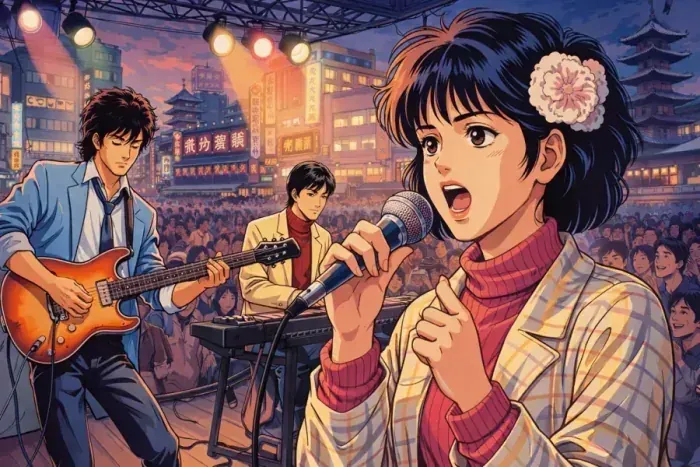 Tokyo, 1960s
 Before Idols: The Early Roots of East Asian Pop
Long before the labels J-Pop and K-Pop appeared, popular music in East Asia was already being remade in cities such as Tokyo, Seoul, Hong Kong, and Taipei. The key changes came after 1945, when war, occupation, migration, urban growth, and new media altered daily life across the region.
Radio stations, cinemas, nightclubs, dance halls, and record shops introduced audiences to sounds that had crossed the Pacific or moved through colonial and postcolonial trade routes. Jazz bands, crooners, orchestras, mambo, chanson, and early rock all entered local listening habits at different speeds. Some sounds arrived first through elite nightlife and urban entertainment districts; others spread through mass broadcasting and cheap records.
Local musicians did not just copy what they heard. They adapted foreign arrangements to local speech rhythms, local audiences, and local ideas of sentiment. Ballads kept familiar emotional phrasing. Bandleaders combined brass, guitar, and drum kits with melodic turns that listeners already recognized. By the 1950s and 1960s, new forms of urban popular music were taking shape across the region. The same imported influence could produce very different outcomes in Tokyo, Seoul, Hong Kong, or Taipei.
These scenes built the machinery that later idol systems would depend on: recording studios, star promotion, chart culture, variety programming, and fan habits. The global success of East Asian pop in the twenty-first century makes more sense once those earlier foundations are visible.
Another foundation was language adaptation. A melody could travel more easily than a lyric, but a song only became locally useful when singers found words, vowels, and emotional pacing that fit their own audiences. Japanese, Korean, Cantonese, and Mandarin all create different stresses and phrase lengths. Translating a song was rarely a simple matter of replacing one text with another. Arrangers had to rethink where a line could breathe, where a chorus could lift, and how a singer could make a foreign harmonic frame feel natural.
This helps explain why early East Asian pop sounds familiar and unfamiliar at the same time. The instrumentation might point toward American jazz, Cuban mambo, French chanson, or British rock, while the vocal line carried local ideas of sorrow, restraint, sweetness, or dramatic release. The hybrid was not a compromise. It was the actual style. Listeners were hearing modernity translated through accents, studio habits, and performance conventions they already understood.
Technology also mattered. Radio created repetition; cinema attached songs to faces; television made stars domestic guests; vinyl, cassettes, and later compact discs changed how often people could replay a performance. Each new medium created a new kind of memory. A nightclub singer could impress the room once. A radio hit could enter a morning routine. A television regular could become familiar across a whole household. Later idol systems inherited that layered familiarity and made it more deliberate.
The result was not a straight road from traditional song to global pop. It was a long period of testing. Some performers stayed close to older ballad forms. Some chased rock bands, brass sections, or electronic studios. Some became actors and singers at the same time. Some built careers almost entirely through television. By the time “J-Pop” and “K-Pop” became exportable labels, many of the practical questions had already been answered in earlier decades.
These early scenes also teach caution about origins. Pop histories often look for a single first moment, but East Asian pop has too many overlapping beginnings for that approach to work well. A Korean base-club singer, a Hong Kong film composer, a Japanese television idol, a Taiwanese Mandarin balladeer, and a Tokyo electronic producer were all building parts of the later story. None alone can explain the whole field. Together they show how modern pop forms when media, migration, commerce, and local taste keep colliding.
Genre labels work best as tools, not containers. Kayokyoku, trot, Cantopop, Mandopop, city pop, J-Pop, and K-Pop each point to real histories, but each one also contains many sounds and social meanings. The labels help organize the map. They should not make the music seem more uniform than it was. The richest parts of the story often appear at the edges where labels overlap.
American Radio and the First Cultural Exchange
The years after 1945 changed the political map of East Asia and, with it, the region’s musical life. Occupation, war recovery, Cold War alliances, and migration all altered who heard what, where, and under what conditions.
Japan remained under American occupation until 1952. South Korea, especially after the Korean War, developed close military and economic ties with the United States. Those relationships brought asymmetry and pressure, but they also created direct channels for musical exchange.
American military bases became one of those channels. Clubs near bases hired local musicians who could perform jazz standards, swing, Latin numbers, country songs, and later rock and soul for American servicemen. Those jobs demanded speed, repertoire, and technical flexibility. Musicians had to learn current material quickly and perform it convincingly for listeners who knew the originals.
Young singers learned English lyrics, copied phrasing from artists such as Frank Sinatra and Ray Charles, and developed the practical skill of switching styles quickly for demanding audiences. For many performers, this was less a glamorous exchange than a difficult apprenticeship inside commercial nightlife.
One early Korean example was the Kim Sisters, who first performed for U.S. troops before entering the American market. The official Ed Sullivan Show archive counts them among the program’s most frequent guests, a rare level of visibility for a Korean act in that era and an early sign that East Asian performers could cross into U.S. mass media.
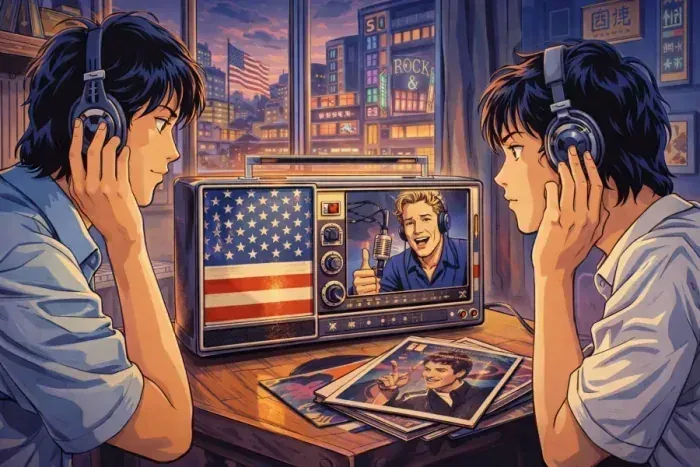
Radio carried those sounds into everyday life more broadly than clubs ever could. Military and commercial broadcasts spread jazz, rhythm and blues, country, and later rock into homes, taxis, workshops, and cafes. Listeners did not need to attend a live show to absorb new rhythms and arrangements. Repetition mattered here. Once new sounds entered daily routine, they stopped feeling exotic and started becoming part of the ordinary musical vocabulary.
Record labels and arrangers quickly saw the commercial potential. Songs were sung in Japanese, Korean, Cantonese, or Mandarin, but they were often arranged with guitars, horn sections, brushed drums, and later electric instruments that signaled modernity.
None of this erased older traditions. It created a layered musical environment in which imported styles, local vocal habits, and commercial entertainment could coexist. That hybrid environment was where modern East Asian pop began.
Military entertainment circuits were especially important because they rewarded versatility before local pop markets fully did. A singer or band working those rooms could not survive with one narrow style. The set might require swing standards, country material, Latin dance numbers, rhythm and blues, and later rock songs, often in a language the performers were still learning phonetically. That kind of work built speed, discipline, and a practical understanding of how arrangements functioned under pressure.
The same circuits also created a gap between skill and prestige. Musicians could become technically advanced in base clubs while remaining marginal inside respectable domestic media. That tension later mattered for Korean pop and rock. Some performers learned electric instruments and American repertoire in spaces that were commercially useful but socially ambiguous. When domestic youth culture shifted, those skills were ready to move into more visible settings.
Radio then widened the apprenticeship. Imported records could be heard repeatedly, not just encountered once in a club. Young musicians learned introductions, drum patterns, horn voicings, English phonetics, and microphone tone by listening again and again. The lesson was not only musical. It was industrial. Radio made clear that modern pop depended on repeatability: the same hook, the same voice, the same arrangement returning often enough to become part of ordinary life.
That repeatability shaped later pop systems directly. Idol music, drama soundtracks, anime openings, and viral dance clips all depend on a similar principle: a short, recognizable unit must survive repeated contact. The technologies changed from radio towers to YouTube premieres and short-form video feeds, but the basic question stayed close to the postwar one. What kind of sound can cross a boundary, return often, and become familiar without losing its local identity?
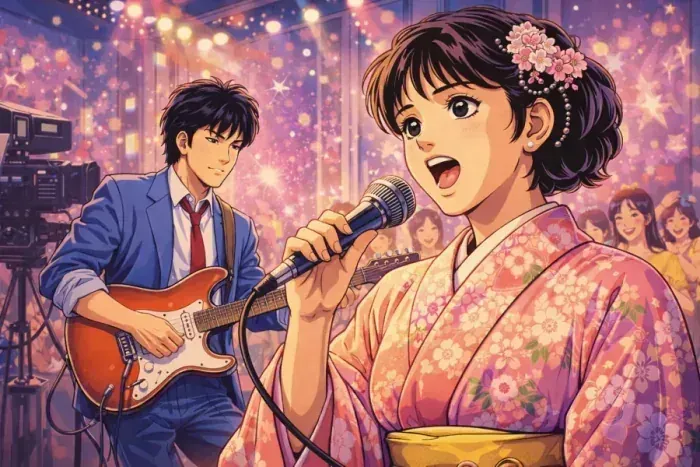
Japan's Kayokyoku: The First Modern Pop Industry
During the 1950s and 1960s, Japan developed a broad category of commercial song later recognized as one of J-Pop’s main ancestors: kayokyoku. It was less a single genre than a commercial field that absorbed jazz, Latin pop, chanson, rock, and Japanese lyric traditions. That flexibility was its strength. Kayokyoku could absorb outside influence without giving up its role as mainstream domestic music.
Many kayokyoku recordings paired sentimental lyrics with lush orchestral arrangements, but the category was wider than that. It included teen-idol material, dramatic ballads, novelty hits, and songs built for television variety programs and festival circuits. In practice, it linked labels, broadcasters, arrangers, and performers inside one commercial system. A song did not need to live only on radio. It could move through television, film, live revue culture, and year-end song events.
One of the defining figures of the era was Hibari Misora. She began as a child performer soon after the war and became one of the central voices of postwar Japanese popular music. Her career showed how a singer could move between film, radio, stage, and records while becoming a national symbol, not just a hitmaker. Her importance lies not in vocal ability alone, but in how her career showed postwar Japanese entertainment could build a star across several media at once.
Another milestone came in 1963, when Kyu Sakamoto’s “Ue o Muite Aruko,” marketed abroad as “Sukiyaki,” reached No. 1 on the U.S. Billboard Hot 100. It was an unusual crossover hit, and for many American listeners it was a first encounter with a Japanese-language pop song. The song did not create a permanent export pipeline, but it proved unusually early that a Japanese-language recording could cross into the American mainstream without being rewritten in English.
As the 1960s continued, the sound shifted again. Group Sounds acts such as The Spiders and The Tigers brought electric guitars, Beatles-era energy, and a more youth- oriented visual style that sat beside older orchestral ballads rather than simply replacing them. That coexistence is important. Japanese pop did not move in clean genre succession. Older and newer forms kept sharing space, audiences, and television time.
By the late 1970s, kayokyoku had already built the domestic infrastructure that later pop would inherit: powerful labels, national TV exposure, agency control, and a public trained to follow stars closely. J-Pop did not emerge from nothing. It grew out of this system.
The strength of kayokyoku was partly its looseness. Because it was a commercial category rather than a strict genre, it could bring together composers, lyricists, arrangers, film companies, broadcasters, and singers who did not all share the same musical background. A song could lean toward enka-like sentiment, American jazz harmony, French theatrical melody, or youth-oriented guitar pop and still belong to the mainstream. That made Japanese pop unusually good at absorbing outside styles without announcing every absorption as a rupture.
Television reinforced that breadth. Variety programs, music competitions, drama appearances, and year-end events made songs visible as social occasions. Viewers did not only hear a single; they saw how a performer bowed, joked, dressed, stood beside older stars, and handled the pressure of live broadcast. Those details became part of star value. Later idol culture would intensify this logic, but the basic grammar was already present in the kayokyoku era.
Kyu Sakamoto’s “Ue o Muite Aruko” also shows how exceptional early crossover could be. Billboard Japan marks June 15, 1963, as the date when the single, renamed “Sukiyaki” for the U.S. market, reached the top of the American Hot 100. That success did not immediately produce a wave of Japanese-language hits in the United States. Instead, it remained a striking outlier: proof that language did not make crossover impossible, but also proof that one hit alone could not build an export system.
The title change itself reveals the limits of the moment. “Sukiyaki” was not a translation of the lyric. It was a marketable Japanese word chosen for American recognition. The song traveled, but under a framing that made it easier for foreign listeners to categorize. Later East Asian pop exports would face the same problem in more complex ways: how to become legible abroad without surrendering the language, humor, and emotional codes that made the work matter at home.
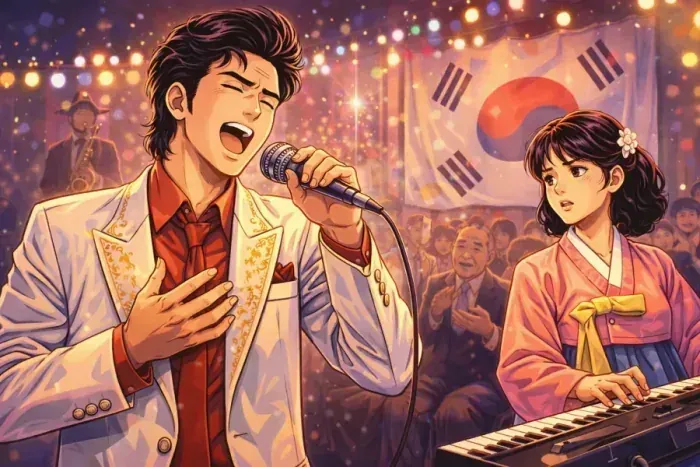
Korea's Trot: A Long Bridge to Modern Pop
While Japan’s pop industry expanded through kayokyoku, South Korea followed a different path. One of the central forms in early Korean popular music was trot, a genre with roots in the first half of the twentieth century that remained commercially and emotionally important for decades.
Trot songs are often built around steady rhythms, memorable melodic turns, and highly expressive vocal phrasing. The style can sound direct and melodramatic at the same time. Themes of longing, departure, reunion, and endurance made sense to listeners living through war, displacement, authoritarian politics, and fast economic change. That emotional register helped trot remain legible across generations even as younger listeners moved toward rock, dance music, and later idol pop.
During the 1950s and 1960s, trot became a backbone of South Korea’s recording industry. Radio favored recognizable voices, labels issued large numbers of singles and albums, and traveling shows carried songs beyond Seoul into provincial circuits. Trot turned Korean popular song into a genuinely national recorded market rather than a mostly urban entertainment form. It linked broadcasters, labels, and touring routes into one repeatable circuit.
One of the era’s defining singers was Lee Mi-ja. Her recordings combined technical control with emotional clarity, and songs such as “Camellia Lady” became reference points for the genre. She became a model for what a major Korean recording voice could sound like in the postwar period. Her style also helped define the seriousness with which popular song could carry public emotion in South Korea.
Cho Yong-pil marked a later transition point. Beginning as a guitarist and singer in local bands, he absorbed rock, soul, and Western pop before becoming one of the central figures linking older Korean popular song to a broader modern pop vocabulary. His 1976 hit “Come Back to Busan Port” became one of the era’s signature songs. His later career showed that a Korean star could move between older sentimental traditions and a more contemporary band-and-studio sound without losing mass appeal.
Live venues near American military bases also mattered. They gave Korean musicians space to learn electric instruments, tight band discipline, and current Western repertoire outside the stricter conventions of mainstream domestic broadcasting. That skill base later fed directly into modern Korean pop.
By the late 1970s and early 1980s, television music shows, talent contests, and larger labels had made the Korean music business more complex. It still was not export-driven in the later K-Pop sense, but the industrial pieces were there. At the same time, another major transformation was unfolding in Chinese-language pop.
Trot’s durability also matters because it complicates the idea that K-Pop simply replaced older Korean popular music. Modern idol pop did not erase the emotional vocabulary that trot had normalized. It inherited a public already used to popular song carrying longing, family separation, social pressure, and national memory. Even when the beat changed, that expectation did not disappear. Korean ballads, drama soundtracks, and many idol group album tracks still depend on a seriousness about melodic emotion that older popular song helped establish.
The genre also created a model of vocal authority. Trot singers were expected to project feeling with clarity, often through vibrato, controlled bends, and direct address. That kind of singing does not map neatly onto later dance-pop, but it shaped the wider culture of what a major voice could do. A Korean pop singer could be judged not only by technical range or novelty, but by the ability to make a familiar emotional phrase feel newly urgent. That expectation stayed powerful even after youth culture turned toward rap, club rhythms, and synchronized choreography.
Television made this continuity visible. Older singers remained present on broadcast stages, tribute programs, and national song events while younger acts experimented with new sounds. The public did not experience Korean pop history as a clean replacement of one era by another. Different age groups and performance styles occupied the same media space. That coexistence gave later K-Pop a broader emotional base than the phrase “idol music” sometimes suggests.
Cho Yong-pil’s career shows that bridge clearly. He was able to stand between band music, older song forms, and modern studio pop because South Korea’s market was already learning to value range. His success suggested that a domestic star could update sound without cutting ties to older audiences. Later idol agencies would pursue younger listeners more aggressively, but they still worked inside a culture where songs were expected to carry melodic force, not only visual excitement.
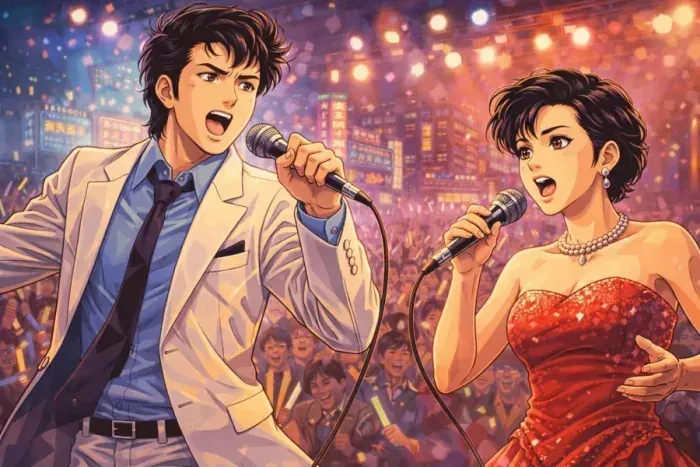
Cantopop and Mandopop Build Regional Pop Markets
While Japan and South Korea were building their own pop traditions, Hong Kong and Taiwan were becoming major centers for Chinese-language popular music. During the 1970s and 1980s, Cantopop in Cantonese and Mandopop in Mandarin grew into powerful commercial systems with reach far beyond their home bases.
Hong Kong’s film and television industries were central to Cantopop’s rise. Singers often moved between records, cinema, and television drama, which meant a successful song could gain strength through several media at once. Labels backed artists who could act, sing, tour, and hold public attention across formats. Theme songs, soundtrack appearances, and star casting gave Cantopop a built-in promotional loop that many other markets did not yet have at the same scale.
One of the era’s defining stars was Anita Mui. Her performances combined vocal authority, bold stage presence, and a sharper dance-pop image than many earlier female stars. Songs such as “Bad Girl” shifted expectations around what a Hong Kong pop star could look and sound like, while her film work expanded her public impact.
Leslie Cheung shaped the genre in a different way. As both singer and actor, he moved Cantopop toward a more modern synth-pop and dance-pop sound while keeping a strong emotional intensity at the center. “Monica” is often remembered as an early turning point in that brighter, more dance-driven direction.
Taiwan became a major center for Mandarin-language pop. Teresa Teng was one of its most important voices. Her phrasing was conversational, intimate, and unusually portable across regions, which allowed songs such as “The Moon Represents My Heart” to circulate through Chinese-speaking communities far beyond Taiwan itself. She made Mandarin pop sound close and personal rather than ceremonially distant, which helped the music travel through radio, cassette exchange, and diaspora listening.
By the 1990s, artists such as Faye Wong pushed Mandopop and Cantopop toward a cooler, more alternative edge. Working across Hong Kong, Taiwan, and mainland China, she showed that Chinese-language pop could be commercially major without sounding conservative.
Together, these scenes created one of the region’s earliest large-scale cross-border pop markets. They linked Hong Kong, Taiwan, mainland China, Singapore, Malaysia, and overseas Chinese communities through language, television, film, cassette culture, and touring. That regional circulation mattered later because it showed that East Asian pop could travel through overlapping media systems rather than through one national chart alone. It also trained listeners to follow stars across several territories at once.
A hit could start as a film theme, gain strength through television, keep moving through cassette sales and touring, and then settle into diaspora radio and karaoke culture. East Asian pop was already multi-platform long before streaming made that normal.
Cantopop’s rise depended heavily on Hong Kong’s unusual position as a media city. It had commercial television, a globally visible film industry, a dense recording business, and audiences that were used to moving between local Cantonese culture and international influence. That made the city especially good at producing stars who could carry several meanings at once: local speech, cosmopolitan fashion, cinema glamour, and a sound that could borrow from Japanese, Western, and Mandarin-language pop without losing its own voice.
Film music was one of the strongest engines. A song attached to a popular movie could reach viewers as part of a story before it had to compete as a standalone single. The cinema gave the singer a face, the face gave the song emotional memory, and the record gave fans a way to replay that memory at home. That loop helps explain why singer-actors were so powerful in Hong Kong. Leslie Cheung and Anita Mui did not simply divide their careers between records and films. The two sides amplified each other.
Karaoke added another layer. Once a song entered karaoke culture, it stopped being only a recorded performance and became a social script. Listeners learned phrasing, emotional peaks, and gestures by singing the songs themselves. That participatory habit mattered across Chinese-speaking markets because it allowed songs to move into restaurants, private rooms, weddings, community gatherings, and diaspora nightlife. A ballad could travel not only as media, but as a shared action.
Mandopop’s regional strength came from a different kind of portability. Mandarin could connect Taiwan, Singapore, Malaysia, mainland China, and overseas communities even when local accents, political contexts, and media systems differed. Teresa Teng’s voice benefited from that structure because it sounded intimate enough for private listening but clear enough to circulate widely. Her songs could feel personal in several different places at once, which is one reason her catalog became so durable.
By the 1990s, that regional market was sophisticated enough to support artists who did not fit older ballad expectations. Faye Wong’s coolness mattered because it showed that Chinese-language pop could absorb dream pop, alternative rock, and electronic textures while remaining commercially central. She made ambiguity marketable. That shift widened the idea of what a Chinese-language pop star could represent and helped prepare audiences for a more fragmented, style-conscious pop landscape.
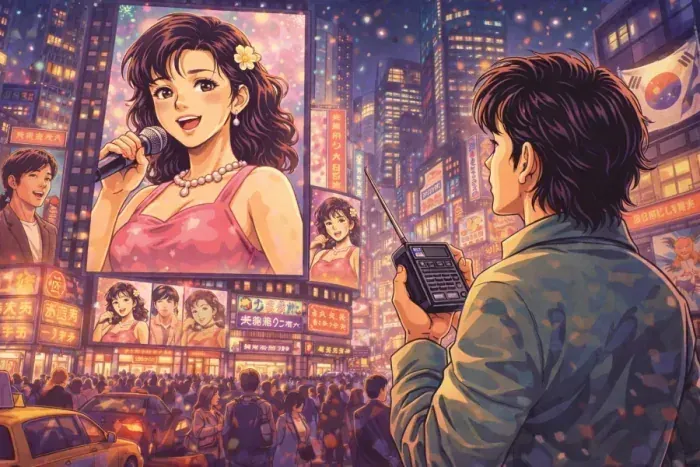
Diaspora Markets and Shared Media Spaces
Chinese-language pop also benefited from diaspora networks that linked cities well beyond East Asia. Record shops, community radio, satellite television, karaoke circuits, and later online forums helped songs move between Hong Kong, Taiwan, mainland China, Singapore, Malaysia, and overseas Chinese communities in North America and Europe.
This was a clear early example of regional pop integration in Asia. Audiences were not consuming music from one place for one market. They were following performers across albums, film appearances, television dramas, touring routes, and publicity networks that crossed several political and linguistic contexts at once.
The result was a more connected popular culture than national charts alone suggest. By the time J-Pop and later K-Pop pushed outward with new industrial models, East Asia already had experience with songs circulating across borders, languages, and media formats. Chinese-language pop had already built that listening habit. That older infrastructure of circulation is one reason later regional pop booms could scale so quickly.
Diaspora circulation also preserved music during periods when formal distribution was thin or uneven. A cassette bought in Hong Kong could be copied in Vancouver, a Taiwanese album could move through family travel to Singapore, and a karaoke video could become a shared reference in a restaurant far from its original market. These routes were informal, but they were not minor. They created memory before streaming platforms could measure it.
That memory often worked across generations. Parents carried songs from one place to another; children heard them in cars, shops, community events, or family gatherings; later those same listeners encountered newer pop online with an ear already shaped by older regional circulation. The global spread of East Asian pop therefore did not begin with a blank international audience. Many listeners already had partial access through family networks, language communities, or local Asian media stores.
The same point applies to translation. Long before online fan translators became central to K-Pop, bilingual listeners were explaining lyrics, celebrity news, and media references inside their own communities. They acted as informal curators. Their choices affected which artists became known, which songs were understood, and which scenes felt accessible to people outside the original language market. Later digital fandom made that work faster and more visible, but it did not invent the mediator role.
Japan Reinvents Pop: The Birth of J-Pop
By the late 1970s, Japanese popular music stood at a productive crossroads.
Kayokyoku still dominated television and radio, but younger musicians and producers were searching for sounds that matched urban consumer culture, late-night city life, new FM radio habits, and new recording technology.
Synthesizers, drum machines, and multitrack recording opened fresh creative possibilities. Artists who had grown up with Western rock, funk, soul, and jazz-fusion began using those tools without abandoning Japanese songwriting traditions. The older and newer styles overlapped for years, which is why the birth of J-Pop looks gradual rather than sudden.
Out of that overlap, a new idea of Japanese pop started to form. The label J-Pop would only become common later, but its foundations were laid here by studio experimenters, idol singers, singer-songwriters, and urban musicians who treated Japanese pop as part of a global conversation rather than a sealed domestic form.
The transition was also economic. Japan’s postwar growth had created a large consumer market for records, hi-fi equipment, television, magazines, fashion, and leisure. Pop music was not floating above that economy. It was one of the ways the economy became audible. A sophisticated studio recording could suggest the same modern life as a new car, an apartment stereo, a late-night drive, or a glossy magazine spread. That connection between sound and consumer imagination became especially strong in city pop, but it was already present in the broader shift away from older song formats.
The recording studio became a status symbol as well as a tool. Multitrack recording, better microphones, synthesizers, and elite session musicians allowed Japanese producers to make records that sounded expensive, detailed, and internationally current. The point was not only to imitate American or European production. It was to show that Japanese pop could meet those technical standards while keeping its own melodic and linguistic center. Listeners heard polish as part of the promise.
At the same time, singer-songwriters complicated the older agency-driven star model. Artists who wrote or shaped their own material gave Japanese pop a different kind of credibility from television idols. They were not necessarily outside the commercial system, but they gave audiences another way to value authorship. That balance between managed pop, studio craft, and personal songwriting would remain a defining tension in J-Pop for decades.
Yellow Magic Orchestra: Electronic Pioneers
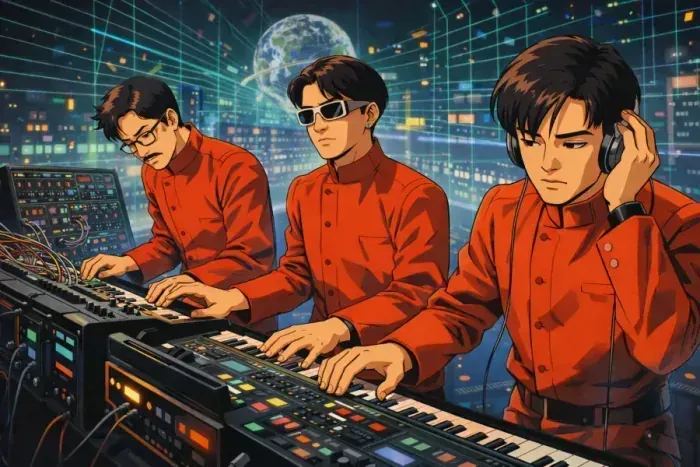
One major turning point in Japanese pop music arrived in 1978 with the formation of Yellow Magic Orchestra, often shortened to YMO. The group brought together three musicians who already had strong reputations in Japan’s recording industry: Haruomi Hosono, Ryuichi Sakamoto, and Yukihiro Takahashi. Each member had worked in different musical environments, yet their collaboration created something entirely new.
Hosono had previously played in the folk-rock group Happy End and had developed an interest in international music styles, especially American pop and Caribbean rhythms. Sakamoto studied composition and electronic music, building a reputation as a thoughtful and technically skilled arranger. Takahashi came from the glam-influenced band Sadistic Mika Band and brought a strong sense of rhythm and pop structure. Together they formed a trio that treated the recording studio as an instrument in its own right.
Their early albums, including Yellow Magic Orchestra (1978) and Solid State Survivor (1979), explored synthesizers, sequencers, and electronic rhythm machines with unusual precision and wit. Tracks such as “Rydeen” and “Technopolis” sounded futuristic without giving up pop hooks, which is one reason the group traveled so well outside Japan. YMO did not treat electronic sound as a cold avant-garde exercise. They made it catchy, ironic, and repeatable.
YMO also treated image as part of the project. Their coordinated stage wear, sleek visual identity, and carefully designed live presentation connected electronic sound to a modern, high-tech look. Later East Asian pop acts would make that audio-visual logic central.
International audiences noticed quickly. Their records circulated among electronic music fans in Europe and the United States, and musicians in emerging synth-pop and techno scenes paid close attention to their sequencing, drum programming, and playful treatment of technology. YMO showed that Japanese pop innovation could influence global pop rather than merely absorb it.
The influence of Yellow Magic Orchestra extended far beyond their own recordings. After the group slowed its activities in the mid-1980s, each member pursued individual projects that continued shaping modern music. Ryuichi Sakamoto built a celebrated career as a composer for film and experimental works. Haruomi Hosono explored world music and ambient sounds, while Yukihiro Takahashi remained active as both performer and producer.
Their legacy can still be heard in contemporary pop and electronic music. They made it plain that Japanese artists could influence the global studio conversation, not only respond to it. At the same time, another branch of Japanese pop was taking shape through television, fan culture, and the rise of the idol star.
YMO’s importance was not simply early access to electronic instruments. They made technology sound like pop language rather than studio equipment. Sequencers and drum machines did not sit behind the songs as hidden tools. They became part of the identity: precise, playful, mechanical, and human at the same time. Later East Asian pop would often turn technological polish into style instead of hiding it as production labor.
The group also arrived at a moment when Japan’s electronics industry carried global symbolic weight. Synthesizers, drum machines, portable stereos, video games, and consumer electronics all contributed to an image of Japan as technologically advanced. YMO played with that image rather than simply celebrating it. Their music could sound futuristic and satirical at once, which gave it a sharper edge than a simple high-tech showcase.
Smithsonian Magazine’s history of the Roland TR-808 places YMO among the early artists using the machine live in Tokyo, before the drum machine became central to hip hop, electro, dance music, and later global pop. That detail places YMO inside a larger technical chain through which Japanese instruments, global studio practice, and new rhythmic languages reshaped pop far beyond Japan.
The trio’s international reception also shows how influence can move through musicians before it reaches mass audiences. YMO were not a conventional global pop phenomenon in the later K-Pop sense. Their records circulated through artists, DJs, producers, and electronic music listeners who were listening for method as much as melody. That kind of influence is quieter than chart domination, but it can be historically deep because it changes what other musicians think is possible.
The Idol Boom: Japan's 70s and 80s Stars
While electronic innovators were expanding the studio, another force was reorganizing Japanese mass culture: the idol system. An idol was not just a singer. The role combined records, television appearances, print media, fan clubs, and a carefully managed public image built around familiarity as much as musical skill.
Many young singers entered the industry through televised auditions and talent programs. These formats let agencies introduce new faces nationally and then guide them through tightly planned release cycles that linked singles, magazines, variety shows, advertising, and seasonal television appearances. The idol was therefore not just a voice on record, but a recurring media presence audiences could keep meeting in different settings.
One of the defining figures of this era was Seiko Matsuda. She debuted in 1980 and soon became a recognizable voice in Japanese pop music. Her songs often blended bright melodies with polished production, creating a style that felt both cheerful and emotionally expressive. Tracks such as “Aoi Sangoshō” and “Akai Sweet Pea” became enormous hits and established her reputation as a leading idol of the decade.
Matsuda’s public image was part of the work, not just a byproduct of it. Her hairstyles, fashion, and bright stage presence fed directly into youth trends, while television, concerts, and fan clubs turned attention into sustained loyalty.
Akina Nakamori, who debuted a few years after Matsuda, expanded that template in a different direction. Nakamori’s music often carried a more dramatic emotional tone, and her stage performances reflected a stronger sense of individuality. Songs such as “Desire” and “Slow Motion” revealed a performer who could balance pop accessibility with expressive depth. Her presence broadened the range of what an idol could represent within the industry.
The system widened further with groups such as Onyanko Club in the mid-1980s. Instead of building everything around one star, producers used a rotating ensemble whose members could “graduate” and be replaced. That logic of turnover, serial attachment, and constant visibility later shaped many large Japanese idol projects.
Behind these artists stood a growing network of talent agencies, producers, and television companies. They coordinated music releases, media appearances, and promotional campaigns with remarkable precision. The result was a highly organized pop industry that could deliver stars, schedules, and chart success with unusual consistency.
The idol model would eventually influence other countries as well. South Korea’s entertainment companies studied the Japanese system while developing their own approach to pop production. Japan’s version, however, retained its own character, rooted in television culture and a strong domestic fan base. Alongside it, another movement was capturing the energy of urban life in a rapidly modernizing Japan.
Japanese idol culture also depended on the careful management of distance. The idol had to feel reachable enough for fans to form loyalty, but not so ordinary that the fantasy collapsed. Television solved this by giving audiences repeated small encounters: interviews, games, variety sketches, seasonal specials, and music performances. A fan could feel that they knew a performer through rhythm and repetition, even when the public image was tightly managed.
That rhythm made the idol a media habit. A single might introduce a new persona, but the daily or weekly appearances sustained it. Magazines extended the image into bedrooms and school bags. Commercials placed it in ordinary consumer life. Concerts and fan clubs turned it into organized attachment. The Japanese system became powerful because it did not rely on music alone to carry the relationship.
The difference between Seiko Matsuda and Akina Nakamori also shows how the system could hold contrasting ideals. Matsuda’s brightness and romantic softness offered one model of 1980s femininity; Nakamori’s darker styling and dramatic performance offered another. Both were idols, but they did not ask fans to feel the same thing. This range made the idol field more flexible than outsiders sometimes assume. It could package innocence, melancholy, confidence, rebellion, and vulnerability inside the same commercial structure.
Onyanko Club pushed the structure toward serialization. The audience could follow member changes, favorites, internal hierarchy, and graduation as part of the entertainment. That logic later became even more explicit in Morning Musume and AKB48. It also has a conceptual link to survival shows and rotating idol collectives elsewhere in East Asia: the process of becoming and leaving can be as commercially important as the finished performance.
The system’s strengths came with limits. Because idols were built through visibility, their private lives and public behavior were often controlled more tightly than those of conventional singers. Fans were invited to feel closeness, but that closeness could become surveillance. The contradiction never disappeared. It became one of idol pop’s lasting ethical questions in Japan and later in South Korea: how much of a young performer’s life should become public material?

City Pop: The Soundtrack of Urban Japan
During the late 1970s and 1980s, another current moved through Japanese pop. While idols dominated television, studio-oriented musicians were making the smoother, more urbane sound later called city pop. The music fit an era of expressways, car stereos, department-store culture, and the promise of metropolitan ease.
City pop drew from American soft rock, funk, jazz fusion, AOR, and rhythm and blues. Electric pianos, clean guitar lines, sophisticated chord progressions, and layered harmonies gave the records a polished surface, while elite session players made that polish feel effortless. The sound suggested mobility, leisure, and technical confidence, which is one reason it fit late-bubble-era urban fantasy so well.
One of the central figures of this movement was Tatsuro Yamashita. His recordings displayed an extraordinary sense of arrangement and vocal harmony. Songs such as “Ride on Time” and “Sparkle” blended upbeat rhythms with warm melodies that suggested both movement and relaxation. Yamashita’s production style reflected a deep appreciation for American West Coast pop, yet his songwriting remained rooted in Japanese sensibilities. Over time he became a widely respected architect of the genre.
Mariya Takeuchi offered a slightly different version of the sound. Her 1984 album
Variety included “Plastic Love,” a song whose steady groove and restrained melancholy later found a second life online. Its international revival did not happen by industry design. It happened because listeners decades later heard something durable in its arrangement and mood. That afterlife is a useful reminder that city pop’s current global reputation was built retrospectively, through rediscovery, not through an export campaign in the 1980s.
Artists such as Anri, Taeko Ohnuki, and Masayoshi Takanaka also contributed to the scene, each bringing a slightly different musical flavor. Some emphasized jazz influences, while others leaned toward dance rhythms or mellow acoustic textures. Despite these variations, the music shared a common sense of polished craftsmanship and cosmopolitan atmosphere.
City pop thrived during Japan’s economic expansion of the 1980s. Record companies invested heavily in studio production, and many musicians had access to high-quality recording technology. Album-oriented listening became increasingly common, allowing artists to build cohesive musical worlds rather than focusing only on singles. The music’s reputation for luxury and polish came partly from that production environment.
Although city pop remained primarily domestic at first, its influence moved quietly across borders through collectors, DJs, reissues, and later streaming. The internet revival of the 2010s and 2020s did not invent the music’s appeal. It exposed how carefully made many of those records already were.
City pop’s later revival can be misunderstood if it is treated as pure nostalgia. Many international listeners did not live through 1980s Japan and were not remembering a lost urban life of their own. They were responding to a sound world that felt both specific and strangely open: night drives, neon, expensive studios, clean rhythm sections, and a melancholy that sat behind the surface brightness. The music offered a fantasy of mobility, but it often carried loneliness too.
That dual feeling is one reason “Plastic Love” traveled so well online. The groove is smooth and controlled, but the emotional atmosphere is not simple happiness. It suggests repetition, distance, and late-night reflection. For listeners discovering the track through algorithms, fan uploads, or recommendation threads, that mixture made the song feel contemporary despite its 1984 release date. It did not need a historical lecture to connect.
Collectors and DJs had been preparing that revival for years before streaming made it visible at scale. Japanese records moved through used shops, reissue labels, dance music sets, and sample culture. International listeners who cared about rare groove, jazz fusion, boogie, and soft rock found Japanese albums that matched those interests while offering different melodic habits. The internet widened a path that specialists had already opened.
City pop also reveals a contrast with K-Pop’s export model. It became global mostly after the fact, through rediscovery and listener circulation rather than through a coordinated campaign by labels at the time of release. That does not make it less global. It means the direction of power was different. Audiences, collectors, uploaders, and playlist makers helped turn a domestic commercial sound into an international reference point decades later.
As the 1990s approached, Japan’s pop landscape continued evolving. Advances in digital recording and new approaches to songwriting began reshaping the industry once again. A new generation of performers soon emerged, bringing a modern pop sensibility that would eventually be recognized around the world under a new label.
The 1990s J-Pop Explosion
During the 1990s, Japanese popular music entered a new phase and the label J-Pop became more visible in media and retail. CDs were booming, televised music culture remained strong, and labels were willing to spend heavily on artists who could define the sound and image of the decade. Tie-ins with television dramas, commercials, and magazine culture made those releases feel even bigger.
Namie Amuro was one of the decade’s most visible stars. Her rise in the mid-1990s introduced a fresh image of pop stardom that connected strongly with younger listeners. Songs such as “Can You Celebrate?” and “Don’t Wanna Cry” combined dance rhythms with emotional melodies, creating a sound that felt both contemporary and personal. Amuro’s stage presence and fashion style influenced trends among Japanese youth, and her success reshaped the visual language of pop performers during the decade.
Another decisive figure was Hikaru Utada. Raised between Japan and the United States, Utada brought a more contemporary R&B and soul vocabulary into Japanese mainstream pop. Their 1999 debut album First Love became the best-selling album in Japanese chart history, while songs such as “Automatic” and “First Love” made introspective writing sound commercially massive rather than niche.
Around the same time, Ayumi Hamasaki emerged as an influential pop figure in Japan. Her recordings blended dance-pop production with introspective lyrics that reflected personal struggles and emotional growth. Songs like “M” and “Boys & Girls” became defining hits of the era. Hamasaki’s relationship with fans extended beyond music through magazines, concerts, and carefully designed visual concepts that accompanied each album. She helped normalize the idea that a Japanese pop star could turn self-stylization into a full-scale narrative across records, fashion, and live performance.
Behind these artists stood powerful producers and arrangers, especially Tetsuya Komuro, whose work defined much of the decade’s dance-pop sound. His productions for acts such as globe, TRF, and Namie Amuro linked Eurodance energy to Japanese melodic pop with unusual commercial efficiency.
The success of these performers reflected the strength of Japan’s domestic music market. By the late 1990s the country had one of the largest recording industries in the world. Record labels could support ambitious production budgets, large concert tours, and extensive promotional campaigns. That scale is one reason J-Pop could become so internally rich without immediately orienting itself toward export.
The compact disc boom made this scale concrete. Japan’s 1990s pop economy rewarded albums, maxi-singles, tie-in singles, limited editions, and carefully sequenced release campaigns. A television drama theme could push a single, a commercial could make a chorus familiar, and a magazine cover could turn the artist’s visual identity into part of the release. The sales environment supported long promotional arcs that were difficult to replicate in smaller markets.
Tie-ins were especially powerful because they turned songs into recurring media events. A viewer heard a theme every week with a drama, then encountered the same artist on a music show, then saw the release in retail displays. This repetition made songs feel embedded in the season. It also helped explain why some J-Pop singles became enormous domestic events without needing international radio or overseas touring.
Hikaru Utada’s First Love sits at the center of this moment because it combined mass-market timing with a different emotional and musical vocabulary. The album arrived inside a strong CD economy, but its R&B phrasing and bilingual sensibility made it feel less bound to older idol forms. Oricon’s later reporting that the album remained the highest-selling album in the history of its weekly album chart confirms not only Utada’s scale, but the size of the market that could receive such a record.
Ayumi Hamasaki’s success shows another side of the same decade. Her records were not only songs; they were chapters in a public self-styling project. Lyrics, covers, videos, fashion, and arena staging worked together, allowing fans to follow the construction of a persona over time. That model anticipated later pop eras in which visual narrative, intimacy, and release cycles became inseparable.
Namie Amuro’s impact also reached beyond the chart. Her style influenced hair, makeup, clothes, dance posture, and ideas of young womanhood in the 1990s. That is important because pop’s power often appears first through imitation. When listeners copy a hairstyle, a way of standing, or a dance gesture, the music has moved from entertainment into everyday behavior.
While Japan’s music industry continued to thrive, South Korea was preparing a different model of pop: more centralized, more training-heavy, and more openly shaped by regional and global ambition.
Korea’s Pop Revolution: The Rise of K-Pop
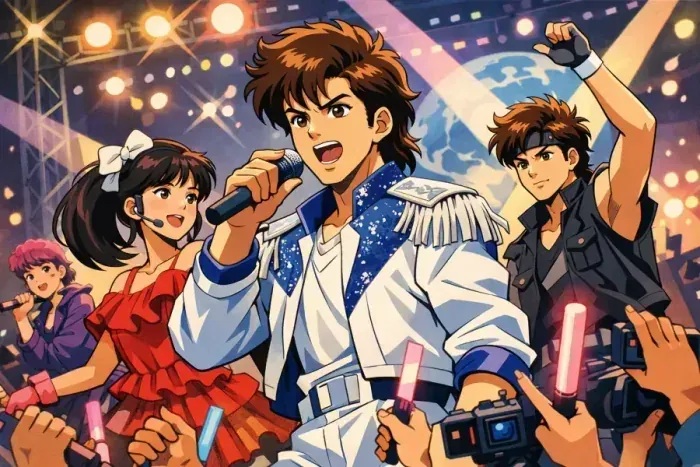
By the early 1990s, South Korea was changing fast. Democratization, media liberalization, consumer growth, and a younger audience with wider listening habits were all reshaping the cultural field. Imported hip hop, rock, and dance-pop no longer felt marginal to youth taste. The question was no longer whether those sounds would enter Korean pop, but who would reorganize the industry around them.
The domestic music business was also looking for a new center of gravity. Trot and older ballad traditions remained important, but they no longer explained what younger audiences wanted from popular music. Rap, club rhythms, and youth-coded performance were moving in from the edges.
In that setting, a small number of performers changed Korean pop with startling speed. They did not invent every element of modern K-Pop by themselves, but they proved that a different center was now possible: rhythm-driven, youth-facing, visually integrated, and built to scale.
The political and media context made that shift possible. South Korea’s democratization after the late 1980s changed public culture, and younger audiences were increasingly exposed to imported music, dance, fashion, and television formats. Older broadcast systems had not disappeared, but they no longer controlled taste as completely. Youth listeners were ready to hear Korean-language pop that acknowledged the sound of global club music, hip hop, and new jack swing without treating those styles as foreign ornament.
Economic pressure mattered too. South Korea’s domestic market was much smaller than Japan’s, which meant that long-term growth would eventually require either intense local competition or external expansion. The export logic of K-Pop was not fully formed in the early 1990s, but the conditions were already pointing in that direction. Companies needed acts that could stand out quickly, perform reliably on television, and eventually move through neighboring markets.
The change was therefore musical and organizational at the same time. Rap, dance beats, streetwear, and youth lyrics made Korean pop sound different. But the deeper shift was the realization that a pop act could be built as a total performance unit. Sound, choreography, styling, member roles, and media story could be planned together. Seo Taiji and Boys made that possibility visible before agencies turned it into a repeatable business model.

Seo Taiji and Boys: The Game Changer
In 1992, a new group appeared on South Korean television and made the existing mainstream sound look old almost immediately. Seo Taiji and Boys, made up of Seo Taiji, Yang Hyun-suk, and Lee Juno, performed “Nan Arayo” (“I Know”), mixing rap, new jack swing, dance beats, and a performance style built for youth culture rather than adult ballad audiences.
The judges were not especially impressed, but the audience reaction mattered more. Young viewers recognized something current in the group’s rhythm, styling, and attitude, and “Nan Arayo” quickly became one of the year’s defining hits. The gap between elite judgment and youth response is part of why the performance now feels so decisive in retrospect.
Seo Taiji had spent years studying hip hop, rock, and dance music, but the group’s impact came from adaptation rather than imitation. Korean-language lyrics about school pressure, generational conflict, and youth frustration made imported sounds feel locally urgent.
Their debut album sold in huge numbers, and later releases kept widening the boundaries of Korean pop. “Come Back Home” added heavier rock and social commentary. Other tracks pushed further into electronic dance production. Each comeback treated image, choreography, and sound as one package. That comeback logic later became routine in K-Pop, but here it still felt disruptive.
Seo Taiji and Boys also changed what performance meant within Korean pop. Their stage routines used synchronized dance not as decoration but as a central part of the music’s impact. That emphasis on choreography later became one of K-Pop’s defining features.
The group remained active only until 1996, but its impact was enormous. Many musicians and producers saw its success as proof that Korean pop music could evolve by blending global influences with local creativity. Younger performers began experimenting with similar styles, and record companies started looking for artists who could appeal to youth culture.
The influence of Seo Taiji extended beyond music itself. One of the group’s members, Yang Hyun-suk, would later become the founder of YG Entertainment, an important company in the K-Pop industry. The groundwork for a new kind of pop system had been laid, and ambitious producers were ready to build upon it.
What made the group so disruptive was not only the mixture of styles, but the way the music addressed youth as a public. Earlier Korean pop had certainly included young listeners, but Seo Taiji and Boys made generational feeling explicit. School pressure, adult authority, social conformity, and the desire for self-expression became part of the mainstream pop conversation. This gave the music a sharper social function than novelty alone could provide.
The group’s choreography also changed how television pop was read. Movement was no longer just a background accompaniment to a singer. It was one of the main ways the group communicated identity. The body carried the beat, the attitude, and the break from older performance manners. Later K-Pop would refine synchronized choreography into a much more precise system, but the shock of seeing dance and rap reorganize the stage was already present here.
Their short career also created a pattern later agencies would formalize: each release had to feel like an event with a new sound, a new look, and a new argument. The modern comeback system depends on that expectation. Fans do not wait only for a new song. They wait for a concept, a visual world, a set of performances, and a shift in group identity. Seo Taiji and Boys did not create the later machinery, but they made the public ready for pop that changed dramatically from cycle to cycle.
The fact that Yang Hyun-suk later founded YG Entertainment gives the story an industrial continuity. The rebellious edge that helped make Seo Taiji and Boys feel different did not remain outside the system. It became one of the system’s house styles. YG would later turn hip hop posture, fashion confidence, and stage impact into a corporate identity, showing how quickly disruption can become infrastructure.
How Entertainment Agencies Were Born
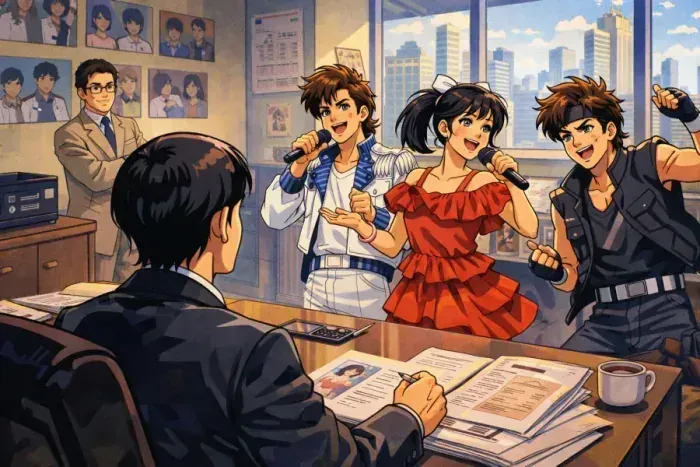
After Seo Taiji and Boys broke through, the Korean music business reorganized around a new idea. Instead of waiting for individual singers to emerge through conventional routes, producers began building companies that could recruit, train, package, and market performers from the ground up.
One of the central figures in this transformation was Lee Soo-man, a former singer who began building what became SM Entertainment in the late 1980s and formalized the company in the mid-1990s. Lee had spent time in the United States and closely observed the American pop industry. He believed Korean music companies could develop a similar system but with a stronger emphasis on training and long-term artist development.
SM Entertainment began recruiting young performers into intensive training programs. Trainees studied singing, dancing, stage presence, language, and media discipline, often for years before debut. That gave companies far more control over lineup design, skill balance, and long-term branding than older star systems allowed.
Another key figure in the emerging industry was Park Jin-young, who later founded JYP Entertainment. Park was both a songwriter and performer, and his experience on stage gave him a practical sense of how pop music could connect with audiences. His company placed emphasis on musicality and personality, encouraging artists to develop individual voices while still working within a coordinated group structure.
Around the same time, Yang Hyun-suk, the former member of Seo Taiji and Boys, established YG Entertainment. His company leaned toward hip hop and rhythm-driven production, drawing from the influences that had shaped his earlier career. YG artists often projected a slightly more rebellious image, which appealed to listeners looking for alternatives to polished mainstream pop. Together, SM, JYP, and YG did not produce one uniform sound. They produced three durable organizational models.
These agencies did far more than produce records. They built vertically organized entertainment systems with in-house or tightly linked recording teams, choreographers, stylists, video directors, managers, and overseas business staff. Song choice, styling, debut timing, and stage design could all be planned together.
Television programs were crucial in introducing these new performers to the public. Music shows broadcast weekly performances that let audiences follow the rise of new groups. Variety programs also helped fans learn about artists’ personalities, strengthening the emotional connection between performers and their supporters. That rhythm of weekly exposure became one of the industry’s central promotional habits.
The entertainment agency model quickly showed why companies favored it. Well-trained groups could debut with fewer weak spots, more coherent branding, and a clearer long-term plan than older star-making systems usually allowed. Fans also began following agencies as brands in their own right, expecting each one to deliver a recognizable style of act.
Within a few years the foundations of the modern K-Pop system were in place. A new generation of idol groups would soon turn that structure into mainstream success.
The agency model solved several problems at once. It reduced uncertainty by training artists before debut, allowed companies to design groups with balanced vocal and dance roles, and made promotion easier because every part of the project could be coordinated. An agency could decide that one member would anchor high notes, another would carry rap sections, another would handle variety shows, and another would help with language access in a target market. The group became a designed ensemble rather than a loose collection of singers.
This design logic also changed songwriting. A K-Pop track had to distribute attention across members, create moments for choreography, and support a visual concept. That encouraged songs with sectional contrast: rap breaks, pre-chorus lifts, dance breaks, chant hooks, and bridges that could spotlight different voices. Structure became part of the group system, not only a musical preference.
Agencies also learned to manage time. Trainee years, debut preparation, teaser release, music video production, weekly music shows, fan events, touring, and overseas versions could be placed on a schedule. That scheduling discipline became one of K-Pop’s most important competitive advantages. It allowed companies to turn attention into a sequence rather than a single burst.
At the same time, the model concentrated power. Because companies invested heavily before debut, they often claimed strong control over contracts, image, repertoire, schedules, and public behavior. The result was a system that could produce unusually polished pop while creating significant pressure on young performers. Any serious account of K-Pop has to hold both facts together.
The First K-Pop Idol Groups
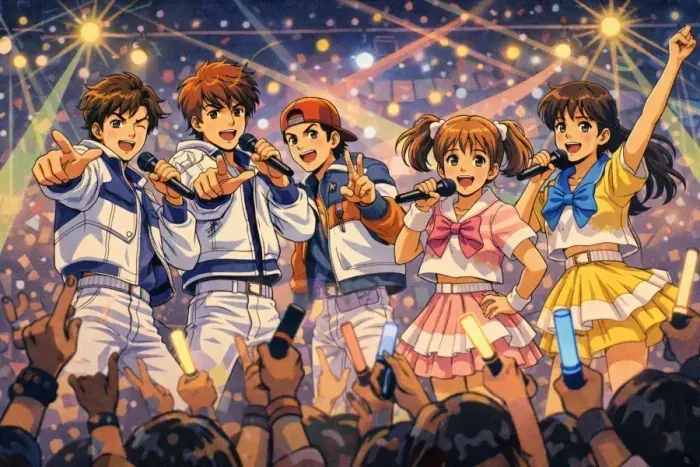
As agencies refined these systems during the mid and late 1990s, a first generation of idol groups entered the spotlight. Their songs, choreography, fan culture, and group-role logic established many of the conventions still associated with K-Pop today.
One of the earliest and most influential groups was H.O.T., created by SM Entertainment in 1996. The five-member group combined rap, melodic pop choruses, and energetic choreography. Their debut album included the song “Candy,” which quickly became a youth anthem. The bright melodies and synchronized dance routines captured the attention of teenagers across South Korea. H.O.T. also made visible how organized idol fandom could become. Fans formed clubs, wore coordinated colors at concerts, and turned support into a collective public practice rather than a private preference. That organized visibility became a template for later fandom culture.
Shortly after H.O.T.’s success, SM Entertainment introduced S.E.S., one of the first major female idol groups in Korean pop. Members Bada, Eugene, and Shoo brought strong vocal harmonies and polished stage performances to the emerging industry. Songs such as “I’m Your Girl” balanced dance rhythms with melodic pop arrangements. The group gave early K-Pop a durable model for the female idol act: coordinated, polished, youth-facing, but still built around recognizable vocal character.
Another influential group appeared through DSP Media with the debut of Fin.K.L in 1998. Their music often leaned toward emotional pop ballads, showing that idol groups could explore different musical moods. Tracks such as “Blue Rain” displayed strong vocal performances and built a loyal fan base. Fin.K.L later produced successful solo artists, including Lee Hyori, whose career would become a recognizable name in Korean pop culture. The group helped prove that idol pop did not have to choose between polish and emotional warmth.
Meanwhile the group Shinhwa, also formed by SM Entertainment, introduced a slightly different dynamic. Their music combined pop melodies with stronger dance and hip hop elements. Over time Shinhwa developed a reputation for creative independence. The members eventually left their original agency but continued performing together, demonstrating that idol groups could maintain long careers beyond their early promotional cycles.
These first-generation groups also shaped K-Pop’s visual grammar. Coordinated outfits, signature choreography, role-based member identities, and increasingly important music videos gave fans several points of attachment inside one act.
Their success proved that the agency model could reliably manufacture large pop events. Record sales rose, concerts grew, and fan communities became more organized. Just as important, companies started thinking regionally. Japan, China, and Southeast Asia were not distant bonuses anymore. They were realistic next markets.
First-generation idols also created the grammar of fan color, fan chants, and collective support. Fans were not only buying records. They were learning how to appear as a public body. Coordinated colors, banners, chants, and seating blocks made loyalty visible to artists, broadcasters, rival fandoms, and agencies. That visibility mattered because it turned fandom into evidence. A company could see demand, a television program could hear it, and a promoter could imagine selling a larger room.
The groups also taught companies how to manage member identity. H.O.T., S.E.S., Fin.K.L, and Shinhwa were not presented as interchangeable performers. Fans learned roles, personalities, vocal colors, and relationships inside the group. This internal map made the act easier to follow over time. It also encouraged fans to support both the whole group and individual members, a tension that would become central to later idol culture.
The first generation’s regional thinking was still cautious compared with later K-Pop, but it was decisive. Japan’s market looked attractive because of its size. China and Southeast Asia looked attractive because Korean television and pop were already gaining attention. Agencies began to understand that overseas success would require more than shipping Korean releases abroad. It would require language study, local media partnerships, adjusted promotion, and touring habits that treated other countries as serious markets.
This period also created the nostalgia layer that later K-Pop would draw on. As newer groups emerged, first-generation songs became references, covers, and proof of lineage. That mattered for domestic legitimacy. K-Pop could present itself as a fast-changing global industry while still pointing to an internal history of pioneers, senior artists, and inherited fan practices.
How the Idol System Works: Training, Production, Power
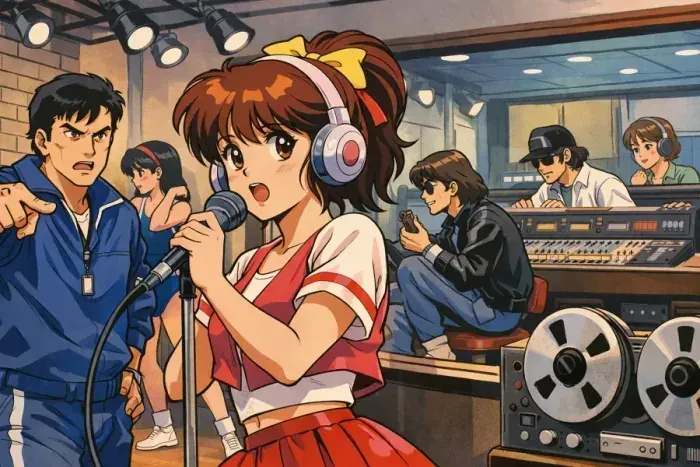
By the early 2000s, the idol business in East Asia had become a full industrial system. Japan and South Korea used different models, but both had learned how to discover, train, promote, and multiply performers on a large scale through close links between agencies, television, labels, and advertisers.
In Japan, talent agencies had already spent decades refining the idea of the pop idol as a multimedia personality who could move easily between music, television, film, and advertising. South Korea adopted some of these ideas while building a more centralized and intensive training model. Korean entertainment companies began preparing performers through years of dance, vocal, and language training before their official debut.
Behind the stage lights sat a dense network of producers, choreographers, stylists, media trainers, and marketers. The same system that produced remarkable coherence also produced remarkable pressure, so idol history is always a labor story as well as a music story.
The word “training” can sound neutral, but in idol history it covers several different kinds of preparation. There is technical training: singing in tune under choreography, developing stamina, learning mic control, and staying synchronized with other members. There is media training: answering questions, managing mistakes, and maintaining a public tone under pressure. There is cultural training: learning languages, etiquette, and the expectations of target markets. There is also emotional training, even when companies do not call it that: learning how to appear warm, confident, grateful, and controlled while living under intense scrutiny.
Japan and Korea organized those demands differently. Japan’s idol system often valued growth in public, allowing fans to watch a performer improve over time. South Korea’s system increasingly valued readiness at debut, asking trainees to reach a high level before the public saw them. Neither model was simple. Public growth could expose young performers to criticism while they were still developing; private training could hide pressure until the polished debut made the effort invisible.
Both systems also linked pop to advertising. Idols could sell records, but they could also sell drinks, cosmetics, phones, clothing, games, and television programs. That made their image economically valuable beyond music. A successful idol was not only a performer; they were a portable trust signal that brands, broadcasters, and platforms could use. This commercial range helped fund the system while increasing the pressure to protect an image at all times.
The labor story is not separate from the musical one. The sound of idol pop is shaped by rehearsed stamina, group discipline, camera awareness, and the need to move between formats. A chorus may be written for a dance break because television needs a visual peak. A bridge may spotlight a main vocalist because the group structure needs balance. A comeback may include variety content because fans need personality contact. The music is built around the labor system that delivers it.
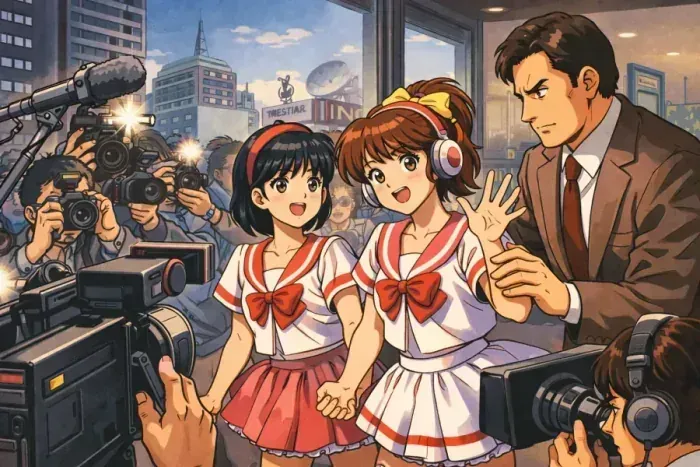
Japan's Idol Agencies and Media Networks
Japan’s idol industry developed gradually through television culture and large entertainment agencies. By the 1980s and 1990s, several companies knew how to guide performers through careers that combined records, acting, variety television, and advertising. They were not only managers. They were media organizers who could sequence a career across several platforms at once.
One of the most influential organizations in this environment was Johnny & Associates, founded by Johnny Kitagawa. The agency focused primarily on male idol groups and became known for its carefully coordinated training programs. Young performers entered the company as trainees and spent years learning singing, dancing, and stage presentation before joining official groups.
Johnny & Associates produced several successful acts, but a significant act was SMAP, which debuted in the early 1990s. The group eventually became a recognizable name in Japanese entertainment. Their influence extended far beyond music. Members hosted television programs, appeared in films, and became familiar figures in everyday media culture. Songs such as “Sekai ni Hitotsu Dake no Hana” reached enormous audiences and helped reinforce the group’s connection with the public.
Another important development arrived through Morning Musume, a female idol group created by producer Tsunku in 1997. The group emerged from a television talent program and quickly gained attention for its rotating membership system. New members could join while older members graduated, allowing the group to remain active and constantly evolving. Songs like “Love Machine” captured the playful energy of late-1990s J-Pop and became major hits. The format made continuity itself into entertainment.
Morning Musume’s structure later influenced many large idol collectives in Japan. The approach let fans attach themselves to individual members without leaving the larger group story. Concerts, fan events, and television appearances kept that attachment active and serial, which was exactly what the model needed.
The Japanese model relied heavily on mainstream media repetition. Variety shows shaped an idol’s public personality as much as records did. Humor, warmth, timing, and approachability sustained long-term attachment in a domestic market where television still had enormous power.
Japan’s large domestic market also allowed idols to achieve enormous success without focusing heavily on international expansion. Record sales remained high within the country, and major tours filled large venues across Japanese cities. While global audiences occasionally encountered J-Pop through anime soundtracks or internet communities, the industry itself remained primarily focused on its home audience.
Meanwhile in South Korea, entertainment companies were studying similar systems while developing a more globally focused approach. The Korean model would soon push the idea of idol training to an even more structured level.
Johnny & Associates also shows how agency power could extend beyond ordinary management. The company controlled access to talent, television appearances, stage training, and group formation in ways that shaped the broader Japanese entertainment field. Its model demonstrated how a talent agency could become an infrastructure company, not just a representative for performers. That concentration of influence later became a source of serious public scrutiny, but historically it helps explain why Japanese idol systems were so durable.
SMAP’s career is especially useful because it widened what a male idol group could do. The members were not limited to singing and dancing. They became television hosts, actors, comedians, advertising figures, and long-term companions to the viewing public. Their success made the group format feel less like a short youth product and more like a media platform that could age with audiences. That idea later influenced how agencies imagined longevity for idol groups.
Morning Musume offered a different lesson. Its rotating structure turned change into a feature instead of a problem. Graduation could create emotion, new members could create freshness, and the group name could survive beyond any single lineup. This was a powerful commercial solution because it allowed fan attachment to renew itself. It also made the audience more attentive to internal process: auditions, introductions, rankings, and departures became part of the story.
Japan’s system remained more domestic than Korea’s not because it lacked ambition, but because its home market could reward complexity. A group could build a long career through television, concerts, fan club releases, and advertising without needing to translate itself for the world. That domestic depth later made international access harder, because the system had not always built the habits of subtitling, licensing, and global platform release that overseas fans needed.
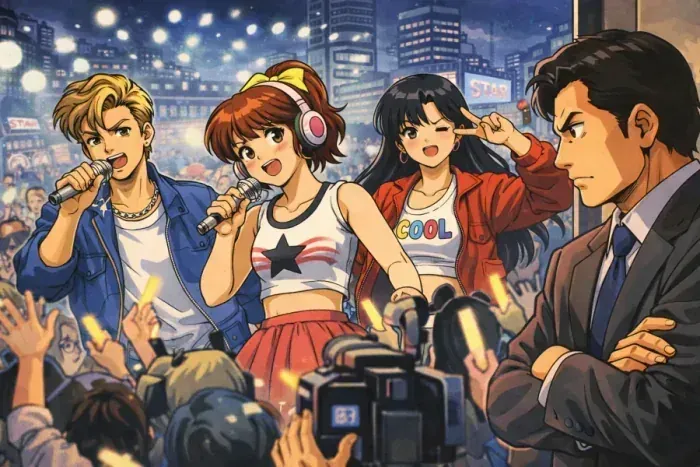
K-Pop Agencies as Cultural Powerhouses
While Japan’s idol system grew through television networks and large talent agencies, South Korea developed a more centralized corporate model. Korean entertainment companies increasingly managed training, songwriting, choreography, visual design, media strategy, and overseas promotion under one roof.
Three companies became especially influential in shaping this structure: SM Entertainment, YG Entertainment, and JYP Entertainment. Each developed its own identity while contributing to the larger framework that now defines the K-Pop industry.
SM Entertainment, founded by Lee Soo-man, played a central role in organizing the trainee system. The company believed that pop stars should be carefully prepared long before their debut. Young trainees studied singing, dance, language skills, and media communication. Some spent several years in preparation programs before appearing on stage for the first time. When new groups debuted, they often arrived with polished choreography, coordinated visual concepts, and carefully planned musical styles. The company treated debut less as a test and more as the launch of a finished product.
That system produced acts such as TVXQ, Super Junior, and Girls’ Generation. Each arrived with enough training and concept clarity to feel finished at debut, not provisional. SM also pushed aggressively into Japan and China, treating overseas growth as part of the model rather than an afterthought.
YG Entertainment, led by Yang Hyun-suk, followed a slightly different artistic direction. The company emphasized hip hop and rhythm-driven production. Artists such as BIGBANG and 2NE1 projected a more independent and edgy image compared with traditional idol groups. The music often incorporated rap verses and modern electronic beats, reflecting the global influence of hip hop culture.
JYP Entertainment, founded by Park Jin-young, developed another distinctive style. Park was deeply involved in songwriting and production, which allowed the company to shape a recognizable musical identity. Groups such as Wonder Girls, 2PM, and later TWICE combined catchy pop melodies with energetic choreography that translated well to international audiences. JYP’s output often felt slightly more performance-friendly and melody-centered, which helped the company compete without copying SM or YG directly.
These companies worked through high levels of coordination. Music videos, album concepts, fashion, teaser campaigns, and stage performances were planned as one narrative package. Fans were being asked to follow not just a song, but an unfolding world.
The model also required intense discipline from performers. Artists often trained for years and worked within tightly organized promotional schedules. The payoff was polish and consistency; the cost was narrower personal control and heavier pressure on young entertainers.
Despite these challenges, the Korean entertainment company model proved extremely effective. It produced artists capable of performing on global stages while maintaining strong connections with their fan communities. With that system fully established, Korean pop was ready to expand beyond its original market and become a broader cultural force.
The “Big Three” label can make SM, YG, and JYP sound more similar than they were. SM often emphasized concept systems, vocal polish, and carefully planned expansion into Japan and China. YG leaned into hip hop confidence, producer identity, and fewer but more event-like releases. JYP placed strong emphasis on performance warmth, memorable hooks, and the public personality of artists. These differences mattered because they gave fans distinct expectations about what each company represented.
The companies also professionalized choreography. Dance was no longer simply an afterthought added after recording. It became part of the song’s architecture. A chorus needed a key point move. A formation needed to reveal member hierarchy without looking static. A music video needed camera angles that made the choreography legible. A live stage needed transitions that worked under broadcast conditions. This is one reason K-Pop dance could become so exportable through covers and tutorials: it was designed to be recognized, repeated, and filmed.
Global expansion required a second layer of planning. Japanese versions, Chinese subunits, English hooks, overseas showcases, local television appearances, and regional fan meetings all demanded coordination. Agencies learned that export was not a single act. It was a calendar. A group might release in Korea, promote in Japan, record a language-specific single, appear on regional television, and return for a domestic comeback while fans online tried to follow all of it. The system rewarded companies that could manage several timelines at once.
That coordination also changed fan expectations. Supporters came to expect teaser photos, track lists, concept trailers, dance practices, behind-the-scenes clips, livestreams, subtitles, and merchandise drops as part of a normal comeback. The song became the center, but it was surrounded by a thick ring of supporting content. This is one of the clearest ways K-Pop anticipated the contemporary attention economy.
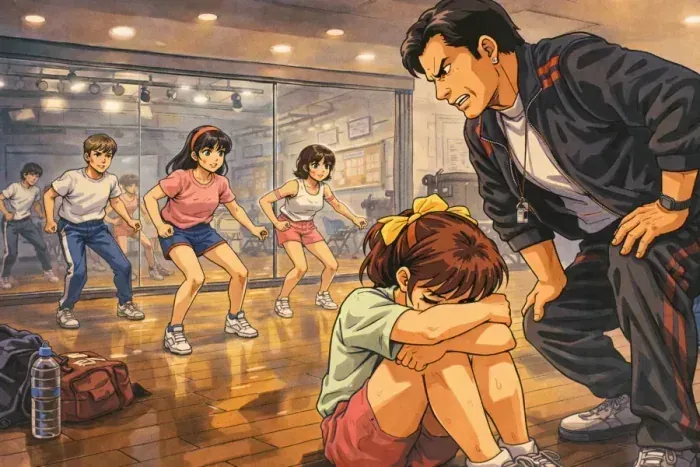
The Trainee System: Dreams and Pressure
Behind the polished performances of K-Pop and J-Pop lies a long period of preparation that most audiences rarely see. In South Korea especially, aspiring performers often enter entertainment companies as trainees while still in their early teenage years. The trainee system became a distinctive feature of the Korean pop industry. It is one reason K-Pop performances look so unusually synchronized and media-ready from the moment a group debuts.
Trainees usually enter through open auditions, scouting, or talent programs. Agencies look for singers, dancers, performers, and increasingly multilingual candidates from Korea and abroad. Once accepted, trainees begin a demanding schedule of vocal lessons, dance practice, media training, fitness work, and language study.
A typical training day can be long, repetitive, and highly monitored. Trainees rehearse choreography for hours, record demos, receive evaluations, and learn how to speak in interviews, variety settings, and international media contexts. The target is not only skill. It is reliability under public pressure. Companies are effectively training for the recording studio, the stage, the camera, and the interview at the same time.
Many trainees spend several years in this environment without knowing whether they will eventually debut. Agencies regularly evaluate their progress and adjust group lineups as new projects take shape. For some trainees the process ends without a public debut, while others eventually join new groups that represent the company’s next generation of artists.
The experience can be both formative and draining. Young performers often build strong friendships because they live inside the same closed routine for years. The same setting also keeps competition permanently visible. Everyone is improving at the same time, and not everyone will debut.
A number of artists who later became global stars passed through these training programs. Members of groups such as Girls’ Generation, EXO, and BTS all spent years refining their craft before stepping onto major stages. Their performances reflect the discipline developed during those early years. The smoothness audiences often read as effortless is usually the visible end of a long industrial process.
Criticism of the trainee system has also become more visible. Journalists, artists, and fans have raised concerns about workload, contractual imbalance, mental health, and the uncertainty built into years of unpaid or underpaid preparation. Some companies have made support systems more visible, but the structural pressure remains part of the model.
Despite these debates, the trainee model remains central to the K-Pop industry. It allows agencies to develop artists with a high level of coordination and stage professionalism. It also helps produce the tightly drilled teamwork seen in many idol groups, where members have often trained together long before their official debut.
The uncertainty of training is one of its defining features. A trainee may improve for years without knowing whether the company will form a group that fits their voice, height, dance style, language ability, or personality. Debut depends not only on talent, but on timing and lineup design. A strong singer might be passed over because the planned group already has a main vocalist. A good dancer might wait because the company wants a different concept. This makes training emotionally difficult in a way that is not always visible from the outside.
Evaluation systems intensify that uncertainty. Monthly or weekly assessments can measure singing, dance, weight, attitude, language progress, and camera readiness. The process can produce rapid improvement because feedback is constant. It can also make young performers feel that every part of the body and personality is under review. That is why many discussions of idol labor focus not only on hours worked, but on the psychological condition of being permanently evaluated.
The trainee system also affects group chemistry. Members who debut together may have spent years practicing, competing, and living near one another. That shared history can make a group unusually cohesive. Fans often sense this cohesion in small interactions: who covers for a mistake, who encourages another member, who knows how to fill silence in an interview. The closeness is partly personal, but it is also produced by long preparation inside the same institution.
International trainees add another layer. They may be learning Korean while adjusting to new food, school arrangements, rehearsal culture, and distance from family. Their presence can help a group reach broader audiences, but it also raises the emotional cost of training. The global idol pipeline depends on mobility that can be exciting and difficult at the same time.
For audiences, the trainee system creates a paradox. Fans admire the polish it produces, but many also worry about the costs. That tension has become part of K-Pop’s public conversation. The same rehearsed perfection that makes a stage thrilling can prompt questions about rest, contract fairness, mental health support, and the age at which young performers should enter such demanding systems.
Female Icons Who Changed the Game
Female performers have been central to East Asian pop from the start, not secondary to male-led industry history. Across kayokyoku, Cantopop, Mandopop, J-Pop, and K-Pop, women artists repeatedly reset the terms of style, emotional address, fashion, and public visibility.
In Japan during the late 1990s and early 2000s, several women became defining voices of J-Pop. Ayumi Hamasaki made self-narration part of mainstream pop scale. Her records combined dance production with lyrics about vulnerability, defiance, and self-fashioning, and her visual concepts pushed that message into magazines, television, and street style.
Namie Amuro mattered for a different reason. Her career pushed Japanese pop away from a narrower idol image toward a more contemporary dance-pop model centered on bodily control, fashion fluency, and adult self-possession. That change had real cultural force, especially for younger listeners in the 1990s.
South Korea also produced female artists who reshaped the regional map. BoA, who debuted at thirteen under SM Entertainment, exemplified how Korean pop could travel through skill, language adaptation, and market strategy rather than novelty alone. Songs such as “No.1” and “Valenti” made that logic audible. "a song that gifted me the most meaningful and happiest moment of my career so far."
Later girl groups expanded those possibilities further. Girls’ Generation, debuting in 2007, defined second-generation K-Pop through exact choreography, durable branding, and songs that were bright on the surface but industrially precise underneath. “Gee” worked not only because it was catchy, but because it crystallized how Korean agencies had learned to package music, image, and repetition together.
Female idols also carry some of the industry’s clearest contradictions. They are often asked to be glamorous but approachable, controlled but spontaneous, and highly polished without seeming remote. Many of the strongest careers in East Asian pop come from artists who learn how to work inside those expectations while quietly revising them.
Through voice, image, stagecraft, and public presence, these artists changed the direction of East Asian pop. They were not just stars inside the story. They set many of its terms.
Female performers also reveal how East Asian pop negotiates control and agency. The industry often placed women inside narrow visual codes, but many major artists used those codes strategically. A sweet image could become a way to command a mass audience before changing direction. A glamorous image could carry ambition. A dramatic image could make emotional intensity commercially powerful. The strongest careers rarely fit a single industry label for long.
Anita Mui is a strong example because she did not build influence through softness alone. Her stage image could be theatrical, androgynous, elegant, or confrontational depending on the performance. That flexibility challenged limited expectations of female stardom in Cantopop. It also made her a model for later performers who treated fashion, gesture, and vocal control as connected forms of authorship.
Teresa Teng shaped power differently. Her voice was gentle, but its reach was enormous. She showed that intimacy can be a regional force. A singer did not need to sound aggressive to transform listening habits across borders. Her influence moved through radio, cassette culture, family listening, karaoke, and memory, which made it durable in ways that chart data alone cannot fully capture.
BoA’s career then made female performance central to the export strategy of Korean pop. Her Japanese-market success was not a side achievement before boy groups took over the story. It was one of the clearest early demonstrations that language training, localization, choreography, and disciplined release planning could move a Korean artist into another major market. Later agencies learned from that example regardless of whether they were launching male or female acts.
The pressure on female idols remains distinctive. They often face harsher judgment over age, body shape, dating, fashion, facial expression, and public tone. At the same time, many of the artists who pushed East Asian pop forward were women working under exactly those constraints. Their careers show that influence does not always look like open freedom. Sometimes it appears in how a performer bends a restricted role until the industry has to widen around her.
The Korean Wave Breaks Borders
At the turn of the twenty-first century, Korean popular culture began moving beyond its domestic market with unusual speed. What started as regional growth in neighboring markets developed into Hallyu, or the Korean Wave: the spread of Korean music, drama, film, celebrity culture, and fashion through interconnected media channels.
Several forces drove that expansion at once. Entertainment companies had already built a repeatable production system. Broadcasters and distributors could export drama and music at scale. Fans had increasing access through cable, satellite, online video, and later social platforms. Songs, stars, soundtracks, and drama narratives reinforced each other. Korean culture was not traveling as isolated products. It was traveling as an ecosystem.
The earliest wave was strongest in East and Southeast Asia, where audiences were already used to cross-border pop circulation. Over time, the same system stretched further into the Americas, Europe, and the Middle East. Korean pop did not become global all at once, but this was the period when regional success started turning into durable international presence.
Official Korean cultural materials trace the term Hallyu to the popularity of Korean television dramas and pop music in Chinese-speaking communities from the mid-1990s, after South Korea and China established diplomatic relations in 1992. Korea.net’s account also places Japan’s major early Hallyu moment in 2003, when Winter Sonata aired on NHK. Those dates matter because they show that K-Pop’s later global rise grew from a broader media wave, not from music alone.
The first Hallyu phase was emotional before it was spectacular. Drama viewers met Korean actors, settings, family conflicts, fashion, food, and soundtrack ballads as a complete media environment. For many audiences, the Korean language became familiar first through melodrama, not idol rap. That familiarity lowered the barrier for later music exports because Korea already signaled a recognizable style of romance, aspiration, and screen polish.
Government policy formed another part of the background. South Korea’s cultural industries received increasing policy attention after the 1990s, when creative exports began to look economically and diplomatically valuable. It would be too simple to say the state created K-Pop. Agencies, artists, broadcasters, and fans did the practical work. But government support, cultural promotion, and export infrastructure helped make Korean popular culture easier to present abroad as a national strength.
The wave also moved unevenly. A drama could succeed in Japan while a pop group struggled there. A singer could become popular in Taiwan before gaining notice elsewhere. A group could build a Southeast Asian fan base years before American media paid attention. Hallyu was not one wave moving smoothly across a map. It was a series of overlapping currents, each shaped by local television schedules, language access, fan networks, and politics.
That unevenness keeps the history from turning into a triumphalist story. Korean culture did not simply conquer the world by quality alone. It traveled through specific channels: exported dramas, subtitled DVDs, cable television, music videos, fan translation, tourism, brand partnerships, and later streaming. Each channel created different kinds of audience. Some viewers became casual drama fans; some became soundtrack listeners; some became idol fans; some entered through fashion, food, or beauty culture. Hallyu grew because those entry points reinforced one another.
BoA and the Japanese Breakthrough
One of the earliest artists to prove the international potential of modern Korean pop was BoA. Debuting in 2000 while still a teenager, she brought the combination that agencies were aiming for: strong vocals, strong dance technique, disciplined presentation, and the ability to adapt across markets. She was not framed as an accidental crossover act. She was trained as a deliberate cross-market artist.
SM Entertainment recognized that Japan represented one of the largest music markets in the world. Entering that market successfully required more than simply translating Korean songs. BoA spent extensive time learning Japanese and adapting her performances to fit the expectations of Japanese audiences. Her early Japanese releases combined energetic dance-pop rhythms with polished production that matched contemporary J-Pop standards.
The effort paid off. Her Japanese album Listen to My Heart reached No. 1 on Oricon in 2002, a commercially and symbolically important result for the Korean music business. A Korean artist had not merely toured Japan or found a niche there. She had competed inside one of the world’s toughest domestic markets and won chart leadership. That changed how Korean agencies thought about export risk.
BoA continued building her international presence through subsequent releases such as
Valenti and Love & Honesty. Her music videos circulated widely across Asian television networks, and she performed in concerts throughout the region. Multilingual ability and stage discipline let her move between markets without sounding like a temporary guest. Localization in her case did not mean diluting a Korean act until it disappeared. It meant arriving in another market with enough fluency to compete seriously inside it.
Beyond her own success, BoA changed industry thinking. Overseas markets stopped looking like speculative prestige projects and started looking like realistic strategic targets. Agencies invested more heavily in language preparation, local partnerships, and market- specific releases because they had a working example in front of them.
BoA also influenced younger artists who were watching her career unfold. Many later K-Pop performers cited her achievements as proof that Korean music could travel beyond national borders. Her work built confidence within the industry at a moment when global recognition still seemed uncertain.
The Japanese breakthrough was demanding because Japan was not an empty export target. It was one of the world’s strongest music markets, with its own idol systems, television habits, retail networks, and fan expectations. A Korean singer entering that space had to compete with local stars on local terms. BoA’s success therefore carried more weight than a novelty appearance abroad. It showed that a Korean agency could prepare an artist to operate inside another country’s mainstream infrastructure.
Language was central to that achievement. Singing and speaking Japanese gave BoA access to television interviews, fan communication, and lyrical nuance that a simple translated release could not provide. This became a lesson for later K-Pop companies: localization was not only about changing words on a page. It required performance fluency, media fluency, and enough cultural ease for audiences to stop treating the artist as temporary.
Her age also shaped the symbolism. Debuting young made BoA appear like proof that long training could produce international readiness early. That reinforced the agency belief that talent should be developed before the public saw the full process. Later groups would apply the same logic collectively, preparing members for several markets before debut or soon after.
The BoA case also clarifies why Japan remained so important to K-Pop even after the U.S. market became more visible. Japan offered high-value sales, sophisticated touring infrastructure, and a nearby audience already familiar with idol culture. Success there could finance further ambition. For many Korean companies, Japan was not a stepping stone to the West. It was a central market in its own right.
The groundwork established by BoA soon supported the rise of other Korean acts seeking audiences abroad. As the decade progressed, new groups emerged with ambitions that extended well beyond the Korean peninsula. The Korean Wave was gathering strength, and the next generation of artists would carry it even further.

Second-Gen K-Pop Conquers Asia
During the mid-2000s, a new wave of Korean artists reached audiences across Asia with far more consistency than before. This second generation of K-Pop was the point where the agency model stopped looking experimental and started looking scalable.
TVXQ were crucial here. Their success in Japan showed that Korean groups could succeed there through patient localization, Japanese-language releases, and serious touring, not through one-off crossover publicity. The distinction turned Japan from an aspirational market into a workable operating model.
BIGBANG gave the era another center of gravity. Formed by YG in 2006, they were sold not only as performers but as artists with visible creative input. G-Dragon’s production role and the group’s fashion language made self-authored charisma part of idol branding. They helped widen the idea of what an idol group could look like, especially for audiences who wanted polish without total uniformity.
Around the same time, Girls’ Generation became one of the era’s defining female groups. “Gee” was not just a hit single. It was a regional media event, strong enough to travel through television, fan circulation, and performance repetition. Later songs such as “Genie” and “I Got a Boy” showed how flexible Korean group pop could become without losing mass appeal.
Wonder Girls pushed that logic outward again. “Nobody” moved easily across Asia and then into the U.S. market, where the group’s Jonas Brothers tour signaled that Korean agencies were no longer thinking only regionally, even when the first American attempts remained partial. This was proof of intent, not immediate domination.
Their success was reinforced by changing media infrastructure. Pan-Asian music television, forums, file sharing, early video platforms, and fan translation all reduced the delay between release and regional uptake.
Touring then converted mediated attention into physical presence. Performances in Japan, Thailand, Singapore, and China proved that K-Pop was no longer just exportable on screen. It could sell rooms and arenas. Once that happened, the regional business became more predictable for agencies, sponsors, and promoters alike.
By the end of the decade, the Korean Wave had firmly established itself as a major cultural movement in Asia. K-Pop artists were no longer limited to their domestic market. Their music, performances, and visual style were becoming part of a broader regional pop culture that continued growing in influence.
Second-generation K-Pop also standardized the comeback as a regional event. Teaser photos, concept changes, music video premieres, choreography stages, and fan translations created anticipation before the song reached every market. This made the release cycle feel synchronized across countries even when official distribution still varied. Fans in Thailand, Singapore, Japan, the Philippines, Indonesia, and the United States could follow the same clues and performances through online platforms, even if they encountered them through different languages.
TVXQ’s Japanese career showed the importance of patience. The group did not simply arrive as Korean stars and expect automatic success. They released Japanese material, appeared in Japanese media, toured, and built credibility through repetition. That approach contrasted with a one-off crossover mentality. It treated another market as a place where trust had to be earned over time.
Wonder Girls showed a different kind of ambition. Their English-language “Nobody” reached No. 76 on the Billboard Hot 100 in 2009, becoming an early Korean entry on the American singles chart. The breakthrough was limited compared with later BTS and BLACKPINK milestones, but it mattered because it showed Korean agencies were already testing American pop infrastructure before the platform environment fully favored them.
Girls’ Generation’s regional strength came from precision and recognizability. “Gee” worked because the hook, styling, choreography, and repetition were all immediate. The song’s brightness sometimes makes its industrial craft easy to miss. It is a tightly organized pop object, designed for television replay, fan chant, dance imitation, and group identity. That kind of clarity became one of second-generation K-Pop’s strongest exports.
BIGBANG added another lesson: idol groups could become more compelling when members were allowed visible creative identities. G-Dragon’s role as writer, producer, and fashion figure helped shift how audiences judged idol authorship. The group did not abandon the agency system, but it made self-styling and creative contribution part of its appeal. That opened a lane for later acts whose credibility depended on balancing polish with personal authorship.
K-Dramas, OSTs, and Cross-Media Promotion
Music alone did not carry the Korean Wave across Asia. Television and film were equally important, especially in the early 2000s, when Korean dramas began drawing large audiences in Japan, China, Thailand, the Philippines, and beyond. Those dramas made Korean popular culture emotionally legible before many viewers ever followed idol music closely.
Many viewers first encountered Korean songs through drama soundtracks. OST ballads and theme tracks attached emotion to specific scenes, which made songs memorable even for audiences who were not following the broader pop market. From there, some listeners moved from a single drama track to an artist’s full catalog. This is one reason OSTs mattered so much commercially. They were conversion tools, not side material.
Television and music also shared personnel. Actors released records, singers took screen roles, and both could benefit from the same publicity cycle. That crossover gave Korean entertainment unusual efficiency: one success in one medium could spill into another.
Rain is a clear example of this crossover system. His music career and screen presence fed each other, helping him become one of the first Korean performers with broad recognition across Asia. He was not unusual because he did two jobs. He was unusual because the system could turn both jobs into one larger public identity.
Music television programs also mattered because they normalized comeback culture. Weekly shows such as Music Bank, Inkigayo, and M Countdown turned each release into a visible sequence of performances, rankings, and fan response. They taught audiences to follow promotion as an unfolding campaign rather than a single release day.
The visual dimension of K-Pop continued expanding during this period. Music videos became increasingly elaborate, featuring cinematic storytelling, stylized fashion, and detailed choreography. These videos circulated widely on television networks across Asia and later found even larger audiences online.
This combination of music, television, and visual storytelling made Korean entertainment unusually portable across borders. A viewer could enter through a drama, stay for a soundtrack, and then follow the same performer into albums, variety programs, and live shows.
By linking those media forms tightly together, Korean companies built a cross-promotional machine that could carry attention from one format to the next with very little loss. That mattered before the streaming boom because it trained audiences to move through an entire entertainment ecosystem rather than a single hit.
Drama soundtracks were especially powerful because they attached songs to narrative timing. A ballad that played during a confession, separation, or reunion could become emotionally branded by the scene. Listeners did not remember only melody. They remembered the face, the camera angle, the season, and the feeling of the episode. That association made OST songs unusually durable across borders, even when viewers did not know the singer’s broader catalog.
This also helped non-idol singers. Korean pop history is often told through idol groups, but OST culture gave ballad vocalists, soloists, and drama-linked performers a major path to recognition. A strong soundtrack placement could reach audiences who were not watching weekly music shows or following dance groups. The Korean Wave therefore widened Korean music’s audience before K-Pop became the dominant international shorthand.
Variety television added a different kind of portability. A singer who appeared funny, humble, competitive, or emotionally open on variety programs could become legible to viewers outside the music itself. This mattered for stars like Rain because the performance identity was supported by personality content. Audiences could follow the dancer, the actor, the interview guest, and the celebrity persona as one continuous figure.
The cross-media system also trained agencies to think in story arcs. A comeback could be supported by a drama appearance, a soundtrack song, a variety guest spot, and later a tour. Each appearance gave another reason for media coverage and fan discussion. That logic became central to K-Pop’s later global rollout, where releases are surrounded by documentaries, livestreams, dance practices, challenge clips, and brand partnerships.
Korean entertainment became strong at reducing wasted attention. If a viewer cared about one part of the system, the industry offered a nearby next step: another episode, a song, a behind-the-scenes clip, a fan meeting, a product endorsement, or a concert. That pathway is one reason Hallyu felt larger than a genre. It behaved like an interconnected cultural environment.
PSY’s Gangnam Style: The Viral Moment
In 2012, Korean pop experienced a breakthrough that changed how an entire field is perceived from the outside. The trigger was PSY’s “Gangnam Style,” a song that was already a domestic sensation before it became a global internet event.
PSY had been active in the Korean music industry for many years before this global breakthrough. Known for his humorous stage presence and satirical lyrics, he often approached pop music with a sense of irony that differed from the polished image of many idol groups. “Gangnam Style” continued this tradition by gently mocking the flashy lifestyle associated with Seoul’s upscale Gangnam district.
The music video was central to the song’s success. Directed with a strong sense of visual humor, the video featured PSY dancing in unexpected locations such as parking garages, playgrounds, and public buses. His exaggerated dance move, often called the horse-riding dance, became instantly recognizable. Viewers around the world began imitating the choreography and sharing their own versions online.
Digital platforms made the song’s spread unusually fast. The video was uploaded to YouTube, where it quickly attracted millions of views. Within months it became the most watched video in the platform’s history at the time, and it later became the first YouTube video to reach one billion views. The viral success showed how internet culture could carry music across language barriers. Many listeners did not understand the Korean lyrics, yet the rhythm, humor, and choreography communicated easily without translation. It was also one of the first moments when platform metrics themselves became part of the story, not just the song.
International media moved quickly after that. PSY appeared on U.S. and European television, and the song reached No. 2 on the Billboard Hot 100. For many gatekeepers, this was the first time Korean pop stopped looking niche and started looking commercially unavoidable. The difference between viral novelty and industrial consequence was not obvious at first, but the industry response made it clear that people were paying attention beyond the joke.
The impact of “Gangnam Style” extended far beyond PSY himself. It introduced large numbers of global listeners to the existence of Korean pop and made labels, journalists, and promoters look again at artists who had already been building strong transnational fan bases. In that sense, PSY opened a door that other acts had already been pushing on for years.
The song also showed that listeners well outside Korea were open to pop music from different cultural backgrounds. Language was no longer an insurmountable barrier when rhythm, visuals, and internet sharing connected listeners across continents.
Afterward, the Korean music industry entered a new phase. Groups that had already developed large international fan bases were ready to move even further onto the global stage, supported by digital platforms and rapidly expanding online communities.
“Gangnam Style” also exposed a difference between virality and fandom. Many viewers shared the video because it was funny, visually clear, and easy to imitate. That did not automatically make them long-term K-Pop fans. But the scale of the moment changed what media companies, journalists, and audiences thought Korean-language pop could do online. It made the possibility of a non-English global hit feel less theoretical.
The song’s satire was also important. PSY was not presenting an idol fantasy of flawless coolness. He was mocking status performance in Gangnam, a Seoul district associated with wealth and aspiration. International audiences often missed the details of that satire, but the exaggeration still traveled. The video worked because it did not require full translation to understand that something was being inflated and laughed at.
YouTube’s own records became part of the story. Guinness World Records notes that the video reached one billion views on December 21, 2012, 159 days after upload. That number was not simply trivia. It turned platform measurement into public proof that a Korean pop song could dominate global attention at internet speed. After that, view counts became even more central to how K-Pop fans, agencies, and media described success.
The aftermath was more complex than a simple breakthrough narrative. PSY did not become the template for all later K-Pop exports. His humor, age, solo identity, and satirical tone were different from the idol group system that later expanded globally. Yet the door he opened was real. He changed the assumptions under which later groups were introduced to international media, making Korean pop easier to pitch as something already proven to travel.
J-Pop's Quiet Global Reach
As K-Pop expanded rapidly, Japan’s pop industry followed a different path. For decades, Japan had one of the world’s largest music markets, and that scale changed the incentives. Strong physical sales, loyal fan communities, and powerful domestic media made it normal to build major careers without treating overseas expansion as urgent. The industry was not turning away from the world so much as operating under less pressure to chase it.
The story of Japanese pop in the twenty-first century is not one of simple isolation. The music kept evolving through idol reinvention, electronic production, anime tie-ins, game music, and online creator culture. What changed more slowly was not creativity, but international access.
More recently, J-Pop has found new listeners outside Japan through streaming, online communities, anime, and gaming culture. That newer reach makes more sense once Japan’s domestic market power is taken seriously rather than treated as a side note.
The contrast with K-Pop is partly a contrast of incentives. South Korean companies had strong reasons to build outward because the domestic market could not support unlimited growth. Japanese companies could often earn enough at home to delay the expensive work of global release. That included negotiating rights, clearing older catalogs for streaming, subtitling video content, building overseas social media teams, and planning tours outside the domestic circuit.
This does not mean Japanese pop lacked international fans. It means many fans had to work harder. For years, overseas listeners relied on imported CDs, fan forums, anime soundtracks, video game themes, unofficial uploads, specialty shops, and translated guides. The audience existed before the industry fully served it. When streaming access improved, some of that older demand became visible all at once.
Japan’s quieter global reach also moved through objects and franchises rather than always through pop stars. Anime series, games, films, fashion brands, and internet subcultures carried songs across borders. A listener might know a theme from Kingdom Hearts,
Demon Slayer, or a Makoto Shinkai film before knowing the artist’s full place in J-Pop. That route is different from K-Pop’s group-centered expansion, but it can be extremely powerful because the song is tied to a beloved world.
The newer streaming generation has started to change that balance. When catalogs are available, subtitles are common, and artists tour internationally, overseas listeners can follow Japanese pop in present tense. The shift is not simply that more people hear J-Pop. It is that they can hear it as part of an ongoing career rather than as a fragmented set of theme songs, nostalgia finds, or isolated viral tracks.
Why Japan’s Music Market Stayed Strong
Japan’s music industry occupies a unique position within the global pop landscape. For many years it has ranked among the largest music markets in the world, supported by strong domestic consumption and a long tradition of physical media sales. According to IFPI’s 2025 global report, Japan remained the world’s second-largest recorded music market in 2024. While digital streaming has become increasingly important, compact discs and collectible editions remained popular in Japan far longer than in many other countries.
This market structure gave Japanese artists unusual stability. Labels could fund large production budgets, elaborate stage shows, and long promotional cycles because domestic audiences consistently bought new releases. Japan did not need an export-first strategy in the way Korea eventually did. A hit at home could already support the kind of infrastructure that other markets needed international growth to finance.
The same strength also slowed international expansion. If success at home was already massive, the incentive to untangle licensing, distribution, subtitles, and marketing for overseas audiences was weaker. That helps explain why J-Pop often looked less visible than K-Pop in the early streaming era even though its domestic industry was extremely strong. Access was often the problem, not lack of music or lack of audience potential.
Despite these barriers, some artists still built strong international followings. Hikaru Utada is a good example: the Kingdom Hearts themes gave many non-Japanese listeners a first sustained connection to her voice and songwriting.
Meanwhile the long legacy of Japanese pop also continued influencing musicians around the world. Producers and DJs exploring older recordings began rediscovering the polished sound of city pop from the 1980s. Songs by artists such as Tatsuro Yamashita and Mariya Takeuchi circulated widely through online music communities, bringing renewed attention to recordings that had once been known mainly within Japan.
Concert tours within the country remained a central part of the industry. Large venues in cities like Tokyo and Osaka regularly hosted multi-night performances by popular artists. Fans often traveled long distances to attend these events, creating a dense sense of community around live music experiences.
Over time digital platforms opened new pathways for listeners outside Japan. Streaming services made catalogs available that had previously been blocked by licensing gaps or simply hard to find. As access improved, international audiences could hear more of J-Pop’s range instead of encountering it only through anime hits or isolated crossover moments.
IFPI’s 2025 Global Music Report is useful because it confirms how unusual Japan remains inside the global music economy. In 2024, Japan was still the world’s second-largest recorded music market, and it remained strongly associated with physical formats compared with many other major markets. That fact helps explain both J-Pop’s domestic strength and its slower international platform strategy.
Physical media in Japan also carried social functions that streaming does not replace exactly. CDs could include limited artwork, DVDs, photo books, event tickets, handshake or fan-meeting access, serial numbers, and collectible editions. Buying was not only a way to hear a song. It could be a way to participate in a fan economy. This made physical sales more resilient because the object carried access, identity, and ritual.
Retail culture supported that resilience. Record shops, specialty displays, release-day events, and chart visibility kept music physically present in city life. For idol fans, the act of buying editions could also become a coordinated form of support. For rock, anime, and singer-songwriter fans, physical editions offered artwork and packaging that felt connected to the work’s world. Streaming changed listening, but it did not instantly replace those habits.
The same structure created friction abroad. A fan outside Japan might see social media discussion of a release but find that the music video was region-locked, the CD was expensive to import, the official site was not localized, or the artist’s television appearances were unavailable. Those barriers made J-Pop look less globally active than it was. The problem was often access architecture, not audience absence.
As labels changed licensing strategies, the international picture became clearer. Older city pop, anime-linked artists, Vocaloid-influenced songwriters, and current J-Pop acts all found listeners who had been waiting for easier access. The result is a more accurate view of Japan’s pop ecosystem: not a sealed domestic world, but a strong domestic world whose global doors opened unevenly.
AKB48: Reinventing the Idol Model
In the mid-2000s, a new concept reshaped Japan’s idol landscape. Producer Yasushi Akimoto introduced AKB48, named after Tokyo’s Akihabara district, and built the group around repeat access. Instead of keeping idols distant, the model encouraged fans to watch members develop in real time. The key innovation was not simply size. It was serial proximity.
AKB48 debuted in 2005 with a structure that was unusual even by Japanese idol standards. The group included a large number of members divided into teams that rotated performances at the group’s theater. Fans could attend regular shows and watch the singers perform in an intimate setting, sometimes several times a week. The arrangement created a sense of familiarity that felt very different from traditional pop concerts in large arenas.
The system pushed fan participation even further through voting events that affected the group’s internal hierarchy. The annual general election became the best-known example. Fans bought records to obtain ballots, which turned chart performance, fan labor, and commercial strategy into one tightly connected mechanism. AKB48 made visible how physical sales could be driven not only by music consumption, but by structured participation.
Musically, AKB48 favored direct, easy-to-repeat pop built for participation rather than distance. Songs such as “Heavy Rotation” and “Koisuru Fortune Cookie” worked well because they were simple enough to circulate through television, fan events, school culture, and mass singalong recognition.
Several members later built successful solo careers or transitioned into acting and television work. Atsuko Maeda, one of the earliest and most prominent members, became a widely recognized figure in Japanese entertainment. Her trajectory showed that the AKB48 system was not only about the collective. It could also produce breakout personalities inside the larger machine.
AKB48’s influence extended far beyond Japan. Sister groups were created in cities across Asia, including JKT48 in Jakarta and BNK48 in Bangkok. These international projects adapted the original concept while incorporating local languages and cultural references. Their expansion showed that the participatory idol model could travel across borders, provided it was localized rather than copied mechanically.
AKB48 also illustrated the strength of Japan’s domestic fan culture. Dedicated supporters followed the group’s activities through concerts, television programs, and fan events. This close relationship between artists and audiences reinforced the stability of the Japanese pop market even as global streaming platforms began reshaping the international music industry.
While the system attracted enormous popularity, it also sparked debates about the pressures placed on performers and the commercial strategies used within idol culture. These discussions reflected broader conversations about the balance between entertainment, creativity, and fan engagement in modern pop music.
AKB48’s theater model changed the unit of idol consumption. Instead of waiting months for a large concert or television appearance, fans could attend smaller, repeated performances and watch members develop over time. This created a sense of continuity that was closer to following a sports team or serialized show than following a conventional recording act. The group was always in motion.
The election system made that motion measurable. Fans were not only expressing affection; they were affecting hierarchy. That gave support a concrete outcome, which increased the incentive to buy, organize, and campaign. Oricon’s reporting on AKB48’s dominance of the 2010 year-end singles chart shows how powerful that mechanism became. The chart was not only measuring song popularity. It was measuring a highly structured participation system.
The sister-group model showed that the concept could travel when localized. JKT48 and BNK48 did not simply export Japanese lyrics unchanged. They adapted language, member presentation, local media relations, and fan routines while keeping the underlying idea of regular access and participatory attachment. This was a different kind of regional expansion from K-Pop’s trainee-company export model. It exported a format more than a single sound.
AKB48 also influenced how observers discuss fan labor. Buying multiple editions, voting, attending events, and tracking member rankings can be experienced by fans as meaningful participation. Critics may see the same behavior as commercial extraction. Both readings can be true at once. The system created real community and real pressure, real attachment and real monetization. That tension remains central to idol culture across East Asia.
A second connection between Japanese pop and global audiences was developing through an unexpected cultural bridge: the growing international popularity of anime and film soundtracks.
How Anime Brought J-Pop to the World
While many Japanese pop artists built mainly for the domestic market, another pathway quietly connected J-Pop with international listeners: anime. For many viewers outside Japan, the first Japanese song they learned by heart was an opening or ending theme rather than a conventional radio hit.
Anime songs travel with the shows that use them. Once a series moves through television, streaming, clips, memes, or fan edits, its music moves too. Viewers who become attached to a story often go looking for the artist behind the theme, which has made anime one of J-Pop’s most effective export channels. The song inherits the narrative charge of the show, and the show inherits emotional reinforcement from the song.
One prominent example is LiSA, a singer whose powerful voice has become closely associated with several popular anime productions. Her song “Gurenge,” used as the opening theme for the series Demon Slayer, reached listeners around the world. The track combines energetic rock instrumentation with dramatic vocal delivery, matching the intensity of the series’ action-driven narrative. Its success shows how a well-placed theme song can pull a Japanese artist into wider international attention.
Another important connection between pop music and animation appeared through the band RADWIMPS. The group collaborated with filmmaker Makoto Shinkai on the soundtrack for the animated film Your Name. Songs such as “Zenzenzense” blended emotional lyrics with dynamic rock arrangements that complemented the film’s storytelling. When the movie became a global hit, the soundtrack reached audiences who might never have encountered the band otherwise. A film soundtrack functioning as a major international entry point into a Japanese rock-pop catalog happens rarely, and this was one of those cases.
At the same time, internet-native music scenes created another route to international discovery. Platforms such as Nico Nico Douga and later YouTube helped songs spread outside traditional label structures. Some major artists moved through that pathway. Kenshi Yonezu, for example, first gained attention online under the name Hachi in the Vocaloid scene before becoming a significant Japanese singer-songwriter of his generation. The route bypassed older television-first promotion and proved that online-native authorship could scale into the mainstream.
Kenshi Yonezu’s later mainstream success shows how porous those worlds have become. He moved from online creation to mass popularity while writing for film, television, and anime, which makes his career a useful example of how internet culture and mainstream Japanese pop now overlap.
Anime-related music works particularly well across cultural boundaries because the emotional themes of these stories often resonate universally. Adventure, friendship, personal growth, and resilience are common elements in many series. When a song captures these emotions effectively, listeners respond even if they do not fully understand the lyrics.
The relationship between J-Pop and anime became one of Japan’s most effective export circuits. Music introduces viewers to artists, and successful series send those viewers back toward broader catalogs. It is a reminder that East Asian pop spread not only through stars, but through media networks that kept redirecting attention. In Japan’s case, cross-media circulation often did the global work that agencies were slower to do.
Anime themes work differently from ordinary singles because they are repeated inside a ritual. Viewers hear the opening or ending every episode, often while seeing the same images, character poses, and emotional cues. The song becomes a gateway into the series’ world. When fans skip the opening, cover it, remix it, or share it, they are still responding to that repeated audiovisual memory.
LiSA’s “Gurenge” is a clear modern example. Its connection to Demon Slayer gave the song a huge narrative frame, but the track also had to stand on its own as a rock-pop single with a strong vocal line and immediate chorus. The anime did not replace musical craft. It amplified it. The song’s success shows how current Japanese pop can move globally through a media property while still becoming associated with a specific performer.
RADWIMPS’ work with Makoto Shinkai shows another model. The songs for Your Name were not simply promotional add-ons. They were woven into the film’s emotional pacing. For international viewers, that meant the band entered through cinema feeling rather than through a conventional chart campaign. A soundtrack could become a first encounter with Japanese rock-pop because the film had already created trust.
Kenshi Yonezu’s path adds the internet-native layer. Vocaloid culture trained listeners to follow producers, characters, covers, and versions rather than only traditional singer-centered releases. That culture made authorship more flexible. A song could begin with synthetic voice software, circulate through covers, and later become part of a major artist’s live catalog. Yonezu’s movement from Hachi to mainstream J-Pop demonstrates how online subculture can become central without losing every trace of its earlier form.
For overseas audiences, anime also solved a context problem. A listener may not know Japanese chart history, but they know the emotional stakes of the story they just watched. That gives the song an immediate frame. The music does not arrive as a foreign object needing explanation. It arrives as part of a narrative the listener already cares about.
Anime, Games, and Internet-Native J-Pop
Anime was not the only cross-media route that expanded Japanese pop abroad. Video games also mattered, especially when theme songs became inseparable from the fictional worlds that introduced them. In those cases, a player might become attached to a singer before ever thinking of them as part of J-Pop as a category.
Internet-native forms of Japanese pop also changed how artists emerged. Some musicians built their first audience through cover culture, Vocaloid production, or direct uploads to video platforms rather than through traditional television promotion. This pathway encouraged a different relationship with listeners. Songs could circulate quickly, inspire remixes and fan performances, and build momentum before major labels fully entered the picture. The audience could encounter the work before the artist had been fully packaged.
Together, anime, games, and internet-born music communities created a wider ecosystem for J-Pop than the domestic chart narrative alone suggests. They gave Japanese artists several routes into international listening culture, especially among younger audiences who moved easily between music, animation, gaming, and online fandom.
Games are especially important because they create long-duration attachment. A player may spend dozens of hours inside a world before hearing a theme song at a key emotional moment. When that song returns later, it carries the memory of play, difficulty, story, and character identification. This is why game themes can become powerful international introductions to Japanese artists even when they were not promoted like conventional pop singles.
Hikaru Utada’s work for Kingdom Hearts shows this clearly. For many listeners outside Japan, songs such as “Simple and Clean” and later themes were not discovered through Japanese radio or television. They were tied to a game franchise that already crossed borders. The result was a durable overseas attachment to Utada’s voice, sometimes formed before listeners had any clear category called J-Pop.
Internet-native communities also changed the direction of influence. In older systems, labels introduced artists and audiences responded. In Vocaloid, cover, and upload culture, audiences often found songs before the industry fully packaged the creator. Listeners compared versions, followed producers, made covers, and circulated favorites through recommendation networks. This made fandom feel more participatory and less dependent on official broadcast schedules. "the timings of the appearances of VOCALOID and Niconico were miraculously aligned."
The boundary between amateur and professional became more porous. A creator could begin with uploads, build an audience, receive covers from other users, and then move into commercial work for anime, games, advertising, or major labels. That route gave Japanese pop a source of new writers and singers who were already fluent in online circulation. It also made the mainstream more stylistically flexible because some of its strongest writers had been trained by platform feedback rather than only by label A&R.
Japan's Streaming Generation Goes Global
By the early 2020s, a new generation of Japanese artists showed that global reach no longer depended only on old-catalog rediscovery. Current releases could travel internationally in real time. YOASOBI’s “Idol” and Creepy Nuts’ “Bling-Bang-Bang-Born” showed that Japanese-language songs could now sustain international attention while they were still culturally current, not decades later. For years, international attention to Japanese pop often moved through older classics, anime memories, or specialist fandom. In this newer phase, current singles could circulate globally while they were still at the center of domestic conversation. "There weren’t many opportunities for Japanese music to go out into the world until now."
Live touring began reflecting the same shift. Ado’s world tours showed that digital attention could turn into substantial ticket demand outside Japan. By 2025, Oricon reported that her second world tour covered 33 cities and drew more than 500,000 people. That scale suggested that newer Japanese pop was no longer traveling only through niche fan communities. It was reaching a broader international concert audience. Touring is an important test here because it measures commitment rather than curiosity. A viral clip can travel quickly, but ticket demand shows that listeners are willing to leave the screen and build time around an artist.
This did not mean Japan copied South Korea’s export model. The route remained more decentralized, with anime, games, streaming, creator culture, and online communities all feeding demand differently. Even so, the change was real. New J-Pop could now arrive abroad as present-tense pop rather than only as a cult favorite or nostalgic rediscovery. That makes the current period historically different from the earlier city-pop revival. The music is not just being rediscovered. It is being followed live.
YOASOBI’s rise is especially useful because it links literary source material, online platforms, anime, and streaming into one model. The duo’s songs often begin from written stories, which gives the project an unusually explicit narrative engine. “Yoru ni Kakeru” moved from online circulation into mainstream dominance, and Oricon’s Reiwa-era streaming reporting later identified it as a defining song of the period. This is a very different route from the CD-era J-Pop superstar model.
“Idol” intensified that pattern through Oshi no Ko. The song worked as an anime opening, a commentary on idol image, and a streaming hit at the same time. Its global spread depended on the series, the speed of fan circulation, and YOASOBI’s existing digital audience. That kind of success shows how modern Japanese pop can build scale without choosing between music fandom and anime fandom. The two can now compound.
Creepy Nuts’ “Bling-Bang-Bang-Born” added another angle by showing how a Japanese hip hop track tied to anime could become an international meme and performance reference. The song’s rhythm, chant-like hook, and danceable phrasing made it easy to clip and repeat. That matters because short-form video rewards moments that can be recognized quickly. Japanese pop, like K-Pop, now has to think about how a song lives in fragments as well as in full.
Ado’s touring scale then proves that online attention can become physical demand. Oricon reported that her 2025 world tour covered 33 cities and expected more than 500,000 attendees, with sold-out arena dates in several major markets. This is not the same as a viral theme song. It shows that a current Japanese artist can convert international listening into a large live audience while maintaining a distinct vocal and visual identity.
The next challenge for J-Pop is consistency of access. One global hit or tour does not guarantee a fully international industry. Catalog availability, subtitles, ticketing, press access, social media strategy, and rights clearance still matter. But the direction has changed. Overseas fans increasingly expect to follow Japanese artists in real time, and artists increasingly have proof that this audience can support more than isolated curiosity.
This shift also changes how Japanese artists can imagine career geography. An artist no longer has to choose between being domestic and being global in the old sense. A release can be primarily Japanese in language, promotion, and cultural reference while still finding listeners abroad through anime, streaming, festival clips, or fan translation. That gives artists more options than the older crossover model, where international success often meant recording in English or being reframed for Western curiosity.
The new model is still uneven. Some artists have strong overseas streaming but limited tour infrastructure. Some have anime recognition but weaker identity outside the theme song. Some have vocal or visual concepts that travel well online but need better press support to be understood. International audiences can discover music quickly; keeping them requires catalog depth, communication, and a sense that the artist’s career is open to them.
For J-Pop, that may be the most important change of the 2020s. The question is no longer whether Japanese music can reach global listeners. It clearly can. The question is how often that reach becomes sustained relationship rather than a single viral encounter.
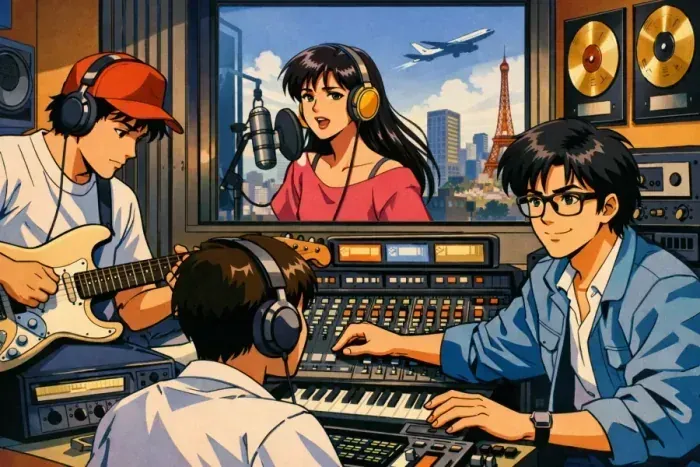
The Hidden Architects Behind the Hits
Behind every successful pop act sits a network of writers, arrangers, choreographers, and producers whose work often determines what an era sounds like. In East Asian pop, their importance is especially visible because songs are so tightly linked to visual concept, member roles, and performance design. A producer in this environment is often deciding not just how a track sounds, but how it will move, how it will be distributed across members, and what kind of visual world it can support.
Both J-Pop and K-Pop rely on collaborative studio environments where composers, lyricists, and producers shape songs long before they reach the stage. Entertainment companies often pull together teams from different countries, which lets ideas move quickly between local industry needs and wider global pop trends. Especially in K-Pop, the final version of a song may be the result of several rounds of structural rewriting rather than a single writer’s finished statement.
Understanding the history of the genre therefore requires attention not only to the artists who perform the songs but also to the people who decide how those songs are built. Hooks, drops, textures, vocal distribution, and even the emotional pacing of a comeback are often settled long before the artists step onstage.
In idol pop, the producer’s job often begins with a concept problem. What should this act mean at this moment? A first comeback after debut may need to clarify identity. A mature release may need to show growth without alienating younger fans. A Japanese single may need to fit local expectations while preserving a Korean group’s brand. A festival track may need impact points that work in a huge outdoor space. These questions shape musical decisions before anyone discusses chord progressions.
Vocal distribution is another hidden craft. A song for a group must decide who opens, who anchors the chorus, who carries rap sections, who handles ad-libs, and where weaker or less experienced members can still appear meaningfully. Good distribution makes a group feel balanced. Poor distribution can create fan conflict or make a performance feel uneven. This is one reason K-Pop listeners often discuss line distribution as part of musical analysis.
Choreographers also shape how songs are heard. A point move can make a hook memorable; a formation change can make a pre-chorus feel like acceleration; a pause can turn a beat drop into visual impact. Dance is not decoration after the fact. It can determine which parts of the track become iconic. Many K-Pop songs are remembered as much through a hand gesture or formation as through a lyric.
Japanese pop has its own hidden architects. Arrangers, studio musicians, anime music supervisors, Vocaloid producers, and television tie-in teams often determine whether a song will fit its intended media route. A track written for an anime opening must survive a ninety-second edit and a full-length release. A city pop record needed session players and engineers who could make polish feel natural. A J-Pop idol single needed composers who understood repetition, fan participation, and television pacing.
Once these roles become visible, East Asian pop sounds less like manufactured simplicity and more like dense coordination. Some songs are highly commercial, but commercial does not mean careless. The best records in this history are often the ones where many kinds of labor are aligned: melody, sound design, choreography, image, media placement, and fan use.

Teddy Park: Architect of the YG Sound
Teddy Park shows how a producer became inseparable from a label’s public identity. His work did not just supply YG Entertainment with hits. It gave the company a repeatable sonic posture: hard-edged, spacious, swaggering, and built around impact.
Teddy first gained recognition as a member of the hip hop group 1TYM, which debuted in the late 1990s. The group’s music reflected strong hip hop influences, a style that was still developing within Korean pop at the time. After several successful releases, Teddy gradually shifted his focus toward production and songwriting within YG Entertainment. His production style did not begin inside the cleaner, brighter strain of idol pop. It came through rap, rhythm, and attitude first.
With BIGBANG, Teddy helped define what YG could sound like at full scale. Songs such as “Lies,” “Fantastic Baby,” and “Bang Bang Bang” were built less around smooth continuity than around impact points: chantable hooks, sudden drops, heavy low end, and sections that felt engineered for crowd response. That was part of why the music worked so well in arenas and festivals. These tracks do not simply build toward a chorus. They build toward moments that can dominate a live room, a teaser clip, or a festival field.
His BLACKPINK productions pushed that method even further. Tracks such as “Ddu-Du Ddu-Du” and “Kill This Love” use tension as structure: sparse verses, escalating pre-choruses, percussive release, and hooks that hit with branding-level clarity. The songs are not trying to sound organic. They are trying to sound unmistakable within seconds. In a platform economy, that kind of immediate identity has enormous strategic value.
Part of Teddy’s importance is that he rarely treats genre as a fixed category. Hip hop, EDM, trap, pop-rap, and anthem-style chorus writing are used as interchangeable tools, then rebuilt around a YG image of confidence and confrontation. Even very different YG releases often feel related at the level of attitude.
He also works in a system where the song is expected to hold up visually. Choreography, styling, teaser rollout, and stage design all depend on whether the track leaves enough space for gesture, pause, and spectacle. In that sense, Teddy’s records are not just audio products. They are performance frameworks designed to survive several formats at once: music video, stage performance, festival excerpt, dance challenge, and fashion image.
Teddy Park matters historically because he shows how a K-Pop producer can function almost like an in-house auteur inside an idol company, shaping not just songs but the emotional and visual grammar of a whole label.
The word “auteur” needs care here because K-Pop is collaborative. Teddy Park does not erase the work of performers, choreographers, stylists, video directors, engineers, and other writers. His importance is that his production choices create a recognizable frame inside which those collaborators work. A sparse verse leaves space for fashion and attitude. A chant hook gives a crowd something to shout. A dramatic drop creates a stage moment that can be repeated in clips. The production becomes a skeleton for several media forms at once.
YG’s release strategy made that identity even stronger. Compared with companies that released more frequently, YG often treated comebacks as larger events. That placed more pressure on each single to feel unmistakable quickly. Teddy’s style answered that pressure through high-contrast structures: quiet confidence before explosion, empty space before impact, and hooks that could become slogans. The songs often leave room for silence, pose, and camera movement, which is why they work so well as visual pop.
BLACKPINK’s catalog shows both the strength and risk of this method. A consistent sonic identity makes the group immediately recognizable, especially for casual global listeners. It also invites criticism when listeners feel formulas repeating. That debate is part of Teddy’s historical significance. His work demonstrates how a producer can build a global brand through sound, and how difficult it becomes to evolve once that brand is strongly associated with a particular kind of impact.
The YG sound also reveals K-Pop’s relationship to hip hop. It borrows from rap, trap, club music, and Black pop performance languages, often through a Korean agency framework and global fashion imagery. That gives the music power and also raises questions about credit, context, and cultural borrowing. Teddy’s productions sit directly inside that debate because they show how global pop styles can be reorganized into a K-Pop brand with enormous reach.

Western Producers in the K-Pop Machine
As K-Pop expanded beyond Asia, its production process also became more international. Companies built songwriting networks that linked Seoul to Stockholm, Los Angeles, London, and other pop centers. The goal was speed, hook density, and concept fit, not prestige.
Many Western composers were initially drawn to K-Pop because of its openness to experimentation. Korean entertainment companies often seek songs that combine strong melodies with unusual structural changes. A track might shift between rap sections, vocal harmonies, and electronic dance breaks within a single composition. For producers accustomed to the more predictable structure of Western radio pop, this flexibility offered an exciting creative environment. K-Pop gave writers room to keep dense ideas that might otherwise be flattened in a radio-first market.
One influential figure in the broader pop world is Max Martin, the Swedish songwriter and producer known for shaping many global pop hits. While Martin himself has worked primarily with Western artists, his influence can be heard indirectly in K-Pop through the production techniques and songwriting approaches that many composers have adopted. Scandinavian songwriting teams, in particular, became regular contributors. They brought strong topline writing, tight chorus construction, and the kind of polished melodic lift that many Korean agencies could then reshape for specific groups.
Another contributor to this international exchange is the American producer Dem Jointz, who has worked with artists under SM Entertainment. His work on songs such as “Kick It” by NCT 127 shows the broader pattern clearly: Korean agencies do not simply import a finished Western pop track. They rebuild it around a group’s concept, member voices, performance plan, and visual identity. The song has to make sense not only on headphones, but inside a member lineup, a choreography script, and a teaser narrative.
The process itself is unusually modular. A team of composers may begin with a demo, then Korean lyricists adapt the text, vocal directors redistribute lines across members, and arrangers adjust the structure to fit choreography, concept films, and live staging. By the time a song reaches the public, it has often passed through many hands with one goal: make it feel custom-built for that act. This is one reason K-Pop can sound highly engineered without necessarily sounding generic.
Because that process involves contributors from different countries, communication and coordination are essential. Entertainment companies often organize international songwriting camps where producers, topliners, lyricists, and A&R teams develop material together. Those camps are not just creative retreats. They are selection systems designed to generate many options and then match the right song to the right comeback.
The outcome is a highly hybrid musical style. K-Pop songs frequently combine influences from hip hop, electronic dance music, R&B, and contemporary pop, but the key point is not simple mixture. It is recombination under tight concept control.
That concept control can be heard in how K-Pop handles contrast. A song may begin with a minimal bass line, move into a melodic pre-chorus, switch to a chant hook, then open into a dance break or bridge. On paper, that structure can look unstable. In performance, it often works because each section has a visual task. The rap section may establish attitude, the pre-chorus may create lift, the drop may create choreography impact, and the bridge may create vocal release. The arrangement is built for a moving camera as much as for headphones.
International writers who understand this system are not simply selling songs into Korea. They are learning a different set of constraints. A demo that might be too dense for Western radio can become useful if it gives a group several performance zones. A hook that feels unusual can work if a point move makes it memorable. A sudden switch can feel like a concept change rather than a mistake if the music video, styling, and staging support it.
This is one reason K-Pop remains attractive to producers. It can preserve ambitious structures that other markets might simplify. The final product may be commercial, but the route to that product often involves unusual formal decisions. In the best cases, global collaboration does not flatten the song. It gives the agency more raw material to shape into a specific performance identity.
Through these networks, Korean pop keeps changing without losing its internal discipline. It did not become international simply by borrowing from abroad. The industry built a repeatable way to turn cross-border collaboration into a coherent house style.
The demo pipeline is one of the clearest signs of K-Pop’s global production logic. A song may begin as an English-language demo written in Europe or the United States, then move to Seoul for lyric adaptation, arrangement changes, vocal direction, and concept fitting. Sometimes the final release keeps traces of the original demo; sometimes it becomes a very different object. The important point is that the song is treated as material to be reshaped around an act, not as a fixed commodity.
This process can make K-Pop unusually adventurous in structure. Western radio formats often reward quick familiarity and smooth continuity. K-Pop can tolerate more abrupt section changes because the visual system helps listeners follow the shifts. A sudden rap break, tempo-feel change, or dance section may feel less jarring when the music video and choreography signal a new scene. The genre’s visual infrastructure gives producers more room to build contrast.
Scandinavian writers became important partly because they were skilled at melodic efficiency. Strong toplines, clean pre-chorus lifts, and memorable hook shapes fit the needs of idol pop. American and British writers brought other strengths: R&B harmony, hip hop rhythm, club textures, or experimental sound design. Korean A&R teams then had to decide what could be localized without losing the group’s identity.
The international process also complicates ideas of national sound. A K-Pop song may include Swedish chords, American drum programming, Korean lyrics, Japanese promotion, Thai or Australian members, and choreography from a Los Angeles studio. Yet listeners still hear it as K-Pop because the final assembly follows Korean idol industry logic. The genre is not defined by pure origin. It is defined by how materials are organized.
That organization has become influential outside Korea. Western labels now pay closer attention to visual concepts, fandom coordination, dance challenges, and multi-format rollouts. K-Pop did not merely adapt global pop methods. It helped teach the global pop business new ways to coordinate sound, image, and fan participation.
The Producers Who Shaped Modern J-Pop
Producers have also played a decisive role in shaping Japanese pop. While listeners often focus on singers and idol groups, the sound of J-Pop has repeatedly been redirected by a small number of composers and arrangers working behind the scenes. In some periods, a producer’s aesthetic was recognizable across a large part of the charts.
A defining figure in this landscape is Tetsuya Komuro. In the 1990s he became one of the defining producers of Japanese mainstream pop. His records merged four-on-the-floor club energy, bright synthesizer lines, and dramatic pop melody in a way that felt modern but still emotionally direct. Through artists such as Namie Amuro, TRF, and globe, Komuro’s sound became so dominant that it effectively described an era. His authorship operated at industrial scale, not just at the level of one act.
Komuro’s approach reflected a growing fascination with international dance music. European club styles, especially eurodance and related electronic trends, clearly shaped his work. By leaning into synthesizers, sequenced rhythms, and big melodic crescendos, he helped push Japanese pop away from older orchestral and band-centered arrangements toward a more digital, club-aware palette.
Another producer who shaped contemporary J-Pop is Yasutaka Nakata. After gaining attention through the electronic duo Capsule, he defined 2000s and 2010s Japanese electro-pop. His style is precise, synthetic, and playful at the same time, with clipped vocals, bright textures, and rhythms that feel engineered as carefully as the melodies. If Komuro pushed J-Pop toward club-sized momentum, Nakata pushed it toward digital stylization as a full aesthetic.
Nakata’s influence became especially visible through Perfume. Their recordings introduced a futuristic electronic sound that felt unusually precise within the idol scene, and “Polyrhythm” exemplified this. The music, choreography, and stage design all pulled in the same direction: repetition, symmetry, and technological polish.
Nakata later worked with Kyary Pamyu Pamyu, whose colorful, surreal pop image drew international attention. Tracks like “PonPonPon” mixed electronic beats with childlike melodic turns and a deliberately exaggerated visual world. For many overseas viewers, that combination became an early online entry point into a more eccentric, internet-native side of Japanese pop.
Together, Komuro and Nakata show how much of J-Pop history can be read through producer logic. One pushed the mainstream toward club-oriented scale; the other rebuilt it around digital precision and stylized artificiality. In both cases, studio decisions changed the direction of the broader scene.
Komuro’s dominance in the 1990s was linked to the CD economy, but it was also linked to Japan’s changing relationship with club music. His productions made dance-pop feel compatible with mainstream emotion. The beats could be bright and mechanical, while the melodies still carried longing and drama. This combination allowed Japanese listeners who were not club specialists to absorb electronic dance vocabulary through pop songs built for television and retail.
Nakata’s later work reflected a different technological moment. By the 2000s and 2010s, digital artificiality no longer needed to apologize for itself. Perfume’s processed vocals, exact choreography, and high-tech staging turned precision into charm. The group did not ask audiences to believe they were hearing untouched voices in a natural room. The aesthetic was the machine-human blend itself.
Kyary Pamyu Pamyu then showed how internet visual culture could make J-Pop travel even when the lyrics were not widely understood. “PonPonPon” circulated partly because it was strange, colorful, and instantly shareable. The video looked like a pop object designed for screenshots and reaction. Nakata’s production supported that visual overload with music that was simple, bright, and synthetic enough to feel like part of the same world.
These producers also show a difference between Japanese and Korean systems. J-Pop often allows a producer’s sound to shape one artist or scene deeply, while K-Pop agencies more often coordinate many producers through company A&R. There are exceptions on both sides, but the contrast helps explain why J-Pop can produce intensely distinctive artist-producer worlds, while K-Pop often produces highly coordinated comeback systems across several acts.
Digital Platforms Change Everything
During the late 2000s and early 2010s, the global music business entered a new digital phase. Online platforms changed how songs were discovered, circulated, clipped, discussed, and ranked. For East Asian pop, that shift arrived at a moment when the music was already highly visual and already supported by organized fandom. That timing gave the region a real advantage. The music was already structurally suited to circulation through video, repetition, and fan interpretation.
Korean entertainment companies had already developed artists with strong performance skills and carefully designed visual identities. Music videos, choreography, and stage concepts translated naturally to video-based platforms. As streaming services expanded, those performances could reach viewers who had never encountered Korean or Japanese pop through television, radio, or physical retail.
The digital environment also turned fans into active participants in circulation. Online communities translated lyrics, organized streaming campaigns, clipped interviews, subtitled variety appearances, and redistributed performances across social networks. In many markets, that fan labor reached people before any local label or broadcaster did. In practical terms, fandom began doing parts of international distribution and localization.
Just as importantly, digital platforms changed the balance of power between local gatekeepers and global audiences. In earlier decades, international discovery often depended on broadcast licenses, physical imports, or specialist media coverage. Streaming and video sharing reduced those barriers. A listener no longer needed a local record shop or music channel to encounter a new artist from Seoul or Tokyo. That shift turned regional pop scenes into global conversations happening in real time.
Streaming services also created new gatekeeping systems of their own through playlists, recommendation feeds, and platform curation. Spotify said in 2022 that average monthly K-Pop streams on its service had reached more than 7.97 billion worldwide, up 27 percent from the previous year. Short-form video pushed this pattern even further. TikTok’s Add to Music App feature was built around exactly this behavior, letting users save songs to a streaming service at the moment of discovery. Together, these systems made discovery more immediate, more repeatable, and easier to convert into full listening. The path from first encounter to full replay became dramatically shorter.
That shift created a new condition: near-simultaneous global access. Once a song, video, or teaser appeared, global fandom could react, translate, archive, and amplify it within hours.
Near-simultaneous access changed the emotional tempo of fandom. In earlier decades, an international fan might wait weeks or months for an imported CD, subtitled recording, or magazine scan. By the 2010s, fans could watch a premiere at the same time as domestic audiences, even if they needed translations afterward. That reduced distance created a stronger feeling of shared event time. A comeback became something global fans could experience live rather than reconstruct later.
Platforms also made metrics public. View counts, likes, playlist placements, chart positions, streaming totals, and follower numbers became part of fan discussion. This changed how success was felt. A fan could see a music video climb in real time and treat that movement as a collective achievement. Agencies and media outlets then used the same numbers as evidence of global demand.
Spotify’s 2022 statement that average monthly K-Pop streams on the service had reached more than 7.97 billion worldwide shows how large this listening environment had become. The number points to repeat listening, not only viral viewing. K-Pop’s global presence was no longer confined to occasional spectacle. It had become routine audio consumption across many markets.
Short-form video compressed discovery even further. A chorus, dance move, or facial expression could circulate without the full song attached at first. That created new entry points but also new pressures. Songs increasingly needed moments that could survive as clips. Choreography needed gestures that could be learned quickly. Visual concepts had to remain legible on a phone screen. The platform did not simply distribute pop; it changed what parts of pop became strategically valuable.
Digital access also widened the archive. New listeners could move backward from a current single to older albums, variety shows, live stages, fan guides, and documentary clips in one evening. This altered how pop history is learned. Fans do not encounter a group only in chronological order. They build a personal archive through recommendations, edits, and searches, often jumping across years and eras. That fragmented discovery has become a normal part of East Asian pop fandom.
YouTube: The Visual Revolution
Few platforms have shaped the global spread of modern pop as strongly as YouTube. For East Asian pop, choreography, styling, member identity, and performance were never secondary to the song.
K-Pop companies quickly recognized the potential of online video. Music videos became carefully designed visual events rather than simple promotional clips. Directors used elaborate sets, dramatic lighting, and tightly controlled editing to highlight both the group formation and the individuality of each member. Even without understanding the lyrics, viewers could learn faces, gestures, roles, and mood.
The structure of many K-Pop songs also fits the rhythm of visual storytelling. Tracks often move through sharply separated sections such as rap verses, melodic choruses, and dance breaks. Music videos mirror those shifts through changes in costume, location, formation, or camera language. That makes the first viewing legible very quickly, which matters on a platform where discovery often happens in seconds.
Groups such as EXO, SHINee, and TWICE became widely known through visually distinctive videos. Each release introduced a new concept, from futuristic lore to bright seasonal pop settings. Fans treated premieres as events, then immediately circulated clips, screenshots, reaction posts, and theory threads across online communities.
YouTube also gave artists room to publish material beyond official music videos. Dance practice clips, rehearsal footage, and behind-the-scenes recordings made the labor of a K-Pop comeback more visible. Fans could compare the polished final performance with the hours of repetition behind it, which deepened both admiration and attachment. These videos also helped create a specific kind of credibility: not rawness, but visible effort.
For international listeners the platform removed many barriers that had previously limited access to East Asian pop. In earlier decades discovering music from another region often required importing physical records or watching specialized television channels. Online video changed this situation dramatically. A viewer anywhere in the world could watch the latest release moments after it appeared online.
Over time YouTube became an essential tool for both promotion and audience mapping. Entertainment companies studied viewing patterns, regional spikes, and engagement data to see where international interest was building. That information fed into tour planning, marketing, and even language choices in interviews and subtitles. The platform functioned as both a stage and a research instrument.
Through YouTube, East Asian pop’s visual language started circulating globally at a speed older broadcast systems could not match. That made fandom more immediate, more archival, and more participatory.
Dance practice videos deserve special attention because they changed the status of rehearsal. In older pop systems, rehearsal was usually hidden behind the final stage. K-Pop made rehearsal-like material part of promotion. The plain room, fixed camera, and casual clothes gave fans a different kind of proof: the choreography worked without editing, sets, or camera tricks. That visibility strengthened respect for the performers’ labor.
These clips also helped create global cover culture. Dancers around the world could learn formations, timing, and point moves from official videos rather than from blurry broadcast recordings. Cover teams then performed those routines in public spaces, competitions, and online uploads. The choreography became a portable social practice. A group in Mexico, France, Indonesia, or the United States could physically enter K-Pop by learning the movement.
YouTube’s recommendation system also linked scenes that older media kept apart. A viewer watching one K-Pop video might be recommended Japanese performances, Thai covers, Korean variety clips, anime openings, or reaction channels. Discovery became lateral rather than national. This helped East Asian pop circulate as a connected field even when the industries behind it remained separate.
Reaction videos created another layer of interpretation. Viewers watched other viewers pause, replay, explain, and emotionally respond to music videos. That format taught new fans how to notice details: member roles, choreography transitions, production changes, and visual references. It also made international listening feel social. A person could discover a Korean or Japanese song alone at home while still feeling part of a public conversation.
The platform’s archive function should not be underestimated. Fans can compare debut stages with later stadium performances, early music videos with current concepts, and demo-like dance practices with award-show remixes. That easy comparison changes how fans judge growth. Artists are no longer remembered only through official greatest hits. Their development is visible, searchable, and constantly reinterpreted.
BTS: A New Kind of Global Fandom
Few artists show the global reach of modern K-Pop more clearly than BTS. Formed by Big Hit Entertainment in 2013, the seven-member group built global scale through accumulation, not a single viral spike: constant touring, direct online communication, and a discography that kept widening without losing its emotional center.
From the beginning, BTS placed strong emphasis on storytelling. Albums such as The Most Beautiful Moment in Life series explored youth, anxiety, ambition, and emotional drift in a way that felt more serialized than interchangeable. The lyrics often addressed pressure, self-doubt, and identity directly, which helped the group feel conversational rather than remote.
The members also maintained an unusually direct relationship with fans through social media platforms. Regular posts, livestreams, and behind-the-scenes videos let supporters follow rehearsals, studio work, travel, and casual moments that older pop systems would have kept offstage. That steady contact helped ARMY feel less like a distant audience and more like an organized community with shared memory. "The fans gave us the wings that allowed us to be where we are."
Digital platforms amplified that relationship. Fans translated interviews, organized streaming, circulated clips, and coordinated promotion across time zones. Songs such as “DNA,” “Fake Love,” and later “Dynamite” did not travel only because labels pushed them. They traveled because fan labor and platform visibility reinforced each other. BTS arrived at the moment when those systems could compound instead of merely coexist.
The group’s success also brought historic milestones. In May 2018, BTS became the first K-Pop act to debut at number one on the Billboard 200 in the United States with Love Yourself: Tear. Their concerts later filled stadiums across North America, Europe, and Asia, while major award shows and television platforms treated them less as a niche import and more as part of the contemporary global mainstream. "No matter who you are, where you are from, your skin color, your gender identity, just speak yourself."
Musically, BTS blended hip hop, electronic pop, and contemporary R&B, but the key was not just variety. The production had to support both rap and vocal lines while carrying a clear emotional arc. That flexibility let the group move across styles without sounding like a different act each time. The catalog widened, but the emotional authorship stayed recognizable.
Their popularity showed that language was no longer the decisive barrier many executives once assumed it was. Listeners connected through emotional framing, recurring themes, performance, choreography, and the feeling of ongoing access to the artists themselves.
BTS also reshaped expectations inside the music industry. Record companies paid closer attention to organized fan communities, direct artist communication, and the compounding effect of constant digital contact. The group showed that global scale could come from ongoing relationship-building, not only from traditional radio promotion or English-first marketing.
BTS’s rise also changed how observers understood translation. The group did not become global because every listener understood Korean immediately. Fans built bridges: lyric translations, cultural notes, livestream summaries, interview subtitles, reading guides, and explanatory threads. Those materials did more than convert words. They taught new listeners how to hear the emotional and social context of the songs. Translation became part of fandom infrastructure.
The Billboard 200 milestone in 2018 mattered because it measured a different kind of arrival from “Gangnam Style.” Love Yourself: Tear was not a one-song viral event. It was an album by a group with an already organized global fan base, and Billboard reported it as the first K-Pop album to reach No. 1 on the chart. That achievement showed that international fans were not only clicking videos. They were buying, streaming, and coordinating around a full release.
The group’s UN and UNICEF-linked activity also widened the public meaning of fandom. The LOVE MYSELF campaign gave ARMY a civic language around support, self-worth, and anti- violence work. UNICEF’s 2021 statement that the campaign had raised US$3.6 million confirmed that the activity was not symbolic only. It showed that a pop fandom could organize around charity and public messaging at a global scale.
Musically, BTS’s catalog helped counter a narrow image of K-Pop as only polished dance music. The group used rap-line tracks, vocal ballads, EDM-pop singles, introspective album cuts, and later English-language releases without reducing its identity to one sound. This range mattered because it allowed different listeners to enter through different doors. Some came for choreography, some for lyrics, some for group chemistry, some for production, and some for the feeling of long-term narrative.
Their career also revealed the strain of permanent visibility. Direct fan contact built trust, but it also meant that absence, exhaustion, injury, military service, and personal growth were interpreted publicly. The group’s later solo work and enlistment period made clear that global idol success must eventually confront adulthood, rest, and individual identity. That transition is now part of the K-Pop story too.

BLACKPINK and the Global Mainstream
While BTS showed the power of fan coordination, BLACKPINK showed how K-Pop could move directly into the center of the global pop business. Formed by YG Entertainment in 2016, the group combined a strong internal identity with collaborations, fashion visibility, and festival-scale exposure.
From the beginning, BLACKPINK paired strong stage performance with a sharply legible musical identity. Songs such as “Boombayah” and “Whistle” introduced a style built around percussive impact, clipped rap phrasing, and hooks that felt immediately brandable. The group’s videos reinforced that clarity through fashion, attitude, and cinematic image control. The result was not only popularity, but instant recognizability across platforms.
Producer Teddy Park played a central role in shaping the group’s sound. His production blended hip hop influences with dramatic electronic arrangements, creating songs that built tension through rhythmic drops and memorable choruses. This approach allowed BLACKPINK to maintain a strong musical identity while appealing to listeners accustomed to Western pop and dance music.
The group’s international reach expanded through collaboration, but those collaborations worked because BLACKPINK already had a sharply defined sound and image. Tracks such as “Sour Candy” with Lady Gaga and “Ice Cream” with Selena Gomez placed them inside existing Western pop circuits without making them sound interchangeable. The collaborations worked as extensions of an existing identity, not as compensation for a weak one.
Another notable collaboration appeared when Dua Lipa invited the group to perform on a remix of her song “Kiss and Make Up.” These partnerships reflected a new stage in K-Pop’s global presence. Instead of appearing only as guest performers in international markets, Korean artists were now participating in mainstream pop collaborations with established Western stars. "The spotlight shed on K-pop is just the beginning."
BLACKPINK also built unusually strong ties to the global fashion industry. Members appeared at major fashion events and worked with international luxury brands, expanding their visibility beyond music. It placed a K-Pop group inside the same image economy as global pop stars, models, and fashion ambassadors rather than in a separate regional lane.
Concert tours further strengthened the group’s international reputation. Their album Born Pink debuted at number one on the Billboard 200, and in 2023 the group became the first K-Pop act to headline Coachella. Performances in cities across North America and Europe introduced live K-Pop shows to audiences who had previously encountered the genre mainly through online videos.
Together, these developments showed that East Asian pop was no longer appearing on the global stage only in isolated breakthrough moments. It had become part of the mainstream circulation system itself through touring, streaming, festivals, fashion, and cross-market collaboration. Television would soon reshape the pipeline again by turning pre-debut training into public entertainment.
BLACKPINK’s global success also depended on scarcity. The group released less frequently than many K-Pop peers, which made each comeback feel larger and increased the pressure on each video, teaser, and performance. Scarcity can frustrate fans, but it can also create event value. In BLACKPINK’s case, limited output made the visual identity of each release especially important because there were fewer songs to define an era.
Fashion made that identity travel beyond music platforms. Luxury brand relationships placed the members in magazines, runway events, ambassador campaigns, and social media spaces where many viewers were not primarily K-Pop fans. This changed the group’s public position. They were not only a music act entering fashion. They became part of a global image economy in which pop, beauty, luxury, and online influence overlap.
Coachella was symbolically important for the same reason. A festival headline slot asks a group to perform not only for its own fandom but for a broader live music public. GRAMMY’s coverage of BLACKPINK as the first K-Pop act to headline the festival in 2023 marked a shift from guest presence to center-stage legitimacy. It also showed that K-Pop’s visual and choreographic scale could function in a Western festival context, not only in idol-specific concerts.
The group’s collaborations with Lady Gaga, Selena Gomez, and Dua Lipa also illustrate a new balance of power. Earlier Asian pop crossovers often involved trying to enter Western markets by adapting to them. BLACKPINK’s collaborations worked because the group arrived with a strong brand already intact. The partnerships made sense as exchanges between recognizable pop identities rather than as one-sided validation.
At the same time, BLACKPINK’s model raises questions about what global mainstream success rewards. It rewards impact, fashion clarity, multilingual access, and strong visual branding. It may reward these qualities more consistently than album depth or frequent musical experimentation. That does not diminish the group’s achievement. It clarifies the kind of global pop economy they mastered.
Television's Role in Creating Stars
As K-Pop continued expanding internationally, another part of the industry drew global attention: television survival shows and talent competitions. These programs let audiences watch the construction of a pop group from the earliest visible stages. Trainees competed through singing, dancing, and performance challenges while viewers followed editing arcs, mentor feedback, and personal storylines week by week. The format turned pre-debut labor into serialized entertainment.
The format created unusually high emotional investment. Fans did not simply encounter a finished group after its debut. They watched the uncertainty, setbacks, and improvement that came before it. That made the performers feel familiar before their official careers even began.
Entertainment companies quickly recognized the promotional value of these programs. Survival shows introduced future artists while generating large online discussions, fan alliances, and early member rankings across social platforms. With translated subtitles, international viewers could participate in the drama almost in real time.
Taken together, competition, serialized storytelling, and fan voting made survival programs an important recruitment and marketing tool. They changed how audiences first met future idols by turning pre-debut uncertainty into part of the product.
Survival television also made evaluation public. Viewers could watch a trainee receive criticism, improve, struggle, or break down under pressure. That visibility changed the emotional contract. Fans were not simply choosing a finished performer. They were choosing someone whose effort they had witnessed. The result was a deeper sense of personal investment before debut.
The format also created a new kind of controversy. Editing can shape sympathy, emphasize mistakes, hide improvement, or turn ordinary tension into a narrative. Voting systems can encourage real participation, but they can also become vulnerable to manipulation, regional imbalance, or organized campaigning. The Produce franchise’s later vote- manipulation scandal made these risks impossible to ignore. The public wanted influence, but the industry still controlled much of the frame.
For agencies, survival shows offered market research. Viewer reactions revealed which trainees attracted attention, which concepts worked, and which performances generated discussion. That information could guide lineup decisions, future casting, and debut planning. In this sense, survival shows were not only entertainment. They were data-rich development tools.
The format also internationalized pre-debut fandom. Subtitled clips, fancams, and voting guides let overseas viewers follow trainees before a group existed. By debut, some fans already had months of emotional history with the members. That compressed the launch cycle dramatically. A new group could arrive with an audience that felt older than the group itself.
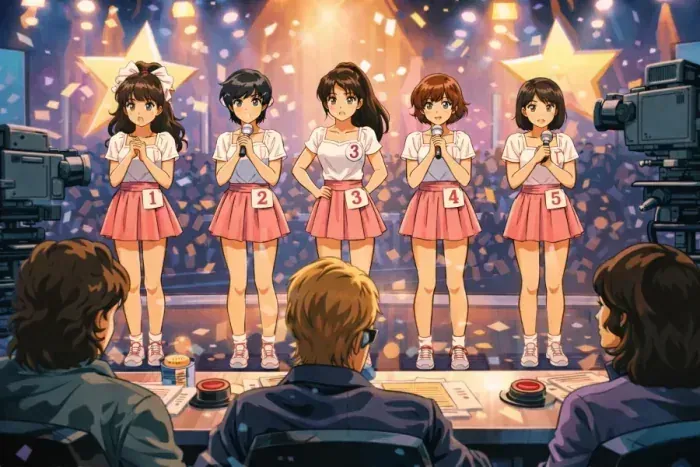
Survival Shows: Where Idols Are Made
Television talent competitions have existed for decades, but the K-Pop industry adapted the format in a way that directly shaped idol production. Instead of focusing only on an individual winner, many programs let viewers watch trainees compete for places inside a future group. The result fused entertainment, casting, and pre-debut marketing into one format.
One of the most influential examples was Produce 101, first broadcast in 2016. The program gathered trainees from numerous entertainment companies and placed them in a series of performance challenges. Over several weeks the participants worked with vocal coaches, dance instructors, and producers while preparing stages that were evaluated by both judges and viewers.
Audience voting played a central role in determining the final lineup. Fans supported their favorite contestants through online voting, which turned preference into measurable power. When the program concluded, the top performers debuted together as the temporary group I.O.I. The show’s success later produced more seasons and a wider wave of similar projects. It also helped normalize the idea that a fan should feel involved in group formation, not just in post-debut support.
Another notable program was Sixteen, which aired in 2015 and produced the girl group TWICE under JYP Entertainment. The series followed trainees through tasks that tested vocals, dance, adaptability, and stage presence under pressure. Viewers watched confidence build, alliances shift, and individual personalities come into focus before the group even debuted.
These programs stage the pressure of idol training as public drama. Contestants rehearse late into the night, record new vocals, absorb criticism from mentors, and compete while forming visible friendships. The appeal comes partly from that tension between rivalry and collective effort.
Survival shows also generate large online discussions. Fans analyze performances, compare edits, debate rankings, and mobilize around preferred contestants through voting campaigns. That interaction creates investment before a group has released a single official single.
For entertainment companies, the format solves a major launch problem. By the time a new group debuts, viewers already recognize the members and already care who succeeds. The formation of the group becomes a public story that unfolds over many weeks instead of a single introduction on debut day.
Through these programs the creation of K-Pop idols becomes part of a shared viewing experience. The debut is no longer the beginning of the relationship. It is the moment a publicly followed process turns into a marketable group.
The Produce 101 model was powerful because it turned scale into drama. A large pool of trainees made the field feel competitive and uncertain, while repeated rankings gave viewers a simple way to track movement. Every performance could change the perceived future. That structure borrowed from sports tables, reality television, and idol fandom at the same time.
Sixteen worked differently because it came from one major agency and led to TWICE. The show allowed viewers to see JYP’s training philosophy in action: not only skill, but charisma, teamwork, adaptability, and public appeal. TWICE’s later success made the program look like a proof of concept for using television to introduce a group’s emotional foundation before its official debut.
These programs also changed how failure is consumed. Trainees who did not make the final lineup could still gain fans, sign elsewhere, debut later, or become recurring figures in industry memory. That gives survival shows an afterlife. Viewers continue tracking eliminated contestants, comparing later careers, and revisiting old performances. The program becomes an archive of possible futures, not only a path to one group.
The global spread of survival formats shows how adaptable the model became. Programs in Korea, Japan, China, and joint-market projects used similar structures while changing language, voting rules, mentor roles, and audience targets. The core appeal remained the same: viewers want to see talent become organized into a group, and they want to feel that their attention helped shape the outcome.
Reality TV: Building Pop Personalities
Beyond survival competitions, reality television became one of the main places where K-Pop artists could appear outside formal performance. These programs follow groups during rehearsals, travel, meals, games, and downtime, turning offstage behavior into part of the fan relationship.
Many idol groups release their own variety or reality series soon after debut. The activities may look simple, such as cooking together, playing games, or preparing for a concert, but they serve a function. Viewers learn each member’s humor, temperament, role inside the group, and relationship to the others through repeated exposure.
A well-known example is Run BTS, a variety program featuring the members of BTS. Episodes range from sports competitions to studio games and improvised challenges. The relaxed format gave fans a repeated lesson in individual personality while also reinforcing the group’s internal chemistry.
Other artists have followed similar formats. Groups such as EXO, Seventeen, and TWICE have released reality content that documents rehearsals, recording sessions, travel, and preparation for major performances. These glimpses of daily life make the labor structure of idol work more visible, not just the polished stage result.
Reality programs also help introduce members to international audiences more efficiently than music alone. Once viewers learn a group’s internal dynamics, later releases carry more emotional weight because the performers already feel familiar. Familiarity becomes a commercial asset before the discography is even large.
Digital platforms expanded the reach of these programs significantly. Episodes often appear on streaming services or video platforms with subtitles in multiple languages. That means fans in different countries can learn members’ personalities and in-jokes almost as quickly as domestic viewers.
The success of reality television within K-Pop reflects a broader truth about modern pop: music is rarely consumed alone. Fans follow narrative, chemistry, effort, and routine as well as the songs themselves. In that sense, personality content is not secondary. It is part of the product.
Reality content also helps stabilize fandom between releases. A group cannot release a major single every week, but it can publish episodes, livestreams, short clips, travel logs, birthday content, rehearsal footage, and casual games. This keeps the relationship active during the spaces between comebacks. In an attention economy, those spaces matter.
The spaces also shape how fans interpret music when it finally arrives. If viewers have watched members practice, joke, worry, travel, or recover from mistakes, a comeback stage does not feel like an isolated product. It feels like the next public result of people the audience has been following. That emotional continuity is one of K-Pop’s strongest advantages over older promotional models.
Reality content can also make labor legible without fully revealing it. Fans may see a late-night rehearsal or recording session, but they still see an edited version. The camera gives access and protection at the same time. Companies decide what kinds of fatigue, conflict, or uncertainty can be shown. This selective visibility keeps the relationship intimate while maintaining the larger image of professionalism.
The format also gives members who receive fewer lines or less center time another way to become visible. A quieter vocalist may become known for humor; a dancer may become known for leadership; a younger member may become central through warmth or timing rather than through musical parts alone. Reality content therefore balances the group image in ways that songs cannot always do.
For international fans, subtitles are crucial. A reality episode without translation can still be visually enjoyable, but translated dialogue gives access to jokes, relationships, and personality. Fan subtitles once carried much of this work; official subtitles later became more common as companies recognized the global audience. That shift shows how fan labor often teaches industries what services are needed.
There is also a cost. The more personality becomes content, the more performers are expected to make ordinary life entertaining. Rest, boredom, disagreement, or privacy can become difficult to protect when fans expect constant access. Reality television deepens attachment, but it also expands the amount of life that can be turned into work.
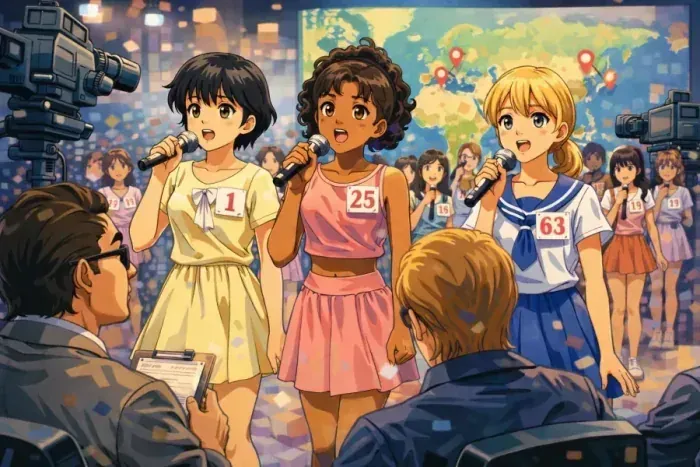
The Global Search for New Idols
As K-Pop expanded internationally, the search for new performers gradually extended beyond South Korea itself. Entertainment companies began looking for talent across Asia, North America, and Europe. What emerged was a global idol pipeline in which aspiring singers and dancers from very different backgrounds entered the Korean training system.
International auditions became a common starting point. Major entertainment companies regularly hold casting events in cities such as Los Angeles, Tokyo, Bangkok, and Taipei. Some candidates are discovered there; others submit video auditions online. Together, those systems let agencies scout talent almost anywhere without waiting for performers to enter the Korean market first.
Once selected, international trainees often relocate to South Korea for intensive preparation. They study Korean alongside vocal training, dance practice, media discipline, and stage performance. The adjustment can be severe, especially for teenagers living far from home for the first time, but the system offers access to one of the most globally visible pop industries in the world. Language and cultural training matter here because a multinational lineup only works if the group still functions coherently in rehearsal, media appearances, and everyday group life.
Several well-known K-Pop artists came through this international system. Mark Tuan of GOT7 grew up in the United States before joining JYP Entertainment’s training program. Lisa of BLACKPINK was born in Thailand and later moved to Korea under YG Entertainment. Examples like these show that multinational membership is no longer unusual in K-Pop’s upper tier.
This international dimension also affects the music itself. Artists who have lived in multiple countries often bring different linguistic instincts, performance references, and musical habits into the group. English phrases, accent variation, and broader youth-culture references are often built into the material because both the performers and the intended audience are already transnational.
Entertainment companies also understand the promotional value of multicultural lineups. When a group includes members from different regions, fans in those places often feel a stronger stake in the act’s success. Tours, interviews, and local campaigns can then be localized more effectively.
The global idol pipeline reflects the transformation of K-Pop from a national industry into an international production network. Trainees, producers, choreographers, and songwriters now move across borders as part of the normal system. The composition of the groups increasingly mirrors the scale of the audience.
Multinational lineups also change how language works inside songs. English phrases, Japanese versions, Chinese introductions, Thai interviews, and Korean verses can all sit inside one group’s public life. This does not mean every member is equally fluent in every context. It means the group is designed to move through several communication zones. The linguistic variety becomes part of the group’s commercial and emotional reach.
Lisa’s role in BLACKPINK is a clear example of this broader pattern. Her Thai background gave Southeast Asian fans a particularly visible point of identification inside a top Korean group, while her performance skill made that identification musically credible. The same principle appears in other groups with Japanese, Chinese, Australian, American, or Canadian members. The member’s background can open attention, but the training system has to turn that attention into group function.
International casting also raises questions about cultural adaptation. Trainees entering Korean companies often have to learn not only language but hierarchy, rehearsal etiquette, media behavior, and expectations around teamwork. The process can produce strong multicultural groups, but it can also be demanding for young people navigating identity under public scrutiny. The global pipeline is opportunity and pressure at the same time.
From an industry perspective, multinational groups reduce distance. A member can speak in local interviews, understand regional humor, or make fans feel seen. From a fan perspective, the effect can be emotional: someone from their country or language background is standing inside a global pop system. That identification has become one of K-Pop’s most effective expansion tools.
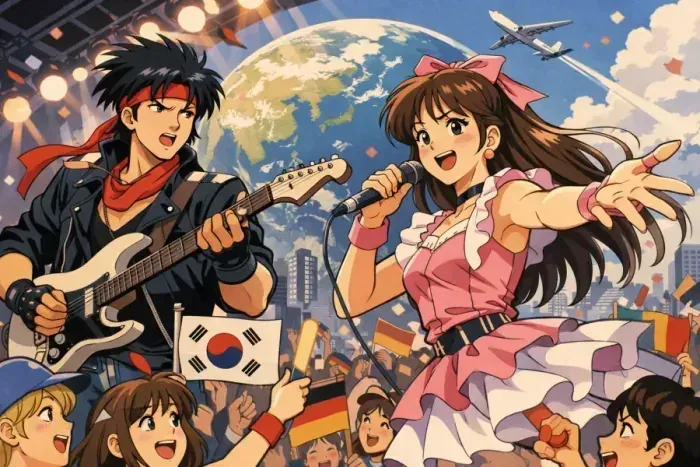
The Power of Global Fan Communities
Pop music has always relied on the enthusiasm of its listeners, yet the relationship between artists and fans in East Asian pop culture has become unusually organized and visible. Fan communities in J-Pop and K-Pop do far more than simply listen to songs. They coordinate online campaigns, support charity projects, translate interviews, archive performances, and build international networks that connect supporters across continents.
Digital media strengthened these communities by giving them tools for speed, coordination, and visibility. Social platforms let fans share performances instantly, discuss new releases, divide translation work, and coordinate projects that promote their favorite artists. What once existed mainly through local fan clubs now operates at global scale.
This culture of participation has played a direct role in the worldwide success of East Asian pop. Fans introduce new listeners to songs, organize streaming events, create archives, and keep artists visible between official releases. Any history of J-Pop and K-Pop that leaves fandom at the edges misses one of the systems doing the work.
Fandom performs work that does not look like ordinary consumption. A fan who translates an interview, creates a beginner guide, maintains a discography spreadsheet, organizes a birthday donation, edits a performance clip, or explains a reference is building infrastructure. None of that appears on a chart in a simple way, but it affects how easily a new listener can enter the music.
This infrastructure often emerges faster than official industry support. International fans may create translation accounts before a label hires a localization team. They may map ticketing rules before a promoter publishes clear guidance. They may explain member names, variety show references, release schedules, and chart rules before journalists understand the basics. In many markets, fandom served as the first public education system for K-Pop and J-Pop.
The emotional side matters just as much. Organized fandom gives listeners a place to put care. A comeback, concert, enlistment, hiatus, award nomination, or anniversary becomes a shared event because fans have tools for responding together. That collective response can make distant artists feel close and can make isolated listeners feel part of a larger public.
Fandom also preserves history. Platforms are unstable: videos disappear, accounts close, rights change, subtitles are removed, and older websites vanish. Fan archives often keep track of performances, translations, set lists, interviews, and release details that official channels treat as temporary. For a fast-moving pop industry, that memory work is essential.
At the same time, participation can become exhausting. Streaming goals, voting deadlines, fundraising drives, ticketing battles, and constant social media defense can make fandom feel like unpaid labor. The same organization that helps artists succeed can pressure fans to prove loyalty through time, money, and visibility. Modern East Asian pop fandom therefore contains both community and workload.
How Modern Fandom Really Works
Modern K-Pop and J-Pop fandoms operate with a level of coordination that often surprises outsiders. Official fan clubs, informal networks, translation teams, and group chats form the backbone of this structure. They are not just social spaces. They are distribution, interpretation, and mobilization systems.
In Korea many idol groups have official fan clubs recognized by their agencies. Membership often includes access to special merchandise, concert ticket opportunities, and exclusive content. Fans proudly identify themselves with the group’s fan name and symbolic color. For example, supporters of BTS are known as ARMY, while fans of BLACKPINK call themselves BLINKs. These identities do more than decorate fandom. They give large, dispersed audiences a usable sense of structure and belonging.
Online platforms have expanded these networks enormously. Social media makes it possible to coordinate release-day projects, translation work, charity drives, and ticketing information across continents within minutes. In effect, fandom now performs some of the promotional and localization work that labels once controlled more tightly. This shows how the labor of pop circulation has been redistributed.
Fan creativity matters here too. Supporters produce artwork, dance covers, data guides, video edits, memes, and explainer threads that often travel farther than official promotional posts. New listeners regularly encounter the fandom first and the catalog second.
Charitable projects have also become part of many fan cultures. Some communities organize fundraising campaigns to celebrate an artist’s birthday or commemorate a major release. Donations may support environmental organizations, disaster relief efforts, or educational initiatives. These activities reflect a shared belief that fan communities can contribute positively to society.
Concert culture provides another important gathering space. Fans attend shows wearing coordinated colors, carrying light sticks that illuminate arenas with synchronized patterns. The visual effect turns the audience into part of the performance itself and makes collective identity visible at arena scale.
Through these networks, modern pop fandom has evolved into an active cultural force. Fans do not simply consume music. They participate in the circulation, interpretation, and celebration of the artists they admire.
Light sticks are a useful symbol of this change. They are merchandise, but they are also interfaces. In many concerts, synchronized light systems turn the audience into a visual part of the show. The fan does not only watch the stage; the fan’s object helps create the arena image. This makes collective support visible in photographs, livestreams, and artist memory.
Fan chants work similarly. They turn listening into timed participation. A chant names members, emphasizes a hook, or fills a musical space left open for audience response. It requires rehearsal and shared knowledge, which means a concert audience is not simply a crowd. It is a prepared performing body. This is one reason K-Pop concerts can feel so intense: the audience has practiced too.
Online coordination extends that concert logic into everyday life. Fans learn how to stream within platform rules, request radio play, vote on award apps, trend hashtags, organize translation threads, and support comeback goals. These actions may look technical, but they also create belonging. A fan who cannot attend a concert can still feel useful during a release week.
Charity projects add moral meaning to that usefulness. Birthday donations, forest planting campaigns, disaster relief drives, scholarship funds, and social campaigns let fans connect admiration with public action. Not every project is large, and not every project should be treated as proof of virtue. Still, the pattern shows that fandoms often want their collective identity to do something beyond buying music.
The risk is that organization can harden into competition. Chart battles, fan wars, and defensive campaigning can turn support into constant conflict. This is not unique to East Asian pop, but the high visibility of fandom metrics can intensify it. When numbers are public and rankings update quickly, fans may feel that love must be proven through measurable victory. That pressure is one of the less comfortable sides of modern pop participation.
Online Communities Bridge Cultures
Online communities changed not only how fans talk about East Asian pop, but how they learn to hear it. Earlier listeners often depended on record stores, imports, or television. Now discovery happens inside constantly updating networks of clips, recommendations, threads, fan edits, and translated context.
A key function of these communities is fast information transfer. Fans translate interviews, lyric fragments, livestreams, and news into multiple languages with remarkable speed. That work reduces delay and keeps international audiences inside the same release cycle as domestic fans.
Discussion forums also turned listening into a form of close reading. Fans compare choreography details, identify recurring symbols in music videos, trace concept changes across album eras, and debate how lyrics shift in translation. In K-Pop especially, where comebacks are often built as complete visual campaigns, that kind of collective analysis becomes part of the product itself. Interpretation is not only commentary here. It is part of the consumption model.
These communities also function as recommendation engines driven by trust rather than platform logic alone. A single fan edit, subtitled clip, or performance thread can bring thousands of new listeners into an artist’s catalog. Many international fandoms did not grow because radio programmers or critics introduced the music first. They grew because fans kept making the case for it in public.
The internet has also encouraged wider cultural curiosity. Listeners who arrive through a song often go on to explore language, variety shows, dramas, fashion, and the references surrounding the release. For many people, East Asian pop is not just a soundtrack. It is an entry point into a larger media world.
Artists now work inside that environment rather than outside it. Livestreams, messaging apps, short-form video, and direct-to-fan platforms make international feedback almost instant. That closeness can feel unusually personal compared with older pop systems, but it is also carefully managed and built into how contemporary fandom works.
Through these overlapping digital spaces, East Asian pop became harder to treat as a regional niche. Music, language, imagery, and community move together, and each one helps the others travel further.
Online communities also shape interpretation by deciding what needs explanation. A music video may include Korean wordplay, Japanese cultural references, Chinese-language idioms, anime callbacks, fashion signals, or references to earlier releases. Fans identify those details and make them readable for others. This work can deepen appreciation, but it can also create competing interpretations when communities disagree about meaning.
The speed of online explanation has changed journalism too. Writers covering K-Pop or J-Pop often rely, directly or indirectly, on fan-made context to understand release history, terminology, and member identities. This can improve coverage when fans correct errors and provide detail. It can also create tension when professional media simplify a story that fans understand as more complex.
Recommendation culture is another important layer. Algorithmic platforms suggest songs, but fans add trust. A playlist made by a knowledgeable listener, a thread explaining an artist’s eras, or a video essay on a producer can guide new fans more effectively than a generic recommendation feed. Human curation helps music cross cultural distance because it supplies reasons, not only links.
Online communities also make backlash travel faster. A mistranslation, styling controversy, contract dispute, or poorly framed interview can spread across languages in hours. This speed can hold companies accountable, but it can also amplify partial information before facts are clear. Global fandom therefore lives with a permanent tension between rapid correction and rapid overreaction.
The best fan mediation slows the process down just enough to add context. It explains without flattening, corrects without humiliating, and distinguishes confirmed fact from interpretation. That kind of work is not glamorous, but it is one of the reasons East Asian pop can sustain serious international audiences rather than only quick viral attention.
Diaspora, Translation, and Fan Mediation
Much of this circulation depends on fans who act as cultural mediators. Translation teams, subtitle editors, glossary writers, and community organizers help songs and interviews move from one language space into another. In many cases, international audiences do not wait for official localization. They build temporary infrastructures of access on their own, often within hours of a release.
Diaspora communities have also played a quiet but important role in this process. Fans who move between languages or cultural contexts often become early interpreters for wider audiences. They explain references, clarify jokes, compare media coverage across regions, and help newer listeners understand why a performance resonates locally. That work rarely appears in official industry histories, yet it has been central to the global spread of East Asian pop. Without that mediation, many songs would still travel, but they would not travel with the same depth of explanation.
This kind of mediation does more than solve language problems. It shapes taste. The songs that travel furthest are often the ones communities can explain, circulate, and place inside a larger story. In that sense, fandom is not just a response to pop success. It is one of the mechanisms that helps produce it.
Diaspora mediation is often personal before it becomes public. A bilingual fan may translate a lyric for a friend, explain why an honorific matters, or clarify that a joke depends on a variety-show habit. These small acts scale up online, but their logic is ordinary: people who move between worlds help others cross. Pop travels better when someone can say not only what a word means, but why it matters.
This mediation also protects nuance. A literal translation can miss tone, politeness, irony, or emotional register. A Korean lyric using informal speech, a Japanese line with seasonal imagery, or a Cantonese phrase loaded with local humor may require explanation rather than direct substitution. Fan translators often become cultural writers because the song demands it.
The work can be difficult because communities do not always agree. Diaspora fans may interpret a reference differently from domestic fans; younger fans may hear a phrase differently from older listeners; fans in different countries may attach different political meanings to the same image. These disagreements show that global fandom is not a single audience. It is a negotiation among audiences.
For artists and companies, this means international success depends partly on people they do not control. A label can release subtitles, but it cannot fully determine how fans explain the work to one another. That loss of control can be uncomfortable for industry systems built around image management. It is also one of the reasons the music can feel alive internationally. Meaning keeps being made after release.

The Conversations Shaping Pop Culture
As East Asian pop gained global visibility, it also entered sharper debates about labor, representation, beauty standards, authorship, and cultural borrowing. A bigger audience does not just create more fame. It also creates more scrutiny, often in real time.
Beauty standards illustrate this dynamic. Idol culture has long relied on tightly managed styling, body discipline, and image consistency. Fans may admire that polish, but critics regularly ask what it costs performers, especially younger ones, to sustain those expectations year after year.
Questions of influence and appropriation are equally persistent. K-Pop and J-Pop have long borrowed from Black music, club culture, Western pop songwriting, fashion scenes, and global internet aesthetics. That openness is part of why the music feels flexible. It is also why audiences ask who gets credited, who gets imitated, and where exchange turns exploitative.
Authorship matters here too. Many idol releases are created through large production teams, which complicates public ideas of authenticity. Some artists gain prestige by writing or producing their own material, while others are judged unfairly for working inside collaborative systems that define pop almost everywhere.
Mental health has become harder to ignore as more artists speak publicly about burnout, anxiety, hiatuses, and the pressure of permanent visibility. Long training periods, extreme scheduling, online harassment, and nonstop performance make these concerns structural rather than incidental.
Fans are now part of these conversations rather than separate from them. They organize support projects, debate agency decisions, challenge media coverage, and sometimes push for better working conditions. That does not mean fandom is always consistent or fair, but it does mean the audience now participates in judging the industry rather than only consuming it.
East Asian pop is not only a success story. It is also a public argument about what pop should ask from artists, what fans should expect in return, and how global entertainment systems ought to behave.
Labor debates have become sharper because the industry now operates under global visibility. A demanding schedule that once might have been discussed mainly in domestic media can now become an international issue within hours. Fans compare contracts, hiatus announcements, health statements, and company behavior across agencies and countries. That comparison creates pressure for higher standards, even when information remains incomplete.
Beauty standards are similarly global and local at the same time. K-Pop and J-Pop idols work inside regional ideals of styling, skin care, weight, youthfulness, and camera readiness, but they are now judged by audiences with many different expectations. Some fans admire the discipline behind the polish; others worry about diet culture, cosmetic pressure, and the narrowness of acceptable bodies. The debate is not a side issue because image is central to idol economics.
Cultural borrowing requires especially careful discussion. East Asian pop has learned from Black American music for decades: jazz, R&B, funk, soul, hip hop, house, and trap all shaped the region’s pop vocabulary. Influence is normal in pop history, but global audiences increasingly ask whether the borrowing includes respect, credit, collaboration, and understanding. A rap verse, hairstyle, dance move, or visual concept may carry a history that cannot be reduced to style.
Authorship debates can also become unfair. Idol pop is collaborative by design, and many great pop records around the world are built by teams. Still, audiences often grant more respect to artists who write, compose, or produce. The fairest view recognizes both truths: self-authorship can matter deeply, and collaborative pop can still be artistically serious. A performer can shape a song through voice, interpretation, stage presence, and career choices even when they did not write every line.
Mental health discussions have forced a broader reconsideration of access. Fans may want updates, livestreams, backstage content, and emotional honesty, but artists need private space to recover and grow. The more global fandom becomes, the harder it is for an artist to step away without explanation. That pressure is structural. It comes from platforms, companies, media, and fans together.
These debates do not cancel the music’s achievements. They make the achievements more realistic. East Asian pop changed global culture through creativity, discipline, media strategy, and fan labor. It also inherited problems common to entertainment industries and developed some of its own. A mature history has to include the shine and the cost.
The debates also show that global audiences are no longer passive recipients. Fans and critics now question agencies, compare labor standards, identify patterns of cultural borrowing, and push for better treatment with a level of speed that older entertainment systems did not face. This scrutiny can be messy and sometimes unfair, but it has changed the balance of public discussion. Companies cannot assume that international attention will remain purely celebratory.
That scrutiny may become one of the forces that shapes the next era. If audiences reward healthier schedules, clearer credit, better translation, respectful collaboration, and more sustainable touring, companies will have incentives to adapt. If audiences demand constant content while criticizing the pressure that creates it, the contradiction will remain. East Asian pop’s future depends partly on whether fans, media, and companies can align their values with their behavior.
Art, Industry, and Fan Expectations
One reason these discussions remain intense is that East Asian pop often asks artists to operate in several roles at once. A performer may be expected to sing, dance, act, handle variety appearances, maintain direct contact with fans, protect a carefully managed image, and still appear natural at all times. That mix can produce unusually durable careers, but it also turns personality itself into labor. What reads as spontaneity on screen often has to be rehearsed, managed, and repeated under pressure.
Fans are part of that tension. Many listeners sincerely want to support artists as people, not simply consume them as products. At the same time, modern fan culture often rewards constant updates, fast replies, behind-the-scenes access, and a steady stream of new content. Intimacy becomes part of the business model, which makes the line between care, expectation, and surveillance harder to draw.
The artists who last often reshape the rules rather than follow them forever. Some move toward songwriting and production. Some shift into acting, fashion, business, or independent labels. Others narrow their public exposure and keep only the parts of the idol system that still work for them. Their careers make clear that East Asian pop is not just a story of powerful systems. It is also a story of negotiation within those systems.
Longevity is one of the most important tests. A system built around youth must eventually answer what happens when performers grow older. Some idols become solo artists. Some become actors or variety hosts. Some move behind the scenes as producers, directors, or company founders. Some leave public life. These paths show whether an industry can treat artists as developing adults rather than replaceable images.
Fans also have to adapt. Supporting a teenage idol group and supporting artists in their thirties require different expectations. The music may become less frequent, the concepts may become more mature, and the performers may draw firmer boundaries around privacy. Fandoms that mature with artists can help create healthier careers. Fandoms that demand permanent youth can trap artists inside old images.
The industry is slowly learning from these transitions. Solo releases, unit projects, acting schedules, producer credits, fashion roles, and independent labels allow artists to keep public value after the most intense idol years. This diversification does not solve every labor problem, but it gives performers more possible futures. A pop system becomes stronger when success does not require staying the same forever.
The same negotiation appears in Japan. Former idols, anime singers, singer-songwriters, and internet-born artists often move between public roles over long careers. The boundaries between idol, actor, voice actor, model, producer, and variety personality can remain fluid. That flexibility has helped East Asian pop create durable celebrity figures, but it also means artists must keep redefining what parts of the machine they are willing to inhabit.
Where East Asian Pop Goes Next
East Asian pop has moved far beyond the stage where it could be summarized by one export story or one industry model. Artists from Seoul, Tokyo, Taipei, Hong Kong, and beyond now work inside overlapping systems of streaming, touring, brand partnerships, fandom, and cross-border collaboration. The next phase will depend less on simple expansion than on how these systems adapt to each other.
New performers are entering the industry with different assumptions from earlier generations. Many grew up in an environment where playlists were global, language-switching was normal, and audience feedback arrived immediately online. That changes how songs are written, how careers are launched, and what kinds of identity feel credible onstage.
Audiences are also learning to hear more than the biggest idol exports. Alongside major groups, listeners now follow soundtrack singers, singer-songwriters, internet-native producers, band scenes, and multilingual soloists. The category has widened, and so has the ear of the audience.
Success has therefore become harder to measure by any single metric. Some artists still depend on physical sales, fan signs, and domestic television exposure. Others build careers through streaming, short-form video, overseas festivals, sync placements, or live touring. The industry no longer runs on one timeline or one route to visibility. That fragmentation makes the current era more open, but also more difficult to describe through any single chart or platform ranking.
The future will likely belong to coexistence rather than replacement. Idol systems will remain powerful, but they will increasingly sit beside looser, faster, and more specialized forms of pop production that are already thriving.
Coexistence also means that older media will keep shaping new music. It is easy to speak as if streaming replaced television or as if short-form video replaced music video, but East Asian pop has usually grown by layering media rather than abandoning them. A song can premiere online, perform on television, become a dance challenge, appear in a drama, sell physical editions, tour arenas, and return later through a fan edit. Each format creates a different kind of attachment.
This layered system will affect how artists pace their careers. A group built mainly for weekly music shows may think differently from a singer-songwriter who depends on streaming playlists, or from an anime-linked artist whose largest audience arrives through a seasonal series. The most durable careers will likely be the ones that can move between these contexts without losing identity. That requires flexibility from artists and restraint from companies.
There is also a question of regional balance. The global conversation often focuses on Japan and South Korea, but East Asian and Asian pop more broadly includes Taiwan, Hong Kong, mainland China, Thailand, Indonesia, the Philippines, Singapore, Malaysia, and diaspora scenes that interact with J-Pop and K-Pop in complex ways. Future pop flows may be less centered on one or two national industries, especially as multinational groups, regional festivals, and platform-native artists become more common.
The audience is already moving in that direction. Fans who begin with one Korean group may later follow Japanese anime music, Thai actors, Taiwanese bands, Chinese-language ballads, or Southeast Asian idol projects. Their listening habits are less bounded by old industry categories than the industries themselves. That listener behavior may push companies toward more open collaboration, better subtitles, wider touring maps, and more serious attention to regional diversity.
Still, scale will remain uneven. Major companies can buy visibility, build training systems, and coordinate global campaigns. Smaller artists must rely on timing, distinctiveness, community, and platform luck. The future of East Asian pop will not be a level field. It will be a field where very large corporate projects and small, agile creative scenes keep influencing each other.
One major question is how global platforms will affect local texture. Streaming can help artists reach listeners quickly, but it can also reward songs that fit platform habits: shorter intros, immediate hooks, clip-ready sections, and moods that fit playlists. East Asian pop has always adapted to media systems, so this pressure is not new in principle. Radio, television, karaoke, CD retail, and music video channels all shaped songs before streaming did. The difference is that platform feedback now arrives faster and at larger scale.
Another question is how language will function. English hooks and multilingual versions can widen access, but Korean, Japanese, Mandarin, Cantonese, Thai, and other languages remain central to the music’s identity. The more interesting future is not one where all artists move toward English. It is one where listeners become more comfortable crossing language boundaries, and where artists decide strategically when translation, code-switching, or linguistic specificity serves the song.
Touring will also shape the next phase. Online popularity is important, but live shows test whether an audience is willing to spend money, travel, and gather physically. The growth of K-Pop arena tours, Japanese artists’ world tours, anime music concerts, and festival appearances suggests that East Asian pop is moving from screen familiarity into live infrastructure. That requires promoters, visas, rehearsal logistics, local partners, and ticketing systems, not only viral demand.
The future will also depend on smaller scenes. Idol groups and major soloists draw the headlines, but band circuits, club producers, vocaloid writers, indie labels, soundtrack singers, rappers, and regional pop scenes keep expanding the field. A global audience that begins with BTS, BLACKPINK, YOASOBI, or anime themes may eventually move toward lesser-known artists. That deepening of listening could be as important as the next chart record.
The industry will also need to address sustainability. Constant comeback cycles, world tours, online content, fan expectations, and brand partnerships can generate growth but also exhaustion. Artists, companies, and fans are already negotiating how much speed is healthy. The next mature phase of East Asian pop may be defined not only by expansion, but by learning how to maintain careers without burning through the people who make them.
Hybrid Pop and Cross-Border Collaboration
Collaboration between artists from different countries is no longer a side project or a special event. It is built into how much contemporary pop is made. East Asian performers now work routinely with international producers, songwriters, choreographers, stylists, and marketing teams, creating releases designed from the start to move across multiple audiences.
One notable example of this trend is the Japanese duo YOASOBI. Their music combines electronic pop production with songs adapted from short stories, giving narrative concept an unusually explicit role in mainstream pop. “Yoru ni Kakeru” spread widely through streaming platforms and video sharing sites, and it later became the first song to pass one billion streams on Oricon’s streaming chart. That trajectory shows how literary framing, internet circulation, and pop immediacy can now sit in the same project.
South Korea has also produced artists who experiment with hybrid sounds. In the early 2020s, groups such as NewJeans attracted attention for a smooth blend of R&B, pop, and nostalgic early-2000s production styles. Their songs often favored lighter textures and more conversational melodies than the dramatic peak-and-drop structures associated with earlier K-Pop. That shift reflected listening habits shaped by playlists, headphones, and short-form clips, where songs often need to feel immediate without sounding overloaded.
Another example of cross-cultural collaboration appears in the work of Jackson Wang, a Hong Kong-born artist who built his career within GOT7 before launching a solo career. Wang regularly records in multiple languages and works with producers from different countries. His music moves between hip hop, pop, and electronic influences, illustrating how some contemporary artists no longer belong neatly to one national market.
These collaborations show how flexible East Asian pop has become. The music is still shaped by local industries, languages, and audiences, but it is no longer easy to sort by national boxes alone. Many careers now unfold across several markets at once, with different songs, platforms, and publics mattering in each one.
Streaming platforms and remote production made that process faster. Demo files, vocal takes, choreography drafts, and visual plans can move between cities in days rather than months. When a release arrives, global listeners often encounter it at nearly the same moment, even if they experience it through very different fan cultures and media systems.
The result is a soundscape where ideas circulate quickly, but not on equal terms. Some artists benefit from large corporate networks, others from internet-native discovery, and many from a mix of both. East Asian pop is now embedded in global pop infrastructure, not positioned outside it.
Cross-border collaboration also changes what listeners expect from authenticity. A song can be deeply meaningful to Korean fans even if part of its demo came from Sweden. A Japanese artist can work with international producers without becoming less Japanese. A Hong Kong-born performer can move through Korean training, Chinese-language promotion, and English-language solo material without fitting one category cleanly. Authenticity in this environment is less about pure origin than about whether the final work feels coherent, credited, and emotionally convincing.
The strongest hybrid projects usually have a clear center. They may use many languages and production sources, but the audience can still understand what the artist or group stands for. Without that center, global collaboration can feel like market calculation. With it, collaboration becomes a way to expand the artist’s vocabulary while keeping a recognizable identity.
Hybrid pop also changes how identity is marketed. A group may be based in Korea, include members from several countries, use Swedish or American songwriters, promote in Japan, and build a large audience in Latin America or Southeast Asia. Calling such an act simply “Korean” or “Japanese” may be correct institutionally but incomplete culturally. The industry is increasingly organized around nodes: training centers, songwriting camps, platform audiences, language markets, and touring circuits.
XG is one example of that complexity. The group is Japanese, works through a global-facing pop and R&B framework, and often performs in English while drawing on training practices associated with K-Pop’s performance discipline. Whether listeners classify them as J-Pop, K-Pop-adjacent, or global pop, their presence shows how younger acts can operate between industry labels. The old national categories still matter, but they no longer explain everything.
NewJeans offered another hybrid model through understatement. Their early songs favored soft textures, concise hooks, and nostalgic references to late-1990s and early-2000s pop and R&B. Guinness World Records’ note that the group reached one billion Spotify streams in 219 days in March 2023 shows how quickly that lighter approach could scale. The lesson was not that maximal K-Pop disappeared. It was that global listeners were ready for more than one K-Pop energy.
YOASOBI’s narrative-pop model, NewJeans’ playlist-friendly softness, XG’s border-crossing performance identity, and Jackson Wang’s multilingual solo career all point to the same change. East Asian pop is becoming less dependent on one dominant export formula. The field now contains several routes to global attention, some corporate and some more platform-native, some group-centered and some author-centered.
That variety will likely make the future harder to summarize. The next globally important artist may not look like a classic idol group. They may be a soundtrack singer, a rapper, a virtual singer, a producer duo, a multilingual soloist, an anime-linked band, or a group assembled through a survival show. The infrastructure built by J-Pop and K-Pop will still matter, but it will be used by artists with different ideas of what pop success should feel like.
Beyond the Idol System: Indie Voices
While large entertainment agencies and idol groups often dominate headlines, East Asian pop also includes broad independent and alternative scenes. These musicians work outside the classic idol pipeline, testing sounds, performance styles, and career paths that do not depend on the same rules of training, promotion, or image control.
In South Korea, an indie and alternative music community has developed over the past two decades. Neighborhoods such as Hongdae in Seoul became known for small clubs where emerging bands performed rock, electronic music, indie pop, and genre hybrids. These venues offered a different kind of apprenticeship: less polished, less protected, and often more musically self-directed than the major-agency system. They also preserved room for scenes that did not need idol-scale visibility to matter culturally.
One artist who bridges the worlds of mainstream and independent music is IU. Although she debuted through a major agency, she gradually built a reputation as a singer-songwriter with unusual long-term control over her image and material. Albums such as Palette and Lilac show how a mainstream star can move beyond idol framing without disappearing from pop relevance.
Another notable figure is Dean, whose blend of R&B, electronic texture, and restrained vocals helped define a more understated lane in Korean pop. His work mattered not because it rejected mainstream music entirely, but because it showed that Korean artists could build broad influence without relying on idol choreography or maximal spectacle.
Hyukoh sits on another side of this landscape. Their music combines alternative rock with loose, emotionally ambivalent songwriting that feels distinct from polished idol pop. Their wider breakthrough, helped by television exposure, showed that Korean audiences were open to artists who sounded less managed and more conversational.
Japan also maintains a rich alternative pop environment. Artists such as Sheena Ringo and Cornelius built strong followings while working with unusual arrangements, dense visual identities, and ideas that did not fit neatly into idol marketing. Their careers show that Japanese pop has long made room for artists who are singular rather than easily packaged.
Digital platforms have made these alternative voices easier to find, but the deeper change is structural. Independent musicians can now release work, build communities, tour niche audiences, and sustain visibility without passing through every older gatekeeping channel.
These scenes matter because they complicate the usual story. East Asian pop is not defined only by large idol groups or export-ready spectacle. It also includes musicians building slower, stranger, and sometimes more personal futures for pop.
Indie scenes also preserve local specificity. A small club in Hongdae, Shimokitazawa, or Taipei can support sounds that would not survive an idol company’s debut committee. Bands can test arrangements in front of small audiences, electronic producers can build scenes through late-night events, and singer-songwriters can develop material without needing a choreography plan. This slower development gives pop culture depth underneath the headline acts.
The relationship between indie and mainstream is not always oppositional. Television, festivals, streaming playlists, soundtrack placements, and collaborations can move independent artists into wider view without fully erasing their origins. Hyukoh’s broader breakthrough after television exposure is a good example of how a band scene can enter mainstream awareness through the right media moment. IU’s career shows the reverse path: a mainstream artist can earn deeper singer-songwriter credibility over time.
Japan’s alternative pop history is especially rich because the mainstream has long had room for eccentric figures. Sheena Ringo’s theatricality, Cornelius’s studio detail, Shibuya-kei’s crate-digging cosmopolitanism, and later internet-native producers all show that Japanese pop innovation often happens beside idol culture rather than outside pop entirely. The boundary between mainstream and alternative can be porous when the audience values distinct worlds.
Independent scenes also benefit from global curiosity. A listener who arrives through a major K-Pop group may later search for Korean R&B, city pop, Japanese math rock, Taiwanese indie, Hong Kong alternative music, or bedroom producers. Streaming makes that movement easier than ever. The challenge is discoverability: smaller artists need context, playlists, subtitles, press, and touring support to turn curiosity into lasting audience.
These scenes are important for artistic renewal. Large idol systems are good at polish and coordination, but they can become risk-averse because so much money is invested before release. Independent and alternative musicians can test rougher ideas with lower stakes. Over time, those ideas may move back into the mainstream as textures, production choices, or songwriting approaches. Pop needs its edges in order to keep changing.
Those edges also protect regional diversity. A large global-facing release often has to be legible very quickly to many audiences. A local indie scene can move more slowly, keeping accents, neighborhood references, niche humor, unusual song lengths, or rougher recording textures that would be smoothed away in a major rollout. That specificity gives the broader pop ecosystem new material to draw from later.
Festivals and live houses are crucial here. They create meeting points where scenes can build outside the logic of television charts or idol comeback schedules. A band that cannot compete with a major agency’s video budget can still build authority through live reputation. A producer can test tracks in small rooms before they become streaming releases. These spaces keep music tied to bodies, rooms, and local scenes.
The global audience benefits when these routes remain visible. If East Asian pop is heard only through the largest companies, listeners get scale but miss texture. If they also hear indie bands, club producers, soundtrack specialists, and singer-songwriters, the region sounds less like one export product and more like the dense musical field it has always been.
Life After the Idol System
The idol system has shaped East Asian pop for decades, but it is no longer the only model that organizes ambition. Younger artists are growing up in an environment where streaming, short-form video, direct fan communication, and international collaboration are basic conditions rather than new opportunities. That changes what pop stardom can look like.
One major shift is digital discovery. Listeners increasingly encounter songs through playlists, short-form video, recommendation feeds, and fan circulation rather than through television alone. That allows artists to reach audiences quickly without depending on the same promotional ladder that shaped earlier generations, even if platform visibility comes with its own instability.
New groups and performers are responding to this environment with different artistic strategies. In the early 2020s, the South Korean group NewJeans drew attention for a musical style that felt more relaxed and understated than much earlier K-Pop. Their songs often emphasized smooth melodies and subtle rhythms, reflecting influences from R&B and early-2000s pop. The group’s visual presentation also leaned toward ordinary settings and lighter styling, creating a contrast with the highly dramatic concepts that defined many earlier idol eras.
The speed of this new environment is clear. Guinness World Records noted that NewJeans reached 1 billion Spotify streams in 219 days on March 8, 2023, the fastest pace then recorded for any K-Pop act. The example illustrates how quickly newer artists can move from debut to global visibility when streaming, platform discovery, and organized fandom reinforce one another.
In Japan, digital culture has also opened space for musicians who began online. Vocaloid producers, utaite singers, and internet-first songwriters built audiences on video platforms long before some of them entered the mainstream industry. That route produces a different relationship to authorship, fandom, and genre than the classic label-first path.
Large entertainment companies, meanwhile, continue refining the idol model rather than abandoning it. New generations of performers benefit from more sophisticated training, advanced stage technology, international marketing networks, and tighter data feedback on what audiences respond to. Arena and stadium shows now combine live performance with immersive visuals, synchronized light systems, and highly engineered fan participation. The idol system is not disappearing. It is becoming more technically advanced while sharing space with other forms of pop work.
The future of East Asian pop will likely include both approaches. Large idol projects will keep drawing huge audiences, while independent and digitally native artists continue testing faster, looser ways of building careers.
What remains constant is adaptation. From radio and television to streaming and platform culture, artists across East Asia have kept reworking pop to fit new media conditions without losing local texture. The next stage will again be shaped by performers, producers, companies, and fans arguing in public over what should change and what should stay.
Life after the idol system also depends on ownership. Artists who gain publishing credits, production skills, choreography input, label partnerships, or business knowledge can carry more of their career with them when a contract ends. This is one reason songwriting and production credits matter so much to fans. They are not only signs of authenticity. They can become practical tools for long-term independence.
Technology may widen those options. Home recording, remote collaboration, direct-to-fan platforms, and short-form video allow artists to test ideas without waiting for a full company comeback. Former idols can release solo material, covers, vlogs, dance clips, or behind-the-scenes work that keeps audiences engaged while they explore new identities. This does not remove the value of major agencies, but it reduces total dependence on them.
The audience’s role will be decisive. If fans support artists only when they remain inside familiar concepts, reinvention becomes risky. If fans follow artists through quieter releases, different genres, slower schedules, or adult subject matter, the system gains room to mature. Pop history is shaped not only by what artists attempt, but by what audiences allow them to become.
The same issue applies to new groups. A debut act entering the 2020s or 2030s faces an audience that knows more about contracts, mental health, cultural borrowing, and platform metrics than earlier fans did. That audience may demand more transparency while also demanding more content. Companies will need to navigate those expectations carefully. The groups that last may be the ones whose systems are flexible enough to protect both performance quality and human limits.
A Story Still Being Written
The story of East Asian pop spans several generations of artists, producers, media workers, and listeners who turned regional scenes into a global cultural force. What began with postwar exchanges of jazz, rock, and commercial song developed into distinct industries in Japan, South Korea, Hong Kong, and Taiwan, each with its own structures, stars, and audiences.
Japanese kayokyoku and later city pop shaped one route into modern pop. Cantopop and Mandopop connected Chinese-speaking audiences through cinema, television, and recording. South Korea built a tightly organized idol system that eventually became a widely watched pop export model. None of these histories replaced the others. They overlapped, borrowed, competed, and kept changing.
Digital platforms accelerated that process. Music videos, fan translation, streaming, and cross-border collaboration let songs move far beyond the channels that once confined them. What changed was not only reach, but speed and density: more people, in more places, could join the same pop conversation at once. They could also enter that conversation through different doors: songs, clips, subtitles, games, fashion, memes, or fan threads.
Today, East Asian pop is part of global music culture at every level, from charts and tours to fashion, streaming, fandom, and online argument. Its future will not be decided by one trend or one country alone. It will come from the friction and exchange between the many pop systems that now share the same space.
That shared space is crowded in productive ways. A listener might move from a K-Pop comeback to a Japanese anime opening, from there to a city pop playlist, then to a Mandopop ballad, a Korean indie band, a Thai idol group, or a Hong Kong singer-songwriter. The old borders between scenes still matter, but listeners now cross them with less friction. This changes how influence works. Artists are no longer only borrowing from distant Western centers; they are also hearing one another across Asia and through global platforms.
The history also shows why “global pop” should not mean sameness. East Asian pop became globally important because it combined international influence with local systems: Japanese television agencies, Korean trainee companies, Hong Kong cinema, Taiwanese Mandopop circuits, anime production committees, fan translators, karaoke rooms, and streaming platforms. The music traveled because it was adaptable, not because it became rootless.
This matters for criticism as well as celebration. When global media treats East Asian pop as one shiny export category, it misses the disagreements inside the field: domestic versus overseas priorities, idol polish versus singer-songwriter authorship, physical sales versus streaming reach, fan intimacy versus privacy, localization versus cultural specificity, and corporate coordination versus independent risk. Those tensions are not side notes. They are the engines that keep the music changing.
The same tensions shape listening. A listener may admire K-Pop choreography and still prefer the looseness of Korean indie rock. They may love anime openings while finding Japanese idol culture difficult to navigate. They may enter through BTS and end up studying older Mandopop, or enter through city pop and then discover contemporary J-Pop. Global audiences do not move through the music in one approved order. They build their own paths, and those paths keep expanding the meaning of the field.
That is why the article ends with listening rather than a final verdict. A historical account can explain routes, systems, and milestones, but the music itself carries details that summary cannot replace: a vocal bend in a trot song, the glossy bass of a city pop record, the tight formation of a K-Pop chorus, the ache of a drama soundtrack, the bright shock of an anime opening, or the communal force of a fan chant. The argument becomes clearer when heard.
The next era will likely keep that pattern. Some songs will be designed for worldwide release from the beginning. Others will travel accidentally through a show, game, meme, cover, or fan edit. Some artists will chase charts; others will build smaller but durable international communities. The field is too broad for one measure of success.
The best way to understand East Asian pop is therefore not to ask when it became global, as if global recognition were a single finish line. It is better to ask how different systems learned to move: through radio, television, film, cassettes, CDs, anime, YouTube, streaming, touring, translation, and fan work. Each system left traces in the music. Those traces are why a current K-Pop stage, a J-Pop anime theme, and an older Cantopop ballad can all belong to the same long story without sounding alike.
That long story is still open because none of those systems has disappeared completely. Radio still matters in some markets. Television still shapes celebrity. Physical editions still carry fan rituals. Anime and games still introduce songs to people who do not think of themselves as pop specialists. Streaming and short-form video keep changing how hooks are discovered. Concerts keep proving which digital audiences will gather in real rooms. East Asian pop became global by stacking these systems rather than replacing one with another. Its future will likely work the same way.
Essential Listening: 50 Songs That Defined the Genre
The clearest way to hear this history is through the songs themselves. From postwar Japanese pop to Cantopop, Mandopop, and the global expansion of K-Pop, these recordings show how the region’s pop vocabulary changed over time.
The playlist below follows the same path as the article. It starts with foundational recordings, moves through J-Pop and regional pop booms, and ends with newer artists whose careers were shaped by streaming, platform culture, and cross-border production.
It is a selective guide, not a definitive canon. Heard in sequence, the list makes one point especially clear: East Asian pop did not develop in a single straight line. It grew through overlapping scenes, industries, and media systems.
The order also shows how many different kinds of turning point exist. Some songs matter because they changed a sound. Others matter because they proved a market could be crossed, because they attached music to film or anime, because they introduced a new kind of idol image, or because fans later turned them into global reference points. A playlist cannot carry every part of that context, but it can make the movement audible.
Listening chronologically helps avoid a common mistake: treating K-Pop’s global rise as the beginning of East Asian pop history. The earlier recordings reveal older systems of circulation, from Teresa Teng’s Mandarin intimacy to Kyu Sakamoto’s unusual U.S. crossover and the Hong Kong film-pop machine behind Cantopop. Those songs show that language, media, and audience mobility were already central long before streaming.
The Japanese selections trace several different pathways rather than one J-Pop sound. YMO represents studio technology and electronic experimentation. Seiko Matsuda and Akina Nakamori represent contrasting idol images. Tatsuro Yamashita and Mariya Takeuchi represent a later rediscovery of city pop’s studio craft. Hikaru Utada, LiSA, Kenshi Yonezu, YOASOBI, Perfume, and Kyary Pamyu Pamyu show how J-Pop kept moving through R&B, anime, Vocaloid, digital production, and internet visual culture.
The Korean selections show the shift from industry formation to global scale. Seo Taiji and Boys mark the youth-pop rupture; H.O.T., S.E.S., Fin.K.L, and BoA show the agency and first export logic; TVXQ, Wonder Girls, Girls’ Generation, BIGBANG, SHINee, 2NE1, EXO, and PSY show the second-generation and viral bridge; BTS, BLACKPINK, TWICE, Red Velvet, ITZY, IVE, and NewJeans show how different global K-Pop became once streaming, fandom, and touring all worked together.
The list also leaves space for absence. No fifty-song guide can fully represent trot, enka, Taiwanese rock, Hong Kong alternative music, Japanese indie, Korean R&B, Vocaloid, anime music, idol theater culture, or regional scenes in Southeast Asia that now interact with East Asian pop systems. The point is not completion. The point is to give listeners a path into the larger map.
Foundations of East Asian Pop
- Teresa Teng – The Moon Represents My Heart / 月亮代表我的心 (1977)
- Hibari Misora – Kawa no Nagare no Yō ni / 川の流れのように (1989)
- Kyu Sakamoto – Sukiyaki / 上を向いて歩こう (1961)
- Leslie Cheung – Monica (1984)
- Anita Mui – Bad Girl / 壞女孩 (1985)
City Pop and Japan’s Pop Boom
- Tatsuro Yamashita – Ride on Time (1980)
- Mariya Takeuchi – Plastic Love / プラスティック・ラブ (1984)
- Anri – I Can’t Stop The Loneliness / 悲しみがとまらない (1983)
- Yellow Magic Orchestra – Rydeen (1979)
- Faye Wong – Dreams / 夢中人 (1994)
The Rise of J-Pop
- Seiko Matsuda – Aoi Sangoshō / 青い珊瑚礁 (1980)
- Akina Nakamori – Desire / DESIRE -情熱- (1986)
- Namie Amuro – Can You Celebrate? (1997)
- Hikaru Utada – First Love (1999)
- Ayumi Hamasaki – M (2000)
Mandopop and Cantopop Go Mainstream
- Jay Chou – Qing Tian / 晴天 (2003)
- Jolin Tsai – Dancing Diva / 舞孃 (2006)
- Eason Chan – King of Karaoke / K歌之王 (2000)
The Birth of K-Pop
- Seo Taiji and Boys – I Know / 난 알아요 (1992)
- H.O.T. – Candy / 캔디 (1996)
- S.E.S. – I’m Your Girl (1997)
- Fin.K.L – Blue Rain (1998)
- BoA – No.1 (2002)
Hallyu: The Korean Wave
- TVXQ – Mirotic / 주문 (2008)
- Super Junior – Sorry, Sorry (2009)
- Wonder Girls – Nobody (2008)
- Girls’ Generation – Gee (2009)
- BIGBANG – Haru Haru / 하루하루 (2008)
K-Pop Goes Global
- SHINee – Lucifer (2010)
- 2NE1 – I Am the Best / 내가 제일 잘 나가 (2011)
- EXO – Growl / 으르렁 (2013)
- PSY – Gangnam Style / 강남스타일 (2012)
The Global K-Pop Era
- BTS – Blood Sweat & Tears / 피 땀 눈물 (2016)
- BLACKPINK – DDU-DU DDU-DU / 뚜두뚜두 (2018)
- TWICE – Cheer Up (2016)
- Red Velvet – Bad Boy (2018)
Alternative Voices and Fresh Sounds
- IU – Through the Night / 밤편지 (2017)
- Dean – Instagram (2017)
- Hyukoh – Comes and Goes / 와리가리 (2015)
The Next Generation of Asian Pop
- Kenshi Yonezu – Lemon (2018)
- LiSA – Gurenge / 紅蓮華 (2019)
- YOASOBI – Yoru ni Kakeru / 夜に駆ける (2019)
- Jackson Wang – 100 Ways (2020)
- ITZY – Wannabe (2020)
- IVE – Love Dive (2022)
- NewJeans – Hype Boy (2022)
- XG – Left Right (2023)
Pop Culture Crossovers
- Perfume – Polyrhythm / ポリリズム (2007)
- Kyary Pamyu Pamyu – PonPonPon / ぽんぽんぽん (2011)
- Sam Hui – Private Eyes / 半斤八兩 (1976)
Final Thoughts
Taken together, these fifty recordings trace a long musical journey. They move from early commercial pop in Japan, Hong Kong, and Taiwan through the rise of J-Pop, the development of idol systems, and the global expansion of K-Pop.
Each song is a different kind of turning point. Some introduced new production methods, some redefined stardom, and some showed how media systems such as television, anime, or platform culture could reshape what counted as pop success.
East Asian pop is now one of the major organizing forces in global music culture. Its history is still unfolding, but the older pattern remains visible. Every new phase grows out of exchange: between local scenes and global markets, between industry planning and fan action, and between songs that travel easily and songs that have to be explained before they can travel at all.
That pattern is why the playlist works best as a beginning rather than an endpoint. After hearing the fifty songs, a listener can move sideways: from Teresa Teng to wider Mandopop, from Leslie Cheung and Anita Mui to Hong Kong cinema, from YMO to Japanese synth-pop and game music, from city pop to jazz fusion and boogie, from BoA to Korean localization in Japan, from BTS and BLACKPINK to the many groups that built parallel fandoms, and from YOASOBI or LiSA into the current anime-music ecosystem.
The songs also show how pop history changes when audiences change. “Plastic Love” means one thing as a 1984 album track and another as a 2010s internet rediscovery. “Gangnam Style” means one thing as Korean satire and another as a global platform milestone. “Idol” means one thing inside Oshi no Ko and another as evidence that current Japanese pop can travel in real time. A song’s meaning is not fixed at release. It keeps changing as new listeners find new routes into it.
That changing meaning is not a weakness in pop history. It is one of the main reasons pop remains historically useful. A song carries the conditions of its making, but it also records the conditions of each later rediscovery. When listeners in another country find an older recording through a playlist, anime clip, sample, dance cover, or family memory, they add a new layer to the song’s public life. East Asian pop has grown through exactly those added layers.
That is the final lesson of East Asian pop’s global story. The music did not travel only because companies planned well, and it did not travel only because fans worked hard. It traveled because songs, images, media systems, and audiences kept meeting at the right moments. Sometimes that meeting was carefully engineered. Sometimes it was accidental. Most often it was both: a prepared industry encountering listeners who found their own uses for the music.