

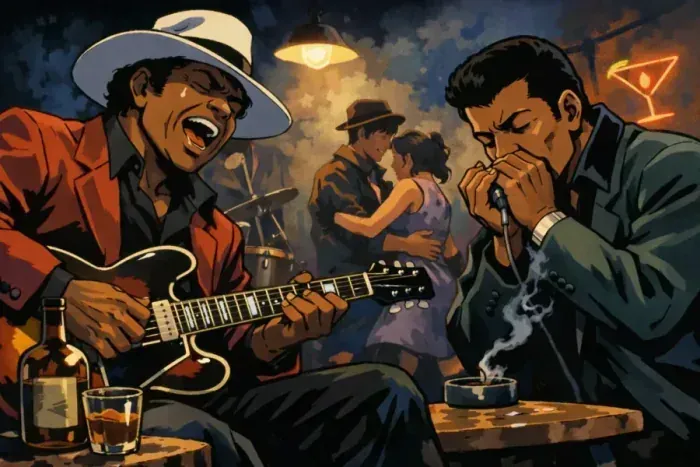
Blues: Where Heavy Music First Learned to Carry Weight
Before heavy music had genre names or scenes, it already had a job. It had to hold pressure that ordinary speech could not always hold. The blues did not begin as a market category or as music built to impress through size. It grew out of Black life in the post-Emancipation South, where debt peonage, hard labor, family separation, forced movement, and racial terror shaped daily life. Long before heaviness became a style, the blues had already turned pressure into sound.
The blues belong at the start of this story. They taught later music what weight could sound like. A bent note could hit harder than a clean one because you could hear effort inside the pitch. Repetition did not flatten the message. It gave feeling time to land. Silence, drag, and held-back timing were not technical limits. They were part of the form.
Later genres added amplification, speed, larger rhythm sections, and stage spectacle, but they kept reaching for the same core tools. Heavy music still returns to a question the blues asked early: how much lived pressure can sound hold before it breaks? Once that question was in place, the story could widen from solitary testimony to groove, movement, and collective force.
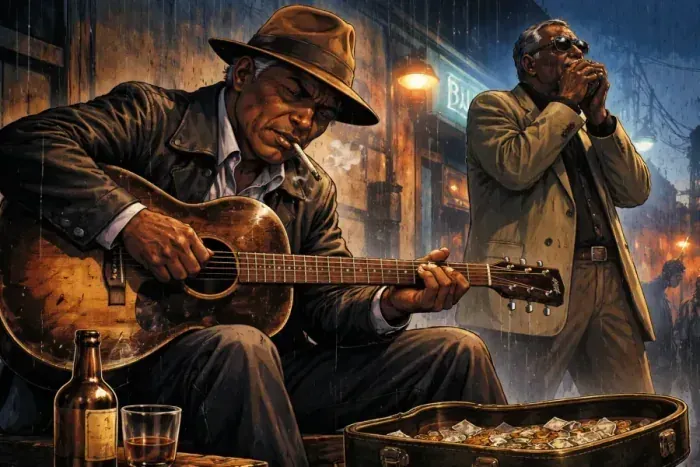
Early Blues: Sparse Sound, Heavy Pressure
Early blues recordings can sound spare, but the spareness is deceptive. One voice, one guitar, and one repeating figure may look minimal on paper, yet the form can carry a great deal of tension. The blues did not grow from comfort. It grew as a way to hold grief, fatigue, desire, wit, and endurance in public when political power and economic security were routinely denied.
Early blues often worked as testimony as much as entertainment. Songs did not need polish to feel complete. They needed enough shape to make experience legible. Repetition mattered because work, travel, debt, and loss were repetitive too. Small changes in pitch, phrasing, or timing mattered because they marked emotional difference inside conditions that could otherwise feel fixed and crushing.
Robert Johnson is still buried under legend, but the records tell the more useful story. His 1936 San Antonio session and 1937 Dallas session captured a Delta style that could move quickly while still sounding uneasy. “Cross Road Blues” and “Hellhound on My Trail” do not need loudness to feel heavy. Their weight comes from pacing, unstable motion, and the sense that something is closing in just outside the words.
Women were just as central to that authority. Bessie Smith’s first Columbia release in 1923 sold more than 800,000 copies in six months and established her as a major force in the Black record market. Her voice was large, controlled, and direct without turning sentimental. She showed that strength in song did not require distance from suffering. It required command over pacing, diction, and how much pain to let through.
What links these early artists is not one fixed style, but one shared use. The music faced experience without sanding it down. Later genres added distortion, speed, and attack, but the core idea stayed intact: sound could carry pressure when ordinary speech and public institutions did not.
As the blues moved from rural settings into expanding urban centers, that logic did not disappear. It adapted. New instruments, louder rooms, and changing audiences changed how weight was delivered. The next phase does not replace the blues. It shifts the center of gravity toward rhythm, movement, and collective force.
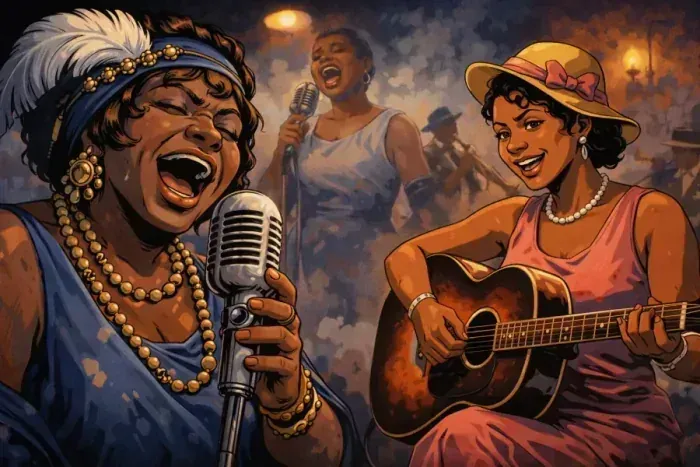
Ma Rainey, Bessie Smith, Memphis Minnie: Women Who Defined Authority
Any honest account of the blues has to include the women who set its public scale. Long before rock or metal talked about authenticity, women in blues showed how authority, humor, vulnerability, and command could live inside the same performance. They did not soften experience to make it easier to sell. They shaped it so listeners could feel it.
Ma Rainey treated the stage as a place of command. Her records could hold desire, anger, humor, self-protection, and sexual autonomy without apology. She could sound in control without sounding distant. Later heavy music keeps returning to that lesson: control often lands harder than excess.
Bessie Smith made that authority impossible to miss. She sang with size, precision, and emotional clarity, but she never sounded tidy or overprotected. Her recordings could feel public and intimate at the same time, which is part of why they still sound forceful now.
Memphis Minnie extended that authority through guitar work as much as through voice. She was respected as a guitarist, songwriter, and bandleader, and her records carried a rhythmic sharpness that later electric players built on. As blues performance moved into louder rooms, she adapted to amplification rather than treating technology as a threat to authenticity. Her career shows that technical control and emotional directness can sit together.
These artists mattered because of what they sang, but also because of how they worked. Women blues performers toured heavily, recorded often, and drew large paying audiences in the 1920s and 1930s. Later histories cut that role down, especially once the industry and later criticism shifted toward male guitar-centered origin stories. The sound of authority in heavy music did not begin with distortion. It began with artists who refused to make themselves smaller for the room.
Their songs also held an emotional range that later heavy genres had to relearn. Strength did not cancel vulnerability. Humor could sit beside anger. Desire did not erase exhaustion. When metal, hardcore, and metalcore later made room for ambivalence, grief, and contradiction, they were returning to patterns women in blues had already handled without much ceremony. "She showed me the air and taught me how to fill it."
As recording markets changed and electric blues grew more prominent, the industry’s center of gravity shifted with them. The lesson remained. Music could hit hard without becoming emotionally narrow. When the blues moved into cities and grew louder, it carried that lesson forward.
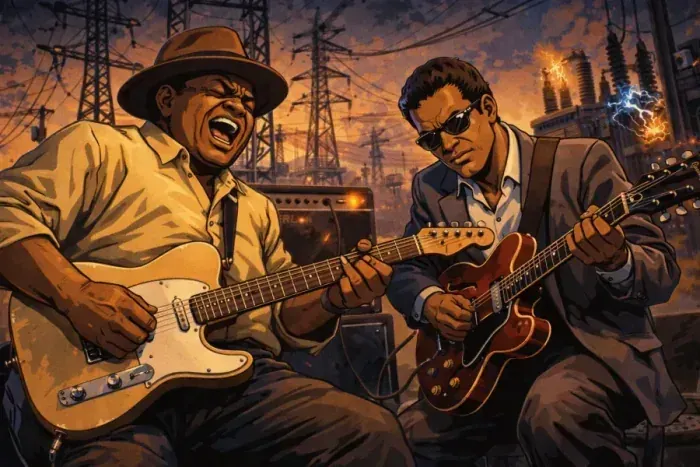
From Porch to Power Grid: When Blues Went Electric
As the blues moved from rural settings into cities, it ran into a practical problem: volume. Urban rooms were louder, more crowded, and less forgiving than porches, house parties, or open-air gatherings. Acoustic instruments that worked in close quarters could disappear in a club or bar. Electricity first solved that problem before it became a style in its own right.
The Great Migration drove that change. From the 1910s through the 1970s, about six million Black Americans moved from the South to cities in the North, Midwest, and West. They carried musical practices with them and reshaped urban culture along the way. In Chicago, Detroit, and St. Louis, the blues tightened, got louder, and landed more physically because city life was denser and venues demanded projection.
Muddy Waters sits near the center of that transformation. After leaving Mississippi for Chicago in 1943, he helped turn Delta blues into an urban electric language built for clubs, bandstands, and amplified rooms. On records such as “Hoochie Coochie Man,” the electric guitar did not smooth the blues out. It gave the music more edge and more reach.
Howlin’ Wolf pushed the same logic in a darker direction. His voice was bodily and rough, large enough to dominate a record before the arrangement had fully settled. Amplified, that force became unavoidable. Listeners heard grain, menace, and scale at the same time. He made discomfort sound chosen rather than accidental.
Electric blues also changed ensemble logic. Guitar, bass, drums, harmonica, and vocals started to lock together as a pressure system instead of a loose accompaniment. Heavy music would keep building on that lesson. It rarely comes from isolated virtuosity alone. It comes from groups learning how to land as one body.
The emotional core of the blues stayed intact, but the scale changed. Private experience became public force. Songs no longer belonged only to a singer’s room or memory. They began to work on clubs, neighborhoods, and whole local scenes. Once electricity made that shared intensity possible, rhythm moved closer to the center.
The Blues Blueprint: What Every Heavy Genre Inherited
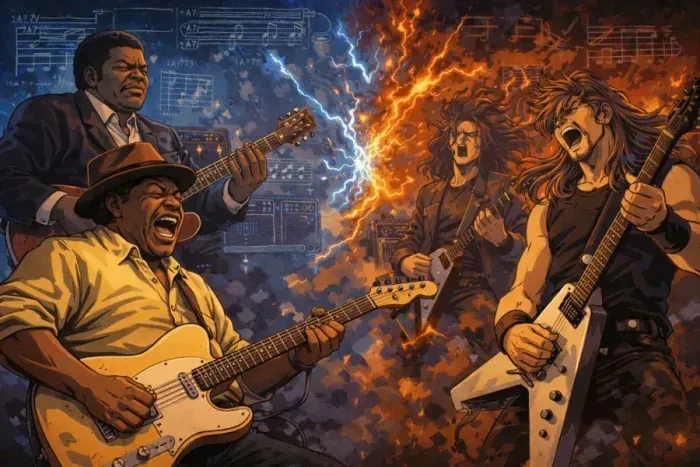
By the time the blues had adapted to urban life, its deepest contributions were already in place. The blues left behind more than songs, chord patterns, or a historical origin story. They also passed down a set of working methods that later heavy genres kept using, even when the surface no longer sounded recognizably blues-based.
The first is the link between repetition and tension. Blues phrases, riffs, and harmonic cycles return because repetition lets pressure gather. The listener is not waiting only for novelty. The listener is waiting for the weight to shift. Later riff-based music, from hard rock to doom to breakdown-heavy metalcore, still works that way.
The second is control. Early blues rarely tried to say everything at once. Silence, drag, and held-back timing mattered as much as the notes themselves. Many of heavy music’s most effective moments still depend on that. Power often comes from pacing, spacing, and withheld impact rather than nonstop escalation.
The third is vocal truth. In the blues, the voice is not decoration. It sounds like a body under pressure. Crack, rasp, stretch, and strain are not automatically errors. That attitude survives in metal, hardcore, sludge, and extreme styles, where delivery often matters more than polish.
The fourth is lyrical directness. Blues writing can use metaphor, but it usually keeps the stakes near the surface. Desire, fear, labor, betrayal, and survival are stated plainly enough to land. When heavy music turns away from fantasy and speaks toward lived reality, it is often returning to blues logic whether it names that debt or not.
Most importantly, the blues proved that music can carry weight without explaining it away. It does not always justify pain or tidy it into a lesson. It states it and lets the listener sit with it. That refusal to make experience easier than it is remains one of the clearest ethics of heaviness.
Once that foundation existed, the next shift did not need a new emotional core. It needed a new way to organize that core around movement. That is where gospel and rhythm and blues enter the story.

Gospel, Sanctified Energy, and the Sacred Roots of Force
The bridge from blues to later heavy intensity does not run only through work songs, secular performance, and urban nightlife. It also runs through gospel. In Black church traditions, music already carried volume, collective energy, rhythmic insistence, and emotional release long before rock or metal treated those qualities as force.
Gospel changes the shape of the pressure. Where blues often frame endurance inside ordinary pain, gospel turns strain into public release and transformation. Handclaps, shouted replies, repeated lines, rising dynamics, and call-and-response show how repetition can build intensity until a whole room changes with it.
Heavy music is not only about darkness or aggression. It is also about escalation, release, and bodies moving together toward a shared peak. Sanctified performance had already worked out that mechanism. The voice could crack, the tempo could push, and the group could answer the lead with force rather than decorum.
Sister Rosetta Tharpe stands at the center of this bridge. Her gospel singing, electric guitar playing, and crossover success showed that sacred intensity and amplified attack did not have to live in separate worlds. Her 1944 recording “Strange Things Happening Every Day” is widely credited as the first gospel record to cross over and become a hit on Billboard’s race chart, the precursor to the later R&B chart, and it points clearly toward rock and roll. She made it easier to imagine music that could be devotional, rhythmic, and physically thrilling at the same time.
Gospel does not sit beside the story as a parallel tradition. It helps explain why later popular music could sound urgent without losing conviction. By the time rhythm and blues took shape, a model for collective release, rising tension, and response was already in place.
Rhythm & Blues: When Music Learned to Move
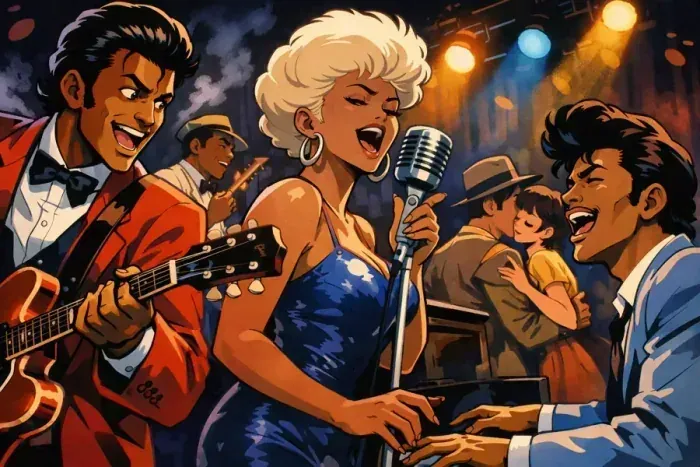
As blues moved into larger rooms and denser cities, rhythm moved closer to the front. The weight was still there, but it no longer stayed inside private reflection alone. It began to move through bodies in real time. Rhythm and blues remained deeply tied to blues practice, but it reorganized that inheritance around motion, timing, and shared physical space.
R&B was also an industry label. In 1949, Billboard replaced the chart label “race records” with “rhythm and blues.” The new term did not create one uniform sound overnight, but it did mark a new commercial frame for Black popular music built around groove, directness, and urban life.
In clubs, dance halls, jukebox routes, and radio studios, songs had to land fast. They had to cut through noise, fatigue, and distraction. Drums and bass supplied the first impact. Songs became shorter, tighter, and easier to feel on contact. The music did not become emotionally lighter. The route into the emotion changed.
R&B also changed who the music was for and how it traveled. Independent labels, local radio, touring circuits, and regional scenes tied it to everyday life. It spoke to workers leaving long shifts, to crowded neighborhoods, and to younger audiences who wanted sound that felt alive in the present. The body was no longer incidental to listening. It became part of the meaning.
Heaviness does not disappear here. It relocates. Pressure now travels through groove instead of stillness, through repetition built to move a room rather than hold one person in place. That change opens the path toward rock and roll, where music becomes both feeling and social identity.
Tightening the Groove: How R&B Brought Blues to the Dance Floor
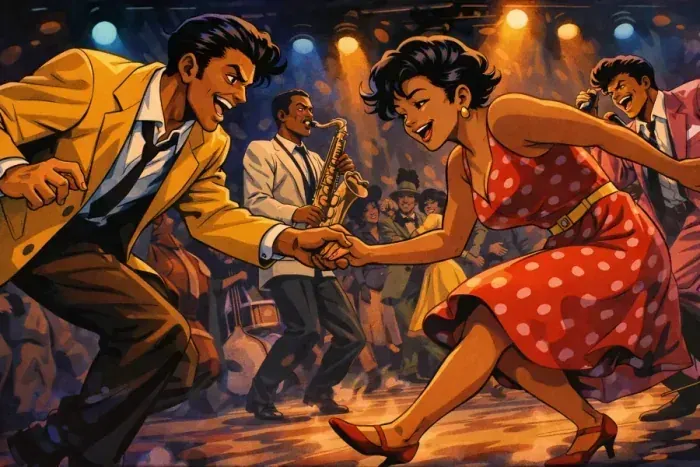
Rhythm and blues did not replace the blues. It tightened the form. The beat moved closer to the center, songs shortened, and momentum became part of the message. Subject matter often stayed familiar, but the delivery changed. Feeling now had to move as well as speak.
Rhythm became structural rather than supportive. Drums and bass did not just accompany the song. They set the emotional ground before a lyric arrived. In loud public spaces, music had to make contact immediately. R&B answered that demand by making groove the first point of contact.
Vocals changed with it. Singers still carried blues directness, but they phrased more tightly against the beat, and call-and-response patterns became more compact and rhythmic. The voice began to lock into the band rather than hover above it. Feeling became shareable.
Ray Charles is a clear example of that balance. His early Atlantic records fused blues phrasing, gospel intensity, and rhythmic drive into a language that felt urgent without coming apart. The songs did not rely on speed alone. They built pressure by keeping the groove alive bar after bar.
Heavy music would keep returning to the same tension. The more a genre expands, the more it has to decide what it will keep rough, intimate, or difficult.
R&B also clarified an idea that later heavy genres still depend on: repetition can intensify experience rather than weaken it. The chorus returns quickly. Instrumental figures are built to keep force circulating. The goal is sustained energy and response, not decorative complexity.
Once music learned how to organize a room through groove, it was close to becoming a visible social force. That is where rock and roll begins.
Who Got Heard: When the Industry Picked the Sound
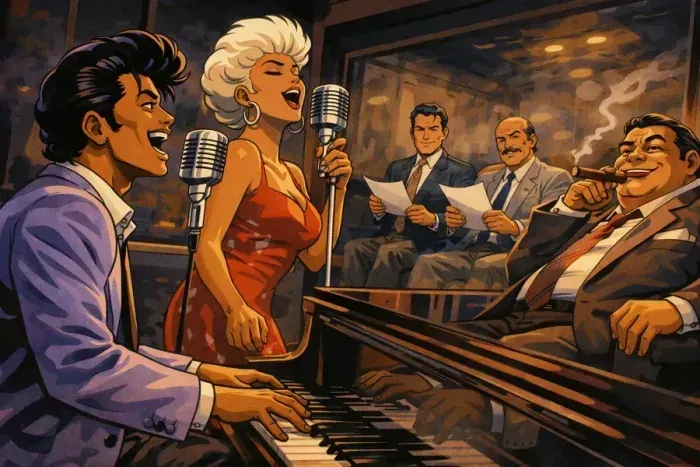
As rhythm and blues grew, the industry began steering its circulation more aggressively. Labels, promoters, distributors, and radio programmers gained more control over which voices would travel nationally and which would stay regional. The sound itself still carried pressure, but visibility no longer moved on equal terms.
Independent labels were vital to the genre’s rise. They recorded quickly, moved records through local networks, and stayed close to everyday listening habits. But those systems were fragile. Once larger companies recognized the market, they brought stronger distribution, cleaner branding, and tighter gatekeeping. The sounds that fit commercial expectations most neatly were usually the ones pushed furthest.
Big Mama Thornton remains one of the clearest examples of how that imbalance worked. Her 1953 recording of “Hound Dog” was a major R&B hit that spent seven weeks at No. 1 and helped lay groundwork for rock and roll. Yet the song’s later crossover life brought far greater mainstream reward to Elvis Presley than to Thornton herself. The issue was not influence alone. It was market access: who got carried into the center and who did not.
That pattern shaped more than a single career. It changed how wider audiences encountered R&B. Rough edges, local textures, and social realities were often softened in translation. The emotional pressure was still there, but it was increasingly repackaged for broader consumption and cleaner marketing.
Women faced even steeper obstacles in that system. Many had helped define the sound, but their visibility narrowed as the industry built more marketable public narratives around other performers. The pattern returns throughout heavy music history: women help build the form, but later storytelling often cuts down how central they were.
This period leaves one lesson in plain view. Genre shifts are also struggles over distribution, ownership, and recognition. R&B had already created the rhythmic and emotional conditions for rock and roll. Industry selectivity helped decide who would become its public face.
Feel It in Your Chest: When Rhythm Took the Lead
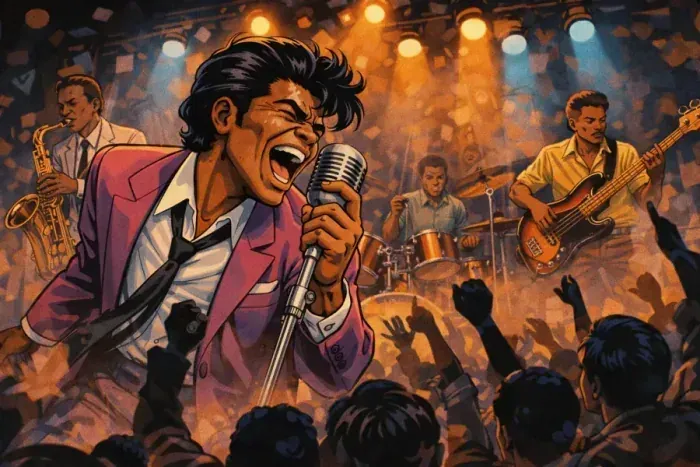
As rhythm and blues spread through clubs, dance halls, and radio, the rhythm section began to determine how people felt a song before they had time to interpret it. Drums and bass were no longer quiet support. They became the center of gravity.
That physical focus changed the relationship between performer and audience. A groove that worked did not simply accompany the room. It organized the room. Timing mattered more than display. Songs that failed to move bodies disappeared quickly from jukeboxes, dances, and local circulation.
Artists who understood that shift fixed it in place. Fats Domino built warmth and bounce through piano-led repetition. Bo Diddley made rhythm itself into a signature by leaning on a clave-derived beat that reduced songs to pulse, stance, and insistence. Rhythm could now carry attitude before a lyric explained anything.
The lesson carries forward. In heavy music, riffs and breakdowns often say something before the lyrics do. R&B established that music could create urgency, defiance, and shared tension through physical design alone.
Movement also made the form easier to travel. Listeners did not need to parse every lyric to feel the song. Once sound could organize bodies across rooms, regions, and local scenes, it was ready to become a broader social marker. That is the threshold rock and roll crosses.

Rock 'n' Roll: The Teenage Revolution
When rhythm and blues crossed into wider public life, it carried more than a strong beat. It carried attitude, mobility, and visible social friction. Young listeners heard a sound that made inherited rules feel less fixed. What began as shared movement became shared identity. Rock and roll did not appear out of nowhere. It formed when that charge no longer fit inside older categories.
The shift was about ownership as much as sound. Teenagers claimed the music as their own while broadcasters, civic authorities, and record companies tried to clean it up for safer consumption. Guitars cut harder outlines. Voices moved further forward. Performers crossed lines of race, class, gender presentation, and public behavior in ways that made music newly visible in daily life.
Songs turned into badges. A record could mark which side of a generational divide someone stood on. Dancing was pleasure, but it was also public behavior, and that behavior carried social meaning.
Rock and roll was never just a neatly bounded genre. Rhythm, visibility, and conflict fused into identity. Once that happened, music could no longer pretend to be socially invisible or neutral.

Too Loud for Adults: Why Rock 'n' Roll Scared the Establishment
Rock and roll did not enter public life quietly. Its disruptive force came partly from the mix of rhythm and blues, gospel, country, and jump-blues energy, and partly from the unease that mix created. Adults who wanted clear cultural boundaries did not get them.
Chuck Berry made the new language sharp and easy to hear. His riffs were concise, driving, and central to a song’s identity, while his lyrics gave teenage life a direct public voice. Cars, school, desire, boredom, and frustration became subjects worthy of the stage rather than details adults could dismiss as trivial.
Little Richard pushed the confrontation further. His records were loud, flamboyant, rhythmically explosive, and unapologetically physical. He did not simply perform songs. He put pleasure, excess, and refusal onstage in ways that made mid-century respectability look brittle.
The reaction was immediate. News coverage, church groups, school officials, and civic commentators often framed rock and roll as corrupting or dangerous. Much of that fear was racial. Black musical practices were reaching white youth audiences at scale, and with them came imitation, admiration, and panic. The music crossed social boundaries long before it presented itself as an explicit political program.
That sense of danger also helped it spread. Attempts to ban dances, condemn radio programming, or police stage behavior only confirmed that the music mattered beyond entertainment. Heaviness changes here. It becomes public confrontation as much as emotional weight or bodily rhythm.
The pattern repeats throughout the history of heavy music. Once a sound becomes tied to identity, it usually triggers resistance. Rock and roll did not solve social conflict. It made that conflict audible and visible.

Gender Panic: The Women Who Rocked the Rules
From the start, rock and roll unsettled ideas about gender and performance. Women were not spectators to that disruption. They helped build it. Their presence turned sound into public behavior.
Sister Rosetta Tharpe is essential here. Her amplified guitar work and gospel force formed a bridge between sacred music, R&B, and what later audiences would recognize as rock performance. Later histories often blurred how central that contribution was, but the basic point is simple: she made loud, forceful guitar playing by a woman visible long before the industry knew what to do with that fact.
Wanda Jackson brought a different challenge. Her voice had grit, edge, and a deliberate attack that cut against the softer roles women were often expected to play in 1950s pop. She did not sound ornamental, and she did not present authority as borrowed masculinity. She sounded like someone taking public space on her own terms.
Public reactions to women in early rock and roll often centered on moral panic. Clothing, movement, confidence, and vocal intensity were scrutinized in ways that male performers rarely faced on the same terms. Rock and roll did not create those double standards, but it made them easier to see. "As one of the first women to really play hard rock & roll."
Later heavy music kept running into the same issue. One of the longest-running myths in heavy genres is that force naturally belongs to masculine presentation. Early rock had already disproved that. Authority could be expressive, emotional, and visibly embodied without becoming less forceful.

From Jukebox to Movement: How Rock Built a Generation
As rock and roll spread, momentum became part of its meaning. Songs moved fast from jukeboxes to radio, from local scenes to national circulation, and from novelty to everyday habit. The single fit that expansion perfectly: brief, direct, cheap to replay, and easy to carry into daily life.
Radio drove the change. Disc jockeys willing to cross stylistic boundaries introduced rock and roll to listeners who might never have heard it live. Package tours reinforced that reach by linking scenes that had previously developed locally. A generation of listeners could now hear itself in the music and in one another, even across distance.
Elvis Presley became one of the most visible symbols of that expansion. His importance is best understood as catalytic rather than foundational. He helped carry Black musical influences, especially R&B, into a wider white mainstream market, but he did not invent the language he popularized. The sound, the pressure, and the social friction were already in place before he became its biggest mainstream face.
Rock and roll also crossed borders early. By the late 1950s and early 1960s, it had taken root in Britain, Australia, and parts of Latin America, where local musicians translated it rather than merely copying it. That early spread is a reminder that heavy music rarely follows one single route. It grows by adaptation.
By the end of this phase, rock and roll was more than a disruptive youth style. It had become a durable reference point. Success created a new desire inside the music: not only to move fast, but to last. Once that ambition took hold, the single was no longer enough. Rock wanted larger forms, larger statements, and more control over time.

Classic Rock: When Rock Became Art, Myth, and Spectacle
When rock and roll settled into everyday life, it widened and slowed. The early jolt did not vanish, but it tilted toward ambition. Artists wanted more room, and audiences were willing to follow them beyond the three-minute single. Classic rock grew out of that expansion. It was less a clean break than a gradual change in scale, purpose, and self-image.
The album became the new center of gravity. Songs no longer had to stand alone. They could answer one another, build atmosphere across a sequence, and hold contradictions over longer stretches of time. Studios changed function too. They stopped being mainly places to document performance and became places where performance could be cut, layered, manipulated, and rebuilt. Rock began to treat the record itself as the finished work.
That shift brought real gains. Bands could think in longer forms. Listeners could hear a release as a statement with its own internal logic rather than only as a bundle of songs. Loudness, quiet, experimentation, and accessibility no longer had to cancel one another on contact. Tension could be stretched instead of spent at once.
But the center narrowed as it grew. Major labels invested more heavily in artists they believed could sell albums at scale and fill larger stages. Rock musicians were no longer clear outsiders. They were being turned into durable public figures, and that created new hierarchies of taste, image, and legitimacy.
Classic rock carries both expansion and exclusion. It gave rock greater formal range, but it also helped canonize a narrower image of who counted as serious, visionary, or central. The next phase responds to musical excess, but also to the distance and hierarchy that success had built into the form.

Three Minutes Wasn't Enough: When Albums Became Masterpieces
The move from singles to albums changed how rock handled time. A song no longer had to state its case and leave immediately. Ideas could unfold, return, contradict one another, or gain meaning from where they sat inside a larger sequence. Listening became more sustained, and records were increasingly heard from beginning to end rather than only as isolated hits.
The Beatles were central to that shift. By the mid-1960s, they were using the studio not simply to capture songs, but to reshape them through tape editing, overdubs, unusual instrumentation, and arrangement choices that could not be reproduced easily onstage. That did more than expand the palette. It changed the idea of authorship. The record itself became part of the composition.
The Rolling Stones pushed a different version of the same expansion. Their albums often stayed closer to blues-based grit, repetition, and menace, but they also treated sequencing and atmosphere as essential. The point was no longer only the single strong song. It was the larger world a record could build around it.
The album format also changed what musicianship could mean. Extended solos, dynamic contrasts, and gradual builds became easier to justify when songs had more space. Jimi Hendrix is crucial here. Feedback, distortion, wah, and improvisation no longer sounded like accidents at the edge of control. They became deliberate ways of shaping texture and tension across an entire recording.
This expansion made rock richer, but it also made it less immediately open. The album-as-art model favored artists with access to time, money, studio experimentation, and label support. As budgets grew, so did hierarchy. Size began to carry prestige of its own.
Even so, the gains were substantial. Albums allowed rock to place loud tracks next to fragile ones, aggression next to reflection, and ambition next to intimacy. Heavy music would later depend on that ability to stretch and manage tension over time rather than spending all its force at once.

The Ceiling That Lowered: Women in Rock's Golden Era
As classic rock consolidated its prestige, women faced a sharper contradiction. Their contributions remained substantial, but the systems that defined seriousness in the genre increasingly favored images of mastery, control, and durable authorship coded as male. Albums, long tours, and studio-centered careers created new forms of opportunity, but they also narrowed the routes through which authority was recognized.
Janis Joplin confronted that narrowing directly. Her voice sounded frayed, urgent, and fully embodied. Instead of treating emotional exposure as a weakness, she made it central to artistic force. That cut against a growing assumption in rock criticism and industry culture that seriousness had to look controlled, detached, and masculine.
Grace Slick represented another form of authority. Her voice was clear, cutting, and structurally essential inside ambitious band arrangements. She did not sit at the edge of the form. She stood in its center. In a culture that often treated women as symbolic additions, that mattered.
The wider industry, however, often reduced women to image, temperament, or novelty. Media coverage followed personality and scandal more readily than musicianship or composition. Access to studio budgets, long-term promotion, and canonical status remained uneven. As rock became more institutionally powerful, it also became more selective about who was allowed to embody that power.
That narrowing had consequences well beyond the 1960s and 1970s. Once classic rock became a reference point for seriousness, it shaped who later histories treated as foundational. Women were never absent from the story, but they were often pushed toward its edges. Hard rock and metal would inherit that pressure, then either repeat it or push back against it.

When Bigger Stopped Being Better: The Era of Excess
As classic rock moved into arenas and long careers, bigness became part of the aesthetic: bigger amps, bigger drum kits, thicker guitar tones. Size was no longer only the result of success. It started to read as proof of seriousness.
Virtuosity moved to the foreground. Extended solos, technical endurance, and exactness were increasingly treated as evidence of commitment. There was real craft in that shift. Players developed new control over tone, timing, and large-form arrangement. But the more rock learned to display mastery, the more easily mastery could harden into distance.
Spectacle grew with it. Songs written for arenas needed projection, stamina, and visual scale more than subtle phrasing. The audience relationship shifted too. The gap between performer and listener widened physically, financially, and emotionally.
Weight started to mean something different. Heaviness attached itself to size, duration, and surface impact rather than only to tension, grit, or control. The music could sound huge while leaving less room for contrast. When nearly everything is emphasized, the difference between force and inflation gets harder to hear.
Excess followed. Larger tours required larger budgets, larger crews, and more visible personas. Freedom and indulgence became part of rock mythology, but so did isolation, overwork, and self-destruction. The culture celebrated expansion while often ignoring what that expansion cost.
Those pressures set up the next turn. Some musicians and listeners wanted something that felt grounded again, less ornamental and more physically necessary. Hard rock emerges from that dissatisfaction. It does not simply get louder. It makes weight feel closer to labor, fear, friction, and the body.

Hard Rock: When Riffs Replaced Romance
As classic rock grew larger, a counter-pressure built inside it. Technical ambition, expanding albums, and stadium scale created real gains, but they also made some listeners feel that display was overtaking force. Loudness could impress without landing. Skill could drift away from physical immediacy.
Hard rock answers that tension by compressing the sound. The music pulls inward and down. Riffs get heavier, tempos settle into bodily weight, and songs aim less at grandeur than at impact. The riff moves closer to the center of meaning.
The emotional register shifts with it. Hard rock foregrounds friction, desire, frustration, and threat rather than transcendence. The blues foundation is still there, but buried deeper under distortion and volume. Where classic rock often reached upward toward myth, hard rock locks back onto the body and its limits.
Place matters here. Industrial cities, economic uncertainty, postwar labor culture, and working-class experience all shaped the music’s feel. Hard rock is rarely about effortless freedom. It is more often about endurance, frustration, and the strain of getting through.
This is the point where weight stops feeling like a side effect and becomes a primary value. Presence matters more than polish. From here, heavy metal is close.

The Riff Takes Over: When Guitar Became King
Hard rock becomes unmistakable when the riff stops acting like decoration and becomes the spine of the song. It repeats, insists, and fixes the track’s center of gravity. Melody still matters, but it no longer makes the final decisions. The riff does.
Led Zeppelin were crucial to that change. Their music kept deep blues roots while pushing toward greater density, repetition, and bodily pull. Even at their most expansive, key tracks are held together by riffs that build pressure rather than decorate a chorus. Jimmy Page’s guitar often works less like accompaniment than like structure.
Deep Purple sharpened related ideas through attack, speed, and tightly coordinated ensemble playing. Guitar and organ did not hover around the song. They drove it. Solos still had space, but the larger goal was concentrated impact.
That shift changes what desire and conflict sound like. In hard rock, both feel more immediate and less idealized. The song does not reach upward toward myth so much as lock itself into friction, insistence, and heat.
Listeners feel that change physically. A repeated riff asks the body to stay inside weight instead of waiting for quick release. That sensation becomes one of hard rock’s clearest inheritances to metal.

Forged in Factories: How Industrial Life Gave Metal Its Sound
Hard rock turns more severe when darkness stops feeling theatrical and starts sounding tied to ordinary material conditions. In industrial settings, labor is repetitive, dangerous, loud, and exhausting. Under those conditions, heaviness is part of daily life, not just a mood.
No band crystallizes that shift more clearly than Black Sabbath. Birmingham’s industrial environment matters here as context, not as romantic myth. The music feels compressed, claustrophobic, and slow-churning rather than expansive. The riffs do not open space. They close it in.
Tony Iommi’s playing is central to that sound. After losing the tips of two fingers in a factory accident at age 17, he altered his setup and technique, using lighter strings and lower tuning to keep playing. The heavier, darker result shows how material constraint can shape form directly. Early metal did not become heavy through artistic ambition alone. It also became heavy through physical adaptation.
Black Sabbath’s lyrics reinforced that turn. Fear, war, paranoia, and moral collapse were treated without much ironic distance. The music did not merely describe dark themes. It embodied them. That alignment between subject and texture helps explain why the band became so foundational. "We've already influenced a lot of bands."
From here, heaviness is no longer just about amplification or stage scale. It becomes density, restraint, repetition, and unease. That combination is one of the clearest routes from hard rock into metal proper.

Beyond Borders: How Hard Rock Became a Global Language
As hard rock became heavier, it also became easier to carry across borders. The core ingredients did not depend on one accent, one local mythology, or one social class. Repeated riffs, strong live impact, and a clear sense of physical weight made the style portable without making it identical everywhere.
In continental Europe, bands such as Scorpions showed how hard rock could combine melodic clarity with disciplined force. In Japan, Loudness showed how the style could be sharpened through precision, speed, and technical commitment. These were not simple copies of an Anglo-American template. They were local answers to the same problem: how to make amplified weight feel focused and durable.
Other regions translated the form through their own live cultures and pressures. In Australia, pub-rock intensity favored directness and stamina. In parts of Latin America, harder rock idioms became tied to youth identity, frustration, and the search for public space under difficult political or economic conditions. The details changed, but the function stayed recognizable.
That spread prepared metal to become a global language rather than a strictly regional one. By the time heavy metal is clearly named and stabilized, many of its basic tools are already circulating internationally. Scenes begin to form in parallel, and heaviness proves unusually adaptable across borders.

How Technology Changed Heaviness
Heaviness is never only cultural. It is also technical. Every major shift in heavy music depends on tools that change what a band can make a room feel. Amplified guitars let notes hang longer and cut through louder spaces. Overdriven tubes, speaker breakup, fuzz boxes, and later distortion pedals turned roughness into something musicians could control rather than merely endure.
Recording changed the equation as much as live gear did. Close-miking, multitracking, and heavier drum and guitar production let bands build a denser, more focused impact than earlier methods allowed. A riff no longer had to sound distant or thin on record. It could feel heavy before it ever reached a stage.
Tuning and instrument design mattered too. Lower tunings increased physical weight, while stronger amplification and sturdier hardware made that weight usable in performance. Bass and kick drum also gained a new role. They stopped functioning only as support and began to shape the listener’s sense of impact in the body.
This technical history does not replace the emotional one. It explains how emotional ideas could be made larger, denser, and more repeatable. Technology gave heaviness a physical grammar. It let pressure be reproduced with more force and more control from one venue, one recording session, and one generation to the next.
By the time heavy metal became a self-aware identity, the tools themselves had become part of the style’s language. Heaviness was now something musicians could design as well as feel.

Heavy Metal: When Heaviness Became Identity
Hard rock eventually stopped feeling like a bridge. The music no longer needed to point back toward blues or lean on spectacle to explain itself. Heavy metal named its own language and built its own standards for what counted as serious.
Clarity starts to matter here. Distortion is shaped rather than smeared. Tempos and structures become more deliberate. Themes like war, fantasy, history, endurance, and alienation add scale without removing pressure. Metal does not soften struggle. It gives struggle a larger frame.
Community matters as much as sound. Fans recognize each other through records, clothing, symbols, logos, and shared knowledge. Belonging is built into the genre’s structure. That helps explain why metal can survive cycles of mainstream attention better than many adjacent styles.
Metal also draws sharper boundaries than earlier rock. Those lines help protect identity, but they also set up later fights over authenticity, authority, and exclusion. The music stabilizes at the same time its social tensions become more visible.

Sharper, Faster, Stronger: When Metal Got Precise
Metal moves forward once precision starts to matter as much as raw power. Riffs become more composed, ensemble playing tightens, and drums and bass lock into a deliberately engineered force. Heaviness becomes more exact.
That change is especially clear in the late 1970s and early 1980s, when the New Wave of British Heavy Metal brought faster tempos, sharper definition, and stronger scene identity. Iron Maiden expanded metal’s sense of scale without losing momentum. Melody still mattered, but it now worked inside a more disciplined frame.
Judas Priest clarified a different side of the same shift. Their riffs were concise, the attack cleaner, and the presentation more streamlined in every sense. That helped separate heavy metal from looser, more overtly blues-based hard rock.
Speed mattered because it raised urgency without relying only on volume. Precision mattered because it made the band sound less like a jam and more like a machine built for impact. The result was a genre that felt increasingly self-aware and self-defining.
Those stronger formal boundaries made metal durable, but they also intensified later questions about authenticity, authority, and access. Once a genre knows more clearly what it is, it also starts arguing more loudly about who belongs inside it.

Women in Metal's Early Years: Proving Heaviness Has No Gender
As heavy metal became more defined, the place of women within it became both more visible and more contested. The genre’s ideals of discipline, force, and endurance did not exclude women by nature. The surrounding institutions often did.
Girlschool are essential here. Emerging alongside the New Wave of British Heavy Metal, they played with speed, toughness, and credibility that made it difficult to dismiss them as a novelty. Historically, that matters because they made it harder to pretend heaviness belonged naturally to men. Women were part of metal’s formative public image, not late additions to a finished story.
Doro Pesch marks another important step. Her work with Warlock and later under her own name gave heavy metal one of its clearest long-term examples of female-fronted authority inside the genre’s core vocabulary. She did not need to stand outside the form to challenge it. She stood inside it and widened its terms.
Women in early metal were often framed as exceptions rather than participants. Yet the scene depended on far more labor than what happened in front of a microphone. Women contributed as musicians, managers, promoters, label workers, writers, and organizers even when official histories narrowed their focus to a handful of male stars.
The barriers were real. Media coverage often treated women as visual anomalies before it treated them as musicians. Authority was tested sooner and mistakes were judged more harshly. Even so, the persistence of women in early metal expanded what the genre could sound like and who later listeners could imagine at its center. The point was never that heaviness had suddenly changed. It was that the old gender claim about who could embody it looked weaker each time women proved otherwise in public.
Doom, Sludge, and the Slow Weight of the Blues
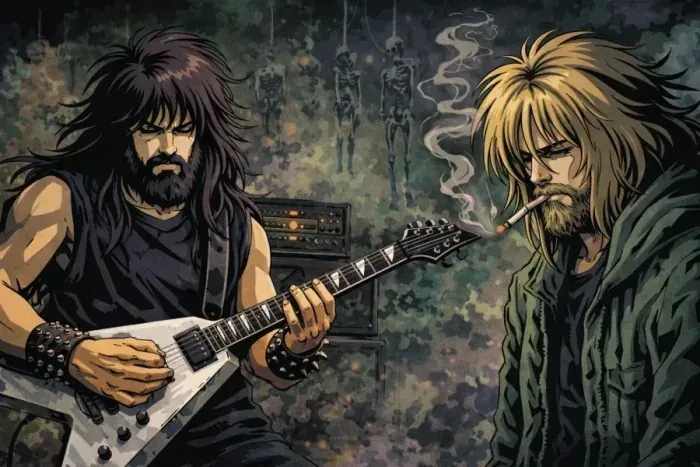
Not every path toward extremity sped up. Another major line of heavy music slowed down and deepened. Doom metal took the drag, repetition, and minor-key dread already present in Black Sabbath’s heaviest moments and treated slowness itself as a source of pressure. A riff could weigh more simply by lasting longer.
Doom keeps the blues inheritance audible. It rarely sounds like Delta blues on the surface, yet it still relies on repetition, strain, and a bodily sense of drag. The effect comes from staying inside weight long enough for it to turn inescapable. More than almost any later heavy style, this line preserves the blues logic of drag: pressure gathers because the music refuses to hurry past it.
Later sludge scenes made that same logic rougher and more abrasive by pulling in punk and hardcore textures. The tempos often stayed slow, but the sound grew dirtier, harsher, and more exhausted. Heaviness no longer pointed only to grandeur or menace. It could also suggest labor, collapse, addiction, or psychic corrosion.
This slower route shows that heavy music never had one single answer to pressure. Thrash would accelerate. Death metal would densify. Black metal would thin the sound into atmosphere. Doom and sludge, by contrast, built heaviness by refusing to move past pain too quickly. In that sense, they keep one of the oldest blues lessons alive.
More Than Music: When Metal Became a Lifestyle
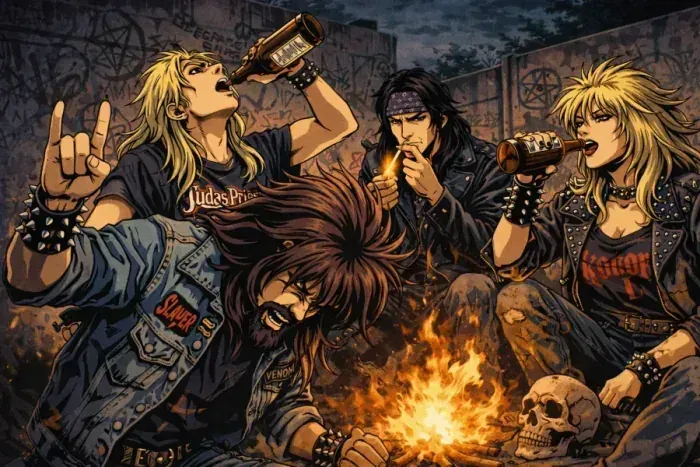
As heavy metal’s sound stabilized, it also became a way of life. Casual listening was no longer enough. Participation mattered. Fans collected records, traded tapes, read fanzines, debated lineups, and organized parts of daily life around the music. Metal became a social world, not just a style.
Before digital platforms made contact easy, scenes survived through effort. Fanzines carried interviews, reviews, and local reports. Tape trading pushed demos far beyond official distribution. A rehearsal-room recording made in one country could affect musicians in another within months. That circulation built connection without a single shared center. Commitment mattered more than convenience.
Live shows gave that network a physical home. Clubs, halls, and small venues kept bands and audiences in close contact. Musicians were often fans first. Fans became promoters, writers, road crew, or players themselves. The line between stage and floor was rarely absolute, and scenes survived because people kept doing work that labels, venues, and local institutions often would not do for them.
Metal’s codes extended beyond sound. Logos, patches, flyers, album art, and shirts acted as signals of belonging in spaces where the music itself was absent. These markers did not just express taste. They made affiliation visible.
That networked structure made metal unusually durable. Even when mainstream attention thinned out, scenes did not disappear overnight. They reorganized, adapted, and kept circulating music through informal channels. Independence became both a necessity and a point of pride.
Strong networks can also harden into gatekeeping. As the scene matured, rules around authenticity, taste, and belonging often grew stricter. Loyalty to the past could protect the culture, but it could also narrow it. That tension between preservation and growth gets sharper once metal pushes toward its most extreme forms.
For many listeners, metal as a way of life offered more than entertainment. It offered structure, shared language, and meaning tied to experience rather than status. That social base helps explain why the genre can fracture, accelerate, and mutate without losing its core identity. The next shift grows directly out of that stability.

Extreme Metal: When Heavy Music Pushed Past Earlier Limits
Once heavy metal knew itself, some musicians felt boxed in. The rules were solid, the communities strong, and the sound instantly recognizable. That security could feel like stagnation. Extremity arrived by pushing against a form that already had a name.
The next phase is escalation, but speed is only part of it. Tempos rise, vocals grow harsher, production turns more severe, and song structures buckle under added pressure. The aim is not polish for its own sake. It is intensity. Extreme metal asks how far sound, theme, and commitment can be pushed before they stop reading as ordinary entertainment at all.
Ideology moves to the foreground. Lyrics and imagery turn toward war, religion, death, social collapse, and cultural refusal. Some artists use those materials to confront fear or violence directly. Others use them to provoke, divide, or reject mainstream values. Whatever the motive, the result is similar: metal becomes less interested in broad appeal and more interested in drawing harder boundaries around what it is.
Community does not vanish, but it changes shape. Scenes get smaller, more committed, and often more suspicious of outsiders. Subgenres multiply, each with its own expectations and internal standards. What once united metal fans under a general banner now splits into more specialized worlds.
Thrash, death, and black metal emerge from that pressure in different ways. They are not minor detours. They are laboratories in which metal tests how speed, density, atmosphere, and ideology can each become a primary source of force. Yet those laboratories do not close the story. Once extremity divides into these different answers, heavy music faces a new problem: how to reconnect force with collective movement and emotional immediacy. That is why the later bridge through hardcore matters so much. It does not abandon extremity. It reorganizes it around the room, the body, and the social event of impact.

Thrash Metal: When Speed Became a Weapon
Thrash metal is speed under control. It takes heavy metal’s precision and tightens it with urgency, trimming anything that drags. The result is not chaos, but compressed pressure. Songs move fast because the form demands it. The sound feels immediate and unstable.
It emerged partly as a reaction to predictability. Faster tempos, tighter arrangements, and sharper attack opened room for greater risk. Riffs became short and percussive. Drumming shoved songs forward with relentless momentum. Vocals moved toward a rougher, shouted register with little interest in melodic comfort. The sound felt confrontational rather than theatrical.
Metallica helped define the balance between speed and structure. Their early songs move quickly, but they stay tightly organized. Sudden changes in direction keep the listener alert, and the tension comes from control under pressure rather than from disorder alone.
Slayer pushed the same logic toward a harsher edge. The riffs are sharper, the solos more chaotic, and the rhythm section more punishingly continuous. The goal is sustained discomfort, not complexity for its own sake. Fear and aggression are built into the form.
Thrash also gave speed a political function. Lyrics about war, state power, social decay, and nuclear anxiety found a natural match in music that felt urgent and unstable. The sound did not replace the message. It intensified it.
Scenes developed quickly, especially in places shaped by economic strain and political pressure. The San Francisco Bay Area became one of the genre’s best-known centers, but related sounds were emerging in Los Angeles, New York, Germany, and Brazil at nearly the same time. Tape trading and touring networks helped the style spread because its language was direct, forceful, and easy to adapt.
Thrash set a new standard: heaviness did not need slowness to feel weighty. Speed could carry pressure too. Once that idea was in place, the next question was obvious. What happens when the music becomes denser and more bodily as well as faster? That is where death metal begins.

Death Metal: When Heavy Music Turned Inward
Death metal takes thrash’s force and turns it inward. Thrash often centers politics, collapse, and speed. Death metal turns toward the body: decay, mortality, physical limits, and the feeling of being trapped inside matter. The music grows heavier by becoming denser and more unevenly weighted, not only by moving faster.
The change is immediate. Guitars drop lower, riffs thicken, and drums swing between blast-like intensity and slower, crushing passages. Vocals sink into a deep growl that makes delivery as important as literal clarity. Listening becomes a bodily experience. The music does not simply ask for movement. It bears down on the listener.
Death were central to defining the language. Their early work established the core vocabulary, while later releases showed that death metal could grow more intricate without losing mass or force. The form does not abandon structure. It rebuilds structure around density rather than forward drive.
Other bands pushed the physical aspect further. Cannibal Corpse used repetition and impact to overwhelm rather than invite. The goal was confrontation, and the heaviness was meant to feel excessive on purpose.
In Europe, another tone emerged. Swedish bands such as Entombed brought in a dirtier, rawer sound with a stronger punk edge. The result was still aggressive, but less clinical than some American approaches. That variation shows how death metal could adapt regionally while keeping its focus on bodily pressure.
Lyrics alone do not define the genre. What matters more is how the music treats the body as the place where pressure is registered. Death metal does not imply mortality from a distance. It names it, dwells on it, and strips away the comfort of abstraction.
That is where it decisively separates from thrash. You cannot accelerate your way through this kind of weight. Density replaces momentum. The music demands endurance more than reaction. Yet even here, a limit appears. Once heaviness becomes so fully tied to the body, some artists begin searching for a different kind of force: one based less on physical mass than on atmosphere, distance, and belief. That pressure helps explain the rise of black metal.
Black Metal: When Heaviness Meant Distance
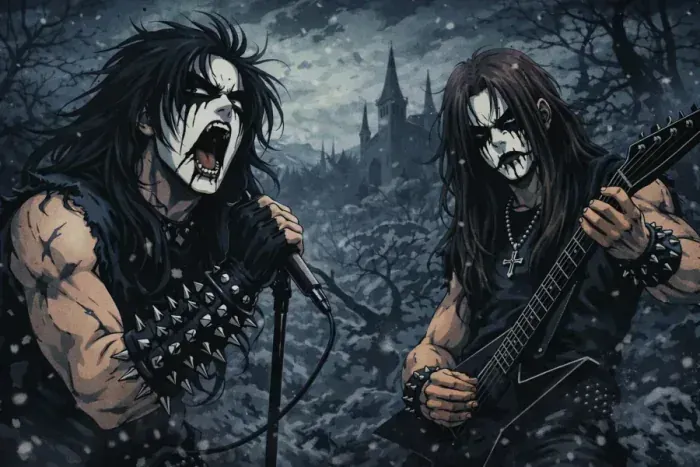
Black metal pushes extremity in a different direction. Where death metal centers the body, black metal uses sound to build atmosphere, belief, and distance. The music often feels empty and cold. It carries less physical weight, but it can still hit hard. Heaviness here comes from remoteness, repetition, and refusal rather than density alone.
The early Norwegian scene is the most visible reference point, not because it invented every element, but because it concentrated them into a particularly stark method. Bands like Mayhem and Darkthrone used raw production, tremolo-picked guitars, and sustained speed to create unease that felt intentional rather than unfinished. The sound lacks warmth. The drums move quickly, the guitars blur into sheets of sound, and the vocals seem far away and barely human. The effect is not welcoming. It keeps the listener at a distance.
Ideology plays a larger role here than in previous forms of metal. Themes draw on mythology, religion, anti-modern feeling, and the rejection of dominant cultural structures. Sometimes those ideas express alienation or resistance. In other cases, they are used more carelessly as provocation. The result is a scene marked by contradiction. Historical memory around black metal is also shaped by violence, crime, and media attention, even though those elements are not the music itself.
It helps to separate sound from scandal. Black metal does not need controversy in order to work. Its force comes from atmosphere, repetition, and intent. By stripping production down and leaning into sustained texture, it lets emotion remain suspended rather than openly resolved. Listeners are not guided toward comfort or closeness. They are left alone with distance.
Outside Norway, black metal developed in different ways. In France, Poland, and parts of South America, artists adapted the form to local history, landscape, and belief. Some bands turned toward ritual and interiority. Others emphasized history or place. Beneath that variety, the deeper method remained the same: using sound to create separation.
These approaches share a refusal of easy access. Black metal does not try to persuade. It builds boundaries and accepts that many listeners will remain outside them. That stance can create intense commitment, but it also limits expansion. The form survives through loyalty and internal conviction more than through broad appeal.
Black metal represents one extreme because it turns distance itself into force. Atmosphere matters more than impact at close range. Separation matters more than invitation. It pushes metal to a point where sound, identity, and ideology begin to fuse. After that, it gets harder to escalate by withdrawal alone. The next transformation will come by moving some of that force back toward contact, bodies, and shared impact.
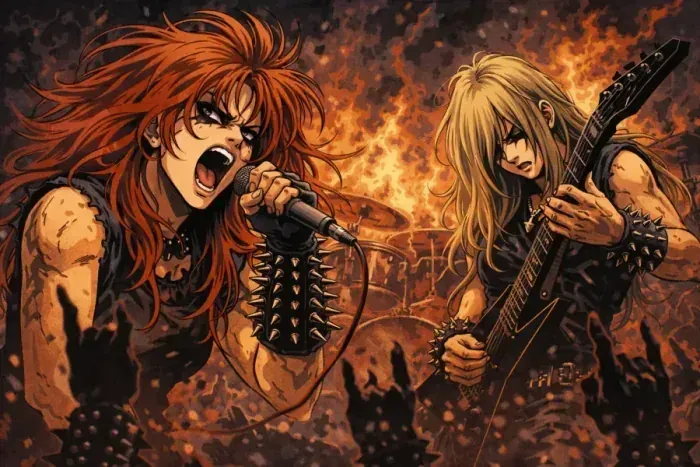
Beyond the Margins: Women in Extreme Metal's Exclusion Era
Extreme metal scenes often define themselves by the lines they draw. Commitment is shown through endurance, taste, and proximity to the core. That makes it harder for anyone read as outside the expected type to move freely inside the scene, and women often face that pressure most directly. They are questioned sooner, tested more often, and asked to prove seriousness in ways many male peers are not.
Women have never been absent from extreme scenes. They have shaped them from positions that official histories often overlook: as musicians, organizers, label workers, promoters, writers, photographers, and scene builders. In underground cultures, that labor is part of what keeps the form alive.
For women performing inside extreme metal, credibility is often treated as something that must be earned again and again. Musical ability alone may not settle the question. Knowledge, attitude, stamina, and social navigation all become part of the extra work of participation. People stay not because the space is easy, but because the music matters enough to justify the effort.
When women take on the most aggressive, dark, or technically demanding roles in the genre, the reaction can expose how much of extreme metal’s self-image still depends on narrow expectations rather than on sound alone. Their presence does not weaken the form. It shows where the culture has confused exclusion with intensity.
Recognizing that presence changes how the history reads. Extreme metal often presents itself as closed, uncompromising, and severe. Yet the continued work of people whom the scene has not always welcomed shows that its boundaries are never as natural as they claim to be.
As extreme scenes push their own values to the limit, those tensions become harder to ignore. A culture built only on exclusion eventually narrows its future. New listeners and younger scenes begin looking for ways to keep heaviness without reproducing the same social closures. That pressure helps prepare the next shift. After years of escalation, extremity starts to feel insufficient on its own. The path forward lies less in greater distance than in reintegration, where physical force reconnects with participation, proximity, and emotional openness.
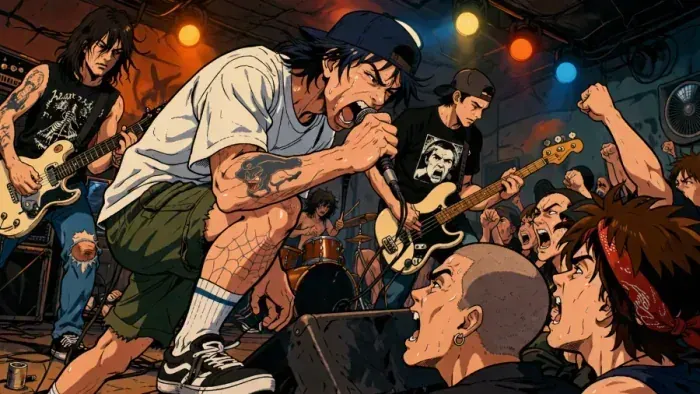
Hardcore, Crossover, and the Birth of the Breakdown
Before metalcore and deathcore gave breakdowns a global audience, hardcore punk had already changed the social mechanics of heavy music. Hardcore sped punk up, stripped the songs to essentials, and put DIY ethics at the center. Its defining traits were speed, aggression, brevity, and self-made infrastructure. Those traits moved authority away from distance and toward participation.
In hardcore scenes, the room itself became part of the music. Songs were shorter, sets were more volatile, and the line between stage and floor was unusually thin. That environment rewarded direct impact over atmosphere and collective movement over individual display. The goal was to make force social, not only to sound heavy.
The next step came when punk and metal stopped circling each other and merged more openly. In the 1980s, crossover scenes brought hardcore’s velocity and anti-polish ethic together with metal’s tighter riff language and more durable weight. That contact zone prepared listeners for a new structural idea inside heavy music: the breakdown as a shared drop in tempo built for tension, anticipation, and mass bodily response.
The breakdown reorganizes heaviness. A riff no longer has to keep accelerating to intensify a song. It can slow down, widen out, and force the room to move together in a more deliberate way. In that moment, the crowd is built into the song’s design, not just reacting after the fact.
That is the missing bridge between classic metal extremity and later core genres. Metalcore and deathcore did not invent the social power of the breakdown from nothing. They inherited it from hardcore spaces where impact, ethics, and collective movement were already tightly linked.

Metalcore & Deathcore: When Emotion Moved Back to the Front
With hardcore and crossover in place, metalcore and deathcore could widen the frame. The question was how to make intensity feel immediate, embodied, and emotionally legible without giving up extremity.
These styles keep metal’s density and technical force, but they rebuild them around hardcore-derived participation. In metalcore, breakdowns sit beside melody, vocal contrast, and a wider emotional range. In deathcore, breakdown weight and extreme vocals push harder toward bodily shock, but the music still aims for impact that feels immediate rather than distant. Pressure does not disappear. It becomes easier to feel from inside the song.
Here heaviness returns to human proximity without giving up precision. The harsh and the vulnerable no longer need to occupy separate genres or separate listeners. From this point, heavy music branches more openly and starts to carry vulnerability as part of its force.
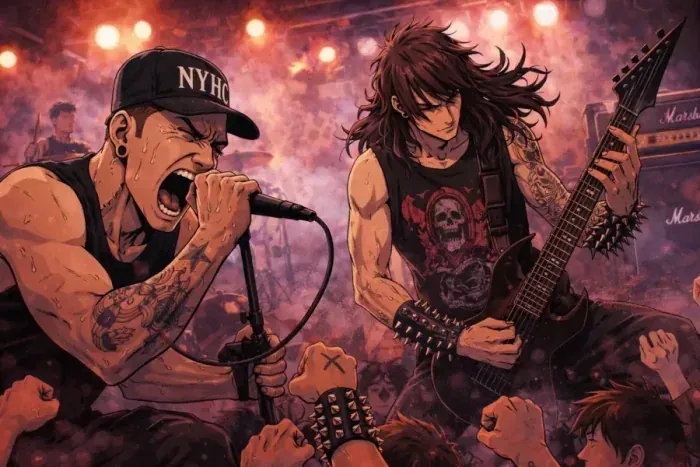
When Hardcore's Raw Ethics Met Metal's Precision
Metalcore works because its parent traditions do not fully agree. It pulls metal’s weight, precision, and structural discipline into the same space as hardcore’s DIY ethic, urgency, distrust of distance, and demand for participation.
That friction is audible in the breakdown. Metal’s control keeps the drop tight and deliberate, while hardcore turns it into a social event inside the song. The music drops into a rhythm the room can inhabit together. The body becomes part of the arrangement.
Converge are a strong example of how unstable this form can sound while staying intentional. Their songs feel volatile, but the volatility is shaped rather than random. Aggression arrives through structure, timing, and vocal strain as much as through lyrics.
Hardcore ethics also reshape the scene around the sound. Small rooms, DIY booking, all-ages spaces, and close contact between stage and floor all reduce the prestige of distance. A band earns respect by showing up, playing hard, and staying accountable to the community around it, not by acting unreachable.
That model challenges older metal assumptions. Authority no longer comes only from mythology, expertise, or endurance. It also comes from access, accountability, and participation. The result is a form of heaviness built less on isolation than on shared force.

When Melody Became Strength
As metalcore developed, melody returned with a different job. It was no longer mere decoration or commercial relief. It became another way to carry stress, grief, and inner conflict with force instead of letting them dissipate.
That melodic turn works through contrast. Clean vocals or expanded harmonic movement do not necessarily soften the song. They can sharpen the emotional stakes by exposing what the harsh section was containing. Killswitch Engage helped make that logic audible for a wide audience: harsh and clean vocals become a structural way of staging conflict rather than a simple stylistic trick.
This move drew criticism from listeners who treated emotional openness as compromise. Yet metalcore’s importance lies partly in refusing that assumption. Being legible does not make music less intense. In many cases, it makes the pressure harder to avoid.
The effect on audiences mattered too. Shared singing, recognizable hooks, and more direct lyrical contact opened the scene to listeners who wanted heaviness without total emotional distance. Accessibility did not erase commitment. It shifted the focus of commitment toward communication.
That helps explain metalcore’s place in the longer history of heavy music. It made space for intensity and openness to coexist without canceling each other out. Melody did not weaken the form. It gave pressure another voice.

New Frontlines: Women Leading Heavy Music's Emotional Shift
As metalcore and adjacent styles expanded the emotional palette, women were not only more visible. They were increasingly helping define where the music could go next. Women were never absent from heavy music, but newer scenes made it harder to label them as exceptions.
Bands such as Jinjer and Spiritbox combine technical command, dynamic range, and emotional clarity without treating those qualities as contradictions. The point is not sudden capability. It is normalization: more listeners now hear that authority as ordinary rather than exceptional. "If you don't want me there, I'll find somewhere where people want to see me."
That shift also affects the culture around the music. Communities that take emotional range seriously often pay closer attention to behavior, language, and access, even if they do not resolve those issues cleanly. The friction shifts. Instead of asking whether women belong in heavy music at all, more scenes are pushed to confront who gets to shape its emotional and social terms.
By this stage, heaviness no longer depends on emotional restriction. It can be powerful, precise, and deeply human at the same time. That opens the way to the article’s final question: what does heavy music do after it has already explored so many forms of force?

Heaviness Today: Finding Meaning After All the Noise
After that reintegration, heavy music moved into a broader, less centralized era. The question is no longer whether heaviness can exist. The question is how artists use a language that already contains many established possibilities.
The landscape is wide and uneven. Styles overlap, scenes coexist without a single center, and listeners move quickly across subgenres that once felt more isolated from one another. Access is abundant, but shared reference points are thinner. Music travels faster than communities do.
Structural pressure on artists is intense. Touring is expensive, public attention is fragmented, and sustainable careers are difficult to maintain. Mental strain, once treated as private weakness, is now discussed more openly as part of the working conditions.
That does not make heavy music less forceful. It changes what force is for. The music is less invested in proving that it can become more extreme at any cost. It is more invested in deciding what still feels necessary after decades of escalation.

The Streaming Era: When Everything Became Available
The way heavy music is found and shared changed dramatically in the streaming era. Listeners can move from Delta blues to black metal to modern metalcore in minutes, often guided by playlists, platform recommendations, and short-form clips rather than by local scenes or slower chains of recommendation.
That access has obvious benefits. Geographic isolation matters less, curiosity is rewarded quickly, and artists outside older gatekeeping systems can find audiences more easily. But abundance also thins out shared memory. When everything is immediately available, shared entry points weaken.
Earlier scenes depended on effort: finding records, trading tapes, reading zines, waiting for tours, and building local trust. Those rituals did not make the music better on their own, but they turned discovery into a social process. Streaming changes that balance. Knowledge becomes broader, faster, and sometimes thinner.
The challenge is not nostalgia for scarcity. It is continuity. Heavy music remains strongest when listeners understand where its forms came from and why they took shape the way they did. That keeps the past usable instead of flattening it into archive material.
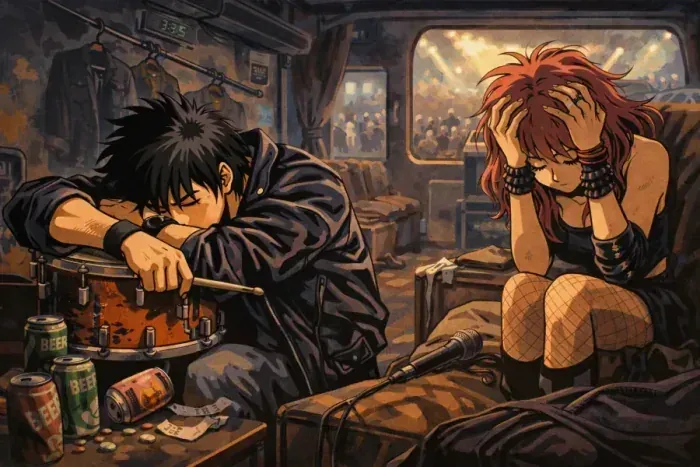
The Hidden Cost: When Touring and Mental Health Collide
Heavy music still values endurance, but the cost of endurance is harder to romanticize now. Touring remains central for many artists, yet it can also produce physical fatigue, emotional depletion, financial strain, and constant public exposure.
Older scene mythology often treated exhaustion as proof of commitment. Silence around burnout, anxiety, or depression was folded into an ideal of toughness. That silence has not disappeared, but it has weakened. More artists now describe mental health struggles as part of the working conditions around music rather than as individual weakness.
That shift fits a long tradition inside heavy music, which has often asked people to confront difficult feeling honestly. The difference now is that some of that honesty extends beyond the stage. Endurance increasingly looks less like self-destruction and more like the ability to slow down, set limits, and remain well enough to keep making work.
This does not solve the larger structural problems around money, labor, and touring. It does change the values around them. Sustainability is becoming part of what seriousness means.
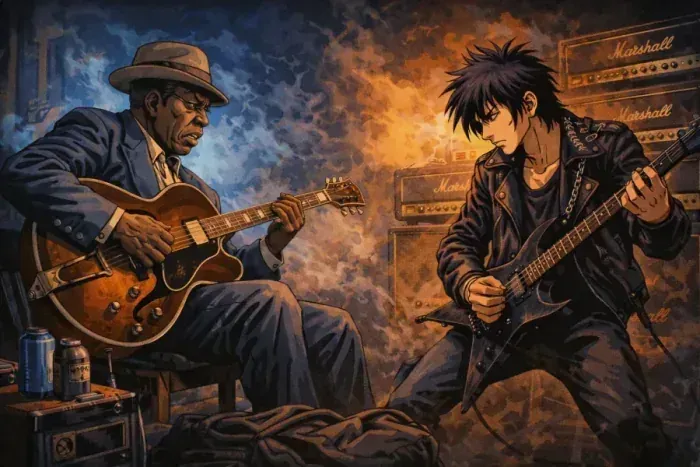
Why the Blues Never Left: The Blueprint That Still Shapes Heavy Music
At the end of this history, one principle still holds. Heavy music gives form to pressure. Styles change, technologies change, and scenes rise and fracture, but the central question remains: how can sound carry something difficult without collapsing?
The blues asked that question first in a lasting modern form. Its answers were demanding but clear. Speak directly. Let repetition do slow emotional work. Leave room for silence. Allow strain to stay audible. Those lessons continue to echo even in genres that no longer sound obviously connected to the blues.
In metal, that inheritance appears through riffs that insist rather than charm. In extreme music, it appears through repetition that refuses comfort. In metalcore, it returns through emotional openness that makes detachment harder to maintain. Even when the textures change, the underlying method remains recognizable.
That is why this arc closes without nostalgia. The blues do not return as costume. They remain present as practice. Heavy music survives when it remembers that its power comes from honesty, pacing, and the ability to make weight feel necessary, not from intensity alone.
In that sense, this history does not really end. Sound forms under pressure, adapts to new conditions, and takes new shapes. The shapes change. The need does not.

50 Tracks That Tell the Story of Heavy Music
By this point, the core idea is simple: heaviness did not begin with distortion, volume, or aggression.
It began as a way of carrying pressure.
This playlist mirrors the arc above. It starts with blues as testimony, then moves through amplification, rhythm, identity, hardening, extremity, and newer forms where heaviness also holds atmosphere, vulnerability, and reflection.
This is not a greatest-hits list. It is a map of turning points.
Each track catches a moment when the meaning of weight changed, widened, or became easier to hear.
The sequence matters.
It begins with voice and repetition, accelerates through rock and metal, reaches points of maximum intensity, and then returns to forms where heaviness is measured less by speed than by depth. That is why the sequence includes tracks slightly outside a narrow metal-only definition. They show that heaviness is a broader expressive method, not a fixed genre boundary.
Each artist appears only once.
Women are central to the sequence, not appended to it.
The selection also keeps a global perspective instead of treating heavy music as a single national story.
This playlist is meant to be heard in order. Years reflect the release year commonly associated with each track, usually the album version.
I. The Roots: Blues as Survival
- Bessie Smith – Downhearted Blues (1923)
- Ma Rainey – See See Rider Blues (1924)
- Robert Johnson – Cross Road Blues (1936)
II. When Blues Went Electric
- Muddy Waters – Hoochie Coochie Man (1954)
- Howlin’ Wolf – Smokestack Lightnin’ (1956)
- Big Mama Thornton – Hound Dog (1953)
III. Early Crossovers and New Attitudes
- Chuck Berry – Maybellene (1955)
- Little Richard – Tutti Frutti (1955)
- Sister Rosetta Tharpe – Strange Things Happening Every Day (1944)
- Wanda Jackson – Let’s Have a Party (1958)
IV. Rock Expands Its Reach
- The Beatles – A Day in the Life (1967)
- The Rolling Stones – Gimme Shelter (1969)
- Janis Joplin – Piece of My Heart (1968)
- Jimi Hendrix – Purple Haze (1967)
V. When Riffs Replaced Romance
- Led Zeppelin – Whole Lotta Love (1969)
- Deep Purple – Highway Star (1972)
- Black Sabbath – Paranoid (1970)
VI. Metal Defines Itself
- Judas Priest – Breaking the Law (1980)
- Iron Maiden – The Trooper (1983)
- Warlock – All We Are (1987)
VII. Thrash: Speed Becomes a Weapon
- Metallica – Master of Puppets (1986)
- Slayer – Raining Blood (1986)
- Megadeth – Peace Sells (1986)
VIII. Death Metal: Heavy Gets Dense
- Death – Symbolic (1995)
- Entombed – Left Hand Path (1990)
- Cannibal Corpse – Hammer Smashed Face (1992)
IX. Black Metal: Distance and Ideology
- Mayhem – Freezing Moon (1994)
- Burzum – Dunkelheit (1996)
X. Metalcore: Emotion Returns
- Converge – Jane Doe (2001)
- Killswitch Engage – My Curse (2006)
XI. Deathcore: Brutality Meets Breakdown
- Suicide Silence – Unanswered (2007)
- Whitechapel – This Is Exile (2008)
XII. Global Voices: Heavy Music Goes Worldwide
- Sepultura – Roots Bloody Roots (1996)
- In Flames – Only for the Weak (2000)
- Jinjer – Pisces (2016)
- Spiritbox – Circle With Me (2021)
XIII. Weight Beyond Genre: Songs About Survival and Release
- Nine Inch Nails – Hurt (1994)
- Bob Marley – Redemption Song (1980)
XIV. Modern Heaviness: Atmosphere Becomes the Riff
- Chelsea Wolfe – Feral Love (2013)
- Amenra – A Solitary Reign (2017)
- Neurosis – Stones from the Sky (2001)
XV. Local Memory, Global Heavy Music
- The Hu – Wolf Totem (2018)
- Alien Weaponry – Kai Tangata (2018)
- Orphaned Land – Sapari (2010)
XVI. Women Leading: Authority in Modern Heavy Music
- Otep – Confrontation (2007)
- Arch Enemy – Nemesis (2005)
- Emma Ruth Rundle – Marked for Death (2016)
XVII. Heaviness Now: Where Heavy Music Stands
- Gojira – Silvera (2016)
- Turnstile – BLACKOUT (2021)
- Sleep Token – The Summoning (2023)
This playlist is not meant to overwhelm.
It is meant to let the arc stay audible.
Each song marks a shift. The sequence moves from emotional endurance to physical force, from collective identity to extremity, and finally to modern forms where intensity and vulnerability can sit together.
These songs make the same point as the article: sounding heavy alone does not define a genre.
It is a response to pressure.
It keeps changing because pressure does not go away.