


Classical Foundations: The Weight of Tradition
Classical music is often introduced as if it were already finished: a shelf of masterpieces, a short list of approved names, a tradition that somehow settled itself. Many listeners meet it in exactly that form. Beethoven and Brahms can start to feel less like working musicians than like marble statues. That picture is tidy, but it leaves out how unstable the tradition actually was. Music moved from courts and churches into public concert life, and every stage of that shift depended on patronage, ticket buyers, teachers, publishers, and access to training. What counted as “serious” music was never decided by notes alone.
By the nineteenth century, the idea of a canon had become more than taste. In German-speaking Europe especially, certain composers came to carry unusual cultural weight. Their scores were edited, archived, replayed, taught, and defended with a seriousness that other repertories did not always receive. Orchestras, critics, conservatories, and publishers all reinforced the same hierarchy. That gave the tradition continuity, but it also made entry harder. A younger composer did not confront form and harmony in the abstract. They confronted precedent. To write a symphony after Beethoven was to write into a field where the standard had already been set at intimidating scale.
That burden of inheritance matters because the later breaks did not come out of nowhere. Modernism, neoclassicism, minimalism, and post-classical music make more sense once we see how heavy the center had become.

The Classical Canon: How Tradition Became Power
When people say “classical music,” they often mean a surprisingly narrow repertory. Beethoven and Brahms sit near the center because their symphonies, chamber works, and piano music came to stand for seriousness, craft, and historical weight. By the late nineteenth century, they were no longer just admired composers. They had become standards against which new music was measured.
That canon was built. Conservatories trained musicians inside particular stylistic lines. Publishers decided which scores circulated widely. Orchestras taught the public what was worth hearing by repeating some works and neglecting others. Critics attached language of greatness, depth, refinement, or excess to the same pieces often enough that prestige started to look natural. Anton Bruckner is a useful case. His symphonies circulated for decades in revised or cut versions before they were more firmly established in mainstream repertory during the twentieth century. Canon formation was not a smooth discovery of quality. It was a struggle over which works would be stabilized, edited, and kept alive.
Public concert life intensified that process. In Vienna, Leipzig, Berlin, and other major centers, orchestras became symbols of civic culture. Going to concerts was not only about hearing music. It was about joining an educated public identity. In practice, that often placed Germanic instrumental music at the center. French, Russian, Italian, Czech, or Scandinavian composers could become famous, but they were still often discussed in relation to the Austro-German line rather than on equal terms.
Composing was also a profession shaped by networks. Success depended on teachers, patrons, publishers, conductors, and performers willing to take risks. Clara Schumann shows how unequal that system remained. She was one of Europe’s most admired pianists and a composer of real authority, yet her works did not enter orchestral and institutional life as durably as those of many male contemporaries. The gap was structural, not musical.
By the end of the nineteenth century, the canon did more than preserve admired works. It defined what ambition was supposed to sound like: large forms, thematic development, harmonic tension, and orchestral depth. Some composers answered that challenge by writing music of enormous complexity. Others felt the standard before they wrote the first note. The canon was no longer just a record of the past. It had become an active set of demands.
By the turn of the twentieth century, the same canon that offered continuity was also starting to feel restrictive. That tension between inheritance and invention sets up the next stage of the story.

Composers as Cultural Workers: The Myth of Genius
The image of the composer as a solitary genius is one of classical music’s most durable myths. Portraits, biographies, and concert ritual still reinforce it. The working reality was more collective. Composers needed commissions, patrons, publishers, rehearsals, performers, and audiences willing to hear new work. The myth survives because it is dramatic. The profession itself was more dependent, negotiated, and unstable.
Beethoven is often treated as the model of artistic independence, and there is some truth there. He negotiated hard, built a public reputation beyond one court, and benefited from an expanding market for printed music and public performance. Even so, he still depended on aristocratic support from patrons such as Prince Lichnowsky and Archduke Rudolph. Brahms, later in the century, also relied on conductors, publishers, critics, and performers. Great work did not move through culture by genius alone. It moved through infrastructure.
As public concerts replaced more private court performance, composers increasingly wrote for an anonymous audience rather than one employer. That brought freedom, but it also brought exposure. Reviews mattered. A successful premiere could lead to more performances, students, and income. A failed one could follow a composer for years. Hector Berlioz is a clear case. Symphonie fantastique was new and influential in 1830, but much of his career was spent fighting institutions and critics that did not know what to do with his scale and orchestral ambition.
Women composers faced all of those pressures and then more. Fanny Mendelssohn Hensel wrote across songs, chamber music, piano cycles, cantatas, and orchestral forms, but much of her work remained unpublished during her lifetime. Clara Schumann balanced composition, virtuoso touring, teaching, editorial labor, and family work under conditions that gave her far less room for institutional recognition than male peers received. Talent was never the only gate.
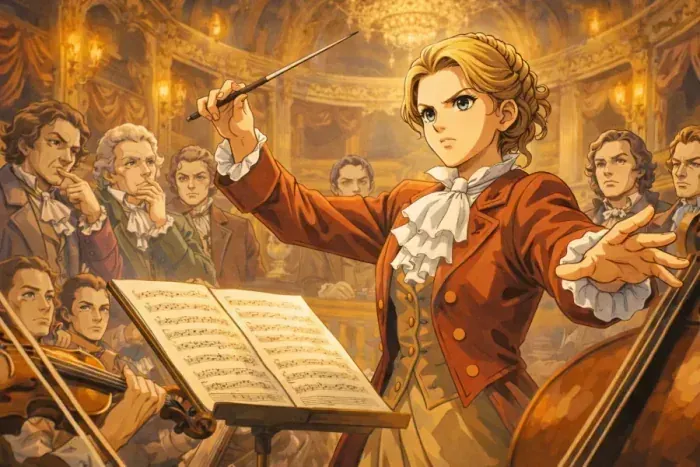
Seeing composers as cultural workers clarifies why tradition carried so much force. Writing a symphony after Beethoven was not only an artistic challenge. It was a career risk. Audiences, critics, and musicians expected scale, authority, and seriousness, and failure had practical consequences.
As orchestras grew and halls expanded, music expanded with them. Symphonies lengthened, harmonies thickened, and orchestration became more elaborate. Composers were not only expressing feeling. They were also working inside a culture that rewarded monumentality. What first looked like growth would later feel, to some younger composers, like overload.
Women in Classical Music: Recognition and Exclusion
Standard concert programs from the late nineteenth and early twentieth centuries reveal a pattern quickly: the names are overwhelmingly male. That was not a neutral sorting process in which the strongest work simply floated to the top. It reflected unequal access to study, publication, patronage, criticism, and performance. Amy Beach shows the scale of that imbalance clearly. Her Mass in E-flat, Op. 5, was performed by the Handel and Haydn Society in Boston in 1892, and her “Gaelic” Symphony was premiered by the Boston Symphony Orchestra in 1896. Both events were treated as exceptional, which is exactly the point. The system could recognize a woman composer. It just did so rarely and reluctantly.
Clara Schumann was one of Europe’s most admired pianists, and she also wrote songs, chamber music, and piano works of remarkable control. Yet she is still remembered more widely as a performer than as a composer. That split says less about the quality of the music than about the hierarchy around it. A woman could be praised as an interpreter. Being admitted to the highest rank of composers was far harder. Her editorial work on Robert Schumann’s legacy and on repertory more broadly also shaped what later generations heard, yet that labor is still less visible than it should be.
Fanny Mendelssohn Hensel faced related limits. She wrote well over four hundred works, including songs, piano cycles, chamber music, cantatas, and orchestral pieces. Some songs appeared under Felix Mendelssohn’s name, which tells us a lot about authorship in the period. Even in a musically privileged family, public identity remained gendered. Her piano cycle Das Jahr from 1841 is now often treated as central to her output, but it did not enter the repertory in anything like real time.
Lili Boulanger shows how fragile institutional progress could be. In 1913, she became the first woman to win the Prix de Rome for composition. That was one of the strongest formal honors available to a young composer in France. Her surviving music combines harmonic color, vocal sensitivity, and structural control, but she died in 1918 at the age of twenty-four. Recognition, even spectacular recognition, did not guarantee durable programming or pedagogical presence. Nadia Boulanger later became one of the most influential teachers of the twentieth century, and part of that work involved protecting and promoting Lili’s legacy.
Exclusion often works through omission rather than scandal. If orchestras, schools, and publishers keep returning to the same narrow list of names, audiences start to absorb that list as a definition of excellence. Absence then starts to look natural. Later generations meet women composers as rediscoveries instead of as part of the main story.
That imbalance shaped the emotional world of the canon as well as its public image. The tradition presented itself as universal while drawing authority from a comparatively narrow social base. By the end of the nineteenth century, the musical language itself was also stretching toward its limits.

Global Voices: Classical Traditions Beyond Europe
When people tell the history of classical music, the story still tends to begin in Vienna, Berlin, Paris, or Leipzig. That emphasis shaped textbooks, concert seasons, and academic study for generations. Yet the history of notated large-form composition, conservatory training, and public musical life was never confined to a few Western European capitals. Composers across Eastern Europe, the Americas, and Asia adapted inherited forms to local histories, languages, and performance cultures. The idea that serious music flowed outward from one secure center hides a much messier reality.
In Russia, Pyotr Ilyich Tchaikovsky and later Sergei Rachmaninoff wrote in forms that were legible across Europe while keeping distinct melodic and rhetorical identities. Their success did not stop Western critics from hearing them through stereotypes of emotional excess or exotic color. Béla Bartók complicates the picture further. Beginning in the first decade of the twentieth century, he collected and studied folk music in Hungary and neighboring regions, then turned that work into a modern compositional language rather than using it as decoration. His fieldwork changed what “national style” could mean.
Latin America adds another dimension. Heitor Villa-Lobos drew on Brazilian materials while writing for orchestra, chamber ensemble, and voice inside international concert culture. The Bachianas Brasileiras do not simply imitate Bach or use Brazil as atmosphere. They put contrapuntal thinking and Brazilian melodic and rhythmic practice into direct contact. Bachianas Brasileiras No. 5 from 1938, for soprano and cellos, remains the best-known example because it is so concentrated and memorable.
In Japan, Tōru Takemitsu absorbed European and American modernism while building a highly personal sense of timbre, space, pacing, and silence. He did not reject Western art music. He reframed it through a different sonic imagination shaped by Japanese aesthetics, literature, and spatial thought. A Flock Descends into the Pentagonal Garden from 1977 is a strong example. The title comes from William Blake, but the sound world is unmistakably Takemitsu’s.
Seen this way, classical tradition was never one line moving cleanly outward from one center. It was layered, uneven, and contested. Some institutions defined standards. Others had to negotiate with them. Meanwhile the core European language kept expanding until the question was no longer whether it could grow, but whether it could keep growing without breaking.
When Tradition Became Pressure: The Limits of Grandeur
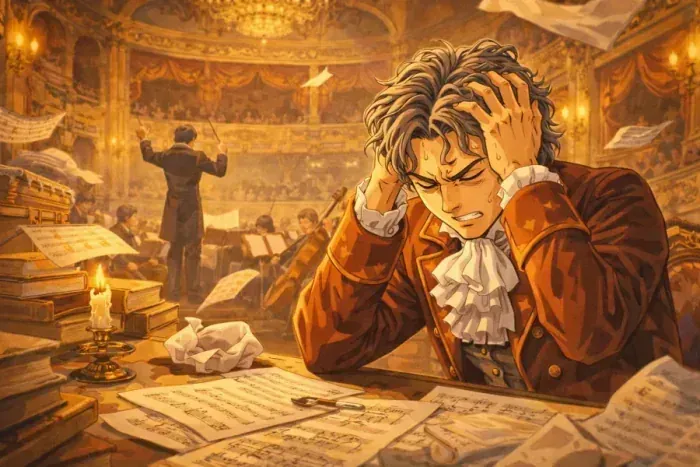
By the late nineteenth century, classical music had become a language of extreme expansion. Orchestras grew, harmony thickened, and symphonic form stretched in duration as well as emotional range. For audiences, that could be exhilarating. For composers arriving after the high Romantic generation, it could also feel destabilizing. A new symphony in the 1890s did not appear in open space. It arrived in competition with Beethoven, Brahms, Bruckner, Wagner, and soon Mahler.
Gustav Mahler makes that tension audible. His symphonies move from chamber-like fragility to huge choral and orchestral statements, from marches and folk echoes to metaphysical climax. Symphony No. 3, composed in the 1890s, can run well over ninety minutes. That scale is exciting, but it also raises a problem. What happens when a symphony starts to be expected to hold everything? Mahler’s famous line that a symphony must be like the world and embrace everything captures both the ambition and the strain of the period.
Richard Strauss hit a related threshold in tone poems such as Also sprach Zarathustra and Ein Heldenleben. His control of orchestral color is astonishing, but the rhetoric is also under pressure. At that level of saturation, the music can start to sound less like development and more like escalation.
Harmony was loosening at the same time. Chromatic saturation, delayed cadence, and remote modulation made resolution less predictable. This was not a sudden break. It was a long drift. Wagner’s Tristan chord is still the classic signpost because it made ambiguity feel structural rather than decorative.
Claude Debussy belongs inside that transition as well. Works such as Prélude à l’après-midi d’un faune and La Mer did not abandon tonality, but they weakened the old sense that harmony had to move by inherited symphonic logic. Color, spacing, and timbre began to carry structural weight.
Arnold Schoenberg began inside exactly this late-Romantic environment. Early works such as Verklärte Nacht from 1899 still inhabit its lush textures, but they already sound restless from within. The inherited language had grown so flexible that it was starting to lose the stability that once held it together.
Once tradition begins to feel like pressure, continuity becomes fragile. Tonality was not abandoned overnight. It was strained until some composers no longer trusted it to do the same work.

From Expansion to Fracture: Why Classical Music Broke
By the early twentieth century, the fracture was difficult to ignore. Late-Romantic expansion had opened huge possibilities, but it had also weakened older habits of tonal clarity. For centuries, Western art music relied on reasonably stable expectations about key, tension, release, and return. Now many composers felt that the inherited language was still powerful, but no longer fully dependable.
Modernism did not begin as rebellion for its own sake. It grew out of saturation. When harmonic tension is stretched again and again, familiar resolution begins to lose force. At that point, continuing in the same style can feel less like continuity than like repetition. Some composers still trusted the old language enough to modify it. Others no longer did.
The fracture was not only musical. It belonged to a broader climate shaped by industrialization, urban growth, nationalism, imperial instability, and political crisis. The concert hall was part of that world, not separate from it. The question was no longer just how to refine inherited grammar, but whether that grammar could still sound truthful inside modern life.
Too Much Sound: The Saturation Point
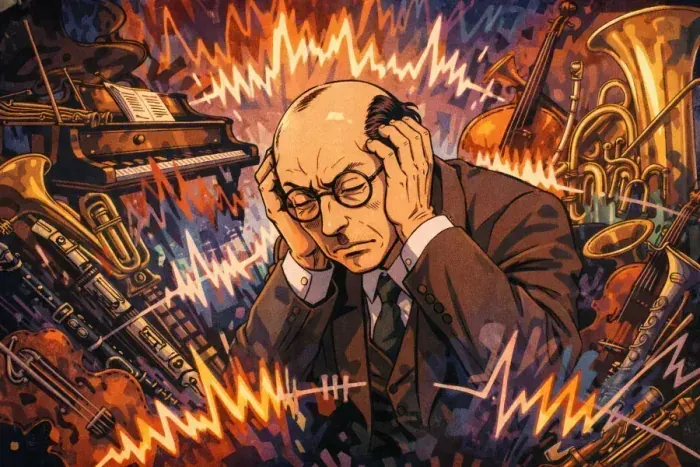
Arnold Schoenberg did not begin as an iconoclast. Verklärte Nacht from 1899 is still deeply rooted in late-Romantic harmony and emotional sweep. Yet within a few years the same language began to buckle under its own flexibility. When almost any sonority can move toward almost any other, the sense of tonal home weakens.
Schoenberg’s move toward free atonality around 1908 was not a rejection of expression. It was an attempt to preserve expressive seriousness when the older tonal framework no longer felt stable enough. In the Second String Quartet, the line “I feel the air of another planet” became a famous sign of that shift. The listener is no longer guided by familiar cadential logic.
Alban Berg and Anton Webern, Schoenberg’s students, followed that break in sharply different ways. Berg kept a strong sense of drama, vocal line, and social pressure, which later shaped Wozzeck. Webern compressed musical thought into radically concise forms. Once tonal landmarks weakened, structure had to be heard through interval, register, timbre, gesture, and silence.
For listeners raised on symphonic buildup and tonal release, this language could feel abrupt or even hostile. Some heard it mainly as an intellectual challenge. Others heard a new kind of honesty in its refusal to console. Either way, the distance between composer and listener widened.
The break was gradual, not instantaneous, but by the early 1920s Schoenberg had developed the twelve-tone method. That made clear that the move away from common-practice tonality was not a passing episode.
This fracture did not destroy tradition. It exposed limits that had been building for decades. Some composers deepened the new complexity. Others searched for different kinds of clarity. Modern classical music would now branch instead of moving in one line.

Breaking the Frame: The Birth of Modern Classical
Once the break was underway, composers did not respond in one way. Some pursued dissonance and system. Others rethought rhythm, sonority, orchestral color, or formal scale. Early musical modernism was not one movement marching in step. It was a crowded field of experiments.
The early twentieth century was also marked by political tension, new technologies, mass urban life, and the visible instability of empires. Under those conditions, the concert hall could no longer function only as a sanctuary of inherited order. It became one place where rupture itself could be staged.
Modernism in music was not about novelty for its own sake. It was about finding forms adequate to changed conditions. Dissonance, rhythmic violence, compression, abstraction, and structural rigor were different answers to the same pressure.
Not all of those answers were equally hard-edged. Olivier Messiaen, for example, built a language around modes, rhythm, color, birdsong, and spiritual symbolism rather than the Austro-German drama of tonal crisis. That matters because modernism was never only one story about dissonance and rupture.
The frame had cracked. The next question was how to work inside the break without simply turning fracture into habit.
The Collapse of Shared Musical Language
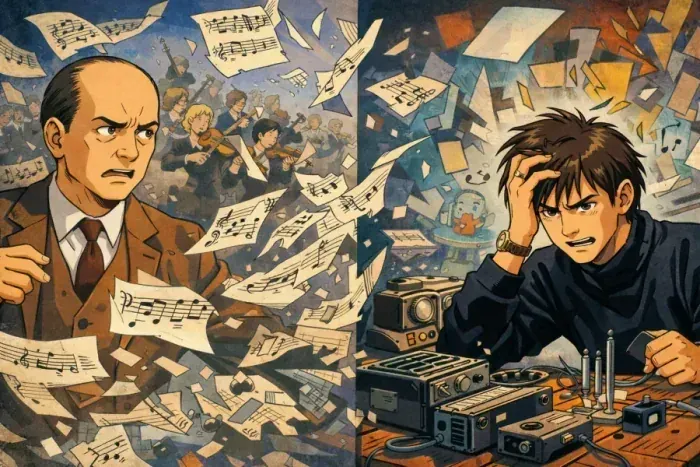
After the first steps toward atonality, the problem became social as well as compositional. Western art music had long relied on shared expectations about harmony and form. Even listeners without training could often hear when a phrase felt finished. When those expectations no longer held, that shared understanding weakened.
Schoenberg’s twelve-tone method was one answer. Instead of a tonal center, the music was organized around an ordered row containing all twelve chromatic pitches. The aim was not randomness. It was a new kind of coherence after the loss of tonal hierarchy.
Anton Webern pushed that logic toward radical concentration. His pieces are brief, and every gesture matters. Silence itself becomes structural. Berg, by contrast, held on to theater, lyric pressure, and human drama. In Wozzeck, dissonance does not cancel communication. It intensifies it.
This sound was hard for many audiences to absorb. Listeners who could follow Mahler’s emotional scale often struggled with Webern’s compressed forms. Critics debated whether modern music was a step forward or a step away. Some said it had abandoned beauty. Others argued that beauty itself had changed.
The loss of shared tonal language did not end communication, but it changed the terms. Listening became more alert to texture, register, contour, and design than to familiar harmonic arrival points.
That shift also widened the gap between art music and mass-audience genres. Operetta, popular song, dance music, and later jazz still addressed broad publics. Highly abstract modernism often moved through smaller specialist circles. Not every composer, however, wanted abstraction to be the only answer.

Stravinsky's Rite of Spring: Rhythm as Shock
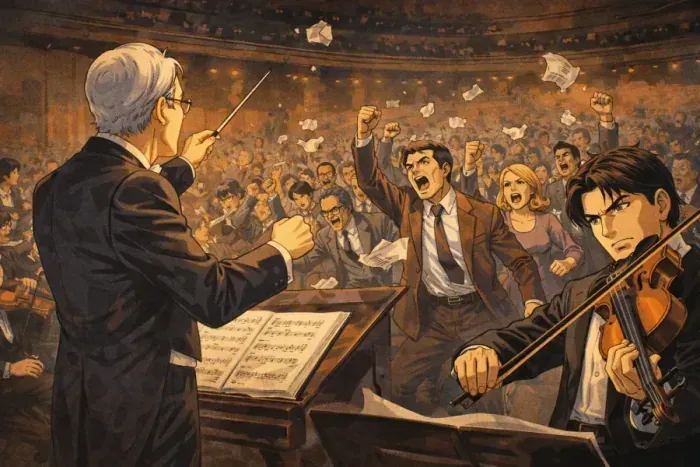
Schoenberg destabilized harmony; Stravinsky destabilized pulse. When The Rite of Spring opened in Paris on May 29, 1913, the audience reaction quickly became legend. Later retellings exaggerated parts of the story, but the hostility was real. Viewers heard and saw something that violated familiar expectations of ballet and orchestral decorum.
The shock came not only from sonority, but from rhythm. The opening bassoon line already feels estranged in its high register. Soon afterward, pounding accents, layered ostinatos, and shifting meters take over. Nijinsky’s choreography intensified the break by replacing classical lightness with angular, heavy, earthbound movement.
Stravinsky did not abandon structure. He redirected it. Instead of long harmonic arcs, he used blocks, collisions, repeated cells, and accent patterns. Energy replaced symphonic unfolding. Rhythm became structural pressure in its own right.
The Rite of Spring arrived in a Europe already tense with instability. It did not predict World War I in any literal sense, but it registered a world in which older forms of order no longer felt secure.
Stravinsky later moved through neoclassicism and other idioms, but this early work had already shown that rhythm could carry the burden of innovation. Classical language could be reshaped without simply extending Romantic harmony.
If harmony alone could no longer carry the full weight of tradition, rhythm offered one new foundation. Another answer would be the search for sharper order after the shock.

Neoclassicism: Order After Shock
Not every composer answered early modernism with more rupture. In the years after World War I, many turned toward older forms, leaner textures, and sharper outlines. Later critics called this tendency neoclassicism. It was not a simple revival of the eighteenth century. It was a modern reuse of older models.
Stravinsky became one of its defining figures in works such as Pulcinella and Symphony of Psalms. Sergei Prokofiev, Paul Hindemith, and others likewise sought renewed balance without pretending that Romanticism or modern crisis had never happened. Counterpoint, dance forms, and transparent orchestration returned, but the harmonic bite remained.
The longer history is not simply collapse followed by reduction. Neoclassicism showed that composers could step back from overload, reorganize inherited materials, and still move forward. That habit of reduction without surrender would return later in very different contexts.
Meanwhile, technology was quietly changing how music reached listeners.
Technology Transforms the Concert Hall
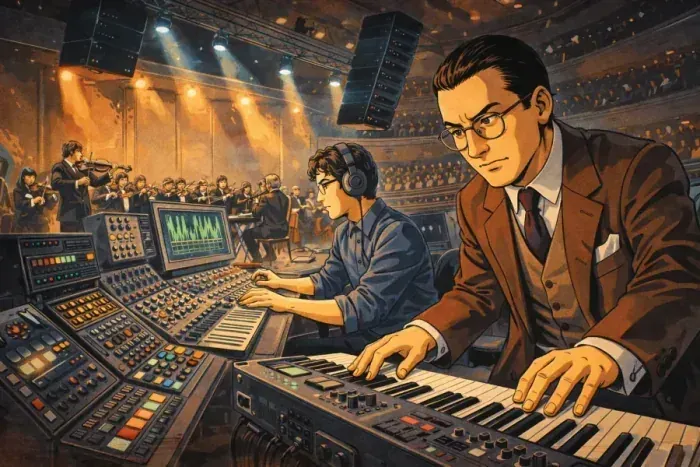
While composers were rethinking harmony and rhythm, another transformation was reshaping the field more quietly: recording. For centuries, classical music largely existed as live event, printed score, and memory. Once sound could be captured and replayed, music no longer belonged only to the moment of performance.
Early recordings were technically limited, but culturally they were decisive. A performance no longer disappeared when the evening ended. Listeners could return to the same interpretation, compare artists, and build familiarity through repetition rather than recollection. Conductors and soloists developed recorded identities, and interpretation gained a new kind of permanence.
Radio accelerated the shift. Broadcasting brought orchestral music into homes that might never enter a concert hall. The older rituals of dress, venue, and public behavior did not vanish, but they were no longer the only frame for listening. Art music entered domestic space.
Technology also changed composition. Edgard Varèse imagined music in terms of sound masses, timbre, and spatial movement rather than inherited melodic logic alone. Electronic studios would later make that thinking more practical, but the conceptual move began earlier. The orchestra was no longer the uncontested center of serious invention.
Repeated listening altered understanding too. Works that seemed baffling on first hearing could now be revisited, learned, and compared. At the same time, recording and radio put art music, dance music, jazz, and popular song into overlapping circuits. The listening public widened, and so did the contrast between experimental and mass-audience repertories.
Recording did not replace the concert hall. It changed what the concert hall meant. Live performance became one listening mode among several, and composers had to think differently about scale, sonority, and audience because of it.
As the twentieth century advanced, the question was no longer only how to write within or against tradition. It was also how music would function in a world shaped by media. Recording made interpretation repeatable, radio made it domestic, and film made it narrative. Composers such as Max Steiner and Franz Waxman showed that accessible orchestral language and serious craft could coexist inside commercial storytelling.
Modernism's Forgotten Women: Hidden Voices
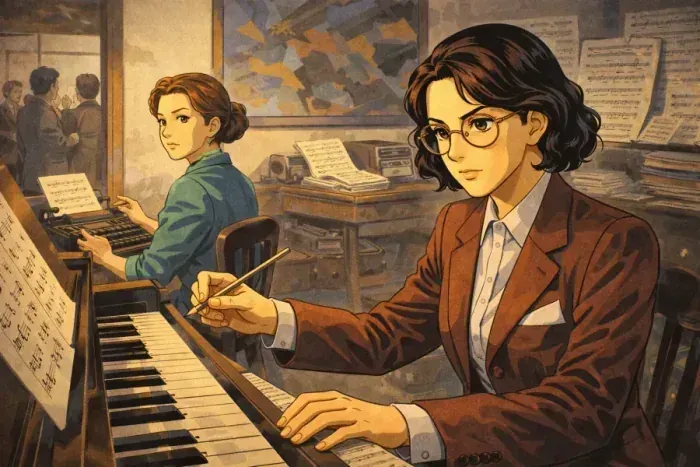
Modernism is still often told through a compressed list of male names: Schoenberg, Stravinsky, Webern, Boulez, Cage. That version is familiar because institutions repeated it for decades, not because it was complete. Women were active inside modernist culture as composers, teachers, organizers, editors, and intellectual peers, yet they rarely received the same long-term visibility in programming, recording, or scholarship.
Ruth Crawford Seeger is one of the clearest examples. Working in the United States during the 1920s and early 1930s, she developed a modernist language of sharp intervallic tension, registral contrast, and formal precision. Her String Quartet 1931 is now widely recognized as a landmark of American modernism, especially for its remarkably controlled slow movement. Later, her work collecting and arranging American folk music showed that experimental writing and vernacular musical life were not sealed off from one another as cleanly as textbook histories often suggest.
Galina Ustvolskaya, working in the Soviet Union, points in a different direction. Although she studied with Dmitri Shostakovich, her music does not read as an extension of his. It is harsher, more compressed, more ritualized, and often almost physically severe. Thick unisons, extreme dynamics, and hammering sonorities give her work a force that sits awkwardly inside the usual Western narrative of modernism. That awkwardness is exactly why she matters.
Elsa Barraine in France also deserves far more attention than standard surveys usually allow. A Prix de Rome winner in 1929, she wrote orchestral, chamber, piano, and vocal music while also working through the political pressures of the 1930s and World War II. Her career reminds us that modernist composition was not only a technical argument about form. It also unfolded inside institutions, occupations, resistance movements, and public debate.
The exclusion here was often quiet rather than dramatic. It happened through season planning, recording catalogs, anthologies, conservatory syllabi, and the habits of critics who kept returning to the same names. Because modernist music already circulated through specialized institutions, those choices had lasting consequences. What was omitted could disappear for generations.
Recognizing these composers does not create one neat replacement canon. It makes the field more accurate and less reductive. Early twentieth-century modernism was not a single march from tonality toward abstraction. It was a contested set of responses to instability, and many of the people shaping those responses were easier for institutions to overlook than to fully absorb.
That matters for listening as much as for history. Once modernism is heard as a broader, less centralized field, the later reaction against overload and distance also becomes clearer. The turn toward reduction did not answer one unified style. It answered a much more varied and uneven landscape than the standard story usually admits.
Audiences in Revolt: The Growing Divide
By the 1920s and 1930s, modern music had acquired a public reputation. For some listeners, it meant courage, discipline, and historical seriousness. For others, it signaled difficulty, distance, and social detachment.
Audiences formed by tonal melody and familiar formal cues often felt disoriented by atonal or highly abstract work. Critics argued over whether difficulty was evidence of artistic advance or a symptom of cultural isolation. The divide was never absolute, but it was real.
Schoenberg believed that resistance to new art was normal and temporary. In the long view, he was partly right. In the short view, the problem remained practical: when familiar tonal cues disappear, listeners must build meaning in slower and less habitual ways.
Stravinsky’s rhythmic modernism was easier for many audiences to absorb than strict serialism, but it also provoked debate. His later move toward neoclassicism suggests that he understood the value of restoring legibility without simply retreating.
Across Europe and the United States, modern composers found support in festivals, smaller organizations, broadcast institutions, and specialized schools. That environment encouraged new work, but it also deepened specialization. At the same time, jazz, film music, and other popular genres were building mass audiences through very different channels.
The tension was not just conservatism versus progress. It marked the breakdown of a shared musical language. Some composers accepted smaller audiences as the price of rigor. Others started looking for ways to reconnect structure with perception.
By mid-century, art music faced a real choice: push farther into system, or rethink listening from the ground up. The next major turn would come through subtraction.

From Complexity to Reduction: A New Beginning
By the middle of the 20th century, that experimental drive had become highly advanced. Serialism and other system-based approaches offered internal logic and precision. For many composers, this clarity was a sign of artistic honesty. But for some, something felt missing. The music could be intense and even excellent, but it often was not appealing to a wide audience.
The problem was not just difficulty. It was the distance. When a composition is packed with formal systems, the emotional and physical experience of sound can become less important. Younger composers started wondering if complexity was its own goal. They did not necessarily reject modernism’s seriousness. They questioned how tightly packed the material was.
Reduction answered that problem in a precise way. If listeners could not hear the logic on the first encounter, some composers asked whether the material itself should be thinned so that process, pulse, duration, and timbre could become perceptible again.
The shift did not happen in one city or through one manifesto. It appeared in experimental scenes across the United States and Europe. Instead of multiplying harmonic options, some composers limited them. Instead of constant transformation, they explored repetition. Instead of emphasizing development, they focused on duration.
Reducing the material was not a sign of retreat. It was a search for renewed connection.

When Complexity Stops Connecting
After World War II, many European composers pushed systematic thinking even further. Pierre Boulez and Karlheinz Stockhausen extended serial ideas into rhythm, dynamics, and timbre. In principle, almost every parameter could be organized. Boulez’s Structures for two pianos, first heard in the early 1950s, became one of the clearest examples of total serial ambition.
For many listeners, however, this degree of control felt remote. Concerts could become spaces of concentration rather than shared release. The organization was rigorous, but not always perceptible on first hearing. Some composers thrived under those conditions. Others began to feel that communication had narrowed.
John Cage answered from the opposite direction. Instead of increasing control, he questioned it. His 1952 piece 4’33”, in which performers remain silent and the environment becomes the event, changed the argument about what a composition could be. Cage was not simply trying to provoke. He was reopening the category of music itself.
Morton Feldman, often linked to Cage, moved toward softness, duration, and delicate patterning. His music does not unfold through conventional drama. It asks the listener to enter a different scale of time.
In the United States, galleries, lofts, and small experimental spaces helped these ideas circulate outside the standard concert system. The change was musical, but it was also institutional. Authority loosened.
Broader social conditions mattered too. Postwar culture valued systems and expertise, but it also had reasons to distrust rigid structures. Music reflected both impulses at once.
By the late 1950s and early 1960s, a younger generation was moving toward reduction with new confidence. Repetition, pulse, and gradual process would become central because taking away had started to feel more urgent than adding.
Minimalism: Less Became More
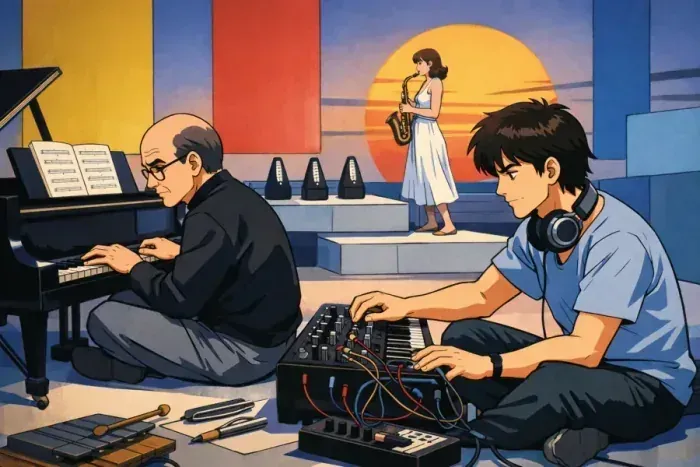
In the 1960s, minimalism emerged in the United States as one response to that condition. It did not begin inside the most established academic institutions. It grew in lofts, galleries, downtown performance spaces, and communities willing to test direct perceptual experience against postwar complexity.
Minimalism was not casual simplicity. It was a disciplined reduction of material into repetition, pulse, duration, and gradual change. Instead of constant thematic development, the listener encountered process unfolding in real time.
That reduction felt radical precisely because it moved against the previous century’s habit of expansion. After decades of dense harmonic and structural argument, repetition could sound almost confrontational.
Minimalism was never one sound. Some composers built with drones, some with pulse, some with additive process, some with text-based listening practices. What joined them was a new relation between structure and perception. Music no longer had to prove seriousness through density alone.

La Monte Young: The Power of the Drone
If minimalism has an origin figure, La Monte Young is close to it. In the late 1950s and early 1960s, he wrote pieces built from sustained tones, long duration, and microscopic change. Instead of moving listeners through harmonic events, he made them inhabit sound itself.
Young’s early pieces, such as Composition 1960 #7, use almost no material. Two notes held for a long duration are enough to challenge conventional development. Little happens on the surface, but the listening experience changes. Tuning, room resonance, and performer interaction become structurally significant.
His work with the Theatre of Eternal Music extended those ideas through amplified drones, just intonation, and microtonal beating effects. Sound became an environment rather than a sequence.
Young’s music was never built for mass appeal, but its influence traveled far beyond the experimental spaces in which it first circulated. By focusing on duration, he changed what musical time could mean. A piece no longer had to move quickly from one event to the next.
This slowing down was not an escape from modernism. It answered modernism from another angle. While serialism multiplied parameters, Young restricted them. The gesture looked small, but its implications were large.
Listening to a long drone can be demanding. If nothing obvious changes, attention wanders and returns. In that sense, minimalism did not make listening easier. It relocated difficulty from written structure to perception.
Other composers would take those lessons and push them into more rhythmically defined music. Pulse would become the next major engine.
Steve Reich: Process as Structure
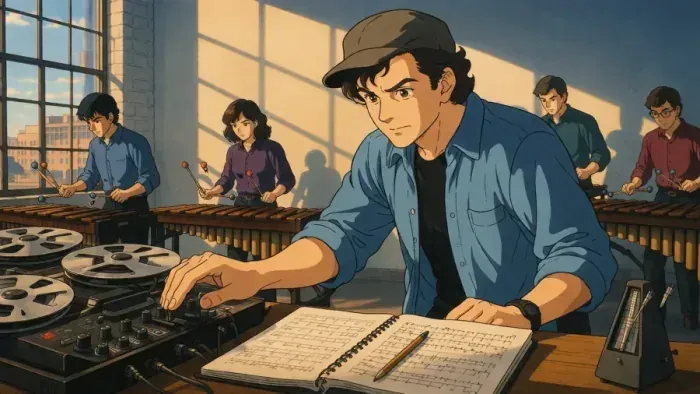
While La Monte Young focused on sustained sound, Steve Reich made process audible through rhythm. In the mid-1960s, he experimented with tape loops. In It’s Gonna Rain, two identical recordings gradually move out of sync and generate new patterns from minimal material. The listener can hear the structure happen.
Reich later transferred the principle to live instruments. Piano Phase and Violin Phase use repeating figures that slip against each other so slowly that process and result are audible at once. Instead of following a theme through contrast and return, the ear tracks small shifts as they accumulate.
Pulse remained central to Reich’s language. Unlike much postwar avant-garde music, his pieces often keep a steady beat. He also drew important lessons from outside European art music, including drumming study in Ghana and other encounters with cyclical rhythmic thinking. Those experiences fed directly into works such as Drumming and Music for 18 Musicians.
Music for 18 Musicians, first performed in 1976, marked a turning point. Its cycle of pulses, harmonic changes, voices, pianos, mallet instruments, strings, and clarinets creates a bright, shifting texture in which repetition and motion coexist.
Reich’s approach reconnected structure and perception. You do not need a score to grasp the design. That openness helped minimalism travel beyond experimental circles.
Not everyone welcomed the change. Some heard repetition as simplification. Others heard it as relief after the opacity of academic modernism. Reich’s own argument was that process-based music lets the listener hear how it is made.
His music was minimalist, but never casual. The discipline lies in restraint, precision, and audible design. By connecting process to bodily rhythm, he made minimalism legible to many listeners who would never have entered the serial avant-garde.
The next important step was not just to make minimalism audible. It was to make it public at larger scale.
Philip Glass: Minimalism for Everyone
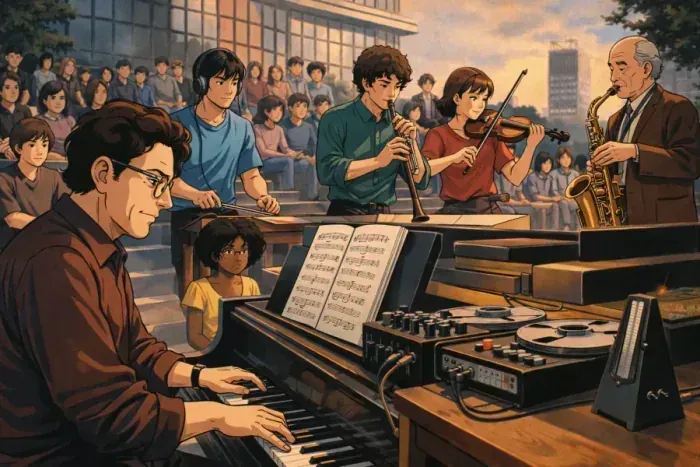
Steve Reich made minimalism rhythmically explicit. Philip Glass made it culturally harder to ignore. In the 1970s, Glass built a language from repeating arpeggios, steady pulse, and gradual harmonic motion, then pushed it toward theater, opera, and public scale.
Einstein on the Beach, created with Robert Wilson and premiered in 1976, was the clearest proof. The opera does not rely on conventional plot. It unfolds through long scenes, visual tableaux, counting, solfege, and musical cycles. Glass showed that minimalism could sustain large form without borrowing Romantic weight.
Some avant-garde composers stayed largely inside academic or gallery worlds. Glass pushed outward. His ensemble toured, recordings circulated widely, and works such as Koyaanisqatsi brought minimalist language to audiences who might never attend a new-music concert.
Glass was criticized partly because he was accessible. For some modernists, that looked like dilution. For others, it looked like recovery: contemporary composition had regained a public ear without abandoning structural intent. The dispute exposed a real split inside art music about who serious music was for.
Glass also made minimalism more overtly emotional. The repetition no longer felt only strict or procedural. It carried urgency, uplift, and theatrical energy.
As minimalism spread, new debates followed. Some critics questioned whether the composer still controlled too much of the listening experience. Others asked whether listening itself could become a social and political practice. Pauline Oliveros would take that question further than almost anyone else.

Pauline Oliveros: Deep Listening as Art
Pauline Oliveros overlaps with minimalism, but her central subject was attention itself. As a composer, improviser, accordionist, and theorist, she developed “deep listening” as a practice of expanded auditory awareness rather than passive reception.
Through group listening exercises and performance situations, Oliveros asked participants to notice not only composed tones, but also surrounding sound, resonance, silence, and social presence. The aim was not polished execution. It was altered awareness.
Her Sonic Meditations, a sequence of text scores, make that philosophy practical. The instructions are simple on the page: sustain a tone, listen before answering, breathe with others, respond to the room. The difficulty lies elsewhere. It lies in presence, collective attention, and the willingness to treat listening as shared action.
Oliveros also worked extensively with electronics, delay, and spatial sound. Unlike models of modernism centered on tight authorial control, her practice distributed agency more widely across performers, listeners, space, and situation.
As a woman in experimental music, Oliveros also worked against entrenched patterns of exclusion. Her influence has continued to widen, reaching contemporary composition, sound art, improvisation, pedagogy, and therapeutic listening practices.
Oliveros shows another side of minimalism. Reducing material was not only an aesthetic choice. It also shifted power. Once the piece is no longer crowded with specialized material, performers and listeners can enter it differently. Listening itself becomes the artistic act.
Oliveros took minimalism beyond process and public performance into philosophy. The question was no longer only how to compose differently. It was about hearing things differently. That legacy matters later in the story because post-classical music often depends on exactly this kind of intensified, intimate listening.
Minimalism and the Question of Authority
As minimalism matured, it raised a difficult question about authority. If music is built from process, repetition, and duration, who controls the experience, and where does form actually reside?
Steve Reich spoke openly about audible processes. The listener could follow the change from one phase to another. That transparency did not remove control. It changed how control was perceived. The composer still defined the system and allowed it to unfold. Philip Glass’s arpeggiated structures also rely on disciplined repetition. The design feels open, but it remains precise.
La Monte Young’s long-lasting tones offered a different point of view. The piece’s duration made the listener’s attention part of the form. Attention might wander and then return. In that sense, control moved inward. The piece created a mood rather than a story.
Pauline Oliveros built on this idea. By focusing on listening together, she challenged the traditional differences between composer, performer, and audience. Her Sonic Meditations gave everyone a role to play. The music was created through interaction.
These approaches show that minimalism was about more than using fewer materials. It also redefined authority. Instead of one composer controlling every meaningful event, music could operate as environment, process, or shared action.
Minimalism was also criticized, sometimes fairly, for becoming predictable once its techniques spread into advertising, film, and mainstream production. What began as a critical alternative to postwar complexity could harden into style.
By the late twentieth century, minimalism had clearly reconnected composition with pulse, perception, and duration. It had also influenced popular music, electronic production, and film. Yet many composers still wanted a broader emotional vocabulary than early process music usually allowed.
The next shift would not abandon repetition. It would soften its edges. Early minimalism focused on system and duration, but a later generation brought melody, atmosphere, and recorded intimacy back toward the center.

Postminimalism: Process Learns to Sing
Minimalism did not move directly from strict process to the intimate sound world of the early twenty-first century. Postminimalism formed the bridge. It kept pulse, clarity, and patterned motion, but admitted wider harmony, stronger dramatic contour, and a more openly expressive surface. The process remained audible, yet the music no longer needed to sound emotionally neutral.
John Adams is one of the central figures in that shift. Early works such as Shaker Loops retain the motor energy of minimalism, but the phrasing is more flexible and the harmonic motion more openly expressive. Later scores and operas expanded that language further, showing that repetition could support large public forms without returning to nineteenth- century symphonic rhetoric. Michael Nyman pushed in a related direction, bringing postminimalist patterning into theater and film with a sharper lyrical profile.
That mattered because it made later post-classical music easier to imagine. Once repetition could carry melody, dramatic pacing, and warmth, composers no longer had to choose so sharply between rigor and emotional access. Postminimalism did not replace minimalism. It loosened its borders.
Back to Emotion: From Systems to Feeling
By the late twentieth century, minimalism had become established enough to create a new problem. Repetition, pulse, and gradual transformation no longer read as inherently radical. They were already present in concert music, film, and recording culture.
Once a style becomes familiar, it stops sounding oppositional. Composers who grew up with minimalism inherited it rather than discovered it. The problem changed: how do you move forward without returning to dense modernism or merely repeating minimalist habits?
The answer did not arrive as a manifesto. It arrived as a shift in emphasis. Structure stayed clear, but emotional presence moved closer to the surface. Recording technology accelerated the change by giving composers tighter control over resonance, layering, imperfection, and distance.
Composers and listeners alike became more interested in inward experience. Systems remained, but they no longer dominated the atmosphere.
Minimalism Finds Its Human Side
Minimalism had already restored pulse and clear structure to modern music. Yet many early minimalist works kept emotion at a distance. The patterns were clear, the changes gradual, and the expressive range deliberately narrowed. Some listeners valued that severity. Others wanted a warmer point of entry.
Arvo Pärt is one of the clearest examples of reduction turning toward spiritual and emotional depth. After working through modernist procedures, including serial techniques, he entered a long period of silence and study in the late 1960s and early 1970s. By 1976 he had arrived at the style he called tintinnabuli. Works such as Fratres and Spiegel im Spiegel use triadic harmony, measured pacing, and active silence to create a sound world that is spare without feeling empty. "Before one says something, perhaps it is better to say nothing."
Pärt’s music is carefully organized, but that order creates room for reflection instead of driving toward climax. Silence does real work. The pacing invites contemplation. Many listeners who found strict modernism forbidding heard this language as accessible without hearing it as simplistic.
At the same time, recording technology was changing what intimacy could sound like. Studio production allowed composers to shape resonance, layering, and spatial depth in ways that live performance alone could not provide. Sound could feel close, almost tactile. Music no longer needed the distance of a large hall; it could sit directly at the ear.
In Europe, Henryk Górecki and John Tavener also built direct languages from simple harmony, slow pacing, and spiritual or devotional subject matter. Górecki’s Symphony No. 3 reached far beyond the usual contemporary-classical audience after the 1992 Nonesuch recording conducted by David Zinman with Dawn Upshaw. Its force came not from complexity, but from patience, repetition, and controlled grief.
This more human minimalism did not reject earlier work. It shifted the center of gravity. The reduced materials remained, but the emphasis moved from process toward atmosphere, memory, stillness, and vulnerability.
By the early twenty-first century, that softer minimalist language had become one of the main foundations of post-classical music: quieter, closer, and more obviously shaped for intimate listening.

A New Cultural Ecosystem
As minimalist language became more flexible, the ecosystem around it changed too. Contemporary composition no longer moved only through orchestras, conservatories, and academic festivals. It also circulated through film, television, independent labels, digital platforms, and mixed-genre venues. The concert hall remained important, but it no longer held a monopoly on seriousness.
That new ecosystem changed both opportunity and expectation. Composers no longer had to compete only through large public forms. They could write for small ensembles, electronics, or hybrid studio setups, and listeners could encounter the results in cinemas, on headphones, or through playlists rather than subscription seasons.
The ecosystem also became more permeable. Minimalist ideas entered pop production, ambient music, and film scoring. Electronic textures entered chamber work. Collaboration became more common than strict hierarchy. The divide between autonomous art and applied music softened.
In this broader landscape, emotional connection became even more important. Music in film did not need to be formally dense to feel serious. It could support narrative with clarity, restraint, and atmosphere. The language of reduction proved remarkably adaptable. It could work inside visual storytelling and in private listening alike.
What changed was not only style, but route. Music could now reach listeners through a cinema, a streaming platform, a label catalog, a festival, a television score, or a pair of headphones. The materials were still recognizable. The listening world around them was not.
Film Music: When Minimalism Met Emotion
Film became one of the most effective spaces for translating minimalist and postminimalist language to a broad audience. Sound and image together made repetition easier to follow, both emotionally and structurally.
Michael Nyman played a major role in this shift. His collaborations with Peter Greenaway in the 1980s helped establish a recognizable post-minimalist language on screen. Later, his score for The Piano brought repeating figures into a deeply emotional narrative. The music still relies on recurrence, but it feels intimate rather than abstract. In cinema, repetition could become tender, not only rigorous.
Philip Glass also contributed heavily to cinema. His score for Koyaanisqatsi in 1982 paired repetitive structures with Philip Glass’s most recognizable harmonic language at a moment when many concertgoers still treated minimalism as niche. In film, pulse and slow harmonic change could support narrative without overwhelming it.
Cinema also changed public perception of modern composition. Many listeners who would never choose a contemporary concert still absorbed related techniques through film.
Hans Zimmer is not a minimalist composer in any strict historical sense, but his blend of orchestral writing, electronics, layered ostinatos, and steady pulse shows how minimalist techniques entered mainstream film scoring. In works such as Inception, repetition becomes a practical tool for tension, scale, and momentum rather than a stylistic argument in itself.
Film scoring also made collaboration visible. Directors, editors, producers, sound designers, and composers shaped atmosphere together. The composer was no longer imagined only as a lone author presenting autonomous works.
Cinema brought techniques that started in experimental spaces to millions of listeners. It did not replace the concert hall, but it ended its monopoly as the most visible public space for serious instrumental music.

Ambient and Electronics: The Hybrid Sound
While film widened the audience for repetition and pulse, ambient music and electronic production changed the materials themselves. Composition no longer had to begin with notes on paper and end with a faithful recording of a performance. Increasingly, the recording process shaped the piece from the start.
Brian Eno’s ambient work in the 1970s was decisive here. He described ambient music as something that could accommodate different levels of attention, and Music for Airports from 1978 made that idea concrete. The piece uses loops, suspended harmony, and very slow change, but it avoids the directional drama expected from symphonic writing. Later composers working between classical instruments and electronics inherited exactly that freedom.
Electronic tools expanded what “instrumental” music could mean. Tape delay, reverb, multitracking, granular processing, and later digital editing let composers hold a sound in place, blur its edges, repeat it with microscopic variation, or place it inside an imagined acoustic space. A piano note was no longer just struck and gone. It could be extended, layered, distorted, or made ghostlike.
That changed ensemble writing as well. A piece built from piano, strings, synthesizers, and restrained processing no longer sounded like a chamber work with decoration added on top. In many cases, the electronics became part of the form. They shaped pacing, depth, and emotional distance just as directly as harmony or melody.
The result was a hybrid language that sat between chamber music, ambient production, and sound art without fitting neatly inside any one category. This was not genre confusion for its own sake. It reflected a real shift in listening culture. More people were hearing serious instrumental music on home stereos, laptops, and eventually headphones than in concert halls.
That scale encouraged intimacy. Instead of writing for the force of a full orchestra, many composers wrote for a smaller palette they could control closely in the studio: felted piano, a small string group, soft synthesizer beds, room noise, and carefully shaped silence. The music did not become smaller in ambition. It became more exact about how it wanted to be heard.
Independent labels helped make this hybrid sound legible. ECM, founded in Munich in 1969, is often discussed through jazz, but its recorded clarity, spatial restraint, and visual identity also trained listeners to hear atmosphere as structure. That production logic mattered enormously for later post-classical records.
By the early 2000s, the basic vocabulary of post-classical music was largely in place: minimalist repetition, ambient space, studio craft, and classical instrumentation used with far less concern for old genre boundaries. What changed next was not only the sound, but the network that carried it.

Independent Labels: Building the Post-Classical Network
The rise of post-classical music was never only about individual composers. It also depended on infrastructure. Labels, producers, curators, promoters, and venue networks did not simply distribute finished work. They shaped the listening frame around it.
ECM’s New Series had already demonstrated that production style, cover design, and careful curation could bring contemporary composition to listeners who might never enter a specialist new-music circuit. Later, labels such as Erased Tapes built a looser but highly effective model. Founded in London in 2007, Erased Tapes became closely associated with artists such as Nils Frahm and Ólafur Arnalds, but its real importance was structural. It treated post-classical music not as a sealed institution, but as one part of a wider artistic conversation that also included ambient music, electronics, experimental pop, and improvisation.
That mattered because scenes do not grow from sound alone. They grow from repeated encounters. Shared producers, mastering engineers, visual language, touring circuits, and festival bookings allowed listeners to move from one artist to another without feeling that they were crossing a hard border. Trust accumulated at the level of the label as much as the individual record.
This network also changed where the music was heard. Instead of relying only on concert halls, artists moved through churches, galleries, warehouses, seated clubs, and hybrid festival spaces. Those venues favored closeness over grandeur and made a quieter musical language feel natural rather than diminished.
In that sense, post-classical music consolidated not just as a style, but as an ecosystem. Its institutions were smaller than those of the traditional classical world, yet often more flexible. That flexibility helped the music travel into everyday life.
From Public Spaces to Personal Moments
In the last few decades, one of the biggest changes has been spatial rather than purely stylistic. Music that once relied on concert halls, subscription audiences, and public ritual now often reaches listeners through headphones, laptop speakers, small venues, and domestic sound systems. The dominant scale has shifted from public monument to private encounter.
That change did not happen overnight. Recording had already weakened the hall’s monopoly in the twentieth century. Cheap digital production, file sharing, streaming, and home studios accelerated the process. Composers no longer needed a major institution to document work, and listeners no longer needed a ticketed event to encounter serious instrumental music.
As a result, intimacy stopped being just an expressive choice and became part of musical structure. Huge climaxes and orchestral mass still matter, but close textures, repeated figures, fragile attacks, and carefully captured room sound often communicate more directly in personal listening spaces.
Post-classical music grew inside that condition. Much of it assumes that the decisive encounter will happen in the listener’s ear, at close range, in the middle of ordinary life rather than at ceremonial distance.

Headphones and the Era of Solo Listening
Streaming platforms pushed this spatial shift even further. Classical and post-classical music adapted quickly because recommendation culture often sorts music by use case as much as by authorship. Pieces circulate under tags such as focus, calm, sleep, study, or reflection almost as often as under composer, performer, or label.
That framing rewards certain kinds of detail. Soft piano transients, close-recorded strings, pedal noise, breath, room resonance, and low electronic textures survive headphones exceptionally well. Monumental orchestral rhetoric can still be powerful, but it does not dominate private listening in the same way it dominates a hall.
The same closeness changes performance practice. In smaller venues, the distance between player and listener narrows, silence becomes more charged, and tiny changes of articulation matter more. A modest gesture can carry a room if the room is listening closely enough.
The home studio became central for the same reason. Affordable microphones, software, and editing tools turned recording into a compositional space rather than a final archival step. Many post-classical works are inseparable from the way they were captured and mixed.
Solo listening also alters emotional reception. Without the social energy of a large audience, repetition can feel like thought turning over on itself, and a sustained tone can feel almost physical. The music is received less as public declaration than as close companionship.
There is an obvious tradeoff. When instrumental music is routed mainly through relaxation or productivity playlists, it can be flattened into function. A work built with careful form may be treated as atmosphere first and statement second.
Still, this move from public to personal space is not simply decline. It marks a real change in musical life. Out of that change, post-classical music developed a distinct identity shaped by minimalism, ambient production, film scoring, and classical craft.

Post-Classical and Neo-Classical: A New Identity
In this new listening culture, the term “neo-classical” is slippery. Historically it already referred to early twentieth-century composers such as Stravinsky who reworked older forms. In the twenty-first century it is often used much more loosely for music that draws on classical instrumentation, minimalism, ambient production, and studio intimacy. That is one reason many musicians prefer broader labels such as “post-classical” or avoid genre labels altogether.
This is not a strict genre with fixed borders. It is closer to a cluster of habits. Piano, strings, drones, restrained electronics, slow pacing, and carefully recorded space appear often, but not always. Structure still matters; it is simply less eager to announce itself.
Many composers associated with this area work across media almost by default. They write for film, release albums, collaborate with visual artists, and tour in venues that do not look like traditional classical circuits. Their music spreads through platforms, labels, recommendation systems, and live networks as much as through older institutions.
Post-classical identity is shaped by those conditions. It grows inside digital distribution, intimate listening habits, and cross-genre collaboration. The emphasis is less on breaking tradition than on finding livable ways to continue it.
Max Richter: Emotion Meets Accessibility
Max Richter is one of the most visible figures in post-classical music because he moves so easily between concert work, albums, long-duration projects, and screen scoring. His language uses repetition and harmonic clarity, but it is built for emotional immediacy.
The Blue Notebooks, released in 2004, helped define that profile. Piano, strings, electronics, and spoken voice combine into a reflective but carefully sequenced album. Its tone is intimate without dissolving into vagueness, and it reached many listeners who did not come in through conservatory or concert-hall culture.
Sleep, first presented in 2015 and released in expanded form in 2017, extends minimalism’s concern with duration into a new setting. At roughly eight hours, it was designed to accompany sleep rather than demand uninterrupted concert attention. Overnight performances reframed the relationship between music, rest, and consciousness. "It's kind of a protest record."
Richter has also written extensively for film and television, including Waltz with Bashir and The Leftovers. In those contexts, his restrained harmony does not overwhelm the image. It creates memory pressure, emotional continuity, and atmosphere.
Some critics question whether post-classical music leans too heavily on mood. Richter’s best work is a useful counterexample. The harmonies are easy to follow, but the pacing, layering, and formal control remain deliberate.
His popularity points to a broader shift. In an overloaded media environment, quiet music can feel more disruptive than spectacle.
Richter is not important because he broke from classical training altogether. He is important because he showed how minimalism, recording culture, and screen work could be combined without sounding compromised or thin.
Jóhann Jóhannsson: Elegy, Scale, and Electronics
If Richter helped make post-classical music broadly legible, Jóhann Jóhannsson gave it a more austere historical weight. His work sits between concert music, sound installation, archival memory, and film. Brass, strings, choir, electronics, spoken material, and low-frequency pressure are not used for surface color alone. They often carry a sense of loss, distance, or systems that have outlived the people who built them.
Albums such as IBM 1401, A User’s Manual from 2006 and Fordlandia from 2008 are central examples. IBM 1401, A User’s Manual grew in part from recordings of his father’s voice and from the history of an early computer that had already become obsolete. Fordlandia turned to the failed industrial utopia that Henry Ford tried to build in the Brazilian Amazon. In both cases, Jóhannsson treated repetition not as comfort, but as memory under pressure. The music seems to circle damaged ambitions, incomplete projects, and the afterlife of modern industry.
That language translated powerfully to the screen. Scores such as The Theory of Everything from 2014 and Sicario from 2015 showed that post-classical writing could be intimate and physically imposing at the same time. Instead of relying mainly on singable themes, Jóhannsson often built tension through mass, texture, sustained dissonance, and electronic depth. The result was cinematic, but not merely decorative.
His importance in this story lies in scale. He expanded the emotional and architectural range of post-classical music. In his work, the genre did not have to choose between the close focus of a studio album and the weight of a large public statement. It could hold elegy, machinery, memory, and cinematic force inside the same language.

Nils Frahm: The Studio as Instrument
If Richter often works through broad emotional legibility, Nils Frahm is more concerned with intimacy, touch, and recorded presence. Trained in classical piano but shaped outside the traditional circuit, he combines acoustic piano with analog synthesizers, tape delay, and close-miked mechanical detail. In his work, the studio is part of the instrument.
Albums such as Felt and Spaces show the method clearly. On Felt, Frahm placed felt between the piano hammers and strings, softening the attack and bringing pedal noise, key motion, and room detail close to the surface. On Spaces, he assembled live recordings from different concerts into a continuous album and left traces of the room intact. In both cases, presence matters as much as pitch. "There is a true and equal give and take between performer and listener."
His work includes repetition, but not strict process structures. A figure may repeat, but small changes in tone, resonance, and texture keep it alive. The pacing lets emotion emerge gradually rather than through abrupt contrast.
Frahm’s influence extends beyond composition. He has repeatedly argued for better listening conditions, better sound, and more attentive performance environments. That links record-making directly to concert practice.
In Frahm’s work, technology does not obscure touch. It extends it. Analog synthesizers, tape-like delay, and studio processing enrich the sound while keeping the grain of the original gesture audible.
The balance between acoustic tradition and electronic experimentation is central to much of the post-classical landscape. Frahm shows that piano- and string-based music can still feel exploratory when sound itself becomes compositional material.
The same environment also supports darker, more psychologically charged work, especially in film.
Hildur Guðnadóttir: Music as Psychological Space
Hildur Guðnadóttir represents another branch of the field. Trained as a cellist and composer in Iceland and Germany, she moves between concert work and screen scoring with a sound world darker and more textural than many piano-led peers. Low strings, drones, breath, unstable resonance, and electronics often replace melodic brightness.
Her score for the HBO series Chernobyl brought that approach to a global audience. The music avoids strong melodic guidance. Instead, it builds tension through sustained sound, industrial resonance, and unstable texture. Guðnadóttir worked with field recordings made at the decommissioned Ignalina power plant in Lithuania, the main filming location for the series, and folded those sounds into the score. The result is immersive and unsettling without becoming melodramatic.
In Joker, she used the cello as a central voice. The instrument does not simply accompany the character. It acts like pressure from inside the frame. Slow lines and dense harmonies shape the viewer’s perception without over-explaining emotion. "Please speak up, we need to hear your voices."
Guðnadóttir’s work belongs to a broader shift in post-classical music toward unresolved feeling. Silence, pressure, and texture often do more than melody. The emotional field is clear, but it does not close neatly.
As a woman working in high-profile film scoring, she also represents a gradual shift in visibility within an industry historically dominated by men. Her success does not solve that imbalance, but it does mark a real change in visibility.
Guðnadóttir’s music shows how post-classical language can adapt to a story without losing complexity. Repetition and reduction are still there, but now they add depth to the atmosphere. The listener enters a space shaped by resonance and tension.
Her work overlaps with Richter and Frahm in method more than in mood. That darker register matters because it shows that post-classical music is not one fixed sound. It is a flexible approach shaped by medium, context, and dramatic need.
Alongside these figures, several women composers and musicians are pushing the boundaries of neo-classical music, exploring new emotional and geographic territories.

Women Shaping the New Classical Movement
Post-classical music is often reduced, unfairly, to soft piano pieces by a handful of male figures. The field is wider than that. Women composers and musicians have expanded its textures, forms, and emotional range in substantial ways.
Agnes Obel is a singer-songwriter from Denmark who now lives in Berlin. Albums like Philharmonics and Aventine feature piano, strings, and layered vocals arranged with careful restraint. The harmonies are inspired by classical music, but the structures are similar to art pop. Obel’s approach combines classical textures with lyrical songwriting, making it subtle and immediately engaging.
Canadian composer Alexandra Stréliski writes primarily for piano and strings. Her album Inscape reached a broad audience through streaming, broadcast use, and live performance. The music favors clear melodic lines and slow harmonic change. It is often presented in calm or reflective contexts, but its craft lies in pacing, voicing, and emotional control.
Icelandic composer Anna Thorvaldsdóttir belongs more clearly to contemporary classical music than to the neo-classical scene, but her work still matters here because it shows how texture, resonance, and spatial thinking reshaped listening in the same period. Even in large orchestral works, she often emphasizes atmosphere, pressure, and sonic ecology over conventional thematic display.
These composers broaden the field in more than one direction at once. They expand its geography, its emotional range, and its formal vocabulary. They also make the border between composition, indie production, and screen work harder to fix.
The field is also broader than the older canon, but inequalities in programming, media coverage, and industry access remain real. Digital distribution has lowered some barriers, yet it has not removed the power of curators, institutions, and networks to decide which voices are amplified.
By working through melody, texture, voice, and sonic character, these artists widen the emotional and formal range of recent classical-adjacent music. The result feels less like a reaction against modernism than like one contemporary way of living with its aftermath.
That wider field also changes how authorship works. Collaboration becomes harder to treat as secondary.
Collaboration: Beyond the Lone Genius
One of the clearest changes in post-classical music lies in method as much as in sound. The old image of the isolated composer delivering a finished work to passive listeners no longer describes much of the field. Collaboration is central.
Ólafur Arnalds is a strong example. His work moves freely across classical, ambient, electronic, and popular forms, and he often collaborates with programmers, visual artists, and other musicians. On re:member, his Stratus setup linked semi-generative player pianos to software that responded to live performance in real time. The point was not machine autonomy. It was designed interaction between human choice and system behavior.
Arnalds has also worked extensively with singers and string players, and those collaborations matter because they broaden color without sacrificing intimacy.
Beyond individual artists, labels, festivals, and touring circuits encourage exchange rather than strict isolation. Musicians appear on one another’s records, remix works, share ensembles, and build audiences across scenes. That is a meaningful change from older institutional models in which compositional identity was guarded more tightly.
The shift mirrors broader cultural conditions. Digital tools make remote collaboration routine. Files move across continents. Creative decisions are often negotiated rather than dictated.
Collaboration also changes live presentation. Visuals, lighting, staging, and sound design often become part of the same work rather than decorative extras.
The lone-genius model no longer explains much of how this music is made. Contemporary authorship is often shared across technical, visual, and musical labor.
That openness has made the scene adaptable, but it has also tied the music more closely to industry pressure and digital economics.

Industry Pressure: The Price of Intimacy
As the style matured, it often sounded calm, reflective, and emotionally grounded. The economy beneath it was less calm. The same digital ecosystem that gives artists global reach also creates pressure to release often, stay visible, and fit platform logic.
For artists working with delicate textures and gradual motion, that environment is both supportive and narrowing. It helps listeners find the work, but it also encourages them to use it as function. The line between art and utility blurs quickly.
Touring is another pressure point. Intimate music depends on attentive audiences and good acoustics, but touring rarely guarantees either. Financial stability often means balancing recording, live performance, commissions, licensing, and administrative labor at once.
The move from public monument to personal atmosphere has made the music more accessible, but it has also made the ecosystem more fragile.

The Rise of Emotional Branding
Streaming platforms changed not only distribution, but framing. Music is often grouped by mood, activity, or function rather than by composer, scene, or historical context.
That creates real opportunities. A listener searching for reflective piano music may find Richter, Frahm, Stréliski, or a lesser-known artist without needing a major campaign or a public-broadcast gatekeeper.
Algorithmic categorization also changes perception. Music designed as a complete statement can be absorbed as productivity sound or atmosphere. That pressure can feed back into the work itself. Shorter tracks and more immediately legible openings circulate more easily.
The economics remain harsh. Per-stream revenue is limited, which encourages frequent release schedules and short cycles of visibility. Long-form projects such as Sleep stand out partly because they refuse that compression.
Visual identity matters too. Album artwork, social media presentation, and stage imagery shape how audiences understand the music before they hear much of it. In this field, it is not always easy to separate genuine restraint from well-managed restraint.
Direct-sale platforms and independent labels increase freedom, but they also shift more labor onto artists. Promotion, touring logistics, visual coherence, and audience maintenance all become part of the job.
None of that determines artistic value, but it does shape listening and sustainability. Maintaining focus under constant visibility is difficult. Sometimes the most necessary artistic decision is to disappear for a while.

Burnout, Silence, and Creative Withdrawal
The calm surface of post-classical music can hide an exhausting work rhythm. Touring, recording deadlines, administrative labor, and constant online visibility do not fit comfortably with slow, detail-oriented art.
Many composers in this field also perform their own music. Unlike orchestral composers working through permanent institutions, post-classical musicians often tour as pianists, cellists, electronic performers, or small-ensemble leaders. Intimate music demands emotional presence night after night, and fatigue accumulates.
Digital platforms make the rhythm feel faster. Audiences expect new material and visible contact. Silence can feel risky in an economy built on constant refresh. But serious creative work rarely moves at the same speed as algorithms.
Some artists in this area have spoken openly about the need for limits. Nils Frahm has insisted on focused listening conditions and sound quality. Max Richter’s long-duration projects also read, in part, as refusals of compression.
Burnout rarely arrives as a dramatic event. More often it appears as delay, withdrawal, exhaustion, or an inability to keep producing under public pressure.
Silence, however, can also be productive. Arvo Pärt’s years of study before tintinnabuli remain an important reminder that retreat can be formative rather than merely absent.
That tension remains central to the field. Music that offers calm to listeners is often made under conditions that make calm difficult to sustain.

Where Classical Music Lives Today
After all these shifts, classical music remains alive not because it resisted change, but because it kept relocating itself. It moved from courts to public concert halls, from broadcast media to streaming platforms, and from monumental symphonic culture to small-scale works shaped in the studio. Each move changed not only the sound, but also the social meaning of the music.
That older institutional world still matters. Major orchestras continue to program Beethoven, Brahms, Mahler, and Stravinsky. Conservatories still train performers through counterpoint, harmony, analysis, and orchestration. But that is only one part of the picture now. Independent artists release records from personal studios, film and game scores carry orchestral language into mass culture, and digital platforms regularly become the first point of entry for listeners who may never buy a traditional concert subscription.
This plurality should not be mistaken for simple fragmentation. It also shows how flexible the tradition has become. Classical music can still function as ceremonial public art, but it can also survive as intimate recorded sound, as interdisciplinary collaboration, or as experimental composition that circulates outside the old institutional center.
The current moment is defined less by one dominant style than by coexistence. Modernist complexity, minimalist process, post-classical intimacy, film scoring, sacred choral writing, opera, and large-scale orchestral composition all remain active at once. What links them is not a shared surface, but an ongoing argument about what inherited musical language can still do.
The question, then, is no longer whether classical music survives. It is where it now lives, which audiences it reaches, and what kinds of attention it can still command.
Listening in the Age of Distraction
Contemporary listening unfolds inside a culture of interruption. Notifications, endless feeds, portable devices, and constant multitasking all shape the conditions under which music is heard. Classical and post-classical music now operate inside that environment rather than above it.
Some listeners still make time for sustained attention in a hall or a quiet room. Others encounter the same repertoire while commuting, working, studying, or trying to slow down at the end of the day. Post-classical music, in particular, adapted easily to that mixed reality. The same track may function as background in one setting and demand full attention in another.
That flexibility feeds back into composition. Clear textures, gradual change, and audible detail help music remain legible across different listening situations. What looks simple from a distance often contains a great deal of internal shaping when heard closely.
Dedicated listening spaces still matter precisely because digital life is so fragmented. Small festivals, carefully programmed venues, and focused live sets create temporary counterworlds in which silence, duration, and concentration recover their force.
Access has widened as well. Recordings, interviews, essays, podcasts, digital program notes, and curated playlists make it easier for listeners to build their own path into the music. Entry is lower than it once was, but interpretation still matters. Without context, algorithms tend to flatten difference.
Listening today is therefore plural rather than unified. A symphony may be heard across several sittings. A piano record may travel with someone for months through headphones. A film score may lead a listener backward into chamber music, opera, or twentieth-century orchestral repertoire.
Fragmented attention does not automatically weaken the tradition, but it does pressure it. Composers and performers have to make musical choices that remain meaningful under altered conditions of focus. The move from density to reduction and then toward intimacy reflects that pressure very clearly.
Classical music endures because it keeps adapting to new habits of hearing without fully surrendering its claim on serious attention. That tension is one of the defining facts of its present.

The Hidden Emotional Power of Classical Music
Beyond style labels, classical and post-classical music can still offer something harder to measure: orientation, continuity, and a workable emotional space when daily life feels crowded or unstable.
Different periods in this history reached listeners in different ways. Romantic symphonies often acted through scale, momentum, and declaration. Modernism often confronted listeners with fracture, instability, and formal pressure. Minimalism reset attention through pulse, repetition, and duration. Post-classical music often works through intimacy, recorded closeness, and restraint. Each approach reflects a different answer to the same problem: how to make listening feel necessary in its own time.
Composers such as Max Richter, Nils Frahm, and Hildur Guðnadóttir are useful examples not because they define the whole field, but because they show how emotional directness can be handled without easy sentiment. Their music often avoids grand resolution. Instead, it builds conditions for concentration. A repeating piano figure, a low electronic hum, or a slow-moving string harmony can steady perception without pretending to solve what lies outside the music.
That should not be confused with therapy as a genre function. Listening remains relational. People hear through memory, grief, fatigue, expectation, and personal history. Quieter textures can matter because they leave room for that encounter instead of crowding it out.
The field itself remains broad. Large orchestral works still overwhelm audiences in live performance. Contemporary opera still confronts political and social pressure. Sacred music, chamber music, installation work, and film music all continue to expand the frame. What has changed is the scale at which meaning often arrives. Intimacy can now matter as much as spectacle.
Across the long arc of this article, one pattern does recur. When inherited language becomes overloaded, some composers simplify. When systems become remote, others search for contact. When public life grows noisy, certain music becomes quieter, slower, and more deliberate.
Classical music is therefore not one style moving forward in a straight line. It is a set of practices that keeps adjusting to institutions, technologies, and habits of hearing. Its future will depend less on purity than on whether composers and listeners continue to meet one another in forms that still feel worth the time.

A Final Reflection: The Power of Listening
Looking back, the move from nineteenth-century canon culture to modernism, and from minimalism to post-classical intimacy, does not read as a neat story of improvement. It looks more like a sequence of responses to pressure. New musical languages emerged when older ones became too burdened, too rigid, too exclusive, or too detached from how people were actually hearing.
In the nineteenth century, composers expanded harmony, scale, and expressive ambition until the inherited system started to strain under its own weight. Early modernism searched for new foundations in atonality, rhythm, timbre, and formal system. Neoclassicism restored certain kinds of order. Mid-century complexity pushed some later composers toward simplicity, duration, repetition, and pulse. Minimalism re-centered the bodily experience of time. Post-classical music then adapted those lessons to studios, domestic listening, cross-genre collaboration, and digitally mediated circulation.
One question runs through the entire arc: how can music speak clearly within its own historical conditions? The answer changes with institutions, media, class, access, and habit. It also changes once the story is widened. Women composers, composers working outside Europe’s dominant centers, and artists moving between traditions were not side notes. They were part of the transformation all along, even when canon-making systems treated them as peripheral.
Technology changed not only distribution, but expectation. The move from hall to headphones altered scale, intimacy, repetition, and attention. Grand rhetorical statement often gave way to closer forms of address. Collaboration displaced older myths of the lone genius. Atmosphere became central without making structure irrelevant.
Classical music survives because it adapts, but adaptation is not automatically virtue. Some changes deepen listening. Others flatten it. The point is not that every new format is equal, but that the tradition remains alive by continuing to argue with the conditions that shape it.
In a culture of speed, distraction, and saturation, music that asks for patience can take on new force. The journey from expansion to fracture, then from reduction to closeness, shows that change in this tradition is rarely decorative. It usually answers altered ways of hearing, making, gathering, and living.

50 Essential Works from Beethoven to Today
Across this full arc, classical music did not move in a straight line. It expanded, fractured, reorganized itself, and found new emotional ground. The distance between Beethoven’s symphonic world and the intimate recorded language of Richter or Guðnadóttir is not only stylistic. It reflects a different culture of listening.
The sequence below is not a list of the “best” works. It is a listening path through the changes described in the article. Each composer appears once. The order moves from monumental nineteenth-century authority through modernist rupture and postwar reduction toward atmosphere, recording culture, and post-classical intimacy.
I. Monumental Foundations: Expansion and Authority
- Ludwig van Beethoven – Symphony No. 3 “Eroica” (1804)
- Johannes Brahms – Symphony No. 4 in E Minor, Op. 98: IV. Allegro energico e passionato (1885)
- Clara Schumann – Piano Trio in G Minor, Op. 17: I. Allegro moderato (1846)
- Fanny Mendelssohn – Das Jahr (1841): September (1841)
- Gustav Mahler – Symphony No. 5 in C-sharp Minor: IV. Adagietto (1902)
- Richard Strauss – Also sprach Zarathustra, Op. 30: Einleitung (Sonnenaufgang) (1896)
- Heitor Villa-Lobos – Bachianas Brasileiras No. 5: I. Aria (Cantilena) (1938)
These works show how scale, development, and orchestral weight became tied to authority and artistic seriousness.
II. Cracks in Tonality: Color and Instability
- Claude Debussy – Prélude à l’après-midi d’un faune (1894)
- Béla Bartók – Music for Strings, Percussion and Celesta, Sz. 106: III. Adagio (1936)
- Tōru Takemitsu – Rain Tree Sketch (1982)
- Olivier Messiaen – Quatuor pour la fin du Temps: V. Louange à l’Éternité de Jésus (1941)
Harmony loosens, color becomes structural, and instability starts to sound productive rather than accidental.
III. Modernist Fracture: Breaking the Frame
- Igor Stravinsky – The Rite of Spring: Part I – Augurs of Spring (Dances of the Young Girls) (1913)
- Arnold Schoenberg – Pierrot Lunaire, Op. 21: No. 8 “Nacht” (1912)
- Alban Berg – Wozzeck: Act I, Scene 1 (1925)
- Anton Webern – Five Pieces for Orchestra, Op. 10: No. 3 “Sehr bewegt” (1913)
- Ruth Crawford Seeger – String Quartet 1931: III. Andante (1931)
- Galina Ustvolskaya – Piano Sonata No. 6 (1988)
Structure sharpens, abstraction becomes audible, and the shared harmonic language of the nineteenth century starts to dissolve.
IV. Systems and Silence: Control and Withdrawal
- John Cage – 4’33” (1952)
- Morton Feldman – Rothko Chapel (1971)
- Sofia Gubaidulina – Offertorium (1980)
- George Benjamin – At First Light (1982)
- Thomas Adès – Asyla: III. Ecstasio (1997)
Here, sound itself becomes the object of scrutiny. Control, silence, and surface gain new structural weight.
V. Minimalism: Reduction as Reconnection
- La Monte Young – The Well-Tuned Piano (1964)
- Terry Riley – In C (1964)
- Steve Reich – Music for 18 Musicians: Section II (1976)
- Philip Glass – Glassworks: Opening (1982)
- Pauline Oliveros – Lear (1989)
- John Adams – Shaker Loops (1978)
Instead of continuous dramatic development, these works rely on pulse, repetition, duration, and gradual change.
VI. Emotional Regrounding: The Spiritual Turn
- Arvo Pärt – Spiegel im Spiegel (1978)
- Henryk Górecki – Symphony No. 3, Op. 36: II. Lento e largo – Tranquillissimo (1977)
- Kaija Saariaho – L’Amour de loin: Act IV – “Je sens un deuxième cœur” (2000)
- Unsuk Chin – Piano Etude No. 6 (2003)
Clarity opens into reflection. Reduced materials reconnect with spiritual weight and emotional depth.
VII. Cinema and Ambient: Music Beyond the Hall
- Michael Nyman – The Heart Asks Pleasure First (1993)
- Brian Eno – An Ending (Ascent) (1983)
- Ryuichi Sakamoto – Merry Christmas Mr. Lawrence (1983)
- Rachel Portman – Emma (Main Theme) (1996)
Film and ambient music carry classical techniques into narrative space, atmosphere, and environmental listening conditions.
VIII. Post-Classical Intimacy: The Studio as Instrument
- Max Richter – On the Nature of Daylight (2004)
- Jóhann Jóhannsson – Flight from the City (2016)
- Nils Frahm – Says (2013)
- Ólafur Arnalds – Near Light (2013)
- Hildur Guðnadóttir – Joker Theme (2019)
- Dustin O’Halloran – We Move Lightly (2013)
- Valgeir Sigurðsson – Dissonance (2010)
Piano, strings, electronics, and studio detail come together in music shaped for close, private listening.
IX. Contemporary Voices: Expanding Horizons
- Agnes Obel – Riverside (2010)
- Alexandra Stréliski – Plus tôt (2010)
- Ludovico Einaudi – Nuvole Bianche (2004)
- Anna Thorvaldsdóttir – Aeriality (2011)
- Caroline Shaw – Partita for 8 Voices: III. Courante (2009)
- Julia Wolfe – Anthracite Fields: IV. Flowers (2014)
- Ellen Reid – p r i s m: Rescue Game (2019)
The present is plural. Contemporary post-classical and adjacent practices grow through collaboration, global circulation, and changing listening habits.
Why This Evolution Matters
The transition from classical tradition to modernism, and from minimalism to post-classical music, mirrors wider cultural shifts. When inherited harmony felt overstretched, composers searched for new systems. When systems became too dense, others simplified. When public monumentality no longer matched lived listening habits, music turned inward.
Today, classical music lives in concert halls, cinemas, playlists, headphones, and small rooms. These 50 works matter not only as stylistic milestones, but also as evidence of how listening itself has changed.