
How the Private Voice Took Hold
Before streaming platforms and home studios, songs moved mainly through memory. They passed from one singer to another in kitchens, fields, churches, union halls, and family gatherings. A melody could carry grief, prayer, warning, or protest. In many cases, no single author stood at the center. What mattered was use, repetition, and shared meaning.
Recording changed that balance. A voice that once belonged mainly to a local setting could now be replayed, sold, archived, and attached to a name. Over time, the singer with a guitar became not just a carrier of songs but a recognizably individual writer. That shift narrowed the distance between performer and listener. Joni Mitchell could sound like she was writing in public. Elliott Smith could sound as if he were singing a few inches from the microphone. Clairo could record in a bedroom and still reach millions of people.
The setting kept changing, but the appeal did not. Across oral tradition, LP culture, college radio, blogs, and streaming apps, listeners continued to respond to voices that felt near, unforced, and specific. The room changed. The closeness stayed.
Before the Revival: Folk as Living Memory
Before folk music became a genre in record stores, it was a way of remembering. Songs carried stories across generations in places where memory, ritual, and performance were often more important than formal archives. A ballad could preserve a crime, a love affair, or a political struggle. A spiritual could carry both faith and resistance. In many communities, music worked as a living archive long before institutions tried to collect it.
When collectors and record companies started documenting these traditions in the early 1900s, they did not create folk music. They entered traditions that already had their own rules, uses, and histories. Field recordings by collectors such as John and Alan Lomax preserved performances that might otherwise have remained local. They also shifted power. Once a song was fixed on disc or tape, questions of authorship, ownership, and payment became much harder to ignore.
That distinction matters for the whole story that follows. Folk did not begin as private confession. It began as shared memory. Only later, through revival culture, recording, and new listening habits, did it increasingly become personal testimony.
Ballads, Spirituals, and the Songs That Traveled
Many of the songs that shaped American folk culture arrived through migration. In the 17th and 18th centuries, British and Irish ballads traveled to the Americas. They told stories of betrayal, shipwreck, murder, and longing. In some Appalachian communities, these songs survived in forms that sometimes changed more slowly than they had in Britain. The lyrics shifted, and melodies were adapted to local instruments. But the narrative structures remained recognizable.
African American spirituals developed under very different conditions. Enslaved people created songs that expressed religious belief, grief, hope, and resistance. Call-and- response patterns created a collective voice. Work songs helped coordinate labor in fields and on rail lines. Music helped communities endure violence, separation, and forced displacement.
Migration within the United States continued to reshape musical culture. During the Great Migration, African American communities moved north and carried traditions that influenced blues and gospel recordings. In rural white communities, string bands and fiddle tunes remained central to social gatherings.
The idea of a single, pure folk tradition is misleading. Folk traditions were always hybrid. They took on new influences, crossed boundaries, and adapted to new realities. When later revival artists sang traditional songs, they often changed them.
By the early 20th century, the United States was rapidly industrializing. Urbanization led many people away from older rural customs. But the songs did not disappear. They changed setting, moving from porches to recording studios and from oral exchange to recorded media. Memories once held mainly in living communities could now circulate through technology. That shift shaped everything that followed.
Field Recordings: Who Gets Credit for a Voice?
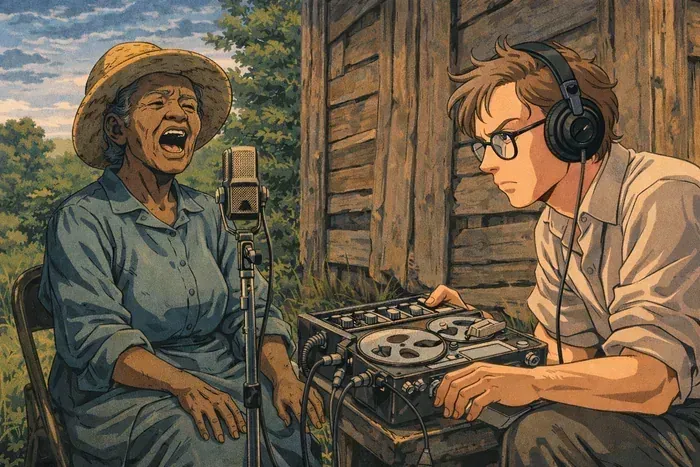
In the early 20th century, recording equipment became portable enough for collectors to travel and document performances they believed were at risk of disappearing. John Lomax and later Alan Lomax became the best-known figures in that work through projects tied to the Library of Congress and beyond. They recorded musicians in prisons, on farms, in churches, and in small towns across the American South, often with heavy equipment and fragile discs.
These sessions preserved voices that might otherwise have remained local. Huddie Ledbetter, better known as Lead Belly, was recorded by John and Alan Lomax at Louisiana State Penitentiary in 1933 and later reached a much wider audience. Traditional ballads, blues songs, children’s songs, and work songs could now be replayed outside the place where they were first sung. Recording did not simply document performance. It changed where the music could travel and who could profit from it.
However, preservation was not neutral. The collector decided where to travel, who to record, and which performances to release. A singer who had never thought about authorship suddenly found a song with a specific name attached to it. Then, more questions followed. Who owned the material? Who made money from it? Who decided what was real?
Elizabeth Cotten’s experience shows how complicated those dynamics could become. According to the Library of Congress, she wrote “Freight Train” at about age twelve. The song later circulated widely through the folk revival, but proper credit and royalties did not follow automatically. Preservation, circulation, and appropriation often overlapped.
Field recordings also shaped public perception. By preserving certain repertoires, collectors encouraged the idea that “real” folk belonged mainly to rural, working-class communities. Urban traditions received less attention. Women were recorded, but men often dominated the public story that followed. The archive reflected not only musical reality but also social hierarchy.
Still, without these recordings, much would have been lost. Lomax and others recorded prison chants, children’s rhymes, and spirituals at a time when radio and popular culture were changing American music. The microphone did more than just record songs. It changed the way performers and listeners interacted with each other. A voice that once only reached a room could now travel across states.
This new reach laid the groundwork for the revival decades later. In the 1950s and 1960s, young musicians learned repertory not only from older singers in person but from commercial reissues, library archives, and field recordings made by earlier collectors. The revival did not appear from nowhere. It grew out of archives that had already made folk music more portable, repeatable, and attached to identifiable performers.
Woody Guthrie, Lead Belly, and the Voice of Witness
By the 1930s and 1940s, folk music was no longer only a record of inherited tradition. In the middle of the Depression, labor conflict, and wartime politics, songs also became a way to answer current events in real time.
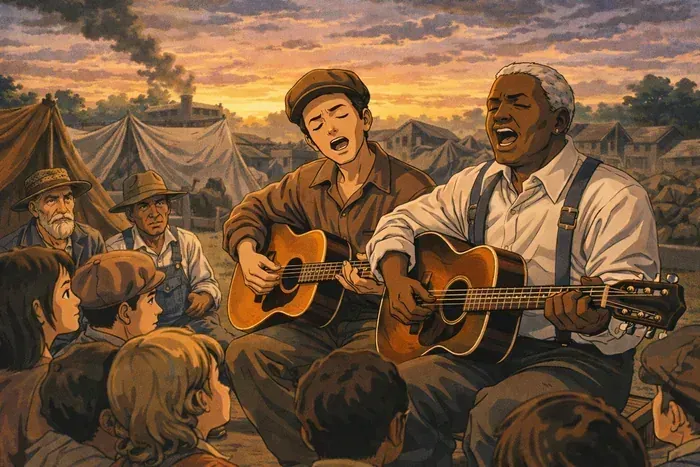
Woody Guthrie was central to that shift. Raised in Oklahoma and marked by the Dust Bowl years, he wrote from lived proximity to migration, poverty, and displacement. Songs such as “This Land Is Your Land” sound simple on the surface, but their verses press on access, exclusion, and ownership. Guthrie did not separate art from politics. He treated songwriting as public work.
Pete Seeger, later a founding member of the Weavers, pushed the communal side of the music even harder. He believed songs should be teachable, adaptable, and shared back into public life. His concerts often worked less like recitals than like organized sing-ins.
Lead Belly brought a different force. He sang ballads, blues, children’s songs, and work material with huge rhythmic authority and a distinctive twelve-string sound. As his recordings circulated, later musicians borrowed directly from both his repertoire and his delivery. His visibility also exposed a distortion built into many later folk histories: African American musicians were not peripheral to folk. They were foundational.
Odetta carried that lineage into the revival with unusual authority. Her recordings of spirituals, work songs, and traditional material sounded historically grounded without trying to imitate an older style mechanically. Bob Dylan later said she was a major reason he turned toward folk.
These artists did not invent protest music. Spirituals, labor songs, and abolitionist music had long carried resistance. What changed was scale. Through records, radio, union events, and concert touring, roots-based songs reached urban audiences that increasingly heard folk as a vehicle for public witness.
The result was a new public role for the folk performer. The singer was no longer only a keeper of songs. The singer could also act as witness, commentator, and organizer. That shift set up the revival years that followed.
When Folk Became Political
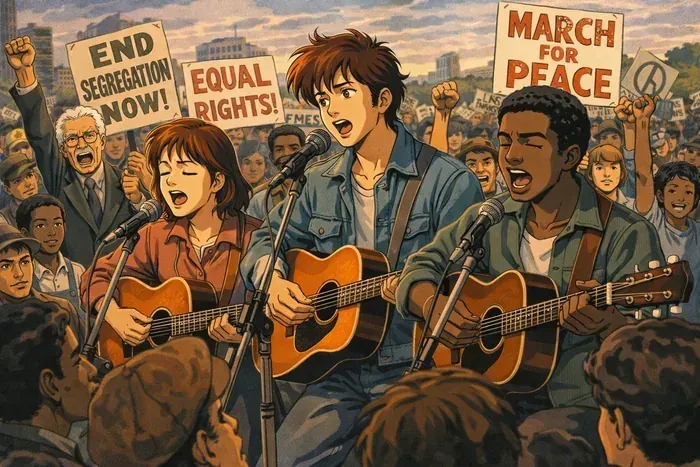
By the middle of the 20th century, folk music had become closely linked with political identity. That connection grew through anti-fascist organizing, labor activism, Popular Front culture, and early civil rights work. People sang at rallies, in union halls, and on picket lines because songs could organize time, memory, and shared purpose all at once.
Pete Seeger’s work with the Weavers in the late 1940s and early 1950s showed that folk could briefly become mass culture. “Goodnight, Irene,” adapted from Lead Belly’s repertoire, became a major hit. But the same political associations that gave the music force also made it vulnerable during the Red Scare. Seeger was blacklisted, and folk’s public image hardened around seriousness, dissent, and suspicion from the mainstream.
During the civil rights movement, songs again moved from performance into action. Spirituals were adapted for marches, mass meetings, and voter-registration work. “We Shall Overcome” became powerful not because it was new, but because a long song tradition was being used collectively in a new political setting. Joan Baez’s presence at marches and organizing events tied the revival directly to that work.
Buffy Sainte-Marie expanded the political scope even more. As a singer-songwriter, she wrote songs about Indigenous rights, war, and colonialism, like “Universal Soldier.” Her career later faced resistance within parts of the industry and broadcasting system. Her presence made tensions around representation and power that had long existed within folk circles impossible to ignore.
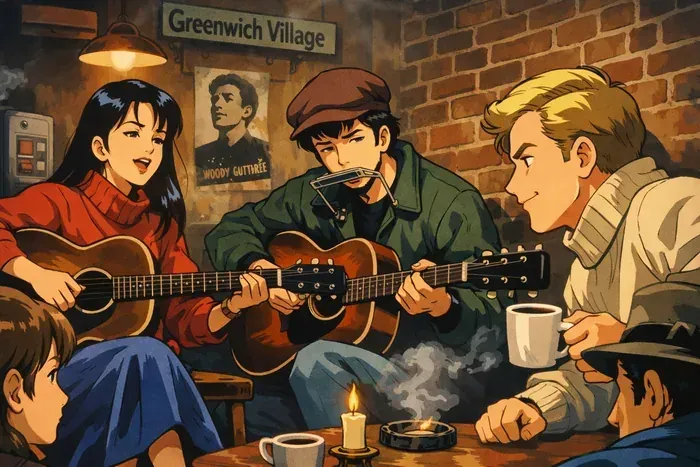
By the early 1960s, folk clubs in cities such as New York, Cambridge, and Boston had become meeting points for young musicians, activists, students, and attentive audiences. Authenticity started to mean more than historical accuracy. It also implied seriousness of purpose and a visible moral position.
The image of the lone singer with a guitar became culturally powerful. A minimal setup signaled honesty. A traditional melody suggested continuity. But change was already under way. As folk drew larger audiences, record labels took notice, and musicians faced a new question: how to reach more listeners without sacrificing artistic integrity.
The Folk Revival: Where Authorship Took Center Stage
By the late 1950s and early 1960s, folk music had moved from archives, labor spaces, and small revival circles into coffeehouses, campuses, and urban clubs. Young listeners, many shaped by civil rights activism and later by anti-war politics, heard acoustic music as an alternative to polished commercial pop. Folk offered history, seriousness, and a way to signal ethical as well as musical taste.
Record labels and television followed. What had once circulated in small rooms now appeared on national broadcasts and in mass-market magazines. The intimacy did not vanish, but its audience expanded. A singer who once played to one room could now speak to a much larger public.
The revival also made authorship newly visible. Interpreting traditional material still mattered, but writing your own songs began to carry unusual prestige. That change did not erase folk’s communal roots. It made the individual songwriter harder to separate from the song.
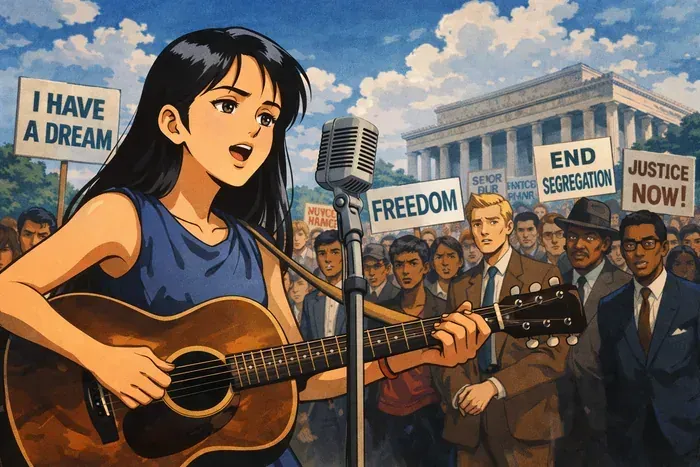
Joan Baez: When a Voice Becomes a Conscience
When Joan Baez released her debut album in 1960, she sounded unlike many revival singers who leaned on roughness as a sign of authenticity. Her voice was clear, disciplined, and exact. That precision became part of her authority.
At first, she sang songs from older traditions, but she also championed contemporary writers. By supporting Bob Dylan’s early work, she helped expand his audience. At the same time, she remained closely tied to the civil rights movement. She performed at the March on Washington on August 28, 1963 and took part in civil-rights activism beyond the stage. Her activism was not separate from her career. It helped define it.
Baez’s prominence also mattered in a scene that often centered male writers and instrumentalists. She became a major interpreter in her own right, and her repertoire, stagecraft, and public commitments gave her unusual authority in a male-dominated field.
As the revival grew, so did discussions about authenticity. Baez’s dedication to nonviolence and social justice made people think that folk artists should live the way their songs say. People expected the message and behavior to match. This expectation grew stronger as the decade went on.
Her role in the revival makes clear how interpretation and activism could merge into a durable public identity. Baez did not need to write every key song herself to shape what the scene meant. "I think it’s quite magnificent, really. I have always viewed my vocal cords as a gift."
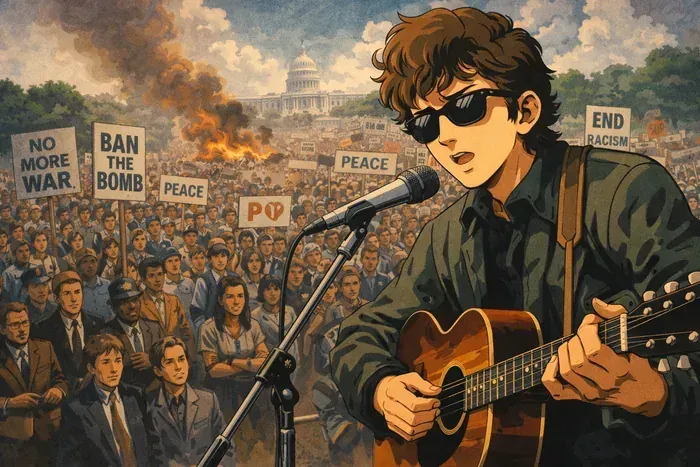
Bob Dylan: The Song That Outgrew Its Genre
When Bob Dylan arrived in New York in 1961, he found a scene that had already been shaped by revival artists and collectors. His early performances were based on traditional material and the music of Woody Guthrie. But he quickly became famous for his songwriting. On The Freewheelin’ Bob Dylan in 1963, songs like “Blowin’ in the Wind” and “A Hard Rain’s A-Gonna Fall” pushed the limits of what a folk song could be. The language felt modern, even when the melodies echoed older styles.
Dylan’s writing made the genre more complex. His lyrics were inspired by journalism, literature, and the Bible. He used denser imagery to express his ideas. The shift did not abandon politics, but it changed the tone. Meanings became less direct. Instead of chanting slogans, listeners were invited to interpret.
By 1965, Dylan’s writing had already outgrown the expectation that a folk song needed to sound spare in order to count as serious. Highway 61 Revisited brought electric instruments, sharper rhythms, and songs such as “Like a Rolling Stone” that were longer and structurally looser than standard radio singles. Amplification unsettled parts of the folk audience, but it also widened the idea of what a songwriter’s voice could sound like.
Dylan’s shift made one thing unmistakable: the folk singer could now be heard primarily as an author with a private imaginative world, not only as an interpreter of shared material or a spokesperson for a movement.
His influence spread quickly. Younger musicians looked to Dylan as an example of artistic freedom. Writing original material became central to credibility. Even artists who disliked his stylistic turn learned that a song could be both ambitious and accessible.
By the mid-1960s, the revival was no longer mainly about recovering old songs. It had become a place for writing new ones. Dylan’s career condensed that change into a few fast years.

Buffy Sainte-Marie: Indigenous Truth in a Folk World
While Bob Dylan was expanding the poetic range of folk songwriting, other voices were pushing its political scope. Buffy Sainte-Marie entered the revival scene in the early 1960s and brought Indigenous history and contemporary struggle directly into folk songwriting.
Her first album, It’s My Way! (1964), included songs about war, displacement, and colonial violence. “Universal Soldier” became widely known through multiple covers, but its force lies in how it relocates blame from abstract leaders to ordinary participation in war. Sainte-Marie wrote plainly, but never cheaply.
Many revival artists worked inside a narrow idea of “American” material. Sainte-Marie did not. Her songs addressed broken treaties, cultural survival, and the long afterlife of settler colonial policy, subjects that mainstream stages rarely made room for.
Her career also shows the limits of the era’s openness. Sainte-Marie later said that her music faced pressure within parts of U.S. broadcasting after she criticized government policy. However formal or informal those mechanisms were, political speech still carried professional risk.
Musically, she did not remain within acoustic arrangements alone. Over time, she experimented with electronic elements and fuller production, challenging narrow ideas about what “real” folk should sound like. Her refusal to stay inside one style anticipated later arguments about whether a genre should remain fixed or evolve.
Sainte-Marie’s presence widened the revival’s frame. The conversation extended beyond labor struggles and civil rights in the American South. Folk became a space where Indigenous communities and anti-war voices from other contexts could enter the public conversation. As the music grew in popularity, the definition of who counted as a folk songwriter also expanded.
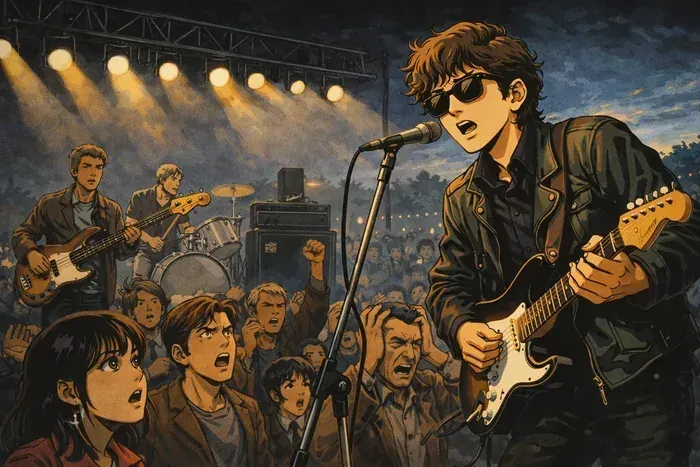
Newport 1965: The Night Folk Went Electric
By the summer of 1965, the folk revival was no longer a niche scene. The Newport Folk Festival had become one of its most visible stages, bringing traditional performers, revival stars, critics, and politically engaged audiences into one place.
When Bob Dylan took the stage with an electric band on July 25, 1965, the reaction was immediate and divided. Backed by members of the Paul Butterfield Blues Band and Al Kooper, he played a loud, amplified set that included “Maggie’s Farm” and “Like a Rolling Stone.” Some people cheered. Others booed. The details remain debated, but the symbolic charge of the set does not.
For some people in the folk community, amplification meant stepping outside the “folk way.” Electric instruments were associated with rock and roll, which some listeners saw as commercial and superficial. In that view, folk had to remain careful, serious, and honest. Dylan’s decision felt like a betrayal of shared values.
Another way to read Newport is not as a break, but as a continuation. Folk music has always been able to adapt to new situations. The banjo used to be considered a modern instrument. Recording technology had already changed how songs were shared. The next tool was simply an electric guitar. Dylan didn’t stop telling stories. He added new sounds to the mix.
The controversy revealed deeper disagreements about what it means to be authentic. Was sincerity defined by sound, by intention, or by audience expectation? Could a songwriter who is also interested in politics use a drum kit without losing credibility? These questions would resurface later, when indie artists were also accused of selling out.
Newport also dramatized a broader shift already under way. The Byrds had already turned Dylan songs into electric hits, and Simon & Garfunkel were combining close harmony with studio polish. Folk and rock were not colliding for the first time. They were becoming harder to separate.
The moment did not end the revival, but it changed it. The lone singer with an acoustic guitar remained powerful. At the same time, there were now more ways to become a modern singer-songwriter. Authorship could include experimentation, expansion, and stylistic risk.
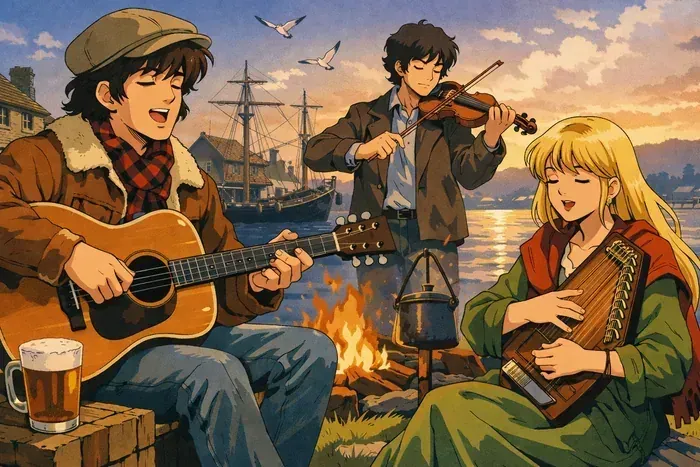
Across the Atlantic: The British Folk Movement
While the American revival drew headlines, a related shift was taking place in Europe. In Britain and Ireland, traditional ballads had never fully disappeared. Folk clubs were widely attended in cities like London, Manchester, and Edinburgh in the late 1950s and early 1960s. Musicians met in small rooms, often above pubs, to share songs with long histories.
The British revival had much in common with its American counterpart. Questions about authenticity, preservation, and politics shaped the scene. But the song traditions and historical context were different. Rather than drawing from one main archive, these musicians worked with a wider range of material: ballads from the British Isles, maritime songs, and regional traditions. American folk recordings influenced them, but the exchange moved in both directions.
The exchange between musicians on both sides of the Atlantic was crucial for the development of intimate songwriting. In Britain, technical refinement and subtle arrangement became more popular. Quiet, thoughtful voices came from within the revival, not from those who were against it. The groundwork for a more inward form of authorship was being laid.
Fairport Convention and Sandy Denny: Tradition Reimagined
By the late 1960s, Fairport Convention had become a defining band of the British revival. Instead of treating traditional material like museum glass, the group used electric instruments while keeping narrative detail at the center. Their 1969 album Liege & Lief remains a landmark because it made old ballads sound urgent rather than embalmed.
Sandy Denny was central to that achievement. Her singing is exact without sounding stiff, and on songs such as “Matty Groves” she holds a long narrative together without theatrical overstatement. She made old material feel lived rather than antiquarian.
Her writing also shifted toward more personal themes. After leaving Fairport Convention, she released solo work that blended traditional sensibilities with introspective themes. Albums like The North Star Grassman and the Ravens showed a singer comfortable with vulnerability. The move from communal repertoire to individual songwriting mirrored changes in the United States.
Fairport Convention’s approach to tradition differed in tone from Dylan’s electric turn. Where Newport became a flashpoint, British folk rock was more often about integration. Electric instruments did not erase history; they reframed it. That let traditional stories reach wider audiences without losing their connection to older sources.
The British revival also built durable venue and festival networks that rewarded close listening. In that setting, understatement, technical skill, and patient arrangement could carry real weight.
Denny also changed expectations around gender in British folk. She was not simply the voice fronting someone else’s vision. She was a shaping intelligence inside the music.
The exchange of music between the United States and the United Kingdom allowed for more experimentation. Songs moved back and forth, changing in how they were sung, arranged, and understood. The conversation reinforced an important idea that would resurface decades later: intimacy does not require minimalism alone. It can be created through careful collaboration or by working alone.
Bert Jansch: Precision, Restraint, and Influence
Fairport Convention made British folk rock more visible. Bert Jansch made it more inward. Jansch emerged in the early 1960s as a guitarist whose precision never sounded academic. His 1965 debut, Bert Jansch, paired traditional material with originals built on intricate fingerpicking that served the song rather than decorating it.
Jansch drew from blues as well as British ballad traditions, a mix that reflected the wider transatlantic exchange shaping the revival. His arrangements were spare, but a single guitar part could imply several voices at once. The quiet demanded attention.
In 1967, Jansch joined Pentangle, a group that combined folk, jazz, and blues influences. Pentangle reworked traditional material with unusual rhythmic and harmonic flexibility. The instruments played against one another in ways that opened space inside the arrangements. Silence and restraint became expressive tools.
That refinement mattered because it showed that folk musicians did not have to choose between tradition and advanced technique. Jansch’s playing later fed into generations of songwriters and guitarists well beyond strict folk circles.
British folk clubs promoted this focus on detail. Unlike the big festival stages, these venues were smaller and more personal. The performers stood close to their audiences. Every mistake was easy to hear. In that environment, precision and honesty mattered more than spectacle.
Jansch’s influence extended well beyond genre boundaries. Many musicians, from Neil Young to Johnny Marr, have cited his guitar style as an influence. His work also showed that folk musicians were not only preserving history. They were advancing technique and opening new possibilities within the tradition.
The British focus on craft complemented the American emphasis on lyrical expansion. Taken together, those approaches helped form the singer-songwriter model that followed.
Nick Drake: Intimacy in Low Volume
Nick Drake remains one of the defining figures of intimate songwriting. He was active in the late 1960s and early 1970s, and he released three albums during his lifetime: Five Leaves Left, Bryter Layter, and Pink Moon. He was not commercially successful during his lifetime. But his influence grew after his death in 1974.
Drake’s work combined many aspects of the British revival into a more subtle style. His guitar tunings created open, resonant textures. The music felt spare even when it included strings or other arranged elements. He sang in a soft voice. Listening to Pink Moon, which is largely built from voice and guitar, feels like entering a private room.
The inward tone was different from the lively energy of earlier revival music. Drake’s lyrics often focused on personal thoughts instead of public events. Nature imagery appeared often, but it did not romanticize rural life. Instead, it gave the songs emotional distance and inwardness. They did not declare positions. They suggested states of mind.
Drake’s initial obscurity reveals something about the market at the time. In the early 1970s, singer-songwriters became popular, but being vulnerable still favored clear melodic accessibility. Artists like James Taylor and Joni Mitchell used introspection and strong melodies to create songs that were popular on the radio. Drake’s restraint may have seemed too mild for what the industry expected.
His later rediscovery changed that perception. By the 1990s, musicians in the alternative and indie scenes were drawn to his minimalist style. The quiet no longer meant weakness. It was a sign of depth. The style of understatement became an example for artists who thought that atmosphere was more important than volume.
Drake’s influence spread slowly but deeply. Later indie and alternative musicians heard in his records a model for quiet intensity, unusual guitar tunings, and understatement that did not need to explain itself. He did not directly create bedroom pop, but he helped make space for later artists such as Elliott Smith and others who treated low-volume singing as an aesthetic strength rather than a commercial limitation.
With Drake, the spread of folk music across the Atlantic Ocean reached a new level of introspection. The shared archive had been replaced by the personal notebook. It was a moment when confession and authorship became central.
The Singer-Songwriter Era: The Album as Confession
By the early 1970s, singer-songwriters had become one of the central forces in popular music. Songwriting had already moved toward individual authorship; now the personal voice became a commercial and artistic center of gravity. The urgency of the early 1960s did not vanish, but it often turned inward.
The album became the era’s key artistic format. FM radio favored longer songs and album tracks, and listeners were encouraged to hear records from start to finish. In that space, narrative and atmosphere mattered as much as hooks. The singer was no longer only interpreting inherited material or speaking for a movement. The singer was presenting a distinct interior world.
Rather than breaking with folk tradition, this deepened one of its long-running threads. The lone voice still mattered most. What changed were the scale, the market, and the subject matter. The room grew quieter even as the audience grew larger.
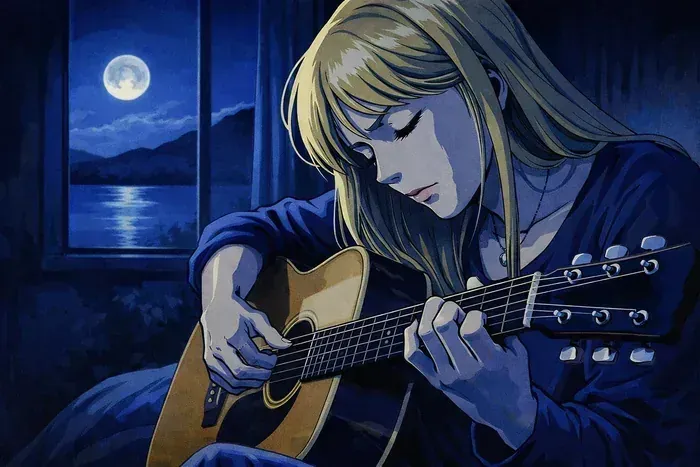
Joni Mitchell: Intimacy, Harmony, and Blue
Joni Mitchell was already a major songwriter by the time she released Blue in 1971. Other artists had turned songs such as “Both Sides, Now” and “Woodstock” into hits, but Blue made Mitchell’s own voice feel unavoidable. The arrangements were spare enough to keep the focus on phrasing, timing, and emotional detail. Piano, acoustic guitar, and dulcimer support the songs rather than dressing them up.
The songs on Blue are emotionally direct without being simplistic. “A Case of You” and “River” deal in longing, regret, and ambivalence rather than clean moral lessons. Mitchell’s writing keeps metaphor and confession in tension. She does not resolve every contradiction for the listener.
Her guitar tunings added harmonic color that set her apart from many other musicians of the same time. The music was elegant yet immediately accessible. Mitchell’s approach showed that intimacy doesn’t have to be complicated. Complexity could help people be more emotionally honest.
Within the music industry, Blue marked a turning point for women songwriters. Carole King’s Tapestry appeared at nearly the same moment, and together those albums changed what mainstream audiences expected. Women were no longer confined to interpreting songs written by others. They wrote and framed their own stories.
Mitchell also refused to stay in one stylistic lane. Early records drew heavily from folk, but later albums such as Court and Spark and Hejira moved toward jazz harmony and more fluid arrangements. That matters here because it shows that intimate songwriting was never limited to one instrumental template.
Mitchell’s work resonated across genres. From Laura Marling to Phoebe Bridgers, later songwriters have drawn on her combination of precision, risk, and emotional candor. She showed that a quiet voice could command attention without becoming louder.
Mitchell helped redefine what personal songwriting could do at album length. By the early 1970s, the shared folk repertory had not disappeared, but it no longer held the center of gravity. A listener came to Mitchell for her point of view, her harmonic language, and her way of turning lived experience into structure.

Carole King: When the Songwriter Steps Forward
When Carole King released Tapestry in 1971, she was already one of the most successful songwriters in American pop. With Gerry Goffin she had written major hits in the 1960s, including “Will You Love Me Tomorrow” and “(You Make Me Feel Like) A Natural Woman.” What Tapestry changed was the public role. King was no longer heard mainly through other voices.
The production avoided obvious drama. The songs were warm, driven by piano, gentle rhythm sections, and close vocal harmonies. King’s voice lacked the grand manner of many pop singers of the time. Instead, it carried a conversational warmth that made songs like “It’s Too Late” and “You’ve Got a Friend” feel immediate.
Some singer-songwriters leaned toward mystery. King leaned toward clarity. Her lyrics speak plainly about separation, trust, fatigue, and recovery, and that plainness helped explain the album’s reach. Tapestry spent fifteen consecutive weeks at No. 1 on the Billboard 200 and remained on the chart for years, evidence that conversational intimacy could be a mass-market form rather than a niche one.
Tapestry also changed how audiences thought about authorship. King had always been a hit writer, but performing the songs herself collapsed the distance between writer and star. The personal voice could now be central and commercially massive at the same time.
The album’s impact went beyond sales. It changed the sound of intimacy in mainstream pop. Vulnerability did not have to arrive as severity or mystique. It could sound lived-in, warm, and almost domestic, with the piano rather than the guitar at the center.
Tapestry showed that personal stories could be successful in the mainstream market. Record labels started investing more in artists who wrote their own songs. The album-oriented era became stronger. Listeners bought records not only for individual songs, but also for the experience of entering someone’s personal world.
Carole King’s move from behind-the-scenes writer to front-facing artist captures a broader change of the period: songwriting itself had become part of public identity.
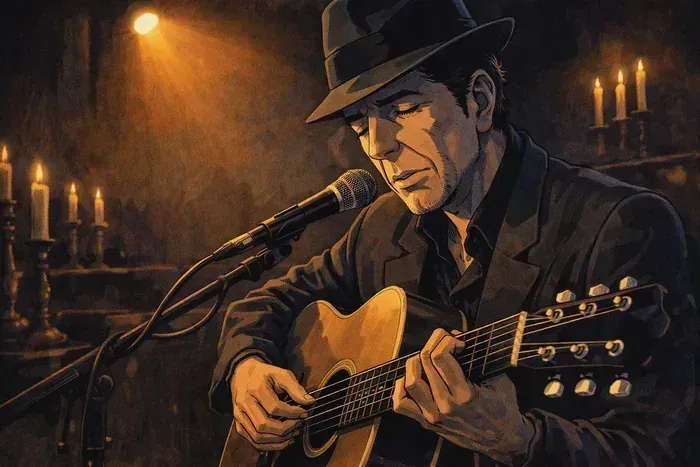
Leonard Cohen: The Poet Who Sang
Leonard Cohen entered the singer-songwriter field from a different angle. Before releasing Songs of Leonard Cohen in 1967, he was already known as a poet and novelist. That prior identity mattered. Listeners heard the songs as writing as much as performance.
Cohen’s writing was known for its ambiguity and moral complexity. Songs like “Suzanne” and “So Long, Marianne” tell stories that aren’t wrapped up neatly at the end. Religious imagery appeared alongside romantic doubt. Desire and guilt are mixed together. The tone was reflective rather than declarative.
In the early 1970s, Songs of Love and Hate took that idea even further. The album felt darker, with simple production that made his voice stand out. Cohen didn’t try to be the best singer. He spoke in a calm and measured way, almost as if he was thinking out loud. The effect invited close listening. The silence around the phrases was as important as the melody.
Unlike some of his North American peers, Cohen did not focus on plainspoken personal stories. Even when he drew from his own life, he expressed emotion through carefully crafted language. The songs felt literary, but they still carried warmth. That balance helped expand what the singer-songwriter label could contain.
Cohen’s range also widened the category itself. North American folk, European poetry, and Jewish liturgical influence all move through the work without settling into one idiom.
His audience also deepened over time. Covers made some songs famous, but his own recordings remained a model for artists who valued phrasing and language as much as tune.
Cohen’s presence in the singer-songwriter era made people think that authorship could take many forms. Being honest about your feelings doesn’t always mean saying everything. It could come through metaphor, restraint, and deliberate pacing. In the growing world of personal songwriting, he created a path defined by quiet authority.

Tracy Chapman: A Quiet Voice in the Loud Eighties
By the late 1980s, the singer-songwriter tradition had already passed through rock expansion, studio polish, and FM-era introspection. Against a chart landscape dominated by arena rock and synth-pop, Tracy Chapman’s 1988 debut sounded unusually direct. Acoustic guitar, steady rhythm, and close attention to story made the album stand apart.
“Fast Car” became the defining song because it never strains for effect. Its narrative tracks class pressure, stalled mobility, and private hope in precise, ordinary detail. Chapman sings it almost without theatrical release. The power comes from accumulation, not from a big chorus or vocal climax.
The album also included “Talkin’ ‘bout a Revolution,” which connects directly to economic inequality and political frustration. Chapman’s protest writing does not rely on grand prediction. It works through patience, pressure, and observation.
Her rise renewed mainstream attention to acoustic singer-songwriters. Chapman’s success showed that a stripped-back, socially observant record could still win heavy radio play, go multi-platinum, and take major awards. Her appearance at the Nelson Mandela 70th Birthday Tribute in London in June 1988 widened that audience even further.
Chapman’s position as a Black woman in a genre often associated with white folk revivalists broadened its image. She did not appear as part of a revival scene. Instead, she carried forward social commentary rooted in earlier traditions while addressing contemporary issues.
By that point, the industry had changed. MTV and large-scale touring helped broaden visibility. But Chapman’s work showed that scale was not necessary for impact. A steady guitar and a clear voice could still anchor a major cultural moment.
Chapman’s success showed that close, direct songwriting still had mass force even in a different production era.
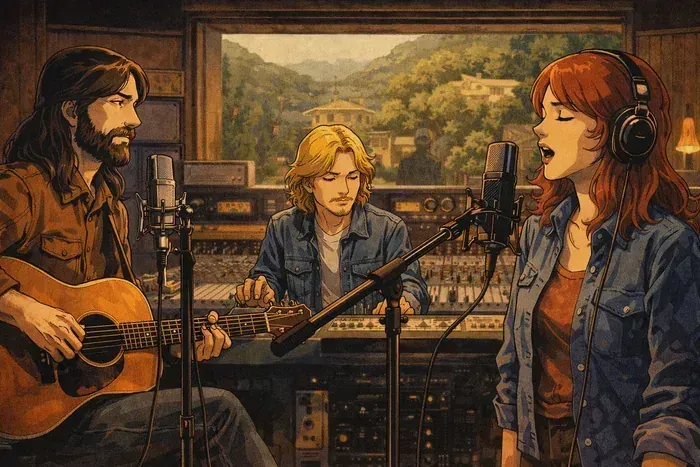
Laurel Canyon: When Intimacy Moved Into the Studio
While individual albums shaped the public image of the singer-songwriter, specific local scenes shaped its sound. In the late 1960s and early 1970s, Laurel Canyon in Los Angeles became shorthand for a network of musicians who brought folk-rooted writing into a more professional studio environment. The scene grew through proximity, shared players, and constant exchange rather than through a single manifesto.
James Taylor’s Sweet Baby James in 1970 captured the mood of this group. The arrangements were elegant but not overly ornate. The songs were anchored by the acoustic guitar, supported by careful production and experienced session players. Taylor’s voice sounded fragile, but not weak. His work combined the intimacy of folk music with the accessibility of radio.
Linda Ronstadt shows another side of the same ecosystem. She moved easily across country, folk, rock, and pop, and although she was not primarily marketed as a confessional singer-songwriter, her interpretive style fit the era’s emphasis on sincerity and song craft. Laurel Canyon was never only about solitary authorship. It also depended on arrangers, harmony singers, producers, and session musicians.
Crosby, Stills, Nash & Young also mixed together the voices of all the musicians and their own individual styles. Their album Déjà Vu combined complex vocal arrangements with songs that addressed political issues. Each member wrote their own material, showing that authorship can exist within a group framework.
The Laurel Canyon environment also reflected the growth of the industry. Major record companies were willing to develop artists over longer periods. Studios became places where albums were crafted as complete statements, not just quickly assembled products. The singer-songwriter was no longer only an outsider in a coffeehouse. Many now worked within professional studio systems.
The shift brought both new opportunities and challenges. Greater resources allowed for richer arrangements and broader distribution. At the same time, businesses were expecting more. Artists had to find a balance between being honest with themselves and being marketable.
The singer-songwriter era was not outside the music business. It learned how to work inside it. Albums were carefully produced, promoted, and toured, but the central image barely changed: one identifiable person, one point of view, one set of songs that seemed to come from lived experience.
By the mid-1970s, the framework was in place. Folk roots had evolved into a mature model of authorship. That studio-centered model did not disappear in the decades that followed. It continued alongside newer, more independent roots networks. The next shift would not abandon the singer-songwriter framework. It would relocate and redistribute it.

Americana and Alt-Country: Folk as Foundation
By the late 1970s and early 1980s, the first singer-songwriter wave had been absorbed into the mainstream, but its methods did not disappear with chart fashion. Some artists followed bigger productions. Others built durable careers closer to regional circuits, independent labels, and roots audiences. The core values moved with them.
In the United States, musicians began drawing on country, bluegrass, and other rural traditions without treating them as museum pieces. The term “Americana” later became one way to describe this space. It functioned less as a strict genre than as a shared orientation. Songs were valued for storytelling, melodic clarity, and a strong sense of place. The scale was often smaller than arena touring, but the commitment to craft stayed strong.
These artists built careers through touring, careful catalog building, and audience trust. By that point, roots-based songwriting was not just a revival tendency. It was an infrastructure.
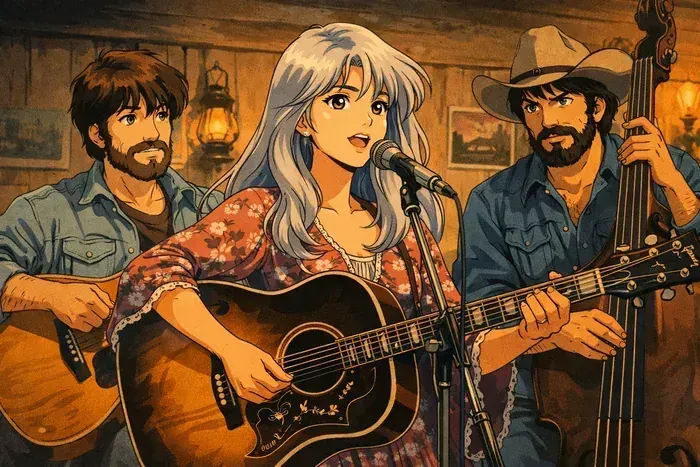
Emmylou Harris: The Curator of American Roots
Emmylou Harris was central to that roots continuum. After working with Gram Parsons, she carried forward a version of country, folk, and rock that treated tradition as repertory, not as costume. Albums such as Pieces of the Sky and Elite Hotel showed how older forms could be revoiced with modern emotional clarity.
Harris is also a songwriter, but one of her lasting strengths is curatorial. She repeatedly found songs by other writers and made them feel inevitable, helping define a version of Americana in which selection, arrangement, and vocal framing mattered as much as authorship in the narrowest sense.
Her voice was clear and emotionally rich. Unlike some singer-songwriters who relied on direct confession, Harris often created intimacy through arrangement. Gentle harmonies and acoustic textures framed her performances. The production was polished, but it kept an earthy core.
In the 1980s and 1990s, Harris kept moving. Wrecking Ball, produced by Daniel Lanois in 1995, pulled roots writing into a more atmospheric sound world without sacrificing clarity of song. That record mattered to younger artists because it proved that tradition and sonic experimentation were not enemies.
Harris also worked collaboratively. Projects like the Trio albums with Dolly Parton and Linda Ronstadt showed that roots music could stay intimate inside shared vocal arrangements. Community never disappeared from the form.
Harris worked with both major record labels and smaller, more independent companies. Her career shows that folk-inspired songwriting can endure beyond short periods of popularity. The focus changed from one of controlling the charts to building strong relationships with audiences.
Americana as a formal category would later be organized through radio, press, and awards, but its practical spirit took shape in artists like Harris. She connected singer- songwriters, country traditionalists, and younger roots musicians without forcing them into one narrow style.

Lucinda Williams: Grit, Grace, and Gravel Roads
If Harris often represented control and curation, Lucinda Williams represented abrasion. Williams drew wider acclaim in the 1990s with records that valued pressure, friction, and emotional exposure over finish. Her voice sounded weathered, and even careful studio work was allowed to keep its rough edges.
Her 1998 album, Car Wheels on a Gravel Road, remains one of Americana’s defining records. The songs blended personal reflection with Southern landscape, capturing both tenderness and frustration. Songs like “Right in Time” and the title track balanced emotional openness with concrete detail. The settings felt specific, and the feelings were not softened by metaphor.
Williams’s songwriting made confession rougher and less romantic. Her relationships were messy, unresolved, and fully lived in. Memory did not smooth experience into nostalgia. The sound matched that honesty. The guitars were ragged rather than polished. Even after careful studio work, the texture stayed rough at the edges.
Her career also shows how slowly roots audiences can build. Years passed between albums, label relationships were often difficult, and momentum did not come from one mass-media channel. It came from touring, critical advocacy, radio niches, and word of mouth.
Williams marks a real hinge point between roots songwriting and later indie directness. She stayed close to story while letting rock pressure into the frame.
The Americana music scene that emerged around artists like Williams allowed for songs that didn’t fit neatly into pop categories. Small venues, special events, and unique radio shows helped musicians build careers outside mainstream visibility. This scene later intersected with independent labels and alternative music networks.
Williams’s work is a reminder that intimacy does not always sound gentle. It can sound worn, unstable, and unsmoothed. That texture later became important to parts of indie folk as well.
Uncle Tupelo and Wilco: When Punk Met Country
By the early 1990s, a younger generation was reshaping roots music from inside indie rock. Uncle Tupelo treated country not as heritage décor but as living material that could hold distortion, class anger, and punk energy.
The phrase “No Depression,” taken from the Carter Family song and then from Uncle Tupelo’s debut, helped name a wider scene. That scene attracted artists who loved older songwriting forms but felt boxed in by commercial country radio.
After Uncle Tupelo broke up, Jeff Tweedy formed Wilco. Over time, Wilco moved beyond a strict alt-country identity, incorporating experimental sounds while keeping a songwriting core shaped by folk sensibility. Albums like Being There and later Yankee Hotel Foxtrot showed a band comfortable combining personal lyrics with complex musical design.
Tweedy often wrote about uncertainty and self-questioning. The tone was similar to that of earlier singer-songwriters, but the sound felt modern. Studio experimentation became a normal part of the language. Noise and texture could exist together with a gentle melody.
The alt-country and Americana music scenes connected older roots artists with new indie audiences. College radio stations, small record labels, and regional tours worked together to create a lasting network. Musicians could develop careers without relying on mainstream country radio or pop charts.
That infrastructure mattered because it let artists keep a strong authorial identity while moving across scenes. Craft and storytelling stayed central even as genre boundaries loosened.
Uncle Tupelo and Wilco show how tradition can change without losing its center. Their work helped set the stage for indie folk artists who later combined quiet vocals with subtle experimentation. That development emerged from hybrid spaces where roots and alternative culture carried equal weight.
Gillian Welch: Minimalism as a Radical Choice
While other alt-country artists were broadening the palette, Gillian Welch moved toward less. In the mid-1990s, she embraced a stripped-down approach rooted in older country and folk textures, with David Rawlings as her essential counterpart.
Her debut album, Revival, released in 1996, sounded old without becoming reenactment. The arrangements were spare and patient, often built on simple chord structures that let the lyrics lead. Welch’s writing drew on rural imagery and historical reference, but the tone remained modern beneath its traditional surface.
Albums like Time (The Revelator) took this minimalism to a new level. The song “Everything Is Free” directly addressed the changing economics of music. It was about how digital distribution affects artists’ ability to make a living. In a few simple sentences, Welch captured a change that would soon define the next generation of songwriters.
Her work with Rawlings showed how collaboration can remain seamless and restrained. Their performances highlighted subtle rhythmic interplay and close vocal blending. The focus remained on the song itself. Silence between phrases mattered. Listeners could hear breath, finger movement, and instrument resonance.
Welch resonated with indie audiences because she showed that historical reference did not require revivalist theater or ironic distance. Tradition could still be a live tool.
Welch sits at the intersection of folk and indie folk. She did not follow trends or lean on heavy production. Instead, she emphasized space and narrative clarity. That approach can be heard in Bon Iver’s early recordings and in the spare arrangements favored by many indie folk artists in the 2000s.
As Americana became a recognized field, Welch was one of its quiet anchors. Her records showed that innovation does not always mean expansion. Sometimes it comes through restraint and incremental refinement.
Indie Pop: Intimacy Without the Acoustic Guitar
By the late 1980s and 1990s, personal songwriting no longer needed to announce itself with an acoustic guitar. In indie pop and adjacent alternative scenes, closeness could come through jangling electric lines, drum machines, cheap keyboards, or carefully dry vocals.
Independent labels and college radio supported artists outside mainstream pop, often at a small scale and through indirect routes. But the artist-listener bond remained strong. Intimacy was no longer genre-bound. It had become transferable.
This blend mattered for the later development of bedroom pop. Many artists who helped define that sound drew from folk songwriting as well as indie pop’s lo-fi aesthetics and DIY spirit. The private voice had learned to live comfortably among drum machines and gentle distortion.

Belle and Sebastian: Stories Told Softly
Belle and Sebastian gave that transferability one of its clearest forms. Their 1996 album If You’re Feeling Sinister became a touchstone for listeners who valued narrative detail, social awkwardness, and understatement over scale.
Stuart Murdoch wrote songs about everyday life. The characters in his lyrics dealt with uncertainty, belief, and social discomfort. The tone was not overly emotional or personal. Instead, it invited close observation. The lines flowed like a conversation with a friend, not like a speech in a stadium.
Belle and Sebastian were a band, but their music still left space around the voice. The arrangements supported the songs without crowding them. As a result, intimacy survived within a collective format.
The group’s early reluctance to engage the press also fit a wider indie suspicion of overexposure. Public distance became part of the aesthetic.
Their influence spread quietly but widely. The band showed that vulnerability could be observant, literate, and lightly arranged without losing warmth.
As they moved through folk, indie pop, and beyond, Belle and Sebastian showed how intimacy can travel across styles. Acoustic guitars remained part of the sound, but so did keyboards and subtle orchestration. The sense of closeness depended less on genre than on tone.
Their work helped prepare audiences for later artists who would mix folk, pop, and electronic styles while keeping close, reflective songwriting. The quiet voice could be moved around and could be used in new ways without losing its appeal.

The Magnetic Fields: Love Songs as Literature
Where Belle and Sebastian leaned toward tenderness, the Magnetic Fields leaned toward construction. Stephin Merritt’s 69 Love Songs treated the love song as both material and form, moving from acoustic folk to synth pop without losing control of voice.
Merritt spoke in a dry, almost distant tone. Instead of being open about his experiences, he often chose to be sarcastic. Songs like “The Book of Love” used simple chord progressions and lyrics that were honest and reflective. The emotional impact came from the lines, not from the singer’s vocal strain.
Electronic instruments never displaced authorship here. Merritt used style almost like a set of masks, but the writing stayed unmistakably his.
The Magnetic Fields operated within the structures of independent record labels, particularly through Merge Records. This independent infrastructure allowed for ambitious projects that might have struggled to meet the expectations of major labels. The album format still mattered here. Even as digital formats grew in the early 2000s, 69 Love Songs asked listeners to stay with a large, deliberate sequence.
Merritt’s approach made the definition of intimate songwriting broader. Emotional truth didn’t require being overly vulnerable. It could be expressed through irony, humor, or formal craft. This flexibility would later influence artists who navigated the space between sincerity and performance in online environments.
By using different kinds of music, The Magnetic Fields showed that a single voice can have many different sounds. The connection between singer and listener depended less on instrument choice and more on perspective. It reinforced a core folk lesson: authorship still mattered.
The band’s work shows that intimacy in modern songwriting isn’t just about being acoustic. It involves structure, phrasing, and narrative control. As technology made recording easier, this portable form of closeness became more popular.
Regina Spektor: Anti-Folk Intimacy at the Piano
Regina Spektor came out of New York’s anti-folk scene, where small rooms rewarded wit, spontaneity, and strongly individual writing. Early records circulated in small circles, but Begin to Hope in 2006 broadened the audience without flattening her singular voice.
Spektor’s piano-centered writing set her apart from guitar-coded folk lineage, but the core logic was similar: a highly recognizable voice, sharp phrasing, and songs that made private feeling sound immediate. “Samson” is a good example. It compresses Biblical reference and emotional intimacy into a small form.
Her arrangements were often simple. Even in fuller arrangements, the piano remained the central instrument. Spektor’s voice sounded close and sometimes like she was talking to someone. She let small mistakes and changes in her voice be heard, which made the performance feel immediate.
The anti-folk environment in which she developed valued spontaneity and personality over technical polish. Performances happened in small places where the audience stood very close to the stage. That atmosphere influenced her style. Listeners did not encounter a distant persona; they saw a songwriter experimenting in real time.
Spektor’s success showed that a small-scale voice could become popular around the world without losing its unique character. She signed with a major record label, but she still kept control of her own songs. The transition followed a common pattern: independent spaces supported authorship, which then reached wider audiences.
Her work also clarified the link between indie pop and singer-songwriter traditions. Acoustic instruments still mattered, but the label “acoustic” mattered less than tone. The connection to the listener depended on the storyteller’s voice and musical phrasing.
As the 2000s went on, digital platforms started to alter discovery more radically. Artists like Spektor benefited from online circulation, but they also pointed toward a newer phase in which bedroom recording and direct audience access would reshape intimacy again.
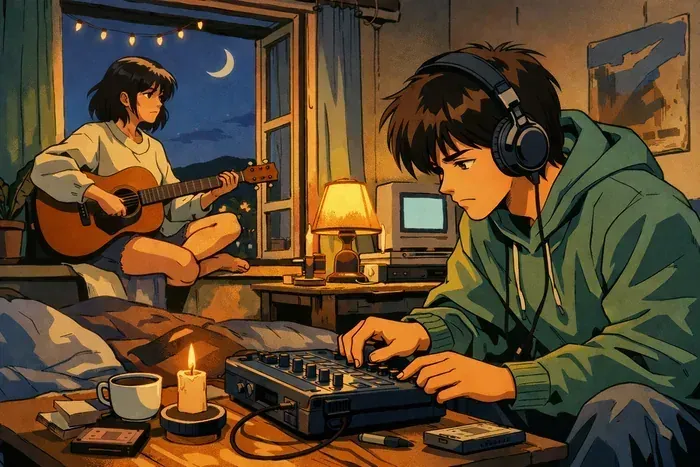
Indie Folk: Lo-Fi, Lonely, and Online
By the late 1990s and early 2000s, a new group of artists brought folk-derived writing back into indie rock. “Indie folk” described a sensibility more than a strict sound: acoustic guitars, close harmonies, modest tempos, and production that often felt deliberately restrained even when the recordings were made in professional studios.
The movement also grew with the blog era. Music sites, message boards, MP3 culture, and later early streaming services changed discovery. Intimate records no longer depended on radio alone. They spread through links, recommendations, and online communities that often valued understatement over polish.
Indie folk did not reject modernity. It used older timbres to answer newer conditions. Lyrics often focused on isolation, landscape, uncertainty, and self-scrutiny, while the music circulated through digital channels that would soon make bedroom recording feel like the next logical step rather than a rupture.
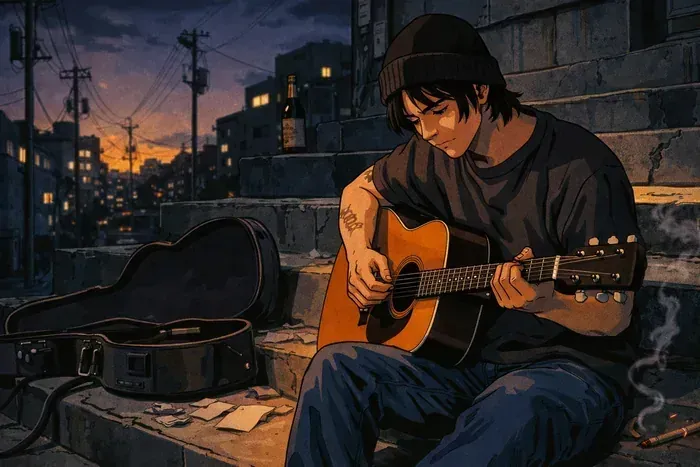
Elliott Smith: The Whisper That Changed Everything
Elliott Smith’s records in the 1990s became one of the clearest models for later intimate indie songwriting. Smith drew wider attention with Either/Or in 1997, but the aesthetic was already there: close-miked vocals, delicately structured guitar parts, and a delivery that suggested private thought rather than public declaration.
The sense of privacy came partly from technique. Smith stacked soft vocal harmonies around the lead line, kept arrangements compact, and used silence carefully. Even when electric instruments entered the frame, the records remained organized around mood, phrasing, and micro-detail.
Lyrically, Smith explored feelings of being alone, self-doubt, and relationships that were not working well. His writing was careful not to make sweeping statements. Instead, it offered hints and images that suggested emotional states without explaining them directly. People often described his music as confessional, but he rarely framed it as explicit autobiography.
Independent labels such as Kill Rock Stars gave him room to develop gradually. College radio and film placements, including the use of “Miss Misery” in Good Will Hunting, broadened his audience. Yet the music still felt private.
Smith strongly influenced later indie folk and adjacent songwriters, though not through imitation alone. What many artists borrowed was not just the whisper or the guitar tone, but the idea that small-scale production could carry major emotional force.
His career also shows the pressure that can follow highly personal songwriting. Listeners often blurred the line between the artist’s life and the work itself. Vulnerability could be mistaken for total disclosure, and that expectation carried real weight.
Smith’s work marks a real turning point in this story. He showed how a layered but small-room recording could feel both crafted and painfully near. In that sense, he helps bridge the distance between the singer-songwriter album and the later bedroom-pop habit of making closeness itself part of the sound.
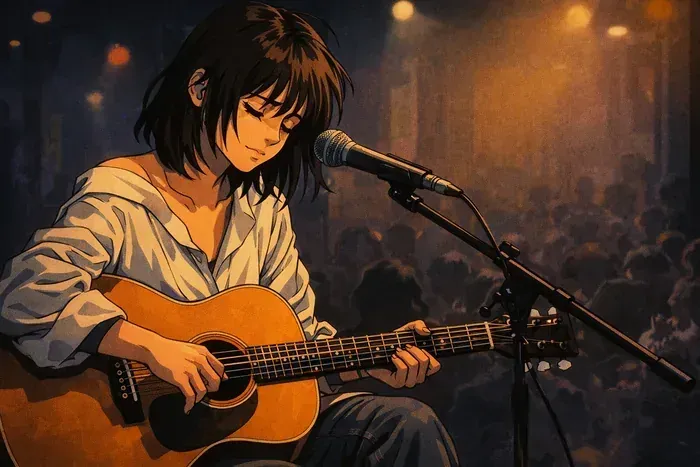
Cat Power: Vulnerability as Performance
Chan Marshall, professionally known as Cat Power, entered the indie music scene in the mid-1990s with a sound that felt exposed and unsettled. Her early albums, including Dear Sir and What Would the Community Think, had a rough sound. The recordings often sounded immediate, as if they were captured while the band was still discovering their sound, not after they had polished it in rehearsal.
In 1998, Marshall released Moon Pix, the album that brought her wider attention while deepening the sense of exposure in her work. Recorded with members of Dirty Three, it balanced sparse arrangements with emotional openness. Songs like “Metal Heart” and “Cross Bones Style” moved slowly, and the silence between lines carried tension.
Marshall’s live performances also became part of her public image. She sometimes stopped songs midway or spoke to the audience with disarming openness. Those moments shaped how listeners understood her work. The line between artist and person seemed to narrow. For some, that deepened the sense of truth. For others, it raised questions about what audiences expect from vulnerable performers.
Her later albums, including The Greatest, introduced fuller arrangements and stronger soul influences. The shift did not abandon intimacy. It gave intimacy warmer textures. Marshall’s voice remained central, and its small tremors carried emotion even at her most restrained.
Cat Power’s career shows how intimate songwriting can move beyond strictly acoustic sound. The production changed, but the sense of proximity did not.
In the indie music scene of the late 1990s and early 2000s, artists like Marshall worked through independent labels, small rooms, and dedicated fan communities. Coverage often leaned heavily on personal narrative, sometimes at the expense of musical detail.
Marshall’s work changed how vulnerability was understood in indie culture. Visible flaws became part of the aesthetic. At times, instability itself was romanticized. Those dynamics would return in the streaming era, when the link between artist and audience grew even more direct.
Through Cat Power, indie songwriting became more willing to leave cracks visible. The quiet voice no longer needed to sound fully composed. It could sound uncertain and still hold attention.
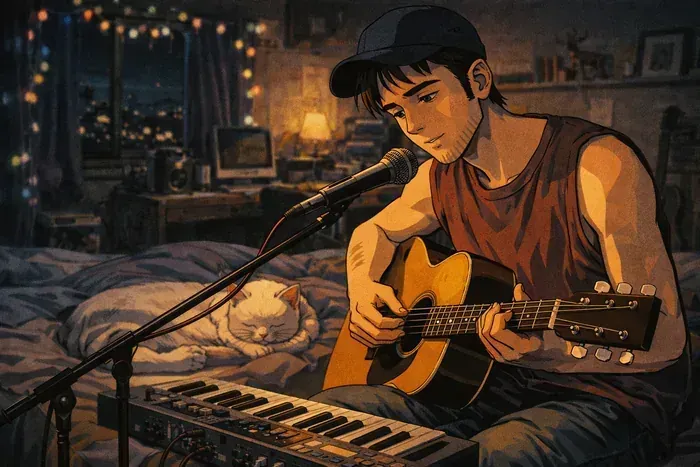
Sufjan Stevens: Ambition in the Key of Intimacy
Sufjan Stevens entered the indie scene with a different kind of ambition. While many of his peers favored minimal surfaces, Stevens preferred denser arrangements and larger conceptual frames. Illinois in 2005 became a defining indie-folk record by combining banjo, strings, horns, and layered vocals without losing a sense of nearness.
The album was linked to Stevens’ much-discussed idea of recording music about all fifty states, a concept he later treated less as a literal plan than as a framing device. The idea still revealed his interest in place as a way of telling stories. Songs like “Chicago” and “Casimir Pulaski Day” move fluidly between public history and private memory.
Stevens’ experience with orchestration and composition helped him see folk instruments as a starting point, not a limit. Banjo and choral layers coexisted. Quiet acoustic moments turned into fuller arrangements. Despite the size of the venue, his voice sounded close. The sound was often soft and fragile, even though the production had many layers.
Later work, including Carrie & Lowell in 2015, used simpler textures. He wrote the album in response to his mother’s death. The album had simple arrangements, with just voice and a gentle guitar. Songs like “Should Have Known Better” showed sadness without being overly dramatic. The recording felt private, even though it was shared with a global audience.
Stevens showed that indie folk could hold both conceptual ambition and emotional depth. The genre did not depend on one production model. It could support orchestral scale as well as near-whispered intimacy.
His career also shows how independent labels and digital distribution changed the reach of this music. Releases through Asthmatic Kitty and related networks could become global conversation quickly in the blog era.
With Stevens, indie folk stopped being describable as a simple return to roots. It became a way to braid history, geography, religion, and private memory into one musical language.

Bon Iver: Solitude, Myth, and Indie Folk
In 2007, Bon Iver’s For Emma, Forever Ago became a defining indie release. Justin Vernon recorded most of it in rural Wisconsin after a period of illness, band breakup, and personal upheaval. The isolation story mattered, but so did the way listeners turned that story into a myth of retreat, repair, and artistic purity.
The songs on For Emma, Forever Ago featured acoustic guitar, high-pitched vocals, and harmonies layered on top of each other. Vernon’s voice was often blurred, as if fading at the edges. Songs like “Skinny Love” and “Re: Stacks” suggest emotional exhaustion without dramatizing it. The arrangements left space for quiet moments.
The album was released through Jagjaguwar, which connected it to an established indie infrastructure. Information spread through blogs and online communities. Its solitude narrative resonated with listeners seeking emotional honesty in a highly mediated era. The idea of recording alone in a cabin was the opposite of the urban spectacle.
As Bon Iver’s career progressed, the sound expanded. Albums such as Bon Iver, Bon Iver and 22, A Million incorporated electronic textures and fragmented structures. That shift challenged fixed ideas about what indie folk should sound like. Even with denser production, Vernon’s voice remained central.
The cabin narrative also reflected a broader indie tendency to frame authenticity as isolation. The image of the artist working alone in nature had a special meaning. It suggested purity and creative focus. At the same time, the album was shared using modern digital networks. Isolation and connectivity existed together.
Bon Iver’s early work shaped many later artists, especially those who adopted high, fragile vocals, layered harmonies, and recording styles designed to feel close and inward. The image of the songwriter retreating from noise became part of indie folk’s visual and emotional language.
Bon Iver sits at a key junction in this history: solitude became a marketable image, and a private recording environment became globally legible almost immediately.
Fleet Foxes: When Harmony Feels Like Home
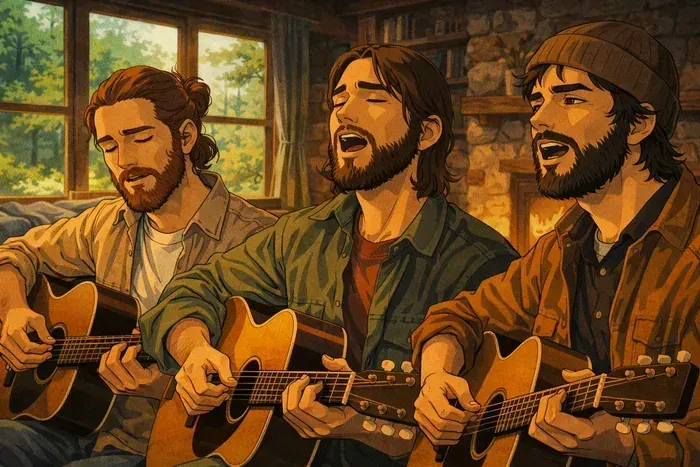
If Bon Iver emphasized solitude, Fleet Foxes offered another model of closeness. Their 2008 debut turned layered harmony into a form of intimacy that felt communal rather than private in the narrow sense.
Songs like “White Winter Hymnal” and “Blue Ridge Mountains” used close harmonies that sounded like Crosby, Stills & Nash, as well as traditional choral arrangements. The production stayed warm and natural. The guitars and drums played gently in the background, supporting the melodies without competing with them. The focus on blending the voices together made it feel like they were all sharing the same space, rather than each person just talking about their own experiences.
Fleet Foxes also used images of the countryside. The lyrics often talked about the changing seasons, natural landscapes, and the cycles of nature. But the tone wasn’t just nostalgic. The songs suggested longing for connection in uncertain times. The images of the countryside were used as a metaphor, not as a way to escape.
The band’s rise coincided with the peak of the blog era. Online publications quickly made their debut a major topic among indie listeners. Where Bon Iver emphasized solitude, Fleet Foxes emphasized group cohesion. Harmony became their way of creating intimacy.
This approach matters because it shows that indie folk was never only about the single isolated voice. Shared feeling could also sound intimate.
Fleet Foxes’ success also showed that folk-derived music could still thrive in the digital age. Independent labels and online distribution let them reach international audiences without following mainstream pop formulas. Their careful arrangements showed that acoustic textures could still resonate widely.
Fleet Foxes revisited older harmony vocabularies without turning them into retro display. The emotional frame was contemporary even when the timbres felt inherited.

Laura Marling, Phoebe Bridgers, and the New Voices of Indie Folk
As indie folk grew in the late 2000s and 2010s, a new generation of women reshaped its emotional vocabulary. Earlier scenes often centered male perspectives, but artists like Laura Marling, Sharon Van Etten, and Phoebe Bridgers wrote with their own authority and range.
Laura Marling emerged from a British scene that also produced bands like Mumford & Sons, but her songwriting took a different path. Albums like I Speak Because I Can and Once I Was an Eagle combined intricate guitar work with lyrical clarity. Marling’s voice was calm and self-possessed. She drew from British folk tradition while writing about autonomy, doubt, and self-definition. The arrangements stayed spare, letting her voice carry the emotional weight.
Sharon Van Etten brought more overt indie-rock force into the frame. On albums such as Are We There, relationship dynamics and vulnerability arrive with fuller production, but the added weight makes the voice feel more exposed rather than less.
Phoebe Bridgers arrived in the late 2010s with Stranger in the Alps and later Punisher, bringing dark humor and self-awareness to her songwriting. She sang with controlled intensity even when the lyrics dealt with sadness and anxiety. The production, developed with Tony Berg and others, mixed acoustic elements with ambient textures. Bridgers showed how this generation could speak openly about emotion without giving up formal control.
These artists worked in a digital environment that amplified personal narrative through interviews, social media, streaming metadata, and fan communities. The line between performer and audience became more porous.
Women in indie folk did not simply inherit an existing model. They expanded it. Strength could sound quiet. Humor could coexist with sadness. The genre’s central voice was no longer defined mainly by male perspective.
Their contributions made indie folk more flexible and more self-aware. Vulnerability did not have to read as fragility. It could also read as control, humor, or refusal.
The Digital Shift: From Vinyl to Upload
By the late 2000s, the conditions around songwriting were changing almost as quickly as the music itself. The album still mattered. From Blue to Illinois, artists had built large statements meant to be heard in sequence.
As recording technology became cheaper and internet distribution expanded, listening habits shifted. Songs moved as digital files rather than as vinyl or CDs. Discovery happened through blogs, file sharing, forums, YouTube links, and later streaming platforms. The artist-listener relationship felt more direct, even though new intermediaries were already forming in the background.
The album did not disappear, but its authority weakened. Singles, playlists, and continuous recommendation feeds began to reorder music outside the artist’s intended sequence. The voice could still sound close. The listening room, though, was now often a phone, a laptop, or a playlist slot rather than a record side.
Home Recording: When the Bedroom Became a Studio
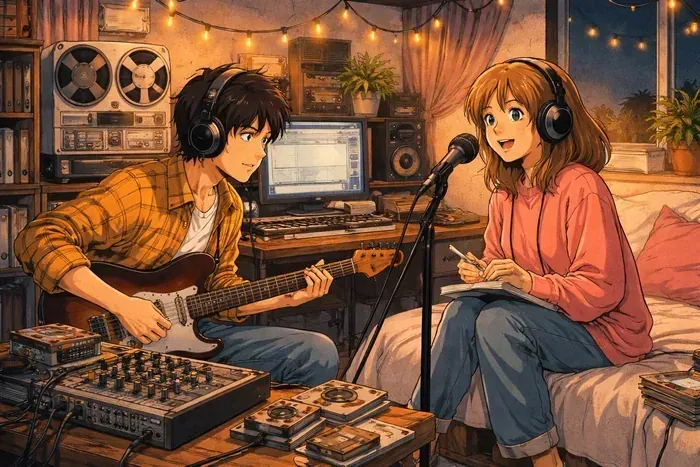
For most of the 20th century, professional studios controlled the best recording tools. By the 2000s, that was no longer true. Digital audio workstations let musicians record, edit, and mix on home computers, and software such as Pro Tools, Logic, GarageBand, and later more affordable DAWs lowered the cost of entry. A bedroom could now function as a real production space rather than just a demo room.
The shift resembled earlier moments when new technology made recording more accessible. The difference was in size. Home recording was used for more than just documentation. It became the main way for many artists to make art. Intimacy went from being an aesthetic choice to a practical reality.
For singer-songwriters influenced by indie folk, this shift fit naturally with the style. Microphones captured breath and the softer edges of acoustic instruments. Imperfections could stay in the final mix without studio pressure to remove them. The atmosphere of a small room entered the recording.
The change also altered power. Musicians gained more control over timing, process, and release strategy because they no longer had to wait for a label-funded studio booking to finish a track. At the same time, technical labor moved onto the artist. Editing, file management, sound design, and basic mixing became part of authorship.
Home recording encouraged people to experiment. Artists could create harmonies, test out different structures, and improve their lyrics over time. The line between the demo track and the final version became blurred. What was once just a rough sketch could now reach audiences without any changes.
For listeners, the sound of proximity grew familiar. Room noise, dry vocals, and slight imperfections no longer read as unfinished by default. They could signal immediacy, control, or honesty. An aesthetic that had been culturally prepared by folk, indie, and lo-fi traditions now had strong technical support.
That environment helped create bedroom pop music. When artists uploaded songs recorded in their own spaces to platforms like YouTube or SoundCloud later on, the sound felt unified. Technology did not invent intimacy. It made the signal stronger and spread it out much faster than ever before.
MySpace, YouTube, and the Blog Era
As recording moved into bedrooms and home studios, distribution shifted online. In the mid-2000s, sites such as MySpace let musicians upload tracks directly to profile pages and build audiences without waiting for radio or physical distribution.
MySpace was both a stage and a social network. Artists gained fans by interacting with them directly. The profile page became a small public room where songs and personal updates existed side by side. This format made singer-songwriters and indie folk musicians feel closer to each other. Fans did not see a distant figure. They found a username, a photo, and a set of tracks in the conversation.
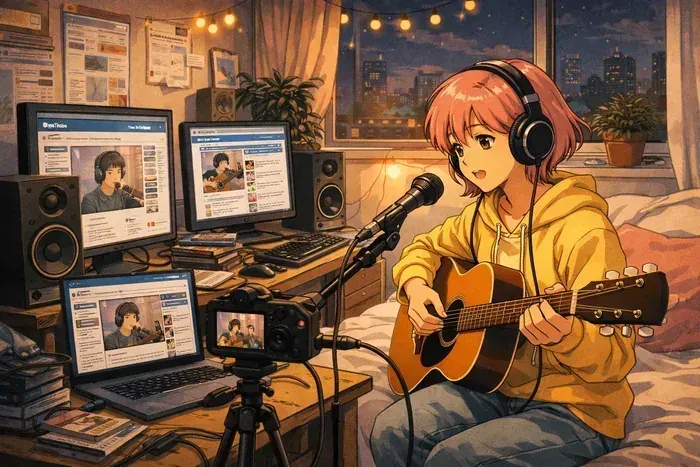
YouTube added another dimension. Recordings made in bedrooms or small venues could be shared with many people. Acoustic covers and original songs used a similar visual style. A camera pointed at a musician sitting on a bed or at a desk created a visual symbol of sincerity. The setting was important. The room itself was part of the performance.
At the same time, music blogs gained real agenda-setting power. A strong review on Pitchfork or a smaller blog could move an artist quickly into wider conversation. Discovery sped up, and geography mattered less than link circulation.
The digital ecosystem rewarded immediacy. Songs no longer had to wait for album cycles. A single upload could attract major attention. Listening became faster, but the desire for closeness remained. In a crowded online environment, directness became even more valuable.
The change also created new pressures. Artists were responsible for managing their own online presence, finding the right balance between creativity and constant visibility. The line between music and persona became even more blurred.
These developments laid the groundwork for the next stage. Bedroom pop would take advantage of the technical tools of home recording and the distribution habits shaped by MySpace and YouTube. The voice could now circulate on its own. It could travel directly from one room to another through a screen.
Bandcamp: A Home for the Independent Voice
As social media expanded, new direct-sales models changed the music economy. Bandcamp, launched in 2008, gave artists a way to sell downloads, physical releases, and merchandise directly to fans without handing the whole transaction to a major label or large streaming service. The platform let musicians set prices, write release notes, and control timing in ways that suited indie folk and emerging bedroom-pop artists.
Bandcamp encouraged a slower, more deliberate form of engagement. Unlike algorithm-driven feeds, its structure emphasized discovery through tags, recommendations, and curated features. Listeners could browse genres, read artist notes, and support musicians financially. The relationship felt personal rather than purely transactional.
For singer-songwriters operating below the chart level, that matters. Many do not need a mass audience so much as a small paying audience that returns. On Bandcamp, artists could release EPs, demos, live sets, and small-run physical editions without waiting for a long industry timetable. The distance between making and selling narrowed.
The platform also supported smaller groups of people with similar interests. Experimental folk, lo-fi recordings, and regional scenes could coexist without competing directly for mass-market visibility. That diversity echoed earlier independent infrastructures built around college radio and small labels, but with global reach.
At the same time, digital abundance created new challenges. Lower barriers to entry also meant more competition. Thousands of artists could upload new work every day. Standing out required more than a home recording. It also required curation, framing, and story.
Bandcamp did not replace labels, managers, or touring networks. Many artists still relied on them. But it did mark a larger shift. Control moved closer to the artist, and at least some revenue could arrive more directly.
Bandcamp functions as both marketplace and archive for independent scenes, from acoustic folk to bedroom pop. That dual role matters. It does not remove gatekeeping entirely, but it gives artists one space where a song can be framed on their own terms rather than only through playlist logic. That model shaped how many later bedroom-pop artists thought about releases, fan support, and long-tail careers. "We all need music to uplift and inspire us, to heal us, and to give us hope."

Playlists and Algorithms: The New Gatekeepers
As streaming services expanded during the 2010s, listening habits changed again. Platforms such as Spotify organized music not only through artist pages and albums but through playlists, recommendation feeds, and mood-based categories. Songs now sat next to tracks chosen by platform logic rather than by the artist’s own sequencing. The album’s narrative had to compete with curated flow.
Playlists gave indie folk and emerging bedroom artists new routes to discovery. If a song landed on a major playlist, it could reach millions of listeners very quickly. Artists no longer had to depend on radio rotation or physical distribution. Entry into the conversation looked easier than ever.
But algorithms introduced a new form of gatekeeping. Data-driven systems helped decide which songs surfaced in recommendation feeds, autoplay chains, and personalized playlists. Metrics such as skips, saves, repeat plays, and completion rates began to matter because they shaped a song’s chances of being heard again. The intimate voice now traveled through filters that were largely invisible to the listener.
The environment affected songwriting itself. Shorter intros, earlier vocal entry, and quicker emotional orientation could become strategic advantages in a context where a skip was easy and immediate. The shift did not erase artistic ambition, but it changed the incentives around pacing.
At the same time, listeners heard music in small pieces. A quiet acoustic track might be played between electronic pop songs on a playlist that has been carefully put together. Context shifted constantly. The relationship between the artist and the audience became more flexible, sometimes less connected to a specific body of work.
For some musicians, the playlist era widened access. Independent artists could reach listeners across the world without relying on older promotional systems. For others, the competition felt overwhelming. Visibility became both opportunity and pressure.
The voice was still the most important part, but it was now more difficult for listeners to hear it. From field recordings to vinyl albums to digital files, each time technology changed, it also changed how intimacy was shared. Now, in the streaming era, closeness depends not only on performance and production, but also on algorithms that quietly guide discovery.
Within this ecosystem, bedroom pop fully emerged. The room where a song was first played wasn’t as important as the way it spread to other people.
Bedroom Pop: Intimacy in the Age of Algorithms
By the mid-2010s, a new label circulated online: bedroom pop. It was never a strict musical formula so much as a bundle of assumptions about scale, method, and mood. Songs were often made at home, sometimes with modest equipment, and uploaded directly to digital platforms. The production could sound unfinished even when it was carefully built. The voice sat close to the microphone. The lyrics leaned toward everyday feeling, hesitation, and private detail.
Bedroom pop drew from several older streams at once. It inherited the first-person focus of singer-songwriters, the lo-fi tolerance of indie and cassette culture, and the melodic flexibility of indie pop. What changed most were speed and reach. A song made in a private room could circulate globally within days.
The image of the lone artist returned, now framed through laptops and social media feeds instead of in nature or coffeehouses. Physical closeness was no longer required for intimacy. It traveled through headphones and phone speakers, making songs feel embedded in daily life.
Clairo: The Bedroom That Went Viral
In 2017, Clairo uploaded “Pretty Girl,” and its webcam video quickly became a reference point for bedroom pop as a visual as well as musical form. The clip showed her in an ordinary bedroom setting, moving casually through a low-fi frame with minimal editing. The song matched the image: understated, dry, and relaxed rather than obviously staged.
Part of the appeal was the lack of distance. The room stayed visible. The camera angle felt domestic rather than cinematic. Viewers did not encounter a polished pop persona first. They encountered a singer who seemed reachable.
Clairo’s later album Immunity, produced by Rostam Batmanglij, used a wider range of sounds. The production expanded, with more complex instrumentation and emotional depth. Songs like “Bags” kept the thoughtful tone, even with more complex music. The change from a simple video recorded in a bedroom to a studio album showed that personal connection could survive collaboration at a larger scale.
Her career also makes clear how digital ecosystems shape perception. Early attention on YouTube and streaming platforms helped place her in the bedroom-pop category, while online debate about class, access, and industry connections complicated the easy myth of pure DIY authenticity. That tension belongs in this history too.
What lasts beyond those arguments is the music itself. Clairo’s writing often works through small detail, understatement, and tonal control rather than spectacle.
Clairo’s rise follows an older pattern in a new medium. The lone voice, once preserved by collectors or nurtured in coffeehouses, now appeared on global platforms. Technology made that voice easier to scale while preserving the illusion of closeness.
Bedroom pop did not reject production value. It redefined it. The informal image became a symbol of the genre. The room behind the singer worked as both setting and statement. In Clairo’s case, that approach connected with millions who recognized something of their own everyday lives in it.

girl in red: Building Community From a Bedroom in Norway
Marie Ulven, known as girl in red, built her audience largely online. Around 2017, she started releasing songs on SoundCloud and streaming platforms from her bedroom in Norway. Tracks such as “I Wanna Be Your Girlfriend” spread through playlists, Tumblr-era sharing, and social media because they sounded direct, unguarded, and easy to claim as one’s own. The production was minimal: soft vocals, simple guitar figures, and light percussion.
Ulven’s songs often deal with queer identity, yearning, crushes, and emotional confusion in plain language. That directness mattered. For many young listeners, especially queer listeners, the songs offered a form of recognition that mainstream pop still delivered only inconsistently. The phrase “do you listen to girl in red?” even became coded shorthand in online queer culture.
The relationship between artist and audience evolved in real time through social media. Ulven spoke openly with fans about songwriting and mental health. The sense of proximity extended beyond the recordings. Listeners did not only stream songs; they followed a person whose experiences often felt close to their own.
Her 2021 album, If I Could Make It Go Quiet, featured fuller production and live instrumentation. The sound grew larger without losing intimacy. The shift resembled an older pattern in bedroom pop, where artists moved from home recording to studio collaboration while preserving a personal voice.
The global reach of girl in red shows how much geography has loosened its hold in the streaming era. A teenager recording in Oslo could affect listeners in Los Angeles or Manila within weeks. The bedroom was the starting point, not the limit.
At the same time, that visibility brought pressure. Online intimacy can intensify support, but it also intensifies scrutiny. The same closeness that builds community can make the line between public work and private life harder to hold.
Ulven’s career clarifies how bedroom pop links identity and circulation. The songs may sound small, but their reach can be large. The voice comes from a private room, yet that room is linked to a wider network of screens and headphones.

beabadoobee: Between Manila, London, and the Internet
Beatrice Laus, known as beabadoobee, reveals how porous the term “bedroom pop” quickly became. Born in the Philippines and raised in London, she started uploading songs in the mid-2010s. Early tracks such as “Coffee” used soft vocals and simple acoustic guitar, and their home-recorded quality mattered because it made the songs feel close rather than finished to an industrial standard.
Her music spread online first and then scaled through streaming. When Powfu sampled “Coffee” for “Death Bed (Coffee for Your Head),” her reach widened sharply. The path from home upload to global recognition moved far faster than older artist-development models based on touring and radio.
Laus’s songs often combine thoughtful lyrics with a subtle alternative rock sound. As her releases grew longer, including the album Fake It Flowers, the music became fuller. Electric guitars and layered instrumentation also entered the frame, but the center stayed the same: personal reflection delivered like a private conversation.
Her background adds another layer to the genre’s story. Bedroom pop can sometimes be described as culturally neutral, but artists like beabadoobee bring distinct experiences of migration, place, and identity into the music. The bedroom becomes a space where those identities can be explored before they are presented to a wider audience.
The UK scene she was part of also influenced her career path. Independent record labels and supportive concert venues provided the necessary infrastructure once online attention reached a tipping point. Digital discovery did not eliminate the need for physical performance. It complemented it.
Beabadoobee’s career shows how readily bedroom pop can absorb other styles. In her case, alternative rock, indie pop, and acoustic songwriting all remain legible. The label works best as a point of origin rather than a permanent stylistic box.
Her path follows a broader pattern. Technology makes entry easier, but artistic growth often still involves collaboration, infrastructure, and change. The room where the first song is recorded does not limit what follows. It anchors authenticity even as the sound and scale shift.

Billie Eilish: Minimalism on the World's Biggest Stage
Billie Eilish occupies a distinctive place in the bedroom-pop story because the core method remained small even as the audience became enormous. Her early work, made with her brother Finneas at home, used many of the genre’s defining traits: close vocals, spare arrangements, whisper-level delivery, and writing that felt diaristic without being literal.
The 2019 album When We All Fall Asleep, Where Do We Go? kept that closeness even while expanding the sonic palette. “When the Party’s Over” uses sparse accompaniment and stacked harmonies to make the voice feel almost physically near. Even on darker, bass-heavy tracks such as “bad guy,” the lead vocal remains unusually dry and intimate for global pop.
Eilish’s success shows that bedroom pop was not limited to a niche audience. Her work proved that minimalism could thrive in arenas and on global charts. The close-mic sense of intimacy survived amplification. "People underestimate the power of a young mind."
Lyrically, Eilish openly discussed anxiety, fame, and adolescence. Her delivery was calm and distant, which made the emotional impact stronger. The contrast between soft singing and heavy subject matter became a defining feature.
It also led to more conversations about mental health and expectations for young artists. The internet made both admiration and criticism more intense. The closeness that draws listeners in can also create pressure when personal stories become public.
Eilish’s rise shows that the bedroom aesthetic can scale without fully disappearing. Home recording created the foundation, but professional refinement, label infrastructure, and global marketing followed. The old line between indie intimacy and mainstream pop became much harder to defend.
Eilish represents a moment when small-room technique becomes part of the global pop infrastructure. The room where the song starts still matters, but it now connects to platforms, marketing systems, and award institutions almost immediately. Intimacy no longer depends on physical nearness. It travels at scale.

mxmtoon: The Artist Who Talks Back
Maia, known as mxmtoon, started uploading songs to YouTube as a teenager. She often filmed herself playing ukulele in her bedroom, and the visual language was deliberately ordinary: a camera, a bed, soft light, no hard separation between person and performance. Songs such as “Prom Dress” paired light melody with sharply recognizable social anxiety.
mxmtoon stands apart from earlier singer-songwriter models because audience-building did not begin with labels, radio, or touring. It began with upload culture. She shared songs, drafts, and process, and that made the relationship with listeners feel conversational rather than one-directional.
Her later albums, including Masquerade and Rising, widened the production palette. Synth textures and fuller arrangements entered the frame, but the tone stayed personal. The songs continued to circle self-doubt, growth, and identity.
mxmtoon’s Chinese American background also matters here. In her work, identity appears less as brand positioning than as part of the ordinary texture of storytelling and public self-explanation.
The change from bedroom uploads to larger stage performances did not break the connection between the artist and the audience. Social media allowed people to stay connected even as venues grew. The sense of direct address was consistent across all formats.
Her career illustrates a form of bedroom pop in which the audience becomes part of the creative loop. Songs circulate through videos, posts, replies, and side conversations. The artist’s voice is embedded in a network rather than held above it.
This close relationship can create both opportunities and challenges. Being constantly visible can make it hard to separate your personal life from your public persona. People expect openness to be a constant.
mxmtoon’s path shows how the intimate voice has adapted to always-on digital culture. The bedroom is no longer only a place to write or record. It is also a broadcast point, an editing suite, and part of the artist’s public image.

When the Room Became the Stage Again
In 2020, one more turn in this history became visible. With touring widely disrupted, artists and platforms leaned harder on livestreams, home performances, and virtual events. The private room was no longer only where songs were written or recorded. It also became a performance venue.
That shift did not create intimate songwriting, but it changed how audiences experienced it. A webcam performance from a kitchen, bedroom, or home studio could now carry some of the role once played by a club set or small theater show. YouTube promoted virtual concert viewing, Spotify added ways for listeners to find virtual events, and Bandcamp launched Bandcamp Live in late 2020 to support ticketed livestreams directly on the platform.
This moment matters because it made an old pattern newly literal. Intimate music has often depended on the feeling that the listener is inside the room with the artist. In the livestream era, the room itself was visible again.
At the same time, the development intensified some of the pressures already described in this article. If the room became the stage, then privacy became even harder to protect. The same technology that made closeness possible also made access feel constant.
The Emotional Cost of Being Authentic
As intimacy became a central part of modern songwriting, conversations about mental health also moved closer to the surface. Earlier singer-songwriters often relied on metaphor, indirection, or partial disclosure when writing about distress. Many contemporary artists speak more openly about anxiety, depression, burnout, and the strain of public attention.
Phoebe Bridgers has spoken about the strain of touring and public scrutiny. Billie Eilish has spoken about the pressure that came with sudden fame at a young age. Online communities can offer support, but they can also create expectations. When artists build a public identity around openness, setting boundaries becomes harder.
Bedroom pop encourages closeness by design. Listeners can feel as if they know the person behind the song, and social media intensifies that impression. Messages, comments, and livestreams can deepen the bond between artist and audience.
At the same time, constant visibility can turn vulnerability into labor. Sharing personal experiences becomes connected to promotion. Artists may feel pressure to remain relatable, which can affect how they present themselves. The quiet room that once symbolized safety is now open to the public.
The industry has responded unevenly. Mental health resources are discussed far more openly than they once were, but the structural pressures remain: unstable touring economics, streaming targets, and the expectation of constant availability online.
These dynamics echo older tensions around authenticity. Earlier audiences judged folk artists on political commitment, repertory, and stylistic purity. Today’s audiences often expect emotional openness instead. The rules changed. The weight did not.
The history traced here shows continuity even as forms change. Songs still carry both personal and shared memory. The technologies that deliver them have changed many times. The human voice remains the central medium of connection across distance.

What Endures in the Personal Voice
This story does not move in a neat line from old to new. It traces a long shift in where closeness happens and how it is delivered. Songs once carried by memory now move through uploads, playlists, and recommendation systems. Instruments changed. Recording tools changed. Distribution changed. The appeal of a near, specific voice did not.
Over time, the meaning of authenticity also shifted. In the revival it often meant loyalty to tradition and visible conviction. In the singer-songwriter era, it leaned toward emotional honesty. In indie folk, it often meant restraint. In bedroom pop, it travels through screens, audience interaction, and platform framing.
Songwriting will keep changing because the conditions around it keep changing. New tools will alter how songs are made, and new platforms will alter how they are found. The harder question is not whether intimacy will survive. It is who will have the time, space, resources, and visibility to define what intimate music sounds like next.
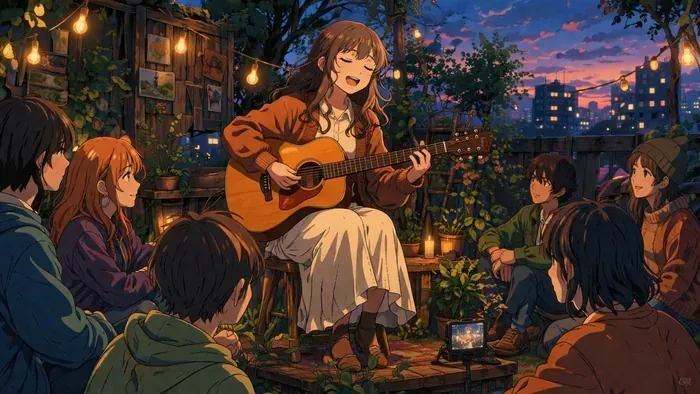
Authenticity: From Currency to Connection
Across this history, authenticity has been both an ideal and a kind of currency. In the early folk revival, it often meant staying close to traditional repertory and sounding credible within it. Performers were judged not only on what they sang, but on whether they seemed to belong to the world they invoked.
When singer-songwriters like Joni Mitchell and Leonard Cohen centered personal perspective, authenticity shifted toward inner truth. The question became less about faithfulness to tradition and more about emotional credibility.
In the indie era, authenticity was closely linked to production choices. Lo-fi recording was a way to be independent from the commercial music industry. Elliott Smith’s soft voice and Cat Power’s rough style made the music feel immediate. Flaws became a sign of truth.
Bedroom pop transformed how authenticity was staged. The bedroom, the webcam, and the dry or minimally edited voice all signal reality quickly. But those signals circulate inside systems where visibility is filtered. Sincerity itself can become part of strategy.
The harder truth is that authenticity has always been entangled with power. Woody Guthrie’s songs traveled through recording and broadcast systems. Carole King’s personal voice reached mass audiences through a major-label industry. Clairo’s bedroom upload only became legible at scale because platforms and users circulated it in particular ways.
Authenticity, then, has never meant the absence of mediation. It means that the relationship between voice and listener still feels trustworthy despite mediation. When audiences sense calculation alone, the connection weakens. When they sense vulnerability or precision, it holds.
Songwriting keeps changing, so authenticity remains a moving target. New technologies may change how voices are recorded and shared, but listeners will still want recordings to feel sincere. The lone voice does not exist outside structure. It moves through structure.

Who Gets to Be Intimate? Class, Space, and Access
The image of the lone songwriter in a quiet room is seductive, but it is also selective. Not everyone has access to privacy, time, equipment, stable housing, or the freedom to make underpaid work while building an audience. Throughout this history, those conditions have shaped who gets heard as intimate.
Early folk traditions grew in communal settings where performance did not depend on a private studio. Recording introduced new barriers. Studio time cost money. Distribution depended on institutions. Artists such as Odetta and Buffy Sainte-Marie faced racialized and political barriers alongside the ordinary difficulty of sustaining a career.
The singer-songwriter era was supported by labels, studios, and professional networks. Albums like Blue and Tapestry were made with resources that were not equally available to everyone. Artists who became nationally famous often moved through systems already shaped by social and economic privilege.
Home-recording technology lowered barriers for independent musicians. Affordable software made home production realistic for many artists. At first glance, bedroom pop can seem fully democratic. In practice, it still depends on stable housing, equipment, internet access, and time that is not consumed by immediate economic pressure.
Class and geography still shape visibility. Artists in major cultural centers often have easier access to collaborators, press, labels, and live circuits. Others depend more heavily on digital networks, which can widen access while also rewarding a narrow set of online habits and promotional skills.
Access is also related to identity. Women and artists from marginalized communities have expanded the field of intimate songwriting, yet they often encounter disproportionate scrutiny online. The close-knit nature of bedroom pop can lead to both harassment and support from fans.
This does not diminish individual work. It places it in context. The voice may sound private, but it is never socially isolated.
As new tools are developed, questions of access will remain central. Who has the quiet room? Who controls the distribution channels? Who is listened to and who is ignored? The change from folk gatherings to streaming platforms shows that intimacy is shaped not only by creativity, but also by structure.

Platforms: The Gatekeepers We Didn't Elect
In the past, record labels, radio programmers, booking agents, and venue owners acted as obvious gatekeepers. Streaming and social media did not eliminate that structure. They rearranged it. Platforms now shape visibility through editorial playlists, algorithms, ad systems, and recommendation design.
For artists working at small scale, this environment offers both opportunity and uncertainty. One playlist placement can expose a bedroom recording to millions of listeners almost overnight. But the logic behind that exposure is rarely transparent.
Data metrics influence discovery. Completion rates, skips, repeat plays, and engagement patterns all affect how often a track reappears in recommendation systems. Song structure can adapt to those pressures. Short intros, early vocal entry, and fast emotional framing become strategic.
Social media adds another layer. Visibility often depends on continuous presence, which pushes artists to share process, personality, and daily life in order to stay legible to the algorithm and to fans. The line between musician and content creator becomes less clear. The quiet room can turn into a stage that never fully closes.
This situation echoes earlier tensions in a new form. In 1965, Newport sparked arguments about authenticity, commerce, and stylistic change. Today, artists face a digital landscape where platform design shapes artistic decisions. The negotiation between autonomy and exposure continues.
Independent artists have found ways to adapt. Direct-to-fan platforms, crowdfunding, and niche communities offer alternatives to algorithmic dominance. However, those who understand and use platform logic still have an advantage.
The voice, once passed down through stories and later through records, now moves through code. The intimacy listeners feel is filtered by systems designed to maximize engagement.
Gatekeepers have changed, but they are still around. Knowing what their role is helps us understand the bigger economic situation of bedroom pop and indie folk. Intimacy is still strong, but it depends on networks that the singer can’t control.

SoundCloud and the Upload-First Artist
One platform deserves separate attention here. SoundCloud, founded in Berlin in 2007 by Alexander Ljung and Eric Wahlforss, was built around a simple premise: creators could upload and share audio quickly without waiting for a traditional release pipeline. That mattered because it shifted attention away from finished albums and toward circulation itself.
Unlike the blog era, which still depended heavily on critics and tastemakers, SoundCloud let artists present work in progress, demos, loose singles, and self-produced tracks in their own voice and on their own schedule. For many listeners, discovery started to feel less like reading about music and more like moving through an active stream of uploads.
This model suited intimate songwriting. A quiet track recorded at home no longer needed a formal release campaign before it could find listeners. Artists could test songs, build a small audience, and refine their sound in public. The line between rehearsal, release, and community became thinner.
SoundCloud did not create bedroom pop by itself, and it was never limited to one style. But it strengthened a broader upload-first culture in which songs could circulate before the industry decided how to classify them. That helped normalize a world where private recording and public discovery happened almost at the same time.

boygenius: Intimacy Can Also Be Shared
The modern story of intimate songwriting does not end with a single person alone in a room. It also includes artists who use collaboration to deepen emotional clarity rather than dilute it. boygenius, formed by Julien Baker, Phoebe Bridgers, and Lucy Dacus, made that point especially well.
Their 2018 EP brought together three distinct songwriting voices that were already known for precision, confession, and restraint. Their full-length album the record, released on March 31, 2023, showed that intimacy could survive inside a collective format. The songs did not erase individual perspective. They placed it beside other perspectives and let the contrast do some of the emotional work. "Music is the language that you’re speaking."
This matters in the larger arc of the article. Folk music began as something shared before it became more tightly linked to individual authorship. In that sense, projects like boygenius do not break the tradition. They reconnect one part of the modern singer- songwriter lineage with folk music’s older communal logic.
Before the conclusion, one point is worth stating plainly: intimacy is not identical to solitude. Sometimes it comes from one voice. Sometimes it comes from several voices making room for one another.

Beyond the Anglo-American Frame
This article follows the most visible line from American folk revival to indie folk and bedroom pop because that route shaped the labels discussed here. But the larger history of intimate songwriting is broader than this frame.
Across Latin America, for example, nueva canción and related movements joined folk-based instrumentation to modern political writing in the 1960s and 1970s. Artists such as Violeta Parra, Víctor Jara, Mercedes Sosa, and Silvio Rodríguez treated the singing voice as both public witness and intimate address. Guitar-centered performance, regional tradition, and close attention to text remained central even when the songs were openly political.
That wider perspective matters because it prevents a false story of origin. Intimate music did not move in a single straight line from Appalachia to Laurel Canyon to the internet. Different regions built their own relationships between folk memory, personal authorship, and contemporary technology. The best way to read the modern bedroom pop era is not as a single inheritance, but as one visible branch within a much larger global history of close singing and personal address.
Seen in that wider context, the final question of this article becomes clearer. The issue is not why one narrow tradition survived. It is why listeners in very different places and periods keep returning to the same feeling of closeness in song.
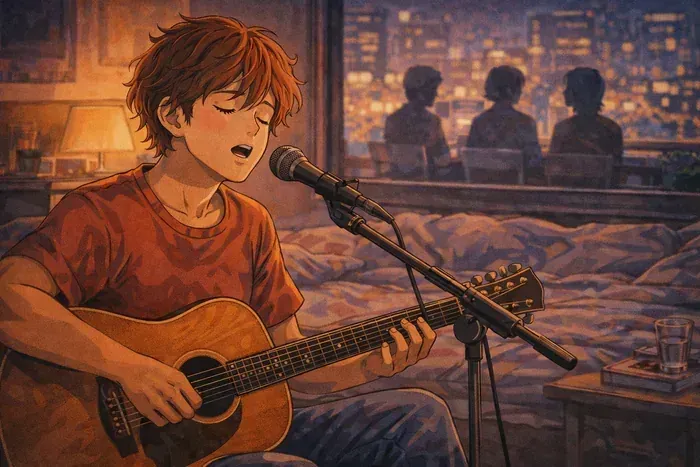
Why We Still Need the Personal Voice
After tracing how oral ballads evolved into streaming-era songs, one question remains: why does the personal voice still carry so much weight? Technology has changed how music is recorded, distributed, and heard. Genres multiplied. Listening habits fragmented. Even so, audiences still respond to a voice that sounds near and recognizably human.
Part of the answer lies in scale. Large productions can impress, but smaller ones often make identification easier. When Woody Guthrie sang about land and labor, listeners heard shared experience. When Joni Mitchell mapped private feeling, listeners recognized themselves in it. When Elliott Smith sang quietly over tense arrangements, he opened space for reflection. When Clairo or girl in red record in a bedroom, the setting feels close to ordinary life.
In all of these examples, the voice carries the narrative. It speaks not as an abstract idea but as a presence. Even when lyrics remain indirect, tone can make the singer feel close and recognizably human. That quality connects the past, present, and future.
Another reason is recurrence. Every generation faces new social, economic, and cultural pressures. In those moments, a single voice can offer orientation. The form changes, but the function is similar. Songs help people process feeling, memory, and uncertainty.
The persistence of the personal voice also shows its adaptability. Folk traditions absorbed migration and new instruments. Singer-songwriters used the studio to deepen, not erase, intimacy. Indie artists adapted to blog culture. Bedroom pop adapted to algorithms. At each stage, the conditions changed while the basic promise remained.
New tools will continue to emerge, including tools that can blur the line between human performance, editing, and synthetic manipulation. Even then, listeners are likely to keep seeking voices that feel credible, specific, and emotionally grounded. Songwriting has already changed form many times, from communal performance to one-to-one address to digitally circulated intimacy. The walls keep changing. The voice remains central.

50 Songs That Trace the Journey From Folk to Bedroom Pop
From field recordings and protest ballads to bedroom-made streaming hits, the history of intimate songwriting shows continuity across changing media. The setting changed. The technology changed. The scale grew from union halls and coffeehouses to global playlists. What remained was the pull of a voice that feels close.
The 50-song collection follows the route mapped above. It begins with protest song and revival folk, moves through the singer-songwriter era, turns toward indie and Americana, and ends in bedroom pop and streaming-era intimacy. Along the way, artists such as Woody Guthrie, Joni Mitchell, Leonard Cohen, Elliott Smith, Bon Iver, Phoebe Bridgers, Clairo, and Billie Eilish show how the idea of “authentic” songwriting keeps changing with its conditions.
The playlist is necessarily selective. The prose focuses most strongly on U.S. and UK lineages because they shaped the modern categories discussed here, but the sequence also points outward to Latin American and other international traditions that developed their own forms of intimate address.
This is more than a chronological list. The sequence is meant to build emotional and historical momentum: collective roots first, then increasingly individual authorship, then indie restraint, and finally the digitally circulated closeness of bedroom pop.
What ties these songs together is not strict genre membership. It is a shared question: how to make a voice feel trustworthy, present, and emotionally legible across changing technologies. These tracks were recorded in prisons, studios, cabins, clubs, and teenage bedrooms. Together, they show how songwriting can keep changing without giving up that core task.
I. Roots and Protest — The Collective Voice
- Woody Guthrie – This Land Is Your Land (1944)
- Lead Belly – Goodnight, Irene (1933 recording)
- Odetta – Water Boy (1957)
- Joan Baez – We Shall Overcome (1963)
- Bob Dylan – Blowin’ in the Wind (1963)
- Buffy Sainte-Marie – Universal Soldier (1964)
II. Transatlantic Bridge — Quiet Refinement
- Fairport Convention – Matty Groves (1969)
- Sandy Denny – Who Knows Where the Time Goes? (1968)
- Nick Drake – Pink Moon (1972)
- Simon & Garfunkel – The Only Living Boy in New York (1970)
III. The Singer-Songwriter Era — The Album as Confession
- Joni Mitchell – A Case of You (1971)
- Carole King – It’s Too Late (1971)
- James Taylor – Fire and Rain (1970)
- Leonard Cohen – Suzanne (1967)
- Tracy Chapman – Fast Car (1988)
IV. Americana and Alternative Roots — Expanding the Frame
- Emmylou Harris – Boulder to Birmingham (1975)
- Lucinda Williams – Car Wheels on a Gravel Road (1998)
- Gillian Welch – Everything Is Free (2001)
- Wilco – Jesus, Etc. (2002)
- Caetano Veloso – Cucurrucucú Paloma (1993)
- Silvio Rodríguez – Ojalá (1978)
V. Indie Folk — The Emotional Peak
- Elliott Smith – Between the Bars (1997)
- Cat Power – Metal Heart (1998)
- Iron & Wine – Naked as We Came (2004)
- Sufjan Stevens – Chicago (2005)
- Bon Iver – Skinny Love (2007)
- Fleet Foxes – Blue Ridge Mountains (2008)
- The Tallest Man on Earth – Love Is All (2010)
- First Aid Kit – Emmylou (2012)
- Laura Marling – Ghosts (2008)
- Sharon Van Etten – Seventeen (2019)
- Phoebe Bridgers – Motion Sickness (2017)
- Adrianne Lenker – anything (2020)
VI. Indie Pop Crossover — Soft Urban Narrators
- Belle and Sebastian – If You’re Feeling Sinister (1996)
- The Magnetic Fields – The Book of Love (1999)
- Regina Spektor – Samson (2002)
- Mitski – First Love / Late Spring (2014)
- Snail Mail – Pristine (2018)
- Soccer Mommy – Circle the Drain (2020)
- Devendra Banhart – Baby (2005)
- José González – Heartbeats (2003)
- Vashti Bunyan – Diamond Day (1970)
VII. Bedroom Pop — Intimacy in the Streaming Age
- Clairo – Bags (2019)
- beabadoobee – Coffee (2018)
- girl in red – We Fell in Love in October (2018)
- mxmtoon – Prom Dress (2019)
- Conan Gray – Heather (2020)
- Cavetown – Boys Will Be Bugs (2019)
- Rex Orange County – Sunflower (2017)
- Billie Eilish – When the Party’s Over (2018)
Why This Playlist Matters
The selection maps more than stylistic change. It tracks shifting ideas of authenticity, authorship, access, and scale. Folk began in shared memory. The singer-songwriter era turned inward. Indie culture emphasized restraint and texture. Bedroom pop made private space publicly legible.
Women shaped every part of this history, from Odetta and Joan Baez to Joni Mitchell, Laura Marling, Phoebe Bridgers, Clairo, and Billie Eilish. International artists also broadened the frame. Caetano Veloso, Silvio Rodríguez, José González, and beabadoobee show that intimate songwriting has never belonged to one country alone.
If you listen in sequence, you can hear the emotional center move from public witness to private confession and then to digitally mediated closeness. The sound grows more layered, then more stripped back again. The ending matters: even in a streaming economy, the most durable instrument is still the human voice.
More than a genre list, it is a historical arc you can hear.