
How Industrial Grew Across Scenes and Decades
When people talk about industrial music, they often imagine harsh machines, distorted guitars, and dark stage lights. The sound can feel mechanical, aggressive, and hypnotic. Yet the history behind it is broader than a single genre label suggests. Industrial music did not appear all at once, and it never belonged to only one scene or country. Instead, it grew out of a long chain of experiments, ideas, and cultural tensions unfolding across several decades.
This article follows one major route through that history rather than claiming to describe every branch in equal depth. It starts with the experimental conditions that made industrial sound possible, then follows the thread through post-punk, industrial culture, EBM, electro-industrial, and industrial metal. Along the way, it also shows that industrial was rarely one stable style. It behaved more like a moving set of techniques and attitudes that different scenes kept redefining.
One major route into that sound reaches back to the late 1970s, when punk had already shaken the music world. Punk stood for raw energy and independence from the established music industry. Young bands learned that they did not need perfect technique or expensive studios. A cheap guitar, a loud amplifier, and something urgent to say were enough. When the first wave of punk began to fade, many musicians kept that rebellious spirit but took it in new directions. Some became more experimental, while others turned toward electronic instruments, tape machines, and unusual rhythms.
That shift opened the door for artists who were less interested in traditional rock songs. They wanted sound itself to behave differently. Noise, repetition, and electronic textures became creative tools rather than accidents. In the United Kingdom, groups such as Cabaret Voltaire began experimenting with tape loops, synthesizers, and manipulated recordings. Around the same time, Throbbing Gristle treated music almost like a form of performance art. Their work grew out of the art collective COUM Transmissions, and their concerts often blurred the line between music, installation, and provocation.
The early industrial scene did not aim for popularity. Many of the artists involved rejected mainstream culture entirely. Instead of writing radio-friendly songs, they explored darker themes such as technology, media power, urban decay, and psychological tension. The sound reflected these ideas. Rhythms felt mechanical. Voices sometimes sounded distant or distorted. Field recordings, film dialogue, and fragments of news broadcasts appeared inside the music. What mattered was not polish but atmosphere.
Across Europe, similar experiments began to appear in different cities. In Sheffield, Cabaret Voltaire built their sound from cheap electronics and tape manipulation, turning the industrial landscape of their city into a kind of sonic inspiration. In West Berlin, Einstürzende Neubauten created percussion from scrap metal, construction tools, and pieces of machinery. Their concerts felt raw and physical, as if the city itself were speaking through metal and concrete.
Another transformation was taking shape in the world of electronic music. Bands such as Front 242 in Belgium started shaping the industrial sound into something more rhythmic and danceable. Their approach later became known as Electronic Body Music, or EBM. The music still carried the cold tone and mechanical precision of industrial sound, yet the beat pushed people toward the dance floor. Groups like Nitzer Ebb pushed this direction further, building powerful tracks from simple rhythms, shouted vocals, and sharp synthesizer lines.
During the late 1980s and early 1990s, industrial music spread even further. Canada became an important center of innovation. Skinny Puppy created dense and unsettling sound worlds built from samples, synthesizers, and disturbing atmospheres. Former member Bill Leeb formed Front Line Assembly, which explored cybernetic themes and darker electronic textures. Their work helped define what later became known as electro-industrial.
Around the same time, a different path emerged in the United States. In Chicago, the label Wax Trax! Records connected European electronic acts with American underground musicians. The label released music by artists such as Ministry, Front 242, and KMFDM, helping industrial sound travel across continents. Chicago clubs became meeting points for musicians, DJs, and fans who were drawn to this new hybrid of electronics, noise, and rhythm.
Another shift followed soon after. Some artists began combining industrial electronics with heavy guitar music. Ministry, led by Al Jourgensen, transformed from a synth-based project into a fierce mixture of drum machines, metal riffs, and political anger. British band Godflesh explored a similarly heavy direction, pairing slow, crushing guitar sounds with mechanical beats. By the early 1990s, industrial music had merged with alternative rock and metal scenes.
The moment when industrial music reached a much wider audience arrived with Nine Inch Nails. Trent Reznor combined industrial textures with emotional songwriting and layered studio production. Albums like Pretty Hate Machine and The Downward Spiral brought the sound to listeners who had never heard the earlier underground scene. At roughly the same time, bands such as Fear Factory developed a precise fusion of metal guitar work and electronic rhythm programming.
Germany added another chapter to the story with the rise of Neue Deutsche Härte, a style that blended industrial metal with German-language vocals and theatrical stage shows. Rammstein became the most visible band in this movement, turning industrial elements into large-scale arena performances shaped by fire, choreography, and dark humor.
Despite these changes, several core ideas remained consistent. Artists continued to explore technology, control, power, and the changing relationship between humans and machines. Studio technology played a major role. Drum machines, samplers, and digital editing tools allowed musicians to reshape sound in ways that traditional bands could not easily achieve.
Industrial music also encouraged artists to challenge expectations about performance and identity. Figures such as Cosey Fanni Tutti explored themes of body politics and media representation through both sound and visual art. In Berlin, Gudrun Gut helped shape the underground electronic scene while supporting independent labels and collaborations. Spoken-word artist Anne Clark brought poetry and dark electronic production together in a way that influenced later generations of musicians.
Looking back, industrial music appears less like a single style and more like a network of ideas. It moved between art spaces, underground clubs, experimental studios, and eventually large concert halls. Along the way, it absorbed influences from punk, electronic music, metal, performance art, and emerging digital technology.
This long and complex journey begins before the word “industrial” was even used for music. Early experiments with tape machines and electronic composition created the tools that later artists would reshape. From there, the music moves through post-punk experimentation, the shock aesthetics of early industrial culture, the rise of Electronic Body Music in European clubs, and the darker electronic scenes of Canada. Chicago’s Wax Trax! network connects these strands to American industrial rock, leading toward the explosive mix of electronics and metal that defined the 1990s.
By the time industrial metal reached large audiences through bands such as Nine Inch Nails and Rammstein, the sound had traveled a long way from its experimental origins. Yet many of the same questions still echoed beneath the music. What happens when machines shape the rhythm of human life? How does technology change the way people communicate, perform, and rebel?
Industrial music has never offered simple answers. Instead, it continues to explore those tensions through sound. The history that follows shows how artists across several countries and generations transformed noise, electronics, and cultural anxiety into one of the most distinctive currents in modern music.

How This Article Uses Industrial Terms
Because this history moves across several scenes, the labels can become confusing. The word “industrial” can refer to the earliest experimental culture around Industrial Records, to a broader family of related styles, or more loosely to any music that borrows machine-like rhythm, noise, and themes of technology or control. Context matters. In the late 1970s, the term pointed to a confrontational art-music network. By the 1990s, it often also described rock and metal hybrids that sounded very different from the first generation.
“Industrial music” in its narrow early sense usually points to artists such as Throbbing Gristle, Cabaret Voltaire, SPK, and Einstürzende Neubauten. Their work often emphasized noise, tape collage, confrontation, and performance art more than conventional songcraft. “Industrial culture” is broader still. It includes the visual language, independent labels, shock tactics, media critique, and underground networks that surrounded the music.
Electronic Body Music, or EBM, names a more rhythmic branch that developed mainly in continental Europe during the early 1980s. Front 242, DAF, and Nitzer Ebb are key reference points. The music reduced the chaos of early industrial into something more disciplined, physical, and club-oriented. Electro-industrial later pushed the electronic side further, especially in Canada, where artists such as Skinny Puppy and Front Line Assembly emphasized sampling, atmosphere, and dark futuristic textures.
“Industrial rock” usually describes music that brings industrial rhythm, production, and texture into rock song structures. Ministry, Nine Inch Nails, KMFDM, and some Wax Trax! projects helped define that path. “Industrial metal” pushes the fusion further by making heavy guitar and metal technique central rather than secondary. Ministry’s heavier phase, Godflesh, Fear Factory, and Rammstein are common examples, although each reaches that label from a different angle.
These terms overlap, and musicians did not always agree on them while the scenes were forming. This article uses the labels as practical guides rather than rigid boxes. That approach reflects the history itself: industrial evolved by crossing boundaries, not by staying inside them.
Before Industrial: When Recorded Sound Became Material
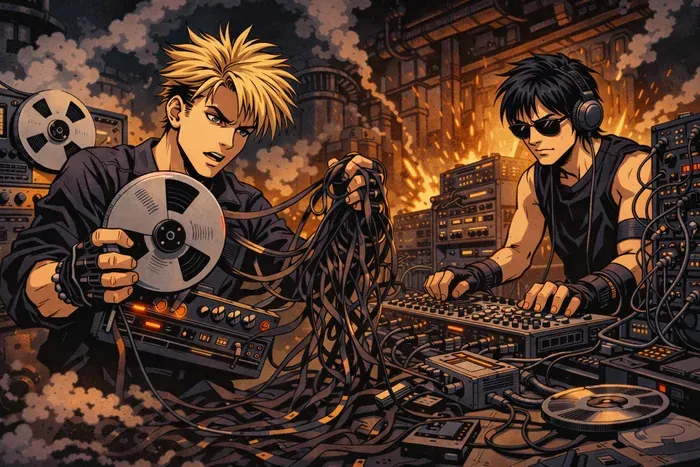
Industrial music did not emerge in isolation. Long before the word “industrial” appeared in music journalism, artists and composers were already experimenting with new ways to shape sound. During the twentieth century, technology slowly began to change how music could be created. Tape recorders, electronic oscillators, and studio editing tools allowed musicians to treat sound itself as raw material. Instead of writing melodies for traditional instruments, they started to cut, layer, stretch, and distort recordings.
These early experiments took place mostly outside the commercial music industry. Many of the pioneers worked in academic studios, art spaces, or small independent environments where curiosity mattered more than commercial success. Their work often sounded strange or unsettling to listeners who were used to conventional songs. Yet these experiments opened doors that later musicians would walk through.
By the late 1960s and early 1970s, a few adventurous bands began adapting these ideas to rock and electronic music. Repetition, mechanical rhythm, and minimal structures slowly entered the language of popular music. These elements would later become essential to industrial sound. In that sense, industrial music began here, in laboratories, studios, and underground scenes where musicians first discovered how machines could reshape music itself.
To understand why later industrial artists cut up tape, sampled mass media, and treated machines as collaborators, it helps to begin with the composers who first turned recorded sound into compositional material. Their work did not sound like industrial music yet, but it established a crucial principle: recorded noise could be organized with as much intent as melody or harmony.
Musique Concrète: Turning Tape Edits into Composition
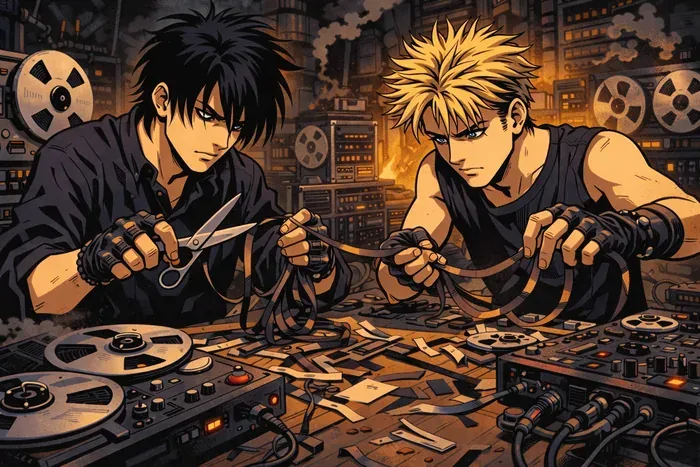
One of the earliest steps toward industrial sound began in the 1940s with a technique known as musique concrète. This approach treated recorded sound as a creative building block rather than a document of a live performance. Instead of writing music for instruments, composers worked directly with recorded material. They captured everyday noises, mechanical sounds, and fragments of speech, then reshaped them through editing and playback techniques.
French composer Pierre Schaeffer played a central role in developing this method. Working at French radio studios in Paris, he experimented with recorded sounds from trains, engines, and other machines. Schaeffer cut tape into pieces, rearranged them, changed playback speed, and created loops. These techniques transformed familiar noises into new rhythmic or atmospheric forms. The results sometimes sounded abstract and sometimes unexpectedly musical.
Another influential figure was Karlheinz Stockhausen, a German composer who expanded these ideas in the 1950s and 1960s. Stockhausen combined electronic tones with manipulated recordings, building complex sound environments that blurred the line between composition and sonic experimentation. His studio techniques explored space, repetition, and texture in ways that later inspired both electronic musicians and avant-garde rock artists.
What made these experiments important for industrial music was not their style but their attitude toward sound. Schaeffer and Stockhausen approached technology as a creative partner. Tape recorders were no longer neutral devices that simply captured performances. They became instruments themselves.
The idea that recorded sound could be cut apart and rebuilt would later shape many forms of underground music. Industrial artists used similar techniques decades later when they layered samples, field recordings, and distorted voices into their tracks. The process of editing and manipulating sound fragments became central to the genre.
Musique concrète also encouraged musicians to listen differently. Everyday noises could become rhythm. Mechanical hums could form texture. Distorted voices could carry emotional weight. This perspective later appeared in industrial recordings that incorporated factory sounds, news broadcasts, and film dialogue.
Although composers like Schaeffer and Stockhausen worked within experimental music circles rather than rock scenes, their influence slowly filtered outward. As recording technology became more accessible in the late 1960s and 1970s, younger artists began adapting these techniques for new contexts. Punk musicians, electronic pioneers, and industrial experimenters all discovered the creative potential hidden inside tape machines.
By the time the first industrial artists emerged in the late 1970s, the basic tools were already available. Tape loops, sound collage, and manipulated recordings had been explored for decades. Industrial music would take these techniques out of academic studios and place them into underground clubs, art spaces, and eventually rock venues.
Minimal Electronics: The Pulse of Urban Decay
While experimental composers explored tape manipulation in studios, another set of ideas began to grow inside underground rock scenes during the early 1970s. A few musicians started stripping music down to its most basic elements. Instead of complex arrangements, they focused on repetition, rhythm, and atmosphere. Simple electronic instruments replaced traditional band structures. These experiments created a raw, hypnotic sound that would later influence industrial music.
One of the clearest examples of this development was Suicide, formed in New York by Alan Vega and Martin Rev. Their music sounded very different from most rock bands of the time. Suicide performed with only a vocalist and a small electronic setup. Rev used primitive synthesizers and drum machines to create harsh, repetitive rhythms, while Vega delivered intense and often confrontational vocals. Their self-titled album Suicide from 1977 presented a stark combination of electronic pulse, distorted tones, and minimal structure.
The atmosphere of Suicide’s music reflected the urban environment surrounding them. New York in the mid-1970s was a city filled with tension, economic uncertainty, and decaying infrastructure. Rather than escape this reality, the band allowed it to shape their sound. Their repetitive electronic patterns felt cold and mechanical, almost like the steady hum of city machinery. This connection between urban life and electronic rhythm would later become a central theme in industrial music.
Around the same time, another group explored similar territory from a different angle. The American band Chrome, led by Damon Edge and Helios Creed, created music that mixed psychedelic rock, electronic noise, and tape manipulation. Albums such as Half Machine Lip Moves from 1979 pushed rock music toward a more fragmented and experimental direction. Chrome used studio techniques to distort guitars, voices, and drum patterns, creating a sound that felt unstable and disorienting.
What made these artists significant was their willingness to reject traditional rock expectations. They did not treat electronic instruments as decorative additions. Instead, the machines became central to the music’s structure. Rhythm could repeat for long stretches without change. Vocals might sound distant or distorted. The goal was atmosphere rather than technical performance.
Listeners sometimes reacted strongly to these sounds. Early audiences often found Suicide’s concerts hostile or confrontational. Yet their approach proved influential for later generations of musicians who were searching for new ways to combine electronics and emotional intensity.
The connection between minimal electronics and industrial music lies in this emphasis on repetition and mechanical rhythm. Industrial artists would later adopt similar patterns, using drum machines and sequencers to build driving, almost hypnotic structures. The stark electronic pulse that defined Suicide’s recordings foreshadowed the colder, more aggressive rhythms that emerged in industrial and Electronic Body Music during the following decade.
These early experiments showed that electronic minimalism could carry emotional power. Machines could produce music that felt tense, unsettling, and deeply connected to modern urban life.
Krautrock: When Bands Became Machines
During the late 1960s and early 1970s, a group of German bands began exploring a new direction for rock music that would later influence electronic and industrial sound. Journalists later grouped many of these artists under the label Krautrock, though the musicians themselves rarely used the term. What united them was a shared interest in rhythm, experimentation, and the creative use of technology.
Among the most influential bands were Kraftwerk, Neu!, and Can. Each approached music differently, yet all three groups helped reshape the role of rhythm and repetition in modern music.
Can, formed in Cologne in 1968, built their sound around long improvisations and tight rhythmic interplay. The band’s drummer Jaki Liebezeit developed a highly controlled style that emphasized steady, almost hypnotic beats. His playing often avoided flashy fills or dramatic changes. Instead, he maintained a focused pulse that could continue for many minutes. This disciplined approach created a strong sense of motion and space within the music. Albums such as Tago Mago and Future Days revealed how repetition could produce tension and atmosphere rather than monotony.
Another key step came from Neu!, founded by Michael Rother and Klaus Dinger after both had briefly worked with Kraftwerk. Neu! introduced a rhythm often described as the motorik beat. The pattern moved forward with a steady, driving pulse that rarely slowed or accelerated. The effect felt mechanical but also fluid, like a machine running smoothly without interruption. Tracks from albums such as Neu! and Neu! 75 captured this sense of continuous motion.
Kraftwerk pushed these ideas further by embracing electronic instruments more fully. Early albums still included traditional instruments, yet by the mid-1970s the group had turned toward synthesizers, drum machines, and sequencers. Their music explored the relationship between humans and technology in both sound and theme. The album Autobahn from 1974 presented electronic music that felt calm, precise, and modern. Later releases such as Trans-Europe Express refined this aesthetic even more.
What connected these German bands to the later industrial movement was their fascination with mechanical rhythm and technological imagery. Kraftwerk sang about trains, highways, and communication systems. Neu! focused on relentless forward motion. Can built hypnotic rhythmic structures that could stretch for long periods without losing intensity.
These ideas spread quietly through underground music scenes across Europe and North America. Musicians discovered that repetition and machine-like rhythm could create a powerful emotional effect. Instead of traditional verse-and-chorus structures, songs could grow from simple patterns that slowly evolved over time.
Industrial artists would later adopt many of these principles. Drum machines, sequencers, and repetitive structures became central elements of the genre. The sense of mechanical movement that appeared in Krautrock recordings helped shape the rhythmic language that industrial music would develop in the late 1970s and early 1980s.
By the time industrial artists began forming their own scenes, the concept of machine rhythm was already established. Krautrock had shown how electronic instruments and repetitive patterns could redefine the structure of modern music.
Post-Punk: Expanding What a Rock Band Could Be
By the late 1970s, punk rock had already changed the landscape of popular music. Bands had shown that energy and attitude could matter more than technical perfection. But once the first wave of punk settled, many musicians began searching for new directions. Instead of repeating the same fast guitars and rebellious slogans, they experimented with sound, rhythm, and structure.
This moment gave rise to what later became known as post-punk. The term does not describe one single musical style. Instead, it refers to a wide range of artists who wanted to rethink what a rock band could sound like. Some drew inspiration from electronic music and dub production. Others explored minimalism, noise, or unusual recording techniques. The result was a loose network of bands that treated the studio as a creative tool and looked far beyond traditional rock for ideas.
Post-punk created the environment in which industrial music could grow. Many of the techniques that later defined industrial sound were already being tested during these years. Bands experimented with tape manipulation, mechanical rhythm, and abstract textures. The stage was set for a new generation of artists who would push these ideas even further.
Public Image Ltd: Dub Space, Tension, and Repetition
One of the first bands to break away from the narrow expectations of punk was Public Image Ltd, often shortened to PiL. The group formed in 1978 after John Lydon, previously known as Johnny Rotten of the Sex Pistols, left the band that had helped ignite the original punk explosion. Rather than continue with a similar sound, Lydon wanted to explore something far less predictable.
Public Image Ltd approached music with an openness that stood apart at the time. Instead of building songs around fast guitar riffs, the band experimented with bass-driven grooves, dub-inspired production, and unconventional song structures. Jah Wobble, the group’s bassist during its early period, played a central role in shaping this direction. His deep, repetitive bass lines created a hypnotic foundation for the music.
The band’s second album, Metal Box from 1979, remains one of the most striking examples of post-punk experimentation. The record moved slowly and deliberately, with long tracks built around rhythm, echo, and texture. Guitars often sounded metallic or abstract rather than melodic. The production emphasized space and atmosphere, allowing instruments to drift in and out of focus.
For many listeners at the time, Metal Box sounded confusing or even alien. Yet the album showed how punk’s rebellious energy could evolve into something more exploratory. PiL treated sound as something flexible. Instead of writing songs that followed traditional patterns, they allowed rhythm and mood to guide the structure.
Another important aspect of Public Image Ltd was their willingness to incorporate influences from outside rock music. Dub reggae production techniques, especially the use of echo and spatial effects, played a clear role in shaping their sound. These studio techniques later became important tools for industrial musicians who wanted to manipulate sound in similar ways.
PiL also demonstrated that aggression in music did not always require speed or volume. The tension in their recordings came from repetition, atmosphere, and Lydon’s intense vocal delivery. His voice often sounded distant or distorted, creating an uneasy emotional tone.
Industrial artists would later adopt many of these ideas. The slow, heavy repetition found in Metal Box foreshadowed the mechanical rhythms that appeared in early industrial recordings. The willingness to reshape rock music through studio experimentation also pointed toward the direction that artists such as Cabaret Voltaire and Throbbing Gristle were already beginning to explore.
Public Image Ltd did not set out to create industrial music. Still, their refusal to follow rock tradition helped open the door for artists who were ready to take even more confrontational steps.
Wire and Gang of Four: Structure, Rhythm, and Critique
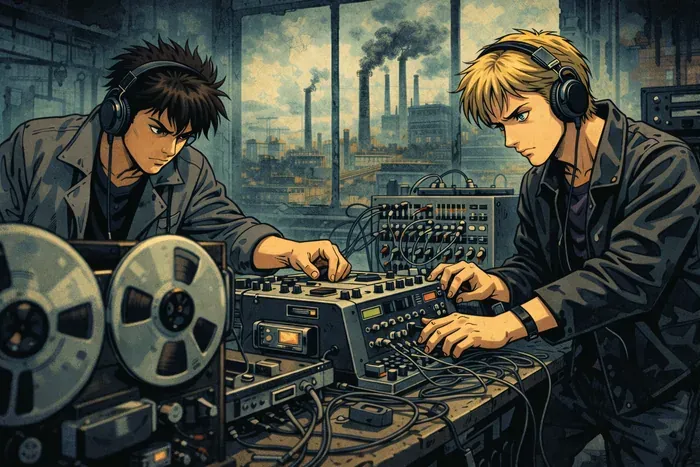
While Public Image Ltd explored dub rhythms and spacious production, other post-punk bands approached experimentation through structure and ideas. Two groups in particular, Wire and Gang of Four, played an important role in expanding the language of punk. Their music remained sharp and energetic, yet the way they organized sound, rhythm, and lyrics pointed toward a more analytical and experimental direction.
Wire, formed in London in 1976, began as part of the early punk movement. Their debut album Pink Flag captured much of that energy, but the band quickly moved beyond the typical three-chord approach. With their second album, Chairs Missing in 1978, Wire began integrating synthesizers, unusual song structures, and layered studio production. The music became more atmospheric and less predictable.
Rather than stretching songs into long performances, Wire often did the opposite. Many of their pieces were short and sharply focused. A single idea could appear briefly and then disappear before the listener fully understood it. This fragmented approach created a sense of tension and unpredictability. At the same time, the band experimented with electronic textures and unconventional guitar sounds, hinting at directions that later alternative and industrial artists would explore further.
Gang of Four, formed in Leeds in 1976, approached post-punk from another angle. Their music combined sharp guitar rhythms with politically charged lyrics and an almost mechanical sense of timing. The band’s 1979 album Entertainment! demonstrated how punk energy could coexist with intellectual reflection.
Guitarist Andy Gill developed a distinctive playing style that focused on rhythm rather than traditional melody. His guitar lines often sounded clipped, metallic, and precise. Instead of filling every space with sound, he used short bursts of rhythm that interacted closely with the bass and drums. This approach created a tight, almost machine-like groove.
Gang of Four’s lyrics also pushed post-punk toward more analytical territory. The band wrote about consumer culture, political power, and social behavior. Their songs examined how systems influence everyday life, sometimes with sharp irony. This mixture of rhythmic precision and social critique later resonated strongly with industrial artists who explored similar themes.
Both Wire and Gang of Four demonstrated that rock music could function as a space for experimentation and critical thought. Their work showed younger musicians that aggression and intelligence did not need to be opposites. Instead, they could reinforce each other.
Industrial musicians would later borrow several elements from these bands. The sharp rhythmic guitar style heard in Gang of Four recordings influenced later industrial rock and metal acts. Wire’s fragmented structures and willingness to experiment with electronic textures helped expand the possibilities of post-punk sound.
By the end of the 1970s, the boundaries of punk had stretched far beyond its original form. Bands across the United Kingdom and Europe were experimenting with rhythm, electronics, and conceptual ideas. Among them were a few groups who would soon move even further away from traditional rock structures. In cities like Sheffield, artists began combining post-punk experimentation with early electronic technology, creating a sound that pointed directly toward the emerging industrial movement.
Sheffield: Tape Experiments in an Industrial City
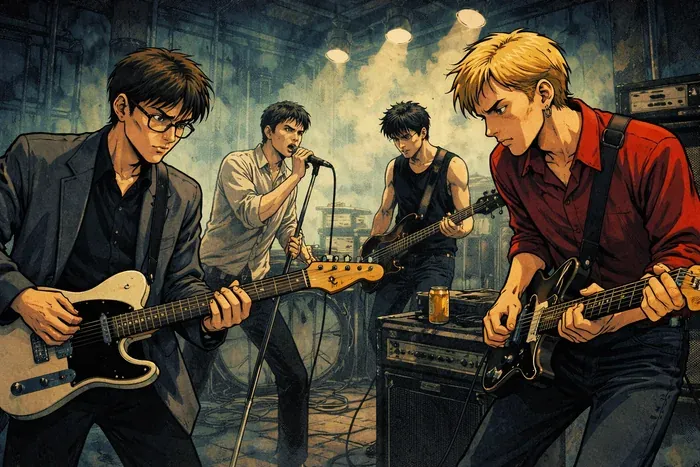
While many post-punk bands experimented with guitars and studio techniques, a different direction was emerging in the English city of Sheffield. During the late 1970s, Sheffield was known for heavy industry and steel production. Its landscape was shaped by factories, warehouses, and machinery. For a generation of young musicians growing up there, that industrial environment became an unexpected source of inspiration.
One of the most influential groups to emerge from this scene was Cabaret Voltaire, formed by Richard H. Kirk, Stephen Mallinder, and Chris Watson. The band approached music with curiosity rather than strict genre boundaries. Instead of building their sound around traditional rock instruments, they experimented with tape machines, synthesizers, and electronic rhythm devices. Their recordings often included manipulated voices, distorted signals, and fragments of found audio.
Cabaret Voltaire’s early releases captured a sense of urban unease. Tracks moved through shifting layers of rhythm, noise, and electronic texture. Albums such as The Voice of America and Red Mecca presented soundscapes that felt mechanical and distant, yet strangely rhythmic. The band often treated the studio as a laboratory where sounds could be reshaped and recombined.
The influence of Sheffield’s industrial surroundings could be heard in these recordings. Repetitive rhythms echoed the steady pulse of factory machinery. Metallic tones and echoing effects created an atmosphere that felt both modern and unsettling. Rather than imitate traditional rock bands, Cabaret Voltaire built a musical language that reflected the technological environment around them.
Sheffield’s electronic underground included other artists who explored similar ideas. Clock DVA, led by Adolphus “Adi” Newton, blended post-punk energy with electronic experimentation and conceptual art influences. Their work often explored themes of psychology, technology, and surveillance. Though their sound differed from Cabaret Voltaire in structure and mood, both groups shared an interest in pushing beyond conventional song forms.
Another project that grew from the Sheffield scene was the early version of The Human League. Before the band later achieved mainstream success with synth-pop hits, its original lineup focused on experimental electronic music. Founding members Martyn Ware, Ian Craig Marsh, and Philip Oakey were fascinated by synthesizers and minimalist rhythms. Their early recordings revealed a fascination with machines, repetition, and synthetic sound.
What made Sheffield important for the development of industrial music was the way these artists embraced electronic technology as a central element of composition. They did not treat synthesizers as decorative additions to rock music. Instead, electronics became the foundation of their sound.
This shift helped prepare the ground for industrial artists who would take these ideas even further. Cabaret Voltaire’s mixture of tape manipulation, mechanical rhythm, and electronic texture offered a blueprint for the darker and more confrontational sound that was beginning to appear elsewhere in the underground music world.
By the end of the decade, several artists were moving beyond post-punk experimentation toward something more confrontational. Their work came to be described with a new word that captured the mechanical intensity of their sound: industrial.
Voices That Expanded Post-Punk's Experimental Range
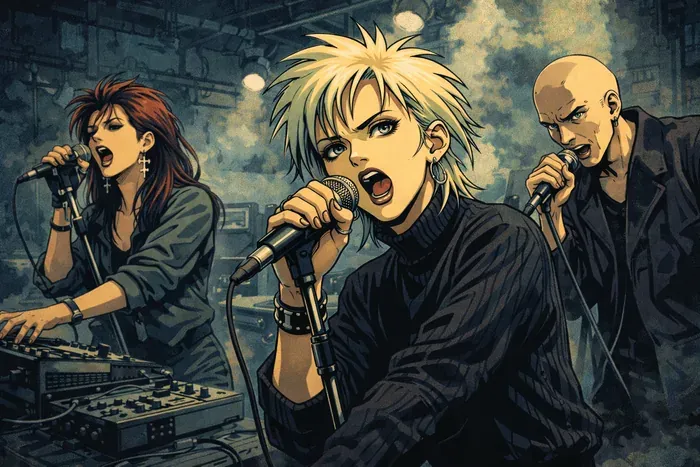
The post-punk era created space for many voices that had rarely been heard in earlier rock scenes. Women artists played an important role in shaping both the atmosphere and the direction of the movement. Their contributions often appeared in experimental music, spoken word, electronic composition, and independent production work. In doing so, they expanded the emotional and conceptual range of post-punk while helping build networks that later supported industrial music.
One distinctive figure was Anne Clark, a British poet and performer who combined spoken word with electronic music. Clark began writing poetry during the late 1970s and soon developed a style that merged her calm, expressive voice with synthesizer-based arrangements. Instead of singing traditional melodies, she recited reflective and sometimes melancholic texts over rhythmic electronic backdrops.
Albums such as The Sitting Room from 1982 showed how spoken language could become part of electronic music. Clark’s work explored themes such as memory, urban isolation, and emotional vulnerability. Her voice remained steady and intimate, creating a contrast with the mechanical tone of the instruments around her. This balance between human reflection and synthetic sound would later appear in several strands of industrial and dark electronic music.
Another important figure within the broader post-punk environment was Gudrun Gut. Born in Germany, Gut became involved in the West Berlin underground scene during the late 1970s. Berlin at that time was a city divided both physically and culturally, yet its artistic communities were highly active. Musicians, filmmakers, and visual artists often collaborated across disciplines.
Gudrun Gut first gained attention as a member of Mania D, a band that blended post-punk energy with experimental structures. Later she joined Malaria!, a group known for its sharp rhythms and minimalist electronic sound. Malaria! combined strong visual identity with stark musical arrangements, creating a style that stood apart from many British post-punk bands.
Beyond her own performances, Gut helped build the infrastructure that supported independent music. She later founded the Monika Enterprise label, which became an important platform for electronic and experimental artists. Her work showed how musicians could shape a scene not only through recordings but also through collaboration and community-building.
The presence of artists like Anne Clark and Gudrun Gut revealed how flexible the post-punk environment had become. Musicians were free to experiment with poetry, electronic sound design, visual art, and unconventional performance styles. These creative approaches broadened the possibilities of underground music.
Industrial artists would later draw from many of these ideas. The mixture of spoken voice and electronic rhythm became a recognizable element in several industrial recordings. The strong visual identity developed by Berlin artists influenced later stage aesthetics and album artwork within the genre.
More importantly, these musicians demonstrated that experimentation could come from many perspectives. Post-punk was not simply a transition from punk to other rock styles. It was a period of discovery in which artists explored new relationships between sound, language, technology, and performance.
As the 1980s approached, some of these experiments began to grow darker and more confrontational. A small network of artists pushed beyond post-punk into a form of music that rejected conventional structures almost completely. Their work would soon define the early phase of industrial culture.

Industrial Culture: Art, Noise, and Deliberate Provocation
By the end of the 1970s, several underground artists were pushing far beyond the experimental boundaries of post-punk. Some were no longer interested in writing songs at all. Instead, they treated sound as part of a broader artistic practice that included performance, visual art, political provocation, and media critique. Out of this environment, the earliest form of industrial music emerged.
The word “industrial” entered music culture through Industrial Records, a small independent label created around Throbbing Gristle in the late 1970s. The label’s slogan described its mission clearly: “Industrial music for industrial people.” This phrase reflected both the sound and the cultural background of the movement. Many of the artists involved lived in cities shaped by factories, heavy machinery, and economic decline. Their music mirrored these environments with metallic textures, mechanical rhythm, and disturbing imagery.
At this stage, industrial was less a settled genre than a loose cultural position. It described a network of artists, labels, performances, and ideas that rejected the usual boundaries between music, visual art, and provocation. That ambiguity matters because the term would later expand far beyond its first context. "Industrial Music for Industrial People"
Early industrial artists often rejected traditional ideas about entertainment. Concerts sometimes resembled art installations or confrontational performances. Recordings combined noise, tape collage, electronics, and spoken fragments. Rather than offering comfort, the music explored anxiety, control, and the strange relationship between technology and modern life.
Within this environment, a small number of artists began shaping what would later be recognized as the foundation of industrial culture. The clearest starting point is COUM Transmissions, where performance art, provocation, and media critique converged before moving directly into music.
COUM Transmissions: The Performance-Art Roots of Industrial
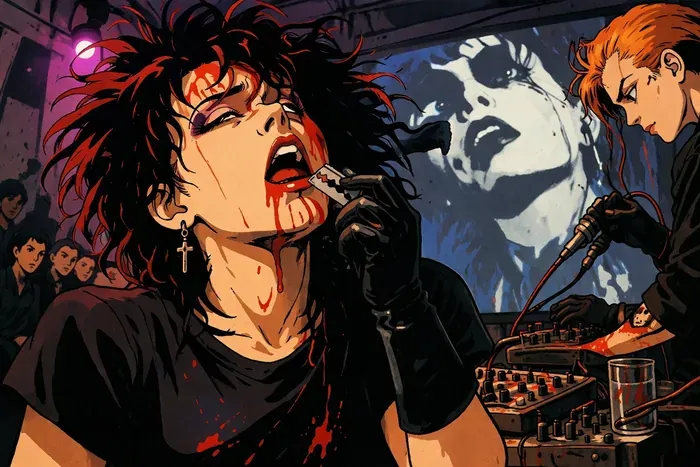
The origins of industrial music cannot be separated from the art collective COUM Transmissions. Founded in the late 1960s in the English city of Hull, COUM began as a loose group of artists interested in performance, experimental art, and cultural provocation. Among its central figures were Genesis P-Orridge and Cosey Fanni Tutti, who would later become key members of Throbbing Gristle.
COUM Transmissions approached art as a direct confrontation with social norms. Their performances often used unconventional materials, controversial imagery, and themes related to sexuality, media, and identity. The group believed that art should challenge the audience rather than reassure it. Their exhibitions sometimes shocked viewers and attracted strong reactions from critics and the public.
One of the most famous COUM exhibitions took place in London in 1976 at the Institute of Contemporary Arts. The show presented photographs, installations, and performance pieces that explored themes of power, control, and media representation. The exhibition sparked heated debate in the British press, with some politicians even criticizing the work in parliament. Yet the controversy also brought attention to the collective’s ideas about art and cultural critique.
Out of this environment, several members of COUM decided to create a musical project that could carry similar ideas into sound. That project became Throbbing Gristle. Alongside Genesis P-Orridge and Cosey Fanni Tutti, the band included Chris Carter and Peter Christopherson, both of whom brought technical and visual expertise to the group. "Everything in the show is for sale at a price, even the people."
To release their recordings independently, the group founded Industrial Records. The label became one of the first platforms dedicated specifically to this new experimental sound. The term “industrial music” began appearing on the label’s releases and promotional materials. It described not only the harsh mechanical tone of the music but also its connection to modern industrial society.
Industrial Records quickly became a hub for a small network of artists who shared similar ideas. The label released music that blended electronics, noise, spoken word, and field recordings. The goal was not commercial success but creative freedom. By controlling their own production and distribution, the artists avoided many of the limitations imposed by traditional record companies.
Cosey Fanni Tutti played a crucial role in shaping the visual and conceptual identity of the movement. Her work often explored themes related to gender, body politics, and the construction of identity in media culture. Through photography, performance, and sound, she helped expand the boundaries of what industrial art could include.
The activities of COUM Transmissions and Industrial Records established the philosophical foundation of industrial music. Sound was only one part of a broader cultural project. Performance, visual art, and social critique all belonged to the same creative space.
From that foundation, Throbbing Gristle moved those ideas into recorded sound and live performance, creating one of the central reference points for the early industrial movement.
Throbbing Gristle: Sound, Shock, and the First Industrial Blueprint
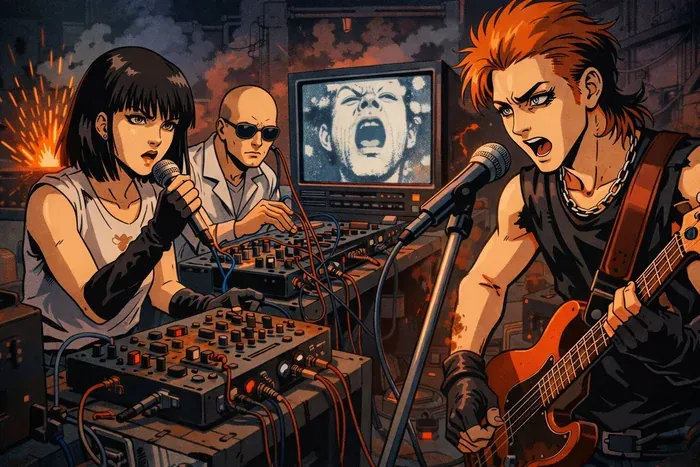
When Throbbing Gristle began performing in the mid-1970s, few audiences had heard anything quite like their work. The group approached music from a markedly different perspective than most rock bands. Rather than writing structured songs, they created intense sound environments built from electronics, noise, tape recordings, and fragmented rhythm. Their performances often felt closer to experimental art than traditional concerts.
The band consisted of Genesis P-Orridge, Cosey Fanni Tutti, Chris Carter, and Peter Christopherson. Each member contributed a distinct element to the project. Carter developed electronic circuits and synthesizer systems that produced harsh tones and pulsing signals. Christopherson handled visual presentation and sound manipulation, drawing from his experience in design and media production. P-Orridge delivered unsettling spoken passages and vocal performances, while Tutti contributed guitar textures, electronics, and conceptual direction.
Their recordings rarely followed familiar musical structures. Instead, the band layered distorted signals, mechanical rhythms, and manipulated voices into dense sound collages. Tracks might shift slowly from quiet electronic pulses to bursts of noise or disorienting samples. This approach created a sense of instability that matched the themes explored in their work.
One of the group’s most widely discussed releases was the 1979 album 20 Jazz Funk Greats. Despite its playful title and seemingly calm cover photograph, the music inside the record revealed the unsettling character of Throbbing Gristle’s sound. Some tracks moved with slow electronic rhythms, while others drifted into dark atmospheres or abrasive noise. The album showed that industrial music could move between tension and quiet reflection while still maintaining its strange, mechanical identity.
Throbbing Gristle’s performances became well known for their confrontational atmosphere. The band sometimes used disturbing imagery, flashing lights, and fragments of film or television audio. Audiences occasionally reacted with confusion or anger. Yet these reactions were part of the artistic intention. The group wanted listeners to confront uncomfortable ideas about media, control, and modern society.
The phrase “industrial music for industrial people,” associated with Industrial Records, reflected this vision. The artists saw their work as a response to life within technologically driven societies. Machines, surveillance, and mass communication were becoming central features of daily life. Throbbing Gristle attempted to mirror those realities through sound.
Their influence spread quietly through underground music networks. Though the group rarely reached mainstream audiences, many younger musicians discovered their recordings through independent shops, small labels, and word of mouth. Artists across Europe and North America began exploring similar combinations of electronics, noise, and experimental production.
Throbbing Gristle eventually ended their first phase in 1981, but their impact remained strong. Members continued working in related projects, and their recordings became reference points for later generations of industrial artists.
By the early 1980s, those ideas were already moving outward. Other musicians adopted industrial techniques and reshaped them within new scenes. Some pushed further into noise, metal percussion, and extreme performance, expanding the edges of what industrial could mean.
Monte Cazazza and Z'EV: Noise, Metal, and Performance
While Throbbing Gristle became the most recognizable name in early industrial music, they were not working alone. Around the same time, several experimental artists were exploring similar territory in other parts of the underground art world. Among them were Monte Cazazza and Z’EV, two figures who helped shape the harsher, more confrontational edge of early industrial sound.
Monte Cazazza, an American performance artist and musician, had already developed a reputation for provocative work before the industrial scene began to take form. His performances often mixed visual art, disturbing imagery, and experimental sound. Cazazza maintained close connections with members of Throbbing Gristle and the broader Industrial Records circle. In fact, he is sometimes credited with helping popularize the phrase “industrial music.”
Cazazza’s recordings reflected the same unsettling atmosphere that defined his performances. Instead of traditional instruments, he often relied on electronics, noise generators, and tape manipulation. The sound could feel chaotic or abrasive, yet it still served a deliberate artistic purpose. His work explored themes related to social control, media influence, and the darker sides of modern culture. Although his audience remained small, his influence within the underground network was significant.
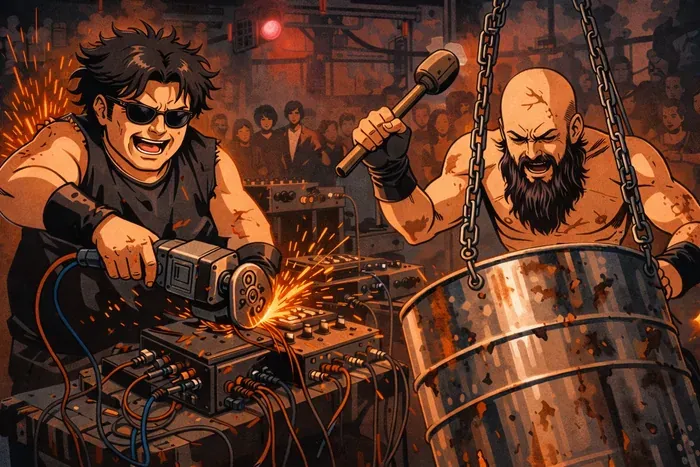
Another important figure was Z’EV, a musician and performance artist from California whose work focused on rhythm and physical sound production. Z’EV approached percussion in an unusual way. Rather than relying on conventional drums, he performed with pieces of metal, chains, pipes, and other industrial materials. These objects produced deep metallic tones and resonant vibrations that echoed the mechanical environment of factories and workshops.
Z’EV’s live performances often felt intense and immersive. He arranged metal objects around the stage and struck them in complex rhythmic patterns. The result was a raw, physical form of music that connected sound directly to movement and material. The metallic resonance of these performances strongly influenced later industrial artists who experimented with nontraditional instruments.
Both Cazazza and Z’EV contributed to a growing network of experimental musicians who shared ideas across continents. Their work circulated through small record labels, cassette exchanges, and independent art spaces. This underground system allowed artists to communicate outside the mainstream music industry.
The noise-driven approach of these performers helped expand the vocabulary of industrial sound. Instead of relying only on synthesizers and tape loops, musicians began exploring physical materials, mechanical resonance, and unconventional performance techniques. Noise itself became a meaningful artistic element rather than something to avoid.
As the early industrial scene developed, these experiments helped define the outer boundaries of the genre. Some artists focused on pure noise and performance art, while others began shaping industrial ideas into more rhythmic and structured forms.
One group that continued refining this balance between experimentation and rhythm was Cabaret Voltaire. Their evolving sound would help connect the earliest industrial movement to the electronic scenes that followed.
Cabaret Voltaire: Tape Manipulation, Rhythm, and Media Critique
While Throbbing Gristle explored the boundaries of noise and performance art, Cabaret Voltaire developed a different path for industrial music. The Sheffield trio gradually transformed their early experimental approach into something more rhythmic and electronically structured. Their work created an important bridge between the beginnings of industrial culture and the emerging electronic music scenes of the 1980s.
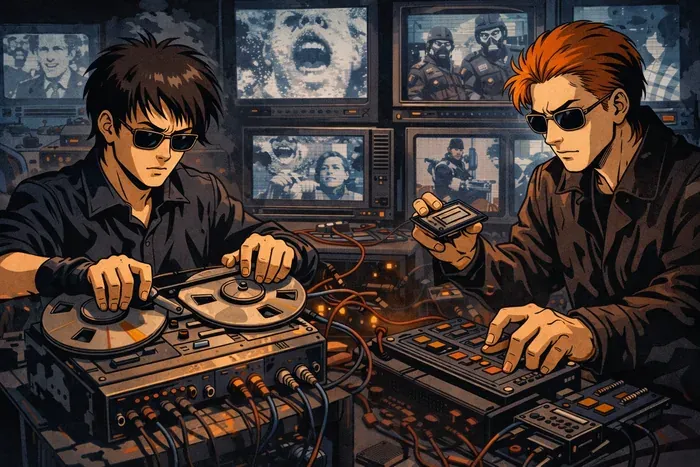
The band’s core members were Richard H. Kirk and Stephen Mallinder, with Chris Watson contributing during the early years before leaving the group in 1981. From the start, Cabaret Voltaire treated technology as a creative playground. Tape machines, synthesizers, rhythm devices, and homemade electronic equipment formed the backbone of their sound.
Early recordings often felt fragmented and abstract. The group layered distorted voices, radio fragments, and mechanical noises over sparse electronic rhythms. These pieces sometimes resembled sound collages more than traditional songs. Yet beneath the experimentation, there was a clear interest in rhythm and structure.
Albums such as The Voice of America from 1980 revealed how Cabaret Voltaire used sampling and tape manipulation to comment on modern media culture. Fragments of speeches, news broadcasts, and other recorded material appeared throughout the music. These sounds created a sense that the listener was moving through a landscape shaped by communication systems and information overload.
Their next major release, Red Mecca in 1981, pushed this approach even further. The album blended electronic rhythm, dub-inspired production techniques, and dark atmospheric textures. Echo effects and spacious mixing created a feeling of depth that contrasted with the harsher noise elements of earlier industrial recordings. The music still carried a strong experimental character, yet it also pointed toward electronic dance music.
Cabaret Voltaire’s work showed that industrial ideas could evolve without losing their critical perspective. The band continued exploring themes related to surveillance, political power, and the influence of media. At the same time, their growing focus on rhythm allowed the music to reach audiences beyond art galleries and experimental venues. "The mission statement from the off was no nostalgia. Normal rules do not apply. Something for the 21st Century."
Their influence spread into underground club culture. DJs and electronic musicians discovered that the repetitive rhythms and dark atmosphere of Cabaret Voltaire’s recordings could work in dance environments. This connection between industrial experimentation and club rhythm helped give rise to a new style known as Electronic Body Music, or EBM.
Cabaret Voltaire therefore played a key transitional role. They carried the experimental spirit of early industrial culture into a more structured electronic framework. In doing so, they helped prepare the ground for artists who would transform industrial sound into something physical and danceable.
As these ideas spread across Europe, musicians in Belgium, Germany, and beyond began shaping the next phase of industrial evolution by combining machine rhythm with the energy of underground club culture.

Across Europe: Local Scenes, Shared Industrial Ideas
During the early 1980s, industrial music began spreading across Europe through a loose network of underground artists, independent labels, and experimental venues. The movement no longer belonged to one group or city. Instead, it developed through several local scenes that shared ideas while keeping their own distinct character.
Different regions approached industrial sound in different ways. Some artists focused on performance art and sonic experimentation, while others explored political symbolism or mechanical rhythm. The environments surrounding these musicians often influenced their work. Cities shaped by heavy industry, political tension, or cultural isolation produced music that reflected those realities.
One of the key centers of industrial creativity during this period was West Berlin. The city’s divided political situation created a distinctive cultural atmosphere. Surrounded by the Berlin Wall and positioned at the edge of Cold War tensions, West Berlin attracted artists who were interested in experimentation and alternative lifestyles. The industrial landscape of abandoned buildings, construction sites, and metal structures provided both visual and sonic inspiration.
This environment produced some of the most distinctive voices in early industrial music. Among them, Einstürzende Neubauten redefined the possibilities of noise and rhythm in especially physical terms.
Einstürzende Neubauten: Berlin's Sound of Scrap Metal
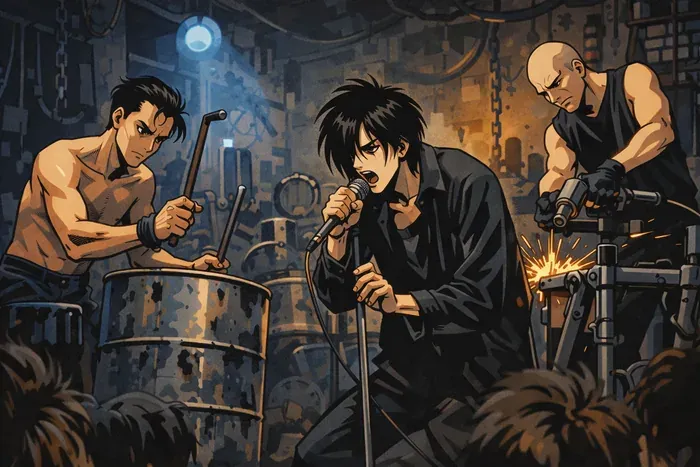
Few bands captured the physical force of industrial sound as powerfully as Einstürzende Neubauten. Formed in West Berlin in 1980 by Blixa Bargeld, N.U. Unruh, and a shifting group of collaborators, the band built its music from materials rarely seen on a concert stage. Instead of relying mainly on traditional instruments, the musicians used scrap metal, steel beams, drills, chains, and construction tools.
The name Einstürzende Neubauten translates roughly to “Collapsing New Buildings,” a phrase that reflected both the group’s fascination with architecture and the unstable political environment of divided Berlin. The city was full of abandoned structures, industrial spaces, and temporary construction zones. These locations often served as rehearsal rooms and performance spaces for the band.
Their debut album Kollaps, released in 1981, introduced a sound that felt raw and physical. The recordings combined metallic percussion, distorted guitars, and fragmented vocals. Rhythms emerged from the impact of metal against metal. The music often sounded as though it had been built directly from the materials of the surrounding city.
Blixa Bargeld’s vocal style added another distinctive layer. His voice shifted between whispered passages, spoken fragments, and intense bursts of sound. The lyrics sometimes reflected urban imagery, emotional tension, or abstract poetry. Rather than delivering clear narratives, the band created sonic environments that suggested industrial landscapes and psychological pressure.
Live performances played an important role in the group’s identity. Concerts often looked like construction sites. Metal objects hung from frames, and performers struck them with hammers or other tools. Sparks, vibrations, and echoing metallic tones filled the room. The visual spectacle reinforced the connection between the music and the industrial environment that inspired it.
Einstürzende Neubauten also demonstrated how industrial music could remain experimental while evolving musically. Later recordings introduced more structured compositions and subtle electronic elements, yet the band continued to explore unusual sound sources. Over time they incorporated custom-built instruments and carefully designed acoustic setups.
Their work influenced a wide range of artists, from experimental noise musicians to industrial rock bands. The idea that music could be built from physical materials rather than traditional instruments became a defining characteristic of the industrial aesthetic.
Beyond sound, Einstürzende Neubauten represented a broader artistic philosophy. The band treated architecture, urban space, and mechanical objects as creative partners. Their performances suggested that music could emerge from the environment itself.
While Neubauten explored the physical power of industrial sound in Berlin, other European artists approached the genre from different angles. Some focused on psychological themes and sonic experimentation. Among them was an Australian-born project whose unsettling recordings would soon leave a lasting mark on the early industrial movement.
SPK: The Psychology of Noise
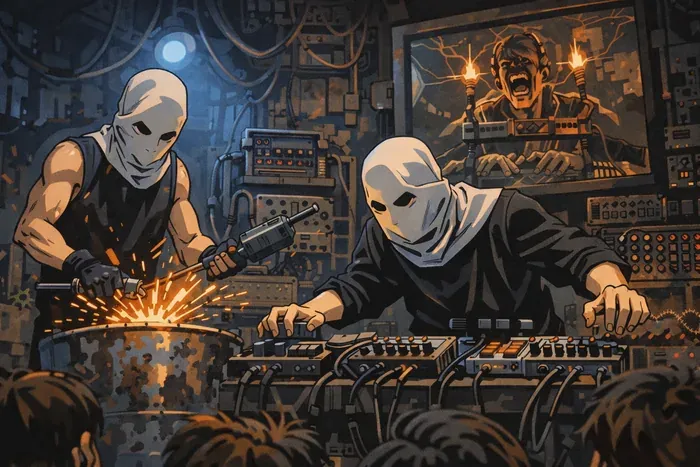
Among the darker voices in the early industrial movement was SPK, a project founded in the late 1970s by Australian musician Graeme Revell together with Neil Hill, who performed under the name Ne/H/il. The group originally formed in Sydney before relocating to Europe, where its work became closely associated with the developing industrial underground.
SPK approached sound from a strongly conceptual perspective. Their music explored themes related to psychology, social control, medical institutions, and the uneasy relationship between technology and the human body. These ideas appeared both in their recordings and in the visual imagery surrounding the project. Album covers, performance environments, and promotional material often referenced clinical or institutional settings.
Early SPK recordings carried a raw and abrasive sound. Electronics, distorted percussion, and manipulated recordings blended into dense layers of noise. The group frequently used mechanical rhythms that felt unstable or fragmented, giving their music a sense of tension and unease. Instead of building smooth grooves, SPK often constructed sonic environments that felt deliberately uncomfortable.
One of their early releases, the album Information Overload Unit from 1981, presented a striking example of this approach. The record combined harsh electronic tones, pounding metallic percussion, and disturbing audio fragments. Listening to the album could feel disorienting, yet the experience reflected the themes the group wanted to explore. The title itself suggested the overwhelming presence of information and technology in modern life.
SPK also experimented with performance settings that blurred the line between concert and installation. Shows sometimes included projections, unconventional lighting, and physical objects that contributed to the atmosphere of the performance. The band’s goal was to create an environment where sound, imagery, and concept worked together.
Over time the project evolved. Later recordings began incorporating clearer electronic structures and synthesizer arrangements. Albums such as Leichenschrei moved toward a more atmospheric electronic sound while maintaining the dark tone that defined their earlier work. This shift demonstrated how industrial music could transform without losing its thematic intensity.
SPK’s influence reached beyond the immediate industrial scene. Their combination of conceptual art, psychological themes, and electronic experimentation inspired artists in electronic music, dark ambient, and experimental performance. The group showed that industrial sound could function not only as aggressive noise but also as a tool for exploring deeper emotional and intellectual territory.
Within the broader European industrial landscape, SPK represented one extreme of the genre’s possibilities. Their work emphasized tension, psychological exploration, and sonic intensity. At the same time, other artists were beginning to connect industrial ideas with political commentary and collective performance. One of the most striking examples of this direction emerged in Britain through the work of Test Dept, a group that turned industrial sound into a forceful form of political theatre.
Test Dept: Industrial Music as Political Theatre
While some industrial artists focused on psychological themes or experimental sound design, the British collective Test Dept connected industrial music more directly to political action and working-class culture. Formed in London in 1981, the group developed a performance style that combined music, visual art, and political symbolism. Their work reflected the economic and social tensions that defined Britain in the early years of the decade.
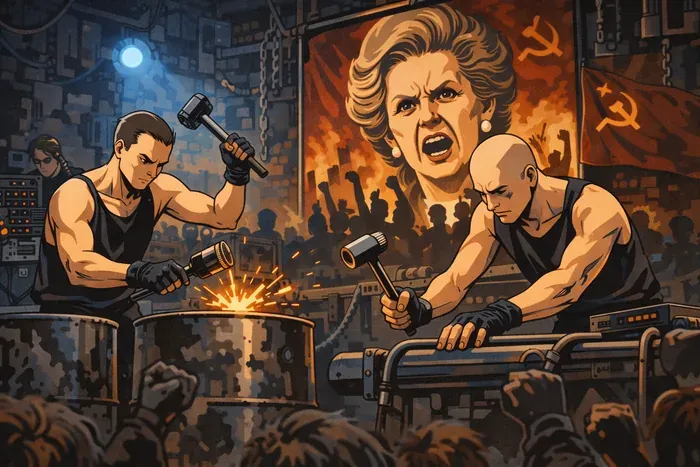
The country was experiencing deep industrial change at the time. Factories closed, unemployment rose, and many communities built around heavy industry faced uncertainty. Test Dept responded to this environment by transforming the materials of industrial labor into instruments. Instead of standard drum kits or guitars, the group performed with pieces of scrap metal, oil barrels, iron plates, and heavy machinery components.
These objects produced powerful percussive sounds that echoed through large spaces. The band often arranged them on stage like a giant mechanical instrument. Performers struck metal surfaces with hammers, rods, or other tools, creating rhythmic patterns that felt physical and imposing. The resulting sound resembled the clanging rhythm of a factory floor, yet organized into deliberate musical structures.
Test Dept’s performances frequently took place in unusual locations. Rather than focusing only on clubs or concert halls, the group appeared in abandoned industrial buildings, warehouses, and public spaces. These environments strengthened the connection between the music and the social realities it referenced. The setting became part of the performance itself.
Political engagement also played a clear role in their work. Test Dept collaborated with activists and supported labor movements, particularly during the British miners’ strike of 1984–1985. The band participated in concerts and events that raised awareness and support for striking workers. In these situations, industrial music became a form of cultural solidarity as well as artistic expression.
Musically, Test Dept combined heavy percussion with electronic elements, sampling, and spoken fragments. The mixture created a dramatic atmosphere that suited their large-scale performances. The group’s work suggested that industrial sound could function not only as experimental art but also as collective expression linked to real social conditions.
Their approach influenced later artists who explored the relationship between industrial music and political identity. By using objects from industrial labor as instruments, Test Dept reminded audiences of the human work that once powered factories and production systems.
Within the broader industrial scene, their work represented a distinct path. While some artists focused on abstract sound or conceptual imagery, Test Dept brought the physical reality of industrial environments directly into performance.
At the same time, another European project was exploring industrial themes through symbolism, imagery, and theatrical presentation. Emerging from the cultural landscape of Eastern Europe, Laibach would soon develop one of the most visually and politically provocative identities within the entire industrial movement.
Laibach: Power, Propaganda, and Totalitarian Aesthetics
During the early 1980s, another influential industrial project emerged from a very different political environment. Laibach, founded in 1980 in the industrial town of Trbovlje in what was then Yugoslavia, developed a style that combined heavy electronic sound with strong visual symbolism and conceptual performance. The group took its name from the German version of Ljubljana, a choice that immediately carried historical tension and political ambiguity.
From the beginning, Laibach treated music as only one part of a broader artistic system. The band became associated with a larger collective known as Neue Slowenische Kunst (NSK), which included visual artists, designers, and theater groups. Together they created a complex cultural project that explored themes of power, propaganda, and national identity.
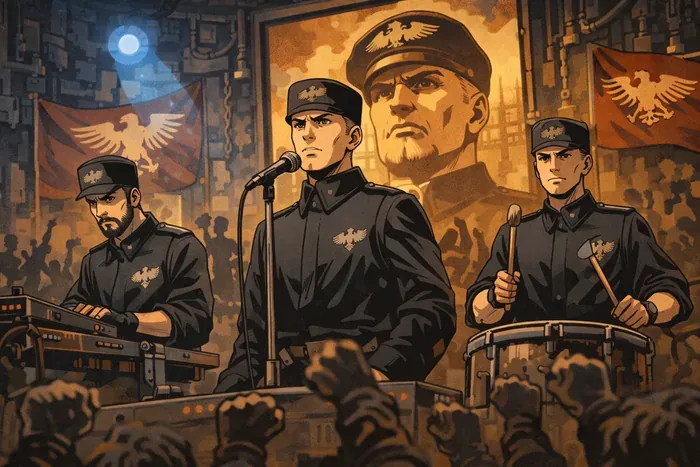
Laibach’s performances and imagery often referenced the visual language of political authority. Uniforms, banners, and strict stage presentation gave their concerts an atmosphere that felt both theatrical and unsettling. The group rarely explained their intentions directly. Instead, they presented symbols that encouraged audiences to question the relationship between ideology, mass communication, and cultural identity.
Musically, Laibach combined elements of industrial rhythm, electronic sequencing, and martial percussion. Their recordings often featured deep, commanding vocals delivered by Milan Fras, whose voice added a sense of authority and dramatic intensity. The band frequently used orchestral samples, heavy synthesizer lines, and rigid rhythmic structures.
Albums such as Nova Akropola from 1986 revealed how Laibach blended industrial sound with grand, almost cinematic arrangements. The music carried a sense of weight and seriousness that distinguished it from other industrial projects. Rather than focusing purely on noise or experimentation, Laibach developed a disciplined aesthetic that felt both modern and historically aware.
One of the group’s most recognizable strategies involved reinterpretations of well-known songs. By covering popular music and reshaping it through their strict visual and musical style, Laibach invited listeners to reconsider the meaning of familiar cultural symbols. These reinterpretations often sounded monumental and slightly unsettling, as if ordinary songs had been transformed into political statements.
Laibach’s work demonstrated that industrial music could engage directly with questions of power and ideology. Their use of strong visual identity, disciplined rhythm, and symbolic imagery created a distinctive artistic language. For many listeners, the group’s performances felt both fascinating and disturbing, encouraging reflection on how political systems influence culture.
The influence of Laibach extended beyond the industrial underground. Their approach to imagery, performance, and conceptual art inspired later musicians across Europe and North America. They also helped demonstrate that industrial music could function as a platform for cultural critique.
By the early 1980s, industrial music had developed several distinct branches across Europe. Experimental noise, political performance, and electronic rhythm all existed within the same broad movement. The next major shift came when some artists placed more emphasis on rhythm and club culture. In Belgium and other parts of Europe, a new sound was taking shape that would soon be known as Electronic Body Music, or EBM.
Industrial and the Body: Discipline, Desire, and Performance
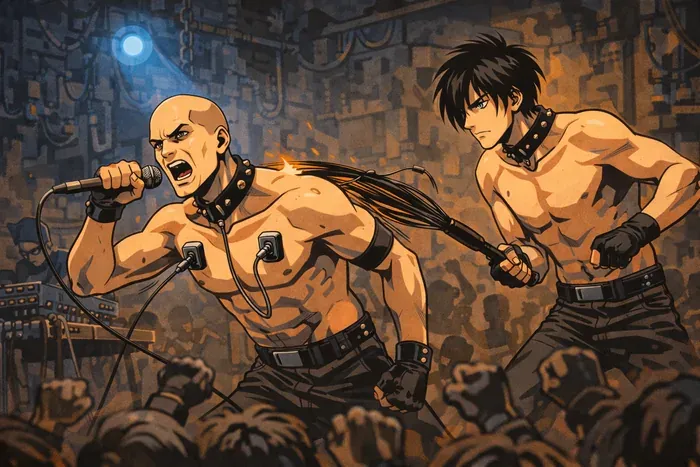
One thread that connects many branches of industrial music is the body. Early industrial artists were often accused of sounding cold or inhuman, yet their work repeatedly returned to physical experience. COUM Transmissions used the body directly as artistic material, challenging public ideas about sexuality, labor, shame, and representation. Throbbing Gristle carried some of that logic into sound, where distorted voices, repetition, and sensory overload created music that could feel intrusive rather than merely decorative.
This bodily dimension also appeared in performance style. Industrial concerts often rejected the easy pleasure of conventional rock entertainment. Instead, they used discipline, confrontation, ritualized gesture, or controlled discomfort. Laibach’s staged authority, Einstürzende Neubauten’s physical percussion, and Test Dept’s use of industrial objects all made performance feel material and embodied. The body was not only watching the spectacle. It was being pressured by volume, rhythm, tension, and symbolic staging.
Electronic Body Music made that connection explicit. Its very name announced that electronic sound was meant to organize movement. Front 242, DAF, and Nitzer Ebb did not abandon industrial discipline. They redirected it toward the dance floor, where repetition and machine rhythm shaped posture, breath, and collective motion. In that setting, industrial music became less about passive listening and more about bodily synchronization.
Later industrial rock and metal continued this history in a different register. Ministry, Nine Inch Nails, and Rammstein all relied on highly controlled live dynamics, visual cues, and rhythmic force to create a shared physical response. Even when the style changed, the underlying question remained similar: how do sound, image, and power act on the body? That continuity helps explain why industrial music could move from art provocation to club discipline to large-scale spectacle without losing its deeper logic.

Electronic Body Music: Discipline, Repetition, and the Club
By the early 1980s, industrial music had already developed a strong reputation for experimentation and confrontation. Many recordings explored noise, conceptual performance, and dark sonic atmospheres. Another direction was also emerging within the European underground. Some musicians began shaping industrial sound into a more rhythmic and structured form that could work in clubs.
Electronic instruments played a central role in this shift. Drum machines, sequencers, and synthesizers allowed artists to build precise mechanical rhythms. Instead of chaotic noise structures, these musicians focused on steady pulses and minimal arrangements. The music still carried the cold tone and technological imagery of industrial culture, but the beat encouraged physical movement.
It soon became known as Electronic Body Music, usually shortened to EBM. The name reflected the connection between electronic sound and bodily movement. The music was not designed only for listening. It was created for dancing, repetition, and shared physical experience.
Even here, the boundaries were flexible. Some precursor acts were later folded into the EBM story even though they were not using the term in a strict way at the time. What ties them together is not perfect genre purity but a shared emphasis on programmed rhythm, minimal structure, and physical force.
Several European artists helped shape this new direction. Among them, one Belgian group became especially influential by defining both the sound and the identity of EBM.

Front 242: Codifying EBM
Few bands shaped Electronic Body Music more clearly than the Belgian group Front 242. Formed in Brussels in the early 1980s by Daniel Bressanutti and Dirk Bergen, the project soon expanded with the addition of Patrick Codenys and vocalist Jean-Luc De Meyer. From the start, Front 242 aimed to create a sound built on electronic precision and rhythmic power.
Their early recordings introduced a distinctive musical language. Instead of complex arrangements, the band relied on strong electronic sequences, steady drum machine patterns, and commanding vocal delivery. The music felt disciplined and direct, with each element serving the rhythm.
One of their first major releases, the album Geography from 1982, already hinted at this approach. The record combined mechanical beats with atmospheric synthesizer textures. Although still connected to the broader industrial underground, the music displayed a clear sense of structure and momentum.
The band refined this style further with the album No Comment in 1984. This release is often cited as one of the key moments in the development of EBM. The tracks presented powerful electronic rhythms that moved steadily forward while maintaining a dark, minimal atmosphere. Short vocal phrases and sampled elements reinforced the music’s mechanical intensity.
Front 242 also developed a distinctive visual identity. The group frequently used numerical codes, graphic symbols, and military-inspired imagery in their artwork and stage presentation. These elements contributed to the disciplined aesthetic that defined their music.
Live performances played a central role in the band’s growing reputation. On stage, the group emphasized energy and precision. Vocalist Jean-Luc De Meyer delivered lyrics with a forceful, rhythmic style that matched the driving electronic beats. Audiences responded strongly to the music’s physical intensity, and the band quickly became a favorite in underground clubs across Europe.
Front 242 also influenced how electronic instruments were used in industrial music. Instead of chaotic sound layers, they focused on carefully programmed sequences and tightly controlled rhythms. This clarity allowed their music to function both as experimental electronic work and as dancefloor material.
As other musicians discovered this approach, Electronic Body Music began spreading beyond Belgium. Bands across Europe adopted similar structures, combining mechanical rhythm with minimalist electronics.
Among the artists who embraced this new style was a British group whose forceful rhythmic sound would soon push EBM into even more aggressive territory: Nitzer Ebb.

Nitzer Ebb: Minimal Rhythm, Maximum Impact
If Front 242 helped define the structure of Electronic Body Music, the British group Nitzer Ebb pushed its physical intensity even further. Formed in the English town of Chelmsford in 1982, the band was led by vocalist Douglas McCarthy alongside Bon Harris and David Gooday. Their approach to electronic music was stripped down, aggressive, and direct.
Nitzer Ebb built their sound from a small number of elements. Drum machines provided the rigid rhythmic foundation, while synthesizers produced sharp bass sequences and metallic electronic textures. The arrangements avoided unnecessary decoration. Instead, each track focused on rhythm, repetition, and vocal energy.
This minimal structure gave the music a strong physical presence. Tracks often moved forward with relentless momentum, driven by pounding electronic beats. The simplicity of the arrangements allowed the rhythm to dominate the listening experience. For audiences in underground clubs, the result was immediate and intense.
The band’s debut album That Total Age, released in 1987, captured this approach well. Songs such as “Join in the Chant” built their energy through repetition and rhythmic layering. Short vocal phrases echoed across the electronic patterns, reinforcing the mechanical character of the music. The track’s call for collective movement reflected the communal experience of dance floors where EBM was gaining popularity.
Nitzer Ebb’s visual presentation matched their sonic identity. Live performances often featured stark lighting, minimal stage design, and highly energetic movement from the performers. Douglas McCarthy delivered vocals with a commanding presence, often shouting rhythmic lines that felt closer to chants than traditional singing. This performance style strengthened the connection between music and physical motion.
The group also worked closely with producer Flood, who later became known for his collaborations with artists such as Depeche Mode and Nine Inch Nails. Flood’s production helped shape the clarity and impact of Nitzer Ebb’s recordings, ensuring that the electronic rhythms remained sharp and forceful.
EBM’s growth during the mid-1980s depended heavily on underground club networks. DJs discovered that tracks by Front 242 and Nitzer Ebb could fill dance floors with a different kind of energy than traditional synth-pop or disco. The music carried a darker atmosphere while maintaining a strong rhythmic drive.
The success of Nitzer Ebb demonstrated that industrial-influenced electronic music could thrive in club environments without losing its harsh character. Their recordings helped establish EBM as a recognizable genre with its own audience and culture.
Elsewhere in Europe, other artists were exploring similar connections between electronic rhythm and confrontational performance. In Germany, one duo had already begun combining raw electronic beats with provocative imagery and minimalist structures. Their work would soon influence both EBM and industrial music in important ways. That project was Deutsch Amerikanische Freundschaft, often known simply as DAF.

DAF: Electronic Aggression from Düsseldorf
While Electronic Body Music took shape in Belgium and the United Kingdom, an important parallel development had already begun in Germany. The duo Deutsch Amerikanische Freundschaft, widely known as DAF, played a crucial role in shaping the raw energy and minimalist rhythm that later became central to EBM and industrial dance music.
DAF formed in Düsseldorf in the late 1970s. The group eventually settled into a compact two-person lineup consisting of Gabi Delgado-López and Robert Görl. Their approach to music was strikingly simple. Instead of building dense electronic arrangements, they relied on a small set of elements: driving drum machine patterns, distorted synthesizer bass lines, and Delgado’s intense vocal delivery.
The duo’s recordings during the early 1980s introduced a sound that felt both primitive and modern. Their album Alles ist gut, released in 1981, became one of the most influential electronic records of the decade. Tracks such as “Der Mussolini” combined rigid electronic rhythm with provocative lyrics and hypnotic repetition.
The music moved with a sense of urgency. Görl’s percussion patterns often sounded sharp and relentless, while Delgado’s voice shifted between commanding chants and rhythmic speech. The sparse arrangements left little space for decoration. Every element served the rhythm.
DAF’s performances also carried a strong visual identity. On stage, the group often appeared stripped down and direct, focusing on movement and energy rather than elaborate stage design. Delgado’s physical performance style reinforced the music’s connection to bodily motion, which later became a defining characteristic of EBM culture.
Their work also challenged expectations about electronic music at the time. During the early 1980s, synthesizers were often associated with polished pop production. DAF showed that electronic instruments could produce something far more raw and confrontational. The harsh synthesizer tones and rigid rhythms created an atmosphere that felt intense and uncompromising.
The influence of DAF spread quickly across European underground scenes. Many later EBM artists drew inspiration from the duo’s minimal structure and physical energy. The idea that electronic music could rely on strong rhythm, simple arrangements, and commanding vocals became a foundation for the genre.
Beyond their musical style, DAF also demonstrated how electronic music could carry strong visual and conceptual elements. Their provocative lyrics and imagery sparked discussion about authority, power, and cultural identity. The group rarely explained these themes directly, leaving listeners to interpret the meaning themselves.
By the mid-1980s, the rhythmic approach pioneered by DAF, Front 242, and Nitzer Ebb had begun shaping a wider club culture across Europe. DJs in cities such as Brussels, Berlin, and London were introducing audiences to this new mechanical dance sound.
As the network of clubs and underground events expanded, Electronic Body Music grew from a small experimental movement into an international scene. The next step in this evolution would involve the communities that formed around these clubs and the shared culture that developed on their dance floors.
Club Culture: How EBM Became Social and Physical
By the middle of the 1980s, Electronic Body Music had begun spreading beyond individual bands and recordings. A wider underground culture was forming around it. Clubs, independent record shops, small labels, and traveling DJs helped connect scenes across several European cities. Through these networks, industrial-influenced electronic music reached audiences looking for something darker and more physical than mainstream synth-pop.
Cities such as Brussels, Berlin, and London became important meeting points for this emerging culture. Nightclubs in these cities started playing tracks by Front 242, Nitzer Ebb, and Deutsch Amerikanische Freundschaft alongside other experimental electronic artists. The music stood out immediately. Its rigid rhythms and minimal structures felt intense on the dance floor, creating a shared physical experience among listeners.
The club environment also changed how industrial-related music was perceived. Earlier industrial recordings often belonged to art spaces or experimental venues. Inside clubs, the same mechanical rhythms began functioning as dance music. DJs discovered that the driving electronic beats could hold audiences for long stretches of time, especially when mixed with other dark electronic styles.
Independent labels played a key role in spreading the music across borders. Companies such as Play It Again Sam in Belgium and Mute Records in the United Kingdom helped distribute recordings by EBM artists. These labels built networks that allowed records to travel quickly between countries, giving the scene an international character.
Mail-order catalogs and underground magazines also helped fans discover new music. Long before digital streaming existed, listeners often learned about bands through fanzines or word-of-mouth recommendations. Fans exchanged cassette recordings, shared club playlists, and organized events that brought together artists from different cities.
Fashion and visual identity soon became part of the scene as well. Many club participants adopted a style that reflected the mechanical and futuristic atmosphere of the music. Black clothing, military-inspired elements, and minimalist design appeared frequently in these environments. The visual language echoed the disciplined rhythms and technological themes present in the music.
The growth of EBM club culture also changed the broader industrial movement. The music was no longer limited to experimental recordings or small art audiences. Instead, it had found a physical space where rhythm, sound, and community could interact.
At the same time, a related development was taking shape in North America. In Canada, a group of musicians began combining EBM rhythms with darker atmospheres, heavy sampling, and complex sound design. Their work would soon help define electro-industrial and widen the reach of industrial music further.
Electro-Industrial: Darker Electronics, Especially in Canada
As Electronic Body Music spread across European clubs, another branch of industrial music was developing in North America. During the mid-1980s, a group of musicians in Canada began experimenting with darker electronic textures, heavy sampling, and complex studio production. Their work kept the mechanical rhythm of EBM but added a deeper sense of atmosphere and sonic depth.
This emerging style later became known as electro-industrial. The music often felt cinematic and unsettling, built from layered synthesizers, distorted samples, and carefully programmed drum machines. Instead of focusing only on the physical drive of the dance floor, these artists explored themes such as technology, surveillance, environmental collapse, and psychological tension.
The Canadian scene gained wider attention through a small network of independent labels and underground distribution channels. Among the most influential groups were Skinny Puppy and Front Line Assembly, two projects whose members shared close creative connections. Their recordings introduced a darker and more complex approach to industrial electronics, one that would shape the genre throughout the late 1980s and early 1990s.
Through these artists, industrial music entered a new phase where sound design, studio experimentation, and narrative atmosphere became just as important as rhythm.
Skinny Puppy: Sampling Horror, Media, and Control
Few bands influenced electro-industrial as deeply as Skinny Puppy. Formed in Vancouver in 1982, the project began as a collaboration between cEvin Key and Nivek Ogre. Both musicians were fascinated by electronic sound manipulation and by the possibilities of emerging studio technology. Their recordings soon developed into intricate sonic environments filled with samples, synthesizers, and unsettling atmospheres.
From the beginning, Skinny Puppy treated the studio as a laboratory for experimentation. Instead of writing straightforward songs, the band layered multiple sound sources into complex arrangements. Drum machines provided the rhythmic backbone, while synthesizers created shifting textures and distorted tones. Over these foundations, the group added fragments of film dialogue, television broadcasts, and other recorded material.
Nivek Ogre’s vocal style became another defining feature. His voice often moved between whispered passages, distorted screams, and fragmented speech. The effect created a sense of psychological tension that matched the band’s dark themes. Many Skinny Puppy recordings explored topics such as animal rights, media manipulation, and environmental destruction.
One of the band’s most influential albums was Too Dark Park, released in 1990. The record demonstrated how far electro-industrial production had evolved. Dense layers of samples and synthesizers created a sonic landscape that felt both mechanical and organic. Rhythms moved with precision, yet the surrounding textures shifted constantly.
Skinny Puppy also placed strong emphasis on visual performance. Their concerts often included elaborate stage design, projections, and theatrical elements. Ogre’s stage presence reinforced the emotional intensity of the music, turning live shows into immersive experiences rather than conventional concerts.
A crucial part of the group’s development was their collaboration with Dwayne Goettel, who joined the band in the mid-1980s. Goettel brought additional technical skill and melodic sensitivity to the project, helping refine the band’s production style. His contributions expanded the harmonic range of Skinny Puppy’s music while maintaining its dark character.
Through these experiments, Skinny Puppy helped redefine the possibilities of industrial electronics. They showed that the genre could move beyond rigid rhythms and explore complex sound design. The band’s recordings influenced a wide range of later artists in electronic music, dark ambient, and industrial metal.
The Vancouver scene soon produced another closely related project that would shape the electro-industrial movement from a different angle: Front Line Assembly, led by former Skinny Puppy member Bill Leeb.
Front Line Assembly: Cybernetic Sound Design
While Skinny Puppy explored dense atmospheres and complex sound collage, another project from the same Vancouver scene developed a slightly different direction for electro-industrial music. Front Line Assembly, founded by Bill Leeb, combined the dark electronic tone of industrial music with a more structured and futuristic approach to sound design.
Bill Leeb had briefly been involved with Skinny Puppy during its early years before leaving the group in the mid-1980s. Soon afterward he began building Front Line Assembly as a studio-based project focused on electronic production. Leeb often worked under the alias Wilhelm Schroeder, reflecting the industrial aesthetic that surrounded the music.
From the beginning, Front Line Assembly emphasized rhythm and atmosphere in equal measure. Drum machines and sequencers created steady mechanical beats, while layers of synthesizers formed a dense electronic landscape. The sound often carried a futuristic quality, reflecting themes related to technology, cybernetics, and digital systems.
Early releases such as The Initial Command in 1987 introduced the basic elements of the project’s style. The music blended electronic sequences with sampled voices and cinematic textures. Compared to the harsher noise elements found in some earlier industrial recordings, Front Line Assembly placed greater emphasis on clarity and structure.
The project evolved significantly with the arrival of musician and producer Rhys Fulber, who became an important collaborator during the late 1980s and early 1990s. Fulber helped refine the band’s programming techniques and synthesizer arrangements. Together, Leeb and Fulber developed a sound that balanced dark atmosphere with precise electronic rhythm.
One of the group’s best-known albums, Tactical Neural Implant, released in 1992, demonstrated how electro-industrial could reach a new level of sonic sophistication. The record combined forceful electronic beats with layered synthesizer melodies and carefully arranged samples. The production felt polished yet still carried the cold intensity associated with industrial music.
Front Line Assembly also contributed to expanding the thematic range of the genre. Their lyrics and imagery frequently explored ideas drawn from science fiction, digital networks, and technological control. These themes connected strongly with the emerging cyberpunk culture of the late twentieth century.
Through this mixture of electronic rhythm, atmospheric sound design, and futuristic imagery, Front Line Assembly helped shape the identity of electro-industrial music. Their recordings influenced many later artists who blended industrial sound with electronic dance music, techno, and dark ambient styles.
The growing use of sampling technology was also transforming the sound of industrial music across the world. Artists began building entire tracks from fragments of film, television, and recorded speech. One group in particular explored these possibilities in striking ways while also connecting industrial sound with early breakbeat and hip-hop rhythms. That project was Meat Beat Manifesto.
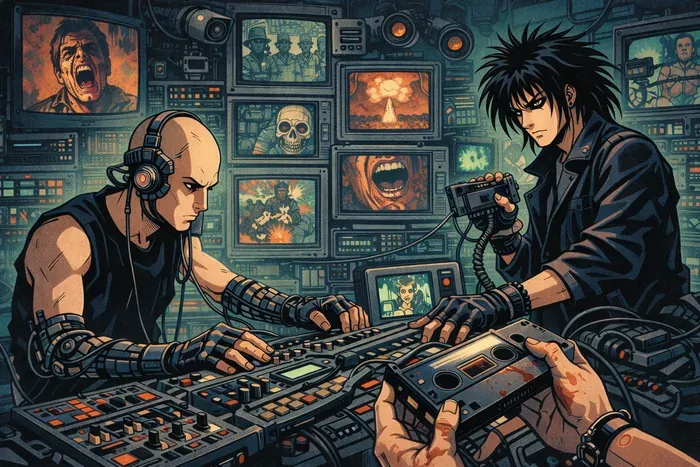
Sampling and Media Collage: Sound as Commentary
As electro-industrial developed during the late 1980s, advances in studio technology began changing the way musicians built recordings. Affordable samplers and digital editing tools allowed artists to capture fragments of sound and rearrange them in new contexts. Voices from films, television broadcasts, and radio transmissions could be inserted directly into a track. For many industrial musicians, these samples became an essential part of their sonic vocabulary.
Groups such as Skinny Puppy had already experimented with this technique by layering samples into dense electronic arrangements. Short fragments of dialogue or environmental sound could add emotional tension or narrative hints without relying on traditional lyrics. The use of sampling helped create a sense that the music was interacting with the surrounding media landscape.
One project that explored sampling in especially creative ways was Meat Beat Manifesto, founded by Jack Dangers. Originally formed in Britain during the mid-1980s, the project later became closely associated with electronic music scenes in the United States. Meat Beat Manifesto approached industrial sound from a perspective that blended sampling, electronic rhythm, and influences from emerging hip-hop production.
Their early recordings demonstrated how fragments of recorded media could form the backbone of a track. Instead of simply adding samples as decoration, the group often constructed entire rhythmic structures from manipulated recordings. Film dialogue, political speeches, and abstract sounds appeared throughout the music, creating a layered collage that felt both chaotic and carefully designed.
The album Storm the Studio, released in 1989, became one of the project’s most influential works. The record combined industrial electronics with breakbeat rhythms and heavy sampling techniques. Tracks moved through shifting patterns of percussion, bass sequences, and distorted sound fragments. The music maintained the darker atmosphere associated with industrial culture while opening the door to new rhythmic possibilities.
Meat Beat Manifesto also reflected the growing relationship between industrial music and wider electronic scenes. Breakbeat rhythms, which later became central to styles such as big beat and drum and bass, appeared alongside industrial textures. This fusion demonstrated that industrial sound could interact with multiple musical traditions while maintaining its distinctive character.
Sampling also reinforced the genre’s interest in media culture. Industrial musicians frequently used recorded fragments to comment on politics, technology, and mass communication. By rearranging these sounds inside new musical structures, they invited listeners to hear familiar voices in unfamiliar ways.
As electro-industrial continued evolving, the use of sampling became a defining characteristic of the genre. Complex sound collages, cinematic atmospheres, and rhythmic programming expanded the possibilities of electronic production.
At the same time, the United States was developing its own industrial-related networks. Those scenes did not look identical to the European model. They were more regionally fragmented and often connected to noise rock, performance art, underground clubs, and independent record culture. That wider American context helps explain why Chicago would matter so much once Wax Trax! emerged as a national hub.

Before the Breakthrough: Industrial Networks in the United States
Before industrial music broke through to wider American alternative audiences, it existed in the United States as a scattered set of local experiments rather than one unified scene. Some artists came from performance art, some from punk and no wave, and others from electronic underground culture. What joined them was a shared interest in noise, repetition, provocation, and the use of recording technology as a creative weapon rather than a neutral tool.
New York had already contributed important foundations through artists such as Suicide and the wider no wave environment. That world was not industrial in a narrow genre sense, but it normalized abrasion, machine pulse, and anti-commercial structure. San Francisco and other West Coast scenes added a different emphasis through performance-based artists, noise experimentation, and confrontational staging. Figures such as Monte Cazazza and Z’EV helped connect U.S. underground art practice to the harsher industrial sensibility that was also taking shape in Britain.
Elsewhere, American underground musicians were testing how industrial methods could merge with rock. Big Black used a drum machine with cutting, metallic guitar textures and a severely controlled sound palette. Swans pursued repetition, physical volume, and stark psychological force. These bands were not identical to British industrial pioneers, yet they helped create an American language of mechanized aggression that would later feed industrial rock and industrial metal.
The United States also provided a crucial infrastructure layer. College radio, independent record stores, tape trading, and small labels helped unusual records travel between cities. Long before industrial music had stable mainstream visibility, listeners could already encounter Cabaret Voltaire imports, no wave releases, experimental cassette work, and early EBM records within overlapping underground networks. Chicago would become the place where many of those currents finally locked together.
By the mid-1980s, the American side of industrial music was therefore ready for a catalyst. It had experimental artists, aggressive guitar-oriented bands, and curious club audiences, but it still lacked a single institution strong enough to connect them. Wax Trax! would fill that role by linking imported European electronics to American musicians who wanted something heavier, stranger, and more rhythmically forceful than either conventional rock or mainstream synth-pop.
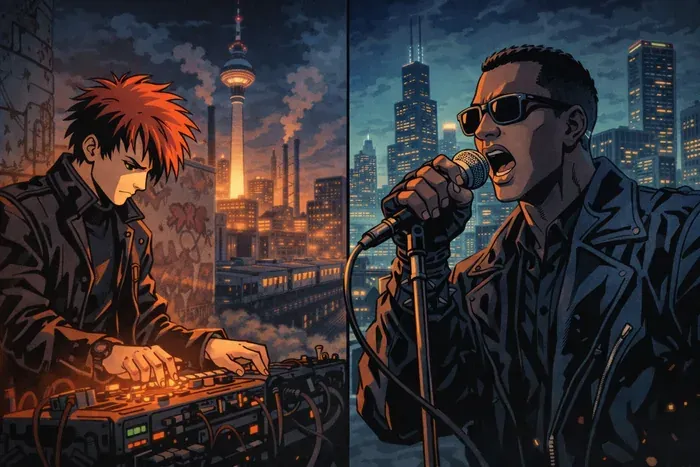
Four Cities, Four Industrial Functions: Sheffield, Berlin, Chicago, and Vancouver
One useful way to follow industrial history is to compare what different cities contributed. Sheffield helped define the electronic and post-punk side of the story. Cabaret Voltaire and related projects turned cheap equipment, tape manipulation, and the city’s industrial environment into a new sonic logic. Their work showed that urban decay, media saturation, and experimental electronics could coexist inside one musical language.
West Berlin supplied a more physical and architectural version of industrial sound. Einstürzende Neubauten treated scrap metal, construction debris, and improvised percussion as instruments, while the surrounding art scene encouraged collaboration across music, film, and visual practice. Berlin’s contribution was not only sonic harshness but also the idea that industrial performance could feel like a public intervention.
Chicago served a different function. It became a translator and amplifier. Through record shops, clubs, DJs, and Wax Trax! distribution, Chicago connected European electronic industrial styles to American underground rock and nightlife. The city helped turn a patchwork of scenes into a more legible transatlantic network. It also accelerated the move toward industrial rock by giving rhythm-heavy electronic music a stable home inside club culture and alternative record circulation.
Vancouver, in turn, became one of the key laboratories for electro-industrial. Skinny Puppy and Front Line Assembly pushed sampling, sequencing, and dark atmosphere into new territory. Their records sounded more studio-built, more cybernetic, and often more psychologically immersive than much of the earlier material. If Sheffield supplied electronic experimentation, Berlin supplied raw materiality, and Chicago supplied infrastructure, Vancouver supplied a refined electronic darkness that shaped the genre’s next phase.
These cities were not the whole story, but comparing them helps the larger history feel less abstract. Industrial music did not spread in a straight line from one origin point. It developed through local scenes that solved different problems, then influenced one another through records, touring, labels, and underground communication.
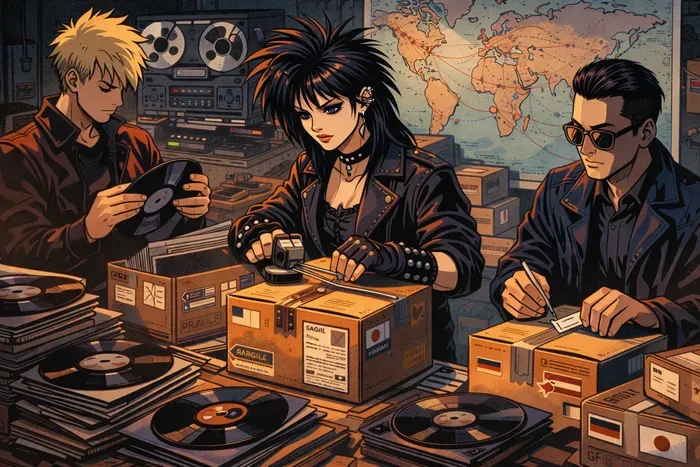
Labels and Distribution: How Industrial Crossed Borders
Industrial music spread through labels and distribution networks as much as through individual bands. Industrial Records gave the first wave not only a name but also a practical structure. It provided a way to release music, circulate printed material, and frame a loose experimental scene as something coherent. Later labels performed similar work for newer branches of the genre, each emphasizing different sounds and audiences.
In Britain, Mute Records became a bridge between experimental electronics, post-punk, and wider alternative circulation. In Belgium, Play It Again Sam helped move EBM and related continental electronic styles across borders, contributing to the broader European network from which PIAS later grew. In North America, Wax Trax! served as the best-known connector between imported European records and American underground musicians. In Canada, Nettwerk became part of the ecosystem that helped electro-industrial artists such as Skinny Puppy reach larger audiences without passing through conventional major-label routes.
Smaller labels mattered too. Antler-Subway in Belgium was associated with parts of the early EBM and industrial-adjacent scene, while many short-lived imprints handled cassettes, 12-inch singles, mail-order catalogs, and limited underground pressings. These businesses were often modest in scale, but they were culturally decisive. They decided which records crossed borders, which scenes heard one another, and which sounds were treated as related rather than isolated.
This networked history is easy to miss if industrial is told only through artists. Labels did more than finance releases. They created genre identity through catalog design, distribution deals, club promotion, and visual consistency. In that sense, industrial music grew not only from sonic experimentation but also from a parallel infrastructure of independent cultural organization.

Scene Infrastructure: How Industrial Actually Traveled
Before streaming, industrial music relied on subcultural infrastructure. Record stores, mail-order catalogs, fanzines, cassette exchange, college radio, specialist clubs, and touring circuits allowed scenes in different countries to recognize one another. These systems were often improvised and fragile, but they were essential to the genre’s growth.
Independent shops mattered because they functioned as social nodes as much as commercial spaces. Staff and customers traded recommendations, flyers, demo tapes, and imported records that were unavailable through mainstream retail channels. Fanzines and small press coverage translated scene knowledge into print, giving listeners a vocabulary for artists who were otherwise absent from commercial radio and music television. College radio and late-night specialty programs extended that reach, especially in the United States.
Clubs were just as important. They were testing grounds where DJs could mix EBM, electro-industrial, post-punk, synth-pop, noise, and later industrial rock into one physical environment. That hybrid listening practice shaped taste before genre categories fully stabilized. Touring also mattered, even when it happened on a small scale. Once bands crossed borders and played unconventional spaces, local scenes stopped feeling isolated and began to understand themselves as part of a wider movement.
Industrial’s history therefore depends on more than recordings. It depends on the routes, rooms, publications, and informal economies that allowed difficult music to circulate. Without that infrastructure, many of these scenes would have remained local curiosities. With it, industrial became an international underground culture.

Chicago: Wax Trax! and a New American Center
While electro-industrial artists in Canada were expanding the sonic depth of industrial electronics, another transformation was taking shape in the United States. In Chicago, a small independent record label began connecting several strands of the industrial underground. Through that network, European electronic acts, American experimental musicians, and club audiences gradually came together.
The label was Wax Trax! Records, founded by Jim Nash and Dannie Flesher. What began as a record shop in Chicago eventually grew into one of the key centers of the international industrial scene during the 1980s. Wax Trax! imported records from Europe and introduced American listeners to artists such as Front 242 and other electronic pioneers. The label also supported local musicians who were developing their own interpretations of industrial sound.
The Chicago scene soon became a meeting point for electronic rhythm, aggressive rock energy, and underground club culture. Through Wax Trax!, industrial music gained a stronger presence in North America. The label’s artists helped transform the genre, pushing it toward heavier guitars, sharper rhythms, and a broader audience.

Wax Trax! Records: The Label That Connected the Scenes
The story of Wax Trax! Records began with a small record shop. Jim Nash and Dannie Flesher first opened Wax Trax in Denver in 1975, sold that store in 1978, and then moved to Chicago to build a new hub for adventurous music. Their goal was simple: to create a place where fans could find unusual and hard-to-locate records from around the world.
At the time, much of the emerging industrial and electronic underground remained difficult to access in the United States. Records from European artists often circulated only through specialized import channels. The Wax Trax! shop began bringing these recordings into Chicago, allowing local musicians and fans to discover a wide range of experimental sounds.
Among the artists whose records appeared in the store were Cabaret Voltaire, Front 242, and other electronic groups associated with the growing industrial movement. These releases attracted a small but passionate community of listeners. The shop soon became a meeting point where DJs, musicians, and fans exchanged ideas and discovered new music.
The transition from record shop to record label happened gradually. Nash and Flesher realized that several local artists were creating music that deserved wider attention. Instead of waiting for larger companies to release these recordings, they decided to start producing records themselves. Wax Trax! Records was born from this decision.
The label quickly developed a reputation for supporting unconventional music. Its catalog included a mixture of electronic experimentation, industrial rhythm, and underground dance music. Many Wax Trax! releases shared a similar aesthetic: mechanical beats, aggressive electronic textures, and bold visual design.
The label also helped strengthen connections between American and European scenes. Bands from Belgium and the United Kingdom could reach listeners in North America through Wax Trax! distribution. American artists also found a platform that encouraged experimentation rather than commercial conformity.
A further factor in the label’s success was its close relationship with club culture. DJs in Chicago and other cities began playing Wax Trax! releases in underground venues, introducing the music to audiences who were eager for something new. The dance floor became a place where industrial electronics and alternative culture met.
Through this network of records, clubs, and personal connections, Wax Trax! transformed Chicago into a central hub for industrial music in the United States. Several artists who later became major figures in the genre released early material through the label. Among them was Ministry, the project that would help push industrial decisively toward a heavier guitar-based form.

Ministry: From Synth-Pop to Mechanical Aggression
Among the artists connected to the Wax Trax! scene, Ministry became one of the most influential forces in reshaping industrial music during the late 1980s. The project was led by Al Jourgensen, a musician who had already moved through several phases of experimentation before arriving at the aggressive industrial sound that would define his work.
Ministry’s earliest recordings during the early 1980s leaned toward synth-driven new wave. Jourgensen later expressed frustration with the direction of those early releases, feeling that they did not fully represent the heavier ideas he wanted to explore. By the middle of the decade, he began reshaping the project in a far more intense direction.
The turning point came with the album Twitch in 1986. Produced with the help of Adrian Sherwood, the record introduced darker electronic textures and heavy rhythmic programming. The music still relied on synthesizers and drum machines, yet the atmosphere had grown harsher and more experimental. Dub-inspired production techniques and layered effects created a sense of depth that separated the album from mainstream electronic releases.
Ministry continued pushing this direction further with The Land of Rape and Honey, released in 1988. This album marked a clear step in the evolution of industrial sound. Jourgensen combined electronic sequencing with distorted guitar riffs, creating a hybrid that felt both mechanical and aggressively physical. The music moved with the rigid precision of programmed rhythms while carrying the raw force of metal guitar.
Tracks such as “Stigmata” and “Deity” demonstrated how this combination could produce an entirely new sonic identity. Drum machines delivered relentless beats while guitars sliced through the electronic layers. Jourgensen’s vocals, often distorted or filtered through studio effects, added another level of intensity.
The production approach behind the album relied heavily on sampling technology and digital editing. Jourgensen and his collaborators used samplers to insert fragments of dialogue and sound effects into the arrangements. These elements created a collage-like structure that reflected the broader industrial tradition of manipulating recorded media.
Ministry’s transformation had a strong influence on the industrial scene. The fusion of electronic rhythm with heavy guitar opened a path that many later artists would follow. Industrial music no longer belonged only to electronic underground clubs or experimental art spaces. It had become something capable of competing with the energy of heavy rock.
The band also helped expand the visual identity of industrial music. Their album artwork and stage presentation reflected themes of political anger, technological anxiety, and social tension. Live performances grew louder and more aggressive, reinforcing the new direction of the music.
Through Ministry’s reinvention, industrial sound entered a new phase where machines and guitars shared equal importance. The Chicago scene continued supporting this transformation, and other artists connected to Wax Trax! soon developed their own interpretations of the genre.
A distinctive group to emerge from this network was KMFDM, a project that blended industrial electronics with rock structures while maintaining strong connections to European electronic traditions.
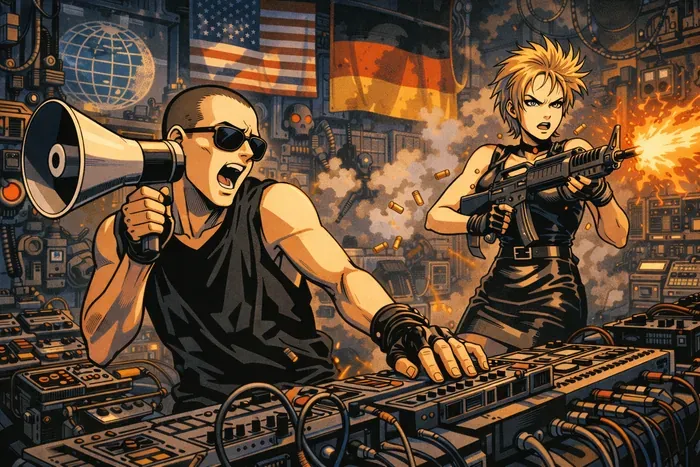
KMFDM: The Global Industrial Network
While Ministry helped push industrial music toward heavier guitar-driven territory, another project connected the Chicago scene with European electronic traditions. KMFDM, founded by Sascha Konietzko in Germany in 1984, became one of the better-known names in industrial rock during the late 1980s and early 1990s.
Konietzko originally formed KMFDM in Hamburg as an experimental performance project that combined electronic rhythm with conceptual art influences. Early recordings relied on drum machines, sequencers, and sampled sounds rather than traditional rock instrumentation. The project soon began attracting attention within the European underground.
KMFDM’s connection with Wax Trax! Records played a central role in the band’s development. Through the label, Konietzko established strong ties with the Chicago industrial scene. These collaborations allowed the group to reach audiences on both sides of the Atlantic. Chicago’s club culture provided an ideal environment for the band’s rhythm-heavy sound.
Musically, KMFDM developed a style that blended electronic programming with aggressive guitar work. Unlike some earlier industrial acts that avoided conventional song structures, KMFDM often embraced the format of rock tracks built around strong hooks and driving rhythm. This approach made their music accessible to listeners who were already familiar with alternative rock or metal.
Albums such as Naïve from 1990 and later releases introduced the band’s signature mixture of electronic sequences, heavy guitar riffs, and rhythmic vocal delivery. Konietzko’s production style emphasized sharp, mechanical beats combined with distorted textures. The music maintained the cold atmosphere of industrial electronics while incorporating the energy of rock performance.
Another notable element of KMFDM’s work was the group’s evolving lineup of collaborators. Over the years, the band featured contributions from numerous musicians and vocalists. This flexible structure allowed KMFDM to adapt its sound while maintaining a recognizable identity.
One of the most prominent voices to appear in later versions of the group was Lucia Cifarelli, whose forceful vocals added a new dimension to the band’s music. Her presence highlighted how industrial rock could combine aggressive sound with strong melodic performance.
KMFDM also developed a striking visual identity. Their album covers, designed in collaboration with artist Aidan Hughes, featured bold graphic imagery inspired by propaganda posters and comic book art. These visuals reinforced the band’s themes of rebellion, media critique, and industrial culture.
Through their transatlantic connections, KMFDM helped strengthen the global network surrounding industrial music. Their recordings circulated widely in underground clubs and alternative music scenes, bridging the gap between electronic industrial acts and guitar-oriented bands.
As the Chicago scene continued expanding, the club environment itself became an essential part of the genre’s development. Several Wax Trax! projects began focusing directly on the energy of nightlife and performance culture, turning industrial music into a soundtrack for underground dance floors across North America.
American Clubs: Industrial Becomes Danceable
By the late 1980s, the Chicago industrial scene had grown beyond a small circle of experimental musicians. Through Wax Trax! Records and a network of clubs and DJs, the music became part of a vibrant underground nightlife culture. Industrial tracks were no longer heard only on experimental albums or in art-oriented performances. They had become part of the dance floor.
Several artists associated with the Wax Trax! label helped define this new atmosphere. One of the most recognizable was Revolting Cocks, a project formed by Al Jourgensen, Luc Van Acker, and Richard 23 of Front 242. The group approached industrial music with a sense of irreverent energy. Their recordings combined electronic rhythms, distorted guitars, and provocative lyrics with a playful, sometimes chaotic tone.
Revolting Cocks’ music retained the mechanical drive of EBM but pushed it in a more aggressive and theatrical direction. Tracks often featured pounding drum machine beats, shouted vocals, and dense layers of electronic noise. In club settings, those songs carried a raw physical force that made them popular among industrial DJs.
Another project that captured the spirit of Chicago’s nightlife was My Life with the Thrill Kill Kult, founded by Groovie Mann and Buzz McCoy. Their music blended industrial rhythm with elements of disco, spoken-word samples, and cinematic atmosphere. The group’s recordings often referenced underground cinema, pulp imagery, and late-night urban culture.
Albums such as I See Good Spirits and I See Bad Spirits introduced a style that felt both dark and playful. Heavy electronic beats supported spoken fragments and dramatic synthesizer arrangements. The music created a sense of theatrical storytelling while remaining rooted in dancefloor rhythm.
The growth of these projects reflected the broader transformation of industrial music during this period. Club audiences were discovering that mechanical beats and electronic textures could produce a strong shared experience. DJs mixed tracks from Wax Trax! artists with EBM releases from Europe, creating a continuous flow of rhythm and atmosphere.
Chicago clubs such as Medusa’s and other underground venues became important gathering places for fans of industrial music. These spaces brought together diverse audiences that included electronic music listeners, punk fans, and alternative club communities. Industrial dance nights often blended multiple genres, including darkwave, synth-pop, and experimental electronics.
The visual culture surrounding these clubs also contributed to the identity of the scene. Dark clothing, military-inspired fashion, and industrial imagery became part of the aesthetic environment. The music and the visual atmosphere reinforced each other, creating a distinct subculture that extended beyond the recordings themselves.
As the 1990s approached, the combination of electronic rhythm, heavy guitar, and underground club energy began pushing industrial music toward a new form. Some artists started emphasizing guitars even more strongly, creating a hybrid that connected industrial electronics with the force of alternative rock and metal. The next stage of the genre would explore exactly that fusion.

Industrial Rock: Rebuilding the Guitar Around the Machine
By the end of the 1980s, industrial music had developed several distinct branches. Electronic Body Music filled underground clubs across Europe. Electro-industrial artists in Canada explored darker and more complex sound design. In Chicago, the Wax Trax! network connected these ideas to American alternative culture. A further direction began to emerge that would reshape the sound of the genre.
Some musicians began bringing guitars back into the industrial framework. Earlier industrial recordings had often focused on electronics, noise, and experimental structures. Now artists began combining programmed rhythms with the physical force of rock instruments. The result was a hybrid that felt mechanical yet aggressive.
That development did not appear suddenly. Several bands had already experimented with similar ideas during the early 1980s. Their recordings suggested that industrial electronics and guitar-driven music could coexist in convincing ways.
Among the earliest groups to build this bridge was Killing Joke, whose dark post-punk sound hinted at the direction that industrial rock would soon follow.

Killing Joke: A Bridge Between Post-Punk and Industrial Rock
Few bands connected post-punk intensity with industrial atmosphere as effectively as Killing Joke. Formed in London in 1978, the group consisted of vocalist Jaz Coleman, guitarist Geordie Walker, bassist Youth, and drummer Paul Ferguson. Their music combined the urgency of punk with a darker and more deliberate sonic approach.
From the beginning, Killing Joke focused heavily on rhythm and mood. Ferguson’s drumming often relied on steady, almost ritualistic patterns that created a hypnotic sense of motion. Over this foundation, Walker’s guitar produced sharp, metallic textures rather than traditional melodic lines. The instrument frequently sounded distorted and echoing, adding a sense of tension to the band’s sound.
Their self-titled debut album Killing Joke, released in 1980, introduced a musical style that many later industrial artists found inspiring. Tracks such as “Wardance” built their energy through repetition and layered rhythm. The music felt intense yet controlled, with each instrument contributing to the overall atmosphere.
The band’s lyrical themes reflected a darker worldview than most rock music of the time. Coleman often wrote about political conflict, social instability, and the threat of global crisis. These ideas matched the cold, mechanical tone present in the instrumentation.
During the early 1980s, Killing Joke continued refining this approach on albums such as Revelations and Fire Dances. Their music gradually incorporated subtle electronic elements and studio experimentation. Synthesizers and production effects appeared alongside the band’s heavy guitar sound, expanding the sonic palette.
One of the group’s most influential records arrived later in the decade with Night Time in 1985. The album blended atmospheric synthesizers with driving rock rhythms, demonstrating how electronic textures could enhance the emotional power of guitar-based music. Songs such as “Love Like Blood” showed that industrial-influenced sounds could reach broader audiences without losing their intensity.
Killing Joke’s influence spread quietly through underground scenes. Many musicians who later became involved in industrial rock cited the band’s rhythmic focus and dark atmosphere as important inspirations. The group’s ability to combine mechanical repetition with heavy guitar helped shape the sonic direction that industrial music would soon explore more fully.
Their recordings suggested that electronics and guitars did not need to compete. Instead, they could interact to create something new. This idea would soon be pushed even further by artists who embraced a slower, heavier, and more mechanical form of guitar music.
One of the clearest examples of that approach came from Britain through the project Godflesh, which transformed industrial rhythm into a crushing form of machine-driven metal.

Godflesh: Machine Metal from Birmingham
If Killing Joke hinted at the fusion of industrial rhythm and heavy guitars, Godflesh pushed that idea much further. Formed in Birmingham in 1988 by Justin Broadrick and G. C. Green, the band created a sound that felt slow, heavy, and mechanical at the same time. Their music drew from metal, industrial electronics, and the harsh atmosphere of the British post-industrial landscape.
Birmingham, like several cities associated with industrial music, carried a strong historical connection to heavy manufacturing. The environment shaped the mood of Godflesh’s recordings. Instead of fast guitar riffs or elaborate solos, the band focused on crushing repetition and dense sonic weight. Many tracks moved forward with deliberate, grinding rhythm.
A defining feature of Godflesh’s sound was its use of drum machines. Rather than working with a human drummer, the band programmed rigid electronic beats that delivered relentless precision. These rhythms created a cold mechanical pulse beneath the guitars. The combination produced a distinctive tension between human expression and machine discipline.
Their debut album Streetcleaner, released in 1989, became one of the most influential records in the development of industrial metal. The album’s production emphasized distortion, depth, and minimal arrangement. Guitar riffs repeated slowly, building pressure through sheer density rather than speed. Broadrick’s vocals often sounded distant or restrained, blending into the heavy sonic environment.
The atmosphere of Streetcleaner felt stark and oppressive. Layers of distortion and mechanical rhythm created a sense of urban desolation. Instead of traditional verse-and-chorus structures, many tracks relied on gradual shifts in texture and intensity. This approach reflected the industrial tradition of repetition and sonic experimentation while maintaining the power of metal instrumentation.
Godflesh continued refining this style on later albums such as Pure and Selfless. Over time the band introduced subtle electronic elements and ambient passages that expanded the emotional range of their music. Even when the sound softened briefly, the underlying mechanical pulse remained present.
The impact of Godflesh extended beyond the industrial scene. Their slow, crushing approach influenced several later metal subgenres, including industrial metal and certain forms of experimental heavy music. Bands exploring the intersection of electronics and extreme guitar sound often pointed to Godflesh as an early inspiration.
The band also demonstrated how industrial ideas could reshape metal itself. Drum machines replaced human timing, and repetition replaced virtuoso performance. The result felt both modern and unsettling.
While Godflesh emphasized weight and mechanical precision, other American artists were experimenting with a different form of aggressive, noise-driven rock that shared some of industrial music’s raw intensity. Two projects in particular, Big Black and Swans, explored this territory in ways that helped shape the evolving industrial rock landscape.
Big Black and Swans: Two Harsh American Approaches
While Godflesh explored a slow and crushing form of machine-driven metal, several American artists were developing another branch of aggressive industrial-influenced music. Their work blended punk intensity, noise experimentation, and mechanical rhythm. Two projects in particular, Big Black and Swans, helped shape this harsh sonic territory during the 1980s.
Big Black, founded in Chicago by Steve Albini, became known for its abrasive guitar sound and confrontational lyrics. The band’s music relied heavily on drum machines rather than a traditional drummer. Albini used a drum machine nicknamed “Roland” to produce rigid, relentless rhythms that felt cold and mechanical. This approach created a strong connection to the industrial aesthetic, even though the band operated mainly within the noise-rock underground.
Big Black’s recordings, especially the album Songs About Fucking, released in 1987, captured an atmosphere of urban tension and social unease. Albini’s guitar tone sounded sharp and metallic, cutting through the mechanical beats with intense distortion. The lyrics often addressed disturbing subjects such as violence, alienation, and psychological conflict. The combination of harsh sound and bleak storytelling made Big Black one of the most uncompromising bands of the decade.
Meanwhile in New York, Swans, led by Michael Gira, were exploring a different form of sonic extremity. Early Swans recordings emphasized slow repetition and overwhelming volume. The band built large rhythmic structures that could feel hypnotic and oppressive at the same time. Instead of fast punk energy, Swans favored deliberate pacing and powerful physical impact.
Albums such as Filth from 1983 demonstrated how repetition could create emotional intensity. Heavy bass lines, pounding drums, and distorted guitars combined into a dense wall of sound. Gira’s vocals often sounded stern and commanding, reinforcing the stark atmosphere of the music.
Although Swans did not belong directly to the industrial genre, their emphasis on rhythm, repetition, and sonic weight influenced several industrial musicians. The band’s early performances were known for their extreme volume and immersive atmosphere, qualities that resonated with artists exploring industrial noise and mechanical sound.
Both Big Black and Swans showed how drum machines, distortion, and repetitive structures could reshape aggressive rock music. Their recordings stood somewhere between punk, noise, and industrial experimentation. This hybrid territory helped prepare listeners for the next stage in industrial music’s development.
During the late 1980s, a number of European artists began exploring a more direct fusion of electronic rhythm and heavy guitar. One group in particular played a major role in connecting industrial electronics with metal structures. That project was Die Krupps, a German band whose evolving sound would soon influence the emerging industrial metal movement.

Die Krupps: Forging the Metal-Industrial Fusion
Among the European artists who helped push industrial music toward heavier territory, Die Krupps played a significant role. Formed in Düsseldorf in 1980 by Jürgen Engler and Ralf Dörper, the band began with a sound rooted in electronic experimentation and mechanical rhythm. Over time, however, Die Krupps developed a style that blended electronic programming with metal guitar in a way that anticipated the industrial metal explosion of the 1990s.
The group’s early recordings reflected the influence of the same electronic environment that had produced bands such as Kraftwerk and DAF. Their debut album Stahlwerksinfonie from 1981 was built around metallic percussion, synthesizers, and sampled industrial sounds. The record felt like a sonic portrait of factory machinery, with repetitive rhythms echoing the pulse of heavy industry.
During the second half of the decade, Die Krupps began evolving toward a heavier style. Engler, who had a strong interest in metal music, started integrating distorted guitar into the band’s electronic arrangements. This decision marked an important turning point. Instead of treating guitars as occasional additions, the band placed them alongside drum machines and sequencers as equal partners.
The shift became clearer on later recordings, where mechanical electronic rhythms supported aggressive guitar riffs. The fusion created a sound that felt both futuristic and physical. Tracks carried the precision of programmed beats while maintaining the raw energy associated with metal.
Die Krupps also collaborated with artists connected to the broader industrial network. One notable project involved a reinterpretation of songs by Metallica, which the band performed using electronic instrumentation. This experiment demonstrated how metal structures could be reshaped through industrial production techniques.
By combining synthesizers, drum machines, and guitar-driven arrangements, Die Krupps helped establish a template for later industrial metal bands. Their work suggested that electronic precision and heavy guitar power could reinforce each other rather than compete.
The band’s visual identity reinforced this connection to industrial culture. Stage imagery often featured metallic design elements and references to machinery, reflecting the same aesthetic that had inspired earlier industrial artists.
Die Krupps’ evolving sound bridged the gap between the experimental industrial underground and the more accessible structures of rock and metal. Their recordings influenced musicians who were beginning to imagine a heavier and more widely visible version of industrial music.
As the 1990s approached, this foundation was ready for a wider breakthrough. The combination of electronic rhythm and heavy guitar was about to reach a much larger audience, and Nine Inch Nails would become one of the clearest signs of that shift.

Industrial Metal: The 1990s Breakthrough
By the early 1990s, the foundations of industrial music had been built across several underground scenes. European artists had shaped Electronic Body Music, Canadian musicians had expanded electro-industrial sound design, and the Chicago network had fused electronics with aggressive rock energy. The stage was now set for a broader breakthrough.
During this period, industrial music entered a new cultural space. The fusion of programmed rhythm, distorted guitars, and dark electronic production began reaching audiences far beyond the underground clubs where the genre had grown. Alternative rock, metal, and electronic music were all evolving quickly, and industrial artists found themselves positioned between those worlds.
Several musicians played key roles in this shift. Some approached industrial music through emotional songwriting and studio experimentation, while others emphasized technical precision and futuristic themes. Together they pushed the genre into new territory where electronic programming and heavy guitar could coexist within forceful and accessible recordings.
Among the artists who defined this moment, one project stood at the center of the transformation: Nine Inch Nails, created by American musician Trent Reznor.

Nine Inch Nails: Industrial Production with Pop and Confession
Few artists reshaped the public perception of industrial music as dramatically as Nine Inch Nails. Founded by Trent Reznor in Cleveland during the late 1980s, the project blended electronic production with introspective songwriting and layered studio experimentation. Reznor approached industrial sound not only as a mechanical aesthetic but also as a tool for emotional expression.
The debut album Pretty Hate Machine, released in 1989, introduced this approach to a wider audience. The record combined synthesizer-driven arrangements with dark lyrical themes and melodic vocal lines. Tracks such as “Head Like a Hole” and “Terrible Lie” demonstrated how industrial rhythm could support structured songwriting while maintaining its aggressive character.
Reznor handled much of the recording process himself, programming drum machines, performing keyboards and guitars, and shaping the album’s production. His attention to detail helped create a polished yet intense sound that stood apart from earlier industrial recordings. Instead of focusing purely on noise or confrontation, Nine Inch Nails balanced harsh electronic textures with emotional vulnerability.
The project reached an even greater level of influence with the album The Downward Spiral, released in 1994. Recorded partly in a studio located in Los Angeles, the album explored themes of isolation, self-destruction, and psychological conflict. Reznor constructed the record as a narrative journey, using a wide range of sonic techniques to shape its atmosphere.
The production combined distorted guitars, sampled sounds, electronic percussion, and ambient passages. Songs often shifted between quiet moments and explosive intensity. Tracks such as “Closer” and “Hurt” showed how industrial elements could support both rhythmic power and emotional depth.
Nine Inch Nails also gained attention for intense live performances. Reznor assembled a band capable of translating the dense studio recordings into intense stage experiences. Concerts featured chaotic energy, dramatic lighting, and moments where instruments were pushed to their limits.
The project’s success brought industrial music into contact with a much broader audience. Alternative rock fans, electronic listeners, and metal audiences all encountered the genre through Nine Inch Nails. While earlier industrial artists had operated mainly within underground networks, Reznor’s work showed that the style could reach mainstream recognition without losing its dark atmosphere.
The growing visibility of industrial music encouraged other artists to explore similar territory. Some bands emphasized the fusion of electronics and metal even more strongly, creating a sound built around precision rhythm and futuristic themes.
One of the most influential groups to develop this direction during the 1990s was Fear Factory, whose combination of industrial programming and extreme metal would help define the next stage of the genre.

Ministry's Metal Era: Psalm 69 and Beyond
While Nine Inch Nails brought industrial music to a broader alternative audience, Ministry continued pushing the genre toward a heavier and more aggressive sound. Under the leadership of Al Jourgensen, the band had already begun blending electronic programming with distorted guitars during the late 1980s. In the early 1990s, this fusion reached its most explosive form.
The turning point came with the album Psalm 69: The Way to Succeed and the Way to Suck Eggs, released in 1992. The record combined industrial electronics with the speed and intensity of metal. Jourgensen and his collaborators used drum machines and sequencers to build precise rhythmic foundations, then layered thick guitar riffs and sampled fragments of film and television over the top.
Songs such as “N.W.O.” and “Just One Fix” demonstrated how effective this combination could be. The tracks moved with relentless energy, driven by mechanical beats and heavy guitar distortion. Jourgensen’s vocals, often filtered through studio effects, delivered lyrics filled with anger and political commentary.
The production techniques behind Psalm 69 reflected the growing influence of digital sampling and studio editing. Jourgensen and his team assembled tracks from numerous fragments of recorded material. Guitar layers, electronic loops, and sampled voices were combined through careful editing, creating a dense and highly controlled sonic environment.
Ministry’s visual identity also became more intense during this period. Album artwork and stage presentation frequently referenced political imagery, media manipulation, and themes of technological control. Live performances amplified the music’s aggression, with loud guitars and pounding rhythms dominating the stage.
The success of Psalm 69 placed Ministry at the center of the industrial metal movement. The album reached a wide audience within both alternative rock and heavy metal communities. For many listeners, it represented the moment when industrial sound fully merged with the force of metal.
The band’s influence quickly spread across the growing industrial rock scene. Several musicians began exploring similar combinations of electronic precision and heavy guitar power. The idea that drum machines and metal riffs could function together opened new creative possibilities.
Another group was developing a style that emphasized technological themes and mechanical precision even more strongly. Their music blended industrial programming with elements of extreme metal, creating a futuristic sound built around tight rhythmic control.
That approach would become the signature style of Fear Factory, a band that brought industrial rhythm into the world of modern metal with striking technical precision.

Fear Factory: Cybernetic Metal Precision
During the early 1990s, another band began pushing the fusion of industrial rhythm and metal toward a more technical and futuristic direction. Fear Factory, formed in Los Angeles in 1989, developed a sound that combined extreme metal precision with the mechanical discipline of industrial programming. Their music emphasized tight rhythmic control, creating a sonic environment that felt both aggressive and machine-like.
The group’s core lineup included vocalist Burton C. Bell, guitarist Dino Cazares, bassist Christian Olde Wolbers, and drummer Raymond Herrera. Together they developed a style that relied heavily on contrast. Brutal guitar riffs and double-kick drumming appeared alongside atmospheric synthesizers and programmed electronic sequences. The combination created a distinctive balance between human performance and digital structure.
Fear Factory’s breakthrough arrived with the album Demanufacture, released in 1995. The record explored themes related to artificial intelligence, technological domination, and the struggle between humanity and machines. These ideas appeared not only in the lyrics but also in the structure of the music itself.
The band used precise guitar patterns that matched the rhythm of the programmed electronic elements. This tight synchronization created a mechanical effect that felt different from traditional metal. Instead of loose groove or improvisation, the music moved with strict rhythmic alignment.
A further distinctive feature of Fear Factory’s sound was Burton C. Bell’s vocal approach. He alternated between harsh, aggressive passages and clean melodic singing. This contrast reinforced the album’s thematic focus on the tension between human emotion and technological control.
Producer Rhys Fulber, who had already worked with Front Line Assembly, contributed electronic programming and sound design to Demanufacture. His involvement strengthened the connection between the electro-industrial scene and the emerging industrial metal movement.
The album received strong attention within both metal and alternative music communities. Listeners who were familiar with industrial electronics recognized the influence of sequenced rhythms and sampled textures. Metal fans also responded to the technical guitar work and forceful drumming.
Fear Factory’s success showed how industrial ideas could evolve inside the framework of modern metal. The band’s emphasis on precision, technology, and futuristic imagery helped expand the genre’s thematic range.
Their work also inspired a wave of artists who explored similar combinations of electronics and heavy guitar. Industrial metal began appearing on larger stages and reaching audiences that extended far beyond the underground clubs where the movement had started.
While Fear Factory emphasized technological themes and mechanical precision, another artist would soon bring industrial aesthetics into mainstream rock culture through theatrical presentation and controversial imagery. That project was Marilyn Manson, whose recordings and performances sparked intense public debate during the late 1990s.
Marilyn Manson: Shock Aesthetics at the Edge of Industrial Rock
During the mid-1990s, industrial rock reached an even larger audience through the controversial rise of Marilyn Manson. The project, led by vocalist Brian Warner, operated at the commercial edge of industrial rock, combining industrial-style production with theatrical imagery, dark humor, and social provocation. While earlier industrial artists had explored confrontational themes within underground scenes, Marilyn Manson carried some of that confrontational energy into mainstream rock culture.
The band formed in Florida in the early 1990s and quickly attracted attention through a combination of aggressive music and dramatic stage presentation. Their early recordings already showed clear connections to industrial production techniques. Distorted electronic loops, heavy guitar riffs, and sampled fragments created a dense sonic environment.
A major turning point arrived with the album Antichrist Superstar, released in 1996. The record was produced in collaboration with Trent Reznor, whose work with Nine Inch Nails had already introduced industrial sound to wider audiences. The album combined harsh electronics, grinding guitar textures, and layered studio effects to create a dark and confrontational atmosphere.
Songs on Antichrist Superstar moved between heavy industrial metal passages and more atmospheric electronic sections. The production used distortion, filtering, and sampling to shape a sound that felt both mechanical and theatrical. The music reflected themes related to alienation, authority, and cultural rebellion.
Marilyn Manson’s stage performances amplified these ideas through elaborate visual presentation. Concerts featured costumes, dramatic lighting, and symbolic imagery that challenged conventional expectations of rock performance. The shows often provoked strong reactions from audiences and critics alike.
The band’s rise also coincided with a period of intense media attention surrounding youth culture and controversial music. Public debates about lyrics, imagery, and stage performance became common in news coverage. These discussions placed Marilyn Manson at the center of broader cultural arguments about artistic expression and social influence.
Despite the controversy, the project introduced industrial aesthetics to many listeners who had never encountered the earlier underground scene. The combination of electronic production and heavy guitar reached audiences across alternative rock and metal communities.
Marilyn Manson’s success demonstrated how industrial sound could operate within mainstream music while still retaining elements of its confrontational spirit. The project expanded the cultural visibility of industrial rock during the late 1990s.
That visibility also clarified a pattern that had been present since the beginning: industrial music repeatedly attracted media fear, moral suspicion, and public misunderstanding whenever it moved outside specialist underground circles. To understand the 1990s clearly, it helps to look at that pattern directly.
Industrial, Media, and Moral Panic: Why the Scene Drew Backlash
Industrial music has often been discussed as if provocation were its only purpose. That reading is too simple, but it helps explain why the genre has repeatedly triggered moral panic. From the COUM Transmissions era onward, industrial artists used difficult imagery, disturbing sound, and hostile performance tactics to expose how media, politics, sex, and power circulate in public culture. For sympathetic listeners, this felt analytical or artistic. For hostile observers, it often looked dangerous, obscene, or deliberately corrupting.
The pattern appeared early. COUM’s Prostitution exhibition and Throbbing Gristle’s public image generated outrage because they refused the usual boundaries between art, body politics, pornography, noise, and mass-media critique. Industrial artists often appropriated unpleasant symbols or institutional language not to endorse them, but to force audiences into uncomfortable acts of interpretation. That strategy created ambiguity, and ambiguity is often where panic begins.
As the music evolved, the same mechanism reappeared in new forms. Ministry’s political rage, sampled media fragments, and militarized visual language could be read either as critique or as threat by listeners who lacked the scene’s context. Nine Inch Nails drew industrial themes into a much larger commercial setting, where emotional extremity and violent sonic texture suddenly reached audiences far beyond underground culture. Marilyn Manson later amplified that dynamic by combining industrial-style production with a highly visible spectacle of controversy.
This history matters because media panic was never just a side effect. It shaped how the genre circulated. Outrage could close doors, but it also generated attention, myth, and a reputation for danger that drew some listeners closer. Industrial scenes learned to live inside that contradiction. They resisted easy respectability, yet they also understood that scandal could be absorbed into branding, journalism, and commercial identity.
The result is one of the genre’s defining tensions. Industrial music often tried to expose systems of manipulation, but it also moved through those systems and was sometimes packaged by them. That does not make every provocation empty, and it does not make every controversy meaningful. It does, however, explain why industrial music has so often been misheard as pure nihilism when much of it was actually wrestling with representation, power, and the machinery of public attention.
Another branch of industrial metal was developing in Europe at the same time. In Germany, musicians were creating a style that combined industrial rhythm with heavy guitars and distinctive German-language vocals. This movement soon became known as Neue Deutsche Härte, and one band would emerge as its most internationally recognized representative: Rammstein.

Neue Deutsche Härte: German-Language Industrial Metal as Spectacle
During the 1990s, Germany became a major center of a distinctive form of industrial metal that blended electronic rhythm, heavy guitar, and a strong visual identity. This movement later became known as Neue Deutsche Härte, often translated as “New German Hardness.” The style drew from several musical traditions that had already influenced industrial music, including EBM, heavy metal, and electronic experimentation.
Like many genre labels, Neue Deutsche Härte was not a perfectly fixed category from the start. It became a useful retrospective name for a cluster of German bands that shared certain traits, even though not every artist used the same balance of metal, electronics, and theatrical presentation.
Bands within this scene often used rigid electronic rhythms combined with distorted guitar riffs. Vocals were typically delivered in German, giving the music a powerful and recognizable character. The result was a sound that felt both mechanical and theatrical.
Neue Deutsche Härte also developed a strong visual dimension. Performances frequently included dramatic stage design, bold lighting, and elements inspired by industrial imagery. These visual components reinforced the music’s connection to themes of power, technology, and modern society.
Although several bands contributed to the development of the style, the movement quickly gained international attention through a group whose dramatic performances and recognizable sound carried industrial metal to audiences around the world: Rammstein.

Oomph!: Pioneers of Neue Deutsche Härte
Before Rammstein achieved international recognition, another German band had already begun shaping the sound that would later define Neue Deutsche Härte. Oomph!, formed in Wolfsburg in 1989 by Dero Goi, Andreas Crap, and Robert Flux, played a crucial role in establishing the early structure of the genre.
From the beginning, Oomph! combined heavy guitar with electronic programming. Their music reflected the influence of both industrial electronics and metal. Drum machines and synthesizers often provided the rhythmic backbone, while distorted guitars added a sharp and aggressive edge.
The band’s early recordings demonstrated how these elements could interact. Instead of treating electronic sounds as background textures, Oomph! integrated them directly into the structure of their songs. The result was a hybrid style that felt precise and mechanical while still delivering the power associated with rock and metal.
One of their important early tracks, “Der Neue Gott,” captured this combination well. The song featured driving guitar riffs supported by rigid electronic beats. Dero Goi’s vocal delivery emphasized rhythm and intensity, reinforcing the music’s industrial atmosphere.
Oomph! also helped establish another defining feature of Neue Deutsche Härte: the use of German-language lyrics. While many earlier industrial bands had worked primarily in English, Oomph! embraced their native language as a central element of their identity. The strong consonants and rhythmic phrasing of German contributed to the music’s forceful character.
The band’s visual presentation also reflected the evolving aesthetic of the scene. Album artwork and stage design often featured industrial imagery, metallic textures, and stark lighting. These elements reinforced the connection between the music and the broader visual culture of industrial art.
Although Oomph! achieved considerable success within European alternative scenes, their work also laid the groundwork for bands that would later reach an even wider audience. By blending electronic rhythm, heavy guitar, and strong visual identity, they helped define the blueprint for Neue Deutsche Härte.
As the 1990s progressed, another German band would build on this foundation and carry the style to a much larger international audience. With forceful stage performances, heavy guitar sound, and striking visual spectacle, Rammstein soon became one of the most visible representatives of industrial metal on the international stage.

Rammstein: Industrial Metal on the World Stage
If Oomph! helped establish the early structure of Neue Deutsche Härte, Rammstein brought the style to a global audience. Formed in Berlin in 1994, the band combined industrial rhythm, heavy guitar, and theatrical stage presentation in a way that captured international attention. The group’s lineup included vocalist Till Lindemann, guitarist Richard Z. Kruspe, guitarist Paul Landers, bassist Oliver Riedel, keyboardist Christian “Flake” Lorenz, and drummer Christoph Schneider.
Rammstein’s sound relied on a carefully balanced combination of elements. Heavy guitar riffs formed the core of many songs, while electronic sequences and synthesizer textures added depth. The rhythm section often moved with a deliberate, marching quality that reflected the influence of industrial music and EBM.
The band’s breakthrough arrived with the album Sehnsucht, released in 1997. The record featured several songs that soon became widely recognized within alternative and metal communities. Tracks such as “Du Hast” and “Engel” combined heavy guitar structures with electronic programming and dramatic vocal delivery. Lindemann’s deep, commanding voice gave the music a distinctive character that stood apart from most English-language industrial metal.
The band’s success expanded even further with the release of Mutter in 2001. This album introduced a slightly broader sonic palette, incorporating orchestral textures and more melodic structures while maintaining the band’s heavy industrial foundation. Songs such as “Sonne” and “Ich Will” demonstrated how Rammstein could balance heavy guitar sound with carefully arranged electronic production.
Beyond the recordings themselves, Rammstein became famous for their elaborate stage performances. Their concerts featured large-scale visual effects, particularly the dramatic use of fire and pyrotechnics. These theatrical elements reinforced the music’s intensity and helped create an unforgettable live experience. The visual spectacle quickly became a defining part of the band’s identity.
Rammstein’s success brought industrial metal to audiences far beyond the underground scenes where the genre had originally developed. The band achieved international chart success and performed on major stages around the world. For many listeners, Rammstein became the first introduction to the industrial metal sound.
Despite their global popularity, the group retained strong connections to the industrial tradition. Mechanical rhythms, electronic sequencing, and carefully controlled production remained central to their music. The band’s disciplined visual aesthetic also echoed earlier industrial artists who had explored themes of power, technology, and performance.
Through this combination of sound and spectacle, Rammstein demonstrated that industrial metal could function on the largest stages without losing its distinctive identity. Their success marked one of the most visible moments in the genre’s history.
By this point, the visual dimension of industrial performance had become increasingly important across the genre. Stage design, imagery, and symbolic presentation often played a role equal to the music itself. That broader visual culture deserves attention in its own right because it helps explain how industrial communicated meaning beyond sound alone.
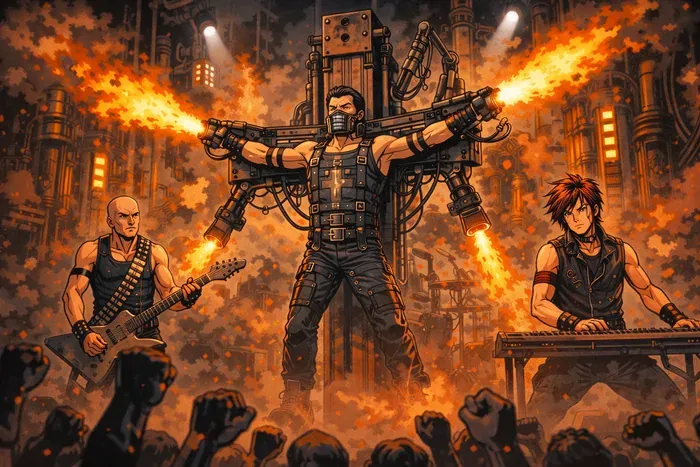
Industrial Spectacle: When Stagecraft Became Part of the Form
From the earliest days of industrial culture, visual presentation played a role almost as important as sound. Many industrial artists treated performance as a complete artistic experience in which music, imagery, stage design, and symbolism worked together. By the time industrial metal reached larger audiences during the 1990s, this visual tradition had become one of the genre’s defining characteristics.
Early industrial performers had already experimented with confrontational imagery and conceptual staging. Throbbing Gristle used projections, disturbing visuals, and unconventional lighting to create unsettling environments during concerts. These performances blurred the line between music and performance art, reflecting the group’s roots in experimental art collectives.
Later artists expanded this idea by building strong visual identities that matched their sound. Laibach, for example, used uniforms, banners, and carefully controlled stage presentation to explore themes of authority and ideology. Their performances often resembled theatrical events where symbolism carried as much weight as the music itself.
As industrial music moved closer to rock and metal audiences, stage production grew more elaborate. Lighting, video projection, and set design became important tools for shaping the atmosphere of live shows. Bands began using visual effects to emphasize the mechanical and dramatic qualities of their music.
Few groups demonstrated this approach more clearly than Rammstein. Their concerts became famous for large-scale pyrotechnic displays, complex stage structures, and carefully choreographed performances. Fire effects, moving platforms, and dramatic lighting created a visual spectacle that matched the forceful rhythm of the music. For many fans, the band’s concerts felt like immersive theatrical experiences rather than conventional rock shows.
Other artists across the industrial scene also explored visual storytelling through performance. Costumes, industrial-themed stage props, and stylized lighting frequently appeared in live events. These elements reinforced the genre’s fascination with technology, machinery, and modern power structures.
The emphasis on visual identity also extended to album artwork and graphic design. Industrial releases often featured bold typography, stark imagery, and references to mechanical environments. Designers used metallic textures, architectural forms, and abstract symbols to create a visual language that matched the music’s atmosphere.
Through these practices, industrial artists demonstrated that sound could interact with image to produce a unified artistic statement. Performance, design, and music became interconnected parts of the same creative expression.
This visual dimension helped industrial music maintain a clear cultural presence even as the genre evolved. The combination of striking imagery and powerful sound allowed artists to communicate ideas about technology, authority, and identity in ways that reached beyond traditional musical boundaries.
As the new century approached, industrial music continued to evolve through new technologies and artistic perspectives. The tools that artists used to create their recordings were also changing rapidly, opening new possibilities for sound design and production.
The Industrial Studio: Machines as Instruments
Industrial music has always been closely connected to technology. From the earliest tape experiments of avant-garde composers to the digital production techniques of modern studios, the genre has relied heavily on tools that allow sound to be reshaped and reimagined. For many industrial musicians, the studio itself became an instrument.
During the 1980s and 1990s, advances in electronic equipment changed how artists approached recording. Drum machines, samplers, and digital editing systems gave musicians the ability to build complex compositions from small fragments of sound. Instead of capturing a live band performance, producers could assemble tracks piece by piece, layering rhythm, noise, and voice into carefully designed sonic environments.
These tools encouraged experimentation. Industrial artists manipulated recordings, altered pitch and tempo, and combined unexpected sources of sound. The process often blurred the boundaries between composition, production, and performance.
Understanding the role of technology helps explain why industrial music developed such a distinctive sonic identity. The genre grew alongside the tools that shaped it.
Drum Machines: Programming the Body
One of the most recognizable elements of industrial music is its mechanical sense of rhythm. Unlike traditional rock bands that rely on human drummers, many industrial artists turned to drum machines to create their beats. These devices allowed musicians to program precise rhythmic patterns that could repeat with perfect consistency.
During the early 1980s, drum machines such as the Roland TR series became widely available. These instruments gave artists the ability to construct rhythmic structures directly inside the studio. Instead of recording a live performance, musicians could design rhythms step by step through electronic programming.
This technological shift had a profound effect on the sound of industrial music. Programmed rhythms often felt colder and more rigid than human drumming. The steady pulse of a drum machine created a sense of mechanical precision that matched the genre’s fascination with technology and industrial environments.
Artists across different branches of the industrial scene embraced this approach. Front 242 used drum machines to produce the tight, marching rhythms that defined Electronic Body Music. Their programmed beats formed the backbone of tracks that moved with disciplined energy on underground dance floors.
Other musicians used drum machines in heavier contexts. Ministry incorporated electronic rhythms alongside distorted guitars, creating a fusion of machine precision and rock aggression. In projects such as Godflesh, drum machines replaced traditional drummers entirely, producing relentless mechanical beats that reinforced the band’s heavy atmosphere.
The use of drum machines also changed the way musicians composed songs. Instead of building tracks around guitar riffs or melodic lines, artists often started with rhythmic programming. Once the core beat was established, additional layers of synthesizers, samples, and guitars could be added gradually.
This process gave industrial music its characteristic sense of structure. Repetition became a central creative tool. Rhythms could continue for long stretches while subtle changes in texture and arrangement created movement within the track.
Listeners often described this sound as “machine-like,” but the effect was not simply cold or mechanical. The contrast between programmed rhythm and human expression created a distinctive emotional tension. Vocals, guitar distortion, and sampled voices interacted with the steady electronic pulse, producing music that felt both controlled and intense.
As recording technology continued to evolve, new tools expanded these possibilities even further. Sampling devices allowed artists to capture fragments of sound from the outside world and integrate them directly into their compositions, opening the door to a new form of sonic collage within industrial music.
Samplers: Building Sound from Fragments
The introduction of affordable digital samplers during the 1980s transformed the creative possibilities of industrial music. These devices allowed musicians to record short fragments of sound and trigger them from a keyboard or sequencer. Instead of relying only on synthesizers or traditional instruments, artists could integrate voices, environmental recordings, and pieces of existing media directly into their compositions.
For industrial musicians, sampling offered an ideal tool. The genre had already developed a strong interest in manipulating recorded sound through tape loops and collage techniques. Samplers made this process faster and far more flexible. Artists could capture a sound, adjust its pitch or speed, and place it within a rhythmic structure almost instantly.
Several groups built entire musical identities around these techniques. Skinny Puppy became widely known for constructing dense layers of samples inside their recordings. Fragments of film dialogue, television broadcasts, and documentary material appeared throughout their music. These elements often carried emotional or political weight, adding narrative depth to the electronic arrangements.
Similarly, Front Line Assembly used sampling as part of its complex electronic production style. Short vocal snippets, atmospheric effects, and synthetic percussion sounds created a futuristic atmosphere that reinforced the band’s technological themes.
Another project that explored sampling in especially creative ways was Meat Beat Manifesto, led by Jack Dangers. Their album Storm the Studio demonstrated how industrial musicians could combine sampling with breakbeat rhythms and experimental electronic production. The record blended fragments of spoken word with layered percussion patterns, creating a dynamic and constantly shifting sound environment.
Sampling also encouraged musicians to interact directly with the surrounding media landscape. Industrial artists often selected fragments from news broadcasts, political speeches, or cinematic dialogue. By rearranging these sounds inside new musical contexts, they invited listeners to reconsider familiar voices and messages.
In many cases, samples served as more than decorative effects. They became structural elements that shaped the rhythm and atmosphere of a track. A short spoken phrase might repeat throughout a song, acting almost like a rhythmic instrument. Environmental sounds such as machinery or mechanical noise could reinforce the industrial aesthetic.
The creative possibilities of sampling expanded rapidly as digital technology improved. More advanced samplers allowed longer recordings, higher sound quality, and greater control over editing. Producers could layer dozens of sounds into a single arrangement, constructing complex sonic environments.
Through these techniques, industrial musicians turned recorded sound into a flexible building material. The studio became a place where fragments of culture could be reassembled into new artistic forms.
As digital technology continued evolving during the 1990s and early 2000s, computer-based production systems began replacing many of the hardware tools that earlier industrial artists had relied on. This shift would once again reshape the creative landscape of the genre.
Digital Production: Editing, Layering, and Control
During the 1990s and early 2000s, computer technology began transforming the way industrial music was produced. Earlier generations of artists had relied on hardware equipment such as drum machines, tape recorders, and standalone samplers. While those tools allowed remarkable experimentation, they also imposed technical limits. Editing sound required physical tape manipulation or careful hardware programming.
The introduction of digital audio workstations (DAWs) changed this process dramatically. Software-based recording systems allowed musicians to arrange, edit, and manipulate sound entirely inside a computer environment. Tracks could be built layer by layer with unprecedented precision.
For industrial musicians, this shift opened enormous creative possibilities. Complex arrangements involving dozens of sound layers became easier to manage. Producers could experiment freely with distortion, filtering, pitch manipulation, and time-stretching. Sounds that once required specialized hardware could now be shaped through software tools.
Artists associated with industrial rock and electronic industrial music quickly adopted these techniques. Trent Reznor of Nine Inch Nails became widely known for his meticulous studio work, combining digital editing with analog equipment to create dense and highly detailed recordings. His production style demonstrated how modern technology could expand the emotional and sonic range of industrial music.
Similarly, producers connected to electro-industrial projects such as Rhys Fulber, known for his work with Front Line Assembly, used digital systems to refine programming and sound design. Software tools allowed intricate layering of synthesizers, samples, and rhythmic sequences.
Digital production also made collaboration easier. Musicians could exchange project files, sound samples, and arrangements across long distances. This process helped industrial music evolve as an international network of artists rather than a set of isolated local scenes.
Another important effect of digital technology was the growing accessibility of production tools. Earlier industrial musicians often required expensive equipment or specialized studios. By the early 2000s, personal computers and affordable software allowed independent artists to create complex recordings from home studios.
This democratization of technology expanded the diversity of the industrial scene. New artists could experiment with sound design, sampling, and electronic rhythm without needing major label support. Independent releases and online distribution allowed these recordings to circulate widely.
Despite these technological changes, the core ideas of industrial music remained recognizable. Mechanical rhythm, manipulated sound fragments, and themes related to technology and society continued to shape the genre’s identity.
As industrial music entered the twenty-first century, these tools enabled artists to explore new directions. Some musicians began merging industrial aesthetics with other electronic genres, while others returned to experimental noise traditions.
Understanding these technological developments helps explain why industrial music has remained adaptable for several decades. The genre evolved alongside the tools used to create it, allowing each generation of artists to reinterpret the relationship between machines and human expression.
From here, the story shifts from tools to afterlives. The next sections show how industrial music continued to influence modern electronic and alternative scenes, and why its methods outlasted its brief period near the center of alternative culture.
Legacy: What Industrial Left Behind
Industrial music began as a confrontational experiment at the edges of the underground. In the mid-1970s, artists such as Throbbing Gristle and Cabaret Voltaire rejected traditional ideas about songwriting and performance. Their work treated sound as a material that could be shaped, manipulated, and combined with visual art, political commentary, and experimental technology. What started as a small network of artists eventually developed into a wide and complex musical culture.
Over the following decades, industrial music evolved through several major transformations. Electronic Body Music connected mechanical rhythm to club culture. Electro-industrial artists expanded the sonic possibilities of sampling and studio experimentation. Industrial metal brought heavy guitars into the genre and carried it far beyond the underground scenes where the movement had begun.
Today, industrial music continues to influence artists across many genres. Elements of its sound appear in electronic music, metal, experimental noise, and alternative rock. The movement’s legacy lies not only in specific sounds but also in its creative philosophy: the belief that music can question technology, culture, and power while constantly reinventing its own form.
Beyond Rock and Metal: Industrial as a Wider Method
Although industrial metal became the best-known endpoint for many listeners, industrial history does not stop there. Some of the genre’s most important long-term effects appeared outside rock and metal altogether. As recording tools changed and scenes crossed one another more freely, industrial methods moved into techno, dark ambient, noise, power electronics, aggrotech, and contemporary experimental production.
Part of that shift came from the studio itself. Once sampling, sequencing, and digital editing became easier to control, artists no longer needed a rock-band format to produce industrial intensity. A track could feel industrial because of its texture, repetition, distortion, and conceptual framing rather than because it contained guitars. That opened a path for producers who were more interested in machine rhythm, atmosphere, or sensory pressure than in verse-chorus songwriting.
Dark ambient and related experimental work carried forward another side of the tradition. Instead of emphasizing the body and the dance floor, these artists extended industrial music’s fascination with environment, dread, ritual, and abstract sonic space. Elsewhere, aggrotech and harder club-oriented styles intensified the EBM and electro-industrial inheritance, making the music faster, denser, and more aggressively synthetic for a new generation of dance audiences.
Industrial ideas also moved into contemporary experimental electronics, where artists use contact microphones, modular systems, software distortion, field recordings, and live processing in ways that echo the genre’s earliest principles. The tools are newer, but the underlying logic is familiar: sound can be broken apart, recoded, and turned into a commentary on modern life. In that sense, industrial remains less a closed genre than a durable method.
Seen from this angle, industrial metal is one major chapter, not the full ending. The genre’s broader legacy lies in how it taught later musicians to think with machines, not just to imitate machine sounds. That lesson continues to shape electronic music well beyond the borders of rock.
Industrial's Echo in Modern Electronic Music
As the twentieth century drew to a close, industrial music began interacting more closely with other forms of electronic dance music. Genres such as techno, darkwave, and experimental electronic production adopted elements that had long been central to industrial culture. Mechanical rhythm, heavy distortion, and atmospheric sound design began appearing across a wide range of club-oriented styles.
One important point of connection came through the relationship between industrial and techno scenes. In cities such as Berlin, electronic producers developed techno styles that shared the same fascination with repetitive rhythm and machine-driven sound. Although techno followed its own cultural path, the emphasis on mechanical pulse and electronic production echoed ideas that industrial artists had explored for years.
Industrial influence also appeared in darker forms of electronic music often grouped under the label dark electro. Artists working within this style drew heavily from the sonic language of EBM and electro-industrial. Rigid electronic beats, distorted synthesizer bass lines, and processed vocals remained central features of these recordings.
Bands such as VNV Nation and Covenant helped carry these ideas into the late 1990s and early 2000s. Their music combined structured electronic rhythm with melodic synthesizer arrangements, creating a sound that connected industrial heritage with contemporary electronic production.
Other musicians explored more experimental directions as well. The influence of early industrial artists such as Throbbing Gristle and Coil continued to shape the world of dark ambient and experimental sound art. These artists often focused on atmosphere and texture rather than traditional rhythm.
Digital distribution also changed the way industrial-influenced electronic music reached audiences. Online platforms allowed independent producers to release recordings without relying on traditional record labels. As a result, new artists from many different countries began contributing to the broader industrial electronic landscape.
Despite the variety of styles that emerged, several core elements remained recognizable. Mechanical rhythm, dark atmospheric design, and a fascination with technological themes continued to define industrial-influenced electronic music.
These developments demonstrated how industrial ideas could adapt to changing musical environments. The genre’s influence extended beyond specific bands and scenes, shaping the production techniques and aesthetic choices of electronic musicians around the world.
Industrial music also continued to interact with the world of heavy guitar-based music. Several metal and alternative rock artists incorporated industrial textures and electronic programming into their work, ensuring that the connection between machines and guitars remained an important part of the genre’s legacy.

Industrial's Mark on Modern Metal and Alternative
Even after industrial metal reached its peak visibility during the 1990s, the genre’s influence continued shaping heavy music in subtle but meaningful ways. Many metal and alternative rock artists adopted production techniques, rhythmic structures, and sonic textures that had originally developed inside industrial scenes.
One clear example can be heard in the work of Static-X, a band formed in Los Angeles during the late 1990s by vocalist and guitarist Wayne Static. Their music blended aggressive metal riffs with tightly programmed electronic rhythms. The band described their sound as “evil disco,” a phrase that reflected the mixture of heavy guitar and mechanical groove. Albums such as Wisconsin Death Trip demonstrated how industrial production techniques could support the energy of modern metal.
Another project that explored a similar hybrid was Rammstein, whose international success helped maintain industrial metal’s visibility into the 2000s. Although their core style remained rooted in Neue Deutsche Härte, the band’s heavy guitar sound and precise electronic sequencing influenced numerous artists across Europe and North America.
Industrial elements also appeared in the work of bands associated with alternative metal and nu metal. Groups such as Fear Factory continued blending electronic programming with extreme metal techniques, while other artists incorporated sampled textures, digital editing, and mechanical rhythm into their recordings.
Beyond specific bands, industrial production methods became increasingly common within modern rock and metal studios. Digital editing, triggered percussion, and electronic layering allowed producers to create highly controlled rhythmic structures. These techniques echoed the earlier industrial emphasis on machine precision.
The influence of industrial music also extended into visual aesthetics and stage design. Many contemporary metal performances feature large-scale lighting systems, video projection, and dramatic visual environments. This approach reflects the tradition established by industrial artists who treated performance as a combination of sound and spectacle.
Some musicians also returned to the darker experimental roots of industrial sound. Artists working within noise, dark ambient, and experimental electronic music continued exploring the themes of technology and alienation that had shaped the earliest industrial recordings.
These developments show how industrial music left a lasting imprint on the broader landscape of heavy and alternative music. Even when artists do not explicitly identify with the genre, the techniques and ideas developed by industrial pioneers remain present in modern production and performance.
The continuing presence of these elements suggests that industrial music was never just a temporary trend. Instead, it introduced new ways of thinking about rhythm, technology, and sonic intensity.
As new generations of musicians experiment with electronic tools and digital environments, the spirit of industrial experimentation continues evolving in unexpected directions.

After the 1990s Peak: Decline, Fragmentation, and Persistence
By the end of the 1990s, industrial was no longer one of the central narratives in alternative music. Part of the reason was success itself. Once industrial rock and industrial metal had entered mainstream and near-mainstream circulation, some of their techniques were absorbed into broader alternative, metal, and electronic production. The genre no longer sounded as singular or shocking as it had during earlier decades.
The scene also fragmented. Some artists moved further into metal, some into dark electronic club music, some into techno and experimental sound art, and others into hybrid forms that only partly identified with industrial at all. This fragmentation did not mean disappearance. It meant specialization. Industrial stopped functioning as one shared alternative trend and increasingly survived through sub-scenes, festivals, niche labels, online communities, and crossover audiences.
Changes in media and music industry structure also mattered. As the early 2000s reshaped distribution, the older infrastructure of print magazines, specialty retail, and physical club networks lost some of its centrality. Yet digital tools also made survival easier for committed scenes. Independent artists could now release music globally, maintain contact with listeners, and build durable niche communities without needing broad commercial visibility.
This is why industrial persisted even after its commercial peak faded. The style was never only a trend. It was a set of production methods, performance strategies, and cultural questions that could keep mutating. What declined was its temporary position near the center of alternative culture. What remained was the deeper industrial habit of thinking through machines, systems, control, and sonic pressure.

Why Industrial Still Matters
More than four decades after its earliest recordings, industrial music remains difficult to define through a single style or sound. From the confrontational noise experiments of Throbbing Gristle to the large-scale stage productions of Rammstein, the genre has kept changing. Yet certain underlying ideas have remained consistent.
At its core, industrial music explores the relationship between humans, machines, and modern society. Early artists used noise, tape manipulation, and provocative imagery to question the structures of power and media that surrounded them. Later musicians translated those ideas into electronic rhythm, heavy guitar, and complex studio production.
One reason for the genre’s longevity is its openness to technological change. Each generation of industrial artists has embraced new tools, from analog synthesizers and drum machines to digital audio workstations and computer-based production. Rather than resisting technology, industrial musicians often treat it as both subject and instrument.
The genre has also maintained a strong connection to visual culture. Album artwork, stage design, and performance art remain central parts of the industrial tradition. Whether through the stark symbolism of Laibach or the theatrical spectacle of Rammstein, visual elements continue shaping how audiences experience the music.
Industrial music’s influence can now be heard across a wide range of musical environments. Electronic producers borrow its mechanical rhythms and dark atmospheres. Metal bands incorporate industrial production techniques. Experimental artists continue exploring noise and sound collage in ways that echo the movement’s earliest experiments.
Equally important is the cultural attitude that industrial music represents. Many of its artists have approached music as a form of inquiry rather than simple entertainment. Through sound, imagery, and performance, they have explored questions about control, technology, identity, and the psychological effects of modern life.
Because of this openness to experimentation, industrial music rarely stands still. New artists continue reinterpreting the genre’s ideas in ways that reflect their own moment and technological environment.
What began in small art spaces and underground clubs has become a lasting part of modern music history. The industrial movement demonstrated that machines, noise, and unconventional sound could become durable creative tools.
As long as musicians remain curious about the relationship between technology and human expression, the spirit of industrial music will continue evolving into new forms.

Listening Path: 50 Essential Industrial Tracks
Industrial music did not appear overnight. Its roots stretch back to the late 1970s, when post-punk bands began pushing rock music toward darker atmospheres, mechanical rhythms, and experimental production. From those early experiments, a new sonic language slowly emerged.
This curated playlist of 50 essential songs follows that evolution step by step. It traces how the cold minimalism of post-punk gradually transformed into the confrontational noise experiments of early industrial pioneers. It then moves through the rise of Electronic Body Music in European clubs, the complex sampling culture of electro-industrial, and finally the explosive fusion of machines and metal guitars that defined the 1990s.
Not every selection here is industrial in the narrowest possible genre sense. A few are included because they are bridge records that make the larger historical arc easier to hear. Taken together, the sequence shows how a shared vocabulary of repetition, machine rhythm, distortion, and studio manipulation moved from fringe experiments into broader rock and electronic culture.
Along the way, the playlist highlights key innovators who shaped the movement. Throbbing Gristle and Cabaret Voltaire turned sound into confrontational art. Einstürzende Neubauten transformed scrap metal into instruments. Front 242 and Nitzer Ebb built a new mechanical dancefloor language. Skinny Puppy and Front Line Assembly expanded the possibilities of sampling and sound design.
By the late 1980s and early 1990s, industrial music collided with alternative rock and heavy metal. Artists like Ministry, Nine Inch Nails, and Godflesh fused electronic precision with guitar power, creating the industrial metal sound that would influence generations of musicians.
The journey continues into the modern era, where artists such as Youth Code, HEALTH, and Author & Punisher reinterpret industrial aesthetics through contemporary electronics and digital production.
Taken together, the playlist works as a sonic timeline of how machines entered modern music.
I. Post-Punk: From Experiment to Tension
- Joy Division – Transmission (1979)
- Siouxsie and the Banshees – Spellbound (1981)
- Bauhaus – Bela Lugosi’s Dead (1979)
- Killing Joke – Wardance (1980)
- The Cure – A Forest (1980)
- Gang of Four – At Home He’s a Tourist (1979)
- Wire – Outdoor Miner (1978)
II. Early Industrial: Art, Noise, and Confrontation
- Throbbing Gristle – Hamburger Lady (1978)
- Cabaret Voltaire – Nag Nag Nag (1979)
- SPK – Metal Dance (1982)
- Throbbing Gristle – Discipline (1981)
- Cabaret Voltaire – Sensoria (1984)
- Einstürzende Neubauten – Yu-Gung (Fütter Mein Ego) (1985)
- Test Dept – Total State Machine (1984)
- Laibach – Geburt Einer Nation (1985)
III. EBM: Discipline for the Dance Floor
- DAF – Der Mussolini (1981)
- Front 242 – Headhunter (1988)
- Nitzer Ebb – Join in the Chant (1987)
- Die Krupps – Machineries of Joy (1989)
- Liaisons Dangereuses – Los Niños del Parque (1981)
- A Split-Second – Flesh (1986)
- Severed Heads – Dead Eyes Opened (1985)
IV. Electro-Industrial: Samples, Atmosphere, and Control
- Skinny Puppy – Assimilate (1985)
- Front Line Assembly – Mindphaser (1992)
- Coil – The First Five Minutes After Death (1984)
- Meat Beat Manifesto – Helter Skelter (1989)
- :wumpscut: – Soylent Green (1993)
- KMFDM – Godlike (1990)
- My Life with the Thrill Kill Kult – After the Flesh (1994)
V. Industrial Rock: Guitars Rewired
- Ministry – Stigmata (1988)
- Nine Inch Nails – Head Like a Hole (1989)
- Big Black – Kerosene (1987)
- Swans – A Screw (Holy Money) (1986)
- Pigface – Suck (1991)
VI. Industrial Metal: The 1990s Breakthrough
- Godflesh – Like Rats (1989)
- Fear Factory – Replica (1995)
- Marilyn Manson – The Beautiful People (1996)
- Static-X – Push It (1999)
- Rammstein – Du Hast (1997)
VII. Beyond Metal: Industrial After the Peak
- Oomph! – Augen Auf! (2004)
- Combichrist – This Shit Will Fuck You Up (2003)
- VNV Nation – Darkangel (1999)
- Covenant – Call the Ships to Port (2002)
- Author & Punisher – Nihil Strength (2012)
- Youth Code – Commitment to Complications (2014)
- HEALTH – Stonefist (2015)
- 3TEETH – Pumped Up Kicks (2016)
- Perturbator – Future Club (2014)
- Zola Jesus – Dangerous Days (2014)
- Chelsea Wolfe – Feral Love (2013)
Why This History Still Matters
This selection shows how industrial music evolved through several distinct stages:
- The dark minimalism of post-punk that laid the emotional groundwork
- The experimental art-driven noise of early industrial pioneers
- The rise of Electronic Body Music in European club culture
- The complex sound design of electro-industrial
- The explosive fusion of electronic rhythm and heavy guitars
- The ongoing reinvention of industrial sound in modern electronic and metal scenes
Industrial music has always reflected the world around it: factories, machines, media systems, and technological change. The artists in this playlist did not just adopt those influences. They transformed them into a new musical language.
Listen in order and you will hear how rhythm becomes mechanical, how noise becomes structure, and how guitars eventually collide with machines.
That continuum is still unfolding.