Alternative and indie are closely related terms, but they did not begin as exact synonyms. In the late 1970s and 1980s, “alternative” usually described music outside the dominant rock and pop market. “Indie” first referred more directly to independent labels, distribution, and scene infrastructure before it also became a style label.
This article follows both meanings together because the same clubs, labels, zines, radio shows, and later digital platforms connect the story from punk to the streaming era. The sounds change sharply from decade to decade, but the central question stays recognizable: how do musicians make space for new ideas outside the center of the industry?
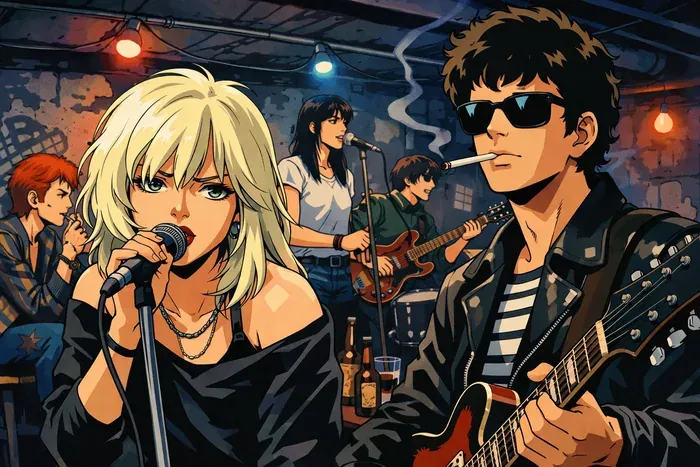
New York Before Punk: The Underground Takes Shape
Punk did not begin as a polished movement with a clear manifesto. It grew in small clubs, cheap rehearsal rooms, and cities marked by economic strain and cultural fatigue. In the mid-1970s, both New York and London were carrying that pressure. Arena rock had grown grand and distant. Progressive albums had become longer and more technical. For many young musicians and listeners, rock no longer felt like something they could touch.
Punk brought it back to ground level. Short songs, direct language, and a refusal to wait for permission gave the music its charge. Bands like the Ramones in New York stripped rock down to speed and hooks. Patti Smith fused poetry with garage intensity, placing a woman at the center of a scene that was often described as aggressive and male. In London, the Sex Pistols turned provocation into headline news, while The Clash connected anger to politics and everyday life.
From the start, punk was more than sound. It was a way of organizing space, sharing ideas, and claiming visibility. That foundation would shape everything that followed.
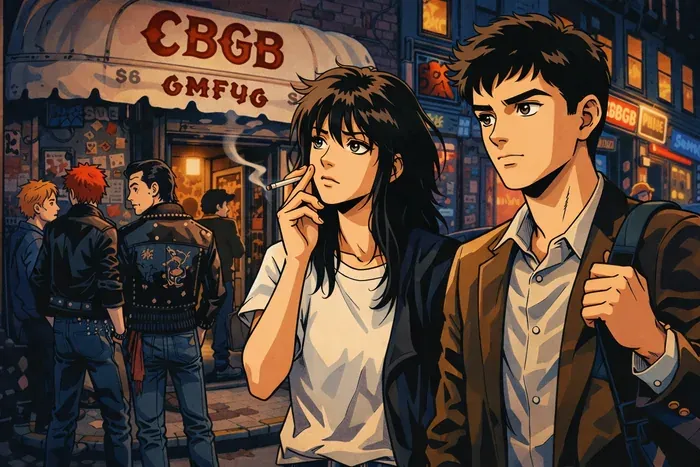
CBGB and the Downtown Network Around It
Before punk became a global headline, its earliest momentum lived in a handful of small rooms in downtown New York. During the early 1970s, the city was facing financial crisis, rising crime, and a general sense that many neighborhoods had been left to decay. Yet within that uncertainty, a creative pocket formed in lower Manhattan. Cheap rent allowed artists, musicians, and writers to gather in the same blocks. Galleries, rehearsal spaces, and clubs blended into one loose community.
One of the most important places was CBGB, a narrow club on the Bowery run by Hilly Kristal. Its name reflected Kristal’s original plan for country, bluegrass, and blues, with room for what he later called “other music” as well. In practice, the venue became home to a group of bands who were all searching for a simpler, more immediate form of rock music. These musicians did not necessarily sound the same, but they shared a desire to start fresh.
Patti Smith stood at the center of this early scene. Her 1975 album Horses, produced by John Cale, merged spoken word poetry with raw guitar energy. Smith drew on literature, beat writing, and rock history at the same time. Songs such as “Gloria” and “Land” felt both intellectual and visceral. She showed that punk did not have to abandon artistic ambition. A woman could lead the stage with authority and imagination.
Around the same time, the Ramones took a different approach. Their self-titled debut album, released in April 1976, reduced rock to its basic ingredients: fast tempos, short songs, and simple chord progressions. Tracks like “Blitzkrieg Bop” (released as a single in February 1976) and “Judy Is a Punk” rarely lasted more than two minutes. Yet the impact was enormous. The band proved that you did not need technical virtuosity or expensive studio time to create something powerful.
Television added another layer to the emerging sound. Their album Marquee Moon in 1977 stretched the possibilities of guitar interplay. Tom Verlaine and Richard Lloyd built long, intricate passages that carried echoes of jazz and art rock. The title track alone ran over ten minutes, an unusual length for music associated with punk. Yet the record still felt urgent and alive, rooted in the same downtown environment as the Ramones.
Other groups, including Blondie and Talking Heads, were also part of the CBGB orbit. Blondie brought pop melodies and a sharp sense of style through the voice of Debbie Harry. Talking Heads introduced nervous rhythms and art-school curiosity. Together these artists formed a scene that was less about a single sound and more about a shared spirit of experimentation.
Word of the New York scene traveled slowly at first. British journalists and musicians who visited the city carried the stories home. Within a short time, that spark would ignite a far louder explosion across the Atlantic.
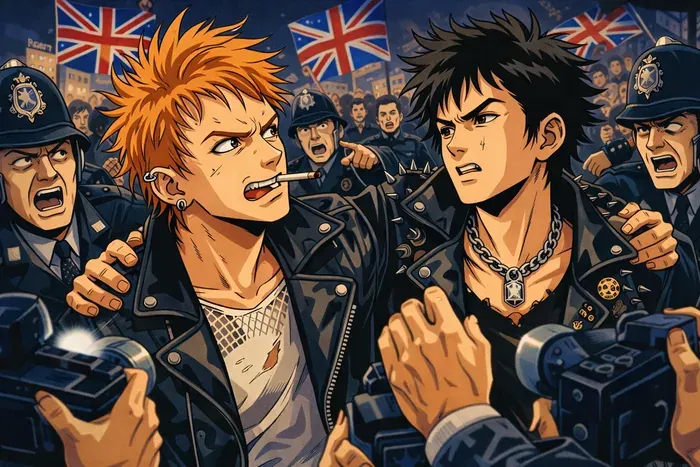
Britain Turns Punk Into a Public Scandal
When that energy reached Britain, the atmosphere was different from New York. The United Kingdom in the mid-1970s faced rising unemployment, strikes, and a growing sense that the country had lost its direction. Many young people felt cut off from opportunity. Music had already begun to reflect this tension, but punk gave it a sharper voice.
The band that drew the most attention was the Sex Pistols. Managed by Malcolm McLaren, the group built its identity around confrontation and spectacle. Their 1977 album Never Mind the Bollocks, Here’s the Sex Pistols delivered songs that were loud, direct, and deliberately provocative. Tracks like “Anarchy in the U.K.” and “God Save the Queen” became lightning rods for controversy. Television appearances led to public outrage. Newspapers condemned the band, while record stores debated whether to stock their music. The reaction only intensified the sense that punk had arrived as a cultural disruption.
Yet the Pistols were only one part of the story. The Clash offered a broader political voice and a wider musical range. Their 1977 debut album The Clash carried the urgency of punk but also drew on reggae, rockabilly, and rhythm and blues. Joe Strummer and Mick Jones wrote about unemployment, police tension, and urban frustration. Songs such as “White Riot” and “Career Opportunities” connected the energy of punk to everyday social realities.
Another important voice came from Buzzcocks in Manchester. Their album Another Music in a Different Kitchen from 1978 showed that punk could be emotionally direct without relying on provocation. Pete Shelley’s songwriting focused on confusion, longing, and relationships. The single “Ever Fallen in Love (With Someone You Shouldn’t’ve)” became one of the most memorable songs of the era. It revealed a softer side of punk, one that would echo through later alternative and indie music.
The British press played a powerful role in amplifying the movement. Music magazines, television shows, and tabloids all contributed to the sense that punk was a social flashpoint. Journalists debated whether the movement represented genuine youth anger or simply a new form of entertainment. For the bands involved, the attention was both a gift and a burden. Visibility brought larger audiences, yet it also invited constant scrutiny.
By the end of the decade, punk in Britain had already begun to shift. Some bands dissolved under pressure, while others looked for new directions. Out of that search would grow a more experimental phase of music that critics later called post-punk.
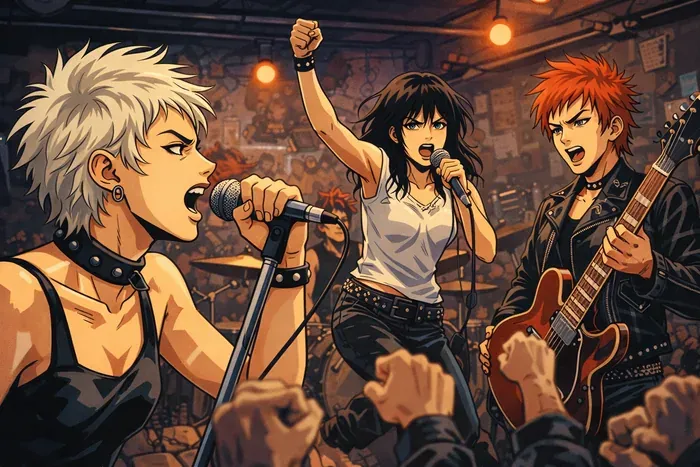
Women at Punk's Core: Rewriting Rock's Gender Norms
The story of punk also looks different when viewed through the women who shaped it. From the beginning, they stood on stage, wrote songs, ran fanzines, and shaped the visual language of the movement. The difference was visibility. Rock history had often framed women as exceptions or novelties. Punk disrupted that pattern by opening the door to artists who did not fit the traditional image of a rock star.
One of the most striking figures was Siouxsie Sioux. As the singer of Siouxsie and the Banshees, she built a presence that felt theatrical, controlled, and unmistakably strong. The band’s debut album The Scream from 1978 pushed beyond simple punk structures. Sharp guitar lines, dark atmospheres, and Siouxsie’s commanding voice created something both intense and mysterious. Songs like “Hong Kong Garden” showed that punk could expand without losing its urgency. Her style and confidence influenced a generation of musicians who saw that authority on stage did not have to follow established gender roles.
Poly Styrene from X-Ray Spex offered another perspective. Her voice was raw, playful, and often confrontational. The album Germfree Adolescents from 1978 tackled consumer culture, identity, and alienation with unusual clarity. The title track mocked the artificial promises of advertising. “Oh Bondage Up Yours!” opened with a line that became legendary among punk audiences. Poly Styrene’s lyrics challenged the idea that punk anger had to come from a narrow social position. She brought humor, critique, and intelligence to a scene that could easily drift toward macho posturing.
The Slits approached punk from yet another angle. Formed by young musicians including Ari Up, the band refused to imitate the sound or behavior of their male peers. Their 1979 album Cut mixed punk with reggae rhythms and loose, exploratory structures. The music felt spontaneous and unpolished in the best sense. The group’s image also challenged expectations. Instead of presenting themselves according to rock’s established visual codes, they embraced a playful, rebellious identity that blurred boundaries between performance and personal expression.
Around these artists grew a network of women who contributed in different ways. Debbie Harry of Blondie moved easily between punk clubs and pop charts. Writers and photographers documented the scene from inside. Fanzines carried voices that mainstream publications rarely included.
These musicians did more than prove that women could participate in punk. They reshaped what participation looked like. Their work expanded the emotional and cultural space of the movement, making it less predictable and far more interesting. They also helped make later feminist and queer currents in alternative music easier to imagine.
DIY Infrastructure: Zines, Labels, and Small Venues
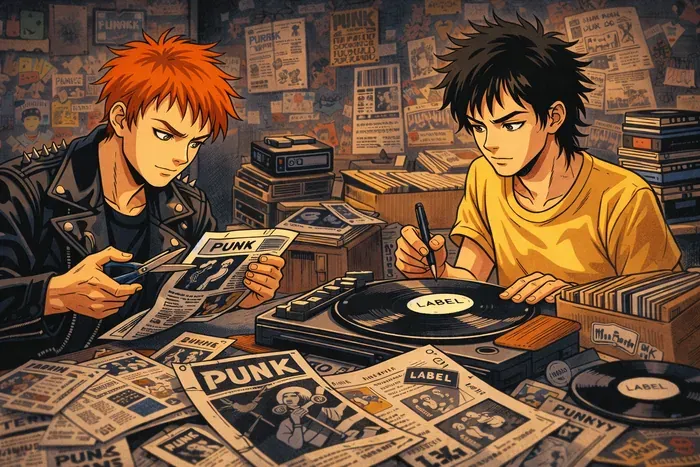
Punk often gets remembered for its sound. Fast guitars, shouted vocals, and short songs form the surface of the story. Beneath that surface stood a network of people and practices that allowed the music to spread in the first place. Without those structures, many of the bands associated with punk might have remained local curiosities.
One of the most influential tools was the fanzine. These small, self-made magazines carried interviews, concert reviews, drawings, and personal commentary. They were assembled on kitchen tables, photocopied in cheap print shops, and passed from hand to hand at shows. One of the earliest and most famous examples was Sniffin’ Glue, started in London by Mark Perry in 1976. The zine spoke directly to readers, using simple language and handwritten layouts. Its message was clear: anyone could participate.
Fanzines served several purposes at once. They documented concerts that mainstream newspapers ignored. They introduced readers to new bands before record labels showed interest. They also built connections between cities. A reader in Manchester might discover a group from London, while someone in Glasgow could learn about a new venue opening nearby. Information traveled slowly compared to modern standards, yet the network was surprisingly effective.
Small record labels formed another crucial part of the infrastructure. Many early punk bands could not rely on major companies, which were often skeptical about the commercial potential of such raw music. Independent labels stepped into that gap. Some were run by musicians themselves, while others emerged from record shops or local promoters. These labels pressed limited runs of vinyl records and distributed them through small stores or mail orders.
Live venues played an equally important role. Clubs like CBGB in New York or the Roxy in London gave unknown bands a stage and a community. The rooms were small, sometimes uncomfortable, and rarely profitable. What they offered was freedom. Artists could experiment without the pressure of large audiences or strict expectations. Musicians met one another, formed new collaborations, and learned from watching each other perform.
The do-it-yourself spirit that grew around these networks shaped the identity of punk. People did not wait for approval from established institutions. They organized their own shows, printed their own writing, and released their own music. That independence created a model that later movements would adopt and adapt.
When the next wave of musicians began searching for new directions at the end of the decade, the infrastructure built during the punk years was already in place. It provided the foundation for the experimental music that soon followed.
Punk Leaves Its First Centers: Australia to Latin America
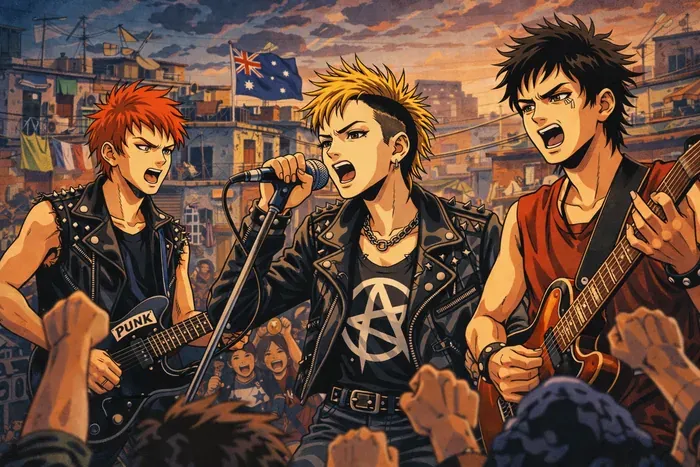
Punk is often told as a story that begins in New York and explodes in London. Those cities were important, yet the energy of the movement traveled far beyond them. Within a few years, musicians in different parts of the world began translating punk into their own local languages, political conditions, and musical traditions. The result was not a single global sound but many parallel scenes that shared a similar spirit.
Australia offered one of the earliest examples. In Brisbane, a band called The Saints had already recorded the single “(I’m) Stranded” in 1976. The track appeared almost at the same time that punk was emerging in the United States and Britain. With its driving guitar riff and urgent delivery, the song captured the same stripped-down intensity. Yet The Saints developed largely outside the main media spotlight that surrounded British punk. Their debut album I’m Stranded later gained recognition as one of the era’s defining records, showing that punk’s ideas could arise independently in different places.
Across Europe, musicians were also responding to the new possibilities. In Germany, bands began to combine punk energy with local political concerns and experimental tendencies inherited from earlier electronic and art music scenes. Groups such as Fehlfarben brought sharp lyrics about modern urban life into the mix. Their 1980 album Monarchie und Alltag carried both punk urgency and a reflective tone that pointed to the next phase of European alternative music.
Switzerland produced another influential group in Kleenex, later known as LiLiPUT. Their songs were playful, rhythmic, and deliberately unconventional. The band’s approach rejected the expectation that punk should sound aggressive or masculine. Instead they embraced humor, spontaneity, and creative freedom. Their recordings circulated through independent labels and small distributors, reaching listeners well beyond their local scene.
In Latin America, punk arrived under very different circumstances. In countries such as Argentina, political repression and censorship shaped everyday life during the late 1970s and early 1980s. Bands like Los Violadores used the language of punk to express frustration and resistance. Their music carried the same urgency heard in London or New York, but the stakes often felt higher. Lyrics and live performances could attract attention from authorities as well as fans.
What connected these scenes was not identical sound or style. It was the realization that music could be created outside traditional hierarchies. Punk gave artists permission to speak in their own voices, even when resources were limited. By the end of the decade, that permission had spread across continents. The next phase of the story took that independence and pushed it into more experimental territory.
Post-Punk: Expanding What Punk Could Be
By the end of the 1970s, that first burst of punk energy had already changed the landscape of popular music. Its raw simplicity opened doors for musicians who had never imagined themselves on a stage before. At the same time, the freedom punk created encouraged artists to explore new directions. Many musicians who came out of the first wave began to ask a different question: what could happen if the same independence was applied to sound itself?
The years that followed did not abandon punk’s spirit. Instead, they expanded it. Guitars were still present, but rhythm sections became more adventurous. Dub, funk, electronic textures, and studio experimentation entered the picture. Some bands slowed the tempo and built atmosphere. Others sharpened their political voice or treated the recording studio as an instrument in its own right.
Journalists later grouped these developments under the name post-punk. The label is convenient, although the musicians involved rarely thought of themselves as part of a single genre. What connected them was curiosity. Artists searched for new structures, new moods, and new ways of organizing music. Cities such as Manchester, Sheffield, and London became laboratories for these ideas. The movement that emerged from this period would reshape alternative music for decades.
Joy Division and Martin Hannett: Space, Distance, and Control
One of the clearest expressions of post-punk’s new atmosphere emerged in Manchester. The city had once been a powerhouse of British industry, yet many of its factories were now closing or struggling. Streets felt quiet in a way that was both physical and emotional. Out of that atmosphere emerged Joy Division, a band whose music captured the tension between urgency and stillness.
The group formed in 1976 under the name Warsaw before settling on Joy Division. The members were singer Ian Curtis, guitarist Bernard Sumner, bassist Peter Hook, and drummer Stephen Morris. They shared an interest in punk’s energy but were equally drawn to mood and texture. Early performances were intense and direct, yet the band soon began developing a more restrained and atmospheric sound.
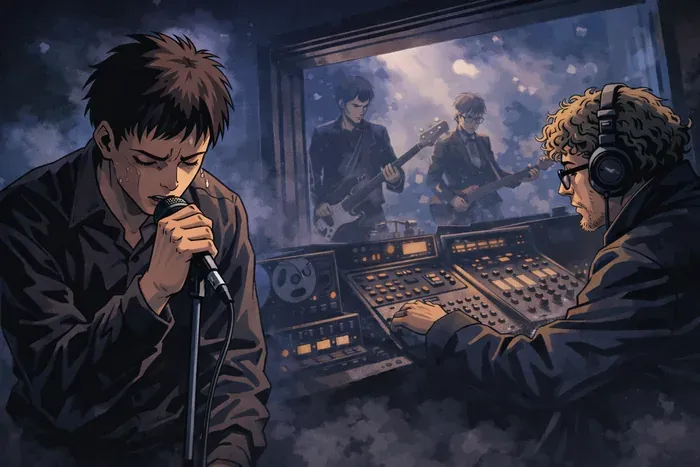
Their debut album Unknown Pleasures was released on 15 June 1979 on the Manchester label Factory Records. The record sounded unlike most guitar music of the time. Producer Martin Hannett played a decisive role in shaping that identity. Rather than capturing the band as it sounded on stage, he focused on creating space inside the recording. Drums echoed through the mix, bass lines moved with melodic clarity, and the guitars often felt distant or suspended.
Peter Hook’s bass became a central melodic voice, frequently carrying lines that might otherwise have belonged to a lead guitar. Bernard Sumner’s playing favored texture over heavy riffs. Stephen Morris kept a steady, almost mechanical pulse that added to the sense of controlled tension. Over this foundation, Ian Curtis delivered lyrics that explored isolation, uncertainty, and emotional pressure. Songs such as “Disorder,” “She’s Lost Control,” and “Shadowplay” captured a mood many listeners found deeply relatable.
Curtis’s stage presence added another layer to the band’s reputation. His performances often involved intense physical movement, sometimes connected to the epilepsy he lived with throughout his life. For audiences, the concerts could feel both powerful and unsettling. The emotional weight carried by the songs was visible in the way he performed them.
Joy Division recorded a second album, Closer, in early 1980. The music pushed even further into atmospheric territory. Tracks like “Isolation” and “Twenty Four Hours” suggested a band moving toward darker and more expansive sonic landscapes. Before the record’s release, Ian Curtis died on 18 May 1980 at the age of twenty-three. The album Closer was released in July 1980, after his death.
The loss of Curtis turned Joy Division into a symbol of a particular moment in post-punk history. Yet the influence of the band extends beyond that tragedy. Their recordings demonstrated how minimal elements could be arranged to create emotional depth. Martin Hannett’s production style helped redefine what a rock record could sound like. In the years that followed, countless artists in alternative and indie music would draw on the sense of space, restraint, and atmosphere first heard in those Manchester sessions.
Wire, Public Image Ltd, and Gang of Four: Taking Rock Apart
While Joy Division explored atmosphere and emotional depth, other post-punk groups focused on dismantling the basic structures of rock music itself. For them, punk’s greatest gift was not simply speed or aggression. It was the freedom to question the rules that had governed guitar music for decades. Three bands in particular helped push that questioning forward: Wire, Public Image Ltd, and Gang of Four.
Wire emerged from the London art school environment and quickly developed a reputation for precision and restraint. Their debut album Pink Flag, released in 1977, arrived at the very edge of the first punk wave. Many of its songs lasted less than two minutes, yet they rarely followed conventional verse-chorus patterns. Instead, the band built sharp, compact pieces that often ended before listeners expected them to. Tracks like “Ex Lion Tamer” and “Reuters” sounded both stripped down and carefully constructed. By the time of their later album 154 in 1979, Wire had begun to expand their palette with synthesizers, layered textures, and more abstract arrangements. Their work suggested that punk minimalism could also become a form of musical architecture.
Public Image Ltd moved in a different direction. After the breakup of the Sex Pistols, singer John Lydon formed the band in 1978. The new project allowed him to step away from the media spectacle that had surrounded his earlier group. With musicians such as bassist Jah Wobble and guitarist Keith Levene, Public Image Ltd built a sound that drew heavily from dub and experimental rock. Their 1979 album Metal Box stands as one of the defining recordings of the post-punk era. The bass lines dominate the mix, echoing the influence of Jamaican studio techniques. Guitar parts often appear as sharp fragments rather than steady riffs. Lydon’s voice moves between spoken reflection and sudden bursts of intensity. The result feels spacious, hypnotic, and unsettling at the same time.
Gang of Four approached post-punk through a combination of rhythm and political observation. Formed in Leeds, the band released Entertainment! in 1979. The record blends angular guitar lines with a tight, danceable rhythm section. Andy Gill’s guitar cuts through the songs in short, percussive bursts, while Dave Allen’s bass provides a steady groove. Singer Jon King delivers lyrics that examine consumer culture, media influence, and power relationships. Songs such as “Damaged Goods” and “At Home He’s a Tourist” turn everyday experiences into sharp social commentary.
What connects these bands is their refusal to treat punk as a fixed formula. Each group used the movement’s independence to test new ideas about rhythm, structure, and meaning. Their recordings helped open the door to a broader musical landscape where experimentation could thrive without losing the urgency that punk had introduced.
Talking Heads and Brian Eno: Art Rock Through Rhythm
After bands like Joy Division, Wire, and Gang of Four stretched post-punk in different directions, another path opened through rhythm and collaboration. Talking Heads became one of the most inventive groups to emerge from the New York scene. Their work showed how punk’s independence could connect with global musical ideas and studio experimentation.
The band formed in the mid-1970s around David Byrne, Tina Weymouth, and Chris Frantz, later joined by Jerry Harrison. Like several early punk artists, they played regularly at CBGB. Yet their music always stood slightly apart from the raw aggression often associated with the scene. Early songs combined nervous energy with sharp observation. Byrne’s lyrics often captured the awkwardness of modern life, while the band’s arrangements relied on tight rhythms rather than heavy guitar distortion.
A major turning point came when Talking Heads began working with producer Brian Eno. Eno had previously been a member of Roxy Music and had already developed a reputation as a creative studio thinker. Instead of treating recording as a simple process of documenting a band, he approached it as an opportunity to build new sonic landscapes.
Their collaboration became especially visible on the album Remain in Light, released in 1980. The record drew inspiration from West African rhythmic structures, particularly the layered grooves associated with Afrobeat musicians such as Fela Kuti. Talking Heads did not imitate these traditions directly. Instead, they adapted the idea of interlocking patterns. Multiple guitar lines, keyboards, percussion, and bass parts move together in repeating cycles, creating a dense rhythmic environment.
Tracks like “Once in a Lifetime” show that rhythmic method in action. The song’s pulsing groove carries Byrne’s vocals through a sequence of reflective and sometimes surreal lines. The rhythm section maintains a steady foundation while the arrangement slowly evolves around it. The music feels hypnotic yet carefully controlled.
The album also reflected a wider collaborative process. Additional musicians contributed percussion, guitar textures, and keyboard parts, giving the recordings a collective feel. Studio layering became a creative tool rather than a technical necessity. Eno encouraged experimentation with loops, tape edits, and overlapping patterns.
That rhythmic expansion changed how many artists thought about guitar-based music. Post-punk no longer needed to revolve around traditional rock structures. Groove, repetition, and texture could carry equal weight. Talking Heads demonstrated that intellectual curiosity and danceable rhythm could exist in the same space. The influence of that idea would reach far beyond the early post-punk years.
4AD and Cocteau Twins: Building Dream Pop
Alongside those rhythmic and political experiments, another current within the movement explored atmosphere and emotion. One of the most distinctive homes for that approach was the British label 4AD. Founded in 1980 by Ivo Watts-Russell and Peter Kent, the label quickly developed a reputation for music that felt immersive, fragile, and visually striking.
4AD releases were recognizable not only because of the sound but also because of their presentation. Designer Vaughan Oliver created record covers that looked like abstract paintings or surreal photographs. These images avoided the aggressive graphics associated with early punk. Instead they suggested mystery, dreamlike landscapes, and quiet introspection. The visual identity became inseparable from the music itself.
Among the artists who shaped the label’s reputation, Cocteau Twins stand out as one of the most influential. The band formed in Scotland in the early 1980s around guitarist Robin Guthrie, bassist Simon Raymonde, and singer Elizabeth Fraser. Their music moved away from punk’s sharp edges toward something more fluid and atmospheric.
On albums such as Treasure from 1984, the band built layers of shimmering guitar sound that often resembled waves of light rather than traditional chords. Robin Guthrie used effects and studio techniques to stretch the guitar into long, floating textures. Beneath these layers, the rhythm section provided gentle movement without dominating the arrangement.
Elizabeth Fraser’s voice became the emotional center of the music. Her singing often blurred the line between language and pure sound. Words dissolved into syllables, vowels, and shifting tones. Listeners sometimes tried to decipher exact lyrics, but the meaning often came through feeling rather than literal interpretation. The voice acted almost like another instrument inside the arrangement.
Cocteau Twins demonstrated that post-punk experimentation did not always have to be harsh or confrontational. Their work suggested another possibility: music that created a private atmosphere where listeners could step away from the noise of everyday life. That sense of space and emotion would influence later styles such as dream pop, shoegaze, and many strands of indie music.
4AD supported other artists who explored similar territory, including Dead Can Dance and This Mortal Coil. Each approached atmosphere in a different way, yet the label maintained a clear artistic identity. The combination of careful production, distinctive design, and emotional subtlety showed how independent labels could shape culture as much as individual bands.
In this quieter corner of post-punk, the movement revealed a new dimension. Punk had opened the door to independence. Labels like 4AD showed how that freedom could lead to beauty, vulnerability, and sonic imagination.
Manchester as Infrastructure: Factory, New Order, and Peter Saville
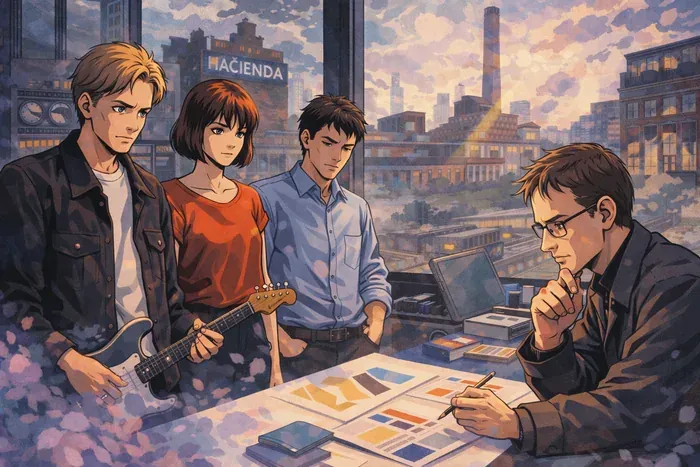
Beyond individual bands, Manchester built a wider cultural system around the music. During the late 1970s and early 1980s, the city developed a cultural ecosystem that connected music, design, clubs, and independent business structures. At the center of that system stood Factory Records, a label founded by television presenter Tony Wilson together with Alan Erasmus in 1978.
Wilson believed that music scenes needed more than just artists. They required places to gather, visual identity, and a sense that creativity could flourish outside the control of large record companies. Factory Records operated with an unusual level of independence. Contracts were often informal, and the label allowed musicians a high degree of creative control. That model did not always lead to financial stability, yet it created an environment where experimentation felt possible.
One of the label’s defining visual voices came from designer Peter Saville. His album covers helped shape how post-punk looked as well as how it sounded. The artwork for Joy Division’s Unknown Pleasures featured a stark image of pulsar waves printed on a dark background. The design felt scientific and mysterious at the same time. Saville later created the sleeve for New Order’s Power, Corruption & Lies, which combined a classical painting with modern typography. These images suggested that alternative music could carry elegance and intellectual depth without losing its edge.
After the death of Ian Curtis in 1980, the remaining members of Joy Division chose to continue working together under a new name. They formed New Order, with Bernard Sumner moving into the role of lead singer while Peter Hook and Stephen Morris remained central to the group’s sound. The band gradually shifted toward electronic rhythms and synthesizers, blending post-punk sensibility with dance music.
Their 1983 album Power, Corruption & Lies marked a turning point. Tracks such as “Age of Consent” balanced melodic guitar lines with bright synthesizer patterns. A year later the single “Blue Monday” pushed even further into electronic territory. Built around drum machines and sequenced bass, the track became one of the most successful twelve-inch singles ever released.
Factory Records also helped establish the Haçienda, a nightclub that opened in Manchester in 1982. The venue later became famous for its role in the city’s dance culture, but in the early years it served as a meeting place for musicians, artists, and fans from across the alternative scene.
Together these elements created something larger than a record label. Manchester’s network of artists, designers, clubs, and independent structures demonstrated how a local scene could shape global music culture.
Einstürzende Neubauten and Industrial Europe's Harsh Imagination
While parts of the post-punk movement explored rhythm, atmosphere, or melodic expansion, another group of artists pushed experimentation toward something far more radical. In several European cities, musicians began questioning not only how songs should be structured, but also what counted as a musical instrument. The result was a body of work that blurred the boundaries between music, performance, and sound art.
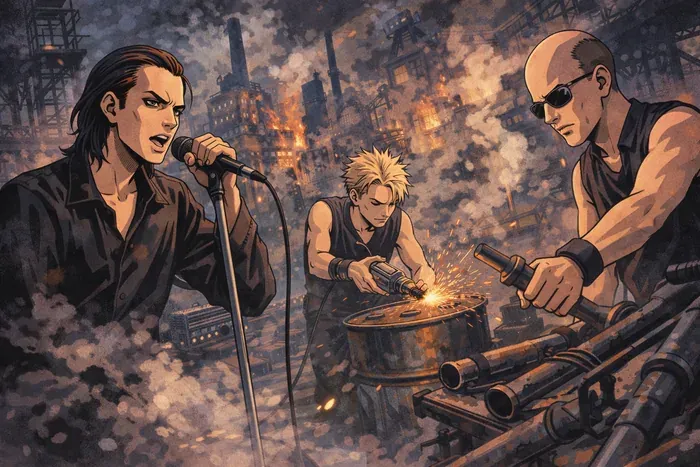
One of the most striking examples came from Berlin with the band Einstürzende Neubauten. Formed in 1980 by Blixa Bargeld and a rotating group of collaborators, the band developed a style that drew heavily on the industrial environment surrounding them. Instead of relying solely on guitars and drums, they incorporated scrap metal, construction tools, steel plates, and other found objects into their performances. The sounds produced by these materials carried a harsh, metallic quality that felt closely tied to the urban landscape of West Berlin.
Early recordings such as Kollaps, released in 1981, presented music that could feel unsettling and physical at the same time. Rhythms often emerged from pounding metal surfaces or striking mechanical parts. The sound was dense and abrasive, yet carefully organized. Bargeld’s voice moved between spoken passages, strained singing, and sudden bursts of intensity.
The band’s work reflected the cultural atmosphere of Berlin during the final decade of the Cold War. The city stood divided by the Wall, surrounded by political tension and constant reminders of history. Many artists living there treated experimentation as a way to process that environment. Music, visual art, and performance frequently crossed paths in galleries, clubs, and temporary spaces.
Industrial experimentation was not limited to Berlin. In Britain, groups such as Throbbing Gristle and Cabaret Voltaire were also exploring electronic noise, tape manipulation, and unconventional rhythms. Their recordings often challenged listeners who expected traditional song structures. Instead they offered soundscapes that felt closer to sonic experiments or social commentary.
Although these artists operated on the fringes of mainstream recognition, their influence spread quietly through later decades. Musicians in alternative rock, electronic music, and experimental scenes borrowed elements of their approach. The idea that everyday objects could become instruments opened new creative possibilities.
Post-punk had already expanded the language of guitar music. Industrial experimentation pushed that expansion even further, asking a more fundamental question about sound itself. By challenging the limits of instrumentation and performance, these artists widened the horizon of what independent music could become.
Goth and Darkwave: Extending Post-Punk's Emotional Range
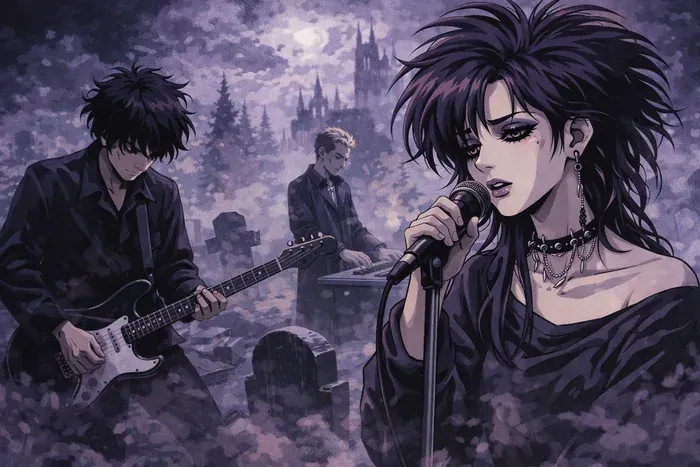
Post-punk also produced a darker emotional lineage that became one of the most durable currents in alternative music. Where some bands turned toward funk, electronics, or noise, others slowed the pulse, deepened the atmosphere, and treated mood as a central musical force. Out of that shift grew goth rock and, in parallel, darkwave, two closely related strands that carried post-punk’s intensity into more nocturnal territory.
Bauhaus became one of the clearest early reference points. Their 1979 single “Bela Lugosi’s Dead” helped define a new sense of space and theatricality in underground rock. The song moved with unusual patience, allowing dub-like bass, echoing guitar, and haunted vocal phrasing to create tension. It suggested that punk’s break from rock convention could lead not only toward speed and aggression, but also toward ritual, restraint, and unease.
Other groups expanded this emotional vocabulary in different ways. The Cure moved from post-punk sharpness toward a more immersive and melancholic sound on records such as Seventeen Seconds, Faith, and Pornography. Siouxsie and the Banshees added drama, precision, and visual authority, while The Sisters of Mercy later emphasized drum-machine discipline and a grander, more monumental form of darkness. Across these bands, the music rarely depended on virtuosity alone. It depended on atmosphere, repetition, and control.
Darkwave developed alongside goth, especially in European scenes where synthesizers and drum machines were already central to underground music. Rather than foregrounding guitar weight, darkwave often blended cold electronic textures with introspective vocals and minimal rhythms. This made the style feel connected both to post-punk and to the expanding world of independent electronic music. Clubs, visual style, and subcultural identity became especially important here. The scene was heard as much in spaces and nightlife rituals as on records.
What makes this lineage important within the larger story from punk to indie is its lasting emotional influence. Goth and darkwave normalized introspection, ambiguity, and stylized sadness within alternative culture. Later dream pop, shoegaze, indie electronic music, and even parts of modern pop all borrowed from that atmosphere. They inherited the idea that intensity does not always need to arrive through speed or noise. It can also arrive through stillness, repetition, and carefully shaped mood.
By the early 1980s, then, post-punk had split into several long-lasting futures at once. One of them led toward dance music. Another pushed into industrial experimentation. This darker path would remain just as influential, especially for artists who treated sound, image, and emotional texture as inseparable parts of alternative expression.
American Hardcore: Speed, Discipline, and DIY Networks
As post-punk pushed outward into experimentation, another branch of the story was growing harder and faster in the United States. The conditions were not glamorous. Many of these scenes formed in suburbs, small clubs, community halls, and improvised venues far from the music industry centers of New York or Los Angeles. Yet the determination that fueled them proved just as powerful as the original punk explosion.
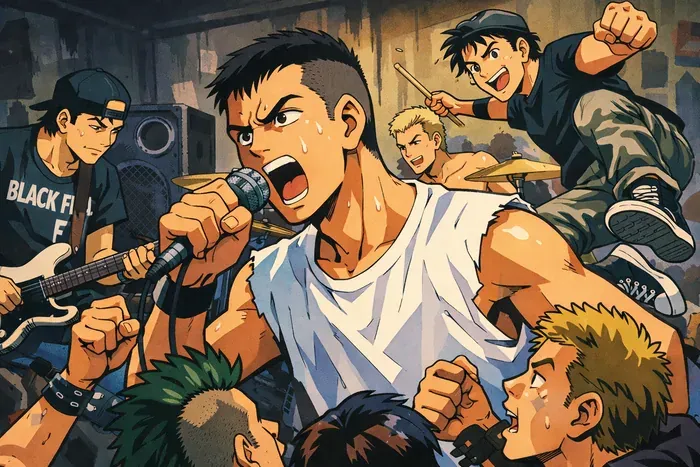
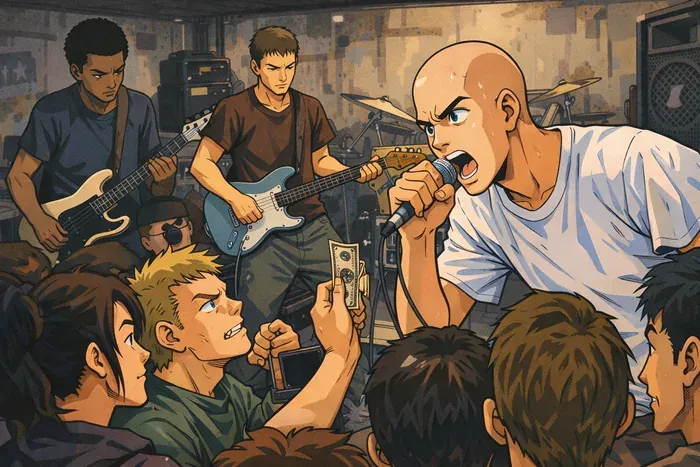
Hardcore punk grew from the desire to push the music faster, louder, and more direct. Songs became shorter, tempos accelerated, and performances often felt intense and physical. The movement built its own touring circuits, record labels, and distribution networks. Musicians booked shows themselves, printed flyers, and traveled long distances in aging vans simply to reach new audiences.
Behind the volume and speed stood a deeper transformation. Hardcore scenes developed a practical version of independence that went beyond attitude. Labels, venues, and fan communities formed a tight ecosystem where artists could survive without relying on major industry support. Cities such as Los Angeles, Washington D.C., Minneapolis, and San Pedro became important hubs.
From this environment emerged a foundation that would later support alternative rock and indie music. The infrastructure created during the hardcore years proved as influential as the music itself.
Black Flag and SST: Touring as Survival
If the hardcore chapter began with a new level of speed and force, Black Flag showed what that energy looked like in practice. Few groups demonstrated more clearly that a band could build its own infrastructure. Formed in Southern California in 1976 by guitarist Greg Ginn, the band became a central force in shaping the sound and working methods of early hardcore.
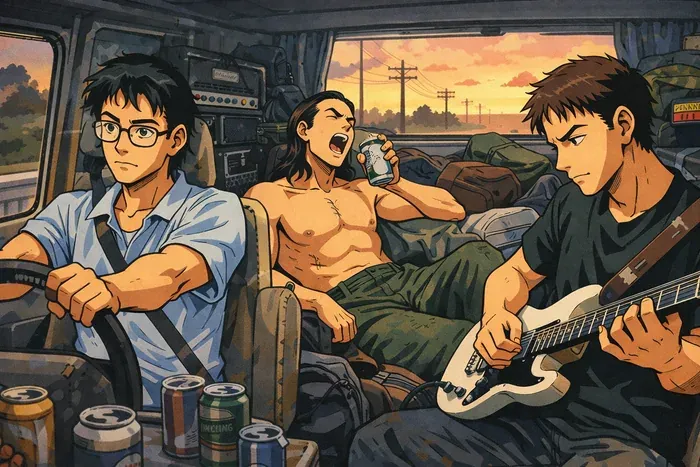
Black Flag’s music was aggressive, fast, and stripped to essentials. Early recordings such as the 1978 EP Nervous Breakdown delivered short bursts of energy built around sharp guitar riffs and shouted vocals. The band’s lineup changed several times during its early years, but its commitment to relentless touring never wavered. Black Flag traveled constantly across the United States, often performing in small clubs, rented halls, or temporary venues arranged by local fans.
These tours were rarely comfortable. Musicians slept on floors, drove long distances overnight, and played for modest fees. Yet the effort created a network of contacts that linked scattered scenes together. A promoter in one city might recommend another venue hundreds of miles away. Fans who attended a show might later organize their own concerts. Slowly a national circuit formed, allowing underground bands to reach audiences without relying on established promoters.
Greg Ginn supported this system through SST Records, a label he founded in 1978. Originally created to release Black Flag’s own music, SST soon expanded to include other artists. The label released recordings by bands such as Hüsker Dü, the Minutemen, and later Sonic Youth. These records circulated through independent distributors and small record shops, strengthening the connection between different scenes.
Black Flag’s 1981 album Damaged, featuring singer Henry Rollins, captured the band’s intensity at its peak. Songs like “Rise Above” and “TV Party” combined blunt lyrics with heavy, driving rhythms. The music expressed frustration, alienation, and the search for personal autonomy. For many listeners, the record felt like a direct reflection of everyday pressures.
Authorities often viewed hardcore shows with suspicion. Police occasionally shut down concerts, and venues sometimes canceled events after complaints from neighbors. Instead of discouraging musicians, these obstacles reinforced the sense that the scene had to rely on itself.
Through constant travel, independent releases, and determination, Black Flag helped create a model for underground survival. That model allowed other bands to build careers outside the traditional music industry. Over time, the infrastructure first tested by hardcore groups would support the rise of alternative rock in the following decade.
Minor Threat and Fugazi: Turning Ethics Into Practice
While bands like Black Flag defined the physical intensity of hardcore, another important strand of the movement grew in Washington D.C. Here the focus extended beyond speed and aggression toward questions about community, responsibility, and the values that surrounded the music. Two bands in particular became closely associated with this approach: Minor Threat and Fugazi.
Minor Threat formed in 1980 around singer Ian MacKaye, guitarist Lyle Preslar, bassist Brian Baker, and drummer Jeff Nelson. Their recordings were brief and explosive, often lasting little more than a minute. Songs such as “Filler,” “Straight Edge,” and “Out of Step” captured the urgency of the hardcore moment. Yet the band’s influence reached beyond sound. The song “Straight Edge” introduced a personal stance against alcohol and drugs that some fans later adopted as a lifestyle. MacKaye himself presented the idea simply as an individual choice rather than a strict doctrine, though it quickly became a visible part of hardcore culture.
Equally important was the band’s role in shaping independent structures. MacKaye and Nelson co-founded Dischord Records in 1980 to release Minor Threat’s music and that of other local bands. The label operated with a simple philosophy. Artists retained creative control, records were sold at reasonable prices, and profits were reinvested into new releases. Dischord also documented the Washington D.C. scene, helping local groups reach listeners beyond the city.
After Minor Threat ended in 1983, MacKaye continued exploring similar ideas through Fugazi, formed in 1987 with guitarist Guy Picciotto, bassist Joe Lally, and drummer Brendan Canty. Fugazi’s music expanded the language of hardcore. Songs often moved through dynamic shifts rather than maintaining a constant speed. Bass lines carried melodic weight, and the guitars alternated between sharp rhythms and open textures.
Fugazi also developed a reputation for its approach to live performance. The band kept ticket prices low and preferred all-ages venues whenever possible. This decision allowed younger fans to attend shows that might otherwise have been restricted to adults. Concerts often took place in community centers, university halls, or independent clubs rather than large commercial venues.
Another defining principle involved distance from major record labels. Fugazi never signed with a large company despite repeated offers. Their albums, including Repeater from 1990 and Red Medicine from 1995, were released through Dischord. The band believed that maintaining control over production, distribution, and ticket pricing helped preserve the integrity of their work.
Through Minor Threat and Fugazi, Ian MacKaye became associated with an idea of ethics within independent music. The goal was not perfection but consistency. By aligning artistic choices with practical decisions, these bands demonstrated that independence could function as a daily practice rather than a slogan.
Hüsker Dü and The Replacements: Opening Hardcore Toward Melody
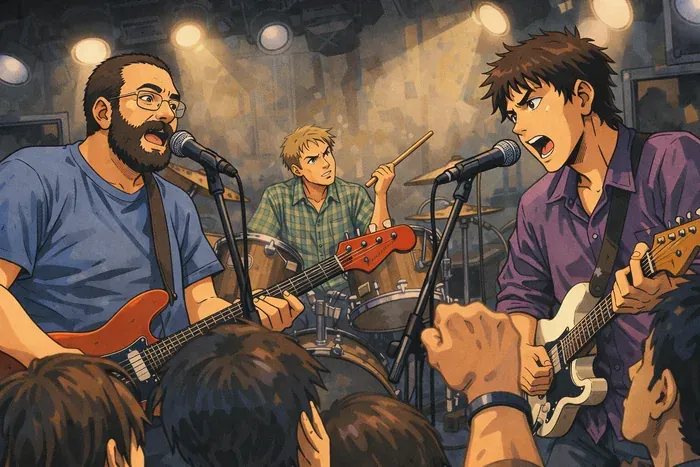
As the hardcore scene matured, some musicians began pushing beyond its strictest limits. By the early 1980s, the American hardcore scene had established its intensity and independence. Some musicians began to feel that the strict limits of the style were becoming restrictive. Speed and aggression had defined the movement’s early years, but artists in several cities started searching for a broader emotional range. Two bands from Minneapolis played a crucial role in that shift: Hüsker Dü and The Replacements.
Hüsker Dü formed in 1979 with Bob Mould on guitar and vocals, Grant Hart on drums and vocals, and Greg Norton on bass. Their earliest recordings reflected the fast, explosive sound associated with hardcore. Over time, however, the band gradually introduced more melody and introspective songwriting. This transformation became especially clear on their 1984 double album Zen Arcade.
Zen Arcade was ambitious for an underground punk record. Instead of short, isolated songs, the album explored a loose narrative about a young person searching for meaning in a confusing world. Tracks such as “Broken Home, Broken Heart” carried the speed of hardcore, while others like “Pink Turns to Blue” slowed the tempo and opened space for reflection. The combination of raw energy and emotional depth expanded the possibilities of what independent guitar music could express.
Around the same time, another Minneapolis group was shaping a different version of that expansion. The Replacements began as a loud and chaotic punk band led by singer and guitarist Paul Westerberg. Early recordings captured a sense of reckless humor and frustration. Yet as the band developed, Westerberg’s songwriting grew more personal and reflective.
Their 1984 album Let It Be revealed that shift clearly. Songs like “Unsatisfied” and “Answering Machine” balanced distorted guitars with a fragile honesty that resonated with many listeners. The music retained the spirit of punk while allowing vulnerability to enter the picture. The band’s performances were famously unpredictable, sometimes brilliant and sometimes deliberately messy, which only reinforced their reputation for authenticity.
Both Hüsker Dü and The Replacements were connected to the independent label SST Records, which helped distribute their music across the United States. Through touring and word of mouth, their recordings reached audiences who were searching for something beyond the narrow boundaries of hardcore.
These bands built a bridge between the underground punk network and the alternative rock movement that would gain wider recognition in the late 1980s and early 1990s. By combining melodic songwriting with the independence of the hardcore scene, they helped redefine what alternative music could sound like.
Bad Brains: Race, Skill, and Hardcore Visibility
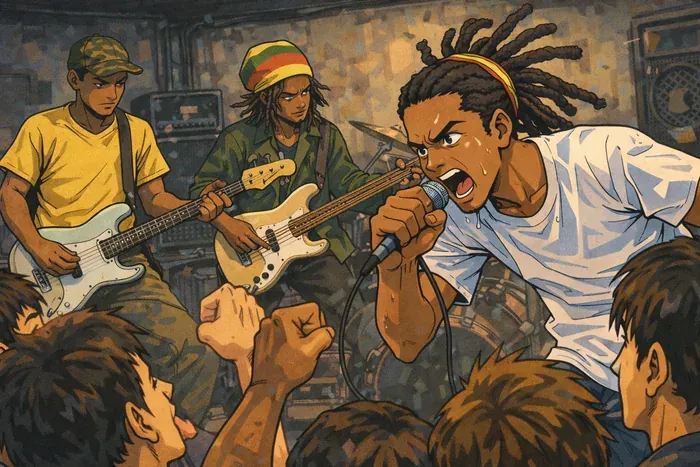
Within that wider hardcore landscape, Bad Brains stood apart in several ways. Formed in Washington D.C. in the late 1970s, the group brought a level of musicianship and rhythmic complexity that surprised audiences who associated punk with simplicity. At the same time, their presence challenged assumptions about race within a movement that was often perceived as predominantly white.
The band began as a jazz fusion group before turning toward punk. Its members were singer H.R., guitarist Dr. Know, bassist Darryl Jenifer, and drummer Earl Hudson. When they shifted direction, they carried their technical ability with them. Songs were incredibly fast, yet the playing remained tight and controlled. Dr. Know’s guitar riffs moved with precision, while Hudson’s drumming added explosive energy without losing clarity.
Their self-titled debut album Bad Brains, released in 1982, captured the group at full intensity. Tracks like “Banned in D.C.” and “Attitude” delivered blistering speed and powerful vocal delivery. Yet the record also revealed another side of the band. Between the hardcore songs appeared reggae-influenced tracks that slowed the tempo and opened a different emotional space. This contrast reflected the members’ connection to Rastafarian spirituality and Caribbean musical traditions.
Bad Brains’ live shows quickly became legendary. Performances moved at a relentless pace, often leaving audiences stunned by the sheer speed of the music. H.R. shifted between melodic singing and sharp vocal bursts, while the band behind him maintained extraordinary control. The energy in the room could feel electric.
At the same time, the group faced barriers that went beyond the usual struggles of underground musicians. Hardcore scenes sometimes struggled with questions of inclusivity, and Black musicians were still rare in many of these spaces. Bad Brains’ presence forced audiences to reconsider narrow ideas about who belonged in punk culture.
Their influence spread widely. Many musicians admired the combination of discipline and intensity that defined their sound. Later alternative and metal bands frequently cited Bad Brains as an inspiration, especially for their rhythmic precision and fearless approach to genre mixing.
Within the broader story of punk and hardcore, Bad Brains represent more than a technical milestone. Their music expanded the emotional and cultural scope of the scene. By blending punk speed with reggae rhythms and spiritual themes, they showed that the movement could hold far more diversity than its early stereotypes suggested.
College Radio and the Public Language of “Alternative”
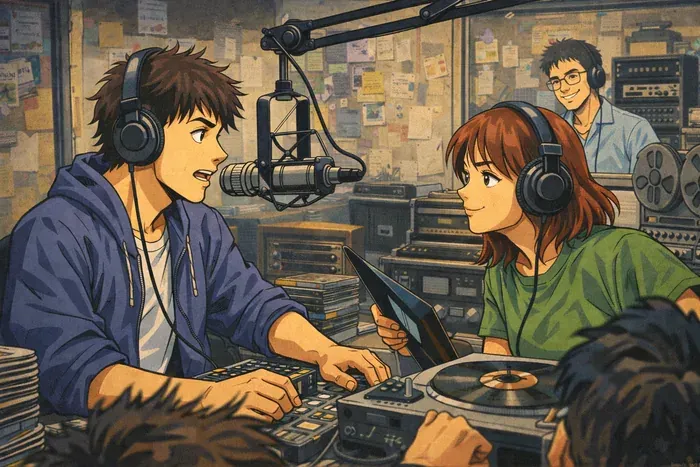
By the 1980s, the infrastructure built by hardcore and independent labels was also changing how listeners discovered music. A quieter shift was taking place across the United States. While hardcore bands built touring networks and independent labels expanded their catalogs, another structure was slowly forming within universities and small community stations. College radio would become one of the most important channels for underground music during this period.
Unlike commercial radio, college stations were rarely bound by strict playlists or advertising pressures. Students and volunteer DJs had the freedom to explore music that mainstream stations ignored. Independent records from small labels arrived in mailrooms across the country, often accompanied by handwritten notes from promoters or musicians themselves. These records might include releases from SST, Dischord, or emerging labels like Twin/Tone and Homestead.
Because these stations operated outside major industry structures, they became natural allies for independent bands. A song that would never appear on commercial FM radio could suddenly reach listeners in several cities through college broadcasts. The audience might not be enormous, but it was dedicated and curious.
One of the groups that benefited from this network was R.E.M., a band formed in Athens, Georgia in 1980. Their early recordings, particularly the 1983 album Murmur, circulated widely through college radio playlists. The music combined jangling guitars, melodic bass lines, and Michael Stipe’s distinctive vocals. Songs like “Radio Free Europe” and “Talk About the Passion” resonated with listeners who were searching for something different from the dominant sounds of mainstream rock.
College radio also helped audiences discover artists such as The Replacements, Hüsker Dü, and Sonic Youth. DJs often shared information about upcoming concerts or new independent releases during broadcasts. In some cases, bands traveling between cities would visit stations for informal interviews or acoustic sessions.
The growing popularity of this music led journalists and industry observers to search for a term that could describe it. By the middle of the decade, the word “alternative” began appearing more frequently. At first it simply referred to music that existed outside the commercial mainstream. Yet over time the label became associated with a broader cultural identity.
College radio did not create alternative music on its own, but it provided a crucial platform. Through these stations, independent artists reached listeners across the country and developed a shared audience. The connection between college radio, touring circuits, and independent labels laid the groundwork for the alternative rock movement that would gain global visibility in the years that followed.
Independent Press and Canon-Making in Alternative Music
Music scenes do not become influential through sound alone. They also become visible through the people and institutions that describe them, rank them, and connect them to a larger story. For punk, post-punk, college rock, and indie, the music press and related media played that role with unusual force. Publications, radio hosts, and later online critics did not simply report on alternative music. They also helped shape what counted as essential, authentic, or historically important.
In Britain, papers and magazines such as NME and Melody Maker were central to this process. They introduced readers to new bands, argued over scenes, and often gave names to emerging movements before the wider public knew how to describe them. That influence could be productive. Writers connected local acts to broader cultural questions about class, art, politics, and youth identity. At the same time, the press could narrow a scene by favoring rivalry, style, or novelty over slower forms of artistic development.
In the United States, college radio and the alternative weekly press played a related but slightly different role. Rather than speaking from a single national center, they formed a distributed network of recommendation and reputation. DJs, local critics, record-store staff, and fanzine editors all helped turn scattered bands into something that felt like a shared cultural field. A group could gain national significance long before it reached the mainstream charts.
As the internet matured, this gatekeeping function did not disappear. It changed shape. Sites such as Pitchfork gave digital criticism a new degree of visibility in the 2000s, especially for indie audiences trying to navigate an expanding flood of releases. Reviews, ratings, and year-end lists became part of how modern listeners built a canon of “important” alternative music. Once again, the process offered both discovery and distortion. It helped small records travel quickly, but it also concentrated attention in ways that could flatten regional differences or reward hype.
This matters because alternative music has always defined itself partly against dominant institutions, yet it has never existed without intermediaries. Scenes need listeners, but they also need narrators. The press, radio, and criticism helped turn local energy into a history that could be shared, debated, and remembered. In that sense, alternative music was not only played in clubs and on records. It was also built in reviews, playlists, charts, lists, and arguments.
The Smiths and the Emotional Turn in Indie Guitar Music
By the early 1980s, punk had already split into several distinct paths. Hardcore scenes in the United States pushed speed and intensity to new limits, while post-punk groups in Britain experimented with rhythm, atmosphere, and studio production. Alongside those developments, another current was forming that would become just as influential for the future of independent guitar music.
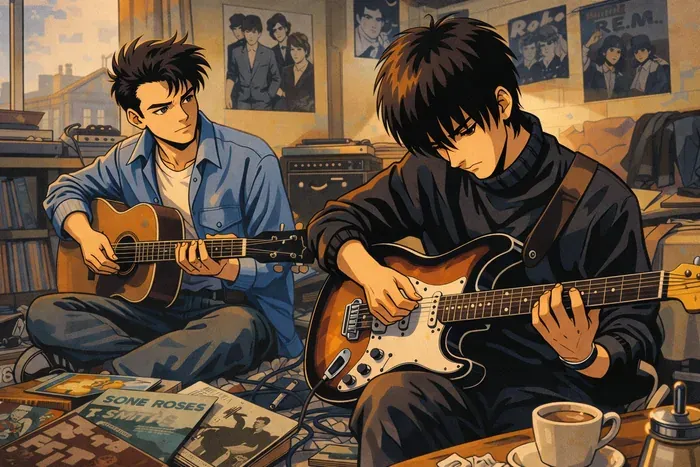
At the center of that development stood The Smiths. Formed in Manchester in 1982, the band created a sound that felt both familiar and new. Their music drew on the melodic tradition of 1960s guitar pop, yet it carried the independence and self-awareness that punk had introduced. Johnny Marr’s bright, layered guitar playing replaced the heavy distortion common in many rock bands of the period. Morrissey’s lyrics approached everyday life with sensitivity, irony, and literary references.
Together they shaped a style that later musicians would recognize as a foundation for indie music. The Smiths did not rely on spectacle or aggression. Their songs spoke quietly about loneliness, humor, disappointment, and longing. In doing so, they offered an alternative identity for guitar music. The influence of that identity would echo through alternative and indie scenes for decades. The next three sections look more closely at the band’s sound, social perspective, and long afterlife in later guitar music.
The Smiths: Marr, Morrissey, and a New Guitar Language
When The Smiths appeared in the early 1980s, British guitar music was in transition. Post-punk experimentation had pushed rock in many directions, while electronic sounds were gaining ground in the charts. Against that backdrop, The Smiths introduced something both simple and quietly radical. Their music returned to the guitar, yet it avoided the heavy blues traditions that had shaped much of classic rock.
The band formed in Manchester in 1982 when singer Morrissey met guitarist Johnny Marr. Marr had been searching for a vocalist who could match his ambition to reshape guitar music. Morrissey, already deeply interested in literature and pop history, brought a distinctive voice and perspective. Together they began writing songs that balanced melody, wit, and emotional honesty.
Johnny Marr’s guitar style became one of the defining elements of the band’s sound. Instead of relying on thick distortion, he built bright, layered arrangements using arpeggios and interlocking patterns. His playing often carried echoes of earlier British pop groups such as The Byrds or The Kinks, yet the structure of the songs felt modern. Tracks like “This Charming Man” or “How Soon Is Now?” revealed how carefully arranged guitar lines could create both energy and atmosphere.
Morrissey’s lyrics stood apart from typical rock writing of the time. Rather than focusing on rebellion or romantic triumph, he explored awkwardness, isolation, and everyday frustration. Songs like “Hand in Glove” and “Still Ill” captured the feeling of being slightly out of place in the world. His delivery moved between humor and melancholy, often with a sharp sense of irony.
The Smiths released their self-titled debut album The Smiths in 1984. The record quickly gained attention in the British independent music press. Critics recognized that the band had created a distinctive voice within the post-punk landscape. Their follow-up albums strengthened that reputation. Meat Is Murder in 1985 and The Queen Is Dead in 1986 expanded the band’s musical and lyrical scope.
The group’s visual identity also contributed to their influence. Instead of glossy promotional photos, their record sleeves featured images of actors, writers, or cultural figures from earlier decades. These choices reflected Morrissey’s fascination with film, literature, and British cultural history.
Although The Smiths existed for only a few years before breaking up in 1987, their impact proved lasting. Marr’s guitar approach became a blueprint for many indie musicians, while Morrissey’s introspective writing encouraged artists to treat personal vulnerability as a legitimate subject for pop songs. Through this combination, The Smiths helped define a new language for guitar-based music that would shape the indie scene for decades.
Everyday Britain, Irony, and Literary Detail
Part of what made The Smiths so distinctive in the 1980s was the way their songs reflected everyday life in Britain with unusual honesty. Many rock bands had drawn inspiration from working-class experiences before, but Morrissey approached the subject from a different angle. Instead of presenting rebellion as loud confrontation, he often described quiet disappointment, social awkwardness, and moments of dark humor.
Manchester provided an important backdrop for that perspective. Like many industrial cities in Britain during the early 1980s, it faced economic uncertainty and rising unemployment. Young people often found themselves navigating limited opportunities and uncertain futures. The Smiths captured that atmosphere without turning it into straightforward political slogans.
Songs such as “Still Ill” and “Heaven Knows I’m Miserable Now” spoke directly to feelings of frustration and emotional fatigue. Yet the lyrics rarely sounded self-pitying. Morrissey’s writing balanced melancholy with wit, sometimes slipping into sharp humor at unexpected moments. That mixture allowed listeners to recognize themselves in the songs without feeling overwhelmed by despair.
Literature and film also shaped Morrissey’s lyrical voice. References to classic British culture appeared throughout the band’s work, though they were often woven subtly into the songs. As a result, The Smiths developed a tone that felt both thoughtful and conversational. Listeners did not need to recognize every reference to understand the emotional core of the music.
The band’s songwriting also touched on subjects that were rarely discussed openly in mainstream pop at the time. Questions about identity, vulnerability, and belonging surfaced repeatedly. Morrissey’s stage presence added another layer to these themes. His manner could appear reserved one moment and theatrical the next. Instead of projecting the confident persona typical of many rock singers, he embraced a more complicated emotional range.
For many young listeners, that openness created a sense of recognition. The songs suggested that uncertainty and self-reflection could belong in guitar music just as naturally as anger or bravado. In a decade often associated with polished production and commercial spectacle, The Smiths offered something quieter and more personal.
Their perspective would resonate strongly with later generations of musicians. Indie artists in the 1990s and 2000s frequently drew inspiration from the band’s ability to combine melody with thoughtful observation. By treating ordinary experiences with seriousness and wit, The Smiths helped expand the emotional vocabulary of alternative music.
How The Smiths Shaped Later Indie Guitar Music
When The Smiths disbanded in 1987, their career had lasted only five years. Yet the musical ideas they introduced continued to spread through the following decades. Many artists who shaped the alternative and indie scenes of the 1990s and early 2000s drew inspiration from the band’s approach to songwriting, guitar sound, and lyrical perspective.
Johnny Marr’s playing became particularly influential. His use of bright, layered guitar lines offered an alternative to the heavy distortion that dominated much of rock music. Instead of relying on power chords alone, Marr built songs from interlocking patterns and melodic fragments. That approach allowed guitars to create movement and atmosphere without overwhelming the rest of the arrangement.
Bands emerging in Britain during the late 1980s and early 1990s absorbed this lesson. Groups associated with the so-called “indie” scene often embraced jangling guitars and thoughtful songwriting. Artists such as The Stone Roses, whose 1989 self-titled album blended dance rhythms with melodic guitar work, carried traces of Marr’s influence. Later British guitar bands would continue exploring that balance between clarity and energy.
The Smiths also shaped how many musicians approached lyrics. Morrissey’s willingness to treat vulnerability, humor, and personal reflection as legitimate themes encouraged others to move away from traditional rock narratives. Indie songwriters frequently adopted a more conversational tone, focusing on small details of everyday life rather than grand gestures.
During the 1990s, American alternative bands also showed signs of the same influence. Groups like R.E.M., who had already developed their own style in the early 1980s, shared a similar emphasis on melody and introspection. The connection was not direct imitation, but a shared belief that guitar music could carry emotional nuance.
The legacy of The Smiths became even more visible in the early 2000s. As a new generation of bands began reviving interest in guitar-driven indie rock, Marr’s style returned to the foreground. Artists such as The Strokes and Arctic Monkeys explored clean guitar tones and tightly arranged songs that echoed earlier British influences, even while developing their own identities.
Beyond specific techniques, The Smiths left behind a broader cultural idea. Guitar music could be thoughtful without losing immediacy. Lyrics could address uncertainty and self-doubt without sacrificing melody or wit. This balance helped define what many listeners eventually understood as the spirit of indie music.
Through that influence, the band’s brief career became a turning point. The Smiths connected the experimental freedom of post-punk with a more personal form of guitar pop that would guide alternative music into the decades ahead.
Alternative Rock Moves From the Margins to the Mainstream
By the mid-1980s, these parallel developments had created a wide underground landscape. Punk, post-punk, and the American hardcore network had all contributed to it. Independent labels were active, college radio stations supported emerging artists, and touring circuits connected cities that had previously been more isolated from one another. Out of that network, a new phase of guitar music began to take shape.
The term “alternative” slowly entered circulation during these years. At first it simply described bands that operated outside the commercial rock industry. These artists released records on independent labels, played in smaller venues, and relied heavily on word of mouth. Yet the music itself was not defined by a single sound. Some groups favored jangling guitars and introspective lyrics. Others explored noise, experimental tunings, or emotional intensity.
During the late 1980s, several bands reached larger audiences while still maintaining clear ties to this underground culture. R.E.M., Sonic Youth, Pixies, and others showed that independent guitar music could resonate far beyond college campuses and local clubs. Their success prepared the ground for a dramatic shift at the beginning of the 1990s.
When that shift arrived, alternative rock moved from the margins of the music industry to its center.
Lollapalooza and the Festival Circuit: Alternative Goes National
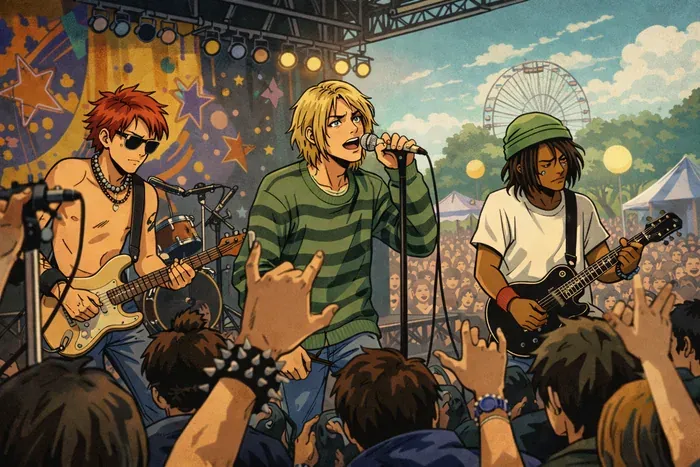
One part of that shift was not a single record but a new kind of public space. In 1991, Perry Farrell conceived Lollapalooza as a farewell tour for Jane’s Addiction, but the festival quickly became something larger. It gathered alternative bands, punk acts, metal, industrial music, hip hop, performance art, and political organizations inside the same traveling event. For many listeners, it offered a first direct encounter with a broad alternative world that had previously been scattered across clubs, college radio, and small magazines.
The format mattered. Instead of presenting one headliner and a set of supporting acts, Lollapalooza staged a temporary scene. Audiences could move between different sounds and attitudes in a single day. That helped listeners understand alternative culture less as a niche genre and more as a loose coalition of overlapping communities. A fan who arrived for one band might leave with an interest in several others.
Festivals also changed the scale of visibility. Underground credibility had long depended on intimacy, local knowledge, and small venues. Lollapalooza showed that alternative music could reach mass audiences without immediately losing its internal diversity. The event did not erase scene differences, but it made them easier to read within a larger public frame.
Other festivals and touring packages would later serve similar functions in different contexts. Yet Lollapalooza marked a turning point because it translated the energy of independent networks into a highly visible national route. That shift helped prepare the ground for the 1990s moment when alternative rock no longer seemed peripheral.
R.E.M. and the Growth of College Rock
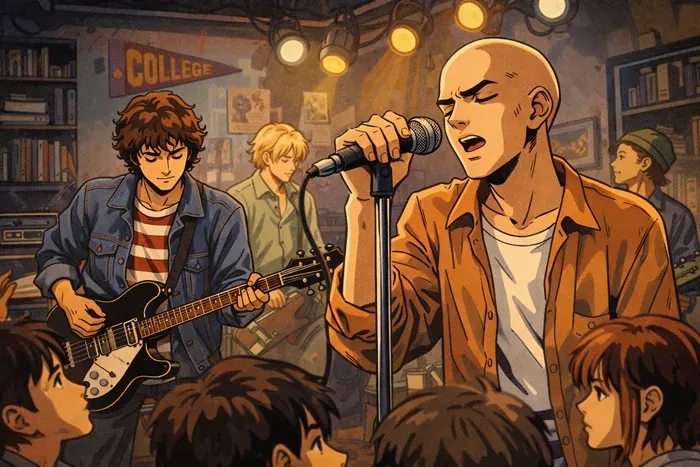
Among the bands that turned that underground network into a broader movement, R.E.M. had already built a quiet but powerful foundation. The band formed in Athens, Georgia in 1980 when singer Michael Stipe met guitarist Peter Buck, bassist Mike Mills, and drummer Bill Berry. Their early concerts took place in small clubs and university venues, the kind of spaces where word of mouth mattered more than marketing budgets.
Athens itself played an important role. The town had a strong university culture and a supportive local music scene. Artists, students, and musicians shared rehearsal rooms, art spaces, and clubs. In that setting, R.E.M. began developing a sound that felt both melodic and slightly mysterious.
Their first single, “Radio Free Europe,” appeared in 1981 on the independent label Hib-Tone. The song quickly became a favorite among college radio DJs. Peter Buck’s guitar style drew from the bright jangle associated with earlier British pop groups, while Mike Mills added melodic bass lines and vocal harmonies. Bill Berry’s drumming kept the songs grounded with a steady, restrained pulse.
Michael Stipe’s vocals gave the band a distinctive identity. His lyrics often felt impressionistic rather than literal, leaving space for listeners to interpret the meaning in their own way. That ambiguity created a sense of intrigue around the band’s songs. People returned to the music repeatedly, discovering new emotional layers with each listen.
In 1983 R.E.M. released their debut album Murmur through the independent label I.R.S. Records. The record received strong support from college radio and quickly gained critical praise. Songs like “Radio Free Europe” and “Talk About the Passion” combined melodic guitar lines with subtle atmosphere. The production avoided the polished sound that dominated much of commercial rock at the time.
R.E.M.’s success showed that an independent band could reach a national audience without abandoning its artistic identity. They toured constantly across the United States, building a loyal following city by city. Fans who heard the band on college radio often attended concerts and helped spread the music through personal networks.
As the decade progressed, albums such as Reckoning (1984) and Life’s Rich Pageant (1986) expanded the band’s reputation. Their songs carried emotional depth while remaining accessible. By the late 1980s, R.E.M. had become one of the most respected groups within the emerging alternative landscape.
Their career demonstrated a new possibility for independent guitar music. Success did not have to depend on spectacle or heavy production. Melody, thoughtful songwriting, and patient touring could build an audience just as effectively. In that sense, R.E.M. provided a working model for the alternative movement that would soon transform the wider rock world.
Sonic Youth: Noise, Tuning, and New Guitar Forms
If R.E.M. showed how independent guitar music could reach a broad audience through melody and steady growth, Sonic Youth represented another direction entirely. Formed in New York in 1981, the band approached rock music as a field for experimentation. Their work combined punk energy with avant-garde influences drawn from art, noise music, and experimental composition.
The group’s core members included Thurston Moore and Lee Ranaldo on guitars, Kim Gordon on bass and vocals, and Steve Shelley on drums, who joined in 1985. Several members had connections to New York’s downtown art scene, where musicians, filmmakers, and visual artists often collaborated. That environment encouraged Sonic Youth to treat sound not just as entertainment but as a creative material that could be shaped in unconventional ways.
One of the band’s defining techniques involved alternate guitar tunings. Instead of tuning their instruments according to standard rock conventions, Moore and Ranaldo frequently adjusted the strings to create unusual harmonic relationships. They also placed objects such as drumsticks or screwdrivers between the strings, producing resonant tones that hovered between melody and noise.
These methods gave Sonic Youth’s music a distinctive texture. Songs could begin with quiet, chiming patterns before gradually building into dense layers of sound. The band balanced dissonance with rhythm, allowing tension and release to unfold over time. Albums like Daydream Nation, released in 1988, captured that method at one of its most fully developed stages.
Daydream Nation is often regarded as one of the defining records of late-1980s alternative music. The album blends long, exploratory guitar passages with focused songwriting. Tracks such as “Teen Age Riot” and “Silver Rocket” combine melody with bursts of distortion that feel both chaotic and controlled. The production maintains clarity even when the guitars grow intense, allowing listeners to hear the interaction between the players.
Kim Gordon’s role in the band added another important dimension. Her bass lines anchored the music while her vocals brought a cool, observational tone to several songs. As one of the most visible women in the alternative rock scene of the time, Gordon also challenged the idea that experimental guitar music was a male domain.
Sonic Youth’s influence spread gradually through touring and critical support. Many younger musicians admired the band’s willingness to push beyond familiar rock structures while remaining connected to the underground network of independent labels and venues.
Through their work, Sonic Youth helped expand the vocabulary of alternative music. They demonstrated that guitars could produce far more than conventional riffs or chords. Noise, texture, and improvisation could all exist within the framework of a rock band.
Pixies: Tension, Dynamics, and the Loud-Quiet Shift
By the late 1980s, alternative rock had already developed several distinct directions. Some bands favored melodic guitar pop, others pursued experimental noise, while a number of artists continued the aggressive spirit of hardcore. The Pixies managed to combine elements of all these strands into a style that felt both strange and immediately memorable.
The band formed in Boston in 1986 around singer and guitarist Black Francis, guitarist Joey Santiago, bassist Kim Deal, and drummer David Lovering. From the beginning their songs displayed sharp contrasts. Quiet, restrained passages could suddenly explode into loud bursts of distorted guitars and intense vocals. The structure later became widely described as the “loud–quiet–loud” dynamic, though the band used it with far more subtlety than the label suggests.
Their early recordings, including the 1987 mini-album Come On Pilgrim, already hinted at this distinctive structure. Yet the Pixies’ sound reached a broader audience with the 1989 album Doolittle. The record combined tight songwriting with surreal lyrics and inventive arrangements. Tracks such as “Debaser,” “Monkey Gone to Heaven,” and “Here Comes Your Man” showed how the band could move effortlessly between melody and chaos.
Black Francis often wrote lyrics that blended biblical imagery, science fiction references, and unexpected humor. His vocal delivery shifted between gentle singing and sudden, piercing shouts. These abrupt changes created a sense of tension that kept listeners slightly off balance. Joey Santiago’s guitar lines added another layer, frequently weaving sharp melodic fragments through the songs rather than relying on traditional solos.
Kim Deal’s presence shaped the band’s sound in important ways. Her bass playing provided a steady melodic anchor, while her vocal harmonies softened some of the harsher edges of the music. She also sang lead on the song “Gigantic,” which became one of the group’s most recognizable tracks. Deal’s contribution highlighted how the band’s dynamic relied on contrast not only in volume but also in tone and perspective.
Producer Steve Albini recorded the Pixies’ 1988 album Surfer Rosa, capturing the band with a raw, immediate sound. The recording emphasized natural room acoustics and minimal studio polish, reinforcing the sense that the band’s energy came directly from performance.
Although the Pixies never achieved massive commercial success during their initial career, their influence grew steadily among other musicians. Bands that rose to prominence in the early 1990s often cited the Pixies as a key inspiration. Their ability to balance melodic clarity with sudden intensity offered a blueprint for alternative rock’s next transformation.
Nirvana, Butch Vig, and Alternative's Mainstream Break
At the beginning of the 1990s, alternative rock still existed largely outside the commercial center of the music industry. Independent labels, college radio stations, and touring circuits had created a strong network, yet mainstream charts remained dominated by polished pop and arena rock. That situation changed dramatically in 1991 with the release of Nirvana’s album Nevermind.
Nirvana formed in Aberdeen, Washington in 1987 around singer and guitarist Kurt Cobain and bassist Krist Novoselic. After several early recordings and lineup changes, drummer Dave Grohl joined the band in 1990. The group had already attracted attention through the Seattle label Sub Pop, which had been developing a regional sound often described as grunge. Their 1989 debut album Bleach carried a raw, heavy tone influenced by punk and underground rock.
Nevermind marked a turning point. The album was produced by Butch Vig, who helped shape the band’s sound without removing its intensity. Vig encouraged careful layering of guitars and vocals, giving the songs a clarity that made them accessible to a wider audience. The opening track, “Smells Like Teen Spirit,” quickly became a defining anthem of the era. Its quiet verses and explosive chorus echoed the dynamic shifts pioneered by bands such as the Pixies, yet the song carried a direct emotional force that resonated with millions of listeners.
Cobain’s lyrics often expressed confusion, alienation, and frustration with social expectations. Instead of presenting rebellion as heroic, his writing frequently acknowledged vulnerability and doubt. Songs like “Come as You Are,” “Lithium,” and “In Bloom” captured the uneasy balance between anger and introspection that defined much of the alternative movement.
The success of Nevermind surprised both the music industry and the band itself. Within months of its release, the album climbed to the top of the charts, eventually displacing Michael Jackson’s Dangerous from the number one position in the United States. Suddenly, a style of music that had grown within independent networks was dominating mainstream radio and television.
Major record labels quickly began searching for similar artists, signing bands from the American underground at an accelerated pace. While this attention brought new opportunities, it also introduced pressures that many musicians had never faced before. The underground ethos of independence collided with the expectations of a global industry.
For Nirvana, the sudden visibility proved difficult to navigate. Cobain in particular struggled with the tension between artistic ideals and public attention. Yet the impact of Nevermind was undeniable. The album changed the perception of alternative rock almost overnight, opening doors for countless bands that had previously existed outside the commercial spotlight. The breakthrough also widened the audience for artists who did not fit the older male-dominated image of guitar rock, which helps set up the next part of the story.
Women in the Breakthrough Era: Expanding Alternative Rock's Public Voice
When alternative rock surged into the mainstream during the early 1990s, women were not on the sidelines. Several artists played central roles in shaping the sound, attitude, and emotional depth of the era. Among the most influential were PJ Harvey, The Breeders, and Hole. Each approached guitar music from a different perspective, yet all challenged the narrow expectations that had often limited women in rock.
PJ Harvey emerged from the English town of Yeovil with a striking sense of artistic control. Her early recordings combined raw guitar energy with a voice that moved easily between intensity and vulnerability. The 1993 album Rid of Me, produced by Steve Albini, presented a stark and powerful sound. Harvey’s songwriting explored desire, anger, and independence with unusual directness. Tracks such as “50ft Queenie” and the title song carried a confrontational tone that refused easy categorization.
Around the same time, Kim Deal stepped into the spotlight through The Breeders. Known previously as the bassist and occasional vocalist of the Pixies, Deal formed the new group in 1989. The Breeders’ second album, Last Splash, released in 1993, became an unexpected success. The single “Cannonball” blended playful bass lines, shifting rhythms, and memorable vocal hooks. Deal’s songwriting often balanced humor with emotional honesty, offering a refreshing alternative to the more dramatic narratives that sometimes dominated rock music.
Hole, led by singer Courtney Love, represented another powerful voice within the alternative landscape. Their 1994 album Live Through This arrived during a turbulent moment in the music world, yet the record quickly earned critical respect. Songs like “Doll Parts” and “Violet” combined melodic structures with raw emotional delivery. Love’s lyrics often addressed identity, vulnerability, and the pressures placed on women in public life.
These artists did not simply add diversity to the alternative scene. They reshaped its emotional and cultural range. PJ Harvey’s intense songwriting expanded the possibilities of personal expression. Kim Deal demonstrated how playfulness and experimentation could coexist with strong melodic structure. Courtney Love confronted media narratives and public expectations with unapologetic force.
Their presence also influenced younger musicians who saw new possibilities within guitar-based music. Women could lead bands, define artistic direction, and address complex subjects without compromise. As a result, the alternative breakthrough of the 1990s became a more inclusive and dynamic moment in rock history.
Radiohead: Expanding Alternative Rock's Artistic Scale
By the middle of the 1990s, alternative rock had already transformed the music industry. Bands that once operated in small clubs now filled arenas, and independent sounds were appearing regularly on mainstream radio. In that climate, Radiohead emerged as a group that reexamined what guitar-based alternative music could become.
Radiohead formed in Oxford, England in the mid-1980s around singer Thom Yorke, guitarists Jonny Greenwood and Ed O’Brien, bassist Colin Greenwood, and drummer Philip Selway. Their early success arrived with the single “Creep” in 1992, a song that captured feelings of alienation with stark simplicity. Although the track became widely known, the band quickly grew uneasy with being defined by a single hit.
Their second album, The Bends, released in 1995, showed a more confident and expansive approach. Songs such as “Fake Plastic Trees,” “High and Dry,” and “Street Spirit (Fade Out)” combined melodic guitar arrangements with reflective lyrics. The production allowed space for quiet moments as well as emotional crescendos, giving the album a sense of scale that went beyond typical alternative rock.
Radiohead reached an even broader artistic level with OK Computer in 1997. The album explored themes of modern anxiety, technology, and social disconnection. Instead of following a straightforward rock formula, the band experimented with layered arrangements, unusual structures, and subtle electronic elements. Tracks like “Paranoid Android,” “Karma Police,” and “No Surprises” demonstrated how alternative music could remain emotionally direct while also embracing complex ideas.
Producer Nigel Godrich played an important role in shaping this sound. His collaboration with the band emphasized clarity and atmosphere rather than heavy studio polish. Instruments often appeared in carefully balanced layers, allowing the music to feel spacious and detailed at the same time.
At the turn of the new millennium, Radiohead continued expanding their approach with the albums Kid A (2000) and Amnesiac (2001). These records incorporated electronic textures, experimental rhythms, and abstract song structures. For some listeners, the shift away from traditional guitar rock felt surprising. Yet the band’s willingness to evolve reinforced the idea that alternative music could remain adventurous even after achieving global success.
Radiohead showed that large audiences did not have to limit artistic ambition. Their work traced a path from the independent spirit of the alternative scene toward a broader, more exploratory form of modern music.
British Countercurrents: Shoegaze, Madchester, and Interior Sound
While alternative rock gained international attention in the early 1990s, British guitar music was also moving along several other paths. These movements did not always compete for the same spotlight as grunge or American alternative. Instead, they explored atmosphere, texture, and rhythm in ways that expanded the emotional possibilities of guitar-based sound.
Two currents in particular stood out. One grew from the swirling guitar landscapes later described as shoegaze. Bands associated with the style focused less on traditional riffs and more on layers of sound that seemed to float and shift over time. The music often felt inward-looking, almost meditative.
The second current emerged from Manchester and its surrounding cultural network. Known loosely as the Madchester scene, the movement blended indie guitar music with the rhythms and energy of dance culture. Clubs, DJs, and bands began interacting more closely, creating a hybrid space between rock performance and club nightlife.
Together these strands showed that alternative music in Britain could move in multiple directions at once. Some artists pursued dense sonic atmospheres, while others embraced rhythm and communal energy. Both approaches would leave a lasting mark on the evolution of indie music.
My Bloody Valentine: Volume, Blur, and Emotional Texture
Among the bands associated with shoegaze, My Bloody Valentine became the most influential. Their music did not rely on traditional rock structures or clear guitar riffs. Instead, the band built dense layers of sound that seemed to move and shimmer like waves. Listening to their recordings often felt less like hearing a conventional song and more like entering a sonic environment.
The group formed in the early 1980s, though their defining period began after Irish musician Kevin Shields joined as guitarist and principal songwriter. Alongside vocalist and guitarist Bilinda Butcher, bassist Debbie Googe, and drummer Colm Ó Cíosóig, Shields developed a distinctive approach to guitar playing that would reshape alternative music.
Rather than using distortion simply to add volume or aggression, Shields treated the guitar as a tool for texture. He frequently used a technique that involved subtle movement of the tremolo arm while strumming chords. This created a wavering, fluid sound sometimes described as “glide guitar.” When combined with layers of effects such as reverb and delay, the result produced tones that seemed to blur and bend in the air.
Their 1991 album Loveless became the definitive statement of that style. The recording process was famously meticulous, stretching across multiple studios and extended sessions. Yet the final result felt strangely weightless. Songs like “Only Shallow,” “When You Sleep,” and “Sometimes” surrounded the listener with thick guitar layers while soft vocals floated within the mix.
Bilinda Butcher’s voice contributed greatly to the album’s atmosphere. Instead of dominating the arrangement, her singing blended gently into the surrounding textures. The words often appeared slightly obscured, allowing the emotional tone of the music to carry as much meaning as the lyrics themselves.
Shoegaze as a label emerged partly from journalists observing the performance style of these bands. Musicians often stood relatively still on stage, focusing on their pedals and equipment rather than dramatic stage movement. The name was meant humorously, yet it captured the introspective mood of the music.
Despite modest commercial success at the time, Loveless became widely admired by musicians and critics. Its influence extended into dream pop, indie rock, and later electronic music scenes. Many artists studied the album’s production techniques and its use of layered sound.
My Bloody Valentine demonstrated that guitars could express emotion not only through melody or rhythm but through texture itself. Their work opened a path for artists interested in building immersive sonic worlds rather than traditional rock performances.
Slowdive: Dream Pop, Space, and Suspension
While My Bloody Valentine explored the outer limits of guitar texture, another band within the shoegaze landscape approached atmosphere in a more reflective way. Slowdive developed a sound that felt calm, spacious, and emotionally open. Their music moved slowly, often unfolding like a long breath rather than a sudden burst of energy.
Slowdive formed in Reading, England in 1989 around guitarist and singer Neil Halstead, vocalist and guitarist Rachel Goswell, guitarist Christian Savill, bassist Nick Chaplin, and drummer Simon Scott. The group emerged during a moment when British indie music was experimenting with layers of sound and mood. Instead of focusing on sharp contrasts, Slowdive preferred gentle transitions and gradual development.
Their early recordings already pointed in that direction. The band’s guitars often shimmered through reverb and delay, creating tones that seemed to drift through the mix. Rather than dominating the arrangement, the instruments blended together in soft waves. That approach allowed each song to feel immersive and contemplative.
The band’s second album, Souvlaki, released in 1993, became the defining example of their style. The record balanced melodic songwriting with expansive sonic textures. Tracks such as “Alison” and “When the Sun Hits” carry a quiet emotional intensity. The music builds slowly, allowing the listener to settle into its atmosphere rather than rushing toward a dramatic climax.
Vocals played an important role in shaping that atmosphere. Halstead and Goswell often sang in gentle, overlapping harmonies. Their voices blended with the guitars rather than standing apart from them. The lyrics frequently explored themes of memory, distance, and emotional uncertainty. Instead of direct statements, the songs offered fragments of feeling that listeners could interpret in their own way.
At the time of its release, Souvlaki received mixed reactions from parts of the British music press. Some critics were beginning to favor more energetic guitar music connected to the emerging Britpop scene. Yet over time the album gained a growing audience who appreciated its subtlety and emotional depth.
Slowdive’s influence continued quietly through later decades. Many artists working in dream pop, indie rock, and ambient-influenced music drew inspiration from the band’s ability to create atmosphere without losing melodic clarity.
Where My Bloody Valentine pushed shoegaze toward sonic density, Slowdive revealed another side of the movement. Their music demonstrated that introspection and calm could carry just as much emotional power as noise or volume.
The Stone Roses: Dance Rhythms in Guitar Music
While shoegaze bands explored inward-looking atmospheres, another movement in Britain was building a very different kind of energy. In Manchester, guitar music began blending with the rhythms and social environment of club culture. The band most closely associated with that shift was The Stone Roses.
Formed in 1983, the group eventually settled into a lineup featuring singer Ian Brown, guitarist John Squire, bassist Mani, and drummer Reni. By the late 1980s they had developed a sound that combined melodic guitar songwriting with grooves influenced by dance music. Their approach felt both nostalgic and forward-looking at the same time.
The band’s 1989 debut album The Stone Roses captured this balance beautifully. Tracks such as “I Wanna Be Adored,” “She Bangs the Drums,” and “Made of Stone” carried bright guitar lines and confident rhythms. John Squire’s playing drew inspiration from 1960s British pop and psychedelic rock, yet the arrangements felt modern and spacious.
Reni’s drumming played a key role in shaping the band’s identity. Instead of the rigid patterns common in much rock music, he brought a looser, groove-oriented style influenced partly by funk and dance rhythms. Mani’s bass lines complemented that groove-oriented style, giving the songs a flowing sense of movement that translated well both on stage and in club environments.
Manchester’s wider cultural context helped support this blend of rock and dance energy. Clubs like the Haçienda had already begun attracting audiences interested in electronic music and DJ culture. As these scenes overlapped, bands such as The Stone Roses found themselves performing for crowds who were comfortable moving between live concerts and dance floors.
The atmosphere surrounding the group often felt celebratory. Concerts became communal events where audiences sang along and shared a sense of optimism that contrasted with the darker tone of much post-punk music. This spirit later became associated with the term Madchester, a loose label used to describe the mixture of indie rock, dance rhythms, and club culture emerging from the city.
Although the band released only one studio album during their initial period of influence, the impact of The Stone Roses proved long lasting. Many later British guitar bands looked back to the record as a moment when melody, groove, and atmosphere came together in a fresh way.
Through this synthesis, The Stone Roses helped demonstrate that guitar music could coexist naturally with dance culture. Their work expanded the possibilities of indie rock and contributed to a more communal, rhythmic dimension within alternative music.
Primal Scream: Indie Rock Meets Rave Culture
If The Stone Roses helped open the door between guitar music and dance culture, Primal Scream walked directly through it. By the end of the 1980s, club culture in Britain had become a powerful social force. Acid house parties, DJs, and late-night dance floors were changing how people experienced music together. Instead of separating rock concerts and club nights, some artists began exploring how the two worlds might overlap.
Primal Scream had originally formed in Glasgow in the early 1980s around singer Bobby Gillespie and guitarist Jim Beattie. Their earliest recordings leaned toward jangling indie pop influenced by bands like The Byrds. Over time the group grew restless with that sound and started experimenting with rhythm and production.
The turning point arrived with the album Screamadelica, released in 1991. The record blended rock songwriting with the techniques and textures of dance music. Instead of relying only on traditional band arrangements, the group worked with producers and DJs who introduced sampling, electronic rhythms, and layered studio effects.
One of the key collaborators was producer Andrew Weatherall, who helped reshape the band’s direction during the recording sessions. Weatherall brought knowledge from the club scene, particularly the long, hypnotic grooves associated with house music. These influences encouraged the band to think differently about structure and rhythm.
Songs such as “Loaded,” “Come Together,” and “Movin’ On Up” illustrate this transformation. “Loaded,” built around a relaxed groove and spoken fragments from a film dialogue sample, feels as comfortable in a nightclub as on a rock stage. “Movin’ On Up” carries a gospel-influenced chorus while still maintaining the album’s dance-oriented pulse.
Screamadelica arrived during a period when many young listeners were moving between clubs and live shows without feeling a strict boundary between them. The album captured that cultural moment. Its music suggested that guitars, synthesizers, and dance beats could share the same creative space.
The success of the record also broadened the definition of alternative music. Until then, many alternative bands had defined themselves partly through resistance to mainstream trends. Primal Scream showed that experimentation could also involve embracing new forms of collaboration and production.
Through this fusion of rave culture and indie rock, Screamadelica became one of the most influential albums of its era. It demonstrated that the spirit of alternative music was not limited to a single sound. Instead, it could absorb new influences and reshape them into something unexpected.
Britpop: When Guitar Music Became a National Debate
As shoegaze, Madchester, and rave-influenced rock developed, another British current was moving toward a more public and confrontational form of guitar music. By the mid-1990s, Britpop turned independent and alternative styles into a national conversation about class, region, identity, and popular culture. It did not emerge from nowhere. It drew on earlier indie guitar traditions, glam swagger, 1960s British pop, and the confidence that bands like The Smiths and The Stone Roses had already restored to homegrown guitar music.
Suede helped signal the shift in the early 1990s by pairing dramatic songwriting with a distinctly British frame of reference. Blur then sharpened that perspective on albums such as Modern Life Is Rubbish and Parklife, writing about everyday English life with wit and satire. Oasis took a different route. Their songs sounded larger, more direct, and more openly anthemic, turning working-class confidence and melodic immediacy into a mass popular language. Pulp added yet another voice, bringing sharp observation and social tension into songs that examined aspiration, embarrassment, and desire.
The movement mattered because it changed scale. In earlier decades, alternative guitar music often grew through college radio, niche press, and local scenes. Britpop moved those energies into tabloids, chart battles, television, and festival headlines. The famous media framing around Blur and Oasis simplified the scene, but it also revealed something important: guitar music associated with independence could now dominate mainstream attention without sounding Americanized or hidden.
That visibility created both opportunity and distortion. On one hand, Britpop gave many bands access to huge audiences and restored commercial force to guitar-centered music in Britain. On the other hand, the press often reduced a diverse field into a narrow story about rivalry, laddishness, and national pride. Some strands of indie culture fit that story easily, while others did not. Women, queer artists, and quieter scenes often received less space in the dominant media version of the movement.
Britpop therefore belongs in this article not only as a commercial peak, but also as a debate about what happens when alternative music enters the center of public culture. It proved that independent guitar language could become mass entertainment. At the same time, it raised an old question in a new form: once the underground becomes visible everywhere, what still counts as alternative?
That question connects Britpop to the softer C86 lineage that follows. Both emerged from British independent culture, but they answered its possibilities in very different ways. One looked outward toward spectacle and chart presence. The other kept insisting on intimacy, modest scale, and emotional lightness.
C86 and Indie Pop: Softness Against Rock Machismo
Not every response to punk and post-punk moved toward heavier guitars or darker atmospheres. Running alongside those louder and denser styles, another strand of independent music developed in the mid-1980s that sounded lighter, more melodic, and sometimes deliberately fragile. The movement later became associated with what listeners began calling indie pop.
The roots of that style can be traced partly to a compilation cassette released in 1986 by the British magazine NME. Known simply as C86, the tape introduced a collection of young guitar bands whose music favored jangling melodies, simple arrangements, and a sense of emotional openness. The songs often felt intimate rather than dramatic.
Some critics initially dismissed that approach as naive or overly gentle. Yet the sound carried a quiet confidence. Instead of competing with the intensity of hardcore or the sonic density of shoegaze, these artists embraced clarity, vulnerability, and everyday observation.
Labels such as Sarah Records later helped nurture this aesthetic, releasing music that valued sincerity and independence over commercial ambition. The influence of this softer indie tradition would continue into the 1990s and beyond, shaping bands who believed that subtlety could be just as powerful as volume.
C86: A Template for Jangle Pop and Indie Sensibility
In 1986 the British music magazine NME released a cassette compilation that would later become one of the most discussed artifacts of the independent music scene. The tape, titled C86, gathered songs from a wide range of emerging bands and was originally meant simply as a snapshot of the moment. Yet over time it came to symbolize a particular approach to guitar music that would shape the development of indie pop.
The artists featured on the compilation did not all sound alike. Bands such as The Pastels, Primal Scream, The Wedding Present, and Shop Assistants each brought their own style. What connected them was a shared emphasis on bright guitar melodies, simple arrangements, and a sense of emotional directness. The sound drew inspiration from earlier British pop groups as well as from the jangling guitar textures associated with American bands like R.E.M.
Guitars often carried clean tones rather than heavy distortion. Musicians favored ringing chords and quick melodic patterns that created an open, shimmering quality. The songs were usually short and focused, built around memorable hooks rather than long instrumental sections. Vocals often sounded slightly fragile or conversational, reinforcing the intimate feeling of the music.
The style did not attempt to dominate the listener through sheer force. Instead it invited attention through clarity and warmth. For audiences who felt distant from the intensity of hardcore or the theatrical elements of mainstream rock, the C86 sound offered a different emotional space.
The compilation also reflected the role of independent labels in nurturing new bands. Many of the groups involved released their recordings through small companies that valued artistic freedom over large sales figures. Records circulated through independent shops, mail order catalogs, and college radio stations. Listeners who discovered one band often explored others within the same network.
Over time, the phrase “C86” began to describe more than the cassette itself. It became shorthand for a broader indie pop aesthetic. The jangling guitar sound, modest production, and introspective lyrics influenced later artists across Britain and beyond.
Some musicians resisted the label, feeling that it simplified a diverse scene into a single category. Yet the impact of the compilation remained clear. C86 helped draw attention to a generation of bands who believed that guitar music could remain gentle, melodic, and personal without losing its independence.
In doing so, the cassette quietly helped define one of the emotional foundations of indie culture.
Sarah Records: Sincerity, Community, and Soft Power
If the C86 cassette captured a moment of emerging indie pop energy, the Bristol-based label Sarah Records later became one of the clearest expressions of that spirit. Founded in 1987 by Clare Wadd and Matt Haynes, the label operated on a small scale, yet its influence on independent music proved lasting. Sarah Records approached indie pop not only as a sound but also as a cultural attitude centered on sincerity, independence, and emotional openness.
The label released records by bands such as Heavenly, The Field Mice, Another Sunny Day, and Blueboy. These groups often shared certain musical qualities. Songs tended to feature bright, jangling guitars, soft vocal performances, and melodic bass lines. Instead of dramatic production, the recordings maintained a simple, intimate tone that made the music feel personal and direct.
What set Sarah Records apart was the philosophy behind the label’s work. Wadd and Haynes believed that independent music could resist the competitive culture of the mainstream industry. Rather than chasing chart success, they focused on building a small community of listeners who appreciated thoughtful songwriting and emotional honesty.
The label’s visual presentation also reflected that philosophy. Sarah Records releases often featured gentle colors, minimal design, and handwritten elements that felt warm and personal. Even the packaging suggested a sense of closeness between artists and listeners.
Heavenly became one of the label’s most recognized bands. Led by singer and songwriter Amelia Fletcher, the group combined upbeat guitar melodies with lyrics that explored relationships, identity, and everyday experiences. Fletcher’s clear vocal delivery gave the songs a conversational tone that resonated strongly with audiences in the indie scene.
The Field Mice approached similar themes from a more introspective angle. Their music often carried a quiet melancholy, with delicate arrangements and reflective lyrics. Albums such as Snowball helped define the emotional atmosphere that many listeners later associated with indie pop’s softer side.
Sarah Records operated for only a few years before closing in 1995, yet the label left behind a distinctive legacy. Its releases demonstrated that gentle, melodic guitar music could carry depth and sincerity without adopting the dramatic gestures often associated with rock culture.
In later decades, musicians in indie pop and bedroom recording scenes frequently cited Sarah Records as an inspiration. The label’s belief in small communities, artistic freedom, and emotional transparency helped shape a lasting model for independent music culture.
Belle and Sebastian: Narrative Intimacy in Late-1990s Indie
By the mid-1990s, many strands of alternative music had become louder, heavier, and more visible in the mainstream. Yet another current continued developing quietly within the independent scene. That tradition drew from the gentle guitar textures of C86 and the emotional sensitivity associated with labels like Sarah Records. One of the bands that carried that tradition forward most clearly was Belle and Sebastian.
The group formed in Glasgow in 1996 around singer and songwriter Stuart Murdoch. Their early recordings emerged from a modest environment connected to a local music course at Stow College. Rather than presenting themselves as a typical rock band, Belle and Sebastian built a sound that felt closer to a small ensemble. Guitars, keyboards, strings, and soft percussion blended into arrangements that emphasized melody and storytelling.
Their debut album Tigermilk appeared in 1996 in a very limited pressing, quickly gaining attention within independent circles. A wider audience discovered the band through their second album, If You’re Feeling Sinister, released the same year. Songs like “The Stars of Track and Field” and “Judy and the Dream of Horses” combined gentle instrumentation with carefully observed lyrics.
Murdoch’s writing often focused on characters who felt slightly outside the mainstream of social life. Students, dreamers, and quiet observers moved through his songs with a mixture of humor and empathy. Rather than presenting dramatic narratives, the music offered small moments of recognition that listeners could interpret personally.
The band’s arrangements also helped define their identity. Acoustic guitars often carried the main structure, supported by subtle keyboard textures or string sections. Female vocalists such as Isobel Campbell added harmonies that softened the emotional tone of the songs. The overall sound felt warm and intimate, inviting listeners into a reflective space.
Belle and Sebastian became particularly influential within indie circles that valued understatement and careful songwriting. Their concerts attracted audiences who appreciated the band’s calm stage presence and thoughtful lyrics. Instead of relying on spectacle, the group created a sense of shared attention between performers and listeners.
Through their approach, Belle and Sebastian continued a tradition that had been developing since the mid-1980s. Indie music did not have to compete through volume or aggression. Soft melodies, detailed storytelling, and emotional subtlety could carry just as much artistic weight.
In that sense, the band helped preserve and renew a quieter strand of alternative culture. Their work reminded listeners that independence in music could also mean the freedom to remain gentle, reflective, and deeply personal.
Lo-Fi and Home Recording: Intimacy Before Bedroom Indie
Before the phrase “bedroom indie” became common, another tradition had already shown that limited recording conditions could become part of a musician’s identity rather than a problem to hide. In the 1980s and 1990s, lo-fi scenes treated cassette culture, four-track recorders, and small home setups as practical tools for artistic freedom. The results often sounded rough around the edges, but that roughness carried meaning. It told listeners that intimacy, immediacy, and personal control mattered more than studio polish.
One important center of this ethic was Olympia, Washington, where K Records and artists such as Beat Happening helped define a deliberately unpretentious model of independent music. Calvin Johnson and his circle showed that a record could sound handmade without sounding careless. Simplicity became a statement against professional polish and macho performance culture. The music often felt small in scale, but its values were expansive.
Elsewhere, bands such as Sebadoh and Guided by Voices pushed home recording in more fragmentary and restless directions. Songs could arrive as sketches, bursts of melody, or emotionally exposed miniatures. Tape hiss, room sound, and uneven levels were not always corrected. They became part of the listening experience. This did not mean lo-fi artists lacked ambition. It meant they were willing to let process remain audible.
Lo-fi also changed how listeners understood authorship. Instead of imagining records as products made only in expensive studios, audiences increasingly heard them as documents of a person’s room, habits, and available tools. That shift mattered for the future of indie because it normalized the idea that songs could move directly from private space to public circulation. A musician no longer needed full institutional backing to make a convincing artistic world.
At the same time, lo-fi was never just one sound. Some artists used it for fragile folk songs, others for noisy guitar pop, still others for collage-like experimentation. What united them was not fidelity level alone, but an attitude toward access and control. Home recording made it easier to test ideas quickly, preserve vulnerability, and resist the pressure to smooth every edge for the market.
This history forms the missing bridge between earlier indie pop and later bedroom indie. When digital recording tools became cheap and widely available, they did not create the desire for intimate self-made music from nothing. They accelerated an older practice. Bedroom indie inherited lo-fi’s trust in closeness, its acceptance of imperfection, and its belief that a small recording environment could still produce lasting emotional force.
From Indie Pop to Bedroom Indie: Intimacy in the Digital Era
The softer strand of indie music that grew from C86 and labels like Sarah Records did not disappear in the late 1990s. Instead it slowly evolved as recording technology became more accessible. Affordable home equipment, computer-based recording software, and the internet allowed musicians to create and distribute music without needing traditional studio environments. From these conditions emerged what many listeners later described as bedroom indie.
The phrase does not refer only to where the music was recorded. It also describes an aesthetic that values intimacy and emotional closeness. Songs often sound as if they were made in private spaces, with minimal production and quiet arrangements. The goal is not technical perfection but authenticity and atmosphere.
One of the early artists who embodied this spirit was Elliott Smith. His albums during the late 1990s, including Either/Or from 1997, presented delicate acoustic guitar work paired with soft, layered vocals. Smith’s songwriting carried a deep sense of introspection. Tracks such as “Between the Bars” or “Angeles” revealed how fragile arrangements could hold powerful emotional weight.
In the following decade, the same approach continued to spread. Independent musicians began recording albums in bedrooms, apartments, and small home studios. Online platforms made it possible to share these recordings directly with listeners around the world. The connection between artist and audience became more immediate and less dependent on traditional industry structures.
Artists such as Sufjan Stevens explored similar territory while expanding the scale of arrangements. His 2005 album Illinois combined intimate songwriting with orchestral textures, demonstrating that quiet indie music could still embrace ambitious musical ideas.
Later in the 2000s and 2010s, musicians like Phoebe Bridgers and others within the indie singer-songwriter landscape continued developing this emotionally direct style. Their songs often revolve around subtle arrangements, conversational lyrics, and a focus on personal experience.
Bedroom indie does not exist as a strict genre with fixed boundaries. Instead it reflects a continuation of the independent ethos that began with punk’s do-it-yourself spirit and later appeared in indie pop. Technology simply made that independence easier to practice.
The thread connecting these artists lies in their willingness to keep the music personal and understated. Even as alternative rock moved through louder and more commercial phases, this quieter tradition remained active. It preserved the idea that small sounds and careful words can create lasting emotional connections between musicians and listeners.
Riot Grrrl: Feminism, Anger, and DIY Media
During the early 1990s, while alternative rock was gaining global visibility, a more grassroots movement was taking shape in smaller venues and independent networks across the United States. Known as Riot Grrrl, it connected music with feminist activism, zine culture, and grassroots organizing. It grew from a desire to challenge the ways women were often marginalized within punk and alternative scenes.
Riot Grrrl was not defined only by a musical style. It also involved meetings, handwritten manifestos, and a network of zines that circulated ideas between cities such as Olympia, Washington and Washington, D.C. Musicians, writers, and fans created spaces where discussions about gender, identity, and personal experience could take place openly.
The music itself often returned to punk’s raw simplicity. Short songs, sharp guitars, and direct lyrics allowed artists to communicate urgent messages without elaborate production. Yet the cultural impact of Riot Grrrl extended beyond sound. It reshaped how many young women approached participation in music scenes.
Bands like Bikini Kill and later Sleater-Kinney became central voices within this movement. Their work helped expand the meaning of independence in alternative culture, showing that creative freedom could also involve challenging social structures within the scene itself.
Bikini Kill: Confrontation, Community, and Voice
When Riot Grrrl began to take shape in the early 1990s, Bikini Kill quickly became one of its most visible bands. Formed in Olympia, Washington, the group brought together singer Kathleen Hanna, guitarist Billy Karren, bassist Kathi Wilcox, and drummer Tobi Vail. Their music drew from punk’s raw simplicity, yet the intention behind it went far beyond sound. For the band and their community, music became a tool for communication, solidarity, and resistance.
Olympia already had a strong independent culture. Small venues, art spaces, and college communities created an environment where musicians and writers could share ideas freely. The nearby city of Washington, D.C. also contributed to this network through labels such as Dischord Records and a history of politically aware punk scenes. Riot Grrrl developed through this connection between cities.
Bikini Kill’s songs were often short and direct. Tracks like “Rebel Girl” and “Double Dare Ya” delivered messages about confidence, friendship, and confronting gender expectations. Kathleen Hanna’s vocal style combined urgency with clarity. On stage she encouraged women in the audience to move toward the front of the room, creating a safer and more visible space within concerts that had often been dominated by aggressive male crowds.
The band also participated in the wider Riot Grrrl network of zines and discussion groups. Zines written by musicians and fans circulated ideas about feminism, personal experience, and cultural change. These small publications often included essays, artwork, and letters from readers who shared similar frustrations with sexism both inside and outside music scenes.
Meetings organized under the Riot Grrrl name allowed participants to speak openly about issues such as harassment, body image, and representation in media. These gatherings were not always easy. Disagreements sometimes arose about strategy or direction. Yet the process itself helped many participants feel less isolated.
Bikini Kill’s recordings, including their 1993 album Pussy Whipped, captured the urgency of the movement. The production remained raw, reflecting the band’s connection to punk’s do-it-yourself tradition. What mattered most was the directness of the message and the sense of shared experience among listeners.
The influence of Bikini Kill extended far beyond their years as an active band. Their music and activism encouraged a generation of artists to see independent scenes as spaces where social questions could be addressed openly. Riot Grrrl demonstrated that cultural change could begin with small networks of people willing to speak honestly and support one another.
Sleater-Kinney: Precision, Politics, and Momentum
As the Riot Grrrl movement evolved during the 1990s, several bands carried its energy into new musical territory. Among the most significant was Sleater-Kinney, a group that expanded the sound and scope of feminist punk while maintaining the independence and urgency that had defined the earlier scene.
Sleater-Kinney formed in Olympia, Washington in 1994. The core members were guitarist and vocalist Corin Tucker, guitarist and vocalist Carrie Brownstein, and drummer Janet Weiss, who joined the band shortly afterward. Tucker and Brownstein had both been connected to Riot Grrrl circles, yet Sleater-Kinney quickly developed a musical identity that stood on its own.
One of the most distinctive aspects of the band’s sound was the absence of a bass guitar. Instead, Tucker and Brownstein built dense guitar arrangements that intertwined rhythm and melody. Their playing often moved in opposite directions, creating tension and movement inside the songs. Janet Weiss’s drumming provided a powerful foundation, giving the music both momentum and clarity.
The band’s early albums already showed this dynamic approach, but their 1997 record Dig Me Out marked a major breakthrough. Produced by John Goodmanson, the album captured the group’s live intensity while allowing space for sharp musical detail. Songs such as “One More Hour” and “Little Babies” combined raw energy with thoughtful songwriting.
Lyrically, Sleater-Kinney addressed themes of identity, relationships, and social expectations with unusual honesty. Corin Tucker’s voice carried a remarkable emotional range, moving from quiet reflection to explosive intensity within the same song. Carrie Brownstein contributed a different perspective through her own lyrics and guitar work, often balancing Tucker’s dramatic vocal style with precise melodic lines.
The band’s concerts became known for their energy and sense of connection with audiences. Rather than relying on theatrical stage gestures, Sleater-Kinney built their performances around musical interaction and shared enthusiasm. The chemistry between the three musicians created a powerful presence that translated easily to live settings.
Through albums such as The Hot Rock (1999) and All Hands on the Bad One (2000), the band continued developing their sound. Critics and listeners alike began recognizing Sleater-Kinney as one of the most important groups within the alternative landscape of the late 1990s.
What made their work especially significant was the way it carried Riot Grrrl’s ideas into a broader musical conversation. Sleater-Kinney demonstrated that feminist perspectives within punk could evolve musically while remaining deeply rooted in independence and community.
Media Framing, Backlash, and Who Gets Heard
As Riot Grrrl gained attention in the early 1990s, the movement quickly encountered the complicated relationship between underground culture and media coverage. Journalists who were unfamiliar with the community often tried to simplify its message. Articles sometimes focused on sensational details rather than the deeper discussions taking place within the scene. This tension shaped how the movement was perceived both inside and outside independent music circles.
Many Riot Grrrl participants had originally used zines and small gatherings as spaces where conversations could unfold without outside pressure. These forums allowed individuals to discuss personal experiences, including harassment, discrimination, and identity. When mainstream publications began writing about the movement, those private conversations suddenly became public topics. Some musicians felt that their ideas were being misrepresented or reduced to slogans.
In response, several Riot Grrrl groups chose to limit their interaction with larger media outlets. Instead of giving interviews freely, they encouraged journalists to read the zines or attend meetings in order to understand the movement more fully. That strategy reflected a desire to maintain control over how the story was told.
The backlash that followed revealed how challenging it could be to change cultural expectations within music scenes. Critics sometimes dismissed Riot Grrrl as overly confrontational or politically narrow. Others misunderstood its emphasis on personal narratives and collective discussion. Yet these reactions also highlighted the importance of the questions the movement raised.
Over time, the broader alternative music landscape began to recognize the significance of Riot Grrrl’s contributions. Musicians who grew up hearing Bikini Kill or Sleater-Kinney later cited them as inspirations for their own work. Conversations about representation, safety at concerts, and gender equality continued to shape independent music communities.
Canon formation in music history often moves slowly. Certain artists and records become widely celebrated, while others remain less visible despite their influence. Riot Grrrl challenged that process by insisting that different voices deserved attention. The movement encouraged listeners to reconsider which stories were included in the history of alternative music.
Today, the legacy of Riot Grrrl extends beyond a single decade or style. Its emphasis on community, self-expression, and cultural critique continues to influence artists who seek to reshape independent music scenes.
Producers and Studios: How Alternative Learned to Sound
By this point in the story, bands alone were clearly not shaping the sound of alternative music. Another group of figures worked just behind them: producers, engineers, and studios. They played a crucial role in turning ideas into recordings that listeners could actually hear and remember.
During the late 1970s and 1980s, many independent bands recorded in modest environments. Budgets were limited, and studio time was often short. Under these conditions, producers developed creative strategies to capture the character of a band without smoothing away its rough edges. Some emphasized atmosphere and space, while others focused on clarity and immediacy.
The relationship between artist and producer could become a form of collaboration. Decisions about microphone placement, room acoustics, and mixing techniques often influenced how a record communicated emotion. A guitar tone, a drum sound, or the balance between instruments could define the identity of an entire album.
Figures such as Martin Hannett, Steve Albini, Butch Vig, and Nigel Godrich approached this role in different ways. Each helped shape recordings that expanded the possibilities of alternative music. Through their work, the studio became not just a technical space but a creative environment where new sonic ideas could emerge.
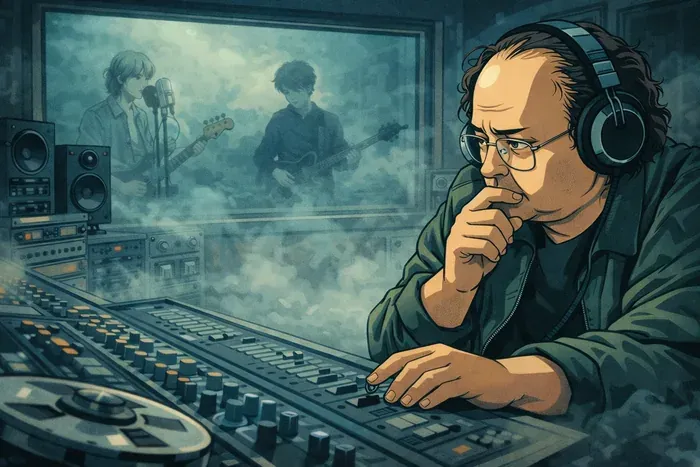
Martin Hannett: Atmosphere as Production Method
Among the producers who helped shape the early sound of post-punk, Martin Hannett remains one of the most influential. His work during the late 1970s demonstrated that the recording studio could be more than a place to document a band’s live performance. For Hannett, the studio became a space where atmosphere, texture, and emotional distance could be carefully built.
Hannett worked closely with Factory Records, the Manchester label that supported artists such as Joy Division and later New Order. The environment around Factory encouraged experimentation. Tony Wilson and the label’s collaborators often allowed producers and musicians the freedom to try unusual recording methods without pressure to follow commercial formulas.
Hannett’s approach relied heavily on space. Instead of placing all instruments tightly together in the mix, he separated them across the sonic landscape. Drums might echo through a room, guitars could appear far away, and bass lines might emerge clearly at the center of the recording. This technique gave the music a sense of depth that felt unusual for guitar-based bands of the time.
His work with Joy Division provides the most well-known example. On the band’s 1979 album Unknown Pleasures, Hannett used careful microphone placement and studio effects to transform the group’s raw performances into something haunting and atmospheric. The drums sound crisp and distant at the same time, while Peter Hook’s melodic bass lines remain clear even within dense arrangements.
This sonic environment shaped how listeners experienced the music. Instead of sounding like a band performing in a crowded room, the recordings suggested wide, empty spaces that mirrored the emotional tone of Ian Curtis’s lyrics. The result was a kind of architectural sound design where silence and distance carried as much meaning as the notes themselves.
Hannett also introduced small sonic details that added character to the recordings. Mechanical sounds, subtle electronic effects, and unusual reverberation techniques appeared throughout the mix. These elements created a slightly surreal atmosphere that distinguished the record from traditional rock production.
His influence extended beyond Joy Division. Other post-punk artists began experimenting with similar ideas about space and texture. Producers in later decades often cited Hannett’s work as an early example of how recording techniques could shape the emotional identity of a song.
Through that method, Martin Hannett helped redefine the relationship between band and studio. The recording itself became a creative object, capable of expressing mood and atmosphere in ways that live performance alone could not achieve.
Steve Albini: Recording as Ethics and Argument
After Martin Hannett showed how atmosphere could be constructed in the studio, another figure pushed in a very different direction. Few producers in alternative music have spoken as openly about recording philosophy as Steve Albini. Active since the 1980s as both a musician and an engineer, Albini developed a reputation for treating the recording studio as a place of documentation rather than transformation. His goal was to capture the sound of a band as honestly as possible.
Albini first gained attention through his own bands, particularly Big Black, whose aggressive, industrial-leaning punk helped define a harsher edge of the American underground. Yet his influence spread even more widely through his work behind the mixing console. Over several decades he recorded hundreds of albums for independent artists across the punk, alternative, and indie spectrum.
His approach to engineering focused on clarity and physical presence. Albini preferred recording musicians together in the same room rather than layering parts separately over long sessions. Microphones were placed carefully to capture the natural acoustics of the space. Instead of heavily compressing or polishing the sound, he aimed to preserve the dynamic range of the performance.
This philosophy became widely known through his work with bands such as Pixies and PJ Harvey. The Pixies’ 1988 album Surfer Rosa stands as a clear example. Albini’s production emphasized the raw interaction between instruments. Guitars sounded sharp and immediate, while the drums carried a powerful, room-filling resonance. The recording felt direct and unfiltered.
A few years later Albini recorded PJ Harvey’s album Rid of Me in 1993. The sessions captured the intensity of Harvey’s trio with remarkable clarity. Songs such as the title track move from quiet tension to explosive release without losing detail in either moment. Albini’s method allowed the band’s dynamics to remain intact.
He also recorded Nirvana’s album In Utero in 1993. By that point Nirvana had become one of the most visible bands in the world after the success of Nevermind. Albini approached the project with the same principles he used for smaller independent acts. The recording sessions focused on capturing the band playing together rather than constructing the music through extensive studio layering.
Beyond technical decisions, Albini often spoke about the ethics of recording work. He preferred to be credited as an engineer rather than a producer, emphasizing that the music belonged to the band. He also rejected the traditional royalty system used in the recording industry, choosing instead to charge a fixed fee for his work.
Through this combination of technical skill and clear philosophy, Steve Albini influenced how many independent musicians approached recording. His work suggested that honesty in sound could carry as much artistic value as elaborate studio production.
Butch Vig and Nigel Godrich: Scale, Clarity, and Control
While some producers in the alternative world focused on capturing raw performances, others explored how studio techniques could expand the emotional and sonic scale of a band’s music. Two figures who played a central role in that studio-centered approach were Butch Vig and Nigel Godrich. Each helped shape albums that reached large audiences without abandoning the creative spirit of alternative music.
Butch Vig first became widely known through his work on Nirvana’s 1991 album Nevermind. Before that breakthrough, Vig had already been active in the American underground scene, recording bands at Smart Studios in Madison, Wisconsin. His experience with independent artists helped him understand the balance between rough energy and accessible sound.
During the Nevermind sessions, Vig encouraged the band to refine their arrangements while preserving the intensity of their playing. Kurt Cobain’s vocals were carefully layered, and guitar parts were recorded with clarity that allowed the songs to sound powerful on both radio and large sound systems. Tracks like “Smells Like Teen Spirit” and “Lithium” carried explosive dynamics but remained easy to follow structurally.
The success of Nevermind demonstrated that alternative music could reach a massive audience without losing its emotional edge. Vig later continued working with artists across different styles, often maintaining this balance between precision and raw energy.
Nigel Godrich approached production from a slightly different angle. His collaboration with Radiohead became one of the most important creative partnerships in modern alternative music. Beginning with The Bends in 1995 and continuing through later albums, Godrich helped the band explore increasingly detailed sonic landscapes.
Rather than emphasizing volume alone, Godrich focused on atmosphere and spatial depth. Instruments were arranged carefully within the stereo field, creating a sense of openness that allowed subtle textures to emerge. On OK Computer from 1997, that approach helped shape songs such as “Paranoid Android” and “Karma Police.” The production allowed complex arrangements to remain clear while supporting the emotional weight of the lyrics.
Godrich continued developing this method on Radiohead’s later records, including Kid A and In Rainbows. Electronic sounds, acoustic instruments, and experimental recording techniques blended together in ways that felt cohesive rather than fragmented.
Together, Butch Vig and Nigel Godrich illustrate two paths through which producers helped alternative music grow. Vig showed how underground energy could translate to mainstream audiences through thoughtful production. Godrich demonstrated how large-scale recordings could remain adventurous and emotionally nuanced.
Their work reveals that the studio itself can become an instrument. Through careful collaboration between musicians and producers, alternative music expanded its sonic possibilities while reaching listeners around the world.
Queer Visibility in Alternative Music
From its earliest years, punk and alternative culture often presented itself as a place for outsiders. Yet that promise of openness was never experienced equally by everyone. Musicians who openly explored queer identity sometimes found both support and resistance within the same communities.
During the 1980s and 1990s, a number of artists began expressing sexuality, gender identity, and personal vulnerability in ways that challenged conventional expectations in rock music. Some did so through direct political language, while others approached these themes through subtle storytelling or emotional openness.
Alternative music scenes provided certain advantages for this kind of expression. Independent labels and smaller venues often allowed artists to work outside the stricter expectations of mainstream entertainment. At the same time, these spaces were not automatically free from prejudice. Musicians still had to navigate social pressures and public reactions.
Artists such as Morrissey, Michael Stipe, Kathleen Hanna, and Laura Jane Grace each engaged with questions of identity in different ways. Their work helped expand the cultural meaning of alternative music, demonstrating that independence could also involve the freedom to explore personal truth within public art.
Morrissey, The Smiths, and Queer Ambiguity in Indie
Among the artists who opened queer space through ambiguity rather than direct slogans, Morrissey became one of the most visible figures. When The Smiths emerged in the early 1980s, rock music still carried many rigid expectations about masculinity and identity. Lead singers were often expected to project confidence, sexual conquest, and emotional control. Morrissey presented a striking alternative to this model. His public persona and lyrical voice introduced a kind of vulnerability that felt unusual within guitar-based music at the time.
Rather than speaking directly about sexuality in simple terms, Morrissey often wrote songs filled with emotional ambiguity. Lyrics explored loneliness, longing, and the experience of feeling different from those around you. That openness allowed listeners from many backgrounds to recognize themselves in the songs, including young queer listeners who rarely heard their emotional lives reflected in popular music.
Tracks such as “Hand in Glove” and “This Charming Man” suggested relationships and emotional connections that did not fit easily into conventional narratives. Morrissey’s delivery carried both humor and melancholy, creating a sense of intimacy with the audience. Instead of the aggressive stage presence common among rock singers, he often appeared reflective, slightly awkward, and deeply expressive.
His visual presentation also challenged typical rock imagery. Morrissey frequently referenced classic cinema, literature, and earlier British cultural icons. The band’s record sleeves featured images of actors and artists rather than traditional promotional photos. These choices helped build an aesthetic world that felt thoughtful and slightly removed from mainstream rock culture.
For many listeners in the 1980s, that approach offered a new kind of emotional language within guitar music. Fans who felt uncertain about identity or belonging found comfort in songs that acknowledged vulnerability without turning it into spectacle. Morrissey did not present clear political statements about sexuality, yet his work opened a space where questions of identity could exist more openly.
The influence of that approach extended into later generations of indie musicians. Artists who followed The Smiths often adopted a similar willingness to write about insecurity, desire, and personal difference. In that sense, Morrissey’s presence contributed to a gradual shift in how alternative music addressed emotional and social complexity.
Although discussions about his later public statements have complicated his legacy, the early work with The Smiths remains an important moment in the cultural history of indie music. Through lyrical ambiguity and emotional honesty, Morrissey helped create room for new forms of expression within the alternative landscape.
Michael Stipe: Visibility Through Reserve
Michael Stipe offered another model altogether. During the early years of R.E.M., the singer often appeared enigmatic. His stage presence was intense but inward-looking, and his lyrics rarely followed straightforward narratives. In the context of 1980s rock culture, this ambiguity created a space where listeners could interpret the music in deeply personal ways.
At a time when many rock performers projected clear and confident public identities, Stipe resisted simple definitions. His vocal style blended emotional urgency with an almost whispered intimacy. Early songs such as “Radio Free Europe” or “Talk About the Passion” carried a sense of searching rather than certainty. That openness allowed audiences to connect with the music without feeling that the singer was presenting a fixed persona.
Over the years, Stipe gradually became more open about his sexuality, though he often framed the subject in broader terms of identity and personal freedom. In interviews during the 1990s, he described sexuality as something fluid rather than easily categorized. This perspective reflected the band’s general reluctance to present simple public narratives.
R.E.M.’s growing popularity gave Stipe’s presence cultural significance beyond the band’s music. Alternative rock audiences during the late 1980s and early 1990s were becoming increasingly diverse. Young listeners searching for models of emotional authenticity sometimes found them in artists who resisted traditional gender expectations.
Stipe’s approach also shaped how vulnerability appeared in alternative music. Instead of presenting emotional expression as weakness, he treated it as a natural part of artistic communication. Songs like “Losing My Religion,” released in 1991, illustrated this quality clearly. The track revolves around uncertainty, longing, and spiritual searching rather than clear answers.
The visual language surrounding the band reinforced this introspective tone. Music videos and album artwork often avoided conventional rock imagery, favoring symbolic or abstract themes. This aesthetic helped create an environment where emotional complexity could exist without pressure to conform to commercial expectations.
Within the broader history of alternative music, Michael Stipe’s presence helped normalize a quieter form of visibility. His openness did not rely on slogans or dramatic declarations. Instead it emerged through the combination of personal honesty, thoughtful songwriting, and a willingness to let ambiguity remain part of the artistic conversation.
For many listeners, this subtle approach carried significant meaning. It suggested that identity could be explored gradually and thoughtfully within public art, allowing space for reflection rather than forcing immediate definition.
Laura Jane Grace: Punk and Trans Visibility
While earlier generations of alternative musicians sometimes addressed identity through ambiguity or quiet openness, later artists began speaking more directly about their experiences. One of the most significant voices in that shift has been Laura Jane Grace, the singer and guitarist of the punk band Against Me! Her work brought conversations about gender identity and trans visibility into the center of punk and alternative culture.
Against Me! formed in Gainesville, Florida in the late 1990s. In its early years the band was closely associated with the American punk underground. Their music combined energetic guitar work with lyrics that often addressed politics, personal responsibility, and social tension. Albums such as Reinventing Axl Rose in 2002 built a dedicated following within independent punk scenes.
For many years Laura Jane Grace, who was then known publicly as Tom Gabel, wrote songs that hinted at a deep sense of personal conflict. Some listeners later recognized that themes of identity and self-perception had already appeared in the band’s earlier work. Yet the full story became public in 2012 when Grace spoke openly about being transgender.
Her announcement arrived during a period when conversations about gender identity were becoming more visible in public life, though many musicians still faced uncertainty about how audiences might respond. Grace approached the moment with direct honesty. She continued performing with Against Me! while beginning her gender transition, allowing fans to witness this personal transformation within the context of the band’s music.
The album Transgender Dysphoria Blues, released in 2014, became a powerful expression of these experiences. Songs such as the title track and “True Trans Soul Rebel” combined punk energy with deeply personal lyrics. Rather than presenting abstract political statements, the record described specific emotions associated with gender dysphoria, self-recognition, and resilience.
Grace’s openness resonated strongly with many listeners who had rarely heard such experiences expressed in guitar-driven music. Concert audiences often responded with a sense of solidarity that extended beyond typical fan culture. The performances became moments where personal identity and musical community intersected.
Her visibility also influenced broader conversations within punk and alternative scenes. Musicians, promoters, and fans began discussing how venues and communities could become more inclusive spaces. These discussions did not resolve every challenge, yet they reflected a growing awareness that independence in music could also involve social responsibility.
Laura Jane Grace’s work continues the long tradition of punk as a platform for personal truth. By speaking openly about gender identity while maintaining the energy and honesty of punk songwriting, she helped expand the cultural space available within alternative music.
Race, Access, and Alternative's Uneven Boundaries
Alternative music often describes itself as a culture of outsiders. Even so, the history of punk, post-punk, and indie scenes reveals uneven patterns of visibility and recognition. Many artists from diverse cultural backgrounds contributed to these movements, but their roles have not always received equal attention in popular histories.
Questions of race and access shaped who could participate in certain scenes, who received media coverage, and which artists later became part of the accepted “canon” of alternative music. Some musicians worked within communities where cultural exchange happened naturally, while others faced barriers that limited how their contributions were understood.
From the reggae influence within British punk to the presence of Black musicians in hardcore scenes, alternative music has always contained a broader range of voices than simplified narratives sometimes suggest. Artists such as Bad Brains, Fishbone, and later TV on the Radio helped expand the sonic and cultural boundaries of the genre.
Examining these contributions more closely reveals how alternative music has constantly been shaped by dialogue between different musical traditions. It also invites a more inclusive understanding of how the history of indie and alternative culture has developed.
Bad Brains, Fishbone, and Black Presence in Alternative
When people describe the early American hardcore scene of the late 1970s and early 1980s, the image often centers on predominantly white audiences and bands. Yet the reality was more complex. Black musicians played important roles in shaping the sound and direction of hardcore and alternative music, even if their contributions were sometimes overlooked in later narratives.
One of the most influential bands in this context was Bad Brains. Formed in Washington, D.C., the group originally played jazz fusion before shifting toward punk’s speed and intensity. Their lineup included singer H.R., guitarist Dr. Know, bassist Darryl Jenifer, and drummer Earl Hudson. The band quickly gained attention for its extraordinary musicianship and explosive live performances.
Their 1982 self-titled album Bad Brains became a landmark recording within hardcore. Songs such as “Banned in D.C.” and “Attitude” delivered remarkable speed and precision. Yet the band also incorporated reggae into their sound, reflecting both Caribbean musical traditions and the members’ connection to Rastafarian spirituality. This blend of punk aggression and reggae rhythm expanded the stylistic boundaries of the scene.
Despite their influence, Bad Brains sometimes faced complicated reactions within the punk community. Many fans embraced the band enthusiastically, yet the broader cultural context of race in the United States still shaped how their presence was understood. For some listeners, the band’s success challenged assumptions about who belonged within punk culture.
Another important group from the same era was Fishbone, formed in Los Angeles in 1979. The band combined punk energy with elements of ska, funk, and soul. Members included Angelo Moore, Kendall Jones, Norwood Fisher, and others who brought remarkable instrumental skill to their performances. Fishbone’s music carried a vibrant sense of rhythm and humor, often addressing social themes while maintaining a playful stage presence.
Albums such as Truth and Soul from 1988 revealed the band’s ability to move between genres without losing coherence. Their concerts were known for energetic performances that blended theatrical elements with tight musicianship.
Together, Bad Brains and Fishbone demonstrated that hardcore and alternative music could draw from a wide range of cultural influences. Their work connected punk with reggae, funk, and other traditions, expanding the musical vocabulary of the scene.
Recognizing their contributions also encourages a broader view of alternative music history. The genre’s development has always involved dialogue between different communities, even when those connections were not fully acknowledged at the time.
British Multiculturalism: Punk, Ska, and Cultural Exchange
In Britain, the relationship between punk and questions of race took a somewhat different form than in the United States. The country’s cities during the late 1970s were already shaped by multicultural communities, particularly through the influence of Caribbean immigrants and their families. This cultural landscape helped create an environment where punk musicians encountered reggae, ska, and dub not as distant genres but as part of everyday urban life.
One of the clearest examples of this exchange appeared in the music of The Clash. Although the band emerged from the original London punk scene, their recordings quickly expanded beyond the fast, stripped-down sound of early punk. On albums such as London Calling in 1979, the group incorporated reggae rhythms and dub-inspired bass lines alongside rock guitars. Tracks like “The Guns of Brixton,” written and sung by bassist Paul Simonon, directly reflected the influence of reggae and the social realities of multicultural London.
That openness to different musical traditions reflected the band’s broader political outlook. Members of The Clash often expressed support for anti-racist movements and spoke openly about the cultural diversity shaping British society. Their music suggested that punk could act as a bridge between communities rather than a closed subculture.
Around the same time, The Specials helped define the 2 Tone movement, which blended ska rhythms with punk’s energy and urgency. Formed in Coventry in 1977, the band included musicians from both Black and white backgrounds. Their lineup featured singer Terry Hall, keyboardist Jerry Dammers, and vocalist Neville Staple, among others.
The Specials’ music combined danceable ska rhythms with sharp social commentary. Songs such as “Ghost Town” captured the economic and social tensions affecting many British cities during the early 1980s. The track’s slow, haunting groove contrasted with earlier ska’s upbeat style, reflecting a more somber mood.
Beyond their music, the 2 Tone movement promoted a visual and cultural message of racial unity. The label’s imagery often included the black-and-white checkerboard pattern, symbolizing collaboration between communities. Concerts and recordings brought together audiences who might not otherwise have shared the same musical spaces.
Through bands like The Clash and The Specials, British punk and post-punk scenes became sites of cultural exchange. Reggae, ska, and dub were not treated as exotic influences but as integral parts of the musical environment. This interaction broadened the sound of alternative music and helped highlight the role of multicultural experience in shaping the genre’s evolution.
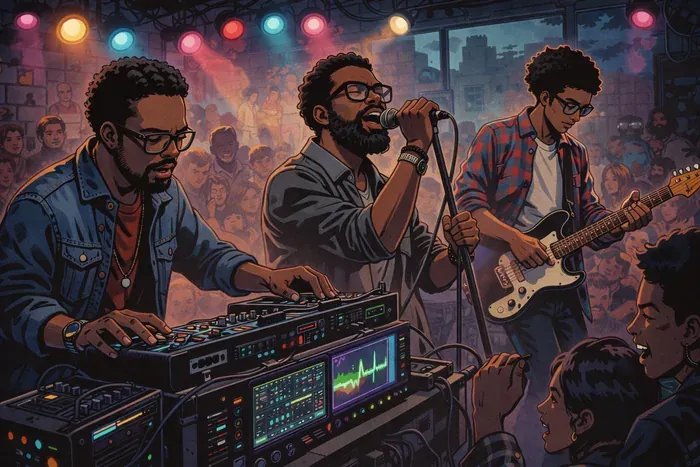
TV on the Radio: Expanding What Indie Could Absorb
By the early 2000s, indie and alternative music had developed a long history of stylistic experimentation. Yet discussions about representation within the genre were still evolving. The Brooklyn-based band TV on the Radio became one of the groups that expanded how indie music could sound and who might be associated with it.
The band formed in New York City in the early 2000s around singer Tunde Adebimpe, multi-instrumentalist and producer David Andrew Sitek, guitarist Kyp Malone, bassist Gerard Smith, and drummer Jaleel Bunton. From the beginning, their music resisted easy classification. Instead of following the familiar patterns of guitar-driven indie rock, the band combined elements from several traditions.
Their 2004 album Desperate Youth, Blood Thirsty Babes introduced a sound that blended layered vocals, electronic textures, and guitar noise. The arrangements often felt dense yet carefully structured. Songs such as “Staring at the Sun” revealed how the group balanced rhythmic intensity with atmospheric production.
TV on the Radio’s breakthrough came with the 2006 album Return to Cookie Mountain. The record featured intricate arrangements that moved between rock, electronic music, and gospel-influenced vocal harmonies. Tracks like “Wolf Like Me” demonstrated the band’s ability to combine driving rhythms with dramatic vocal performances. The song builds gradually before exploding into a powerful guitar-driven climax.
Tunde Adebimpe and Kyp Malone’s vocal interplay became one of the band’s defining characteristics. Their voices moved between soulful singing and urgent expression, adding emotional depth to the music’s complex arrangements. Meanwhile David Andrew Sitek’s production style blended analog instruments with electronic processing, creating a sound that felt both modern and organic.
The band’s presence also carried cultural significance within the indie landscape. At a time when many indie rock lineups still reflected limited diversity, TV on the Radio’s success challenged assumptions about who belonged within the genre. Their music drew from a wide range of influences including post-punk, soul, electronic experimentation, and art rock.
Critics often noted that the band’s work echoed the experimental spirit of earlier alternative artists such as Sonic Youth while also introducing new sonic possibilities. Albums like Dear Science from 2008 further expanded that approach, incorporating horn arrangements and rhythmic grooves influenced by funk and dance music.
Through their creativity and openness to multiple traditions, TV on the Radio demonstrated that indie music could continue evolving beyond its earlier boundaries. Their work reminded listeners that the genre’s strength has always come from its ability to absorb new voices and new musical ideas.
Drugs, Policing, and Alternative's Public Image
As alternative culture grew more visible, the spaces around it also attracted intense public scrutiny. Throughout the history of punk, alternative, and indie music, moments of controversy, moral panic, or political pressure have repeatedly shaped how the music is perceived by wider society. These reactions have sometimes focused on lyrical themes, performance styles, or the communities gathering around particular venues and festivals.
Questions about drug use, public order, and youth culture frequently appear in these debates. In many cases, authorities and media outlets have treated emerging music scenes as symbols of broader social anxiety. From the punk explosion of the late 1970s to the rave-influenced club culture of the early 1990s, alternative music has often existed in tension with institutions that sought to regulate public behavior.
For musicians and fans, these pressures sometimes created unexpected forms of solidarity. Scenes responded by organizing independent venues, community networks, and informal support systems. While the realities of substance use and nightlife remained complex, these cultural conflicts also revealed how music scenes could become spaces where larger social debates unfolded.
Examining these tensions helps illuminate another dimension of alternative music history: the negotiation between creative freedom and public regulation.
Heroin, Grunge, and the Dangers of Myth
When alternative rock moved into the mainstream during the early 1990s, the sudden visibility of the scene brought intense media attention. Alongside discussions about music, journalists often focused on the lifestyles of musicians. In the case of the Seattle grunge scene, this attention frequently centered on drug use, especially heroin. Over time, a complicated mixture of reality, rumor, and cultural myth began to shape how the movement was remembered.
The Seattle music community that produced bands such as Nirvana, Soundgarden, Alice in Chains, and Mudhoney grew from relatively small clubs and independent networks during the late 1980s. Many musicians shared rehearsal spaces, apartments, and touring vans. The environment reflected the broader challenges faced by young artists in a working-class city where opportunities could feel limited.
Within that context, substance use existed as part of everyday life for some musicians, just as it did in many creative scenes across different decades. Yet the rapid commercial success of alternative rock amplified public fascination with these personal struggles. Media coverage sometimes reduced complex individuals to simplified narratives of rebellion and excess.
The story of Kurt Cobain became particularly central to this discussion. Cobain spoke openly about physical pain, emotional stress, and the pressures of sudden fame. His heroin use, which he acknowledged in interviews, often became the focus of sensational headlines. While Cobain himself sometimes tried to explain the personal reasons behind his struggles, public narratives frequently turned those explanations into dramatic myths about the grunge generation.
Another musician whose experiences shaped the conversation was Layne Staley of Alice in Chains. Staley’s powerful voice defined albums such as Dirt from 1992, a record whose lyrics addressed addiction and personal darkness with stark honesty. Songs like “Rooster” and “Down in a Hole” resonated deeply with listeners who recognized the emotional weight behind the music.
Yet the way these stories were reported often blurred the line between artistic expression and public spectacle. For many fans, the music itself represented vulnerability and authenticity. For some media outlets, the same struggles became material for dramatic storytelling about rock culture.
The reality of addiction within the music world was painful and complex. Musicians faced demanding touring schedules, financial uncertainty, and sudden shifts in public attention. These pressures did not create substance use on their own, but they often intensified existing difficulties.
Looking back, it is important to separate the music from the mythology that grew around it. The grunge movement produced songs of remarkable emotional depth. Reducing that artistic legacy to stories about drugs risks overlooking the creative achievements that made the music meaningful in the first place.
Ecstasy, Rave Culture, and State Response
While the American alternative scene of the early 1990s often became associated with the darker mythology surrounding grunge, a different cultural story unfolded in Britain and parts of Europe. The rise of rave culture and electronic dance music brought thousands of young people together in clubs, warehouses, and outdoor gatherings. In these spaces, guitar music, electronic beats, and youth culture began to overlap in new ways.
The late 1980s saw the rapid spread of acid house, a style of dance music that emerged from Chicago and quickly found enthusiastic audiences in Britain. DJs, promoters, and club owners created events where large crowds gathered to dance for hours at a time. These nights often felt communal and euphoric, shaped by repetitive rhythms and shared physical movement.
Within that environment, the drug MDMA, commonly known as ecstasy, became closely associated with rave culture. Many participants described the substance as enhancing feelings of connection and openness on the dance floor. As rave gatherings grew larger, the presence of MDMA attracted increasing attention from law enforcement and the national press.
British authorities responded with a mixture of concern and regulation. Large outdoor parties, often held in warehouses or rural locations, sometimes operated without official permits. These events could attract thousands of people, creating logistical and safety challenges. Police raids and shutdowns became common during the late 1980s and early 1990s.
The tension between youth culture and public policy eventually produced new legislation. The Criminal Justice and Public Order Act of 1994 introduced measures aimed partly at restricting large unlicensed gatherings where amplified music was played. The law famously described such music as containing “repetitive beats,” a phrase that quickly became symbolic of the government’s attempt to regulate rave culture.
Musicians and cultural observers responded in different ways. Some saw the legislation as an overreaction that misunderstood the social value of dance music communities. Others acknowledged the practical difficulties of managing massive events that lacked formal organization.
The relationship between rave culture and alternative music remained fluid throughout this period. Bands such as Primal Scream and Happy Mondays had already begun blending guitar sounds with dance rhythms, reflecting the shared spaces between clubs and indie venues.
Over time, rave culture became more integrated into mainstream entertainment. Festivals, licensed clubs, and professional promoters created safer environments for large gatherings. Yet the debates surrounding these early years remain an important reminder of how youth culture, music, and public policy can collide during moments of rapid cultural change.

Scandal, Backlash, and the Cost of Visibility
Throughout the history of alternative music, the relationship between artists and the media has often been uneasy. Independent scenes typically grow through word of mouth, small publications, and dedicated fan communities. Once these scenes attract wider attention, however, the dynamics of coverage can change quickly. Stories about controversy or scandal sometimes begin to dominate the narrative.
In Britain during the 1990s, the rise of Britpop created a media environment where rivalries between bands became part of everyday entertainment coverage. Newspapers and music magazines frequently framed groups such as Oasis and Blur as competitors in a cultural battle. While the musicians themselves occasionally encouraged the rivalry with humorous remarks, the press often amplified these tensions into dramatic headlines.
The most famous moment came in August 1995 when Oasis and Blur scheduled single releases during the same week. Oasis released “Roll with It,” while Blur presented “Country House.” Journalists described the event as a symbolic clash between two visions of British guitar music. Chart sales were reported daily, turning a routine release schedule into a national spectacle.
These media narratives were not always harmful. The attention helped bring alternative music into broader public awareness. Yet the cycle of hype and backlash could also place musicians under intense pressure. Bands that suddenly found themselves in the spotlight sometimes struggled to maintain the creative focus that had originally defined their work.
In the United States, similar patterns appeared around artists whose personal lives attracted heavy media coverage. The public attention surrounding Courtney Love, the singer of Hole, often focused as much on her relationships and public persona as on the band’s music. This imbalance reflected a broader tendency within celebrity journalism to prioritize sensational stories over artistic discussion.
The economics of media coverage contributed to this dynamic. Newspapers, television programs, and later online platforms competed for audience attention. Controversial headlines and dramatic narratives often generated more engagement than careful analysis of songwriting or musical innovation.
For musicians, navigating that environment required balancing visibility with personal boundaries. Some artists embraced the publicity, using it to amplify their message or reach new audiences. Others retreated from interviews and media appearances in order to preserve a sense of privacy.
Understanding these cycles of hype, scandal, and backlash helps explain how alternative music entered the public imagination. The stories told about artists often shaped how listeners interpreted their work. At the same time, many musicians continued creating meaningful music despite the noise surrounding them.
The Economics of Independence: Scenes, Money, and Survival
The idea of independence has always stood at the center of punk, alternative, and indie culture. But after questions of identity, visibility, and public backlash, another issue comes into view: how this world actually sustained itself. From the earliest days of small record labels and self-organized tours, musicians sought ways to operate outside the traditional structures of the music industry. Yet independence has never meant complete separation from economic realities. Bands still needed to pay for recording sessions, travel, equipment, and the everyday costs of living.
During the 1980s and 1990s, a network of independent labels, distributors, and promoters gradually formed around alternative music scenes. These organizations offered artists opportunities to release records and reach audiences without signing contracts with major companies. At the same time, the financial conditions of independent music often remained fragile.
The transition into the digital era introduced new challenges. Streaming platforms changed how listeners discovered music, but they also altered how revenue flowed through the industry. Touring became increasingly important for many artists, even as travel costs continued rising.
Examining the economic foundations of alternative music reveals another side of independence. Creative freedom often depends on practical systems that allow artists and communities to sustain themselves over time.
Independent Labels: Building Alternatives to the Major System
Independent record labels have long served as the infrastructure that allows alternative music to exist outside the dominant structures of the commercial industry. While major labels often focus on large-scale distribution and chart success, smaller companies have historically provided spaces where emerging artists could develop their sound with greater creative control. Several labels played particularly important roles in shaping the alternative and indie landscape.
One of the most influential was Dischord Records, founded in Washington, D.C. in 1980 by Ian MacKaye and Jeff Nelson, members of the hardcore band Minor Threat. Dischord began as a way to release the band’s own recordings, but it soon expanded into a broader platform for the local punk community. The label operated according to principles that emphasized fairness and transparency. Artists retained creative ownership of their work, and records were sold at reasonable prices to keep music accessible.
Through releases by bands such as Fugazi, Rites of Spring, and others within the D.C. scene, Dischord helped establish a model for independent labels that valued community and long-term sustainability over rapid expansion. The label’s success demonstrated that alternative music could thrive through networks built on trust and collaboration.
Across the country, another independent label played a key role in bringing alternative rock into wider public awareness. Sub Pop, founded in Seattle in 1986 by Bruce Pavitt and Jonathan Poneman, became closely associated with the emerging grunge movement. Early releases by bands such as Nirvana, Soundgarden, and Mudhoney helped define the heavy guitar sound that later gained global attention.
Sub Pop’s approach combined underground credibility with a sharp understanding of media and branding. The label promoted Seattle as a distinct musical hub, encouraging journalists to view the city as a center of new creative energy. This strategy helped build anticipation around the bands before they reached mainstream audiences.
By the late 1980s and early 1990s, labels such as Matador Records expanded the independent landscape even further. Founded in 1989 by Chris Lombardi and later joined by Gerard Cosloy, Matador became known for supporting a wide range of artists including Pavement, Yo La Tengo, and Liz Phair. The label’s catalog reflected the diversity of indie music during that period, from lo-fi guitar recordings to more polished alternative rock.
Together, these labels illustrate how independent infrastructure allowed alternative music to grow. They created spaces where artists could experiment, develop audiences gradually, and maintain control over their creative direction. Independence, in this sense, became not only an aesthetic idea but a practical system sustained by committed communities.
Touring Networks: How Indie Sustained Itself
Long before streaming platforms reshaped the music industry, touring formed the economic backbone of independent music. For many punk, alternative, and indie bands, live performance was not simply a promotional tool. It was often the most reliable way to sustain a career. The networks that made touring possible developed gradually through cooperation between musicians, small venues, promoters, and local scenes.
During the 1980s, hardcore and punk communities across the United States created an informal touring circuit that connected cities such as Washington, D.C., Chicago, Minneapolis, and San Francisco. Bands would travel long distances in vans, carrying their own equipment and often sleeping on floors offered by fans or other musicians. Shows took place in clubs, community centers, or improvised venues that welcomed independent artists.
Groups like Black Flag became known for their relentless touring schedules. Their constant travel helped build an audience for underground music in places where alternative rock had previously received little exposure. Other bands soon followed similar paths, turning the national touring network into an essential part of the independent music ecosystem.
This circuit also encouraged collaboration between local scenes. Promoters in different cities shared contact information and coordinated performance dates. When a touring band arrived in town, local groups often opened the show, strengthening connections between communities. These interactions helped spread new sounds and ideas quickly across regional boundaries.
In Europe, similar systems developed through independent clubs and festivals. Cities such as Berlin, Amsterdam, and Manchester hosted venues where alternative artists could perform for dedicated audiences. Festivals later became especially important, bringing together multiple bands and exposing fans to a broader range of music.
Touring, however, rarely produced large profits for independent musicians. Travel costs, equipment maintenance, and venue expenses could consume much of the income generated from ticket sales. Many artists balanced touring with part-time jobs or relied on support from labels and merchandise sales.
Despite these challenges, the touring circuit played a vital cultural role. Concerts allowed listeners to experience music in a shared physical space, creating a sense of community that recordings alone could not provide. Fans who discovered a band through word of mouth or college radio often developed lasting connections through live performances.
Through these networks, alternative music spread far beyond its original cities. The touring economy transformed local scenes into a wider cultural movement sustained by dedication, cooperation, and the simple act of traveling from one stage to the next.
Streaming Platforms and the New Economics of Indie
At the beginning of the twenty-first century, the economic foundations of independent music shifted again. Digital distribution had already changed how listeners discovered songs, but the arrival of large streaming platforms transformed the structure of the industry more dramatically. Services such as Spotify, Apple Music, and Deezer created vast libraries where millions of recordings could be accessed instantly.
For listeners, the change made music more available than at any previous point in history. Independent artists could release recordings without pressing physical copies or negotiating with traditional distributors. A musician working from a home studio could upload a track and reach audiences around the world within hours.
Yet the financial implications proved complex. Streaming services typically pay artists small royalties for each play. While these payments accumulate for extremely popular songs, many independent musicians receive modest returns even when their music attracts thousands of listeners. As a result, streaming income alone rarely sustains a career.
Independent labels and artists responded by developing new strategies. Touring continued to provide essential revenue, but musicians also explored merchandise sales, direct fan subscriptions, and crowdfunding platforms. Websites such as Bandcamp created spaces where listeners could support artists more directly by purchasing digital albums, vinyl editions, or special releases.
At the same time, streaming platforms introduced a new kind of visibility shaped by algorithms. Curated playlists began influencing how audiences discovered music. Instead of relying only on radio DJs or record store recommendations, listeners often encountered new artists through automated suggestions based on listening patterns.
This system offered opportunities as well as challenges. Independent musicians could appear alongside major artists within the same playlists, potentially reaching audiences far beyond their local scenes. Yet the competition for attention within these vast catalogs also became intense. Songs might circulate widely for a brief moment before disappearing beneath the constant flow of new releases.
Some artists adapted by releasing music more frequently, maintaining visibility through a steady stream of singles and collaborations. Others focused on cultivating smaller but dedicated communities of listeners who supported their work consistently.
The streaming era did not eliminate the spirit of independence that shaped alternative music. Instead it changed the conditions under which that independence operates. Musicians today navigate a landscape where creative freedom exists alongside new economic uncertainties, continuing the long conversation between art and survival that has defined indie culture for decades.
The Indie Revival: Guitar Music in the Digital 2000s
At the beginning of the 2000s, guitar-based music entered another period of renewal. After the dramatic rise of grunge and alternative rock in the early 1990s, many listeners had turned toward electronic music, hip hop, and new pop production. Indie scenes, however, never disappeared. They adapted to new economics, new technologies, and the expanding world of online communities.
The early years of the new century introduced a generation of bands that rediscovered the energy of earlier guitar traditions while adapting them to a new cultural environment. Garage rock, post-punk revival, and experimental indie styles emerged almost simultaneously. The internet played a growing role in spreading these sounds across international audiences.
Artists from cities such as New York, London, Montreal, and Melbourne began attracting attention through blogs, file-sharing networks, and independent radio programs. Instead of relying exclusively on traditional industry promotion, musicians could now reach listeners through digital platforms and word of mouth.
Bands like The Strokes, Arctic Monkeys, Arcade Fire, and Tame Impala demonstrated how indie music could enter the new century with fresh ideas while still carrying the legacy of punk and alternative culture.
The Strokes: Minimalism, Style, and a New Guitar Reset
When The Strokes released their debut album Is This It in 2001, many listeners felt that guitar music had regained a sense of immediacy. The band’s sound drew heavily from earlier influences such as late-1970s New York punk and post-punk, yet it arrived at a moment when much mainstream rock had grown polished and predictable. The Strokes presented something leaner, more direct, and unmistakably stylish.
The group formed in New York City in the late 1990s. Its members included singer Julian Casablancas, guitarists Nick Valensi and Albert Hammond Jr., bassist Nikolai Fraiture, and drummer Fabrizio Moretti. The band developed its music in rehearsal rooms and downtown clubs where audiences still valued the stripped-down energy of earlier punk scenes.
Is This It captured that atmosphere with remarkable clarity. The production emphasized tight rhythm sections and interlocking guitars rather than heavy distortion. Songs such as “Last Nite,” “Someday,” and “Hard to Explain” relied on simple structures and memorable riffs. Julian Casablancas’s vocals, often filtered through light distortion, added a slightly detached tone that matched the band’s urban aesthetic.
Critics quickly connected the album to earlier New York artists such as Television, The Velvet Underground, and the Ramones. Yet the music did not feel nostalgic. Instead it translated those influences into a form that resonated with a new generation of listeners.
The Strokes also arrived during a moment when the internet was beginning to reshape music discovery. Early music blogs and online forums helped spread enthusiasm for the band beyond New York’s club scene. Fans shared songs, concert stories, and photographs that circulated widely through digital communities.
The success of Is This It encouraged record labels to look again at guitar-driven bands emerging from independent scenes. Groups such as Interpol, The Libertines, and Yeah Yeah Yeahs soon attracted similar attention. Together they formed part of what journalists often called the “garage rock revival,” though the music itself varied widely in tone and structure.
The Strokes’ influence extended beyond sound. Their visual style, understated stage presence, and connection to urban nightlife contributed to a broader cultural image of indie music during the early 2000s. Leather jackets, vintage guitars, and minimal production became symbols of a return to rock’s essentials.
Although the band’s later albums explored different directions, their debut remains one of the defining recordings of the decade. Is This It reminded listeners that simple guitar music, played with confidence and clarity, could still feel fresh and exciting in the digital age.
MP3 Blogs, MySpace, and the New Discovery Circuit
Between the era of college radio and the later dominance of streaming platforms, another layer of infrastructure reshaped how indie music traveled. In the 2000s, MP3 blogs, MySpace pages, online forums, and early digital magazines accelerated discovery in ways that were faster and less centralized than print media, but still more curated than the algorithmic environment that would follow. It was a transitional ecosystem, and it changed how alternative music reached listeners.
MP3 blogs were especially influential because they combined criticism, taste, and direct access. A writer could praise a new band and immediately attach a track for readers to hear. That changed the speed of circulation. Artists no longer had to wait for physical distribution, scheduled radio play, or magazine lead times alone. A song could move across cities and countries in a matter of hours, carried by recommendation rather than by formal industry rollout.
MySpace made this shift even more visible. Bands could upload songs, photos, tour dates, and messages directly to a public page, while listeners could pass links through their own networks. For indie scenes, this mattered because it lowered the threshold for being found. A local group no longer needed major press coverage before reaching people outside its hometown. The page itself became part of the pitch, combining music, image, and social connection in one place.
Online tastemakers also changed the pace of hype. Earlier scenes often grew through local accumulation: a club residency, a college station, a print review, a tour. The blog-and-profile era could compress those stages. A handful of enthusiastic writers, message-board users, or playlist curators could make a band seem suddenly unavoidable. The benefit was obvious. Small acts could break through quickly. The downside was also clear. Attention could become volatile, with scenes and artists being pushed upward and then abandoned at high speed.
This environment helps explain why the 2000s indie revival felt both communal and unstable. It still depended on taste communities and word of mouth, but those communities were now digital, searchable, and constantly in motion. Arctic Monkeys became one of the best-known examples of this acceleration, yet they were part of a broader shift. Indie music was no longer only local before it became national. It could become networked first, then physical, then commercial.
Seen from a longer historical view, MP3 blogs and MySpace were a bridge. They preserved something of the older DIY and recommendation culture while preparing listeners for a world where online circulation would shape almost every stage of musical life. They were not the end of gatekeeping. They were its digital reconfiguration.
Arctic Monkeys: Online Hype Meets Local Momentum
A few years after The Strokes reignited interest in stripped-down guitar music, another band demonstrated how rapidly the internet could transform a local scene into an international phenomenon. Arctic Monkeys, formed in Sheffield, England in 2002, became one of the earliest major guitar bands whose rise was closely tied to online sharing and digital communities.
The group’s lineup included singer and guitarist Alex Turner, guitarist Jamie Cook, bassist Andy Nicholson in the early years, later replaced by Nick O’Malley, and drummer Matt Helders. As teenagers, the members began performing in small venues across Sheffield. Their early audience grew through word of mouth and through homemade recordings that circulated online.
Fans frequently shared the band’s demo tracks through file-sharing platforms and online forums. Instead of viewing this circulation as a threat, the group allowed the music to spread naturally. By the time Arctic Monkeys released their first official recordings, a strong audience had already formed.
Their debut album, Whatever People Say I Am, That’s What I’m Not, arrived in 2006 and set a UK chart record for a debut album by a group in its first week. Songs such as “I Bet You Look Good on the Dancefloor” and “When the Sun Goes Down” combined energetic guitar riffs with vivid storytelling. Alex Turner’s lyrics often described nightlife, relationships, and small moments of social observation drawn from everyday urban life.
The band’s sound carried traces of earlier British guitar traditions, including the sharp rhythms of post-punk and the melodic sensibility associated with indie rock. At the same time, the songs felt contemporary, reflecting the experiences of young listeners navigating modern city culture. That combination helps explain why the record spread so quickly beyond Sheffield and connected with a much wider audience.
Arctic Monkeys also represented a generational shift in how audiences interacted with music. Online communities allowed fans to share live recordings, discuss new songs, and organize concert attendance. This digital network helped transform the band from a local favorite into a national sensation before major media outlets fully recognized their impact.
As their career progressed, Arctic Monkeys continued exploring new musical directions. Albums such as Favourite Worst Nightmare (2007) and later AM (2013) incorporated broader influences ranging from desert rock to hip hop-inspired rhythms. The group’s willingness to evolve helped sustain their relevance over multiple decades.
The band’s early success remains a key moment in the history of indie music. It demonstrated that the internet could accelerate the traditional path of touring, word of mouth, and independent discovery. In doing so, Arctic Monkeys illustrated how digital culture was reshaping the way alternative music reached its audience.
Arcade Fire: Collective Scale in Indie Rock
While bands such as The Strokes and Arctic Monkeys revived the sharp immediacy of garage and post-punk traditions, another group demonstrated that indie music could also expand toward large-scale arrangements and emotional depth. Arcade Fire, formed in Montreal in the early 2000s, brought a sense of collective energy that contrasted with the minimalist aesthetic of many contemporary guitar bands.
The group was built around singer and songwriter Win Butler and multi-instrumentalist Régine Chassagne, supported by a rotating ensemble that included musicians such as Richard Reed Parry, Tim Kingsbury, and Jeremy Gara. From the beginning, Arcade Fire approached songwriting as a collaborative process involving multiple instruments and voices. Their concerts often featured an array of guitars, violins, accordions, percussion, and keyboards.
Their 2004 debut album, Funeral, quickly gained attention within independent music circles. The record carried a powerful emotional tone shaped partly by personal experiences of loss among members of the band. Songs such as “Wake Up,” “Rebellion (Lies),” and “Neighborhood #1 (Tunnels)” combined driving rhythms with layered arrangements that gradually built toward dramatic climaxes.
Unlike many indie recordings of the era, Funeral embraced a broad sonic palette. Strings and choral vocals appeared alongside guitars, giving the music a sense of scale that felt both intimate and expansive. The album’s emotional sincerity resonated strongly with listeners who were searching for music that balanced personal reflection with communal energy.
Arcade Fire’s reputation grew through their intense live performances. Concerts often featured musicians switching instruments mid-song and encouraging audience participation. The atmosphere could feel almost ceremonial, with large crowds singing along to the band’s anthemic choruses.
The group’s follow-up albums continued exploring ambitious musical ideas. Neon Bible (2007) introduced darker themes and grander arrangements, while The Suburbs (2010) examined the cultural landscape of suburban life. The latter record received the Grammy Award for Album of the Year, an unusual recognition for a band rooted in independent music culture.
Arcade Fire’s success showed that indie music could sustain large, emotionally ambitious projects without losing its sense of authenticity. Their work bridged the gap between underground scenes and international recognition, showing that alternative music could still evolve toward new forms of artistic scale.
Through their collective spirit and expansive sound, Arcade Fire added another dimension to the evolving story of indie music in the twenty-first century.
Tame Impala: Psychedelia, Pop, and the Solo Studio
As indie music moved deeper into the 2010s, another shift began to take shape. The boundaries between rock, electronic production, and pop songwriting grew increasingly fluid. One of the artists who captured this transformation most clearly was Tame Impala, the psychedelic project led by Australian musician Kevin Parker.
Tame Impala began in Perth in the late 2000s. Although the band performs live with several members, Parker writes, records, and produces the studio albums largely on his own. This approach reflects the technological changes that had become common in independent music by that time. Affordable recording equipment and digital production tools allowed artists to construct complex sonic worlds from home studios.
The project’s early recordings drew heavily from the psychedelic rock tradition of the late 1960s and early 1970s. Parker’s debut album Innerspeaker, released in 2010, featured swirling guitars, layered vocals, and warm analog textures that echoed bands such as Pink Floyd and Cream. Songs like “Solitude Is Bliss” and “Lucidity” balanced vintage influences with modern production clarity.
Tame Impala’s second album, Lonerism from 2012, expanded this sonic palette. Parker introduced more synthesizers and intricate studio effects, creating a sound that felt both nostalgic and futuristic. Tracks such as “Elephant” and “Feels Like We Only Go Backwards” became widely recognized examples of contemporary psychedelic pop.
What distinguished Tame Impala from many earlier indie rock acts was the central role of production. Parker treated the studio as a compositional tool. Instruments were layered carefully, with echo, reverb, and subtle distortion shaping the emotional tone of each song. The result was music that felt immersive and dreamlike.
That approach reached an even wider audience with the 2015 album Currents. On that record Parker moved further toward electronic rhythms and pop structures while maintaining the project’s psychedelic identity. Songs like “Let It Happen” and “The Less I Know the Better” demonstrated how indie sensibilities could blend with danceable grooves and polished production.
Tame Impala’s success reflected a broader transformation within alternative music. Younger listeners no longer saw strict boundaries between rock, electronic music, and pop experimentation. Instead, artists were free to move between styles while maintaining a distinct personal voice.
Through his work as both songwriter and producer, Kevin Parker illustrated how indie music had entered a new era. The spirit of independence that once relied on small labels and touring circuits now extended into the creative possibilities of digital production and global collaboration.
Global Indie: Beyond the US and UK Centers
Even though the histories of punk, post-punk, and indie are often told through New York, London, Manchester, Seattle, and a handful of other Anglo-American centers, the later development of indie music became increasingly global. By the 1990s and 2000s, scenes in Latin America, Japan, Scandinavia, continental Europe, Canada, and Australia were not simply echoing British or American models. They were adapting independent music to local languages, social histories, and aesthetic priorities of their own.
In Latin America, independent rock and pop scenes developed through a mix of local labels, festival circuits, and regional media networks. Artists often moved fluidly between indie, art pop, electronic production, and older national traditions. In Japan, highly curated record culture, club networks, and hybrid pop experimentation helped produce a different kind of indie modernity, one less tied to rock purism and more open to design, collage, and stylistic precision.
Scandinavian scenes added another dimension. Bands and producers from Sweden, Iceland, Denmark, and Norway often approached indie through strong melodic writing, atmospheric production, and a willingness to blur the line between guitar music and electronics. Continental European artists likewise built scenes that drew from post-punk, synth pop, noise, dance music, and art-school traditions in distinct combinations. What mattered was not uniform sound, but the repeated creation of local infrastructures that could sustain music outside dominant commercial formulas.
This wider map changes the meaning of indie itself. Once the term moved beyond its earlier British and American centers, it became less useful as a narrow genre label and more useful as a description of method. Independent music could mean different languages, different production aesthetics, and different relations to the mainstream depending on the country or city involved. In some places, indie stood against commercial pop. In others, it overlapped with national pop traditions or experimental electronic culture.
The global spread of indie also complicates the idea that innovation always travels outward from one center. Influence now moves in several directions at once. Listeners in London or New York discover artists from Seoul, Mexico City, Reykjavik, Stockholm, Paris, or Melbourne as part of the same digital environment. That does not erase local context, but it does mean that alternative music in the twenty-first century is no longer best understood as a story with one homeland. It is a network of scenes that constantly borrow from one another while still sounding rooted in place.
Seen this way, the move from punk to indie is not only a transatlantic history. It is also the story of how independent methods became globally portable. The tools changed, the languages changed, and the scenes changed, but the desire to build new musical space outside the center remained recognizable across borders.
What Does “Alternative” Mean After Streaming?
By the 2020s, the word “alternative” carries a very different meaning than it did in the late 1970s or early 1990s. After decades of reinvention, what once described music operating outside the commercial mainstream now appears across streaming playlists, major festivals, and global chart rankings. Bands that might once have been considered underground can reach millions of listeners within days through digital platforms.
This transformation raises a simple but important question: if independent music is now widely accessible and often commercially successful, what does “alternative” actually refer to today?
The answer lies less in a specific sound than in a set of attitudes that have developed over decades. From the DIY spirit of punk to the experimental openness of post-punk, from indie pop intimacy to modern bedroom production, alternative music has always represented a willingness to explore creative paths outside established expectations.
In the streaming era, those expectations continue to shift. Scenes now form across online communities rather than geographic neighborhoods. Artists build audiences through algorithms as well as touring circuits. Still, the core impulse remains familiar: musicians searching for new ways to express themselves beyond the limits of mainstream convention.
From Local Scenes to Digital Networks
For much of the history of punk, alternative, and indie music, scenes were physical places. Cities such as London, Manchester, New York, Seattle, and Athens, Georgia developed recognizable musical identities because musicians, clubs, record stores, and audiences existed within the same local ecosystem. Bands rehearsed in nearby spaces, met at shows, and exchanged ideas through face-to-face communities.
These environments created what many listeners later recognized as a “scene.” A small venue might host several bands from the same city on a single night. Local fanzines and college radio stations documented the activity, while independent record stores became meeting points where fans discovered new music.
The rise of the internet gradually altered this geography. By the late 1990s and early 2000s, online forums and music blogs allowed listeners to share recommendations across continents. Bands could attract international attention even before leaving their hometowns. Arctic Monkeys’ early rise through internet sharing offered a clear example of that shift.
Streaming platforms accelerated the transformation further. Today, listeners often encounter new artists through algorithmically generated playlists rather than through local concerts or record stores. These systems analyze listening habits and recommend songs that match particular tastes. As a result, musical discovery increasingly occurs through digital networks rather than geographic communities.
The shift also has advantages. Musicians working in small towns or countries without large music industries can now reach global audiences. A bedroom recording uploaded to a streaming service may find listeners across several continents within days.
At the same time, the digital environment sometimes weakens the sense of local identity that once defined many alternative scenes. When listeners encounter music primarily through playlists, they may know little about the cultural context that produced it. The shared physical experience of concerts and neighborhood venues can become less central to the discovery process.
Yet scenes have not disappeared entirely. Live music still plays an important role in sustaining independent culture. Cities continue to support clubs where musicians meet and collaborate. Festivals and touring networks bring together artists who may have first discovered each other online.
Rather than disappearing, the geography of alternative music has expanded. Physical communities and digital networks now coexist, creating a hybrid environment where creativity flows between local spaces and global audiences.
DIY or Brand? Independence in the Platform Economy
From the beginning of punk culture, the phrase DIY, “do it yourself,” carried a specific meaning. Bands released their own records, printed flyers, organized concerts, and built networks without waiting for approval from major industry institutions. Labels such as Dischord and early independent scenes treated this independence not only as a practical necessity but also as a cultural value.
In the twenty-first century, the idea of independence has become more complicated. Digital technology allows artists to record music at home, distribute songs through streaming platforms, and promote their work through social media. In many ways, that environment seems like the fulfillment of the original DIY dream. Musicians no longer need large studios or physical distribution networks to reach listeners.
Yet the same platforms that enable independence also introduce new forms of dependency. Streaming services control how music appears in playlists, how royalties are calculated, and how algorithms recommend songs to audiences. Social media platforms influence how artists communicate with fans and how quickly their work spreads online.
As a result, independence sometimes becomes intertwined with branding. Musicians often need to maintain a constant online presence, sharing updates, images, and short videos that keep their profiles visible within algorithm-driven systems. The creative process can become linked to digital visibility in ways that earlier generations of musicians did not face.
Independent labels continue playing an important role within that environment. Companies such as Domino Recording Company, Merge Records, and Matador Records help artists navigate the complexities of distribution, promotion, and licensing while still offering more creative autonomy than many traditional major-label contracts.
Other artists choose to operate almost entirely on their own. Platforms like Bandcamp allow musicians to sell music directly to listeners, often retaining a larger share of the revenue. These systems revive aspects of the earlier DIY tradition by emphasizing direct relationships between artists and fans.
The meaning of independence today therefore involves negotiation rather than complete separation. Musicians balance creative control with the realities of digital infrastructure. The goal remains similar to the ideals that shaped early punk scenes: maintaining the freedom to create music on one’s own terms.
In this evolving landscape, independence is less about rejecting all industry structures and more about understanding how to navigate them while preserving artistic identity.
Why the Idea of “Alternative” Still Endures
After several decades of musical change, one point becomes clear: “alternative” has never described a single sound. The term has traveled across many styles: the raw speed of punk, the experimental atmosphere of post-punk, the melodic introspection of indie pop, the explosive energy of grunge, and the hybrid forms of modern indie and electronic production. What connects these movements is not a specific guitar tone or recording technique, but a shared cultural instinct.
At its core, alternative music has always emerged from moments when musicians felt that existing formulas no longer expressed their experiences. Punk grew from frustration with the excesses of 1970s arena rock. Post-punk artists expanded the language of guitar music through experimentation. Indie pop scenes rediscovered intimacy and vulnerability. Later generations blended rock with electronic rhythms, hip hop influences, and digital production.
Each wave of artists reinterpreted the idea of independence in its own way. Some worked through small labels and touring circuits. Others used home studios and online communities. The methods changed, but the impulse remained consistent: finding space outside dominant expectations.
Another lasting element of alternative culture is its openness to dialogue between genres and communities. Reggae influenced early British punk. Funk and soul shaped bands like Fishbone. Electronic music transformed the sound of Primal Scream and Radiohead. More recently, artists such as Tame Impala have blended psychedelic rock with contemporary pop production.
The word “alternative” therefore functions less as a category and more as a reminder of a process. Music scenes constantly question their own boundaries, absorbing new influences and redefining themselves in response to changing social and technological conditions.
Listeners also play a role in sustaining that tradition. Independent record stores, college radio stations, small venues, blogs, and streaming playlists have all served as points where curious audiences discover unfamiliar sounds. The survival of alternative culture depends partly on that willingness to explore beyond the most visible trends.
Looking back across the decades from punk to modern indie, one pattern stands out. Whenever music begins to feel predictable, another generation of artists appears with new ideas, new communities, and new methods of sharing their work.
As long as that process continues, the spirit of the alternative remains alive.
A Long Continuum: From Punk Basements to Global Indie
Looking back across the decades from the late 1970s to the present, the history of punk, post-punk, alternative, and indie music begins to resemble a long conversation rather than a straight line. Each generation inherits fragments from the previous one and reshapes them according to its own cultural moment.
The first punk scenes created the basic tools of independence. Bands such as The Ramones, The Clash, and Sex Pistols showed that music could be direct, fast, and accessible without the infrastructure of large studios or corporate promotion. Just as important, they demonstrated that small venues and local communities could sustain entire musical movements.
Post-punk artists expanded these ideas. Groups like Joy Division, Siouxsie and the Banshees, and Talking Heads experimented with rhythm, production, and lyrical themes. Their work suggested that punk’s spirit of independence could support creative exploration rather than simply raw rebellion.
During the 1980s and early 1990s, American independent scenes translated those ideas into practical systems. Labels such as Dischord, SST, and Sub Pop built networks where bands could record, tour, and release music without relying entirely on major record companies. Artists including R.E.M., Sonic Youth, and Pixies carried the sound of these networks into wider public awareness.
The sudden breakthrough of Nirvana in 1991 pushed alternative music into the global mainstream. Yet even as the word “alternative” became a marketing category, smaller scenes continued evolving in parallel. Shoegaze, Riot Grrrl, and indie pop communities each developed their own creative identities.
In the 2000s, bands such as The Strokes, Arctic Monkeys, and Arcade Fire showed that guitar music could renew itself once again. Meanwhile artists like Tame Impala demonstrated how modern recording technology allowed individuals to build complex sonic worlds from modest studios.
Today the landscape looks very different from the early days of punk clubs and photocopied fanzines. Streaming platforms, digital communities, and global touring circuits shape how listeners encounter new music. Yet the deeper pattern remains familiar. Musicians still gather around shared ideas, form new scenes, and search for ways to express themselves beyond established formulas.
That process suggests that alternative music is less a genre than a continuing movement of curiosity and reinvention. From basement shows to global festivals, the tradition persists wherever artists and listeners remain willing to explore what music can become next.
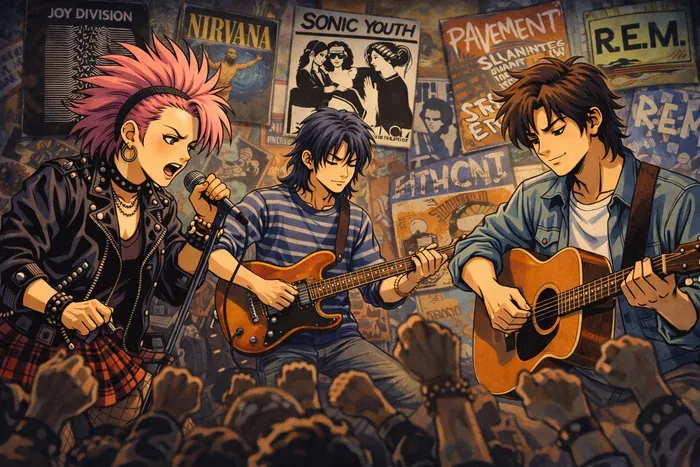
From Punk to Indie: 50 Songs Across Alternative History
The story of alternative and indie music did not begin with a single band or a single moment. It emerged gradually from the restless energy of late-1970s punk scenes, expanded through the experimentation of post-punk, and eventually evolved into the diverse global indie landscape seen today. What started in small clubs and DIY communities became one of the most influential cultural movements in modern music.
Punk bands such as Ramones, Sex Pistols, and The Clash stripped rock music back to its essentials. Their songs were short, direct, and fueled by urgency. That raw energy created the foundation for a generation of artists who believed music could exist outside the traditional industry system. Independent labels, college radio, and underground venues helped build a parallel world where new sounds could develop.
During the 1980s, post-punk and college rock expanded the possibilities of guitar music. Artists like Joy Division, Talking Heads, The Cure, and The Smiths explored atmosphere, rhythm, and emotional introspection. At the same time, American underground scenes produced bands such as R.E.M., Hüsker Dü, Pixies, and Sonic Youth, whose recordings would later shape the language of alternative rock.
The early 1990s brought the movement into the global spotlight. Albums from artists like Nirvana, PJ Harvey, The Breeders, and Smashing Pumpkins transformed alternative music from a subculture into a defining sound of the decade. Yet independence remained central to its identity. Riot Grrrl bands, indie pop collectives, and shoegaze groups continued exploring new emotional and sonic directions outside mainstream expectations.
By the early 2000s, a new generation rediscovered the power of guitar music. The Strokes, Interpol, Yeah Yeah Yeahs, and Arctic Monkeys helped spark an indie revival, while artists such as Arcade Fire and TV on the Radio expanded the genre’s emotional and sonic scale. Later acts including Tame Impala, Mitski, Phoebe Bridgers, and Wet Leg continued reshaping the sound of indie for the streaming era.
The playlist below traces that evolution. Moving from the explosive beginnings of punk through post-punk innovation, the rise of alternative rock, and the global indie renaissance of the 21st century, these fifty songs map the cultural journey of a movement that continues to reinvent itself.
Rather than presenting a random collection of tracks, the sequence follows a clear listening path. The early songs capture the raw urgency of punk. The middle section explores experimentation and the rise of alternative rock. The final stretch moves into modern indie scenes where introspection, atmosphere, and genre fusion shape the sound.
If you want to understand how punk rebellion transformed into today’s global indie culture, this listening path offers a clear and immersive journey.
The Listening Journey: 50 Songs Across Half a Century
-
Ramones – Blitzkrieg Bop (1976)
-
Sex Pistols – Anarchy in the U.K. (1976)
-
The Clash – London Calling (1979)
-
Bad Brains – Banned in D.C. (1982)
-
Siouxsie and the Banshees – Hong Kong Garden (1978)
-
Talking Heads – Psycho Killer (1977)
-
Gang of Four – Damaged Goods (1979)
-
Joy Division – Love Will Tear Us Apart (1980)
-
The Cure – Just Like Heaven (1987)
-
The Smiths – This Charming Man (1983)
-
R.E.M. – Radio Free Europe (1981)
-
Hüsker Dü – Makes No Sense at All (1985)
-
The Replacements – Bastards of Young (1985)
-
Pixies – Where Is My Mind? (1988)
-
Sonic Youth – Teen Age Riot (1988)
-
My Bloody Valentine – Only Shallow (1991)
-
Slowdive – When the Sun Hits (1993)
-
Belle and Sebastian – The Boy with the Arab Strap (1998)
-
Pavement – Cut Your Hair (1994)
-
The Stone Roses – I Wanna Be Adored (1989)
-
Nirvana – Smells Like Teen Spirit (1991)
-
Smashing Pumpkins – 1979 (1995)
-
PJ Harvey – Rid of Me (1993)
-
The Breeders – Cannonball (1993)
-
Hole – Doll Parts (1994)
-
Bikini Kill – Rebel Girl (1993)
-
Sleater-Kinney – Dig Me Out (1997)
-
Blur – Song 2 (1997)
-
Oasis – Wonderwall (1995)
-
Primal Scream – Loaded (1990)
-
The Strokes – Last Nite (2001)
-
Interpol – Obstacle 1 (2002)
-
Franz Ferdinand – Take Me Out (2004)
-
Yeah Yeah Yeahs – Maps (2003)
-
Arctic Monkeys – I Bet You Look Good on the Dancefloor (2005)
-
The Libertines – Time for Heroes (2002)
-
Arcade Fire – Rebellion (Lies) (2004)
-
TV on the Radio – Wolf Like Me (2006)
-
LCD Soundsystem – All My Friends (2007)
-
Florence + The Machine – Dog Days Are Over (2009)
-
Tame Impala – The Less I Know the Better (2015)
-
St. Vincent – Los Ageless (2017)
-
Courtney Barnett – Pedestrian at Best (2015)
-
Mitski – Your Best American Girl (2016)
-
Phoebe Bridgers – Kyoto (2020)
-
Wolf Alice – Don’t Delete the Kisses (2017)
-
Alvvays – Archie, Marry Me (2014)
-
Wet Leg – Chaise Longue (2021)
-
Japanese Breakfast – Be Sweet (2021)
-
IDLES – Never Fight a Man with a Perm (2018)
Why These Songs Still Resonate Today
This curated listening journey highlights how alternative music evolved across half a century. From the DIY ethos of punk through the experimental spirit of post-punk, the commercial breakthrough of 1990s alternative rock, and the internet-driven indie renaissance, these tracks illustrate how each generation reshaped the meaning of independence in music.
Whether you are exploring the roots of indie rock or rediscovering the artists who shaped modern alternative culture, this playlist offers a concise guide through one of the most influential musical movements of the last fifty years.