Soul: Where the Beat Found Its Emotional Core
Before there were drum machines, festival stages, and giant LED walls, there was a voice. Soul grew out of Black gospel and rhythm and blues: call and response, melisma, handclaps, testimony, and the belief that music should move the body as well as the spirit. Those habits did not stay in church. By the late 1950s, they had already moved onto radio, into theaters, and into neighborhood clubs.
Artists such as Ray Charles and Sam Cooke helped turn that language into modern popular music. Their records carried gospel intensity into secular songs about love, desire, dignity, and change. In the 1960s, labels such as Motown in Detroit and Stax in Memphis gave that emotional force distinct studio identities and national reach.
That transformation was cultural as well as musical. Soul helped make Black performance, Black style, and Black emotional authority more visible in American public life at a moment when segregation, unequal media access, and industry gatekeeping still shaped nearly every part of the business. A soul record was never just a melody and a beat. It carried a social presence into living rooms, cars, jukeboxes, and local dance halls.
Soul did more than produce great singles. It changed how rhythm sat inside a song. Backbeats felt heavier. Bass lines moved closer to the center. Vocals stayed intimate even when the message was public. Every dance style that follows in this article, from funk to techno, carries some part of that foundation.
That foundation was musical, but it was also social. Soul records circulated through Black radio, neighborhood record stores, touring circuits, and television appearances that gave new visibility to Black performers in an unequal media landscape. By the time later dance genres emerged, they were drawing not only on a sound but on an already established world of labels, audiences, stagecraft, and shared memory.
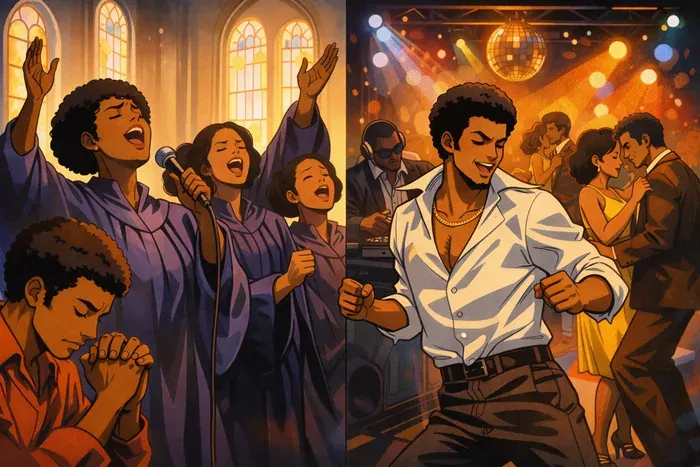
From Church Pews to Club Floors
Soul did not arrive fully formed. Its language was already alive in Black churches across the American South. Gospel singers stretched syllables until they trembled. Congregations answered back. People clapped, stamped, and sang at once. The body was already part of the music. Later, that collective energy would move from pews to dance floors, but the emotional grammar was in place early.
Ray Charles was one of the first artists to cross that line in a way the whole country could hear. When he recorded “What’d I Say” in 1959, he pulled church-style call-and-response into a secular setting charged with desire. The electric piano riff felt urgent. The backing vocals sounded unmistakably gospel, even though the lyrics were not religious. Some radio stations banned the song. Churches criticized him. Audiences loved it. That tension between sacred roots and secular freedom became part of soul’s identity.
It also changed the practical language of rhythm and performance. “What’d I Say” does not feel arranged like a tidy pop standard. It unfolds through vamp, repetition, response, and escalation. Those are dance-floor values before modern dance music existed as a category. The track works because it stays in the pocket and lets intensity build over time rather than rushing to a neat conclusion.
Sam Cooke’s path was different. He first became known with the Soul Stirrers before moving into pop and R&B. His voice sounded calm, elegant, and conversational. “You Send Me” was a crossover hit, but “A Change Is Gonna Come,” recorded in 1964 and released that December, revealed a deeper side of soul. Cooke framed civil rights-era pain with restraint rather than slogans. He was killed on December 11, 1964, just before the song reached the public, which gave the record an added historical weight it did not need to ask for.
Around them stood artists such as Mahalia Jackson, whose gospel singing shaped the phrasing and emotional control of a generation. Even singers who moved into secular material kept something of her approach: the held note, the delayed entrance, the way silence could build pressure before the next line arrived.
What changed during this period was not only the sound but also the audience around it. Black families moved from the rural South to cities such as Chicago, Detroit, and New York, building new communities, new radio audiences, and new nightlife. Stations started targeting Black listeners more directly. Independent labels looked for records that could travel beyond one region. Musicians suddenly had to balance church expectations, business ambition, and social responsibility at the same time.
By the early 1960s, soul had become a bridge between church-rooted expression and mass popular culture. It proved that music could speak plainly about love, pain, faith, and injustice without losing rhythmic drive. That balance between feeling and groove is where the rest of this story begins.
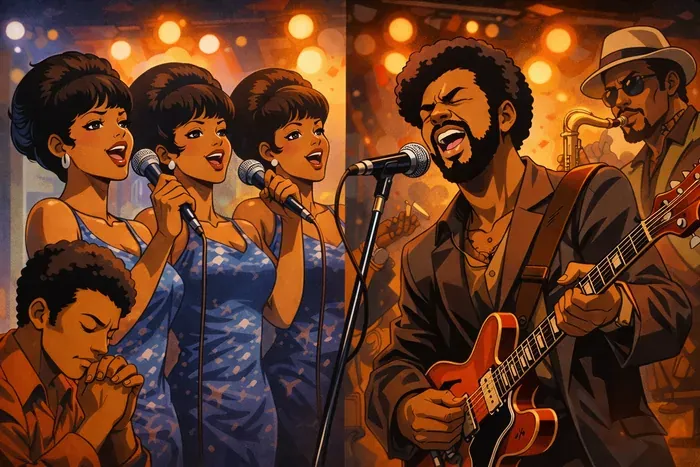
Motown and Stax: Two Visions of Soul
As soul moved from local scenes into the national charts, two labels shaped its direction in very different ways: Motown Records in Detroit and Stax Records in Memphis. Both were rooted in Black communities. Both trusted rhythm and voice. But their methods, their sounds, and even their ambitions were different.
Motown, founded by Berry Gordy in 1959, was famously organized. Gordy had worked on an assembly line before starting the label, and he carried some of that discipline into the studio. Songwriters, producers, arrangers, and session musicians worked as a system. The house band later became known as the Funk Brothers. Together they built a sound that was melodic, polished, and made for radio. Artists rehearsed choreography and camera presence almost as carefully as the songs themselves. The goal was crossover success, and Motown reached it.
That system could seem controlled from the outside, but it was also a remarkable machine for craft. Different specialists handled writing, arrangement, performance, image, and session playing with unusual consistency. The records sounded concise, but behind that concision was constant refinement: finding the right key, the right vocal phrasing, the right tambourine placement, the right amount of bass for radio and jukeboxes.
Groups like The Supremes became international stars. “Stop! In the Name of Love” sounded light on the surface, but the rhythm section underneath it was firm and exact. Motown made Black artists visible to a much broader American public, though that crossover success also came with pressure. Performers had to navigate television, touring, and industry expectations that were rarely built around their interests.
Stax, by contrast, felt more relaxed and more immediate. The label was based in a converted movie theater in Memphis. It grew out of collaboration between Black and white musicians in a segregated South. The house band, Booker T. & the M.G.’s, played with a strong, focused pocket. The sound was less polished than Motown and more direct. Horns hit harder. The drums sat closer to the surface. The recordings let you hear musicians responding to one another in real time.
That real-time quality is part of why Stax records still feel so physical. Where Motown often aimed for gleam and exactness, Stax often preserved the grain of the room. You can hear air around the drums, pressure in the horns, and a rhythm section that sounds like it is making decisions together rather than simply executing a plan handed down from above.
Otis Redding was a clear example of that approach. In songs like “Try a Little Tenderness,” his voice moves from soft restraint to explosive power. You can hear breathing, strain, and urgency. The performance feels human and almost fragile. Stax did not try to smooth that intensity into something safer. It trusted the force of the performance itself.
Both labels mattered during the Civil Rights era because they offered different models of Black musical power. Motown showed how Black performers could enter mainstream American media at scale. Stax proved that Southern soul did not have to be polished into something else to carry authority. Together, they built studio habits, star systems, and audience networks that later dance genres would inherit.
They also taught later producers two different lessons that never disappeared. Motown showed how arrangement, branding, and repeatable studio discipline could turn local talent into durable pop language. Stax showed how groove, room feel, and ensemble tension could carry equal authority. Later dance music would move back and forth between those poles for decades.
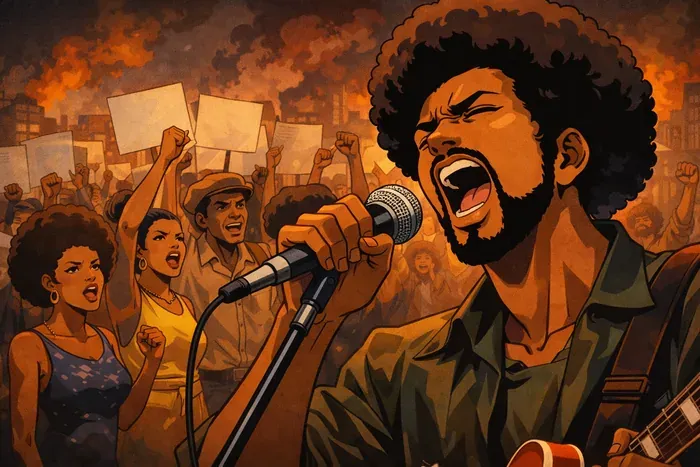
When Soul Found Its Voice in Protest
By the late 1960s, soul was changing again. The hit singles were still there, but albums were opening up. Artists were no longer satisfied with three-minute stories about romance. The world outside the studio had become harder to ignore. The Civil Rights Movement, the Vietnam War, urban unrest, and generational change were pressing in from every side, and musicians responded by widening the emotional and political range of the music.
Aretha Franklin had already made “Respect” into an anthem in 1967. Otis Redding wrote and first recorded the song, but in her hands, it became something else. She made the title clear, spelled it out, and claimed authority in her phrasing. Her version had both personal and political meanings. It spoke to women demanding dignity and to Black audiences insisting on recognition. Franklin’s voice sounded gentle and strong at the same time, and she was in complete control. She didn’t need to shout to be heard.
A few years later, Marvin Gaye released What’s Going On in 1971. Motown’s reputation was built on tight singles, but this album unfolds like a conversation. The songs run into one another. Themes return. The title track opens with layered vocals and gentle percussion, almost like a street scene caught in sound. Gaye sings about war, poverty, environmental damage, and spiritual confusion. He sounds less like an accuser than someone trying to make sense of a divided society. It was a major shift for both the artist and the label, and it proved that soul could hold complex ideas without losing its rhythmic force.
GRAMMY’s 50th-anniversary feature on the record is useful here because it shows how grounded the album was in lived pressure, not abstract prestige. Gaye was responding to grief, Vietnam, police violence, and social fracture, and he used arrangement to hold those themes together. The album is lush, but it is not escapist. Its groove keeps moving while the questions stay unresolved.
Curtis Mayfield had a similar experience. His music for the 1972 film Super Fly did not glorify the film’s drug-dealer protagonist. Instead, Mayfield’s songs examined the social conditions of that time. Songs like “Freddie’s Dead” combined strong social messages with compelling rhythms. The music felt smooth and seductive, but the lyrics were critical and cautionary.
During this period, the studio became a place for longer thoughts. Artists pushed labels for more control. Producers experimented with layering, orchestration, and sequencing. Soul was no longer only music for dancing or radio rotation. It had become a space for reflection. The groove remained, but now it carried questions about justice, identity, and survival.
That expansion of form matters later because dance music did not emerge from a shallow tradition. Even when later club records reduced lyrics or shifted toward instrumentals, they inherited a Black popular music culture that had already linked rhythm to dignity, struggle, desire, and self-definition.
That wider emotional and political range matters later. Disco, house, and modern electronic dance music may not look like protest music at first glance, but one key idea starts here: rhythm can carry social meaning. The dance floor would inherit more than a beat. It would inherit a voice.
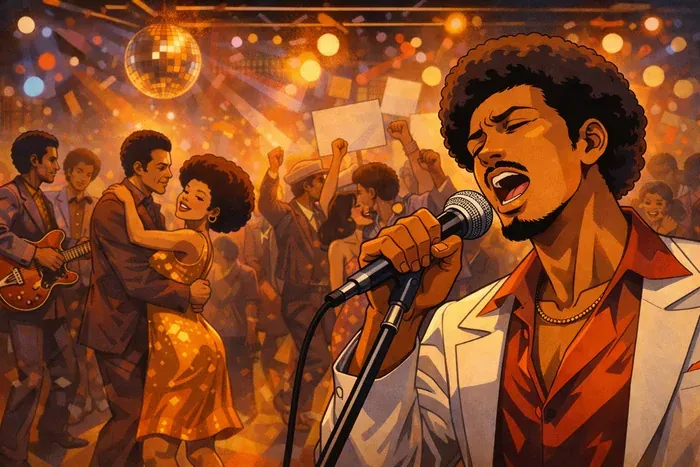
Philadelphia: Where Soul Turned Toward Disco
As political soul expanded the album form, another branch of Black popular music was quietly refining the architecture of the dance floor. In Philadelphia, producers and arrangers developed a sound that was smoother, more orchestral, and more tightly locked to a steady pulse than most earlier soul records. The feeling stayed in place, but the groove grew more continuous.
Songwriting and production teams such as Kenny Gamble and Leon Huff worked with musicians who knew how to balance elegance and drive. MFSB’s “TSOP (The Sound of Philadelphia),” released in 1974 and later used as the theme for Soul Train, captures that balance clearly. The groove moves forward without rushing. Strings lift the track without blurring the rhythm. The bass line keeps the whole record grounded.
Groups like The O’Jays brought that production style into vocal storytelling. Songs such as “Love Train” and “Back Stabbers” combined social awareness with danceable arrangements. The message could be hopeful or cautious, yet the rhythm still invited people onto the floor. These records carried a sense of unity without pretending tension had disappeared.
What Philadelphia changed, above all, was flow. The rhythm section was less about sudden hits and more about glide. Hi-hats, strings, and congas could work together to keep motion continuous, which made these records especially useful to DJs trying to sustain a room rather than restart it every few minutes.
Female vocal groups mattered here too. The Three Degrees delivered performances that were polished yet expressive. Their harmonies sat comfortably inside lush arrangements, proving that refinement did not have to mean emotional distance. You can hear how carefully these records were built: precise horn stabs, strings that lift a chorus without swallowing it, and drums that keep everything danceable.
Philadelphia soul did not announce a revolution. It refined one. The beat grew steadier, the arrangements wider, and the records more useful to dancers and DJs. When disco rose in the mid-1970s, it did not arrive from nowhere. Philadelphia had already shown how soul could become more luxurious, more rhythmic, and more club-oriented without losing its human core.
Philadelphia matters so much in this story because it linked the emotional authority of soul to the continuous momentum that disco would depend on. The result still sounded rich and human, but the dance floor was starting to become the main frame of reference.
Funk: When the Rhythm Took Over
By the end of the 1960s, the dance floor had moved closer to the center of the story. Soul had already given popular music a deeper emotional language. Now rhythm itself stepped forward. The beat was no longer just there to support a melody. It was becoming the main event.
Funk came out of soul, but it changed the center of gravity. Guitars became tighter. Bass lines grew heavier and more melodic. Drummers played patterns that felt blunt, direct, and physical. The spaces between notes started to matter as much as the notes themselves. Crowds in clubs and community halls felt that shift immediately. Funk cared less about soaring melody and more about what happened when a band locked into one repeated pattern.
Funk taught listeners a new kind of attention. Instead of following a song mainly by its chord changes or chorus, you followed the pressure inside the groove. Tiny rhythmic adjustments, a bass accent, a guitar scratch, or a shouted cue could become the real event. Modern loop-based dance music depends on exactly that kind of listening.
Artists like James Brown and Sly and the Family Stone changed how bands worked together on stage. Their records arrived during a period of rapid social change. Black identity, political pride, and urban realities all found expression in the sound. Funk did not give up on feeling. It reorganized feeling around the pulse. The dance floor was getting louder, harder, and more focused.
That change mattered far beyond one genre label. Funk made repetition feel active rather than empty. It taught listeners and dancers to hear small shifts in timing, bass emphasis, and ensemble interaction as the real drama of a track. Later disco edits, house loops, and techno patterns all depend on that lesson.
James Brown: The Man Who Locked the Beat
When people describe funk as a turning point, James Brown usually comes first. By the early 1960s he was already a major soul star, known for explosive performances and relentless rehearsal. But in the middle of the decade, something shifted. The center of attention moved away from chord progressions and toward rhythm itself.
Songs like “Papa’s Got a Brand New Bag” and later “Get Up (I Feel Like Being a) Sex Machine” revolve around what Brown called “the one,” the first beat of the measure. The band hits it hard. Guitars play short rhythmic figures. The bass works in tight, repeating phrases. Horns punctuate rather than float. Even Brown’s voice locks into the groove and often behaves like another instrument.
That approach changed the structure of popular music. Instead of building songs through constant melodic movement, Brown built them through repetition. Tension came from small adjustments: a guitar accent, a horn stab, a shouted instruction to the band. The music felt alive and tightly controlled at the same time.
The band itself was crucial. Musicians like Bootsy Collins and his brother Catfish Collins, who later spent time in Brown’s orbit before moving into other projects, embraced this rhythmic philosophy. Bass no longer just supported the harmony. It drove the track forward with thick, elastic lines. Drummers left space between beats instead of filling every gap.
Brown’s method also changed rehearsal culture. Tightness was not treated as a bonus. It was the whole point. A groove only worked if every player understood how little was necessary and how much force a stripped-down pattern could carry. That discipline is one reason so many later producers, including house and hip-hop artists, kept returning to James Brown records for rhythmic lessons.
Brown’s stage presence reinforced the whole method. He demanded precision, and musicians were reportedly fined for missing cues. The result could feel almost mechanical in its tightness, yet it was built entirely from human interaction. Audiences responded with movement. The groove did not need explanation.
Funk of this period also reflected the era directly. In the late 1960s, demands for Black pride and self-definition were growing sharper. Brown’s records carried that confidence. The rhythm was forceful. The band sounded certain of itself. Songs like “Say It Loud – I’m Black and I’m Proud” connected music to identity without hesitation.
After that, dance music was operating on new terms. A song could now build power by staying on one rhythmic idea and tightening it over time. Later disco producers, house DJs, and techno artists all worked from that premise.
Sly Stone: Funk as Freedom
While James Brown made rhythm more precise and controlled, Sly and the Family Stone came at groove from another angle. Their music felt looser, brighter, and socially broader. The band included Black and white musicians, men and women, sharing the stage as equals. In the late 1960s, that mattered on its own.
Early hits like “Dance to the Music” and “Everyday People” combined bright melodies with strong, syncopated rhythms. Bass and drums kept the songs moving, but the vocals still sat at the center. Many voices answered one another. Feeling seemed to belong to the group rather than to one lead figure. The groove invited movement, but it also hinted at the possibility of living together differently.
By 1971, the mood had changed. There’s a Riot Goin’ On sounded darker and more fragmented. A primitive drum machine, the Maestro Rhythm King MRK-2, helped give the record its hazy, layered texture. The bass was still strong, but the atmosphere had tightened. The optimism of the late 1960s had been shaken by political violence and disillusionment, and Sly Stone’s writing reflects that. Songs like “Family Affair” move with a steady, almost hypnotic rhythm that feels less like celebration than thought under pressure.
That record matters for the later history of dance music because it made machine rhythm feel psychological. The beat no longer had to sound triumphant or even communal in a simple way. It could sound tired, suspicious, intimate, or emotionally fogged. Later post-disco, deep house, and certain strands of techno would all return to that idea.
The band’s personal turmoil also shaped the music. Substance abuse, pressure from fame, and changing relationships all left marks on the recording process. The unified sound of the earlier records gave way to something more fragile. That vulnerability did not weaken the groove. It made it heavier. Repetition started to feel more like reflection than escape.
Sly Stone’s approach made funk music more emotional. Where James Brown was precise and authoritative, Sly allowed for more ambiguity. He mixed psychedelic sounds with strong rhythms. He was not bound by the rules of conventional songwriting. This openness influenced later producers, who saw the studio as a place to experiment rather than simply capture performances.
Sly and the Family Stone also expanded the idea of funk as collective expression. Dance music would later depend on communities gathering in shared spaces, and Sly’s records already carried that social imagination. They showed that groove could be joyful and full of doubt at the same time, bright and unsettled, unified and fractured. That complexity would stay with the music that followed.
Parliament-Funkadelic: Cosmic Funk for a New World
If James Brown built funk like a machine and Sly Stone treated it as a social experiment, George Clinton turned it into a universe. Through Parliament and Funkadelic, often grouped together as Parliament-Funkadelic, he made funk more dramatic, cosmic, and deliberately excessive. The groove remained steady, but now it came wrapped in myth, characters, and story.
In 1975, Mothership Connection turned funk into a vehicle for liberation. The imagery was impossible to miss. Spaceships landed on stage. Characters like Dr. Funkenstein appeared in liner notes and lyrics. This was not fantasy for its own sake. It was a way of imagining Black identity beyond the limits imposed by American history. Later scholars would call it Afrofuturism. At the time, it felt playful and radical at once.
That imagination did real musical work. Parliament-Funkadelic made it easier to hear groove as world-building. A bass line, a chant, and a repeated riff could suggest not only a song but a whole alternate social space. That is one reason Detroit techno artists later heard George Clinton as an ancestor rather than a distant funk eccentric.
The music itself rested on strong bass and sharply defined rhythm guitar. Bootsy Collins was central here. His bass lines were flexible, melodic, and often became the part listeners remembered first. Songs like “Give Up the Funk (Tear the Roof off the Sucker)” use repetition, but they also pile on chants, horn riffs, and call-and-response vocals. The groove can stretch for minutes without losing momentum.
Parliament-Funkadelic also treated the studio as a space for excess and experimentation. Layered vocals, long jams, and dense textures mattered more than keeping a song tidy. Live shows pushed that even further. Costumes, props, and collective improvisation could make a concert feel half ritual, half performance art.
The social context matters here. In the mid-1970s, many urban communities were dealing with economic hardship, even as Black cultural pride remained a powerful force. Clinton’s world offered escape without denial. It acknowledged struggle, but insisted just as strongly on joy and imagination. On the dance floor, that could feel like permission to try on new identities rather than defend old ones.
The influence on later dance music is easy to hear. Extended grooves, playful vocal fragments, and heavy bass all feed directly into disco and house. So does the idea that rhythm can carry narrative weight. Later DJs and producers built entire scenes around the echo of these records, from Chicago to Detroit and beyond.
Parliament-Funkadelic showed that funk could be more than just tight minimalism. It could be big, funny, about politics, or strange. But the foundation was simple: a steady beat, a deep bass line, and a crowd moving together.
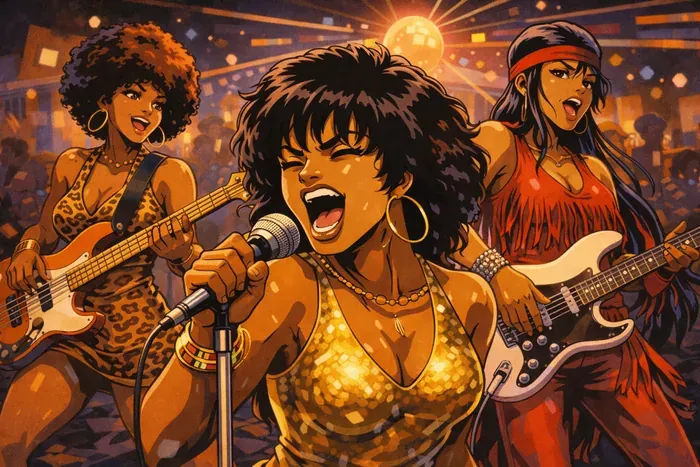
The Women Who Made Funk Fierce
Funk is often remembered through its bandleaders and bass players, but women were just as important in shaping the genre. They were bold, complex artists who received less credit than they deserved. Their presence was not decorative. It challenged expectations around sexuality, authority, and creative control.
Betty Davis is one of the clearest examples. Her albums, including her 1973 self-titled debut, were raw and direct. The grooves were deep and stripped down. Her lyrics were unapologetically frank about desire. She did not reshape her voice to fit radio expectations. Some stations refused to play her music. Conservative audiences rejected it. Musicians, however, respected the force of what she was doing. She wrote her own material and worked closely with her band, helping shape the sound from the inside.
That authorship matters. Betty Davis did not simply front a groove that others designed for her. She shaped the tone of the records and the terms of the performance. Later dance music, especially disco and house, would depend heavily on women whose voices conveyed power, control, and sexual self-definition. Davis helps make that later lineage easier to hear.
Chaka Khan was another key figure. As the lead singer of Rufus, she combined technical skill with emotional power. The song “Tell Me Something Good,” written by Stevie Wonder, showed her ability to move from warmth to force in a single phrase. The rhythm sections behind her were tight and layered, but her voice conveyed the emotional core. When she launched her solo career, she kept the same balance between joy and vocal command.
The industry context was often difficult. Labels tried to control how artists were presented. Male producers usually received more public recognition. Women had to navigate expectations around appearance, sexuality, and radio appeal. Some managed to work successfully inside that system. Others, like Betty Davis, became cult figures rather than chart-dominant stars.
Their influence still runs through the genre. Funk’s physical force, its openness about desire, and its insistence on self-definition all draw from these voices. On stage, women claimed space in ways mainstream audiences often found unsettling. In the studio, they insisted on being heard as writers and collaborators.
The dance floor picked up that energy quickly. Later disco divas and house vocalists would inherit the same mix of sensuality and strength. The groove stayed, but the image of who could command it changed. In a genre built on repetition, these artists kept finding ways to make autonomy audible.
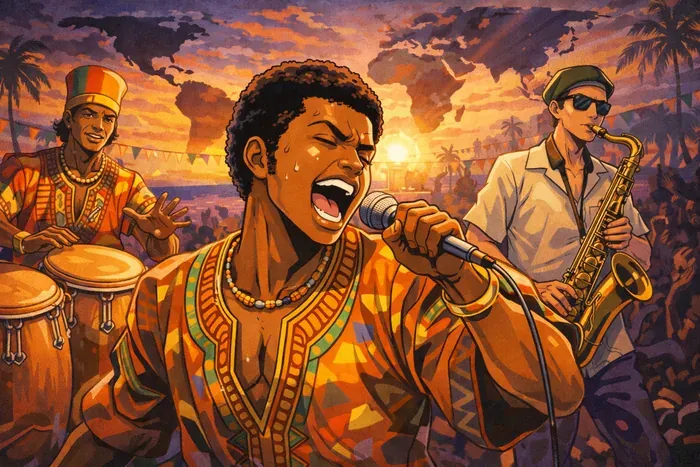
Afrobeat: The Atlantic Rhythm Exchange
While funk was developing in the United States, a similar but different style was emerging in West Africa. Fela Kuti combined highlife, jazz, and American funk to create Afrobeat, a style with long, layered rhythms and strong political messages. His music was not a copy of funk. It expanded its logic.
After spending time in the United States in the late 1960s, Fela began incorporating elements of soul and funk into his music, including prominent horn sections and a strong emphasis on rhythm. When he returned to Nigeria, he combined these influences with African percussion patterns and longer song structures. Some of the songs on the 1976 album Zombie were over ten minutes long. The repetition was intentional. Horn lines circled. The drums were playing in steady cycles. Guitars played sharp, short notes. Fela sang in a mix of English and Nigerian languages, talking about corruption, military power, and social injustice.
The groove was mesmerizing, but it wasn’t passive. Each instrument had its own space, and together they made a dense but clear texture. The bass lines were deep and melodic. The drumming kept the music going, but it wasn’t too fast. The dancers reacted naturally. But the lyrics were very important. Fela’s music was both communal and confrontational.
His band, Africa 70, and later Egypt 80, was a group of musicians working together. The live performances were very immersive and lasted a long time. There was real political risk. The Nigerian government attacked his home. He could go to prison. Even so, he kept releasing music that mixed danceable rhythms with direct criticism.
Afrobeat shows how rhythm traveled across the Atlantic Ocean and came back changed. Funk drew from African rhythmic traditions. Afrobeat took the tight rhythms of funk and made them even better by using them in a different social setting. The exchange was not abstract. Musicians toured, listened, and responded to one another.
That Atlantic flow of ideas is important for the story that follows. Disco, house, and later global dance music all used similar exchanges. Rhythms would move between continents, change their meaning, and return in new forms. Afrobeat is an early example of that process. This shows that groove isn’t just for one city or one industry. It exists in movement, in conversation, and in communities willing to shape it to their own realities.
Afrobeat also helps correct a common simplification in dance-music history. The story is often told as if innovation moved mainly from the United States and Europe outward. Fela Kuti’s work shows something more reciprocal: African rhythmic thinking was never just a distant origin point. It remained active, contemporary, and capable of reshaping what came back across the Atlantic.
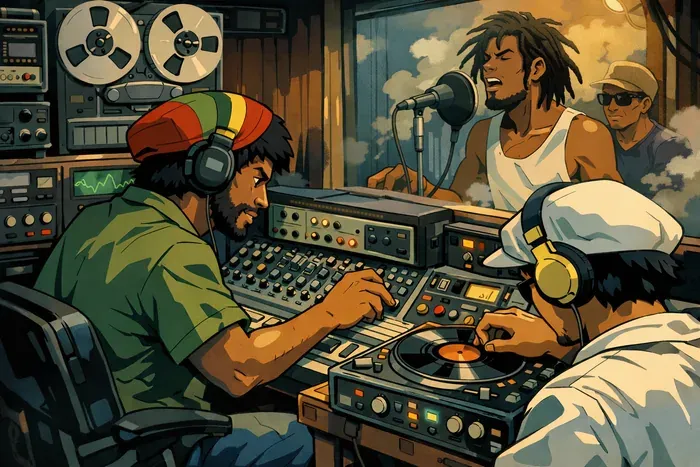
Dub: How the Studio Became an Instrument
By the mid-1970s, rhythm was already at the center. Funk had made it denser. Philadelphia soul had made it smoother. Disco was beginning to stretch the logic of the dance floor. But another major change was happening, and it did not begin in New York or Detroit. It began in Kingston.
In Jamaica, producers and engineers started treating the studio as an instrument in its own right. Instead of recording a band and leaving the performance alone, they pulled tracks apart. Vocals dropped out. Bass came forward. Echo and reverb changed the sense of space. New versions grew out of existing songs. The groove remained, but its shape became less fixed.
This was tied to sound-system culture, where selectors needed exclusive cuts, strong bass, and versions that could work for a crowd in real time. Dub was not only a clever studio idea. It was a response to how people were actually listening: loudly, physically, and in collective space.
King Tubby and Lee Scratch Perry were key figures in this approach. Their work influenced more than just the reggae genre. It changed how producers around the world understood rhythm, space, and repetition.
Dub introduced a new idea that would influence disco, house, and techno music: a track isn’t set in stone. You can rebuild it, extend it, strip it down, and transform it. The dancefloor would soon start thinking the same way.
This can be easy to miss if you listen only for genre tags. But once producers learned to treat arrangement, echo, bass weight, and breakdown as movable parts, the logic of modern club music was already in place. Long before digital editing made that process look normal, dub had already made recorded music feel open-ended.
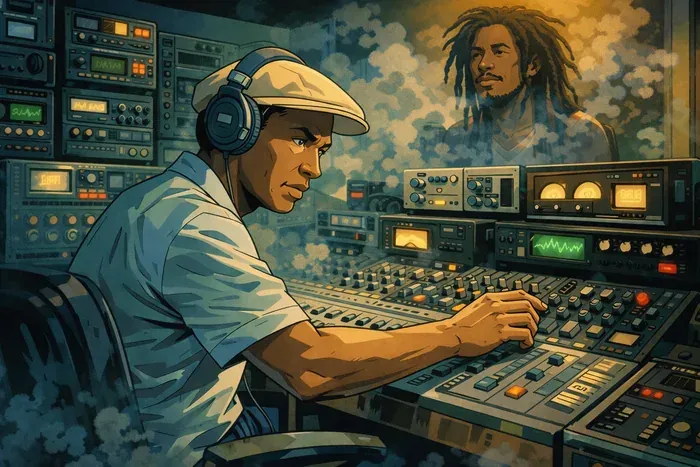
King Tubby: The Man Who Remixed Reality
In Kingston in the late 1960s and early 1970s, sound systems sat at the center of community life. Large speaker stacks filled open-air yards. Records were played loud, and people came not only to dance but to listen closely. The bass had to carry. The rhythm had to hold. Out of that environment came one of the most important changes in modern production, driven by King Tubby.
King Tubby started out in electronics. He understood circuits and signals in practical terms, and when he moved into music, he used that knowledge creatively. Instead of treating a finished song as fixed, he broke it into parts. Vocals disappeared. Drums and bass stepped forward. Echo drifted into space. Reverb made a snare hit feel larger and more dramatic.
That technical knowledge gave him unusual control over sonic illusion. A delay was not just an effect. It was a way to redraw the room. A bass line was not just accompaniment. It was the spine of the whole experience. Later club music would treat both ideas as obvious, but dub had to invent that listening practice first.
These “versions” were not simply instrumentals. They were reimagined spaces. A familiar rhythm might return, but the arrangement felt altered from the inside. Tubby used the mixing desk like a live instrument, moving faders and triggering effects in real time. The result was spacious and immersive. Silence became part of the groove. A sudden drop could create more tension than any chord change.
The approach changed how audiences heard repetition. In dub, repetition was never fully static. Small changes in echo, delay, or balance could make the whole track feel different. Bass became the central sound, solid and deep enough to hold everything else together. That attention to low frequencies would later become essential in club systems from New York to Chicago to Berlin.
Dub also changed ideas about authorship. Producers and engineers moved closer to the center. The person at the console could alter the meaning of a song without writing a new lyric. That disrupted the usual hierarchy of popular music, where singers and front-facing performers tended to get the credit. In Jamaica’s sound-system culture, the selector, the engineer, and the crowd all helped shape the final experience.
The influence of dub music spread quietly at first. Jamaican records reached the United Kingdom through migration and diaspora networks. DJs and producers in New York and London paid close attention. The idea that a track could have different versions, each with its own atmosphere, was popular in nightclubs.
King Tubby was one of the first to focus on the rhythm, bass, and space in music. This laid the foundation for later styles like disco edits, house remixes, and techno builds. The dancefloor would fully embrace version culture. What started as technical experimentation in Kingston turned into a philosophy: groove is flexible, and the studio can change it.
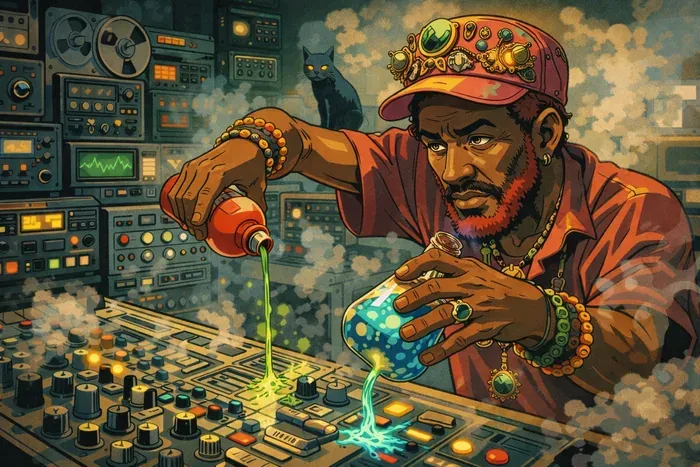
Lee 'Scratch' Perry: Mad Genius of Dub
If King Tubby approached the mixing desk with the focus of an engineer, Lee Scratch Perry treated it like a laboratory. Working mainly at Black Ark Studio in Kingston during the 1970s, Perry pushed dub into stranger territory. He layered sounds in ways that felt dreamlike and sometimes chaotic, yet were always grounded by rhythm.
Perry worked with bands such as The Upsetters and produced for artists including Bob Marley and the Wailers in earlier phases of his career. In his own productions, however, he allowed experimentation to lead. Drum hits might echo into distant space. Snare cracks could dissolve into reverb trails. Fragments of vocal lines appeared and disappeared. Animal sounds, percussion scraps, and studio chatter sometimes found their way into the mix.
What held everything together was the bass and drum foundation. Even when the surface felt unstable, the low end remained steady. This balance between structure and unpredictability would later become essential in electronic dance music. A techno track might introduce filtered sweeps and delayed effects, yet the kick drum anchors the room. Perry was already playing with that tension decades earlier.
His approach also blurred the line between performance and production. The mixing process itself became expressive. Adjusting tape speed, manipulating echo units, and manually triggering effects turned the engineer into a performer. A track was no longer a fixed object. It evolved through intervention. That mindset would later resonate strongly with DJs who extended or reshaped tracks in real time.
Perry’s work traveled beyond Jamaica through record shops, migrant communities, and adventurous producers abroad. In the United Kingdom, dub influenced post-punk and emerging electronic scenes. The idea that space could be part of rhythm entered club thinking. Silence, echo, and delay were no longer background tools. They became compositional elements.
Dub did not aim for the polished sheen that Philadelphia soul pursued. It embraced texture, sometimes even distortion. Yet beneath the rough edges lay careful listening. Perry understood how a small shift in timing or resonance could alter the mood of an entire track.
As disco developed extended mixes and house producers began stripping tracks to drums and bass, the echo of dub was already there. The belief that rhythm can be rebuilt inside the studio, that atmosphere can deepen groove rather than distract from it, owes much to Lee “Scratch” Perry. His work widened the idea of what dance music could sound like, even before it was called dance music in the modern sense.

Sound Systems Cross the Ocean
Dub did not stay in Jamaica. In the 1970s, large Caribbean communities in cities like London and Birmingham brought sound-system culture with them. Weekend dances centered on large speakers, heavy bass, and DJs who knew how to build energy patiently. The point was not spectacle. It was vibration. The music had to be felt in the chest.
In that environment, dub became part of British musical life. Independent labels started pressing Jamaican music. Producers tried similar techniques in local studios. One person who embraced and expanded on dub’s ideas was Adrian Sherwood. In the late 1970s and 1980s, Sherwood used his On-U Sound label to mix dub music with post-punk and early electronic experimentation. Echo, delay, and stripped rhythms fed entirely new scenes.
What matters here is not the charts but the infrastructure. Sound systems taught people to listen for bass differently. They made long, hypnotic tracks feel normal. They encouraged listeners to hear the DJ and the engineer as creative figures rather than background technicians. Those ideas would soon line up with emerging club culture.
British scenes in the late 1970s and early 1980s were already shifting. Post-punk bands were exploring texture and atmosphere, and dub’s spacious production style fit that search naturally. When electronic instruments like drum machines and synthesizers became easier to access, dub offered a working method: leave space, let the rhythm breathe, and use effects to alter perception.
The club would be the place where everyone met. As disco and later house records reached the UK, DJs mixed them with tracks influenced by dub. The bass-heavy sound made certain rhythms especially powerful. Extended versions were popular in sound system settings where repetition was important.
Cross-pollination prepared the ground for later developments in UK club culture, from early rave to bass-driven scenes in the 1990s. The idea that music could be reworked endlessly, that versions could coexist, and that the studio itself was a performance space traveled from Kingston to London and then outward again.
That inheritance is easy to underestimate because it often appears as technique rather than as headline style. But the modern club edit, the breakdown, the bass drop, the extended mix, and the sense that a record can keep mutating all have part of their logic here.
By the time disco was taking over dance floors in New York, people were already using tools to reshape recorded songs. Dub’s impact seemed subtle but was profound. It made it possible to create new rhythms and use new spaces. It taught producers and DJs to see recorded music as something that can be changed, rather than a perfect, unchanging work of art.
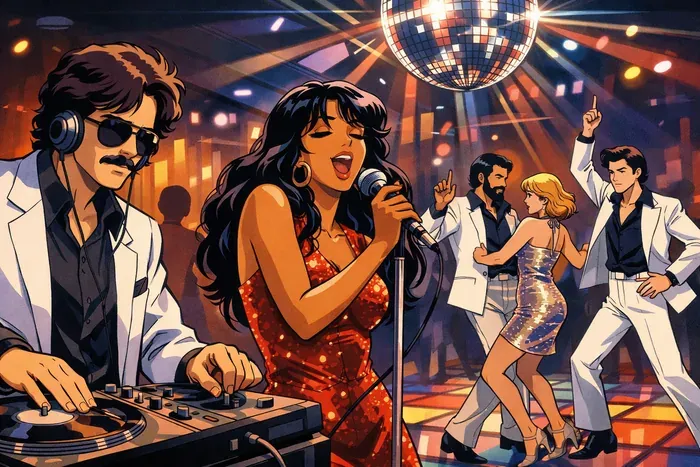
Disco Becomes a Culture
By the mid-1970s, several streams were meeting in the same room. Soul had deepened popular music’s emotional range. Funk had pushed groove to the front. Dub had shown that recorded tracks could be reshaped for dancers. In New York, those ideas met inside clubs with serious sound systems and audiences who treated the night as both pleasure and refuge.
Disco did not begin as a corporate category. It grew inside Black, Latino, and queer spaces: loft parties, neighborhood clubs, and rooms where dancers wanted continuity rather than interruption. Celebrity and spectacle were not the point. Sound was. So was careful selection, and so was the shared sense that a dance floor could hold a community together for hours.
That social function is crucial. For many dancers, the club was one of the few places where visibility, style, pleasure, and safety could exist together, even if only temporarily. The music mattered because it helped sustain that fragile space. Disco was not just upbeat entertainment. It was a practical culture of gathering.
DJs such as David Mancuso and Larry Levan understood that a night had structure. Records were not just played. They were sequenced, extended, and emotionally paced. Disco turned repetition into social architecture. Once the groove became continuous, dance music could do something different with time, tension, and community.
Disco matters historically even beyond its chart years for one basic reason: it established the idea that a dance night could have its own narrative arc, separate from radio logic or live-band set lists. The DJ was no longer filling gaps between songs. The DJ was shaping a collective experience across hours.
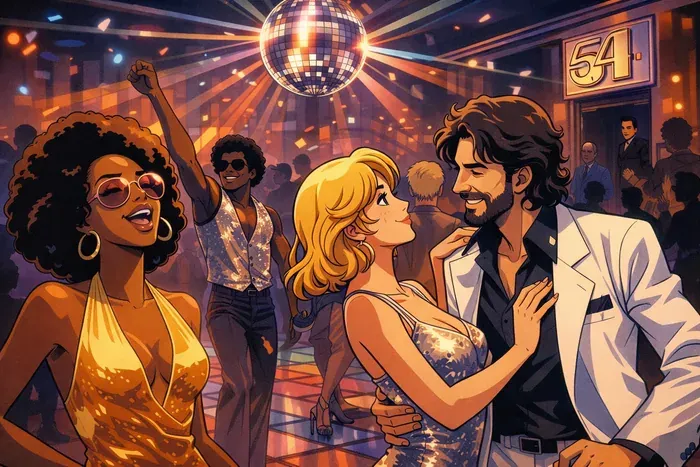
The Clubs That Built Disco Culture
Disco’s early history cannot be separated from the rooms where it lived. In the early 1970s, before the genre had a clear commercial identity, parties were held in lofts and private venues across New York. One of the most influential was The Loft, curated by David Mancuso. He did not see himself as a performer so much as a host. Sound quality, lighting, and the emotional shape of the night all mattered to him.
At The Loft, music was not restricted by radio logic. Mancuso played soul, funk, Latin records, early disco productions, and imports. He let tracks run longer than usual. The sound system was central. Bass needed to feel warm and clear. High frequencies had to sparkle without turning harsh. Dancers responded to that care. The party felt intimate and communal rather than theatrical.
A few years later, the Paradise Garage became another key space, shaped by Larry Levan. Levan approached DJing as a form of storytelling. He would build tension slowly, sometimes letting a record loop through extended breaks, sometimes dropping in unexpected selections. The room’s energy guided him. If the crowd leaned in, he adjusted. If they needed release, he delivered it.
Paradise Garage was more than a club. It functioned as a social center for many Black and queer New Yorkers. The dancefloor offered safety and visibility at a time when mainstream culture often denied both. Music became a shared language. The repetition of a groove created a sense of unity that extended beyond the walls.
These DJs relied heavily on extended mixes and imported records. They worked with producers and remixers who understood that the club needed space for movement. The 12-inch single, with longer instrumental passages and deeper bass, became more important in exactly this context.
What stands out about these spaces is their focus on community rather than spectacle. There were no giant screens or corporate sponsorships. The emphasis was on the connection between record and listener, and the DJ shaped that relationship carefully.
Disco’s later commercialization would shift attention toward chart success and celebrity performers. Yet the roots remain here, in rooms where music was curated with patience and respect. The DJ emerged as a central figure, not because of ego, but because someone had to shape the flow of the night. That role would grow in significance as dance music evolved.
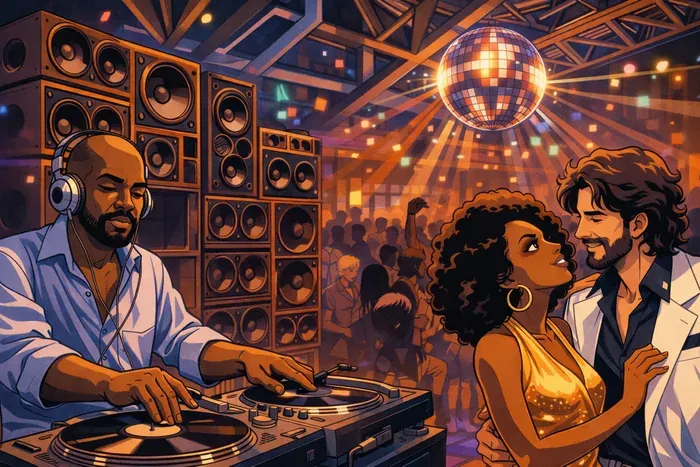
Sound Systems and Club Architecture
Dance music history is also a history of rooms. A record that sounds ordinary on small speakers can feel transformative on a carefully tuned club system. That is why places such as The Loft, Paradise Garage, and later Ministry of Sound mattered so much. They did not simply host scenes. They helped shape how records were mixed, tested, and remembered.
David Mancuso treated sound as a form of hospitality. At The Loft, clarity mattered as much as selection. Paradise Garage pushed that philosophy toward even greater scale. The DJ booth, the speaker placement, the darkness of the room, and the timing of the lights all affected how a groove landed. A long intro only works if the room can hold tension. A bass line only becomes social architecture if the sound system lets people feel it in their bodies rather than merely hear it.
That physical logic helped drive the rise of the 12-inch single and later house and techno production. Producers began making records for club systems, not just for radio. Kicks had to be stronger. Bass had to stay clear at volume. Hi-hats had to cut without becoming painful. As GRAMMY’s house timeline notes when describing clubs such as Ministry of Sound, sound quality itself became a defining part of club identity.
This helps explain why certain styles spread when they did. Disco’s continuity, dub’s low end, house’s drum-machine pulse, and techno’s insistence on repetition all make more sense inside a room built for immersion. Dance music has always depended on infrastructure as much as inspiration. The architecture of the club was part of the composition.
The 12-Inch Single: Time for the Dance Floor
As disco nights grew longer, producers and DJs ran into a practical problem. Most pop songs were made for radio. They lasted three or four minutes and often faded out just as the dance floor was settling in. In clubs, that was not enough. Dancers needed time. DJs needed space to move from one record into the next without breaking the spell.
The 12-inch solved a technical problem, but it also changed expectation. Once dancers got used to longer intros, breakdowns, and instrumental passages, the old radio-single format started to feel restrictive in club settings. House and techno would inherit that altered sense of time almost completely.
The solution was the 12-inch single. Pressed on larger vinyl with wider grooves, it gave producers better sound quality and more room. Bass sounded fuller. Drums carried more weight. Just as important, the format encouraged longer versions, sometimes doubling the length of the original track.
Tom Moulton played a major role in this shift. In the early 1970s, he began experimenting with longer mixes. He was not simply making songs longer. He was changing their structure. He emphasized transition points, repeated sections, and adjusted levels to build tension and release. His remixes were not afterthoughts. They were new interpretations made for the dance floor.
Remix culture should not be treated as a late add-on to dance music. In disco, the remix was already becoming a compositional form. Moulton’s work helped normalize the idea that a record could exist in a radio version, a club version, and a more rhythmically useful version for DJs, each with its own purpose.
That approach changed the relationship between producer and DJ. A remix could become more important in clubs than the original radio version. The studio became a place where tracks were shaped with dancers in mind. Bass lines were emphasized. Percussion came forward with greater clarity. Sometimes vocals held back so the room could build anticipation.
The 12-inch record also changed how people thought about who wrote the songs. Remixers gained recognition. Record sleeves started listing extended versions and club mixes as different works. The idea that a song could have multiple official versions was similar to dub’s earlier version of culture, but now it was happening within a growing commercial framework.
Clubs like The Loft and Paradise Garage loved these longer records. DJs could seamlessly blend intros and outros. A steady four-on-the-floor beat became the foundation of the music. The music played nonstop. Even when the singer stopped singing, the beat continued.
By the mid-1970s, the 12-inch single was no longer a new idea. It had become the norm in disco production. This technical change may seem small, but it had a long-lasting effect. House and techno would later depend on similar long song formats. The dance floor wasn’t simply responding to songs anymore. Songs were being built around the dance floor.
Moroder & Summer: The Electronic Revolution Begins
While New York DJs were refining the extended mix, another change was unfolding in the studio. In Munich, Italian producer Giorgio Moroder began using synthesizers in a way that would shift dance music’s future. Working closely with Donna Summer, he fused disco’s steady beat with electronic sequencing.
The breakthrough came with “I Feel Love” in 1977. Unlike many disco records of the period, it did not rely on a full orchestra or live band. Instead, a pulsing synthesizer pattern ran almost continuously from beginning to end. The bass was sequenced and repeated. The kick drum kept time without the looser swing of earlier soul or funk rhythms. Over that mechanical base, Donna Summer’s voice sounded sensual but never passive.
The Library of Congress notes that Moroder and Pete Bellotte wanted the track to sound like the future, and that intention is easy to hear. “I Feel Love” does not just use electronics as color. It organizes the whole song around machine regularity. Summer’s vocal does not fight that regularity. It glides through it, which is one reason the record still feels so decisive.
The effect was startling. The track felt like it had arrived from the future. Its repetition was hypnotic, almost minimal, yet it still hit the body hard. Dancers moved to the steady pulse. Without the usual strings or horns, the arrangement felt open, clear, and focused.
Moroder’s production style was all about structure. He treated synthesizers as composition tools rather than novelty effects. Sequencers made mathematical precision possible, but the precision did not remove emotion. It redirected it. Summer’s vocal gave the machine warmth without softening its edge.
The collaboration also showed how the industry was changing. Disco was no longer just a music style played in underground clubs. It had become international. European dance music was becoming popular in the United States. Technology spread quickly across the world. Producers in New York and Chicago paid close attention to these changes.
“I Feel Love” did not immediately replace orchestral disco, but it opened a new path. It suggested that the future of dance music might be electronic. The steady four-on-the-floor beat paired with sequenced bass would later become a defining feature of house and techno.
Moroder and Summer did not leave soul’s emotional force behind. They translated it into a new language. The groove stayed central. The voice still carried desire and control. What changed was the engine. For the first time, the dance floor seemed fully in sync with the machine, and the shift sounded natural rather than abrupt.
Chic: The Art of the Perfect Groove
Giorgio Moroder helped bring electronic music to disco, but Chic showed that having live musicians was still an important part of the genre at its best. Guitarist Nile Rodgers and bassist Bernard Edwards founded Chic, a band that approached disco with discipline and clarity. Their records were not built on excess. They were built on precision.
Listen to “Le Freak” or “Good Times.” The first thing you notice is how tight the playing is. Rodgers’ guitar cuts in sharp rhythmic strokes that lock perfectly with Edwards’ bass. The bass does not simply follow the chords. It drives the track with melodic authority. The drums stay steady and clear. Strings and backing vocals add lift, but they never pull attention away from the beat.
“Good Times,” released in 1979, became one of disco’s key records. Its bass line later served as the foundation for “Rapper’s Delight” by The Sugarhill Gang, linking disco to early hip-hop. That crossover was not accidental. Chic’s rhythm section was built for repetition. DJs could extend it. MCs could ride over it. The groove was sturdy enough to hold new forms without breaking.
Chic also arrived at a difficult moment. By the late 1970s, disco was wildly successful, but the backlash was growing. Rock critics dismissed the genre as shallow. Events like Disco Demolition Night in Chicago in July 1979 exposed how race, homophobia, and cultural tension shaped public reaction. For many fans, disco meant freedom and community. For others, it had become a symbol of excess and commercialization.
That tension gives Chic extra importance. Their records made it impossible to dismiss disco as careless craft. Nile Rodgers and Bernard Edwards built grooves so exact that they could travel into hip-hop, post-disco, pop, and house without losing force. “Good Times” is not just a hit. It is one of the clearest demonstrations that a dance groove can function as long-term musical infrastructure.
In that atmosphere, Chic kept its commitment to craft. Rodgers paid obsessive attention to arrangement and balance. The songs left room for dancers while still carrying hooks strong enough for radio. The band’s presentation was polished, but it rarely tipped into empty theater.
What makes Chic so important is balance. They kept funk’s rhythmic force and soul’s melodic intelligence while embracing disco’s longer structures. The same records could work in clubs and on radio without feeling compromised.
As house and later dance music evolved, that lesson held. Arrangements would become even sparser, but the core principle stayed the same: rhythm must be clear, bass must be strong, and repetition must feel intentional. Chic showed that even at disco’s commercial peak, groove was still a matter of craft.
The Divas Who Defined Disco
Disco did not just change rhythm. It also changed who stood at the center of the stage. Women and queer artists claimed space in ways that felt direct and unapologetic. Their presence shaped the music as much as producers and DJs did.
Gloria Gaynor became a symbol of resilience with “I Will Survive” in 1978. The song begins softly, then gathers confidence line by line. Gaynor’s delivery is powerful without becoming harsh. In clubs, the record quickly became more than a hit. It became a shared moment, especially for women and gay men who heard real independence in it.
Sylvester brought gospel-trained vocals and an openly queer identity into the disco spotlight. Records like “You Make Me Feel (Mighty Real)” mixed soulful singing with strong electronic rhythm. His voice floated above the beat with striking clarity. On stage, he embraced theatricality without apology. In a culture that was often hostile, that presence in clubs could feel deeply affirming.
Grace Jones approached disco from a different angle. Working with producers in New York and Europe, she combined rhythmic minimalism with a visual style that felt cool, severe, and unforgettable. Her performances challenged conventional ideas about gender. Her voice could sound calm and distant, but it still carried rhythmic force. She showed that disco could be stylish and unsettling at the same time.
These artists worked inside an industry that often tried to control how women were framed and marketed. Image management, radio expectations, and publicity all shaped careers. But the dance floor operated by different rules. In the club, voice and rhythm mattered more than press narratives. Extended mixes gave singers more room. Dancers responded to the music, but they also watched who was commanding the room.
Disco’s divas took soul’s emotional clarity and funk’s physical energy and made both their own. They made identities visible that mainstream platforms often ignored. On the dance floor, vulnerability and strength no longer had to cancel each other out.
As house and later dance genres developed, the commanding vocal kept returning. Diva traditions, gospel phrasing, and declarations of independence would all reappear in Chicago and beyond. Disco’s women were not standing next to the music. They were defining it.
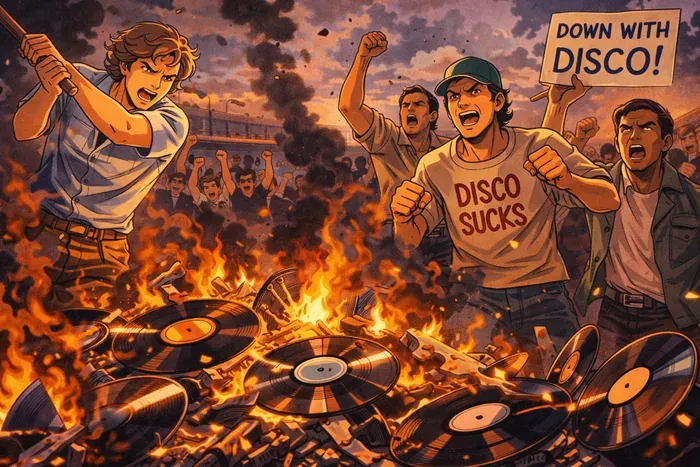
Disco Demolition: When the Backlash Came
By the end of the 1970s, disco was everywhere: on radio, in films, and on television. Its success was impossible to miss. But that success also made it a target. Rock critics dismissed it as shallow or fake. Others treated it as little more than commercial product. Underneath those complaints sat deeper tensions around race, sexuality, and changing cultural power.
The clearest symbol of that backlash was Disco Demolition Night at Chicago’s Comiskey Park in July 1979. A local radio DJ organized the event and invited fans to bring disco records to be destroyed between baseball games. The night quickly spiraled. Crowds rushed the field. Records were burned and smashed. Some treated it as a statement of musical taste. Many others saw it as an attack on the communities that had built disco culture in the first place.
The reaction did not kill disco overnight, but it changed industry behavior. Major labels became less eager to use the word “disco.” Some artists avoided the tag entirely. Radio formats shifted. The rhythm, however, did not disappear. It moved back into clubs, independent labels, and regional scenes.
That distinction matters. The backlash was partly about commerce, but it was never only about commerce. Disco had made marginalized communities audible and visible in mainstream space. Once the genre became a target, many of the values it carried had to retreat to more local circuits again. That retreat helped create the conditions for house, post-disco, and other scenes that prized the dance floor over the charts.
DJs kept playing extended mixes. Producers kept improving four-on-the-floor structures. In cities like Chicago and New York, young musicians listened closely. They heard not only popular songs but also underground records, dub-influenced versions, and electronic experiments. The infrastructure remained intact: music was played on 12-inch records, and DJs shaped the sound.
The backlash also revealed how closely dance music is tied to identity. Disco had made Black, Latino, and queer communities more visible and given them shared space. The hostility directed at the genre felt personal because the dance floor had become both refuge and social statement.
Even after the mainstream spotlight moved on, the creative core did not fade. It adapted. Productions became leaner. Drum machines became more affordable. Independent pressing plants served smaller but committed audiences. What looked like an ending from the outside was, in practice, a transition.
Disco’s most successful period was over, but its lessons were still important. The extended structure, bass-driven sound systems, DJ-centered culture, and vocal authority would all carry forward. The next phase would emerge not from stadium spectacles, but from warehouses and neighborhood clubs once again.
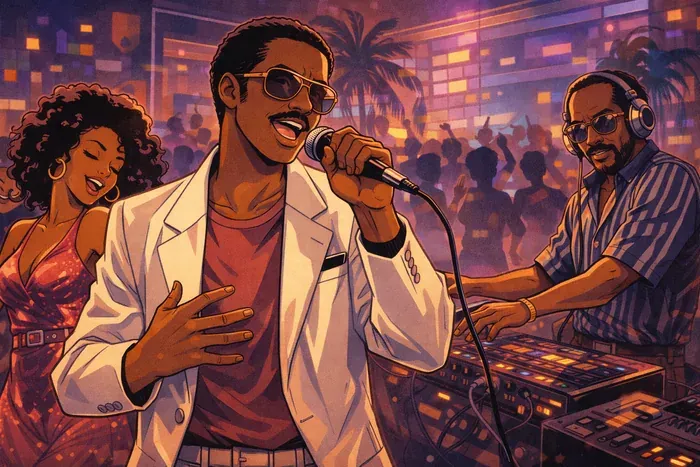
After the Backlash: Post-Disco and Boogie
One of the easiest mistakes in dance-music history is to treat 1979 as a clean ending. Disco’s commercial peak collapsed, but the groove did not. It shifted into leaner, synth-led forms that writers often group under post-disco, boogie, or modern soul. These records kept the dance floor moving while trimming back the orchestral scale of classic disco.
Artists such as D-Train, Patrice Rushen, Mtume, and ESG show different sides of that same shift. D-Train turned electronic bass and drum-machine precision into club warmth. Patrice Rushen preserved sophisticated harmony and musicianship while tightening the rhythmic frame. Mtume helped define a sleek early-1980s Black dance sound that fit radio, roller rinks, and clubs alike. ESG reduced the groove even further, using sparse percussion, bass, and chant-like vocals in ways that would echo through dance-punk, house, and hip-hop.
This period kept Black dance music alive when the word “disco” had become a liability in parts of the industry. The beat stayed steady, but the surface changed. Synthesizers handled more of the arrangement. Bass lines became more elastic. These songs often sounded lighter, but they were also more modular, easier to mix, and closer to the stripped-down logic that house producers would soon adopt.
In practical terms, post-disco taught producers how to make a room move with less material. That lesson would become decisive in Chicago. If the groove could survive with a drum machine, a bass line, a chord stab, and a vocal fragment, then an entire new era of dance music was already within reach.
Post-disco and boogie were not side roads. They were part of the main road from disco to house. They taught producers how to keep a record danceable with fewer parts, and they taught dancers that a groove could feel modern without needing a full disco orchestra behind it.
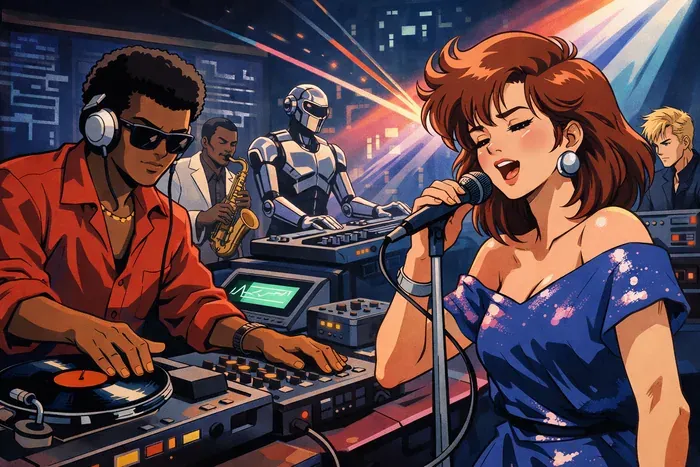
The Bridge: When Machines Learned to Groove
When disco lost mainstream favor around 1979, its methods did not disappear. They broke apart into smaller scenes, local radio shows, independent labels, and DJ networks. Producers started using drum machines and synthesizers that were becoming cheaper and easier to control. The arrangements thinned out, but the desire for a steady, body-centered pulse remained.
In New York, selectors kept moving between soul, disco, electro-funk, and the first machine-heavy experiments. Latin club culture remained central. So did Black radio. The result was not a clean break from disco but a period of reduction and recombination.
The years between disco’s backlash and house music’s formal emergence matter for exactly that reason. They were not a dead zone. They were the workshop where machine rhythm learned how to groove.
That workshop was noisy, local, and mixed. It included radio programmers, record stores, Latino club crowds, Black dance floors, downtown experimenters, and DJs who did not care much about clean genre borders. The key change was not that people suddenly abandoned the past. It was that they learned how to compress disco’s social and rhythmic intelligence into smaller, cheaper, more portable forms.
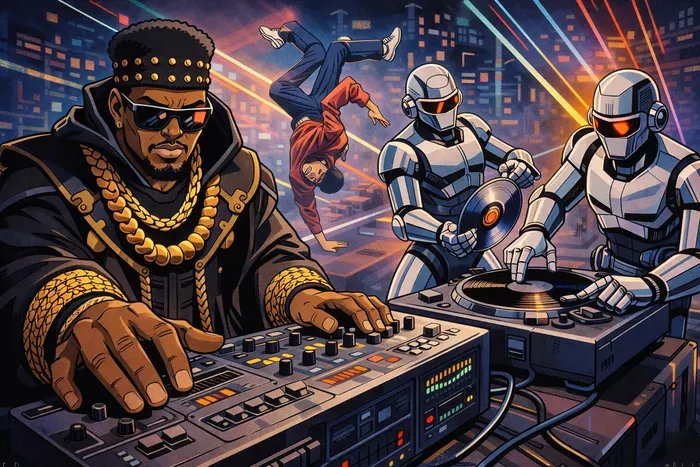
Afrika Bambaataa and the Rise of Electro
In the early 1980s, New York was still a city built around dancing, even if radio no longer wanted to say “disco.” In the Bronx, hip-hop was developing its own language around DJs, MCs, graffiti, and breakdancing. But the link between disco and hip-hop was stronger than many simplified histories suggest. Early hip-hop DJs had learned a great deal by extending breaks from disco and funk records. The dance-floor logic was still there.
Afrika Bambaataa was central to the next phase. He was both a DJ and a community organizer through the Universal Zulu Nation. In 1982, he released “Planet Rock,” produced with Arthur Baker and John Robie. The track drew on European electronic music, especially Kraftwerk, but it also hit with unmistakable drum-machine force.
“Planet Rock” did not sound like classic disco. Its groove was built from programmed drums and synthesizer lines rather than live rhythm sections. The Roland TR-808 supplied a clear, hard pulse. The bass moved in repeating electronic patterns. The vocal felt closer to chant than to soul lead singing. Even so, the emphasis on repetition kept it tied to disco’s legacy.
Just as important, it shifted the dancer’s relationship to the beat. Disco often wrapped the groove in strings, vocals, and flowing arrangement. “Planet Rock” exposed the skeleton. The drums hit with unusual clarity. The synthetic melody looped without apology. That made space for breakdancers, club dancers, and DJs to hear rhythm as something more architectural and less ornamental.
The track became popular in clubs across New York and other cities. The dancers moved to the music. Breakdancers found space in its sharp rhythmic edges. DJs loved it because it went well with both funk records and new electronic tracks.
What made “Planet Rock” so important was not only the sound but the proposition behind it. It showed that machines could carry groove without losing physical force. It also showed that dance music could fuse Black American club culture with European electronic minimalism without flattening either side.
The style became known as “electro.” Drum machines let producers make tracks without a full band. Synthesizers offered new textures. The rhythm was cleaner, sometimes colder, yet still built for movement.
Electro matters here because it proved that machine rhythm could carry identity and scene energy, not just novelty. It connected Bronx hip-hop, club culture, and European electronic ideas in a form that still worked bodily. Without that proof, the leap from disco to house would have sounded much more abrupt than it actually did.
Afrika Bambaataa’s work is at a turning point. Disco had opened the dance floor to longer songs. Electro stripped that groove down and rebuilt it with circuitry. House music built on that idea, using a steady kick drum that repeats itself. The bridge between live disco orchestration and machine-driven dance was now firmly in place.
Arthur Baker: Producing the Electro Bridge
If Afrika Bambaataa was the DJ connecting cultures, Arthur Baker was the producer translating them. In the early 1980s, Baker moved easily between disco’s decline, hip-hop’s growth, and the rise of electronic production. He understood that genres were less separate than they looked. The studio became the place where those worlds could meet.
Baker was already active in dance music before “Planet Rock,” working on club-oriented productions that still grew out of disco logic. With “Planet Rock,” he helped make a record that mixed the TR-808 with sharp synth lines and hip-hop vocals. The result sounded new, but the underlying structure still left room for dancers and DJs.
Baker was also involved in early electro and freestyle scenes in New York. He worked with artists who mixed singing and rapping, Latin club culture and downtown electronic experimentation. The studio sessions were collaborative. People were getting better at hearing which sounds belonged together, even when they came from different scenes.
That kind of collaboration is easy to flatten in hindsight. At the time, almost nobody had a clean map of what counted as hip-hop, electro, post-disco, club music, or pop crossover. Baker’s importance lies partly in his comfort with that uncertainty. He worked as if the room would decide what belonged together, and in many cases it did.
This period marked a real shift in how dance music was built. Drum machines reduced the need for large rhythm sections. Sequencers allowed patterns to repeat with exactness. Smaller studios could now produce tracks without the cost of orchestral disco arrangements. That technical accessibility opened the door to new voices.
Baker’s work also made something else clear: groove was still the test. Even as electronic music spread, DJs cared most about how a record landed in a room. The low end had to be right. The rhythm had to carry the crowd. Technology was extending dance-floor logic, not replacing it.
Radio stations like WBLS in New York helped make those links audible. DJs played electro and freestyle next to soul and disco. Clubgoers could hear the continuity for themselves. On the dance floor, the move from orchestral disco to minimal electronic rhythm did not feel sudden.
Arthur Baker’s career shows how dance music often changes through collaboration rather than sudden rupture. He was an important bridge between disco and the electronic future. The road to house was not built in one city or one moment. It took shape gradually as producers recognized continuity beneath the changing surface.
Freestyle: Latin Beats in the Electronic Age
While electronic music was becoming more machine-centered, another style was taking shape in New York’s Latin club scene. Freestyle mixed electronic drum programming with melodies rooted in disco and R&B. It thrived in neighborhoods where Caribbean and Latin American communities sustained active nightlife.
Freestyle tracks typically used steady drum-machine beats, bright synth hooks, and emotional lead vocals. They were built for clubs and dance radio. The arrangements were far from the orchestral sweep of mid-1970s disco, but the emotional focus stayed strong. Love, heartbreak, longing, and celebration were still at the center.
In the early to mid-1980s, artists like Lisa Lisa with Lisa Lisa & Cult Jam and Shannon helped define the sound. Tracks like “Let the Music Play” paired a clear four-on-the-floor beat with high, urgent vocals. The bass was synthesized but still warm. The structure gave DJs room to mix and extend.
Freestyle showed that electronic music could still be emotional and immediate. The voice remained central. In that sense, freestyle carried disco’s diva tradition into a new technological setting. Clubs in Brooklyn and the Bronx embraced these records, and radio helped push them further.
It also kept a crucial lesson alive for house: electronic rhythm does not need to cancel romance, vulnerability, or melodic directness. Freestyle records were often built from very few parts, but they still aimed for emotional immediacy. That balance between stripped-down programming and strong vocal identity would keep returning across later dance music.
The cultural setting matters here. Latin and Black communities in New York were dealing with economic strain and a changing city. Club spaces offered continuity. Groove provided a kind of stability when other institutions felt unreliable. Producers and DJs often worked outside major-label systems and depended instead on local labels and networks.
Freestyle did not dominate the charts for long, but its influence lasted. It proved that drum machines and synthesizers could still support strong vocal presence. It also showed that dance scenes were never one-dimensional. Different neighborhoods developed different sounds even when they shared rhythmic ground.
As the 1980s went on, these ideas came together. The simple, electronic pulse of electro, the catchy beats of freestyle, and the long mixes of disco all paved the way for something new. In Chicago, young DJs were listening closely. They had access to drum machines, imported records, and clubs eager for change. The next chapter would begin there, but the bridge had already been built.
House Music: Born in Chicago, Heard Worldwide
By the early 1980s, Chicago had a deep record culture. Disco had never fully disappeared there. Even after radio formats changed, clubs kept playing extended mixes and underground imports. Young DJs studied records from Philadelphia, New York, Munich, and London. They listened across funk, soul, electro, and European synth experiments. Once affordable drum machines became available, the ingredients were in place.
House music did not appear fully formed. It emerged through edits, homemade tracks, and DJ experiments tested directly on the floor. The four-on-the-floor beat moved even closer to the center. Bass lines became simpler. Vocals were sometimes reduced to a few words. What mattered most was the reliability of the kick drum.
That reliability changed how the room behaved. House did not depend on constant surprise. It depended on trust. Dancers could settle into a repetitive structure and start hearing small changes as meaningful: a clap entering, a hi-hat opening, a vocal phrase returning, or a bass line pulling slightly harder against the grid. The track did not have to narrate every second. It had to sustain physical concentration.
That simplicity was partly aesthetic and partly economic. Drum machines, secondhand gear, small studios, and local pressing networks made it possible to produce functional club music without the budgets disco had often required at its peak. House sounded stripped down because the scene wanted directness, but also because directness matched the available tools.
Frankie Knuckles was central to that shift. At the Warehouse, he played a sound that still carried disco’s warmth but had shed some of its density. The soul remained. The long-form club structure remained. But the tools, and soon the records themselves, were changing.
Frankie Knuckles: The Godfather of House
When Frankie Knuckles moved from New York to Chicago in the late 1970s, he brought with him the pacing and emotional logic of disco. At the Warehouse, he played for a largely Black and gay audience that wanted the same sense of freedom and continuity earlier disco rooms had provided, but with a harder, more direct edge.
Knuckles did not simply play records. He reshaped them. Using reel-to-reel tape and later drum machines, he extended breaks and reinforced the rhythm. Some disco cuts were pitched slightly faster. Extra percussion was layered on top. If a record lacked force, he gave it more. Those adjustments created a sound that felt more direct and more repetitive than classic disco.
That editing practice is one of the clearest links between disco and house. Knuckles was not rejecting the records he inherited. He was asking more of them. Could they last longer? Could the kick carry the room more firmly? Could the arrangement hold dancers in a deeper state of focus? House grew partly from those practical questions.
The term “house” is widely linked to the Warehouse and to record-store shorthand for the music associated with that scene. However it settled, the sound was becoming clearer. It kept disco’s four-on-the-floor foundation but reduced the arrangement. Strings faded back. Drum machines and simple synth parts moved forward. The track had more room to breathe, and that space made the rhythm hit harder.
Knuckles also preserved disco’s emotional core. Vocal tracks still mattered. The music was gospel-inflected, and the themes were often uplifting, which tied dancers back to older soul traditions. But the structure had changed. Tracks leaned on repetition and gradual layering rather than dramatic shifts.
The Warehouse’s sound system mattered enormously. Bass had to be strong enough to carry the room. The kick drum provided a steady floor. Dancers moved for hours without needing the night to break its spell. Knuckles controlled the pace patiently.
That patience shaped house structurally. A set could unfold in long arcs rather than in radio-sized bursts. Once dancers accepted that logic, producers had a new target. They were not writing for passive listeners. They were writing for rooms willing to stay inside one groove long enough for tiny shifts to matter.
In the early 1980s, Chicago was dealing with economic strain and disinvestment. In that context, clubs became places of release and self-expression. House did not promise pure escape. It offered rhythm as stability. The beat stayed constant even when the world outside felt uncertain.
Frankie Knuckles’ approach connected different eras. He held onto disco’s emotional warmth while embracing new technology. His edits and programming prepared the way for producers who would soon make original house records. The groove remained. The arrangement grew simpler. The dance floor responded immediately.
Ron Hardy: Pushing the Limits at the Music Box
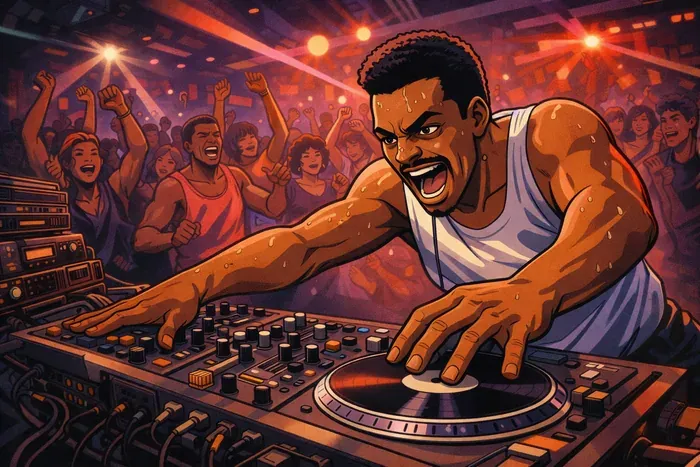
Frankie Knuckles was known for warm, smooth sets, while another Chicago DJ was known for loud, intense ones. Ron Hardy, who worked at the Music Box, came to the dance floor with a different energy. His sets were louder, faster, and sometimes unpredictable. Where Knuckles refined his skills, Hardy tested his limits.
The Music Box was famous for its loud music and for staying open late. Hardy played tracks that were rougher, often early drum machine experiments that other DJs might have considered unfinished. He would repeat sections over and over, letting dancers adjust gradually to unfamiliar patterns. If a record felt strange at first, he didn’t give up on it. He believed repetition could change how people heard a track.
That faith in repetition was radical in practice. Hardy trusted the floor enough to let a track become itself slowly. A record that sounded abrasive on first contact could turn ecstatic after several minutes at high volume. This is one reason later accounts of house often understate the role of risk. The scene did not only reward polished songs. It also rewarded DJs who could make people hear new structures.
One of the sounds associated with Hardy’s sets was the Roland TB-303 bass synthesizer, which would later define acid house. The bass lines of early acid tracks sounded rough compared to the polished disco sound. Hardy took that challenge. He played records at higher speeds, which made them seem more urgent. The room reacted physically. The groove felt unstoppable.
Hardy’s influence came from both what he played and how he played it. He treated the DJ booth like a laboratory. Mistakes and rough textures were not hidden. They were swallowed up by the night’s energy. This openness encouraged local producers to experiment without waiting for perfection. "What made you stand out is that you had a version of a record that no other DJ had."
Chicago producers took that lesson seriously. The Music Box helped show that house could be darker, rougher, and more mechanical than disco without losing physical impact.
Hardy’s legacy is important because it widened the genre before the genre had even settled. Without that pressure from the Music Box, house might have remained more purely soulful and smoother in texture. Hardy kept open the path toward acid, tougher drum-machine tracks, and the more abrasive forms that would later resonate strongly in Europe.
The difference between the Warehouse and the Music Box shows that house was never one fixed sound. It was a conversation between uplift and pressure, warmth and abrasion, gospel memory and machine insistence.
Ron Hardy’s sets showed the more minimalist and intense forms that would become popular in Europe later in the decade. The steady four-on-the-floor kick remained the foundation. The textures around it became sharper and more artificial. The dance floor adapted with it.
The First House Records: From DJ Booth to Vinyl
As Chicago DJs reshaped disco with edits and drum machines, the next step was almost inevitable. Instead of altering existing records, producers started making their own. House moved from the booth into the studio and then onto vinyl.
One of the first house records to travel widely was Jesse Saunders’ “On and On,” released in 1984. It was built around a drum machine pattern and a repeating bass line, and it sounded lean compared with most disco productions. The vocal was direct. The emphasis was squarely on rhythm and repetition. It was rough around the edges, but that roughness was part of the point. A small studio and inexpensive equipment were enough to make a record clubs would actually play.
Marshall Jefferson brought a different energy. “Move Your Body” from 1986 used piano chords and bright harmonies that recalled gospel-inflected disco. The record quickly became known as a house anthem. It paired mechanical drums with warmth and melody, showing that the genre could hold minimalism and emotional lift at the same time.
That record also clarified a productive split inside house itself. One line pushed toward rawer machine hypnosis. Another pushed toward piano uplift and collective release. Both belonged to the same culture, and DJs could move between them inside a single night.
At the same time, Larry Heard, often recording as Mr. Fingers, was exploring a deeper and more introspective side of the sound. “Can You Feel It” paired soft synthesizer chords with steady drums. The mood was calm rather than aggressive. Heard showed that house could be meditative without losing momentum.
These producers worked with machines like the Roland TR-808 and TR-909 and with simple synthesizers. Patterns were programmed rather than played live. Repetition was deliberate. The kick drum stayed constant. Bass lines moved in tight circles, giving the tracks forward motion without dramatic turns.
Independent labels like Trax Records were crucial in spreading these early tracks. Supply could be uneven. Quality control could be messy. But the records moved fast through DJ networks. Stores in New York and London started stocking Chicago releases, and European DJs paid attention.
That messy infrastructure is part of the story, not an embarrassing detail around it. Chicago house did not arrive with polished industry systems. It spread through small labels, white labels, word of mouth, specialist stores, tape copies, and DJs carrying records across cities. Its roughness was built into the way it circulated.
The move from edited disco to original house records was a structural shift. DJs were no longer only curators. Many became producers as well. The dance floor now shaped the studio more directly, and tracks were built for mixing, with long intros and outros already in mind.
House did not reject disco’s legacy. It reduced it to essentials. Strings and full bands gave way to drum machines and synthesizers. The emotional core remained, but the arrangement grew leaner. The sound was clearly new, yet it still rested on what came before.
Vocal House: When Gospel Met the Drum Machine
Even as house leaned harder into drum machines and stripped-down structures, the voice remained central. One of the strongest strands of early house connected directly back to gospel. The club and the church found common ground again, this time over electronic rhythm.
Tracks like “Someday” by CeCe Rogers, produced by Marshall Jefferson in 1987, carried a clear spiritual tone. The lyrics spoke in the language of hope and perseverance. Piano chords brightened the track, while the kick drum kept it firmly tied to the floor. The effect was openly uplifting.
That uplift was not decorative. In clubs built around Black and queer community, release had real social weight. A vocal-house peak could feel like relief, testimony, affirmation, and group energy at once. The machine did not erase that feeling. It gave it a new frame.
That mix of gospel-style singing and electronic rhythm became one of vocal house’s defining signatures. The emotional force associated with artists like Aretha Franklin returned in a new setting. The arrangement had changed, not the need for release. Instead of a live band, producers used drum machines and synthesizers, leaving a stable base for the singer to push against.
Chicago clubs loved these records. Dancers responded to the mix of repetition and release. The structure let DJs build momentum gradually and then open the room with a powerful vocal section. In those moments, house could feel communal in the same way disco had felt a few years earlier.
Women played a major role in this tradition. Many vocalists drew directly on church-trained technique and phrasing. Their performances carried feeling without losing control, balancing the precision of drum machines with something recognizably human. That tension is one reason vocal house hits so hard emotionally.
The style soon moved beyond Chicago. In New York, producers fused it with garage sensibility. Later, European musicians reworked it in their own scenes. The basic idea held: a steady pulse underneath and a voice strong enough to lift the room above it.
Vocal house makes the connection to soul impossible to miss. Even when machines took over much of the instrumentation, the singing stayed expressive. The music did not become colder. It became more layered, a place where circuitry and testimony could coexist.
As house spread internationally, that balance between rhythm and voice kept shaping the genre’s growth.
The Machines That Rewired the Club
House did not become electronic only because taste changed. It also changed because new machines altered what a single producer could do in a small room. Roland’s drum machines and bass synths mattered because they made repetition programmable, portable, and cheap enough to circulate beyond major studios.
They also changed authorship. One person could now sketch rhythm, bass, and arrangement without waiting for a full band, arranger, or expensive studio block. That did not make the music easier in a deep sense, but it did make experimentation faster. Scenes could develop through iteration rather than through rare large-scale sessions.
The TR-808, introduced in 1980, was not built to launch club revolutions. Roland’s own history notes that its analog sound was partly the result of cost limits around digital sampling at the time. Yet that constraint became an advantage. The 808 gave producers a kick drum with unusual weight, a clear step sequencer, and a sound that could feel both machine-like and physical.
The TR-909 followed in 1983 and pushed that logic further. Roland describes it as a hybrid instrument, combining analog circuitry for several core drum sounds with digital cymbal samples. What mattered in clubs was how sharp and direct it felt. Its attack cut through a room. Its sequencing encouraged the strict repeatability that house and techno needed.
Then there was the TB-303. Released in 1981 and initially misunderstood, it later became central to acid house. Roland still frames the instrument as one that helped define the late-1980s acid movement once producers rediscovered its fluid, squelching low end. The important point is not technological mythology. It is that these machines gave dance music new kinds of motion. A groove no longer depended on a whole band locking together in real time. One producer could program the pulse, test it in a club, and revise it fast.
This shift did not erase musicianship. It changed where musicianship lived. Timing, pattern design, sound choice, and low-end control became central skills. By the mid to late 1980s, those skills were no longer side issues. They were the grammar of the new dance floor.
Larry Heard and the Birth of Deep House
Not all Chicago house pushed toward harder drums or rougher textures. Another branch moved in the opposite direction. It slowed the emotional pace, widened the harmonic space, and brought introspection back into the club. Larry Heard, recording as Mr. Fingers and later with Fingers Inc., was central to that turn.
Heard’s records sounded different from much early house because they treated the machine as a way to hold feeling, not flatten it. “Can You Feel It,” released in 1986, is a key example. GRAMMY’s house timeline still treats it as a deep-house classic, and Roland’s own breakdown of the track notes that Heard built it from a small setup centered on the TR-909 and JUNO-60. The result was spare, but it did not feel empty. The kick was steady, the chords were warm, and the mood was reflective rather than explosive.
That was deep house’s breakthrough. It kept Chicago’s machine pulse, but it brought back some of soul’s inwardness and some of disco’s warmth. Instead of pushing every section toward a peak, Heard let chords breathe and let repetition generate emotion slowly. The result worked for late-night listening as much as for dancing, and it proved that house could carry tenderness without losing structure.
This is one of the places where dance-music history gets too linear if told badly. The move from soul to machines was never a one-way cooling process. Deep house demonstrates the opposite. New hardware could create new intimacy. Programmed drums could support melancholy, memory, and gentleness just as effectively as they could support pressure.
Fingers Inc. pushed the idea further by linking Heard’s production to strong vocals from Robert Owens. In those tracks, the bond between soul and house became unmistakable. The drum machine stayed in front, but the feeling behind it was still rooted in Black vocal traditions, in longing, release, and collective memory.
Deep house matters here because it interrupts a false story. Dance music did not move from soul to electronics by getting colder step by step. Again and again, artists used new machines to bring warmth back in. Heard showed that the club could still hold subtlety, melancholy, and beauty even after the groove had become fully programmable.
Garage to House to Jersey
Chicago was not the only place where house kept its connection to soul. Across the Hudson, New York and New Jersey developed another line of the story, one rooted in Paradise Garage, Club Zanzibar, and a style of DJing that treated house less as a hard machine sound than as an emotional continuum.
Larry Levan’s work at Paradise Garage had already shown how disco, early house, post-disco, and left-field imports could be shaped into long, ecstatic narratives. GRAMMY’s house timeline still treats Levan’s New York underground sound as a major influence on house, and Frankie Knuckles carried part of that sensibility to Chicago. But the story did not end there. Tony Humphries’ own biography notes that when he began his long residency at Club Zanzibar in Newark in 1982, the club became synonymous with the Jersey sound, a soulful electronic style that helped nurture house in both New Jersey and New York.
Zanzibar mattered because it preserved a certain musical richness while Chicago was stripping the groove down. Humphries did not work in one narrow style all night. His own account stresses range, funk, and long-form pacing. That breadth helped shape a house sound full of gospel chords, rolling bass, female vocals, and a smoother kind of release. The goal was not austerity. It was lift.
That point matters because “garage,” “Jersey,” and “deep house” are often reduced to soft subgenres in retrospective genre maps. In practice, they were powerful systems of room control. Their richness was functional. Warm chords, layered percussion, and vocal peaks gave DJs different ways to manage intensity over long nights.
Kerri Chandler grew up inside that world. GRAMMY describes him as one of the progenitors of deep house alongside Larry Heard, and links his development directly to Club Zanzibar and the deep, soulful side of New Jersey house. Chandler’s records later became famous for thick low end, jazz-influenced chords, and an unusual ability to make a programmed groove feel intimate. In that sense, Jersey did not simply imitate New York or Chicago. It fused them, then pushed the music toward a more durable soulful-house language.
That line would travel far. GRAMMY’s timeline also notes that New Jersey’s soulful house helped inspire UK garage in the 1990s. That is why the Paradise Garage-to-Zanzibar route matters here. It clarifies that house did not develop in one straight line from Chicago minimalism to global club culture. Another branch stayed explicitly musical, vocal, and R&B-informed, and that branch changed the future too.
The Remix Becomes a Culture
By this point, remixing was no longer just a studio trick. It had become part of dance music’s way of thinking. Tom Moulton is central to that shift. Apple Music’s artist biography still describes his early reel-to-reel mixes for continuous dancing at Fire Island as the start of an accidental remix career built on extending records and making them more rhythmically dynamic. Behind that short summary sits a much bigger change: once a record left the studio, it still was not finished.
Once that idea took hold, DJs and remixers became structural figures rather than after-the-fact decorators. Frankie Knuckles extended disco records on tape when the supply of ideal club singles dried up. Larry Levan and Tony Humphries used edits, sequencing, and club-specific versions to reshape how audiences heard familiar songs. The dance floor rewarded records that could breathe, break down, and return with more force than the radio edit allowed.
By the 1990s, remix culture was fully embedded in house. GRAMMY’s house timeline points to New York as a major center of this phase, led by producers such as Masters at Work, David Morales, François K, Todd Terry, and Danny Tenaglia. This was not a footnote to the genre. It was one of the mechanisms through which house expanded globally. A remix could break an artist in clubs before radio noticed. It could also give a vocal, percussion figure, or bass line a second life in a different scene.
Masters at Work were especially important because they treated the remix as arrangement, orchestration, and history all at once. Their best work kept house functional for dancers while bringing in salsa, disco, gospel, jazz, and street-level New York rhythm. In their hands, remixing was not just about making a record longer. It was about placing that record inside a larger Black Atlantic conversation.
It matters to the article’s broader argument that dance music did not move forward only through new machines or new subgenres. It also moved through reinterpretation. Remix culture made memory practical. It kept the past active inside the present, one new version at a time.
Remixing belongs in the center of the story rather than at the margins. It gave dance music one of its main engines of historical continuity. Instead of throwing old forms away, clubs kept bending them into new shapes.
Sampling as Memory
Remixing changes a record from the outside. Sampling often changes history from the inside. Once producers could lift a bass line, drum break, chord stab, or vocal phrase from an older recording and build a new track around it, the archive itself became part of dance music’s working method.
That mattered immediately in hip-hop and post-disco, but it also became central to house, techno, and later French touch. Chic’s “Good Times” helping generate “Rapper’s Delight” is one of the clearest early examples of disco crossing into another form through reuse. Later producers would do the same more fragmentarily: a diva cry, a conga loop, an old string flourish, a sermon-like phrase. The source might be partly hidden, but the emotional residue remained audible.
Sampling also solved a cultural problem. Dance music moves fast, and club culture often looks future-facing. Sampling gave producers a way to keep older Black musical knowledge active inside new systems. Soul, funk, disco, gospel, and boogie did not have to survive only as influences in people’s heads. They could survive as literal materials inside fresh tracks.
It changed how listeners learned history, too. Not every dancer would know the source of a sample in the moment, but many tracks carried recognizable traces: a Chic bass line, a soul shout, a church phrase, a string flourish, a breakbeat from an older funk record. Sampling let the past circulate under new names, at new tempos, and in new social settings. That is one reason dance music can sound radically current while still carrying older emotional codes.
Sampling belongs next to remixing in this story. It is not only a production technique. It is a way of carrying memory forward. When French-touch producers looped old disco records, when house borrowed gospel exclamations, or when hip-hop and dance music shared breakbeats, they were doing more than decorating the present. They were making lineage audible.
Acid House and the UK Explosion
If deep house brought warmth back into the machine, acid house pushed the machine toward instability. The turning point was Phuture’s “Acid Tracks.” Roland’s 2019 lifetime achievement citation for DJ Pierre and Spanky describes the group’s 1987 12-inch as the first acid house record and identifies the style through the Roland TB-303’s distinctive basslines. That description is still useful because it captures both the sound and the break in logic. Acid did not just simplify house. It made the groove squirm.
The track mattered immediately because it proved that timbre itself could drive a club record. Instead of relying on lush chords or diva vocals, acid house often built tension through one unstable bass sequence, tweaked in real time until it felt alive. That gave DJs a new way to work the room. The body still followed the four-on-the-floor kick, but the ear had to track the changing line underneath it.
The sound traveled quickly to Britain. GRAMMY notes that Frankie Knuckles held a summer residency at Heaven in London in 1987, one sign of how fast Chicago house was crossing the Atlantic. By 1988 and 1989, acid house had become far more than an import. A British Council entry for the documentary They Call it Acid describes 1989 in the UK as the birth of a new youth culture, while BBC program material on the era links the scene to ecstasy, illegal rave events around the M25, and a major pop-cultural shift.
London and Manchester became especially important because they turned a club sound into a mass social phenomenon. Warehouses, fields, and temporary venues could hold larger crowds than traditional clubs, and acid house fit those spaces unusually well. It was repetitive enough to last for hours, strange enough to feel new, and simple enough to spread quickly through white labels, radio, and pirate networks.
The social change was as important as the musical one. Acid house altered who dance music appeared to belong to in public. What had grown in Black and queer club cultures in the United States now entered a broad British youth culture that included clubs, illegal raves, tabloid panic, police pressure, and an entire economy of flyers, promoters, and temporary spaces. The music stayed rooted in house, but its public scale changed dramatically.
This British phase matters because it changed the scale of dance music. Chicago created the sound, but the UK helped turn house into a visible youth movement with its own fashion, press panic, and political consequences. From that point on, dance music was no longer only an underground urban culture. It was also a mass public event.
Women in House Beyond the Vocal
House history is often told through a familiar group of male DJs and producers, with women appearing mainly as vocalists. That picture is too narrow. Women were also selectors, producers, organizers, radio figures, and label builders. Those roles matter because house was always more than a catalog of tracks. It was a social infrastructure.
Chicago offers a clear example. GRAMMY describes Lady D, born Darlene Jackson, as one of the first women to emerge on the city’s underground house scene in the early 1990s. The same timeline also notes that Lady D, DJ Heather, DJ Collette, and Dayhota made history in 1997 with Superjane, the first female DJ collective in the United States. That was not only a symbolic milestone. It changed booking patterns, mentorship, and who younger DJs could imagine themselves becoming.
DJ Heather matters for a related reason. GRAMMY’s house history highlights her as one of the figures who carried Chicago house forward during a slower period for the city’s scene. Her importance is partly musical and partly structural. Artists like Heather preserved a DJ-centered, groove-first approach while other scenes chased bigger spectacle or more aggressive branding.
That kind of continuity work is easy to miss because it rarely comes packaged as a dramatic origin story. But scenes survive through exactly this kind of labor: local bookings, trusted residencies, radio presence, mentorship, and the ability to hold a room consistently over time. House was sustained not only by breakthrough records, but by people who kept its social habits alive week after week.
The broader Midwest story belongs here too. GRAMMY places Stacey Hotwaxx Hale among the artists who helped shape house in Detroit, and Apple Music describes her as one of the first DJs to play house on Detroit radio in the 1980s. Radio, residencies, and teaching were part of how house survived and spread. Hale’s later role as an educator only extends that earlier pattern.
Including these figures changes the history in useful ways. It makes house look less like a sequence of lone geniuses and more like a scene built through curation, teaching, persistence, and community maintenance. That picture is more accurate, and it fits the music better too.
Detroit Techno: The Sound of Tomorrow
While Chicago house stayed close to gospel release and disco uplift, another electronic language was taking shape a few hours north. Detroit in the 1980s was marked by industrial decline, disinvestment, and a strong memory of machine labor. Young musicians grew up between that reality and a flood of radio signals carrying funk, electro, and European synth music across the border.
Techno came out of that tension. It shared house music’s reliance on drum machines and synthesizers, but the mood was different. The groove was leaner. The atmosphere could feel more futuristic, more austere, and more clearly tied to the image of a modern industrial city. In Detroit, the future was not an abstract fantasy. It was a serious question. What could Black music sound like in a city shaped by assembly lines, layoffs, automation, and a deep awareness of modern technology?
Detroit techno did not reject Black dance-music history; it reframed it. The same interest in groove, repetition, and physical movement remained, but the emotional register shifted. Where Chicago often sounded warm and communal, Detroit could sound streamlined, suspended, and speculative, as if asking what Black dance music might become under new urban and technological pressures.
That helps explain why the music often felt both emotional and restrained. Detroit producers were not trying to recreate disco’s lush fullness. They were reducing the palette. The kick, the hi-hat, the bass figure, and a small set of synthetic textures could carry the whole track. The result was not cold in a simple sense. It was disciplined. It trusted repetition, timing, and tone more than overt decoration.
Juan Atkins, Derrick May, and Kevin Saunderson were the most important people in this development. Later, they became known as the Belleville Three. They created a sound that would travel far beyond Michigan, partly because it was so portable. A few machines, a small studio, and a clear idea were enough to make records that could reach Chicago, New York, the United Kingdom, and then a rapidly changing Berlin.
The Belleville Three: Detroit's Electronic Pioneers
In the suburbs of Detroit, three high school friends started experimenting with electronic music in the early 1980s. Juan Atkins, Derrick May, and Kevin Saunderson were listening to funk, electro, and European synth music at the same time. Radio shows carrying records from Germany and the United Kingdom widened the frame. Kraftwerk sat next to Parliament and Funkadelic, and the combination felt natural rather than forced.
Juan Atkins was the main idea person for the trio. He released early recordings under the name Cybotron. In 1983, the song “Clear” mixed strong drum machine beats with soft synthesizer sounds. The rhythm was perfect. The atmosphere felt like science fiction but wasn’t over-the-top. There was space in the arrangement. Each element had room to breathe. That spaciousness mattered. The track did not crowd the listener. It let the machines speak plainly, which became one of techno’s defining strengths.
Derrick May’s approach to techno was more dramatic. His 1987 track “Strings of Life,” released under the name Rhythim Is Rhythim, used a steady electronic beat, energetic chord sequences, and a strong piano sound. The record felt urgent and emotional, but it was still much simpler than disco’s orchestration. May later described techno as music that sounded like “George Clinton and Kraftwerk stuck in an elevator.” The image captures the blend of funk, roots, and European machine logic.
May’s records often pushed harder on tension and motion. They did not only lock into a groove. They surged. That gave Detroit techno one of its lasting paradoxes: music built from precise machines could still sound impatient, unstable, and alive.
Kevin Saunderson brought a slightly more accessible edge. He produced “Big Fun” and “Good Life” under the name Inner City. These tracks balanced techno’s mechanical pulse with catchy vocal hooks. These records were successful in the United Kingdom and helped introduce Detroit’s sound to European audiences.
That crossover mattered for more than sales. It showed that Detroit producers could move between underground club tracks and records with wider pop reach without losing their basic identity. Inner City did not abandon machine rhythm. It proved that machine rhythm could also support joy, melody, and a direct song structure.
The Belleville Three were united by their shared approach to structure. The kick drum was steady and in the center. The bass lines were often electronic and repetitive. Melodic fragments floated over the rhythm rather than controlling it. The tracks were built for DJs, with long beginnings and endings that allowed for easy mixing.
They were not identical, though, and that distinction is important. Atkins leaned toward conceptual futurism and electro precision. May brought drama, lift, and emotional pressure. Saunderson often made the bridge to more vocal and accessible forms. Together they did not create a single formula. They defined a field of possibility.
The mood was influenced by Detroit’s industrial context. The city was struggling financially. But techno did not collapse into despair. It looked forward. The sound felt clean, sometimes plain, but also open to possibility.
The Belleville Three did not think they were inventing a genre at first. They were trying out different tools. Drum machines and synthesizers were becoming more affordable. Small studios allowed musicians to be independent from major record companies. As their records traveled to Chicago, New York, and eventually Europe, the term “techno” caught on. The word was not only a marketing label. It helped separate Detroit’s sound from house at a moment when both scenes were using similar hardware but aiming at different emotional outcomes.
Techno did not replace house music. It made the map bigger. The dance floor now had two paths, both of which were related to disco’s steady beat and funk’s rhythmic structure.
Underground Resistance: Techno with a Message
As techno gained popularity outside of Detroit, some artists worked to protect its independence and clarify its message. In the late 1980s, the group Underground Resistance became a strong voice for the music scene. The group was founded by Jeff Mills, “Mad” Mike Banks, and Robert Hood. They rejected commercial gloss and emphasized autonomy.
Jeff Mills was already known as a fast and skilled DJ. With Underground Resistance, he started making tracks that were more minimalist, focused on rhythm, and repeated. The music often felt urgent and uncompromising. The kick drums were loud and clear. The synthesizer lines were simple, often just short, repeating patterns.
That reduction was ideological as well as musical. Underground Resistance treated control of the means of production as part of the art itself. Pressing their own records, using stark visual identities, and refusing easy personalization all pushed against the idea that dance music had to become polished celebrity product in order to matter.
Underground Resistance also controlled its own releases. The group pressed records on their own and didn’t get any mainstream promotion. Sleeve designs often featured images related to war or had names listed as “Anonymous.” The focus was on sound rather than on celebrities. This approach reflects the overall situation in Detroit, where economic difficulties and political dissatisfaction influenced people’s daily lives. The music subtly conveyed that tension.
Their records also changed how techno could signify. Earlier Detroit work often balanced futurism with elegance. Underground Resistance made room for militancy, opacity, and discipline. The machine was no longer just a modern instrument. It could also be part of a protective strategy: make the track strong, make the message unmistakable, and keep outside systems at a distance.
Tracks like “The Seawolf” and “Sonic Destroyer” are good examples of this style. They didn’t use fancy music. They built up the intensity by adding layers and pacing. The repetition was hypnotic. The atmosphere felt serious, even confrontational at times. But the groove never went away. Dancers could lock into the beat and stay there for minutes.
That type of techno was different from the more upbeat house music being made in other places. It focused on simplicity and discipline. The focus on independence also played a role in the development of techno music in Europe, especially in Berlin after the fall of the Berlin Wall. Clubs liked the new, simple sound. DJs liked mixes that were long and kept the energy up for hours.
Underground Resistance showed that electronic dance music could have a political message without using explicit slogans. The refusal to meet commercial expectations made a statement. Technology didn’t have to be just for entertainment. It could be based on the community and how people see themselves.
Later on, Jeff Mills became famous for playing long DJ sets that were fast and precise. His performances made techno seem more intense. The kick drum was the foundation. The whole room moved together.
That directness influenced Europe deeply. Berlin promoters, labels, and dancers heard in Detroit techno a form that could thrive in large industrial spaces without losing focus. The records were spare enough to travel and forceful enough to define whole nights.
At this point, the machine’s design started to take shape. Disco had a shimmering sound, while house music was uplifting. Techno, on the other hand, could sometimes feel stark. But you could still see where they came from. The steady beat, the importance of repetition, and the central role of the DJ connected Detroit’s warehouses to earlier dancefloors.
The Women of Detroit Techno
People often talk about Detroit techno using just a few names. But women were very important in creating and maintaining the scene. They contributed in many ways, such as producing music, DJing, working at record labels, and building communities. The sound may have been minimalist, but the network around it was layered and collaborative.
K-Hand, born Kelli Hand, is a central figure. She started working in the late 1980s and founded her own record label, Acacia Records. Her music blended the steady beat of Detroit techno with the warmth and energy of house music. The song “Think About It” had a deep, steady bass sound and clear drum beats. The groove was strong but not too tight. There was room for small changes.
Her role was important partly because it shows how misleading rigid genre borders can be. Detroit artists moved between techno and house continuously, and K-Hand did that with particular authority. Acacia Records also mattered because label ownership shaped who could release work on their own terms and how quickly records could circulate through specialist shops and DJ networks.
K-Hand’s work shows that the boundaries of Detroit were always changing. The music was a mix of techno and house. Producers switched between styles without being tied to any one of them. The label system let artists keep their independence. The records were usually limited, and they were sold through special record shops and DJ networks.
However, the visibility was not the same everywhere. News outlets often focused on a few male producers. Women often had to fight for people to recognize their equal skill and creative output. This pattern wasn’t just seen in Detroit. Music scenes around the world have had the same problems. But the presence of artists like K-Hand challenges that.
Women also played an important role in Detroit’s music scene, hosting DJ residencies and organizing local events. Clubs relied on consistent selectors who understood pacing and how the crowd responded. These roles required trust and expertise. The dance floor doesn’t just respond to a place’s reputation. It responds to timing, sensitivity, and reading the room.
That kind of labor often disappears from simplified histories because it is harder to turn into a single heroic origin story. But scenes survive through repetition: weekly sets, small labels, local radio, record-store knowledge, and the people who keep introducing one generation to the next. Women’s work was central to that continuity.
Detroit’s independent structure offered both opportunity and limitation. If companies didn’t keep such close watch on artists, they could try new things without worrying about what the company would do. At the same time, there were only a few ways to promote records. Artists were sometimes recognized abroad earlier than at home.
The general story of technology often highlights its industrial look and futuristic tone. Adding women’s contributions complicates that image in productive ways. The sound was not just from the machine. People who created art had to deal with social rules and expectations.
As techno spread to Europe and beyond, Detroit remained an important symbol. Its artists, including women who had helped create the foundation, continued to influence new generations. The steady beat of the kick drum continued. The quiet insistence on creative autonomy did too.
Berlin: Where Techno Found a New Home
When techno arrived in Europe in the late 1980s, it found especially fertile ground in a city changing fast. After the Berlin Wall fell in 1989, abandoned buildings and empty industrial spaces took on new lives. Young people from East and West met in basements and warehouses. Techno’s steady, machine-driven pulse suited that unsettled moment almost too perfectly.
Clubs like Tresor, which opened in 1991 in the basement of a former department store, became key meeting points. Detroit records were imported and played hard. The stripped, intense style of artists like Jeff Mills made immediate sense there. The rooms helped shape the sound: concrete walls, large spaces, and long nights all favored tracks built from repetition and hypnosis.
That physical context matters. Berlin did not simply “like” techno. The city had a rare combination of vacant space, political transition, low cost, and a strong desire for new collective rituals. Techno fit those needs because it did not require a fixed script. A set could last for hours, identities could blur in the room, and gradual change could feel more important than spectacle.
The Berlin scene was different from both Chicago and Detroit. It quickly grew into a network of clubs, labels, and promoters. Residents held weekly nights. Flyers circulated by hand. For a while, the city’s relatively low rents gave artists room to take risks without immediate commercial pressure.
The exchange with Detroit was unusually direct. Tresor’s own history emphasizes that the club and label were shaped early by musicians from Michigan, including Juan Atkins, Underground Resistance, and Drexciya. That was not a vague influence. It was a working relationship built through travel, records, and recurring contact.
Artists from Detroit traveled to Berlin and found enthusiastic audiences there. The exchange was direct. Records pressed in the United States influenced European producers, who then added their own textures and interpretations. The conversation continued, not just from one side.
Berlin also helped codify techno culture. Clubs became destinations. Media outlets started documenting the scene. As the 1990s continued, electronic festivals spread across Europe. The underground still mattered, but the infrastructure was becoming easier to see.
The mood in Berlin was often minimalist. Long DJ sets emphasized gradual change rather than sudden impact. The kick drum might hold for hours. Dancers stayed locked to the rhythm. The experience could feel immersive, collective, and intensely physical without becoming spectacular.
That approach eventually became one of Berlin techno’s signatures. Rather than organizing the night around a sequence of obvious peaks, many DJs treated the set as slow architecture. Tiny shifts in hi-hats, reverb, pressure, or density mattered because the listener was already inside the groove. Patience became part of the pleasure.
The European embrace of techno pushed it further around the world. What started in Detroit as a response to local conditions took hold in cities with very different histories. The machine aesthetic spread because it was adaptable. Producers could remove or add elements in new ways while keeping the core pulse intact.
By the mid-1990s, techno and house were global. Clubs from Chicago to Berlin to London were sharing a common language. The story was no longer tied to one region. It had become a network, and the next phase would scale that network even further.

The 90s: When Bass Got Heavy and Beats Broke Free
By the early 1990s, house and techno were already established on both sides of the Atlantic. But the story did not move in a straight line. Scenes started branching again, especially in the United Kingdom, where Caribbean sound-system culture and pirate radio helped generate new rhythmic ideas.
The steady four-on-the-floor pulse still mattered, but producers were now pushing bass harder and making rhythm more complex. Groove became more syncopated. Breakbeats returned in new forms. Vocals were cut, pitched, and looped. The dance floor changed with the sound.
This was not fragmentation for its own sake. It reflected a broader shift in how dance music circulated. Raves, pirate stations, dubplate culture, specialist shops, and cheaper studio tools created faster feedback loops. Tracks could be tested in clubs, revised, pressed in small runs, and played again quickly. That made scenes more experimental and more local at the same time.
Meanwhile, in New York, garage and vocal house music built on the emotional tradition of disco by creating sophisticated remixes. François Kevorkian and the duo Masters at Work helped keep the connection between gospel-influenced vocals and club music alive.
The 1990s did not forget the past. They recombined it. The pulse changed shape, but the family resemblance remained easy to hear.
That decade is crucial because it shows how wide the dance-music map had become without breaking apart entirely. A listener could move from deep garage to jungle to big beat and still hear familiar structural ideas: bass as architecture, repetition as energy storage, and the DJ mix as the basic frame of meaning.
New York Garage: Soul Never Left the Building
As Chicago house changed and Detroit techno grew more austere, New York held onto a different emphasis. Garage, named after Paradise Garage, kept disco’s emotional depth while updating the production. The groove stayed steady, but the voice moved closer to the center.
François Kevorkian played a central role in shaping that sound. As a DJ and remixer, he rebalanced records with unusual care. He clarified bass lines, stretched instrumental sections, and adjusted the mood without losing the song’s feeling. His remixes did not erase the original. They re-voiced it for club systems that needed power and clarity.
That practice made the remix feel like interpretation rather than decoration. A garage record often depended on arrangement as much as on songwriting. When the strings entered, when the vocal crest arrived, and how long the drums held before that release could define the whole effect of a night.
Masters at Work, the duo of Louie Vega and Kenny “Dope” Gonzalez, carried that tradition forward in the 1990s. Their records mixed house with Latin percussion, jazz inflection, and strong vocals. Songs like “To Be in Love” showed that garage could be elegant and deeply danceable at once. The kick stayed steady, but the surrounding percussion gave the tracks depth and motion.
Their importance also came from range. They could make tracks that worked in clubs, on radio, and in DJ crates without flattening the style into generic crossover music. GRAMMY’s house timeline places Masters at Work, François K, David Morales, Todd Terry, and Danny Tenaglia at the center of 1990s New York house for exactly that reason: they kept the city’s remix and vocal tradition active while dance music was changing around them.
In New York, garage culture depended heavily on remix logic. DJs were not just playing records. They were working with versions. Extended intros and outros made long transitions possible, and the strongest vocal moments were often placed carefully inside a set so they could release tension that had been building for minutes.
Women’s voices were essential to this scene. Many singers had gospel training, which gave them the intensity and control to carry a nightclub room. Lyrics often revolved around love, strength, and spirituality. Even as production became more sophisticated, the human center held.
New York clubs in this period were varied and often fragile. Economic pressure and changing city policy shaped nightlife constantly. Garage kept disco’s spirit alive without returning to full orchestral excess. The records were cleaner, deeper, and more polished, but the emotional aim was familiar.
Garage made it clear that emotional connection could remain central to electronic dance music. While other scenes explored abstraction, garage insisted on connection through voice and groove. Underneath the production changes, the line from church to disco to house stayed clear.
Ballroom and Voguing Culture
New York house history is also inseparable from ballroom culture. Built by Black and Latino queer and trans communities, ballroom created competitive social spaces where music, fashion, dance, and self-invention were all central. The club was not only a place to dance. It was a place to become visible on your own terms.
House fit ballroom for practical as well as emotional reasons. The beat was stable enough for walking, posing, and voguing, but flexible enough to allow dramatic breaks and vocal peaks. DJs could shape a room for tension, release, and display. That made house more than background music. It became part of a larger performance language tied to identity, survival, and style.
This lineage matters because ballroom kept the queer history of dance culture active even as house spread into more commercial circuits. When later pop stars, fashion scenes, and global club audiences absorbed voguing and ballroom aesthetics, they were drawing from a culture that had already been refining movement and social codes inside the house era.
The connection also clarifies why later New York clubs, including spaces linked to the Sound Factory and downtown house culture, mattered so much. As GRAMMY’s house timeline notes, Frankie Knuckles’ New York return intersected with ballroom’s liberating queer energy. That is not a side story. It is part of how house remained tied to bodies, identity, and collective self-fashioning rather than becoming only a machine groove.
Jungle & Drum & Bass: When the Beat Broke Apart
New York garage kept vocals warm, while the United Kingdom pushed rhythm into rougher terrain. In the early 1990s, producers in places like London and Bristol made breakbeats louder, faster, and heavier in the bass. Jungle, and later drum & bass, grew out of that experimentation.
Artists like Goldie and Roni Size helped define the sound. Instead of relying on a steady four-on-the-floor kick, jungle broke rhythm into chopped breakbeats. Samples of funk drums were sliced and rearranged at high speed. The bass stayed deep and heavy, drawing directly on dub’s low-frequency tradition.
Goldie’s album Timeless from 1995 brought orchestral ambition into drum & bass while keeping the club intensity. The tracks went beyond the usual radio formats, with strings layered over fast percussion. The music felt restless and urban, reflecting the multicultural reality of British cities.
Roni Size, especially through the Reprazent group, balanced technical precision with groove. His work had a strong rhythmic foundation and incorporated jazz influences and complex programming. The focus on bass weight connected jungle to earlier sound system culture. The club system was still very important. If the low end didn’t resonate physically, the track failed.
Pirate radio was crucial to jungle’s spread. It bypassed traditional media and built local followings directly. DJs moved through records quickly, showing off rhythmic variation. The energy on the dance floor felt different from a house night: more jagged, more precise, and often tense in a communal way.
Jungle and drum & bass still showed the influence of house music. The focus on extended DJ mixes and club-ready structure remained. However, the musical language changed. Instead of playing steady beats, musicians started playing syncopated rhythms. The groove broke, then put itself back together at higher speeds.
The evolution showed how dance music reshapes itself around local conditions. The UK’s Caribbean heritage and sound-system tradition deeply informed its bass culture. The result felt urgent, urban, and unmistakably local.
As the 1990s continued, electronic dance music became more diverse. Some strands got heavier and faster. Others moved toward melody. The map widened quickly. But even at very different speeds, the same basic logic remained: rhythm creates order, and bass gives the body something solid to hold.
Big Beat: Electronica Hits the Mainstream
By the mid to late 1990s, electronic dance music in the UK was growing quickly and moving onto larger stages. Big beat and related crossover styles mixed breakbeats, rock energy, heavy bass, and strong hooks. They brought club force into festivals and radio without fully severing underground ties.
The Chemical Brothers were central to this shift. Their 1997 album Dig Your Own Hole balanced club function with cinematic scale. “Block Rockin’ Beats” came with a huge bass line, distorted synth riffs, and chopped vocal samples. The structure still worked for DJs, but it clearly aimed bigger.
Underworld took a different route. Their 1996 track “Born Slippy .NUXX” became widely known after Trainspotting, but its power was already in the track itself. It builds gradually over a steady four-on-the-floor pulse while fragmented spoken lines create mounting tension. Underworld often let tracks unfold slowly, preserving the immersive quality of club music even as the audience widened.
Big beat and related crossover sounds brought electronic music closer to rock festival culture. Live shows used lighting rigs and were produced on a large scale. The DJ booth started sharing space with stage performances. The audience grew beyond just dedicated clubgoers.
Mainstream popularity did not end underground scenes. Instead, it created parallel paths. Some producers focused on tracks that would appeal to a wide audience. Others stuck to playing in small venues and with independent labels. The tension between big and small became part of dance music’s ongoing story.
The 1990s also made the album more important in electronic music. Singles still mattered for DJs, but full-length releases let artists work with mood and narrative across multiple tracks. In that sense, electronic music was reconnecting with an older album-based logic already familiar from soul and techno.
Big beat’s success showed that electronic rhythm could scale up without losing physical energy. Whether it came from kicks or breakbeats, the beat still had to move bodies. The tools improved and the venues expanded, but the core idea of groove as shared experience remained intact.
As the new millennium approached, electronic dance music faced a choice: remain underground, scale up commercially, or do both at once. The next phase would test that balance.

The DJ as Superstar: When Dance Music Went Global
By the late 1990s and early 2000s, electronic dance music had moved from warehouses and pirate radio into large venues and international circuits. Cheap flights, digital promotion, and a growing festival infrastructure made constant travel possible. Scenes that once felt local were becoming visibly connected.
Ibiza became one of the clearest symbols of that new era. The island’s clubs attracted visitors from across Europe and beyond. The DJ was no longer only a host for a community. In many cases, the DJ had become the main attraction.
Artists like Carl Cox became known for long sets that remained technical without losing the room. Others, including David Guetta, moved more directly between club culture and mainstream pop.
The groove remained. The scale changed. The dance floor was no longer serving one neighborhood at a time. It had become global, with all the opportunity and pressure that comes with that.
A new contradiction came into focus with that shift. Dance music had grown out of local communities, scene-specific rooms, and regional sound systems, yet it now circulated through global brands, tourist economies, and festival infrastructures. The music did not stop being local in its roots, but its business model was changing fast.

Ibiza: The Island That Made DJs Into Stars
Ibiza had been on Europe’s club map since the 1980s, but by the late 1990s it had become central. Clubs like Pacha, Space, and Amnesia drew international crowds every summer. DJs who secured residencies there could become globally recognizable. The island was a place of pleasure, but also of serious career-building.
Carl Cox is a good example of how the residency model worked. He became known for long, technical sets that blended house and techno while staying attentive to the crowd. He was a DJ first, not just a spectacle. Track choice, pacing, and transitions still determined the night, even as the audience grew.
The residency system created a new rhythm for dance-music careers. Instead of one-off events, DJs built weekly nights tied to specific clubs. Marketing grew more sophisticated. Flyers turned into glossy campaigns. Lineups were announced months in advance. The club night itself became a brand.
David Guetta represents another side of that shift. He came out of the French club scene and moved into high-profile pop collaborations in the 2000s. “When Love Takes Over” fused house rhythm with radio-ready vocals. The four-on-the-floor beat stayed central, but the commercial target was now much broader.
During this period, DJs increasingly operated like brands. Their names appeared in huge type on posters. Social media amplified visibility. Travel schedules became punishing. Some artists thrived in that environment. Others saw the pace as unsustainable.
The events also got bigger. Large open-air festivals across Europe and North America attracted tens of thousands of attendees. Production budgets increased. Light shows and stage design became more elaborate. The dance floor was no longer a dark, anonymous space. It became a spectacle.
But even with all the changes, some things stayed the same. DJs still used steady kicks and long mixes. Transitions were still very important. The relationship between the selector and the crowd continued to define success.
Ibiza’s rise shows how dance music adapted to globalization. What began in local communities had become part of international networks. The groove traveled easily. The harder question was how to preserve connection as the distance between scene, artist, and audience grew.
French Touch: Disco's Digital Renaissance
While Ibiza represented the globalization of DJ culture, France offered an alternative path in the late 1990s. Often called “French touch,” a group of producers used modern electronic music to create new versions of disco songs. They used older records, filtered loops, and made the digital production sound warm.
Daft Punk was a central part of this movement. Their 1997 album Homework was mostly raw house and techno, but by the time of Discovery in 2001, the duo was more open about the melodic richness of disco. The song “One More Time” had a steady four-on-the-floor beat, processed vocals, and bright, looping chords. The rhythm was steady. The mood felt more openly celebratory.
GRAMMY’s 20th-anniversary piece on Discovery describes that record as a clear evolution from the rougher house and techno of Homework toward a shinier mix of house, funk, and pop. That description is useful because it shows French touch was never only about nostalgia. It was about how to make archival listening feel euphoric again in a digital era.
Cassius also made similar music. Their work often used samples from disco music, gradually changing the sound to create tension. This technique made repetition feel dynamic. Instead of adding a lot of new elements, producers focused on shaping the sound around a central beat.
Filter sweeps became one of the movement’s best-known techniques, but the idea was broader than a single effect. French producers were interested in how a loop could breathe. Tiny changes in EQ, compression, saturation, or arrangement could make a short borrowed fragment feel like it was opening and closing in real time. That gave the tracks a strong sense of lift without requiring large harmonic changes.
The French style wasn’t just a copy of 1970s disco. It reframed that legacy. Producers used technology to isolate fragments of older tracks and reshape them in new ways. The result felt both nostalgic and modern. Dance floors responded immediately.
The way French electronic acts looked also mattered. Daft Punk’s use of helmets and controlled imagery shifted attention from celebrity to sound. In a time when DJs were becoming more visible, they chose a form of deliberate anonymity.
That visual control also fit the music’s logic. French touch often turned familiar materials into sleek surfaces: old strings, old funk guitar, old vocal phrases, but filtered through precise digital editing and a stylized public image. Cassius, Motorbass, Stardust, and later Justice all worked in different ways, yet they shared an interest in making dance music feel curated rather than casual.
French touch showed that dance music’s history could be revisited in a creative way. Disco’s influence was still present, but it was now more obvious. The steady kick drum, the emphasis on bass and loop, and the communal uplift connected the 2000s back to earlier decades.
As digital production tools got better, it became easier to use them to reference past eras. Producers could access large collections of recordings. The risk was that it would just be repetitive and have no purpose. The best French touch records avoided that problem by keeping a steady beat and clear arrangement.
The wave reinforced the idea that dance music always comes back around in cycles. Styles become popular, then lose popularity and change. The pulse stays the same. The surface changes.

EDM: America Falls in Love with the Drop
In the late 2000s and early 2010s, electronic dance music surged in the United States. What had been mostly underground moved into the mainstream under the label EDM. Festivals expanded. Ticket sales rose quickly. Production budgets increased.
Groups like Swedish House Mafia made progressive house popular with huge audiences. The song “Don’t You Worry Child” had a strong, catchy melody and a steady, rhythmic beat. The structure often followed a clear arc: build, pause, drop, release. This format worked well for large crowds.
That structure was not accidental. It fit the architecture of festival stages and very large crowds. In a club, a DJ can work with subtle transitions because the room is already contained. At a massive event, the music often has to signal change more clearly. The drop became a social cue as much as a musical one. Thousands of people could anticipate it together.
Calvin Harris also brought club culture and pop charts together. His productions combined house music with well-known singers, reaching radio listeners who might not have gone to underground events. The steady beat remained central, but the arrangements were more polished and accessible.
Large festivals like Ultra Music Festival in Miami and Electric Daisy Carnival in Las Vegas became central parts of this ecosystem. The stage design focused on big, impressive sets. The performance included visual elements, fireworks, and lights that were timed to match the music. The DJ booth was often higher than the crowd.
Those events helped fix EDM as a recognizable public brand. Ultra began in Miami in 1999, and Insomniac describes EDC as beginning in Los Angeles in 1997 before growing into a huge multiday festival network. By the 2010s, these were no longer niche gatherings. They were major entertainment properties with travel packages, sponsorships, livestreams, and highly codified visual identities.
The growth created opportunities, but it also put pressure on the community. Artists traveled widely, exploring different continents. The travel schedules were difficult. As the scale grew, so did the expectations. Some performers found it hard to keep up that speed. People started talking more about mental health and burnout.
The criticism that followed was also worth taking seriously. Some longtime club listeners heard the new festival style as overly simplified, too dependent on obvious crescendos, and too detached from the room-reading traditions of house and techno DJing. That criticism was not entirely fair to every artist, but it pointed to a real change in emphasis. The event itself had become a spectacle, not just a dance floor.
Some people complained that EDM made dance music too simple and predictable. Others said that the festival wave helped new audiences learn about rhythms with long histories. Even though the visuals were stunning, the music stayed true to its classic style, with its repetitive beats, deep bass, and crowd-moving anthems.
The American music scene’s recent resurgence is a good example of how dance music goes from being underground to mainstream. What started as a small music genre in Chicago and Detroit clubs decades earlier had now grown to fill arenas. But smaller venues still had a lot of parallel scenes. Not all producers tried to make films for festivals. Many people continued to support their local communities and independent record labels.
EDM didn’t replace house or techno. It became one part of a larger whole. The steady beat of the kick drum, a style influenced by disco and improved over time, kept thousands of dancers moving. The scale had changed. The pulse continued.
New Centers of Gravity: Dance Music's Map Widens
As festival culture grew in North America and Europe, it became harder to pretend that dance music still moved in one direction. House and techno had always drawn on African and Caribbean rhythmic histories. In the 2000s and 2010s, artists from cities such as Johannesburg and Lagos were no longer treated only as listeners or adapters. They were driving global conversations about groove.
Digital distribution accelerated that shift, but it did not create it from scratch. Local club traditions, radio cultures, and independent scenes remained the base. What changed was visibility. More listeners could finally hear how regional rhythms were reshaping the global dance floor from within, not from the margins.
This is one of the most important corrections to older dance-music histories. For a long time, those histories were often written as if innovation moved outward from a few American and European capitals. That frame misses how scenes in Africa, Latin America, and elsewhere were constantly developing their own club logics, local stars, and production languages. What changed in the digital era was not the existence of those scenes. It was the speed and scale with which outsiders could hear them.
It changes the way the whole history should be read. Chicago, Detroit, New York, London, Berlin, Johannesburg, and Lagos are not steps in a single ladder. They are interacting centers. Dance music grows by circulation, reinterpretation, and local pressure, not by one city handing finished ideas to another.
Afro-House & Amapiano: South Africa's Global Sound
When Black Coffee began gaining international attention in the 2000s, he did not sound like a copy of Chicago or European house. His records drew on South African house history, deep-house textures, and local rhythmic habits shaped by kwaito and related scenes. The tempo stayed measured. The percussion did quiet but important work. Vocals often blended into the track instead of dominating it.
South Africa’s house scene developed its own identity in the 1990s after the end of apartheid. Clubs became places where people could express themselves and rebuild. House music was popular because it was repetitive and open. Producers added regional rhythms, drawing on kwaito and other local styles. The result was a unique style that wasn’t influenced by either Chicago house or European techno. It was adapted to local realities.
That local adaptation is the key point. South African producers did not simply inherit house as a finished global template. They slowed some things down, changed the rhythmic emphasis, treated percussion differently, and built grooves that sat inside local listening habits. In many tracks, the effect is subtler than a European festival record but no less physical. Movement comes from interlocking patterns rather than from one dominant hook.
Black Coffee’s global rise in the 2010s showed that this sound could travel without losing its internal logic. His sets usually favored patient development over abrupt drops. Percussion and bass did the structural work. The crowd moved with the long arc of the set rather than waiting for a single climax.
Amapiano, which emerged in South African townships in the 2010s and grew rapidly in the late 2010s, pushed that process further. Its slower tempos, rolling bass movement, and distinctive log-drum patterns gave dancers a different pocket from classic house. It is not simply house under another name, but it shares the same commitment to repetition, groove, and long-form physical response.
Its spread also shows how local scene knowledge and digital circulation now work together. Dance challenges, DJ edits, informal uploads, club recordings, and social media clips all helped amapiano travel, but the style remained grounded in township parties, local dancers, and a recognizable rhythmic feel. That grounding is why it did not disappear as a short internet novelty.
The popularity of Afro-house and amapiano around the world shows changes in how music is shared digitally. Producers don’t have to depend on European or American record labels to get their music out there. Online platforms allow regional music scenes to connect with listeners all over the world. Local communities are still the foundation. The music continues to be influenced by its cultural context.
This shift makes older, Western-centered histories harder to defend. Groove has always crossed borders. South African scenes remind us that dance music grows by localizing the pulse again and again, not by repeating one original model forever.
New Voices, New Visibility: Reclaiming the Lineage
As dance music became more popular around the world, people started talking more about access and representation. Women and queer artists have always been a part of the culture, from disco divas to Detroit producers. But the lineups and media coverage often didn’t show what was really happening. The 2010s brought more direct challenges to that imbalance.
Honey Dijon is an important voice in this evolution. She comes from a family of musicians in Chicago and later lived in New York and Europe. She mixes classic house music with modern production styles. Her sets pay tribute to disco, garage, and techno while openly foregrounding her identity as a trans woman. The music still has a strong rhythm, but her presence also carries cultural weight beyond the booth.
That visibility matters because it changes how dance history is narrated in the present. For decades, many of the people most central to club culture were visible on dance floors but undercredited in official histories, festival hierarchies, and press coverage. When artists like Honey Dijon are recognized openly inside the house lineage, it does not rewrite the past. It makes the past easier to describe honestly.
Clubs and festivals started to change their lineups to include more variety. Initiatives promoting gender diversity became more popular. Independent collectives organized events focused on women and queer DJs. These efforts did not change what happened in history. They talked about contributions that had been around for a long time but were often ignored.
That process remains uneven, but it has changed expectations. Promoters, journalists, and audiences are now more likely to ask who built a scene, who gets booked repeatedly, and who gets left in the background while others become its public face. Those are not external political questions added onto dance culture. They shape which sounds, careers, and local histories survive. "To share my Chicago house music roots and black queer and trans culture with you and the world is profound and emotional."
Social media also changed the way things worked. Artists could build audiences without relying solely on traditional gatekeepers. At the same time, online visibility created new challenges. People were paying more attention to the situation. It became more difficult to balance personal expression and constant exposure.
That tension is especially sharp in dance music because the culture has long depended on forms of selective visibility. Clubs can offer freedom partly through darkness, partial anonymity, and room-specific trust. Social media pushes in the opposite direction, asking for constant documentation, brand clarity, and public legibility. Contemporary artists have to negotiate both.
Today’s music often sounds like music from the past. Disco’s strong vocals, house’s steady rhythm, and techno’s minimalism can all be found in the same set. Producers can easily switch between different types of music. The lines that separated different scenes feel less clear.
The dance floor is still a place where new ideas are tested. The success of diversity efforts doesn’t come from words, but from real experience. If the room responds, the groove holds. If the connection feels forced, dancers will notice. Electronic music relies on trust between the DJ and the crowd.
The renewed focus on inclusion shows that dance culture comes from marginalized communities. To honor that history, we need to pay attention to it. The movement that started in church spaces, went through soul and disco, and grew into global festivals, carries social memory with it.
Today’s leaders, including artists like Honey Dijon, show that change doesn’t erase the past. It reinterprets it. The steady kick drum still keeps the beat. Voices all around it continue to claim space and shape the next part of the story.
The Digital Shift: Algorithms, Streams, and the New Dancefloor
In the past, dance music moved through record shops, radio shows, and word of mouth. DJs hauled crates of records. Promoters printed flyers. Scenes formed slowly, often within a few neighborhoods. Today, a track can circulate worldwide in hours. The tools have changed again, and so has the path between artist and listener.
Laptops replaced much of the hardware producers once needed. Streaming platforms changed listening habits. Algorithms started recommending playlists where record-store clerks and local DJs once guided discovery. The dance floor still matters, but a large share of dance music now reaches people first through a phone screen.
The shift does not simply change speed. It changes sequence. Earlier scenes often moved from room to record to broader recognition. Now a track can travel online first, gather a public before it has a stable local home, and then return to clubs carrying outside demand with it. The order of validation has become less predictable.
These changes have created new opportunities. A producer in a bedroom studio can release music without pressing vinyl. At the same time, digital systems filter what we can see, favoring certain formats and attention spans. The steady rhythm continues, but the path from the studio to the listener is different now.
Electronic dance music now lives in two places at once: in rooms and online. Any honest account of the current moment has to hold both realities together.
That split affects not only distribution but also aesthetics. Some records are still built to unfold over a long mix on a club system. Others are shaped to catch attention quickly on streaming platforms or short-form video. Many producers now work between those demands, which helps explain why contemporary dance music can sound so structurally mixed.
Bedroom Producers and the Home Studio Shift
In the 1980s, making dance music usually meant access to drum machines, hardware synthesizers, and studio time. By the 2000s, digital audio workstations such as Ableton Live and Logic Pro made it possible to compose, arrange, and mix entire tracks on a laptop.
The shift opened the field to many more people. Producers no longer needed major-label budgets just to experiment. Samples could be imported instantly. Virtual instruments simulated classic drum machines and synthesizers. The sounds of the TR-808 and TR-909 were now available to anyone with software, headphones, and enough patience.
The technology did not make skill less important. Programming groove, balancing low end, and building tension still depend on careful listening. But it became much easier for new producers to enter the field. Scenes could start in cities without a long club history, and young artists could share tracks online without waiting for old gatekeepers.
That democratization has real historical weight. Dance music has always depended on people finding ways around exclusion, whether through pirate radio, independent labels, homemade edits, or budget gear. The home-studio era extended that pattern. It did not solve unequal access, but it lowered the cost of entry enough to let many more people test ideas before any institution gave permission.
Independent labels released digital-only singles. DJs used USB drives instead of vinyl. Beatmatching changed too. Software could handle tempo alignment that once required more manual labor. Some saw that as a loss of craft. Others saw it as a chance to focus more on selection, arrangement, and reading the room.
Bedroom production also changed collaboration. Files could move across continents in minutes. Vocalists could record remotely. Remixes could circulate almost immediately. In that sense, the old logic of the “version” returned in digital form.
At the same time, the flood of new releases made discovery harder. Lower barriers to entry expanded the field, but they also created a new problem: abundance.
Even with all the new technology, the dance floor remains the hardest test. A track may collect streams online, but it still has to work in a room. Bass has to move more than the producer wearing headphones. Repetition still has to hold a group.
Digital tools allowed more people to participate in dance music culture. They did not eliminate the need for groove discipline. A steady kick still has to be placed with care. The lineage from soul and disco is still there, even when the track is made with a mouse instead of hardware knobs.

Streaming & Algorithms: The Attention Economy
As production tools became more accessible, distribution changed just as dramatically. Streaming platforms replaced many traditional sales channels. Instead of buying a 12-inch single or downloading a full album, listeners increasingly encountered tracks through curated playlists and algorithmic recommendations.
That changed how dance music spread. A house track might now break because it lands on a large playlist rather than because a DJ played it in a club. Exposure can come quickly. A song uploaded from a home studio can reach millions within days.
Algorithms reward specific behaviors. Tracks that grab attention early are more likely to be replayed and pushed outward. Short intros can perform better than long DJ-friendly builds. Producers now face two different systems of value: the logic of the club and the logic of streaming. The first often rewards patience. The second usually rewards immediacy.
That split can be heard directly in the music. Some contemporary records still unfold with slow intros, long tension arcs, and bass-first design for DJs. Others front-load the hook, reduce the setup time, and treat the track more like a quickly recognized object than a long physical environment. Neither approach is automatically better, but they answer to different forms of listening.
Social media intensifies the split. Short-form video platforms circulate clips, challenges, and hooks. A bass drop or vocal phrase can become widely recognizable even when the full track remains unknown. For some artists, that opens doors. For others, it can make music feel fragmented into moments rather than songs.
At the same time, streaming has made global listening far easier. A listener can move from Chicago house to South African amapiano in seconds. Regional styles no longer depend only on physical export networks. That speed changes how influence travels.
DJs have had to adapt. Sets now often include tracks discovered online rather than only in record shops. Digital libraries replace crates. The curator still matters, but the sources feeding that role have multiplied.
There are tradeoffs. Far more music is available, which can make sustained attention harder. Many revenue models tied to streaming reward volume over long-term listening. Independent artists end up juggling visibility strategy alongside the actual work of making music.
But the club still settles the question differently. In a room, tracks unfold over time. Dancers respond to bass weight and repetition. Algorithms may shape discovery, but the room still shapes meaning.

The Price of the Global Circuit
As electronic dance music expanded globally, touring schedules expanded with it. In the past, DJs usually built reputations locally and then traveled outward. By the 2010s, international calendars had become routine. Flights between continents, festival slots, and club residencies were often booked months in advance.
The global circuit created real opportunities: larger audiences, more stable income, and creative exchange across scenes. It also created more stress. Constant travel makes routine hard to maintain. Sleep gets disrupted. Time zones blur. Recovery becomes difficult in a world organized around nightlife and adrenaline.
Many well-known DJs and producers have spoken openly about exhaustion and mental health. The pressure to remain visible in a competitive digital environment adds another layer. Social media amplifies that pressure. Silence can read as absence. The line between public performance and private life becomes harder to hold.
That tension is not new. In the past, musicians also had to tour. What’s different now is the scale and speed. A DJ can perform in three countries in one weekend. Digital promotion ensures that every set is documented and shared immediately.
Dance music often presents itself as celebration and release, but that atmosphere depends on labor. Producers spend long hours refining tracks. DJs prepare carefully. Crews build rooms, manage sound, run lights, and move equipment through punishing schedules. The global circuit can make that labor look effortless precisely when it is becoming harder to sustain.
This matters historically because dance culture has always depended on infrastructures that are partly hidden: local promoters, door staff, engineers, label workers, radio hosts, designers, and the people who maintain continuity when trends change. In the global era, the distance between the visible performer and the invisible support system often gets even larger.
There is also a deeper contradiction here. Dance music grew from scenes where local knowledge mattered intensely: which room sounded right, which DJ understood the crowd, which night felt safe, which record only made sense at 4 a.m. The global circuit creates opportunities, but it can flatten those specificities into an endless chain of branded events if artists and communities are not careful.
That does not mean international exchange is a mistake. Exchange has always been part of the music. The issue is whether circulation leaves room for local memory or replaces it. The best touring artists still adapt to rooms, cities, and scenes instead of treating every stop as the same.
The Thread That Binds: Continuity Under Change
If this story has one constant, it is not a machine or a genre label. It is the way Black music kept teaching dance culture how to balance feeling and repetition. Soul made emotion rhythmic. Funk made repetition dramatic. Disco made continuity social. House and techno translated those lessons into electronic form without fully breaking from them.
That continuity is easiest to miss when dance history gets split into neat shelves. Soul is supposed to be about voice. Funk is supposed to be about rhythm. Disco is supposed to be about nightlife. House is supposed to be about machines. Techno is supposed to be about the future. In practice, each form keeps borrowing from the others. A house chord can sound like gospel memory. A techno sequence can carry funk discipline. A disco vocal can still shape a 2020s club set.
The point is not that all dance music sounds the same. It clearly does not. The point is that the body keeps recognizing certain values across time: tension held through repetition, release earned through timing, bass as physical orientation, and voice as a carrier of human stakes even when words are sparse.
That is also why the article begins before the machines. Once the story is told that way, the later developments stop looking like ruptures from nowhere. They look like translations. The hardware changes. The rooms change. The audience scale changes. But the deeper logic of groove stays strangely durable.
The Voice That Remembers
One of the clearest ways this continuity survives is through the voice. Even in heavily electronic forms, dance music keeps returning to vocal fragments, gospel-inflected phrasing, spoken declarations, diva peaks, and short lines that carry more emotional memory than their word count suggests. The voice often appears less often than it did in classic soul, but when it arrives, it can still reorganize the whole room.
That is true in disco anthems, in Chicago vocal house, in garage, in sampled church phrases, and even in certain techno or EDM moments where a single repeated line becomes the emotional spine of a track. The voice acts like a reminder that groove is never only technical. It is always attached to people, identities, and shared emotional codes that predate the machine.
This is also why dance music so often returns to testimony-like language: survive, hold on, feel love, move your body, can you feel it. These are not elaborate lyrics, but they do not need to be. In a club context, brevity can carry extraordinary force if the timing is right. The line does not need to explain everything. It needs to open a feeling the room already knows how to complete.
The Groove That Unites Us
Groove, meanwhile, is the article’s other through-line. Not because it is vague, but because it is unusually precise. A groove is not just a beat. It is the relationship between timing, weight, repetition, and expectation. It is what lets a dancer predict enough to trust the track and still stay alert for change.
Funk clarified this idea by teaching listeners to hear tiny rhythmic differences as major events. Disco scaled it up into long-form social flow. House abstracted it. Techno hardened it. Amapiano redistributed it through different low-end patterns. Across all of those forms, groove keeps doing the same basic work: it organizes bodies in time without requiring a full explanation.
One reason dance music continues to travel so well across languages and borders is that the surface codes can change dramatically, but the bodily logic remains intelligible. A listener may not know every local reference in a track from Lagos, Johannesburg, Chicago, or Detroit. But if the groove is strong, orientation arrives quickly. The body learns first, and the analysis follows.
Giving Credit Where It's Due
Any history of dance music gets simpler and less truthful when it turns into a parade of hero names detached from their scenes. Individual artists matter. So do signature records. But clubs, local radio, record stores, remixers, vocalists, sound engineers, promoters, and dancers all helped decide which ideas survived long enough to become history.
Credit also matters because dance music has repeatedly been commercialized at the same time that the communities who built it were minimized, copied, or treated as background. Disco was mocked even while its structures fed pop. House came from Black and gay Chicago club culture, then spread globally through circuits that often obscured that origin. Techno from Detroit was embraced abroad while Detroit itself struggled economically. Those patterns are not accidents around the music. They are part of its social history.
Giving credit accurately does not reduce the music to politics. It does something more basic. It lets the records sound more legible. Once you know where a groove came from, who needed a particular room, or why a sound system mattered, the track usually becomes richer rather than narrower. Context does not drain pleasure. It sharpens it.
For the same reason, newer efforts to foreground women, queer artists, Black originators, and regional scenes outside the usual American-European axis matter so much. They are not charitable additions to an already finished canon. They are repairs to the historical map.
The Pulse Lives On: Memory in Motion
From Ray Charles to Black Coffee, from church call-and-response to the TB-303, the story is not a straight line but a chain of revoicings. Each generation changes the tools, the rooms, the speed, and the public language around the music. But the core task remains familiar: make rhythm carry feeling strongly enough that strangers can move together.
Modern dance music still sounds haunted in productive ways for exactly that reason. Soul is in the lift of the vocal. Funk is in the discipline of the pocket. Disco is in the commitment to continuity. Dub is in the treatment of space. House is in the steady trust of the kick. Techno is in the future tense of repetition. None of these layers fully disappear when the next one arrives.
The article’s title points to electronics, but the deeper subject is continuity under change. Machines made new structures possible. They did not invent the human need those structures answer. That need was already audible in gospel, R&B, soul, and the dance floors that held them.
If the pulse still travels so easily today, across cities, scenes, apps, and festivals, it is because it carries more than efficiency. It carries memory. That memory is why the music still moves, still returns, and still makes new futures out of old grooves.
That reminder belongs in the history as much as any machine or subgenre. Dance music has always depended on labor that is easy to romanticize from a distance: hauling records, tuning systems, rehearsing vocals, programming drums, promoting nights, building scenes, and sustaining communities over time.
50 Tracks That Map the Journey
How did dance music move from soul’s emotional directness to the programmed pulse of house and techno? Not through one sudden break, but through a long chain of changes in rhythm, studio practice, club culture, and technology.
The playlist below follows that arc across nine phases. It begins with gospel-rooted soul, moves through funk and disco, crosses into electro, house, and techno, and then opens into the wider global landscape. Each artist appears only once, so the list works better as a map of turning points than as a ranking of the biggest names.
Phase 1: Soul Foundations — Before the Machines
- Sam Cooke – A Change Is Gonna Come (1964)
- Ray Charles – What’d I Say (1959)
- Aretha Franklin – Respect (1967)
- Otis Redding – Try a Little Tenderness (1966)
- Marvin Gaye – What’s Going On (1971)
- Curtis Mayfield – Move On Up (1970)
- The Supremes – Stop! In the Name of Love (1965)
These tracks shaped the emotional vocabulary of groove. The voice led. Rhythm supported.
Phase 2: Funk — When Rhythm Took Over
- James Brown – Papa’s Got a Brand New Bag (1965)
- Sly and the Family Stone – Dance to the Music (1967)
- Betty Davis – If I’m in Luck I Might Get Picked Up (1973)
- Chaka Khan – I’m Every Woman (1978)
- George Clinton – Atomic Dog (1982)
- Fela Kuti – Zombie (1977)
Here, bass becomes central. Repetition grows stronger. The groove becomes physical.
Phase 3: Disco — The Dancefloor Comes Alive
- MFSB – TSOP (The Sound of Philadelphia) (1974)
- The O’Jays – Love Train (1972)
- Gloria Gaynor – I Will Survive (1978)
- Sylvester – You Make Me Feel (Mighty Real) (1978)
- Chic – Good Times (1979)
- Grace Jones – Pull Up to the Bumper (1981)
- Donna Summer – I Feel Love (1977)
Extended mixes, four-on-the-floor beats, and club culture reshape music into shared experience.
Phase 4: Electro — The Machine Bridge
- Kraftwerk – Trans-Europe Express (1977)
- Afrika Bambaataa & the Soulsonic Force – Planet Rock (1982)
- Shannon – Let the Music Play (1983)
Drum machines enter. Synth bass lines replace orchestras. The future begins.
Phase 5: Chicago House — The Pulse Refined
- Jesse Saunders – On and On (1984)
- Frankie Knuckles – Your Love (1987)
- Marshall Jefferson – Move Your Body (The House Music Anthem) (1986)
- Mr. Fingers – Can You Feel It (1986)
- CeCe Rogers – Someday (1987)
- Ron Hardy – Sensation (1986)
House strips disco down to essentials. The kick drum anchors everything.
Phase 6: Detroit Techno — Machine Soul
- Model 500 (Juan Atkins) – No UFO’s (1985)
- Rhythim Is Rhythim (Derrick May) – Strings of Life (1987)
- Inner City (Kevin Saunderson) – Good Life (1988)
- X-101 (Underground Resistance) – Sonic Destroyer (1991)
- Jeff Mills – The Bells (1994)
- K-Hand – Global Warning (1994)
Minimalism, futurism, and industrial rhythm redefine the dancefloor.
Phase 7: UK & 90s — Breaking the Beat
- Goldie – Inner City Life (1994)
- Roni Size / Reprazent – Brown Paper Bag (1997)
- Underworld – Born Slippy .NUXX (1996)
- The Chemical Brothers – Block Rockin’ Beats (1997)
- Stardust – Music Sounds Better with You (1998)
Breakbeats, rave culture, and French touch revive and transform disco memory.
Phase 8: Festival Era — The World Stage
- Daft Punk – One More Time (2000)
- Carl Cox – I Want You (Forever) (1996)
- David Guetta feat. Kelly Rowland – When Love Takes Over (2009)
- Swedish House Mafia – Don’t You Worry Child (2012)
- Calvin Harris – Feel So Close (2011)
Electronic dance music reaches stadium scale without losing its four-on-the-floor core.
Phase 9: Global House — New Voices, New Sounds
- Black Coffee – Drive (2015)
- Honey Dijon – Not About You (2017)
- Masters at Work feat. India – To Be in Love (1999)
- Ame Strong (François K Remix) – Tout Est Bleu (1999)
- The Blessed Madonna – He Is the Voice I Hear (2020)
Modern house reconnects with soul, disco, and global rhythm traditions.
Why This Journey Still Matters
Dance music changes quickly, but its deeper structure is unusually durable. The steady beat that fills a club today still carries traces of gospel phrasing, funk bass logic, disco continuity, and the machine discipline of house and techno.
This playlist works best as a historical path through those changes. If you want to hear how modern dance music was built, start at the beginning and follow the groove as it changes form without giving up its core purpose.