


La Reina del Malecón is a dramatic Afro-Cuban pop and Latin rock concept album of love, storm, freedom and legend by the sea.
Tracklist
Liner Notes
A short editorial read on the album world, sound, and standout moments.
About the Album
La Reina del Malecón is the kind of concept album that does not simply introduce a character — it lets her appear out of the night. She arrives on the seawall like a rumor carried by salt air: a woman in red, a voice sharpened by love and loss, and a presence that seems too vivid to be ordinary. Is she real? Is she a ghost of Havana’s memory? Is she the voice of everyone who has ever stood at the edge of the city and looked toward the dark water, wondering whether to stay, leave, forgive or fight? The album never answers too neatly, and that is part of its power.
The opening track, “La Reina del Malecón,” works like a cinematic curtain rising. It establishes the myth immediately: the sea, the moon, the streetlights, the woman whose name everyone knows and nobody fully understands. From there, “Noche de Sal y Neón” pushes the album into the city’s bloodstream, all glowing streets and night movement, while “Corazón de Ron y Ceniza” reveals the romantic damage beneath the queen’s poise. The album knows how to be dramatic without becoming melodramatic; its emotional language is bold, but grounded in images that feel physical — salt, rum, ash, flowers, rain, stone, brass, sweat and sea wind.
One of the album’s strengths is its balance between sorrow and movement. Even when the lyrics speak of grief, the music rarely collapses into stillness. “Cuando Baila la Tormenta” turns a storm into a dance, matching defiance with percussion and brass. “Flores Para los Que Se Fueron” is more elegiac, offering one of the album’s most moving moments: a song for those who left, disappeared or were swallowed by distance. Yet even here, the record avoids empty sentiment. Memory becomes rhythm. Mourning becomes a communal act. The dead and the absent are not reduced to tragedy; they become part of the city’s continuing song.
By the middle of the album, La Reina is no longer only a performer. She becomes a kind of emotional conductor for the people around her. “La Ciudad Tiene Hambre de Canción” is one of the most direct statements of the album’s purpose: the city is hungry for expression as well as entertainment. For a release valve. For a chorus big enough to hold what daily life often forces people to hide. That is where the album earns its pop scale. The big refrains are not decorative; they are part of the story. They give the listener the feeling that an individual voice is turning into a crowd.
The darker side arrives beautifully in “Beso de Agua Negra,” where the sea is not romantic but dangerous, almost sentient. It has taken something from the queen, and the song carries the tension of a confession she can barely speak. Then “Tambores Bajo la Luna” brings the album back into celebration, not as escapism, but as resistance. It understands something essential about great Latin music: dance can be joy, but it can also be survival. Sometimes a body moving in rhythm is a body refusing defeat.
The album’s final stretch is especially strong. “No Me Rompe el Mar” is the record’s great anthem of endurance, a proud Latin rock declaration that the sea, the past and the pain cannot break her. “Cartas Que Nunca Crucé” turns unsent letters into one of the album’s most tender metaphors, while “Barrio de Fuego Lento” grounds the myth in everyday life: neighbors, kitchens, old radios, repaired engines, gossip, pride and shared heat. The queen belongs to the Malecón, but she also belongs to the barrio. Her legend is not distant from ordinary people — it is made from them.
The closing pair, “Si Me Voy, Me Quedo Cantando” and “Amanecer Sobre el Malecón,” gives the album its emotional resolution. The queen may disappear, or perhaps she was never there in the simple sense. But her voice remains. The ending does not frame her as a vanished celebrity; it frames her as a song that has passed into others. By the final chorus, the album has shifted from mystery to inheritance. The queen’s true legacy is not that people remember her. It is that they begin to sing for themselves.
Production Notes
All tracks were generated with AI music models, then processed for the final sound. No human performance recordings are used.
Full album download
Download the complete album
Get the full ZIP package with tagged audio files, cover artwork, and album metadata.
Support MelodyMind
Help keep the albums coming
If this album was useful or fun to listen to, a small contribution helps cover hosting, tools, and new music experiments.

Mon Cœur en Exil
Mon Cœur en Exil is a warm French-Mediterranean pop album of exile, longing and love across borders, where Marseille, Paris and the sea become memory in song.
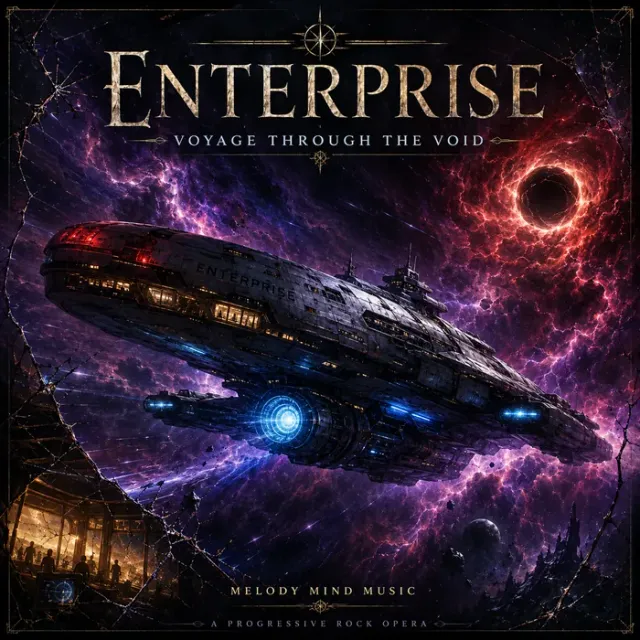
Enterprise: Voyage Through the Void
A cinematic progressive rock opera of starship conflict, sacrifice and hope driven by soaring guitars, vivid storytelling and a cosmic scale through the void.

Luz de Cempasúchil
Latin pop and mariachi accompany a Día de Muertos homecoming shaped by marigolds, family secrets, and an unfinished love story.

Welcome to the Family
Welcome to the Family turns corporate wellness, layoffs and hollow culture slogans into biting alternative rock, pop-punk satire and protest with sharp teeth.


