


A retrofuturist Italian art-pop concept album about Olivetti, memory, labor and technology, turning Ivrea’s industrial past into a real question for us today.
Tracklist
Liner Notes
A short editorial read on the album world, sound, and standout moments.
About the Album
Le Macchine Sognano Ancora begins with an abandoned factory and a practical job. Elena, a young restorer, is cataloguing what remains before a former Olivetti complex in Ivrea is converted into luxury apartments and offices. Then she finds an old computer in a locked basement. When it wakes, it does not offer software or diagnostics. It opens a memory. Letters, employee newspapers, housing plans, punched cards, training records and fragments of conversations begin to surface, turning the building into something far more complicated than an industrial ruin.
That premise gives Melody Mind Music a concept album about technology that is ultimately much more interested in people than machines. Sung entirely in Italian, Le Macchine Sognano Ancora moves through Progressive Art Pop, retrofuturist Synth Rock, Chamber Pop and Italian electronic music without treating those styles as decoration. Warm analog synthesizers, Rhodes electric piano, melodic bass, dry live drums, restrained strings and clean guitar establish a coherent musical world. A recurring four-note relay motif keeps resurfacing in different forms until machine memory and human memory begin to feel inseparable.
The opening stretch is deliberately tactile. “Ultimo Inventario” leads Elena through glass, dust, labels and locked rooms before the first mysterious relay clicks beneath the floor. “La Valentine Rossa” places a bright red typewriter at the center of the story and turns industrial design into a question of responsibility: can an object be functional, repairable and beautiful while respecting the person who has to use it? “Il Tesserino Scritto a Mano” narrows the album to a single employee badge, allowing an ordinary worker’s name, family and working day to push back against the anonymity of statistics. By “Case di Vetro, Mattino,” the view has widened from the factory floor to the city around it—housing, libraries, childcare and education become part of the same social architecture.
The album’s central idea crystallizes in “La Fabbrica Appartiene Anche alla Città.” Crucially, this is not presented as a slogan from some flawless golden age. The record refuses to turn Olivetti’s history into a postcard. There were hierarchies, conflicts, difficult decisions and economic pressure. What interests the album is something more useful: the fact that industry could seriously ask what a company owes the place that makes its success possible. What should work provide besides wages? Who gets considered when technology changes? What happens when responsibility disappears behind the language of efficiency?
Musically, the middle of the record becomes more restless as the story moves from mechanical production into computation. “Schede Perforate” uses punched cards as both physical image and rhythmic idea, while “Il Turno delle Macchine” turns retraining and technological change into a tense conversation between old skills and new systems. Then comes “Memoria Centrale,” the album’s major turning point, where the computer finally answers Elena directly.
That moment could easily have become a science-fiction gimmick. Instead, the machine remains deliberately limited. It stores, retrieves and compares; the uncomfortable intelligence lies in the documents it has preserved. When Elena describes platform workers, remote programmers and outsourced call-center employees, the archive does not deliver a grand prophecy. It simply places the present beside the past and leaves the listener to notice what changed—and what merely changed terminology.
The second half becomes sharper. “Sedie Arancioni Vuote” walks through an abandoned cafeteria and shows industrial decline not as one spectacular collapse, but as a sequence of reasonable-sounding removals. “Voci in Outsourcing” stretches the factory across borders until responsibility becomes difficult to locate. “Il Curriculum Non Dorme” may be the album’s strongest contemporary song: a portrait of permanent reskilling, ratings, profile maintenance, short contracts and professional visibility, where the working day no longer truly ends because employability itself has become unpaid work.
The lyrics remain grounded in screens, schedules, badges, renderings, tickets, courses and physical spaces. That concreteness matters. Le Macchine Sognano Ancora does not need to shout its politics because its arguments emerge from what its characters actually experience.
“Non Voglio un Museo” provides the decisive turn. Elena rejects the easiest solution: preserving the old factory as a tasteful memorial to a more idealistic industrial age. Instead, she imagines a public laboratory for repair, technical education, shared tools, programming and experimentation. “Laboratorio Aperto” then takes that idea into a meeting room, where ownership, funding and public access have to be argued over rather than magically resolved. There is no perfect victory and no unanimous applause. There is something more believable: a proposal strong enough to survive disagreement.
The title track closes the album six months later. Old cafeteria tables now hold soldering irons and broken amplifiers. Students test sensors. New manuals sit beside old technical drawings. The red Valentine still misses one letter. The computer remains active, not as a sacred relic but as part of a growing archive.
“Le Macchine Sognano Ancora” never seriously claims that machines dream. Its final question is far more interesting: when technology appears to carry a dream, who put that dream there? Who benefits from it? Who gets excluded? And who has the power to rewrite it?
Recommended if you like: Political punk, post-punk, protest rock, anti-authoritarian lyrics, dystopian concept albums, AI-assisted music projects. The album does not sound like a punk record, but it shares that tradition’s instinct to interrogate ownership, authority and the language institutions use to make political or economic choices appear inevitable.
What makes Le Macchine Sognano Ancora worth hearing is its refusal to choose between ideas and songs. It has an argument, but it also has recurring hooks, strong visual motifs, changing rhythmic structures and a recognizable sonic identity. The Valentine typewriter, orange chairs, punched cards, handwritten badge, green monitor text and glass architecture become emotional landmarks across fourteen connected chapters.
By the end, Ivrea no longer feels like a historical setting. It feels like a test case for the digital present.
This is an album about remembering forward: asking what was lost when work became more abstract, distributed and measurable, while refusing to pretend that the answer is simply to rebuild the past. Its conclusion is neither nostalgia nor technological pessimism. It is participation. Keep the machines. Keep the knowledge. Keep the uncomfortable questions.
And reopen the doors.
Production Notes
All tracks were generated with AI music models, then processed for the final sound. No human performance recordings are used.
Full album download
Download the complete album
Get the full ZIP package with tagged audio files, cover artwork, and album metadata.
Support MelodyMind
Help keep the albums coming
If this album was useful or fun to listen to, a small contribution helps cover hosting, tools, and new music experiments.
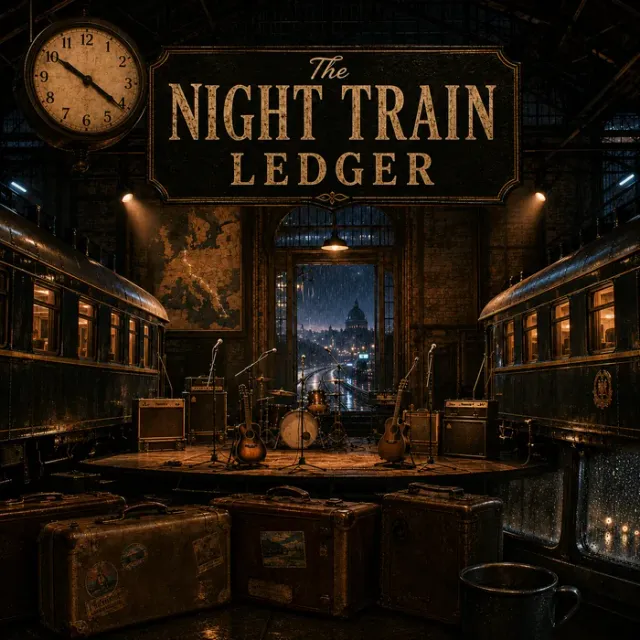
The Night Train Ledger
Heartland rock turns an overnight train from Berlin to Trieste into a shared story of work, regret, failing infrastructure, and connection between strangers.
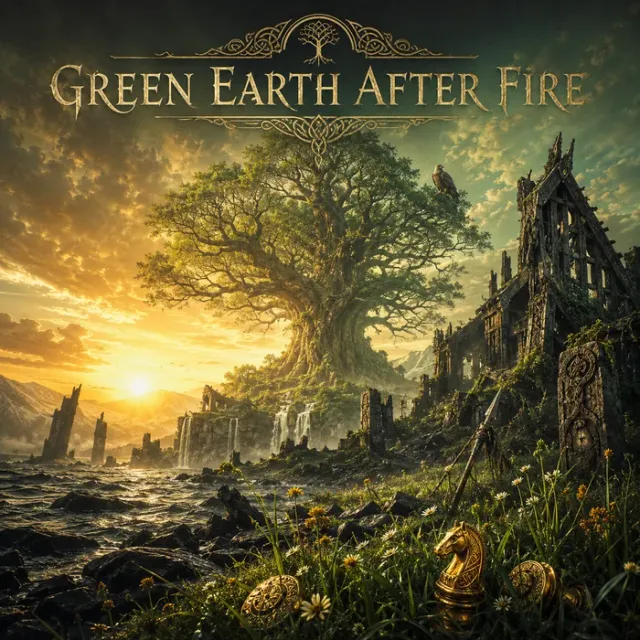
Green Earth After Fire
A Nordic folk Viking metal journey beyond Ragnarök, where gods and humans face memory, forgiveness, power, and the fragile promise of renewal. After the fire.
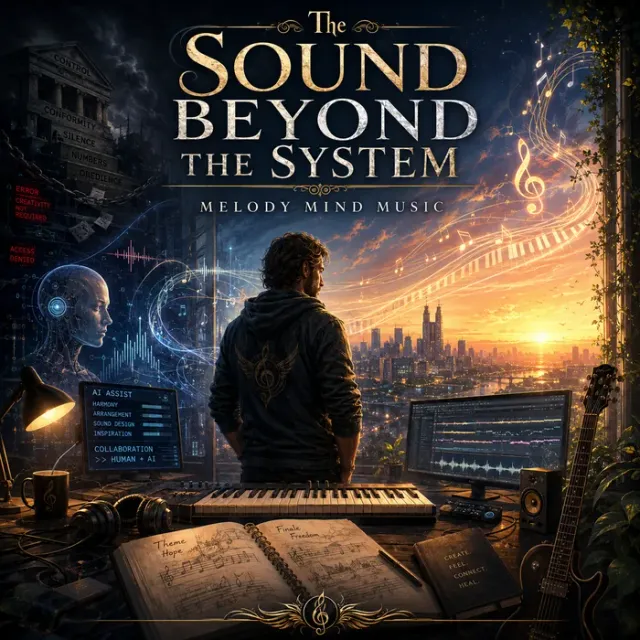
The Sound Beyond the System
Symphonic metal follows recovery from workplace burnout as an AI-assisted music project gives its creator a life beyond the system.

La España de los Kilómetros Vacíos
La España de los Kilómetros Vacíos explores rural loss, memory and renewal through Spanish alternative folk rock, vivid characters, and intimate storytelling.


