
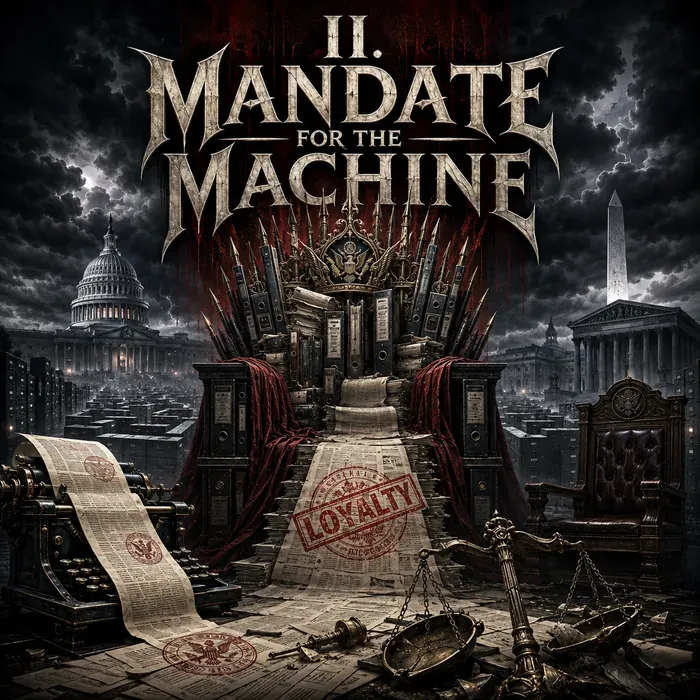
Symphonic Metal Opera
Mandate for the Machine
A dark symphonic metal opera about Project 2025, executive power and democracy under pressure—cold, theatrical and fiercely anti-authoritarian over 14 tracks.
Liner Notes
A short editorial read on the album world, sound, and standout moments.
About the Album
Mandate for the Machine is not an album about a coup. There are no tanks on the avenue, no burning barricades. Its horror is quieter and more convincing: folders are opened, names are sorted, legal language is sharpened, and institutions are taught to answer to one will. Across fourteen tracks, Melody Mind Music turns Project 2025, MAGA power politics and the “unitary executive” idea into a dark symphonic metal opera about how authoritarianism can arrive wearing a suit and speaking in the vocabulary of procedure.
The album begins inside the machine room. “Mandate for the Machine” introduces conference rooms, loyalty stamps, personnel lists and decrees waiting to be signed. Guitars, pipe organ, low strings and percussion give the music weight, but the tension comes from the contrast between grandeur and administration. This is not fantasy-metal pageantry transplanted onto politics. The spectacle grows from office corridors, memoranda and the choreography of institutional capture.
Every song advances the same story inside the system. “The Unitary Throne” speaks with the confidence of executive power discovering how much it can claim. “Schedule F Funeral March” shifts to public servants whose expertise becomes a liability when loyalty is valued above competence. “Architects of Obedience” exposes the network behind the leader—lawyers, recruiters, strategists, donors and media operators who each contribute to a larger design. By “The Law Firm Guillotine,” legal argument has become an instrument of removal, its polished clauses doing the work older regimes assigned to visible violence.
The music is differentiated without losing the album’s identity. Odd-meter riffs sit beside funeral-procession drums, doom-weighted courtroom passages, galloping power-metal momentum and a warped bureaucratic waltz. Pipe organ, low orchestration, typewriter rhythm and a three-note machine motif bind the record together, while each arrangement has a purpose. “Civil Service in Chains” slows the pace and brings the damage home through a dismissed worker and his daughter. “Heritage of Fire” accelerates into ideological fervour. “Executive Order Nocturne” uses piano and a measured 6/8 pulse to make an unsigned decree sound seductive before its consequences become clear.
At the centre stands “The Courts Beneath the Boot,” the album’s bleakest theatrical set piece. An empty courtroom, a missing judge, a broken scale and government counsel armed with binders create a chamber drama in real time. The song’s weight comes not from constant volume, but from pressure: pauses, low strings, detuned piano and the question of whether law still has force when power decides judgment is optional.
From there, the record enters its most severe stretch. “Checks and Balances Burn” is built around institutional hesitation—Congress waits, courts delay, agencies bend and every guardian assumes another will act first. “A Republic in Red Ink” turns administrative revision into a crooked waltz, with safeguards crossed out one line at a time. These songs understand that democratic erosion is rarely one spectacular event. It is a sequence of postponed objections, softened rulings, altered job classifications and decisions made by people insisting they handle only one small part.
Yet Mandate for the Machine is not satisfied with despair. Resistance does not arrive as a flawless hero or an easy uprising. It begins with copies, records, objections and people preserving what others want erased. “The Bureaucrats of Midnight” gives clerks, analysts, archivists, inspectors and lawyers the album’s most quietly defiant chorus. Their weapons are dates, names, files and verifiable facts. The choice is modest but enormous in consequence: open the door, keep the record, refuse to let the machine rewrite its history.
That decision drives the record into “When the Constitution Screams,” a finale that earns its scale because the album has spent thirteen tracks showing what is at stake. Guitar, organ, orchestra and ensemble vocals collide as private machinery meets public evidence. The song does not treat the Constitution as a sacred object beyond criticism. It acknowledges failure, exclusion and amendment, then argues that the document matters only when people force its promises to live. The result is forceful without becoming empty patriotic theatre.
The closing “No King Above the Law” lowers the volume without lowering the stakes. The damaged scale is repaired, but it does not hang exactly as before. Some workers return; some chairs remain empty. A fresh binder waits behind another door. That image keeps the album honest. Authoritarian structures are not defeated forever by one verdict, election or burst of courage. They survive in habits, networks and opportunities, and return when scrutiny fades.
Recommended if you like: Political punk, post-punk, protest rock, anti-authoritarian lyrics, dystopian concept albums, AI-assisted music projects. The recommendation is broader than the album’s metal classification because its real kinship is with records that treat political anger as craft rather than decoration. Listeners drawn to recurring symbols, shifting perspectives and a complete narrative arc will find plenty to unpack, while symphonic and progressive metal fans will hear complexity used to sharpen the story rather than bury it.
Mandate for the Machine is worth hearing in sequence, preferably with the lyrics close at hand. Its hooks are immediate, but the deeper reward lies in returning objects: the red stamp, broken scale, empty chair, typewriter and folders that change meaning as the story progresses. What begins as equipment of control becomes evidence, memory and resistance. The album does not ask the listener to admire its machinery. It asks them to notice when that machinery is being built—and to decide what they will do before it starts running.
Production Notes
All tracks were generated with AI music models, then processed for the final orchestral sound. No human performance recordings are used.
Full album download
Download the complete album
Get the full ZIP package with tagged audio files, cover artwork, and album metadata.
Support MelodyMind
Help keep the albums coming
If this album was useful or fun to listen to, a small contribution helps cover hosting, tools, and new music experiments.
Join the conversation
Reactions from the web
Mentions, likes, reposts, and replies from IndieWeb and Fediverse-friendly sites can appear here after you allow community features.
The Last Crown of Ashes
A tragic symphonic metal opera about a doomed queen, betrayal, forbidden love and a crown surrendered to save a kingdom from ashes.
The Architecture of Collapse
The Architecture of Collapse is a dark symphonic metal opera about broken systems, burnout, rage, and one developer losing himself inside the machine at work.
The Sound Beyond the System
A symphonic metal opera about work, recovery and music reclaiming the self—cinematic, humane and made for listeners who want a story that stays with them too.
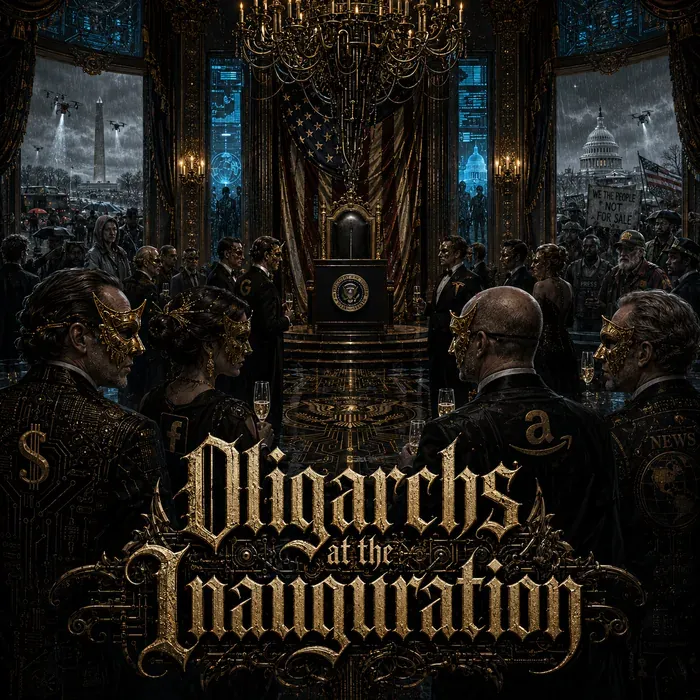
Oligarchs at the Inauguration
A dark symphonic industrial metal opera about oligarchs, media power and democracy under siege—grand, furious, theatrical and disturbingly timely for America.
Community
Comments...
Read or leave a comment about this album. Comments are provided by Cusdis and load only after you allow the comments feature.
Enable comments to load the discussion from Cusdis.