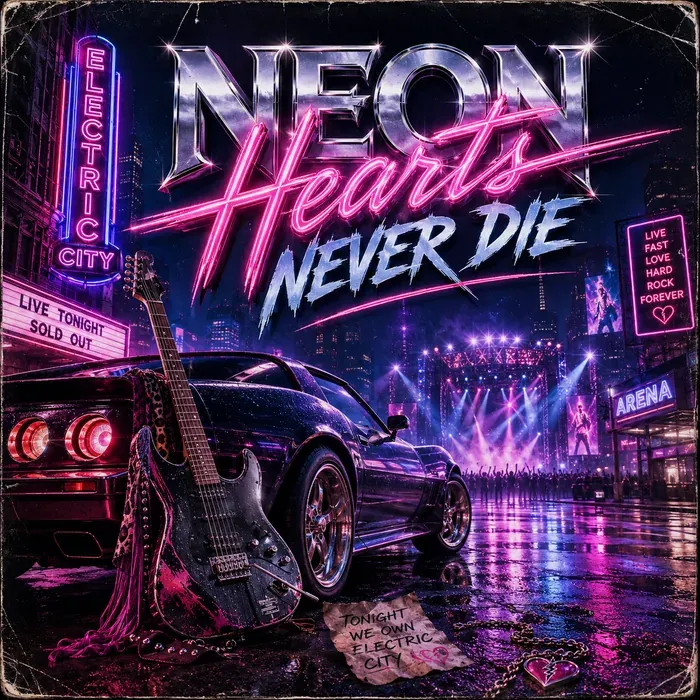
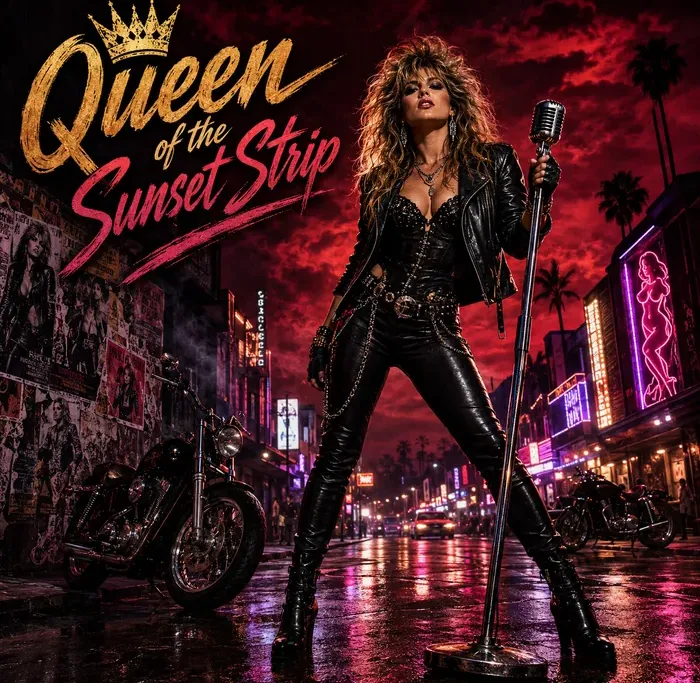
Cover art for the album Neon Hearts Never Die

Hair Metal

Neon Hearts Never Die

Neon Hearts Never Die is a neon-lit glam rock concept album of big riffs, lost love, betrayal and comeback dreams in Electric City’s midnight glow.

Cue the first track

Neon Hearts Never Die

0:00 -0:00
Ready to play

Liner Notes

A short editorial read on the album world, sound, and standout moments.

About the Album

Neon Hearts Never Die is the kind of album that does not enter quietly. It arrives under pink and violet streetlights, with rain shining on black asphalt, a guitar leaning against a chrome-lined sports car, and the sound of a crowd gathering somewhere in the distance. Built as a full concept album in the spirit of classic hair metal, glam rock and arena rock, it tells a story about youth, ambition, romance, betrayal and the dangerous belief that a song can outlive everything that tries to destroy it.

The album takes place in Electric City, a fictional 1980s metropolis where every boulevard looks like a music video and every dream comes with a price tag. At its center is a young rock band chasing the impossible: the first real gig, the first taste of applause, the first romance that feels larger than life, and the first painful lesson that fame is never as clean as it looks from the crowd. This is not just a collection of rock songs with neon aesthetics. It is a rise-and-fall-and-rise-again story told through guitar hooks, big choruses, power ballads and late-night emotional wreckage.

From the opening rush of “Electric City Nights”, the album throws the listener straight into the city. The band arrives broke, hungry and convinced that the night belongs to them. It is a perfect opener: loud, bright, romantic in the reckless way only young musicians can be. The title track, “Neon Hearts Never Die,” turns that belief into the album’s central oath. It is a stadium-sized anthem about friendship, music and the kind of hope that survives even when common sense says it should not.

What makes the album work is the emotional contrast beneath the shine. Yes, there are huge riffs, glittering synth touches, leather-jacket swagger and choruses built for raised fists. But behind the glamour, the songs keep returning to loneliness. “Wild Boys Don’t Cry” cuts through the pose and shows the fear behind the eyeliner and bravado. “Midnight Radio Love” brings in the album’s most romantic thread: a fragile connection that exists through late-night calls, radio static and the ache of distance. It feels nostalgic without becoming hollow, because the longing is specific and human.

The middle section is where the dream begins to corrode. “Backstage Angels” captures the chaos of success: fans, temptation, managers, bottles, promises and bad decisions moving too fast to stop. Then “Chrome and Broken Promises” darkens the mood, turning the music industry into a polished machine of contracts, image control and beautiful lies. The song gives the album a harder edge. It is still arena rock, still melodic, still built for volume, but there is bitterness under the chrome.

The emotional centerpiece is “One More Night in Fire,” a classic power ballad in the best sense: dramatic, sincere and built around the moment where love and ambition finally collide. It is not just a sad love song. It is the sound of someone realizing that chasing a dream can still make you guilty, selfish and afraid. That tension carries into “Leather, Lace & Lies,” where heartbreak turns into self-destruction, and then into “Runaway Stage Lights,” where the band runs from everything by touring harder, playing louder and pretending the applause is enough.

By the time “When the Glitter Falls” arrives, the album has earned its melancholy. This is the morning-after song, the hotel-room silence after the show, the moment when fame stops feeling like rescue and starts feeling like another locked door. It is followed by “Ashes of the Encore,” the album’s collapse point: the cancelled show, the broken band, the crowd outside, the dream nearly burning itself to the ground. In lesser hands, this kind of story could become melodramatic. Here, it feels fitting, because the album has always understood that glam rock is not only about excess. It is also about survival through excess.

The final stretch gives Neon Hearts Never Die its emotional payoff. “Hearts on the Run” is the sound of reconciliation, not as a clean happy ending, but as a decision to keep going with scars visible. Then “Raise Your Hands to the Sky” brings the band back to Electric City for a triumphant finale. The comeback does not erase the damage. That is why it matters. The band is not immortal because they avoided pain. They are immortal because the songs carried them through it.

Musically, this album is recommended for listeners who love big, melodic rock with dramatic storytelling: classic hair metal, glam rock, arena rock, power ballads, 80s synth flair, huge guitar solos and choruses that feel made for a live crowd. It has the neon romance of late-night radio, the bite of rebellious rock mythology and the emotional sweep of a concept album that wants to be heard from beginning to end.

Recommended if you like: Political punk, post-punk, protest rock, anti-authoritarian lyrics, dystopian concept albums, AI-assisted music projects. While Neon Hearts Never Die leans more into glam metal and arena rock than punk, it shares that same outsider spirit: young people pushing back against control, industry pressure, broken promises and the machinery that tries to turn art into product.

The reason this album is worth hearing is simple: it understands the pleasure of rock spectacle without losing the heart underneath. It gives you the big choruses, the neon streets, the guitars, the romance, the heartbreak and the comeback. But it also gives you characters to follow, a city to imagine and a reason to keep listening after the first hook lands. Neon Hearts Never Die is not just nostalgia for a louder decade. It is a full-throttle reminder that some dreams are foolish, some dreams are dangerous, and some dreams are still worth turning up all the way.

Production Notes

All tracks were generated with AI music models, then processed for the final sound. No human performance recordings are used.

Full album download

Download the complete album

Get the full ZIP package with tagged audio files, cover artwork, and album metadata.

Support MelodyMind

Help keep the albums coming

If this album was useful or fun to listen to, a small contribution helps cover hosting, tools, and new music experiments.
Join the conversation

Reactions from the web

Mentions, likes, reposts, and replies from IndieWeb and Fediverse-friendly sites can appear here after you allow community features.

Community

Comments

Read or leave a comment about this album. Comments are provided by Cusdis and load only after you allow the comments feature.