
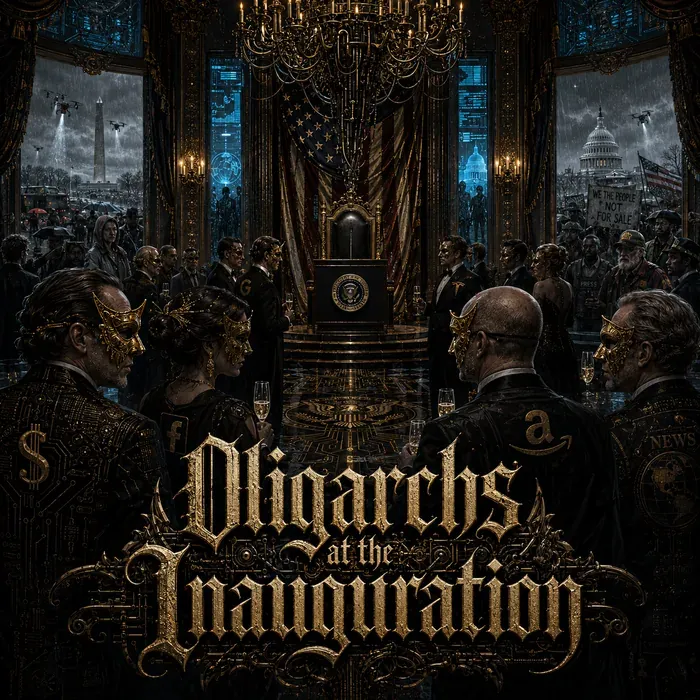
Symphonic Industrial Metal
Oligarchs at the Inauguration
A dark symphonic industrial metal opera about oligarchs, media power and democracy under siege—grand, furious, theatrical and disturbingly timely for America.
Liner Notes
A short editorial read on the album world, sound, and standout moments.
About the Album
Oligarchs at the Inauguration is a fourteen-track symphonic industrial metal opera set inside a Washington ballroom where political ceremony has become corporate theatre. Behind gold masks and champagne flutes, platform owners, media executives, lobbyists and billionaires circle a new president while workers, journalists, migrants, Indigenous voices and veterans wait outside in freezing rain. The album is not interested in one villain standing alone at the center of the room. Its sharper target is the network around him: the owners who normalize him, the platforms that amplify him, the broadcasters that soften him and the institutions that decide silence is safer than resistance.
Musically, the record is built on a strict foundation. Down-tuned guitars move with the weight of machinery, live drums strike with industrial precision, low brass turns ballroom grandeur into threat, and pipe organ lines suggest state ceremony and corrupted religion. A recurring three-note motif passes through brass, organ, piano and electronics.
The opening title track establishes the scene with immediate force. “Oligarchs at the Inauguration” places the listener between polished marble inside and soaked cardboard signs outside. Champagne glasses ring like chains, drones hover over Washington and contracts move beneath sleeves. “Prime Time Coronation” shifts into the broadcast control room, where camera angles manufacture consent rather than document events.
The album grows more unsettling because it rarely relies on abstract accusations. “Bezos in the Balcony” links delivery networks, entertainment, cloud infrastructure and political access through one elevated viewpoint. “The Newspaper That Would Not Speak” turns a blank editorial column into a moral crime scene. An owner calls, an editor hesitates, a sentence disappears. That small act shows how democratic institutions can be hollowed out without spectacle.
“Billion Dollar Knees” is driven by a crushing industrial stomp and a crooked 7/8 figure whenever the wealthy bow. Its satire is brutal but disciplined: these are not untouchable masters of the universe, but frightened men protecting access, regulation and profit. The slow doom of “Platform Gods” changes the emotional temperature. Told through the voice of a migrant content moderator, it asks what it means for a company to know a person’s passport, purchases, habits and fears while refusing to recognize her dignity.
At the center, “The Ballad of the Silent Editorial” becomes a full operatic confrontation. An editor argues that compromise is necessary to keep a newsroom alive; a reporter answers that a paper which survives by refusing to speak has preserved only its furniture. When the editor admits no explicit threat was needed, the album reaches its central revelation: power is strongest when institutions anticipate what it wants.
The second half descends beneath the ballroom. “Server Farm Confessional” gives the infrastructure a voice, but does not excuse the people behind it. Concrete, copper, coolant, land and electricity replace the comforting metaphor of “the cloud.” “Merchants of Attention” follows with a grotesque 12/8 sales pitch in which fear, anger and division become inventory. The merchants do not care which side wins. They care that nobody looks away.
“Democracy Behind a Paywall” broadens the story beyond the gala. Local reporting disappears, public records become inaccessible and verified information carries a subscription fee while rumors arrive for free. Yet the song introduces the record’s first durable hope: a laundromat, folding chairs, copied pages and neighbors reading together. The answer is not a flawless technological savior. It is shared infrastructure, public knowledge and people willing to do slow civic work.
That idea drives “The Cowardice of Networks,” where reporters, technicians and producers stop waiting for permission and build an independent transmission from fragments each preserved. The climax, “Blood on the Balance Sheet,” brings the evidence into the ballroom. Contracts, deleted lines, worker injuries and suppressed testimony appear together, not as slogans but as an account that must be read aloud. The confrontation remains civic rather than violent. Its weapons are records, names, dates and witnesses.
The closing track, “Break the Golden Circuit,” refuses a convenient victory. The drones still fly. The towers still belong to the wealthy. The platforms have not vanished. What has changed is the public’s understanding of how the circuit works and who benefits from keeping it closed. The final song turns the three-note motif upward and replaces machinery with human voices. Its message is demanding rather than comforting: democracy is not restored by one leak, one election or one brave speech. It survives through open records, independent journalism, accountable technology, organized labor and institutions that cannot be silenced by a private phone call.
This is an album worth hearing from beginning to end, preferably with the lyrics close at hand. It offers the scale of a metal opera without losing sight of individual hands, rooms and choices. It asks who owns the stage, who controls the feed, who edits the record and who is left outside the door. More importantly, it asks what happens when those outside stop accepting the role of spectators.
Production Notes
All tracks were generated with AI music models, then processed for the final orchestral sound. No human performance recordings are used.
Full album download
Download the complete album
Get the full ZIP package with tagged audio files, cover artwork, and album metadata.
Support MelodyMind
Help keep the albums coming
If this album was useful or fun to listen to, a small contribution helps cover hosting, tools, and new music experiments.
Join the conversation
Reactions from the web
Mentions, likes, reposts, and replies from IndieWeb and Fediverse-friendly sites can appear here after you allow community features.
Mandate for the Machine
A dark symphonic metal opera about Project 2025, executive power and democracy under pressure—cold, theatrical and fiercely anti-authoritarian over 14 tracks.
Saints of the Empty Hospital
Saints of the Empty Hospital is a gothic metal requiem for exhausted care workers, lost patients, and a healthcare system stretched beyond its limits tonight.

La Ville en Colère
French protest punk concept album with post-punk grit, urban rage, class tension and dark hope in a city that refuses to stay silent.
The Dice Remember Blood
The Dice Remember Blood is a dark fantasy metal saga of cursed choices, lost identities and grim victories, told through all 14 cinematic, story-driven songs.
Community
Comments...
Read or leave a comment about this album. Comments are provided by Cusdis and load only after you allow the comments feature.
Enable comments to load the discussion from Cusdis.