

Industrial Metal
Pager at Midnight
Pager at Midnight turns sleepless on-call chaos into industrial metal - sharp riffs, black humor, human stakes, and a story that refuses to log off after dawn.
Liner Notes
A short editorial read on the album world, sound, and standout moments.
About the Album
Pager at Midnight is an industrial and alternative metal concept album about the people who keep modern companies alive after everyone else has gone home. Its battlefield is a kitchen floor at 2 a.m., lit by red monitors, a cracked pager and the cold glow of a laptop.
At the centre is Mara Voss, newly responsible for operations, infrastructure and site reliability at Infinite Loop Solutions. Management promises a proper team. What she gets is Tariq Mansour, an exhausted Linux administrator, and Lena Hoffmann, a young cloud engineer with more certificates than production experience. Together they inherit an on-call rota built on missing names and outdated documentation.
“Welcome to the On-Call Rotation” establishes the album’s dark humour immediately. The riffs stomp with the dull force of machinery while the lyrics expose a familiar corporate trick: responsibility arrives before the resources needed to carry it. Then “Pager at Midnight” throws the team into its first real night of alarms. At 2 a.m., the payment platform goes down.
Pager at Midnight examines the systems that make disaster inevitable. “Everything Is Healthy” turns a falsely green dashboard into a brutal chorus about the distance between internal metrics and customer reality. “Alert Number Four Hundred” captures alarm fatigue until the warning that matters is nearly lost in the noise. “Wake the Database Engineer” is funny and unsettling: a failing ledger is passed between departments because every official owner has left, moved or been reorganised out of existence.
The industrial metal foundation is more than decoration. Gated drums, downtuned guitars, distorted bass and clipped electronic pulses give the record the texture of server rooms, notification tones and fluorescent offices. Yet the songs never blur into one mechanical march. “Works in Every Region but One” slows the pace and shifts attention to the people hidden inside percentages. A report may call the service 98 percent available, but the remaining two percent still represents customers unable to complete a transaction.
“The Runbook Ends Here” is one of the album’s sharpest pieces of writing. The emergency documentation guides the team through obvious steps, then stops exactly where the real problem begins. Its odd-meter tension mirrors the uncertainty of acting without a safe procedure. That pressure breaks open in “Incident War Room,” the album’s central collision. Developers, support staff, operations engineers and silent managers enter the same call, each holding part of the truth. Overlapping voices and hard rhythmic shifts recreate the confusion of a major incident without drowning the listener in jargon.
The consequences arrive fast. In “Scale Until the Money Is Gone,” autoscaling saves availability by creating more cloud instances while the monthly budget burns in real time. The dilemma is genuine: keep the service alive and spend recklessly, or protect the budget and let customers fail. By “Thirty-Six Hours Awake,” the jokes have drained away. Mara can no longer trust her own judgment. Time, hunger and responsibility collapse into one exhausted monologue, and the album makes its strongest argument: reliability built on human damage is another kind of failure.
That idea carries into “The Process Nobody Owns,” where Klaus discovers an ancient service copying an entire customer table every five minutes. The process has outlived the people, teams and purpose that created it, but it still consumes resources because nobody has the authority to stop it. The song turns technical debt into institutional memory: old decisions continue to act long after their makers disappear.
The final stretch refuses an easy victory. “Silence the Pager” is not about ignoring problems; it is about restoring meaning to alarms. The team cuts 487 warnings down to a small number requiring immediate human action. Then “Reliability Is Not a Dashboard” delivers the album’s defining statement. Mara presents the incident report to the board and rejects the language of heroism. She does not want praise for surviving thirty-six hours without sleep. She wants owners, backups, staffing, tested procedures and the right to stop unsafe work.
Naturally, management responds with a new dashboard and a mandatory resilience webinar.
That punchline could have ended the album, but “Your Private Number Is Ringing” goes further. Mara turns off the official pager, only for her private phone to light up seconds later. This time she does not simply answer. She routes the problem back through the process and draws a boundary the company can no longer pretend not to see. The ending remains open, but it is not hopeless. The system may still fail. The difference is that Mara no longer accepts being treated as part of the machinery.
Pager at Midnight is recommendable because it understands that workplace satire is strongest when the people inside it are treated seriously. The album is funny without becoming a novelty record, angry without losing detail, and technical without shutting out listeners who have never opened a terminal. Its characters feel worn, capable and recognisably human. Its hooks carry the story, its recurring pager motif binds the record together, and its best songs turn invisible labour into something loud enough to hear.
Even listeners outside the technology world will recognise the wider themes: understaffing disguised as efficiency, responsibility without authority, management language replacing practical change, and workers expected to become endlessly available. Pager at Midnight gives those pressures a hard mechanical pulse, memorable choruses and a narrative that grows more urgent with every track. It is a concept album for anyone who has ever kept something running while the people above them slept.
Production Notes
All tracks were generated with AI music models, then processed for the final sound. No human performance recordings are used.
Full album download
Download the complete album
Get the full ZIP package with tagged audio files, cover artwork, and album metadata.

Saints of the Empty Hospital
Saints of the Empty Hospital is a gothic metal requiem for exhausted care workers, lost patients, and a healthcare system stretched beyond its limits tonight.

The Last Funeral of Anubis
The Last Funeral of Anubis turns death, bureaucracy and grief into a dark cabaret odyssey of black humor, gothic folk and chamber blues. With one human pulse.
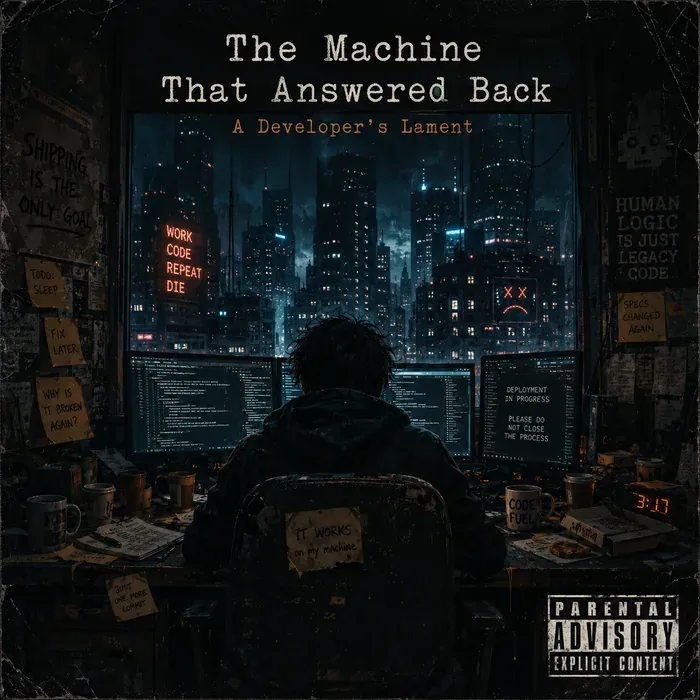
The Machine That Answered Back
A dark progressive symphonic metal opera about burnout, AI, authorship and survival, where code, choir and collapsing deadlines become one human crisis story.

Sombras de Granada
Dark Andalusian folk metal concept album set in nocturnal Granada, where love, ghosts and Moorish memory become one haunting legend of desire and loss. Night.
Support MelodyMind
Help keep the albums coming
If this album was useful or fun to listen to, a small contribution helps cover hosting, tools, and new music experiments.