

Return of the Legacy System
Made with generative AI; directed and curated by Daniel.
A progressive doom metal satire where a failed cloud migration awakens an ancient system that still controls the company’s entire digital world after decades.
Tracklist
14 tracks
Liner Notes
A short editorial read on the album world, sound, and standout moments.
About the Album
Return of the Legacy System is a progressive doom metal concept album about one of the least glamorous disasters imaginable: a software migration that goes wrong. Yet the record treats that corporate nightmare with the scale, tension and narrative discipline of a technological tragedy. At Infinite Loop Solutions, the decades-old core system ORACLE-X9—known internally as The Beast—is scheduled for retirement. Management promises a clean move to the cloud in six weeks. Consultants insist the conversion is routine.
The album’s great strength is that it never reduces this premise to office jokes. The humour grows from recognisable details: grey binders filled with handwritten notes, hard-coded customer numbers, a file named FINAL_FINAL_USE_THIS_ONE, forgotten access rules and the instruction “Do not terminate process seven.” These details create a neglected but believable world. The comedy lands because the stakes keep rising. What begins as management optimism turns into broken invoices, locked doors, missing wages and a company discovering that its supposedly obsolete software quietly controls almost everything.
Musically, Return of the Legacy System is built around progressive doom metal: slow, weighty guitar riffs, patient rhythmic development, prominent bass movement, Hammond organ and carefully placed changes in meter. The songs are heavy without becoming shapeless, and complex without sounding like technical exercises. A recurring five-note motif moves through the album in different forms, sometimes on organ, sometimes in bass, sometimes inside the guitar arrangement. It gives The Beast a musical identity before the system becomes a speaking presence.
The System Before Time opens the album with the scale of an industrial legend. Its restrained tempo and dark organ figures establish ORACLE-X9 not as equipment, but as an institution older than much of the workforce. Klaus Knows the Code introduces the album’s most important human figure: the veteran developer who remembers why the undocumented compromises were made. Rather than presenting Klaus as a magical technician, the song gives him history, regret and practical authority. He understands the code because he remembers the emergencies that created it.
From there, the record becomes increasingly tense. Six Weeks to the Cloud turns unrealistic planning into an urgent progressive-metal hook, while FINAL_FINAL_USE_THIS_ONE transforms an embarrassing filename into a crucial discovery. Do Not Terminate Process Seven is one of the album’s strongest pieces: a slow, ritualistic doom track built around the warning that an unknown process must remain alive. By Comments in Forgotten Tongues, the source code has become institutional memory, filled with warnings from exhausted developers who solved immediate problems and left the consequences to the future.
The Consultant Said It Was Easy provides the album’s most openly satirical chapter. Its polished surface mirrors the confidence of a sales presentation, while the arrangement gradually becomes unstable as the automated conversion fails. The song targets the wider corporate desire to replace understanding with a diagram, a progress bar and a reassuring status report.
Migration Day Massacre is the central collapse. Faster progressive sections give way to crushing doom as billing, payroll, inventory and building access fail at once. The sequence is funny in places—the CEO is reclassified as a former intern—but the track never loses its sense of consequence. Million-Dollar Invoice and Locked Out by Our Own Software examine the damage from more personal perspectives, showing how abstract migration errors become customer distrust and public humiliation.
The title track marks the album’s darkest point. Return of the Legacy System is not a triumphant resurrection song. The Beast refuses to run on modern hardware because its identity is tied to the original machine. This leads into Journey to the Forgotten Data Center, where the team travels to an abandoned site on the edge of town. Acoustic elements and measured pacing give the song a physical sense of movement without abandoning the album’s heavy character.
Klaus and the Beast delivers the true climax. Structured as a dialogue between creator and system, it avoids the easy conclusion that old technology is either heroic or evil. Klaus admits that years of urgent fixes helped create the problem. The Beast answers that it only followed the rules it was given. When Process Seven finally returns, the resolution feels earned because it is based on responsibility rather than nostalgia.
The closing Successfully Modernized is a sharp epilogue. Management announces victory, the presentation turns green, and the original system continues running in the forgotten data center. The humour is understated and cutting. Nothing has really been replaced; the failure has simply been renamed as progress.
This album is recommended not only for listeners who enjoy progressive doom metal, theatrical heavy music and tightly constructed concept records, but also for anyone who appreciates satire with a real narrative spine. Recommended if you like: Political punk, post-punk, protest rock, anti-authoritarian lyrics, dystopian concept albums, AI-assisted music projects. Those references make sense less because the album copies those sounds than because it shares their suspicion of institutions, polished language and authority without understanding.
Return of the Legacy System is worth hearing as a complete album. Its recurring motifs, changing perspectives and controlled pacing reward uninterrupted listening. Beneath the jokes is a serious observation: systems become dangerous when organisations depend on them while refusing to understand them. The Beast survives because everyone mocked its age, but no one took responsibility for its replacement. That combination of heavy music, precise storytelling and corporate absurdity gives the album a distinct identity—and makes its final green cursor difficult to forget.
Production Notes
All tracks were generated with AI music models, then processed for the final sound. No human performance recordings are used.
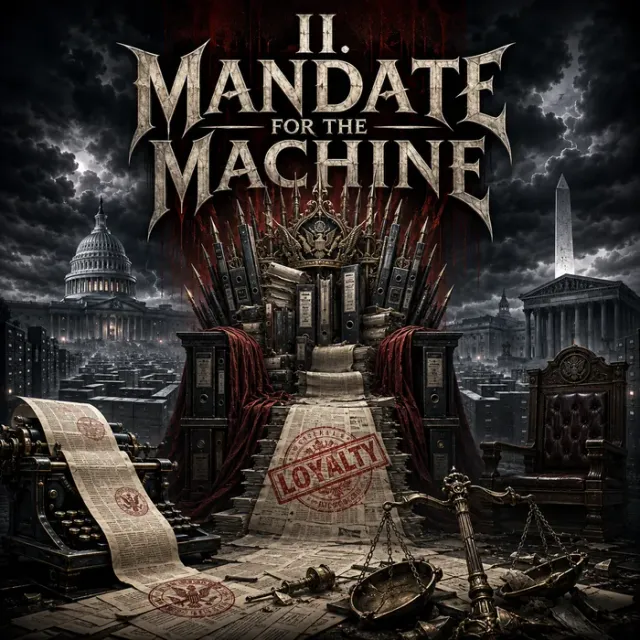
Mandate for the Machine
A dark symphonic metal opera about Project 2025, executive power and democracy under pressure—cold, theatrical and fiercely anti-authoritarian over 14 tracks.
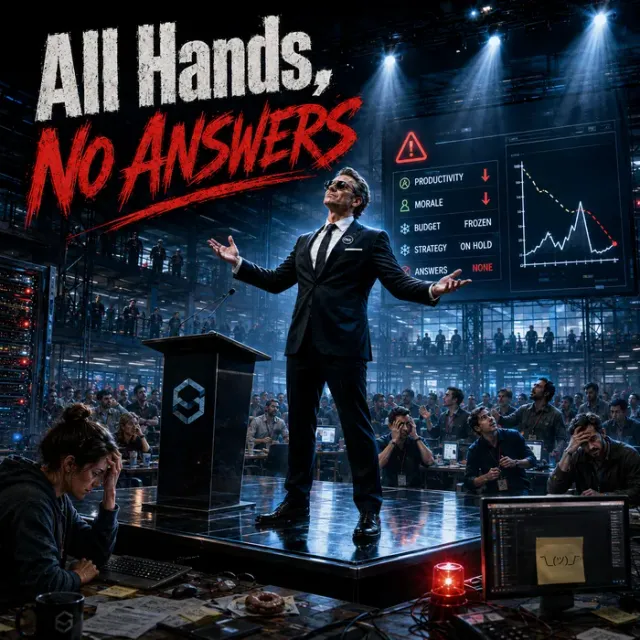
All Hands, No Answers
A theatrical comedy arena-metal rock opera about corporate spin, broken systems, filtered truth and a CEO discovering the crisis beneath the stage lights now.
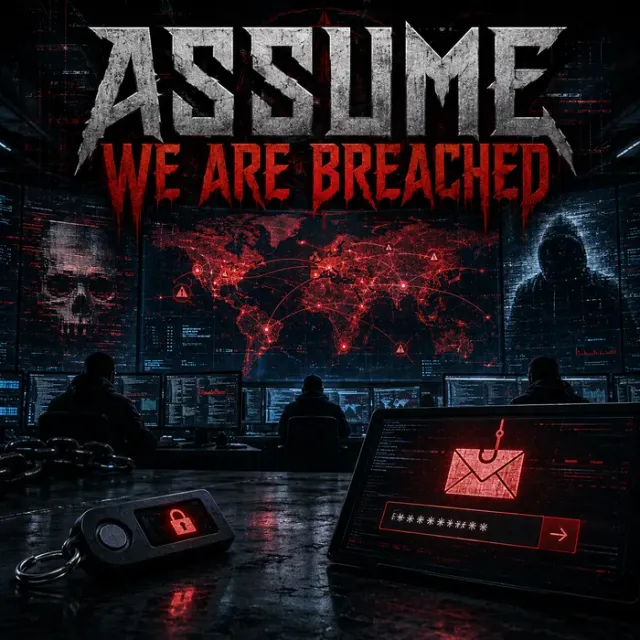
Assume We Are Breached
Industrial thrash concept album about cyber breaches, phishing, hidden accounts and corporate denial—dark, urgent, precise and dangerously addictive. Hear it.
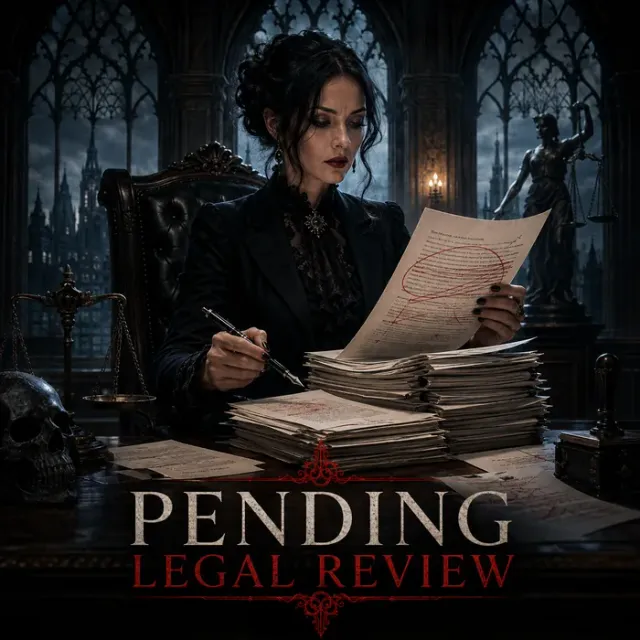
Pending Legal Review
Pending Legal Review is a gothic rock and doom metal concept album about contracts, liability, legal pressure, red lines and the hidden risk of signing blind.


Download the complete album
Get the full ZIP package with tagged audio files, cover artwork, and album metadata.
Help keep the albums coming
If this album was useful or fun to listen to, a small contribution helps cover hosting, tools, and new music experiments.