
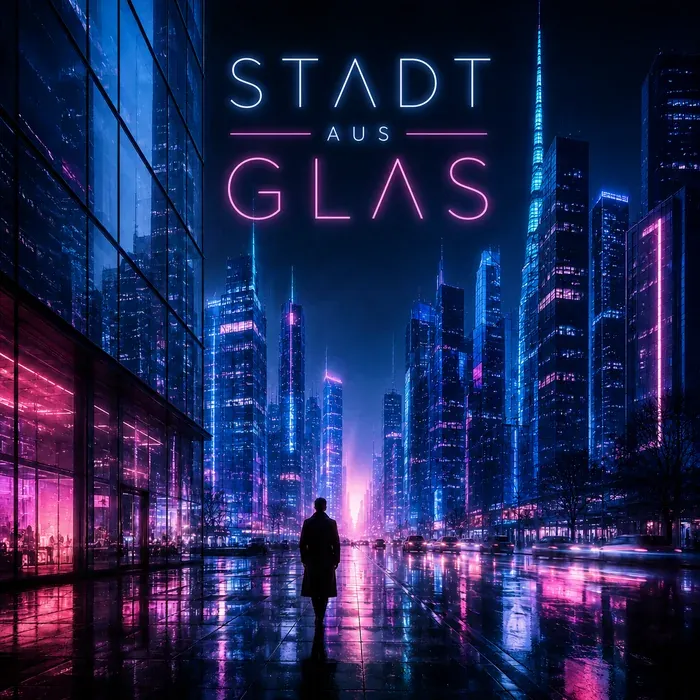
Synth-Pop
Stadt aus Glas
Stadt aus Glas is German-language synth-pop with an NDW afterimage: cool drum machines, pulsing sequencers, rain-lit city scenes, and songs about trying to stay human inside a bright, distant, overconnected world.
- Tracks 14
- Length 42 min
Liner Notes
A short editorial read on the album world, sound, and standout moments.
About the Album
Stadt aus Glas takes a familiar synth-pop setting and keeps it usefully cold. The album has neon, rain, U-Bahn platforms, apartment windows, screens, and mirrored facades, but it does not treat the city as decoration. The glass matters because everyone can see everything and still fail to touch anything.
The record is rooted in German-language synth-pop with a clear Neue Deutsche Welle afterimage. The drum machines are dry and direct, the sequencers keep the streets moving, and the synth lines have that slightly glassy quality that suits the title. It is not a nostalgia exercise, though. The 1980s vocabulary is used to talk about a present-day kind of distance: messages instead of voices, contact without closeness, light without warmth.
“Neon im Regen” opens the album in the right weather. The city is already shining, but the shine is wet and unstable. “Fenster ohne Licht” narrows the view to apartment blocks and dark rooms, while “U-Bahn Herzen” catches the brief intimacy of public transport: people standing close enough to hear each other breathe, then disappearing at the next stop. The title track turns those images into the album’s central idea. A city can be beautiful and unbearable for the same reason.
The middle run is strongest when it refuses easy drama. “Bildschirmküsse” does not need to explain digital loneliness at length; the word itself already carries the problem. “Betonhimmel” gives the record more weight, with the city pressing down instead of glowing from a distance. “Spiegelnde Fassaden” and “Kein Empfang” then push the theme from setting into identity. The question is no longer only whether anyone is reachable. It is whether the person looking back from the glass is still recognizable.
The second half lets warmth enter carefully. “Wir tanzen nicht allein” is brighter, but it does not suddenly turn the album into escape music. The dance floor is still inside the same city. “Menschen aus Licht” works because it finds connection in small human signals: a face, a voice, a gesture, a moment that feels less mediated. “Offline” makes that choice more explicit, not as a slogan against technology, but as a wish to be present without being constantly translated through a screen.
“Unter fremden Sternen” opens the view outward, as if the city has finally become visible from a little distance. “Zwischen den Signalen” is the right late-album hinge: traffic lights, train signs, phone bars, and inner hesitation all become part of the same language. By the time “Letzte Bahn nach Morgen” arrives, Stadt aus Glas has earned its dawn. It is not a clean rescue. It is a small movement toward another person, which is enough for this kind of record.
Stadt aus Glas works best as a synth-pop album about surfaces that almost become walls. Its clean production, German vocal lines, and NDW-colored pulse give the songs their style, but the lasting subject is simpler: how hard it can be to find a real signal in a city full of light.
Production Notes
All tracks were generated with AI music models, then processed for the final sound. No human performance recordings are used.
Support MelodyMind
Help keep the albums coming
If this album was useful or fun to listen to, a small contribution helps cover hosting, tools, and new music experiments.
Synthetic Eden
Synth-pop set inside a flawless artificial paradise, where perfect weather, controlled feeling, and beautiful surfaces begin to sound wrong.

Queen of the Sunset Strip
Queen of the Sunset Strip is a glam metal and sleaze rock album about Roxanne Vale, a club singer building her own crown from neon, bad contracts, cheap champagne, toxic romance, and loud amplifiers. Dirty riffs, bluesy lead guitars, gang vocals, and hard rock choruses keep the glamour scratched and dangerous.

Tuhansien Järvien Laulut
Tuhansien Järvien Laulut is a Finnish-language melancholic folk rock album about leaving the city, returning to an old summer house, and hearing family history through lakes, cassette tapes, letters, sauna rooms, islands, and dark water. Acoustic guitars, soft piano, restrained drums, warm electric textures, and natural ambience keep the record intimate rather than grand.

Cuore di Napoli
Cuore di Napoli is Italian folk pop with mandolin, accordion, acoustic guitar, tamburello rhythm, and a street-level story about family, poverty, love, pride, and a young musician learning what his city has given him.