
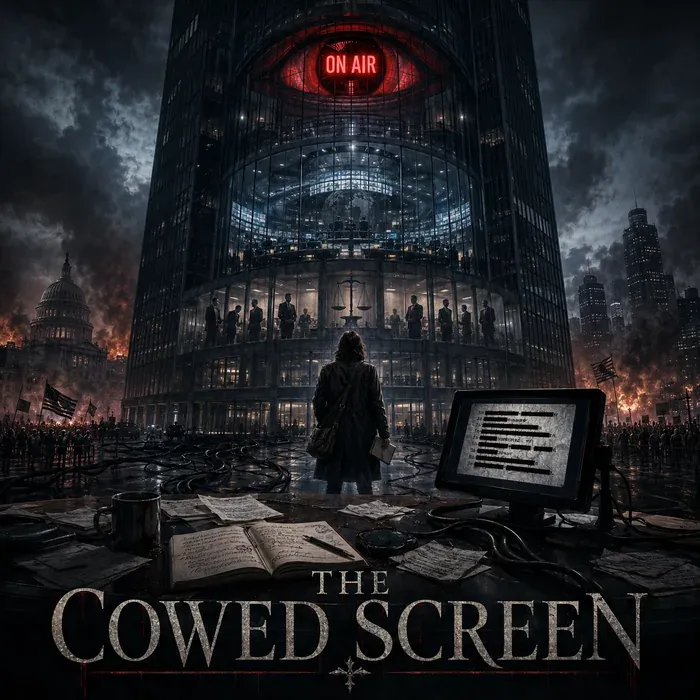
Symphonic Gothic Metal
The Cowed Screen
The Cowed Screen is a dark symphonic metal opera about censored newsrooms, political fear, corporate power and the fight to keep truth on air, before it dies.
Liner Notes
A short editorial read on the album world, sound, and standout moments.
About the Album
The Cowed Screen begins with a red light glowing above a newsroom and ends with that same light reclaimed as a public promise. Between those two images lies a fourteen-track symphonic gothic metal opera about what happens when journalism knows the truth but becomes too frightened, compromised or commercially dependent to say it clearly.
At the centre of the album is Jonah Reed, a veteran investigative reporter working inside a glass broadcast tower while the country beyond its walls slips into intimidation, disinformation and political violence. He has the documents, the witnesses and the dates. What he lacks is an institution willing to stand behind them. Every sentence is examined by lawyers. Every accusation is softened into a vague “claim.” Every fact is weighed against lawsuits, advertising contracts, access to power and the interests of the people who own the network.
The result is not a simple story of brave reporters versus villains. The Cowed Screen is more unsettling than that. Its journalists understand what is happening, yet participate in their own silencing one edit at a time. The anchor lowers his eyes rather than refusing the rewritten script. An editor deletes names while looking at her mortgage bills and her daughter’s photograph. Corporate counsel does not need to prove a report false; it only needs to make publishing the report ruinously expensive. Fear rarely arrives here in uniform. It enters through policy meetings, sponsor calls, revised wording and the suggestion that everyone has something to lose.
Musically, the album turns the newsroom into a gothic theatre of power. Down-tuned guitars, pipe organ, low strings and tom-heavy drums give the record a severe, architectural weight, while the recurring three-note “ON AIR” motif moves through the songs like a warning signal. It appears as an organ figure, a bass pattern, a distorted jingle and, eventually, an ascending phrase of resistance. The production is close and controlled: voices feel trapped inside booths, conference rooms and studio glass rather than floating in cinematic space.
Each track adds a different room to the story. “Lawsuit Lullaby” transforms legal intimidation into a poisonous waltz, its reassuring language made more disturbing by the calmness with which it is delivered. “The Anchor Lowers His Eyes” is a restrained moral collapse, built around piano, cello and the moment a respected broadcaster chooses professional survival over the truth he recognises. “Commercial Break for Fascism” cuts between political violence and cheerful advertising, exposing the grotesque ease with which suffering can be replaced by a sales message. “The Camera Never Blinked” is narrated by a studio camera that records every act of cowardice but cannot intervene.
The album’s central sequence is strong. “The Editor’s Trembling Hand” gives self-censorship a human pulse, while “Silence at Sixty Minutes” provides the decisive rupture: Jonah’s investigation reaches the air, the evidence appears, and the network kills the signal before the full story can be broadcast. The sudden blank frame becomes more incriminating than any carefully managed statement. From there, “Sponsored by Compliance” shows the corporate machine rewriting censorship as responsibility, while “Defamation by Thunder” brings the cost to Jonah’s door in the form of personal lawsuits and a prepared retraction.
What keeps The Cowed Screen from becoming a catalogue of defeat is its understanding that a free press is larger than any single network, presenter or newsroom. In “Static Over the Republic,” fragments of the interrupted report survive through local journalists, students, librarians, technicians and viewers who preserved the evidence. The story moves away from the mythology of one heroic broadcaster and toward a more demanding idea: journalism survives through verification, shared records, protected sources and people willing to compare public claims with documented facts.
That idea reaches its dramatic peak in “The Signal Breaks Free.” The climax is not framed as a violent uprising or an act of faith in Jonah. Instead, the complete files are released with their sources, dates and evidence intact. Jonah’s most important line is also the album’s ethical centre: do not trust the reporter out of loyalty; test the claim. The closing track, “Broadcast the Fire,” carries that principle into an independent newsroom where the red “ON AIR” light no longer belongs to a frightened corporation. It belongs to a process that remains open to correction, scrutiny and disagreement.
This is an album about media cowardice, but it is also about the difficult discipline required to resist it. Truth is not presented as a heroic feeling. It is paperwork, corroboration, uncomfortable questions and the refusal to remove the subject from a sentence. The Cowed Screen recommends itself through that precision. It has the sweep of a metal opera, the tension of a newsroom thriller and the anger of a protest record, yet it never forgets that democracy can be lost in small editorial decisions long before anyone announces that it is gone.
Listen closely, preferably from beginning to end. The red light is already on.
Production Notes
All tracks were generated with AI music models, then processed for the final orchestral sound. No human performance recordings are used.
Full album download
Download the complete album
Get the full ZIP package with tagged audio files, cover artwork, and album metadata.
Support MelodyMind
Help keep the albums coming
If this album was useful or fun to listen to, a small contribution helps cover hosting, tools, and new music experiments.
Join the conversation
Reactions from the web
Mentions, likes, reposts, and replies from IndieWeb and Fediverse-friendly sites can appear here after you allow community features.
The Queen Beneath the Cathedral
A majestic gothic metal opera of betrayal, buried crowns and sacred fire. For fans of post-punk drama, protest rock, dystopian albums and AI-assisted music.
Oligarchs at the Inauguration
A dark symphonic industrial metal opera about oligarchs, media power and democracy under siege—grand, furious, theatrical and disturbingly timely for America.
A Republic of Many Bloods
A fierce symphonic metal opera about America’s buried histories, broken myths and unfinished fight for a plural, honest democracy. Hear it now, in full today.
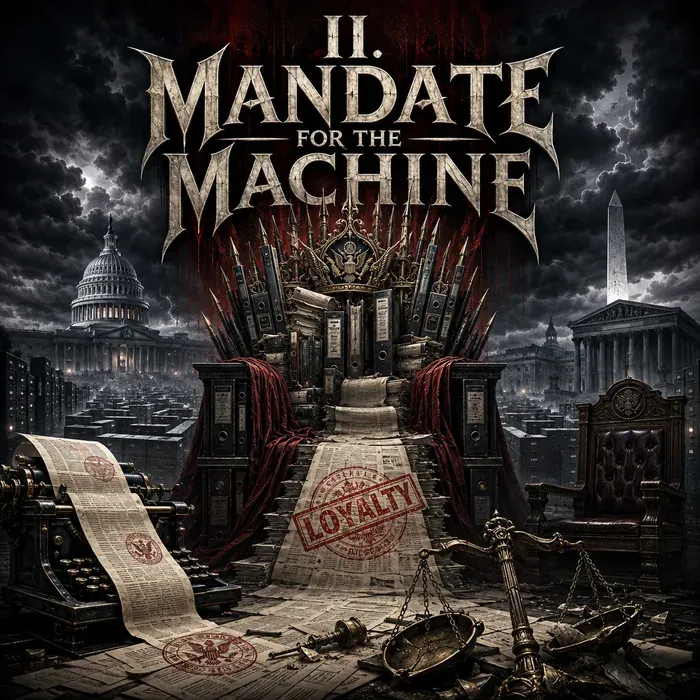
Mandate for the Machine
A dark symphonic metal opera about Project 2025, executive power and democracy under pressure—cold, theatrical and fiercely anti-authoritarian over 14 tracks.
Community
Comments...
Read or leave a comment about this album. Comments are provided by Cusdis and load only after you allow the comments feature.
Enable comments to load the discussion from Cusdis.