
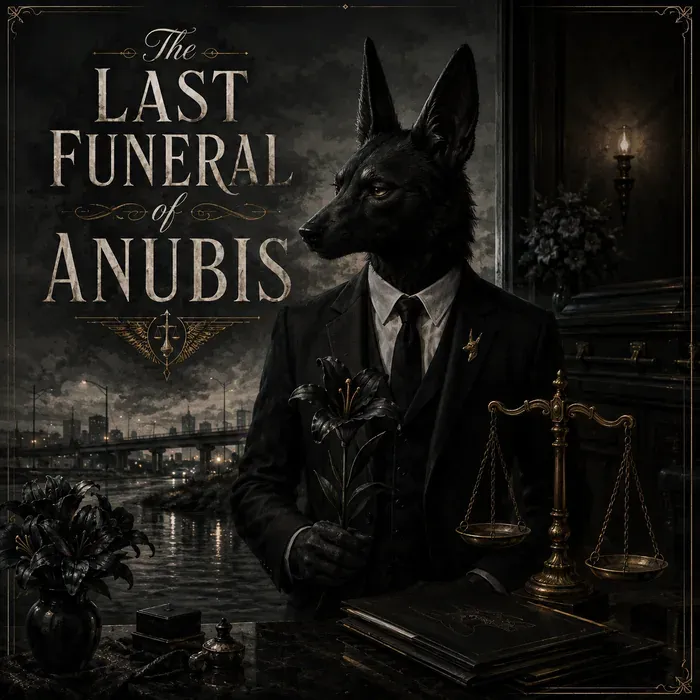
Dark Cabaret
The Last Funeral of Anubis
The Last Funeral of Anubis turns death, bureaucracy and grief into a dark cabaret odyssey of black humor, gothic folk and chamber blues. With one human pulse.
Liner Notes
A short editorial read on the album world, sound, and standout moments.
About the Album
The Last Funeral of Anubis begins with a bleak joke: the ancient guardian of the dead now works at a funeral home beside a gray highway. He wears a black suit, answers the telephone, memorizes package prices and explains why “Premium Eternity” costs extra. Yet the album never treats death itself as a joke. Its humor targets the systems built around mourning—the brochures, payment plans, plastic lilies and administrative boxes that try to make grief manageable and efficient.
Musically, the record lives between dark cabaret, gothic folk, chamber blues and funeral procession. Upright piano, bowed cello, harmonium, frame drums and resonator guitar give the songs tactile weight. The deep baritone at the center does not perform Anubis as a theatrical monster. He sounds tired, observant and quietly offended by the indignities surrounding him: less a god demanding worship than a civil servant who remembers when death carried ritual meaning.
“Funeral Home by the Highway” opens with a divine gatekeeper reduced to a name badge, weak coffee and fluorescent light. The recurring line “Every soul still has a weight” becomes the record’s moral compass. At first, it recalls the Egyptian weighing of the heart. As the story develops, the phrase changes. Weight becomes guilt, memory, unfinished conversation, economic pressure and the burden placed on those left behind.
The early songs sharpen the satire without breaking the solemn mood. “The Jackal Wears a Tie” turns workplace etiquette into a tense cabaret tango, while “Premium Eternity Package” uses an uneven sales-pitch rhythm to expose funeral commerce. “The Coffin Catalogue Blues” is funnier on the surface, but the humor catches in the throat when product codes and polished finishes give way to the child-size section near the back. The album lets a sharp line land, then leaves silence for its consequence.
The story deepens with “Weighing Hearts After Closing Time.” Alone in the basement, Anubis places the possessions of the dead on hidden scales: a wedding ring, a bus pass, a broken comb, a schoolbook. These are ordinary things that have absorbed the shape of a life. The song also turns judgment back on the judge. Anubis begins to wonder whether any heart can be measured cleanly, and whether mercy belongs outside the law or at its center.
That question becomes personal when Mara arrives in “Widow at Reception,” carrying her husband Elias’s coat and an envelope that cannot cover the funeral bill. The track avoids easy sentiment. Mara remembers a man who laughed too loudly, repaired buses, feared deep water and left a cup beside the sink. These details make Elias present before his voice is heard. When Anubis marks the service “Paid in full,” the act is a modest refusal to let a price list determine the dignity of a farewell.
The midpoint, “Embalming Room Lullaby,” is where office satire gives way to supernatural consequence. Preparing Elias after hours, Anubis discovers a final message and performs an ancient rite beneath fluorescent lights. The sealed world of the funeral home cracks open. A river appears behind the morgue, carrying names, unfinished words and souls that have been processed but never truly mourned. Harmonium, cello and floor toms move like oars through dark water.
From there, The Last Funeral of Anubis becomes less a story about one employee resisting one manager and more a study of institutional forgetting. “No Discount on Grief” rejects the idea that compassion is a percentage taken off a valid price. “The River Behind the Morgue” reveals unclaimed dead reduced to tags, numbers and blank next-of-kin fields. “Names in Black Folders” may be the album’s most unsettling song because its horror is administrative rather than supernatural. The folders are frightening precisely because they are believable.
The final movement gives the record its emotional force. In “A Soul Too Heavy to Leave,” Elias admits that love and regret can occupy the same life. Mara’s response refuses both easy forgiveness and permanent condemnation. Truth does not repair everything, but it allows movement. “Last Prayer Under Fluorescent Light” gathers the album’s images—folders, scales, lilies, names, river and artificial light—into a communal vigil. Anubis’s final act is not to pronounce judgment, but to surrender his authority to judge. The god of the scales places his own heart upon them.
The title track closes with restraint. There is no spectacular resurrection and no promise that grief disappears. Instead, the funeral home changes. The package displays come down. The catalogue is removed. Real flowers replace plastic ones. People are invited to bring names, stories, truth and whatever they can afford. Anubis is gone, but his belief survives in a more human form: every life deserves witness, and every farewell deserves dignity.
This is an album worth hearing in sequence. Its songs work individually, but their images gain meaning through repetition and change. The black folders become vessels of memory. The scales shift from judgment to self-examination. The river moves from buried disturbance to shared passage. Most importantly, the album balances satire and mourning without letting either cancel the other. It is funny because the bureaucracy is absurd, painful because the grief is not, and memorable because it understands the difference.
Although its sound is rooted in cabaret, gothic folk and chamber blues rather than conventional punk, its anger is unmistakably political: it challenges institutions that turn vulnerable people into customers and human loss into inventory.
Production Notes
All tracks were generated with AI music models, then processed for the final orchestral sound. No human performance recordings are used.
Full album download
Download the complete album
Get the full ZIP package with tagged audio files, cover artwork, and album metadata.
Support MelodyMind
Help keep the albums coming
If this album was useful or fun to listen to, a small contribution helps cover hosting, tools, and new music experiments.
Join the conversation
Reactions from the web
Mentions, likes, reposts, and replies from IndieWeb and Fediverse-friendly sites can appear here after you allow community features.
Le Cabaret des Ombres
A dark cabaret concept album of velvet, secrets and lost souls, where Parisian glamour turns into gothic theatre, betrayal and haunting chansons.
Thunder Doesn’t Pay the Rent
Thunder Doesn’t Pay the Rent turns Zeus’s midlife crisis into biting blues rock, where unpaid bills, bruised pride, black humor and hard-won humility collide.
Velvet Coffin
Velvet Coffin is a gothic rock concept album of toxic love, post-punk shadows, dark romance, velvet vocals and a burning escape from obsession.
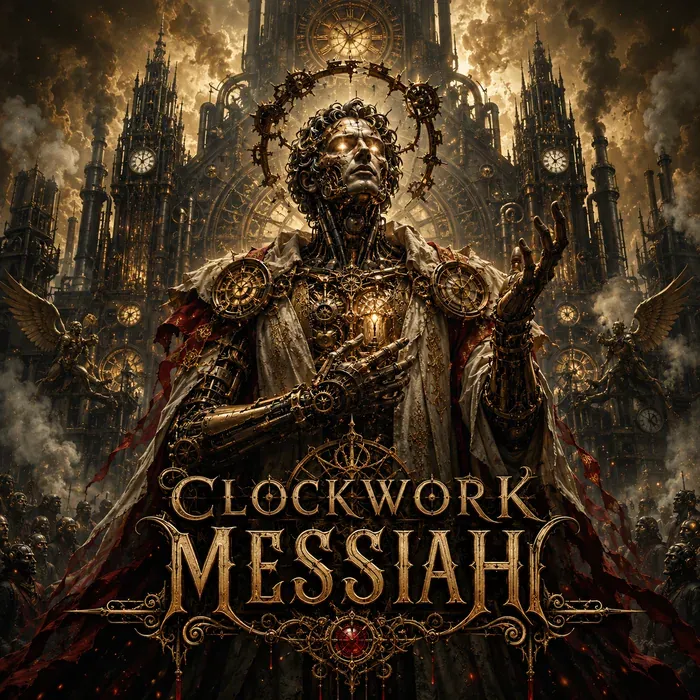
Clockwork Messiah
Clockwork Messiah is a dark steampunk metal opera of faith, control and rebellion, where a machine prophet learns to feel, bleed, resist and fall from grace.
Community
Comments ...
Read or leave a comment about this album. Comments are provided by Cusdis and load only after you allow the comments feature.
Enable comments to load the discussion from Cusdis.