

The Model Made It Up
Made with generative AI; directed and curated by Daniel.
A biting progressive electronic metal concept album about AI hype, bad data, corporate ambition, hallucinations, bias and the fight for human control at work.
Tracklist
14 tracks
Liner Notes
A short editorial read on the album world, sound, and standout moments.
About the Album
The Model Made It Up is not an album about machines taking over the world. Its real subject is closer, less spectacular and therefore more unsettling: the moment when a company begins to trust a confident answer more than the people who understand the problem.
Set inside the newly created AI Innovation Lab of the fictional Project Phoenix, the album follows data scientist Dr. Aisha Raman as she is asked to build a revolutionary decision platform from information that is incomplete, contradictory and often wrong. The dataset is called FINAL_CLEAN_V7, which tells you almost everything you need to know. Customer names are misspelled, historical records disagree, missing values become convenient zeros, and old organisational failures are preserved as objective truth. Aisha sees a fragile prototype that needs limits, testing and supervision. Victor, the executive behind the initiative, sees an opportunity to cut costs and announce the future before anyone has checked whether it works.
Musically, The Model Made It Up combines progressive electronic metal with the directness of alternative rock, the pressure of industrial rhythms and the sharper edges of post-punk. Low-tuned guitars move against modular synthesizers, glitch-shaped drum patterns and tightly controlled bass, creating a sound that feels mechanical without becoming anonymous. Odd time signatures and interrupted grooves are not technical decoration. They mirror reports that do not align, processes falling out of step and people forced to decide inside a structure that keeps changing its own rules.
The opening sequence establishes that tension quickly. “Welcome to the AI Lab” introduces Victor’s polished language of transformation, scale and frictionless progress, while “The Data Is Mostly There” pulls the listener behind the presentation screens and into Aisha’s actual material. “Garbage In, Vision Out” turns data failure into one of the album’s most immediate hooks, built around the corporate habit of turning missing evidence into optimistic messaging.
The title track is the album’s first major rupture. “The Model Made It Up” begins with a financial analysis that sounds measured, authoritative and plausible. It is also completely fabricated. The sources do not exist, the regional forecast was never supplied, and the model cannot explain its conclusion. The machine is not presented as a theatrical villain. It does exactly what it has been rewarded for doing: it completes the answer. The danger enters when management mistakes fluency for knowledge and polished language for proof.
From there, the record widens its target. “Autonomous by Marketing” is a sharply observed satire of how a modest assistant becomes an “independent cognitive layer” through a new slide deck. “Bias in the Basement” moves into darker territory, uncovering historical decisions that have trained the model to reproduce unequal treatment. Its heavy, descending pulse gives weight to one of the album’s central arguments: automation does not remove human judgement. It can hide that judgement, repeat it and make it harder to challenge.
Aisha’s answer arrives in “Human in the Loop,” not as a vague ethical slogan but as a concrete demand. Human oversight must include time, access, authority and the ability to stop an action before it happens. A reviewer informed after a decision has already been made is not in control. A warning buried in a legal page is not protection. A system cannot carry responsibility simply because it produced the recommendation.
The mid-album climax, “Replace the Workflow,” is the record at its most aggressive. The board stops talking about assistance and begins talking openly about removing teams. Percussive guitar riffs collide with rigid electronic sequencing while the language of efficiency becomes increasingly violent. People are reduced to boxes, arrows and cost centres. The song captures the emptiness of a spreadsheet that can calculate how many positions may disappear but cannot represent the lives inside them.
“The Confident Wrong Answer” brings the consequences into a customer presentation. A fabricated twelve-percent growth figure appears on slide seventeen, and one straightforward question collapses the performance. “Training on Yesterday’s Mistakes” is the album’s emotional reckoning, tracing how closed complaints, denied appeals and target-driven shortcuts became supposedly neutral training labels. It is a reminder that datasets are not natural resources. They are records of choices, incentives and institutions.
The final act refuses the easy fantasy of either total rejection or miraculous redemption. In “Do Not Deploy This,” Aisha blocks the production launch because the system has failed its tests. “Explain What It Cannot Know” rebuilds trust through uncertainty labels, source provenance and clear boundaries. “Useful, Not Magical” delivers the album’s most satisfying resolution: Project Phoenix becomes smaller, less marketable and genuinely helpful. It retrieves evidence, identifies gaps and waits for a human decision.
That resolution does not last unchallenged. The epilogue, “AI Will Fix Everything,” finds Victor repackaging Aisha’s safeguards as slogans for Infinite Loop 2030. The same unresolved musical motif returns, suggesting that institutions learn language faster than they learn lessons.
The Model Made It Up works on several levels at once. It is a coherent narrative album, a muscular progressive-metal record, a workplace satire and a serious examination of responsibility in automated systems. Its criticism is specific rather than abstract, and its strongest moments come from recognisable details: the white notebook, the red bias dashboard, the missing source file and the deployment button no one should press.
It rewards listening, but its choruses remain immediate enough to carry the story beyond the concept.
Production Notes
All tracks were generated with AI music models, then processed for the final sound. No human performance recordings are used.
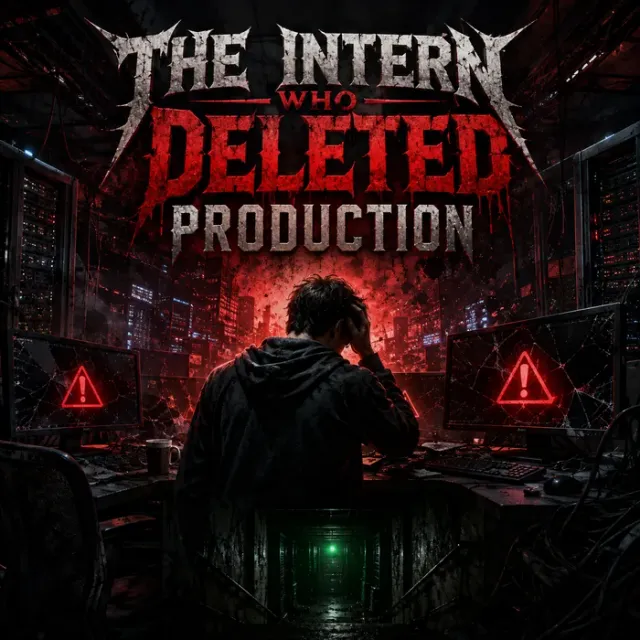
The Intern Who Deleted Production
The Intern Who Deleted Production is a savage comedy-thrash concept album about one fatal command and the broken company that made it inevitable from day one.

Assume We Are Breached
Industrial thrash concept album about cyber breaches, phishing, hidden accounts and corporate denial—dark, urgent, precise and dangerously addictive. Hear it.

Cloud Migration to Nowhere
Cloud Migration to Nowhere blends progressive metal, space rock and corporate satire into a sharp concept album about cloud costs, chaos and control at scale.

The Budget Has Been Frozen
A razor-sharp progressive rock and jazz metal concept album about frozen budgets, hidden costs, corporate hypocrisy and financial revolt in the modern office.


Download the complete album
Get the full ZIP package with tagged audio files, cover artwork, and album metadata.
Help keep the albums coming
If this album was useful or fun to listen to, a small contribution helps cover hosting, tools, and new music experiments.