

The Morning Meeting Has Been Extended
Made with generative AI; directed and curated by Daniel.
Hard rock album about a newsroom that quietly adopts data tools because they actually work. The first release in The Newsroom Is Fine series.
Tracklist
14 tracks
Liner Notes
A short editorial read on the album world, sound, and standout moments.
About the Album
The Morning Meeting Has Been Extended arrives as the first installment in The Newsroom Is Fine, a ten-part series. Written in English, the album adopts a wry, energetic, and frustrated mood. It explores a functioning newsroom that adopts real-time audience analytics as a useful addition to editorial judgment. What begins as a five-minute demonstration gradually alters who can prove an argument, what gets discussed in meetings, and how authority is distributed around the room. The album does not treat analytics as corrupt or inherently dangerous; rather, the complication is subtler: the tools work, people begin depending on them, and a new form of evidence quietly becomes part of the newsroom’s decision-making culture.
The story opens when Leo Brandt introduces Audience First during an ordinary morning meeting at Current. Initial skepticism gives way to attention when the dashboard provides information the newsroom genuinely did not have before. Sara Malik is the first person to turn that information into institutional leverage. Live audience evidence allows her to challenge assumptions that previously depended on seniority or instinct alone. Headline testing then proves useful, and Blink’s stronger digital performance gives the newsroom another reason to pay attention. The decisive moment arrives when audience evidence helps Sara rescue an important service story from weak placement. Its strong performance demonstrates that listening to readers does not automatically mean abandoning journalistic value. After that victory, the central question changes. The newsroom is no longer deciding whether the numbers belong in the room. It is deciding what authority those numbers should have. Adrian Vale sets the boundary: metrics may inform editorial judgment, but they do not replace it. By the end, nobody announces a revolution. The dashboard simply becomes part of the morning routine.
The album operates within the framework of classic hard-rock fundamentals viewed through a contemporary recording chain. The production aesthetic prioritizes organic band-in-a-room energy, featuring natural amp distortion, restrained compression, realistic drum dynamics, and audible bass. There is no sterile modern-metal polish. Vocals are conversational, grounded, and hard-rock delivered with clear diction and natural grit. Verses feel character-driven rather than theatrically sung, while choruses broaden without becoming arena-rock caricatures. The core instrumentation relies on twin electric guitars, melodic electric bass, an acoustic drum kit, and occasional restrained organ or electric-piano support. Keys remain secondary and appear only where useful for contrast. Guitar work is defined by dry-to-crunchy rhythm guitars with audible pick attack, concise melodic lead phrases, and occasional twin-guitar movement. The bass is audible and mobile, often answering the rhythm guitar rather than merely doubling roots. The drum kit is punchy with a firm snare, natural kick and tom weight, human fills, and slight timing variation. The rhythm and groove are mostly straight 4/4 hard-rock drive with controlled tempo variation, occasional half-time space, and rhythmic stops derived from meeting interruptions, cursor clicks, and dashboard refreshes.
A recurring leitmotif of a short ascending three-note guitar figure first appears during Leo’s demonstration. Early in the album, it sounds intrusive and slightly unresolved. Around Track 08, it becomes associated with evidence that genuinely works. During Tracks 09 through 14, it increasingly appears without dramatic emphasis until, in the epilogue, it simply belongs to the newsroom’s musical vocabulary. Just Five Minutes features Leo’s supposedly brief Audience First demonstration disrupting the normal morning meeting and earning enough attention to continue. A fuller demonstration converts vague skepticism into specific questions because the data proves genuinely useful. Adrian leaves the dashboard visible to everyone, turning private analytics into shared newsroom evidence. Sara uses live performance figures to challenge a senior editorial assumption and gains measurable institutional authority. Positive dashboard indicators begin affecting the room emotionally even while people insist they are not watching them. A controlled headline test produces a useful result, making limited experimentation difficult to dismiss. Blink’s stronger digital performance turns analytics from an internal curiosity into evidence about Current’s competitive weakness.
The Story We Nearly Buried serves as the album’s decisive proof point. Audience evidence helps rescue a useful service story from weak placement. The successful result is formally recorded alongside editorial reasoning, transforming a one-off victory into institutional memory. Adrian draws the central boundary: numbers may enter the argument, but they do not make the final editorial decision. The newsroom’s loudest skeptic voluntarily checks the figures and begins arguing from them rather than merely against them. Adrian privately tests whether accepting evidence has weakened editorial responsibility and decides that judgment must remain accountable rather than insulated. The Morning Meeting Has Been Extended concludes the arc as audience review becomes a permanent agenda item; the temporary experiment becomes ordinary procedure. Green Before Coffee captures the final state: the newsroom checks the dashboard before the first coffee is finished, revealing that the institutional change is complete precisely because nobody treats it as remarkable. Verses leave space for speech-like detail, and instrumental sections create actual contrast rather than continuous maximum loudness. The album maintains a dynamic range where choruses widen naturally, ensuring the music remains human and uncluttered.

Ronan Vale
Ronan Vale brings weight to hard rock without turning every line into a shout. He is strongest on riff-led songs that need a dependable center: hard rock with broad hooks, arena-sized choruses, and alternative-rock arrangements that still want real physical weight.
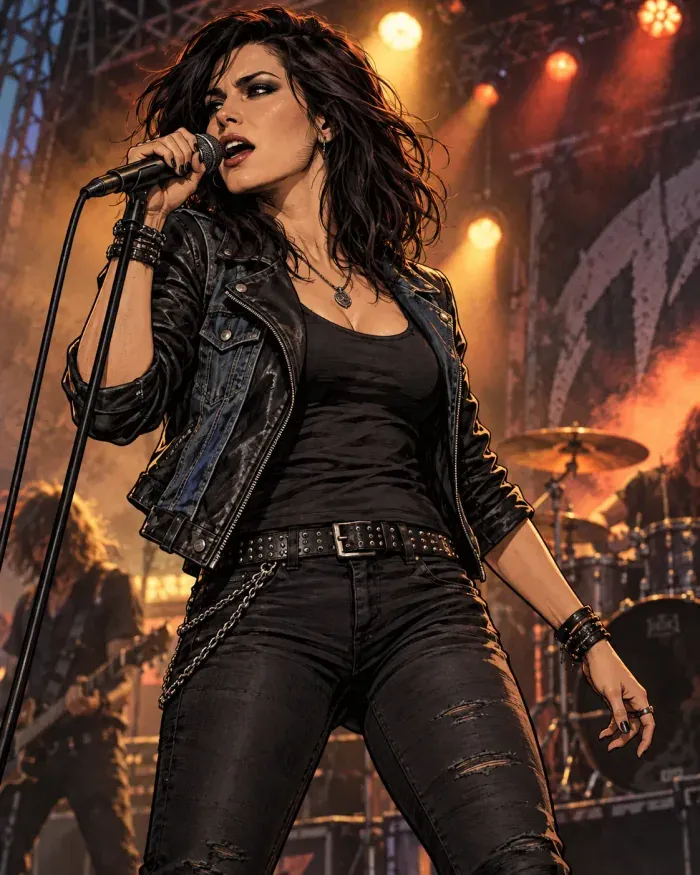
Tessa Vane
Tessa Vane gives hard rock a sharper, more tightly controlled edge. She fits hard rock that relies on strong verse-to-chorus movement, muscular alternative rock, and arena rock where the hook needs clarity as much as power.


Download the complete album
Get the full ZIP package with tagged audio files, cover artwork, and album metadata.
Help keep the albums coming
If this album was useful or fun to listen to, a small contribution helps cover hosting, tools, and new music experiments.