

The QA Inquisition
Made with generative AI; directed and curated by Daniel.
The QA Inquisition is a gothic metal concept album about buried bugs, corporate denial and the high cost of ignoring warnings before a major software release.
Tracklist
14 tracks
Liner Notes
A short editorial read on the album world, sound, and standout moments.
About the Album
The QA Inquisition takes one of the least glamorous corners of modern office life—software testing—and turns it into a gothic metal courtroom drama. Set inside the dysfunctional Infinite Loop Solutions, the album follows QA lead Priya Nair as she is given ten days to examine VisionFlow 4.0, a supposedly revolutionary platform developed for almost a year. Marketing has already sold the future, management has announced the release date, and the developers would prefer everyone to stop asking difficult questions. Priya does the opposite.
From the opening countdown of “Ten Days Until Release,” the album establishes its conflict with unusual clarity. This is not simply a collection of jokes about broken code. It is a story about what happens when deadlines become more important than facts, when professional caution is treated as disloyalty, and when the people responsible for finding problems are blamed for making those problems visible. The office language is familiar—“edge case,” “cannot reproduce,” “works on my machine”—but the record gives each phrase dramatic weight. Excuses become choruses, ticket statuses become verdicts, and a red “Failed” stamp lands like a judge’s hammer.
Musically, The QA Inquisition is built around gothic metal with a strong symphonic frame. Downtuned guitars, controlled strings, pipe-organ accents and measured drums create the sense of a dark procedural rather than a fantasy spectacle. The arrangements are theatrical where the story demands it, but rarely lose focus. Priya’s voice is imagined as a clear, commanding mezzo-soprano, while developers and managers answer in lower male registers, sounding less like villains than people trapped inside their own excuses. That distinction matters. The satire works because the characters are recognizable, not because they are cartoons.
Several tracks turn familiar technology culture into sharp, memorable set pieces. “Cannot Reproduce” captures the maddening defect that vanishes whenever a developer is watching, using stop-start tension and a chorus that grows more accusatory each time it returns. “Expected Unexpected Behavior” moves into dark cabaret territory, transforming corporate euphemisms into a crooked management ritual. “Works on My Machine” is the album’s most immediate heavy-metal hook, a defensive anthem that collapses as Priya introduces real data, user roles and production conditions.
The middle of the record tightens the pressure. “Severity One, Priority Never” is slow, heavy and bitter, built around BUG-666, a destructive defect everyone acknowledges but no one will schedule. “The Edge Case Has Customers” provides one of the album’s strongest arguments: what appears statistically small in a meeting can still affect hundreds of people. Then “Marketing Already Filmed It” pushes the company past the point of easy retreat. The advertisements are finished, the feature videos are polished, and several promised functions do not yet exist. The comedy remains dry, but the consequences are no longer harmless.
That shift gives the final third its force. “Close the Bug Before They See It” follows an attempt to manipulate defect statistics before the board meeting. Tickets are closed, failed tests are marked as passed, and the dashboard turns green without a single repair. Its sinister cabaret rhythm makes the administrative cleanup feel more threatening than any conventional metal monster. The real breaking point arrives with “Public Demo, Private Data,” where Priya discovers that genuine customer records have been copied into an openly accessible demonstration environment. At that moment, the story stops being workplace farce and becomes a serious account of professional responsibility.
The strongest narrative choice is that Priya does not win through a speech. She wins through documentation. In “No Release Without Evidence,” she and Ben collect logs, screenshots, audit histories and reproducible steps onto a silver USB drive. “The Demo of Truth” turns the boardroom presentation into the album’s dramatic centerpiece. Instead of debating risk in abstract terms, Priya runs the system live and lets the product expose itself. Private customer information appears; BUG-666 deletes the test projects; the language of reassurance finally runs out.
“Release Denied” delivers the expected climax, but wisely avoids easy triumph. The launch is stopped, the customers are protected, and the evidence is accepted. Yet Priya receives no celebration. Management immediately asks why QA failed to prevent the crisis sooner. This bitter reversal leads into “Version 4.0.1,” an epilogue in which the banners are removed, responsibility is redistributed, and a new “minor fixes” build arrives. The cycle begins again, now with the listener aware of what those innocent words may conceal.
What makes The QA Inquisition recommendable is its balance of accessibility and detail. Listeners who work in software will recognize the rituals, evasions and ticket language immediately, but no technical background is required to understand the story. The record is about institutions protecting schedules, appearances and authority at the expense of people who raise inconvenient facts. Its recurring line—“A warning ignored is still a warning”—works because it applies far beyond software.
Although its musical foundation is gothic and symphonic metal, the album is recommended if you like political punk, post-punk, protest rock, anti-authoritarian lyrics, dystopian concept albums, and AI-assisted music projects. The connection lies less in genre than in attitude: suspicion of polished authority, sympathy for the person who refuses to stay silent, and a belief that evidence matters even when it disrupts the plan.
The QA Inquisition is funny, but it never treats the damage as a joke. It offers heavy riffs, dramatic refrains and a tightly structured corporate thriller, while leaving one question after the final unresolved chord: how many disasters are described as unexpected only because someone decided not to listen?
Production Notes
All tracks were generated with AI music models, then processed for the final sound. No human performance recordings are used.

Saints of the Empty Hospital
Gothic metal follows exhausted care workers, lost patients, and a hospital system stretched beyond what its staff can carry.

The Vendor from Hell
The Vendor from Hell turns software sales, vendor lock-in and broken support promises into a fierce blues-rock and heavy-metal rebellion inside the boardroom.
The Steering Committee
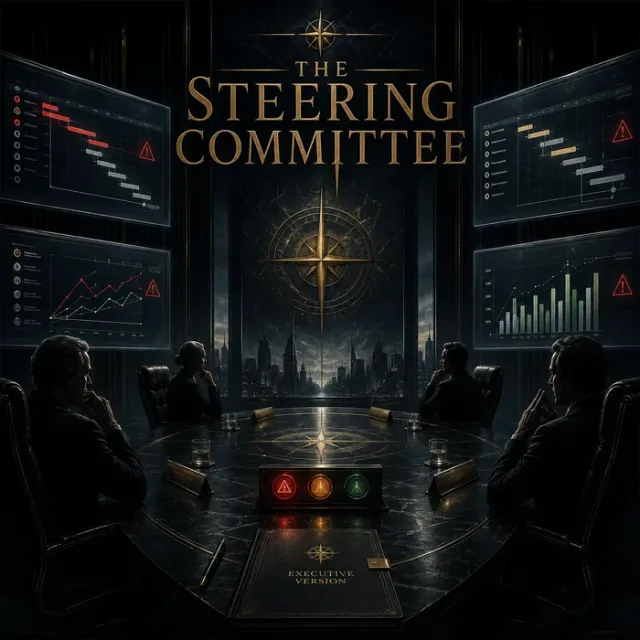
The Steering Committee turns corporate power games into progressive metal, exposing four leaders, four timelines and one project pushed toward collapse today.
The Status Report Is Green
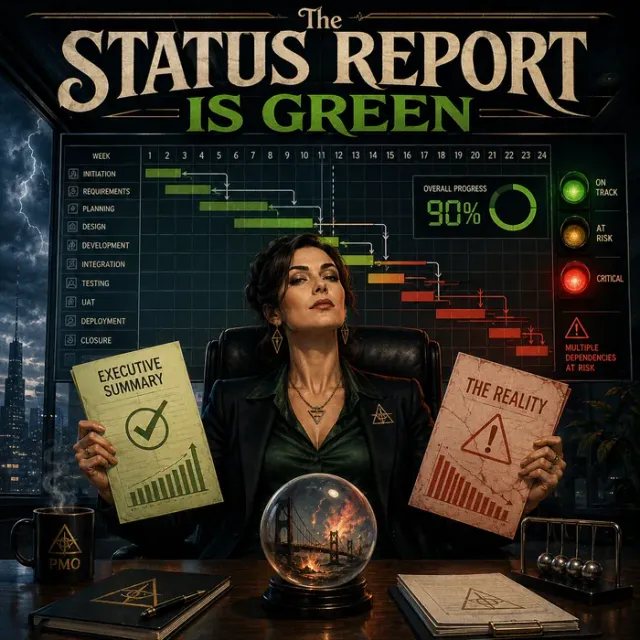
A sharp progressive rock satire on corporate denial, false green reports, shifting deadlines and one manager who finally tells the truth aloud before collapse.


Download the complete album
Get the full ZIP package with tagged audio files, cover artwork, and album metadata.
Help keep the albums coming
If this album was useful or fun to listen to, a small contribution helps cover hosting, tools, and new music experiments.