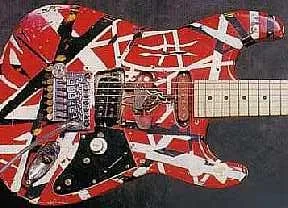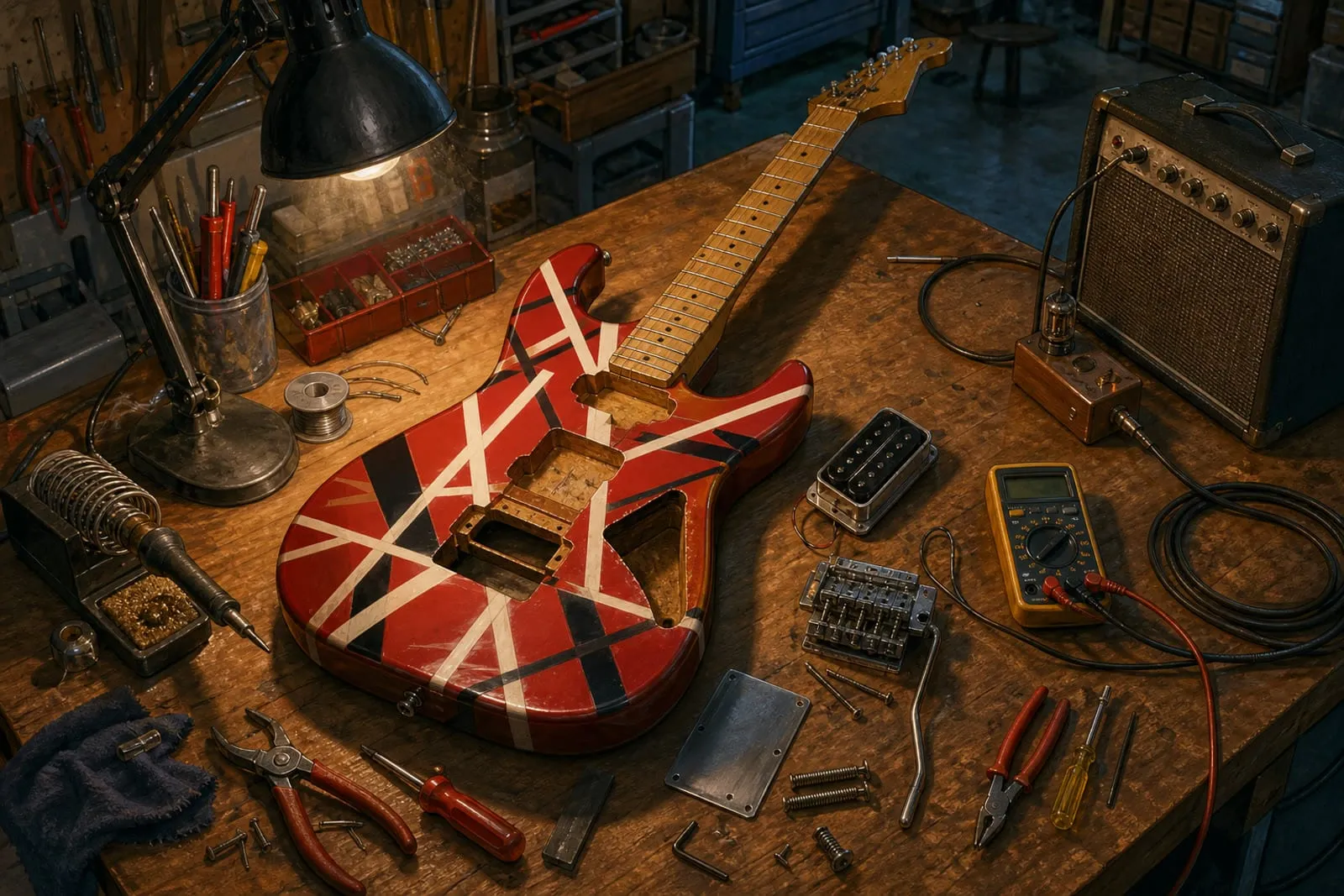

The striped guitar makes a persuasive museum object because its mismatched parts, routed wood, bicycle paint, tape lines, and partial electronics seem to explain how it was made. The homemade appearance is less revealing than the problems Eddie Van Halen kept finding in ordinary instruments. Each alteration addressed something physical or musical: unwanted feedback, a tremolo that pulled strings out of tune, pickups that did not produce enough drive, or a body that put controls under an active picking hand. The famous surface records those decisions, while the rest of the workshop extended to his amplifier, his hands, and the stage. 1
A machine assembled around a player
Van Halen did not invent the solid-body guitar, the humbucking pickup, the vibrato bridge, or two-handed tapping. His achievement came from joining available ideas into a system that suited his own motion. The original Frankenstein combined a Stratocaster-style body and neck with the kind of humbucker associated with Gibson guitars. In practical terms, it pursued two desires that the late-1970s mass market usually kept in separate instruments: the physical balance and tremolo possibilities of a Strat-style design, and the denser output of a bridge humbucker driving a loud amplifier. 1
The guitar changed repeatedly. Van Halen cut the pickup cavity, installed and replaced hardware, repainted the body, and eventually worked with locking vibrato systems. Some components visible on the front were decoys or remnants rather than functioning controls. That disorder was functional. A single working bridge pickup and one volume knob reduced the number of choices his hand could hit by accident. The object was not a prototype awaiting a clean production version. It was a stage tool whose history remained attached to it.
The stripped control layout also tied the guitar more closely to the amplifier. With no pickup selector to cross during a fast movement, the right hand could travel over the body without changing the circuit by accident. Changes in density came from the single volume knob, the force of the attack, muting, and the response of an amplifier already running loud. The apparent lack of options shifted more control into the player’s hands. It also explains why copying the pickup alone could reproduce only one part of the setup.
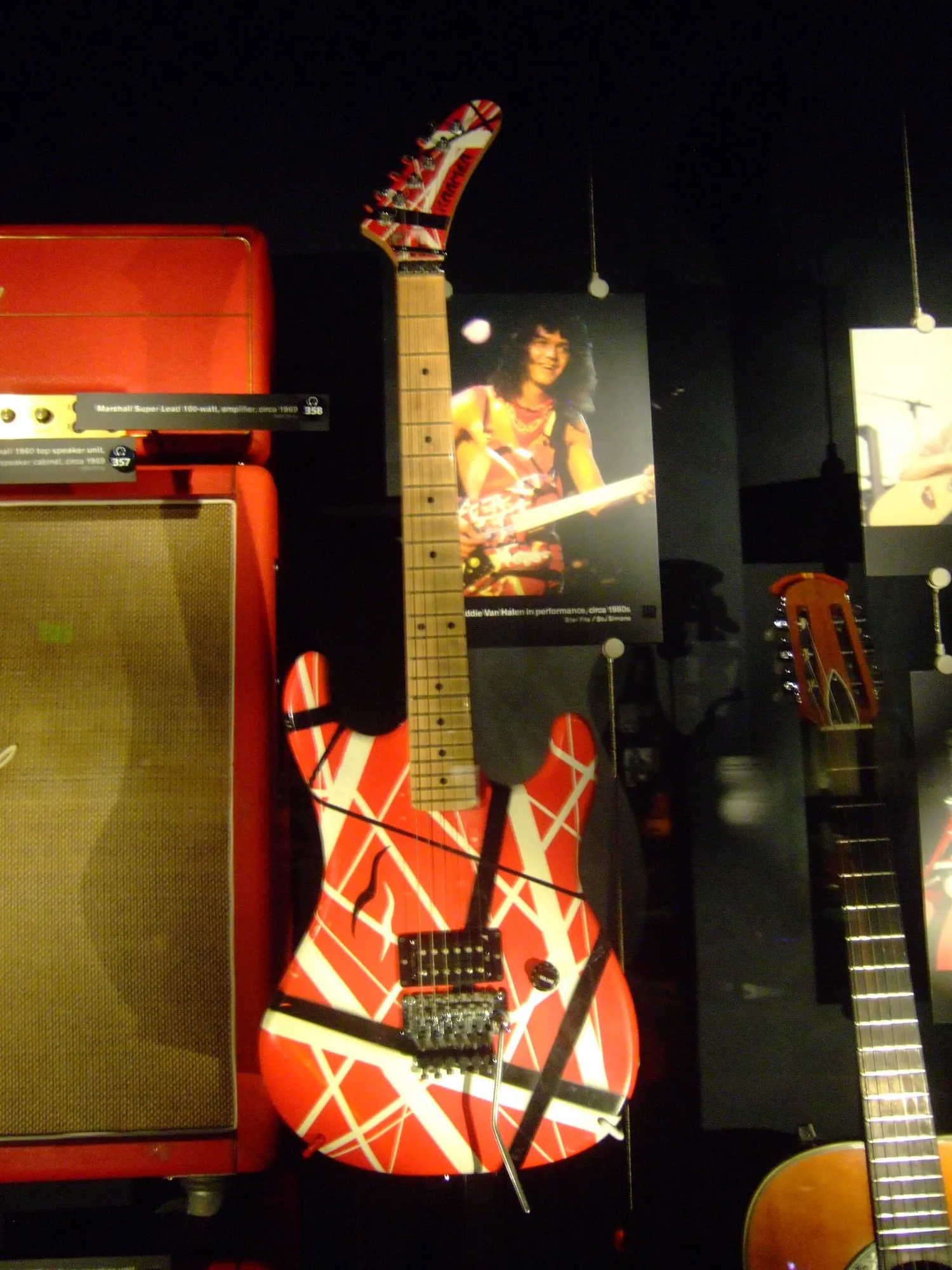
Calling the guitar a breakthrough product obscures its individual fit. Products promise repeatability; Frankenstein preserved the changing match between one player and one set of parts. Later replicas could reproduce its appearance with extraordinary accuracy, down to scratches and tape marks. Van Halen’s working method instead gave players permission to interfere with equipment. The National Museum of American History’s cataloged “Frank 2” is itself a Fender-built replica that Van Halen used for most of the 2007–08 North American tour, not the original guitar from the first albums. The distinction is explicit in the museum record and easy to lose when every striped instrument becomes “the Frankenstein.” 2
Technique changes the hardware brief
Van Halen’s most copied gesture placed the picking hand on the fingerboard. A finger from that hand struck notes between phrases articulated by the fretting hand, allowing wide-spaced arpeggios and fast patterns to be played without picking every note. The method made a guitar neck behave briefly like a small keyboard. Van Halen had studied piano as a child, but tapping was no simple transfer from piano to guitar. It created a mechanical problem: when both hands work on the neck, the instrument must remain stable while the player gives up the usual support supplied by the picking arm. 4
That problem produced one of Van Halen’s least glamorous but clearest inventions. His 1985 patent application described a folding support attached to the rear of a stringed instrument. Rested against the player’s body, it held the guitar outward in a more horizontal position so both hands could reach the fingerboard. The patent does not depend on celebrity language. Its drawings and claims define a hinge, plate, and support member. A performance technique had generated a hardware requirement, which was then translated into a reproducible mechanism. 5
The support never became as culturally visible as the stripes, perhaps because most players copied the hand movement without needing the guitar held at the patented angle. It still shows Van Halen’s working method: when the instrument’s standard posture obstructed a phrase, he changed the position of the body.
His approach to harmonics shows the same exchange between touch and device. Tapped harmonics, pinched attacks, left-hand slurs, tremolo dips, and rapid volume changes do not create one uniform “Eddie technique.” They manage the start, pitch, color, and decay of a note by different means. High amplifier gain makes light fingerboard attacks audible, but it also magnifies noise. Muting becomes part of the technique. The right hand is therefore not simply freed from picking; it takes on several jobs, sometimes within the same short phrase.
Tuning stability became another construction problem. Traditional vibrato use changes string tension across the bridge; deep pitch drops can leave strings returning at slightly different tensions around the nut and tuners. Van Halen’s playing made that weakness audible because bridge movement was structural, not an occasional color. His adoption of Floyd Rose locking systems joined the nut, bridge, and fine tuners into a better-controlled path. The solution affected composition: a phrase could end with an extreme pitch drop and the next chord still had a reasonable chance of arriving in tune. In his final gear interview, Van Halen describes pushing for fine tuners after encountering an early locking design. Hardware enabled a gesture, and repeated use exposed what the hardware still lacked. 6
The amplifier as a workbench
Accounts of Van Halen’s early amplifier setup have accumulated contradictory claims, many encouraged by the guitarist’s own reluctance to give competitors a reliable recipe. The stable center is a Marshall Super Lead operated loud enough for substantial distortion, with a Variac used to reduce the supplied voltage. In his final long gear interview, Van Halen said the amplifier controls were turned up and the Variac acted as his volume control. He also recalled that an early interview contained deliberate misdirection about whether the device raised or lowered voltage. 6
A Variac is not a guitar effect in the ordinary sense. It changes the AC voltage presented to the amplifier. That affects the conditions under which the amplifier’s components operate, and careless settings can damage equipment. Reducing the story to “starving an amp” misses the practical chain around it: a very loud non-master-volume head, speaker cabinets, room acoustics, microphones, and a player using the guitar’s volume control and touch to move between densities. The recorded sound was the result of the chain, not a secret voltage number.
Van Halen’s gear stories invite myth because they promise that one hidden modification will unlock the sound. His own descriptions tell a messier story. He bought, broke, rewired, and tested equipment because no catalogue configuration settled the matter. Even the famous “brown sound” phrase became unstable; later interviews connected it to Alex Van Halen’s snare rather than a branded guitar tone. Those conflicting accounts make the line between documented mechanisms and sales folklore especially important.
Recording the hand, not displaying the trick
On the first Van Halen album, “Eruption” compressed the workshop into less than two minutes. Picked runs, slurs, tremolo movement, muted attacks, and the final tapped sequence shift quickly enough that the listener hears changes of texture before inventorying how each was made. The amplifier sustains small contacts; the hands continually decide which noise will be signal.
The performance also altered how other players watched guitarists. Two-handed tapping had precedents, so describing Van Halen as its inventor erases a longer history. What the record and subsequent visibility did was make the technique a central public problem for rock guitarists: listeners wanted to identify the motion, stores fielded requests for equipment, and manufacturers had an incentive to package the result. The Smithsonian’s electric-guitar history places Van Halen in that broader cycle of players adapting an already adaptable instrument. 4
The best imitations copied more than speed. Van Halen could make a rhythm part snap through controlled muting, suspend a chord with tremolo, or place a noisy scrape as a transition. Construction and phrasing were linked by timing. A high-output pickup was useful because of how it met the amplifier; the tremolo mattered because a phrase had been composed around pitch movement; the simple control layout mattered because the right hand traveled across the instrument.
From private modification to manufactured replica
By 2011, Fender and Van Halen donated Frank 2 to the National Museum of American History. The museum noted that the replica had been used extensively on tour and that its acquisition documented innovation and popular music, rather than presenting it as the first striped guitar. The object now performs a different job. Onstage, its wear and layout supported a musician. In a collection, those features become evidence to be cataloged. 3
Manufacturing the replica created a tension. The more precisely a company reproduced accidental marks, the more a once-open process hardened into a visual specification. Buying the correct stripe pattern was easier than asking why a control sat in the wrong place for one’s own hand. Van Halen eventually worked closely with manufacturers on signature instruments, pickups, amplifiers, and hardware. The garage method had moved into engineering teams, where a modification had to survive repeated production and touring.
His comments to the Smithsonian return often to necessity. He wanted a sound or a physical response, could not buy the combination, and made it. That account can become heroic too quickly. Plenty of musicians modify equipment without access to major companies, museum acquisition, or patent counsel. What distinguishes Van Halen is not the universal discovery that instruments can be altered. It is the audible precision with which his alterations, technique, and arrangements reinforced one another. 1
What the stripes can and cannot show
The museum guitar lets a viewer inspect routing, paint, hardware, and wear, but it is silent about pressure. It cannot show how lightly a tapped note begins, how aggressively a muted chord is struck, or how stage volume changes the player’s sense of sustain. A photograph of Van Halen performing restores posture but still freezes the feedback loop between hands, speakers, and room.
Conservation imposes another limit. A curator must stabilize an object whose working life depended on adjustment and wear. Replacing a failing part might preserve playability while destroying evidence; leaving it untouched may ensure it will never function again. Frank 2’s museum value lies in documented use, not in proving that its controls still deliver a particular tone.
The full object is distributed across records, patents, interviews, instruments, and conflicting testimony. No single source supplies a final schematic for “the sound.” Together they document a musician who treated standard design as a proposal. The lasting practice is to locate the precise point where an instrument resists a musical idea, then decide whether the hand, the circuit, or the instrument should change.